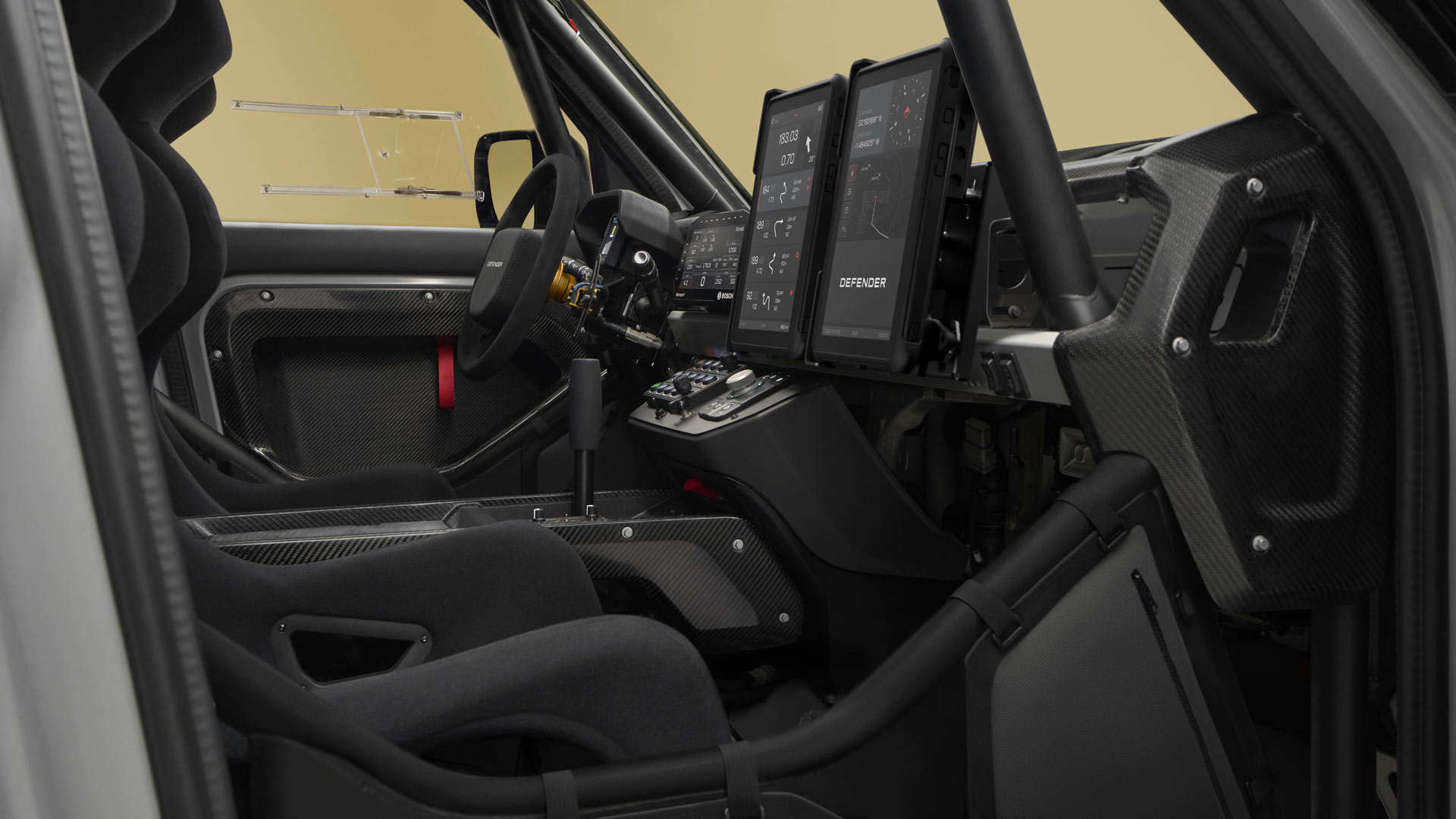
Land Rover has unveiled an off-road racing version of the Defender, ahead of its motorsport debut in 2026.
The Defender D7X-R shares its underpinnings with the high-performance Octa version of Land Rover’s 4×4 – and is built on the same production line.
However, the D7X-R is destined for a hard life in the formidable 2026 World Rally‑Raid Championship (W2RC).
The W2RC will begin with the Defender D7X-R’s toughest test: the infamous Dakar Rally. The famous endurance race covers more than 3,000 miles of competitive stages across Saudi Arabia.
Related to the Defender Octa
Land Rover will enter the Defender D7X-R 110 in the new ‘Stock’ category of the W2RC, which has strict rules on what can be modified for competition use.
The D7X-R uses the same platform as the Defender Octa, along with its 4.4-litre twin-turbocharged V8 engine. The latter remains unmodified, but will make use of sustainable petrol to meet FIA regulations – supplied by a gigantic 550-litre fuel tank.
The Defender Octa’s suspension setup remains, albeit with new dampers developed by Bilstein.
There is even a special ‘Flight Mode’, developed by the Defender Rally team. This automatically adjusts the level of torque from the engine when the D7X-R is airborne, helping to ensure a smooth landing on sand dunes.
Racing into the unknown
Other key changes include the fitment of an FIA-specification roll cage, bespoke bodywork to improve off-road clearance, and integrated hydraulic jacks for quick tyre changes.
Land Rover has entered three crews into the 2026 Dakar Rally, including the two-man team of Stéphane Peterhansel and Mika Metge.
Peterhansel is a true Dakar legend, having won the event a record 14 times. His most recent victory was in 2021 with Mini.
Ian James, Defender Rally team principal said: “Defender is driving into the unknown – to overcome the dunes, handle the heat and race flat‑out against the clock. We know Dakar represents one of the toughest challenges in motorsport – but that’s exactly why we are entering.
“With world‑class partners and some of the best rally‑raid drivers on the planet, we’ll give it our all. I’m incredibly proud and excited to make our competitive debut in the W2RC and I look forward to what the season will bring.”
BMW has announced a celebratory special edition to mark the end of Z4 roadster production.
The appropriately named Z4 Final Edition will be available to order from January 2026, before the final Z4 sports car rolls off the line in March next year.
Changes for the last-of-the-line Z4 are limited. However, BMW still hopes that the Final Edition ‘may well become a collectors’ item’ over time.
Originally unveiled at the 2018 Pebble Beach Concours d’Elegance, the third-generation ‘G29’ Z4 sold in modest numbers over the years that followed.
End of the road for BMW’s roadster
The Z4 Final Edition’s most distinguishing feature is the exclusive option of Frozen Matt Black paint.
Other paint colours from the Z4 range are also available, but M High-gloss Shadowline exterior trim is standard on all cars – along with red-painted BMW M brake calipers.
Inside, contrasting red stitching is used on the dashboard, centre console and door trims. M Sport seats are finished in a combination of Vernasca leather and Alcantara, also with red stitching.
Clock is ticking for the Z4
The finishing touches are a sports steering wheel clad in grippy Alcantara, plus engraved door sill trims that mark out the Z4 as a Final Edition.
It marks a low-key end for the third-generation Z4, which was developed to share its platform with the Toyota GR Supra coupe.
Earlier this year, Toyota announced its own GR Supra Final Edition. Production of the Japanese marque’s sports car also ends next year.
BMW will offer the Final Edition package for all versions of the Z4 roadster, ranging from the four-cylinder sDrive20i and sDrive30i models, right up to the 340hp M40i. Prices and availability for UK customers have yet to be confirmed.
The gift was kindly meant, but I found it hard to hide my disappointment. About 20 birthdays ago, my parents bought me a supercar experience. You know the sort of thing: drive a fast car – a Ferrari 360 Modena in my case – around a track, then take home a framed photograph to prove it. After a doom-laden safety briefing, I spent more time signing insurance waivers than actually behind the wheel. Then, when we finally ventured onto the circuit, my chaperone urged me to go slower and shift up sooner to “protect the engine”.
The PalmerSport experience day is absolutely nothing like that. Over the course of nine action-packed hours, you will drive an array of bona fide competition cars, from a Caterham Seven to a McLaren Artura GT4. The instructors are all racing drivers who live and breathe motorsport (a certain Sir Lewis Hamilton once worked here), and each activity is timed so you can compete against your colleagues. Oh, and you are encouraged to push the cars to their limits, driving as fast as you possibly can.
PalmerSport was established in 1991 by former Formula 1 and BTCC driver, Jonathan Palmer. His company, MotorSport Vision, owns and operates circuits such Brands Hatch, Donington Park and Snetterton, and runs a variety of race series – including the GB3 Championship and Ferrari Challenge UK. In 1999, PalmerSport moved from its original base at Bruntingthorpe airfield to the purpose-built Bedford Autodrome, where it has remained ever since.
Taking a plunge
The milky winter sun has barely edged above the horizon when I sign in at Bedford, but the forecast is dry and unseasonably warm. Phew. Over a cooked breakfast and coffee, a fellow guest tells me about the Le Mans simulator rig he has at home. Clearly, unlike me, not everyone here is a racing rookie.
We watch a briefing video presented by Martin Brundle, then jump on a bus to the South Circuit for the first drives of the day. It turns out I’ve been thrown straight in at the deep end…
Yep, I’m starting off in the McLaren Artura GT4. The new pride of the PalmerSport fleet is a full-blooded endurance racer with slick tyres, an F1-style steering yoke and an air jacking system for quicker pit stops. Its twin-turbocharged 3.0-litre V6 does without the plug-in hybrid tech of the regular Artura, which is outlawed by GT4 regulations. Kerb weight is thus around 1,200kg – nearly 200kg less than its street-legal sibling.
Playing by Papaya rules
In vibrant Papaya orange with Palmersport decals, the McLaren has an aura of single-minded intent. Folding myself through a beefy rollcage, its cabin looks cluttered yet starkly functional. The bucket seat is fixed in position, but a sliding pedal box means you can find a good driving position. “Ready?” asks my instructor over the in-helmet intercom. I pull the right paddle to engage first gear with a clunk. “As I’ll ever be.”
No question, the McLaren feels brutally quick, its shorter-ratio gearbox blamming through 8,500rpm upshifts before the bellowing V6 can pause for breath. Once the Pirelli P-Zero tyres are up to temperature, though, it isn’t the untamed animal you might expect.
In fact, it’s relatively easy to drive, as befits a turn-key customer racing car, with smooth steering, fade-free carbon brakes and staunch grip. Its balance feels neutral, erring towards safe understeer at the limit, although stomping on the throttle too early can certainly unstick the rear end – as I discover on only my second lap.
Getting back to basics
Driving any circuit for the first time, most of your brain’s bandwidth is occupied by where you are going: the racing line, braking points, the correct gear for each corner and so on. With the PalmerSport instructor’s crisp, calm directions in my ear, however, I felt able to relax and simply enjoy the car. And what a car! The Artura feels up on its toes, reacting instantly to your inputs. Yet also seems to flatter your mistakes, encouraging you to commit to fast corners and feel the enhanced downforce at work.
Back in the hospitality suite, I rush over to the electronic leaderboard. Hmmm. A fastest lap of 1min 6.16sec puts me 11th out of 12 in our group – a sobering reminder that perhaps I’m not a driving deity after all. I quietly resolve to do better in the next challenge: the back-to-basics Palmer JP-LM.
A roofless (and ruthless) sports prototype with a spaceframe chassis and mid-mounted 3.0-litre Cosworth V6, the JP-LM is an unapologetically raw racing car. Dropping down into its snug cockpit feels like wriggling into a 164mph bathtub, facing a tiny steering wheel and simple LCD rev counter. My backside is millimetres from the tarmac and the mirrors are filled by a hulking rear wing. There are no driver aids – not even anti-lock brakes – and no excuses.
Mario Kart made real
I’d thought the McLaren would be an abrupt wake-up call, but in retrospect it mollycoddled me. With 450hp per tonne and no windscreen, the JP-LM takes no prisoners; it’s an assault on the senses. The cacophony is such that my co-driver uses hand signals, rather than the intercom, to indicate gear shifts and braking points, encouraging me to clip kerbs and use every inch of the track in the quest for quicker lap times.
It works. When I stumble dizzily out of the car, face flushed and fingers tingling, my best time for the lap of the West Circuit is 1min 24.25sec, placing me fourth overall. It’s an encouraging result, although a further reality check comes from my instructor, who takes me for a passenger lap in the JP-LM and promptly goes 10 seconds faster. Point taken.
Next up is go-karting, perhaps the purest motorsport of them all. Despite mustering just 13hp, the Honda-engined karts are raring to go fast and sideways. As two groups of six drivers take turns on the circuit, what ensues feels like a real-life version of Mario Kart. I’m wrestling with the steering wheel, bouncing off stacks of tyres and drifting through corners at 90 degrees like I’ve just hit one of Bowser’s banana skins. By the time the chequered flag falls, my wrists are aching with the strain, but I have set the third fastest lap. Onwards and upwards.
Flying with wings
Suddenly, things get serious again; it’s time to go it alone in Formula 3000 cars on the West Circuit. After another video pep talk from Martin Brundle, I pull on a fireproof race suit and clamber into the cramped, single-seat cockpit. Under its skin, the F3000 is closely related to the JP-LM, with the same 250hp V6 and paddle-shift gearbox, but it has less weight and a lot more downforce. Two onboard video cameras will also capture my performance for posterity.
Taking a deep breath, I exit the pit lane and start steadily, acutely conscious of my cold tyres. The gear shifts feel jarring at first and I seem to be steering in a series of straight lines, like the perimeter of a 50p piece. As my speed increases, though, everything starts to coalesce. Being able to see the front wheels means you can place the car more precisely and nail each apex.
Still, the window between grip and slip is a narrow one, and learning to trust the F3000 through high-speed corners feels like a leap of faith. When the fun stops, my fastest lap of 1min 29.17sec is good for third place – albeit an eternity behind the pro record of 1min 12.1sec. Practice makes perfect, I suppose.
Mud, sweat and gears
After a delicious steak-and-salad lunch that does my power-to-weight ratio no favours, we head for the off-road course in a convoy of Land Rovers. Each one has a target sticker in the middle of its windscreen, the idea being to score points by hitting the bullseye with tennis balls that are suspended on strings above each obstacle. Like most things I’ve attempted today, it’s harder than it looks, but I can’t fault the classic Defender. Up steep ramps, through water splashes and balancing on parallel logs, it maintains a dogged, low-range crawl while I simply steer. As another ball misses the target, this feels like a showcase of the 4×4’s ability more than mine.
Next we’re back on track in the Caterham PalmerSport: a bespoke racing version of the Seven that weighs less than 650kg and hits 60mph in 3.9 seconds. The first challenge is a back-to-back drift battle on identical oval circuits, finishing with a tyre-smoking donut around a traffic cone. Having previously taken part in a Caterham Drift Day at Brands Hatch, I know how readily these cars spin up their rear wheels and slide around. However, doing so against the clock requires a cool head and measured inputs. “The traction control is your right foot,” my instructor says.
I end up finishing in second place, then head to the East Circuit brimming with confidence. Yet pride inevitably comes before a fall, and I have my first spin of the day, sending the Caterham backwards across the grass until we glide to an undignified halt. If anything, the Seven – which is shod with Falken winter tyres – feels even more playful here, demanding constant corrections as you barrel into each corner at 90 degrees to the direction of travel. It’s the closest thing I’ve driven to a go-kart since, well, earlier today.
Seven in a spin
Given my unplanned pirouette, I’m satisfied with fifth place on-track in the Caterham. Now, as the daylight starts to fade, there is only one car left on our agenda: the Ginetta G56 GTA. A derivative of the most successful GT4 racer of all time, the British-built Ginetta has a 270hp 3.7-litre Ford V6, rear-wheel drive and perfect 50:50 weight distribution. After a few sighting laps of the short and tightly coiled North Circuit in an electric Hyundai Ioniq 5 N, I’m ready for a last blast.
All day I’ve been focused on lap times, but what follows next feels like a race. With my instructor shouting over the metallic thrash of the Ginetta’s dog-ring gearbox, I’m driving flat-out, tight on the bumper of the car in front with another G56 looming large in my mirrors. I’m desperately trying to defend my position while looking for opportunities to overtake.
Shifting up as the LEDs on the steering wheel flicker red, then braking as late as I dare, the experience is intense and all-consuming. By the time the marshals end our session, I’ve set a fastest lap of 52.73 seconds – only 2.4 seconds slower than the pro target and good for third place. I’m mentally exhilarated and physically exhausted.
A dream day for drivers
The PalmerSport experience isn’t cheap, with prices from £1,000 for a full day. That said, in terms of the cars available and how hard you’re encouraged to push, there really is nothing like it. Bedford Autodrome also has conference facilities for corporate guests, so you can discuss sales strategies in the morning, then hit the circuit after lunch. For car or motorsport fanatics, it’s the ultimate driving day out.
More than a quarter (25.9 percent) of vans on British roads fail their first MOT test, according to new data.
Analysis of MOT test outcomes from 2024 found Light Commercial Vehicles (LCVs) have a first-year failure rate more than twice that of other vehicles.
By comparison, failure rates for non-LCVs were recorded at 12.6 percent for the same period.
Given the ever-increasing number of vans on UK roads, fleet industry experts have said this van MOT failure rate ‘poses a significant threat to national infrastructure and traffic flow’.
There are now more than 5.1 million vans in use on UK roads – an increase of one million in the last 10 years.
‘Flashing amber light’ for the van sector
Brakes and tyres were highlighted as being the primary MOT failure points, with ignorance of previous advisories noted as a potential cause.
Stuart Lovatt, chair of TyreSafe, highlighted the link between advisories and failure: “Verifleet’s data is a flashing amber light for the entire van sector. Our primary concern is that a quarter of tyre failures were previously noted as advisories.
“This means fleet managers had a documented warning and chose to gamble. As the only contact point between the vehicle and the road, a tyre advisory ignored on a loaded van is a critical safety gamble. Simple, regular checks save lives and prevent breakdowns.”
Verifleet’s analysis highlighted that around 25 percent of vans presented for subsequent MOTs had received advisories beforehand. Ignoring these warnings is likely have contributed to the 25.9 percent failure rate.
Failures caused by business decisions
Ian Andrew, CEO of the National Tyre Distributors Association (NTDA), spoke for frontline service providers: “Our members – the tyre distributors and fitters – are on the frontline, and they see these neglected advisories every day. The 25 percent failure rate is a direct reflection of businesses choosing to defer necessary vehicle maintenance rather than investing in timely, professional attention.
“This decision inevitably leads to unnecessary call-outs, unplanned downtime and missed deliveries, directly impacting the bottom line. We urge all LCV operators to ensure their drivers are conducting their daily walk-around checks.”
Mark Cartwright from National Highways added: “A vehicle breakdown on the Strategic Road Network is not just a commercial inconvenience; it’s a major cause of congestion and poses a significant risk to road users.
“When one in four vans is found to be non-compliant, it translates directly into avoidable safety incidents and hours of disruption for the five million-plus vehicles that are essential to the UK economy.”
A 2013 Bentley Mulsanne originally used by King Charles III is set to be auctioned next week.
The H&H Classics Millbrook Sale will see the Bentley saloon sold amongst a range of other intriguing vehicles, from an Aston Martin DB4 Vantage to a Ford Capri.
However, the Bentley used by the former Prince of Wales will likely be one of the leading lots, with an estimate of between £80,000 and £100,000.
That it comes with a desirable and very luxurious specification, and Bentley’s twin-turbocharged 6.75-litre V8 engine, will only heighten the Mulsanne’s appeal.
A Bentley fit for royal service
Originally owned by the Bentley Motor Cars Press and Special Vehicles Department, the Mulsanne was allocated to the royal household in December 2013.
A number of Mulsannes were used by the royal family, with several built to a special specification for the Queen’s Diamond Jubilee celebrations in 2012.
This particular Bentley, finished in Dark Sapphire with a Magnolia leather interior, was used extensively by the Prince of Wales. Numerous images on the auction listing show ‘DA63 XGO’ with the now-King Charles III.
This included 21-inch alloy wheels, four-wheel air suspension, burr walnut interior trim, a rear-view parking camera, power-adjustable lumbar support in the front and outer rear seats, a power-closing boot lid, a digital radio, television reception and a heat-insulating windscreen.
In total, nine service stamps are found in the Mulsanne’s history file, with around 34,000 miles now showing on its odometer.
Ready for a new household
Bentley retained ownership of ‘DA63 XGO’ until 2017, when it was sold to a private collector. It subsequently changed hands again in 2023, becoming the property of the current vendor.
Given the provenance behind the Mulsanne, along with its strong level of standard specification, expectations are high for when it crosses the block.
The Bentley will be auctioned on Wednesday 3 December 2025, with the H&H Classics sale taking place at Millbrook Proving Ground in Bedfordshire.
New research reveals that male drivers pay out far more than women when it comes to speeding fines.
The UK-based study by road safety tech specialist Ooono uncovered a major disparity between the amount of fines paid by male and female drivers.
On average, analysis found that men paid £804 for speeding fines, with women spending £324 in comparison.
During the past 12 months, more than a fifth (21 percent) of male drivers said they had paid more than £1,000 in speeding fines. This is in contrast to just three percent of women admitting the same.
Bigger fines for male drivers
More than a third (35 percent) of men said receiving a speeding fine has affected their monthly finances, compared to 24 percent of women.
In addition, 18 percent of men admitted to being late with their mortgage payment as a result of receiving a speeding fine, versus just eight percent of women.
Some 10 percent of male drivers said they had to borrow money to cover the cost of a speeding fine. Only three percent of women said the same.
Ooono’s wider Driver Distraction survey found that men were more likely to check their phone while driving, with 43 percent saying they had done so. In contrast, only 26 percent of women admitted to doing this.
More than a third (36 percent) of men said they could be distracted by in-car infotainment systems, versus 15 percent of female drivers.
Sean Morris, Ooono UK’s chief operating officer, said: “We see, from our research, that men drive faster and take more risks, probably due to over confidence. That confidence can be misplaced, and the fines speak for themselves.”
Following the announcement of a pay-per-mile tax for electric cars in the budget, Omoda and Jaecoo have launched their own rebate scheme.
The UK Government’s new Vehicle Excise Duty (VED) system will apply to electric and plug-in hybrid cars, taking effect from April 2028.
It means electric vehicle drivers will pay a road charge of 3p for every mile driven, with plug-in hybrids charged 1.5p per mile.
However, Chinese brands Omoda and Jaecoo have launched finance deals that aim to offset the cost of the pay-per-mile scheme.
Offsetting future VED charges
Those purchasing either a Jaecoo E5 or Omoda E5 electric SUV can receive a discount equivalent to between two and three years’ worth of the new pay-per-mile EV tax.
It adds up to a discount of £600 from the car’s purchase price, the same as covering 20,000 miles under the 3p-per-mile scheme.
To qualify for the EV Tax Rebate, customers need to order through Omoda and Jaecoo’s national dealership network, and make use of an approved 48-month finance agreement.
The 2025 Omoda E5 comes with a 61kWh battery pack that offers an official range of up to 267 miles. Opting for the Jaecoo E5 brings the same 61kWh battery, but a range of 248 miles when fully charged.
Smoothing the EV transition
Taking the EV Tax Rebate into account, monthly prices for the Omoda E5 start at £339 on a 48-month deal. This includes a £3,426 customer deposit, plus a £3,750 discount through the government’s Electric Car Grant.
Opting for the Jaecoo E5 will see customers pay £379 per month on a 48-month term. This requires a £4,760 customer deposit, in addition to the Electric Car Grant discount.
Gary Lan, CEO of Omoda and Jaecoo UK, said: “Today’s budget introduces a new 3p-per-mile EV tax from 2028-2029, and we want to make the transition to electric driving as smooth as possible for our customers immediately – not three or four years from now.
“Our EV Tax Rebate for the Omoda E5 and Jaecoo E5 effectively covers the first few years of this new tax, giving drivers the equivalent of thousands of miles of zero-cost motoring. These vehicles represent the forefront of electric mobility, and this initiative reflects our commitment to making clean, efficient, and intelligent transportation more accessible to UK drivers from day one.”
Wider bays top the list of what UK motorists want to improve their experience when it comes to parking.
New research has found that almost half (48 percent) of drivers would like to see parking spaces made larger.
With SUVs now accounting for eight of the top 10 best-selling vehicles in the UK, many new cars struggle to fit inside a standard parking bay.
Notably, 21 percent of drivers said they had suffered a ‘door ding’ on their own vehicle thanks to another car parking too close.
Still using 1970s standards
When it comes to the size of a typical parking space in the UK, there is no longer a standard measure used.
The 2016 Traffic Signs Regulations and General Directions legislation relaxed the standards, leaving only a minimum width of 1.8m.
However, since the 1970s, dimensions of 4.8m in length and 2.4m in width have frequently been used as a suggested size. These are the most common parking space dimensions found across the UK.
Width is a particular issue when it comes to parking, with family SUVs such as the Kia Sportage, Nissan Qashqai and Ford Puma all more than 1.8m wide. This leaves little room for manoeuvre when it comes to opening doors.
Drivers are already adapting
Larne O’Donoghue, spokesperson at YourParkingSpace, said: “This research tells us that space and comfort are now top priorities when parking – not just price. Many car parks are working with layouts that were designed decades ago, and that mismatch is clearly being felt by today’s motorists.
“While national guidelines may take time to evolve, we’re finding that drivers are already adapting by planning ahead, choosing locations carefully, and prioritising convenience when deciding where to park.”
Lower parking prices were a concern for 46 percent of those questioned, with guaranteed spaces a desirable feature for 34 percent of survey respondents.
Vauxhall has revealed a new van that can ensure tradespeople get a perfect cup of tea every time.
It may sound like an ambitiously early April Fool’s Day stunt, but the Vauxhall Vivaro Electrici-TEA is a real concept from the British brand.
With more than 100 million cups of tea consumed by Brits each day, Vauxhall has recognised that many tradespeople spend their tea break behind the wheel of a van.
A recent survey also revealed that 93 percent of tradespeople would make a cuppa on the go if they had the facilities to do so.
In search of the perfect cuppa
Almost three quarters (71 percent) of those surveyed said they appreciate it when a customer makes them a cup of tea. However, close to half (49 percent) said they prefer tea they have made themselves.
The main reason for this, cited by 60 percent of respondents, was that making their own brew ensures it is exactly how they like it.
Vauxhall’s research found that Yorkshire Tea was the preferred brand for tradespeople, and that tea bags should be steeped for one minute and 53 seconds.
Almost three quarters (72 percent) of tradespeople add sugar to their tea, with an even split between those who prefer one or two teaspoons (32 percent each).
‘The ultimate tea-making solution’
Accessed through one of the twin sliding doors on the electric-powered Vivaro, the mobile kitchen includes an electric kettle, tea bag dispenser, brew timer, thermal mugs and a fridge.
There is also a sink with a 10-litre water supply and, perhaps most importantly of all, a special biscuit tin for snack storage.
A chocolate digestive emerged as the top choice of biscuit to accompany a brew, selected by more than a third (35 percent) of respondents.
Steve Catlin, managing director at Vauxhall, said: “With 90 percent of tradespeople saying that a good hot drink has a positive impact on their day, we wanted to create the ultimate tea-making solution for the thirsty tradespeople of Britain. The Vivaro Electrici-TEA concept does exactly that, providing all the tools necessary to create that perfect brew from the comfort of their own van.
“The builder’s brew can mean a wide variety of things, but our research puts the uncertainty to bed to ensure those working on site get what they are looking for.”
Cars that are classified as historic vehicles are eligible for many benefits and exemptions, both at a national level and when it comes to driving in Clean Air Zones.
Historic vehicles don’t have to pass an MOT test each year. They also aren’t eligible for vehicle excise duty (VED – commonly known as road tax). However, the application processes for these are slightly different.
Historic vehicles exempt from the MOT
To qualify as historic, a vehicle must have been built or first registered more than 40 years ago. The rule applies on a rolling basis, so it currently covers cars built before 1 January 1985.
Also, no ‘substantial changes’ must have been made to the car during the last 30 years. These include replacing the chassis, body, axles or engine to change how the vehicle works.
It sounds prescriptive, but it’s not as onerous as you might think. For example, fitting a new engine is not considered a substantial change, nor is modifying the same basic engine to a larger cubic capacity.
Other acceptable changes include modifications made to preserve a vehicle because original parts are no longer available, or upgrading axles and running gear to improve safety (fitting disc brakes rather than drums, for example).
New legislation that took effect from 26 August 2025 that like-for-like repairs and restorations no longer need to be reported to DVLA. More modified vehicles, such as classic EV conversions, can also retain their original identity – rather than potentially have to wear a Q-plate. Owners still need to notify the DVLA, which will add a modified marker to the V5C registration document.
Evidence of an MOT test is required to tax a vehicle. Owners can declare MOT exemption at the Post Office with a V112 exemption from MOT form.
Historic vehicles exempt from VED road tax
A rolling 40-year exemption is also in place for historic vehicles when it comes to road tax, or Vehicle Excise Duty (VED).
Owners need to apply for a vehicle tax exemption in order to stop paying VED. This is also known as putting a vehicle in the ‘historic tax class’.
Owners do this by applying at a Post Office that deals with vehicle tax. They will need to bring the:
The Post Office will send the V5C to the DVLA and owners will receive an updated logbook with their car’s new historic vehicle status listed.
Note that owners still have to tax their vehicle, even if they don’t have to pay. The DVLA will send a vehicle tax reminder before it is due to expire. Owners then apply online in the usual way – but without paying a fee.
It is illegal to drive a vehicle if it is not taxed, even if it is in the historic tax class. Also, older vehicles used commercially for a trade or business, such as ice cream vans, are not exempt from vehicle tax. Neither are taxis.
London ULEZ and historic vehicles
Cars in the historic vehicle class are exempt from the London ULEZ (Ultra Low Emission Zone), too. This covers almost the entire area inside the M25.
Vehicles must be registered as historic vehicles with the DVLA, and those used for commercial purposes – e.g. coffee vans parked on the street – are still liable for the ULEZ.
However, all vehicles registered before 1 January 1983 are exempt from the ULEZ, regardless of commercial status. ANPR cameras will check the tax status of the vehicle using a DVLA database.
Clean Air Zones and historic vehicles
Historic vehicles are also exempt from other Clean Air Zones across the UK, such as the one in Birmingham city centre.
Here, a historic vehicle is one defined as being exempt from VED road tax and in the historic tax class.
As with the London ULEZ, automatic number plate recognition (ANPR) cameras will pick out historic vehicles and ensure owners don’t receive a fine for not paying the charge.