

Nine years from now, EVs could be the only type of car sold new in the UK. Electric cars are the future, then – but they’re also a force to be reckoned with in the present.
The latest monthly sales figures from the Society of Motor Manufacturers and Traders (SMMT) show EVs secured a 24.2 percent share of the UK new car market. For context, that is nearly 18,000 more registrations than diesel cars, which claimed a mere 4.5 percent share.
The popularity of electric cars is expected to increase as the charging network grows and the number of petrol/diesel alternatives shrinks. EVs are steadily becoming more affordable, too.
We’ve rounded up the best electric cars on sale right now, from the stoutly sensible Kia EV3 to the brilliantly bonkers Lotus Evija. Our choices are presented in alphabetical order.
Audi RS E-Tron GT

First launched in 2020, the Audi RS E-Tron GT received a midlife makeover in 2023, mirroring updates to the closely related Porsche Taycan. Highlights included a bigger 105kWh battery, faster charging (up to 320kW) and new two-chamber air suspension. The three-tier range comprises the 680hp S E-Tron GT, 856hp RS and 925hp RS Performance.
The RS Performance is the quickest and most powerful production car Audi has ever built, with the ability to hit 62mph in 2.5 seconds using launch control, along with a WLTP range of 364 miles.
We said: ‘It has more power than you really need, but the E-Tron GT Performance combines long-distance range and comfort with handling poise and nuanced feedback – plus a generous helping of futuristic style. If EVs leave you cold, driving this one might change your mind.’
Read our Audi RS E-Tron GT Performance review
BMW i7

BMW’s electric flagship is a luxury saloon to rival the Mercedes-Benz S-Class and EQS. The i7 has a huge 101.7kWh battery, which offers up to 372 miles of range in the XDrive 60 model we tested. Its styling will divide opinion (to put it politely), but the big BMW is wonderfully refined, comfortable and relaxing to drive. It’s even better in the back seats, where passengers can recline and enjoy a widescreen movie experience.
Even the entry-level i7 exceeds £100,000 and the range-topping M70 xDrive (pictured above) will set you back £165,000. However, consider that much of its technology is shared with the £350,000 Rolls-Royce Spectre and suddenly the BMW doesn’t look so expensive after all.
We said: ‘Your field of vision is filled by a 31.3-inch 8K ‘Theatre Screen’ that folds down from the roof. Bolstered by 36 speakers and 1,965 watts of Bowers & Wilkins surround-sound, it’s hands-down the best in-car entertainment system on the market.’
BMW iX3
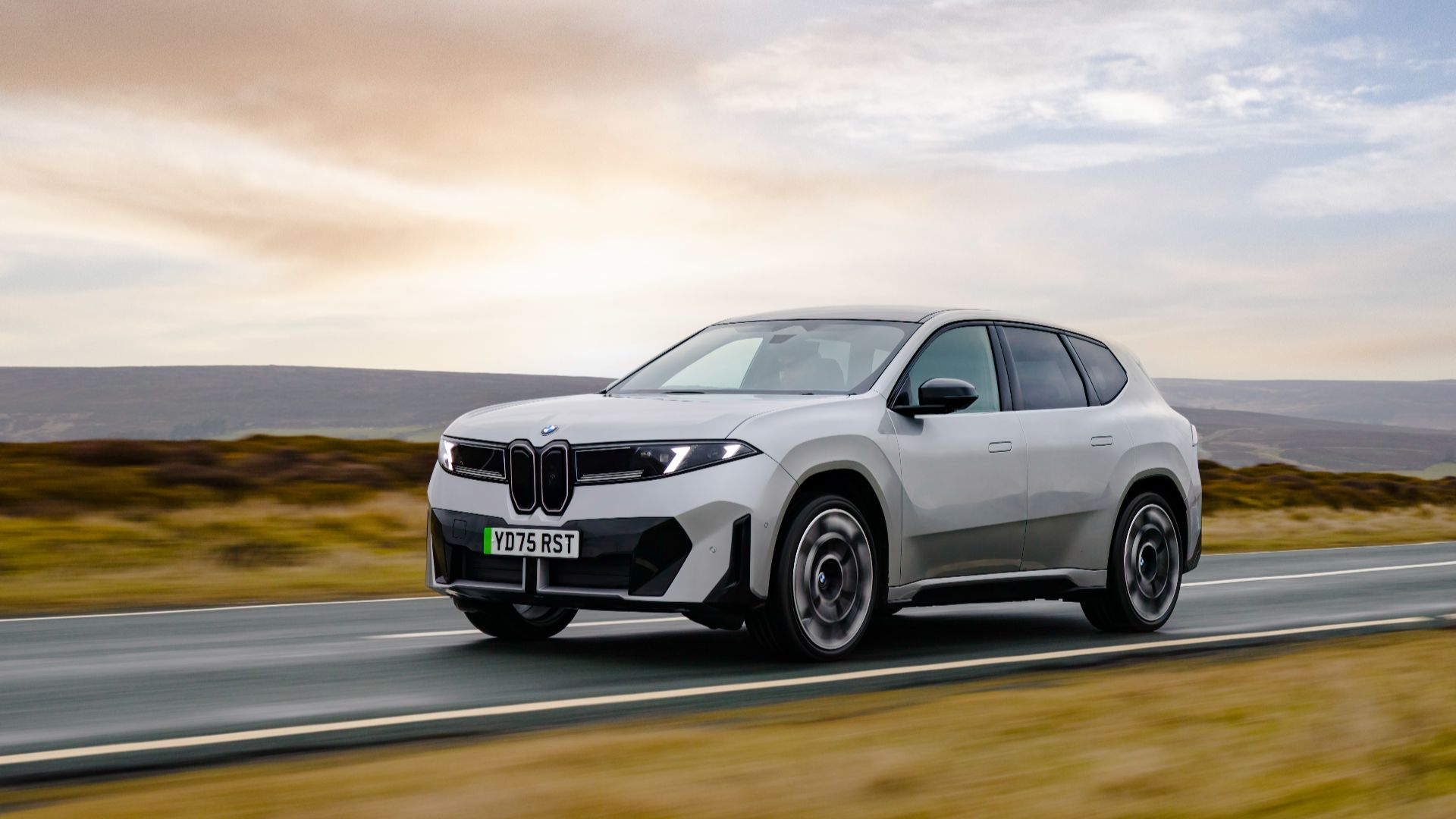
It’s hard to overstate the importance of the iX3 to BMW. As the first vehicle in the German company’s ‘Neue Klasse’ range of electric cars, it needs to be a standard-setter and a sales success. Thankfully, early indications suggest it will be both.
For starters, the iX3 has the longest range of any EV currently on sale – at up to 500 miles in the official WLTP test. It’s also comfortable, spacious and packed with technology, including a new Panoramic iDrive display that helps you keep your eyes on the road. Best of all, despite being a 2,360kg family SUV, the iX3 still drives with the finesse and feedback of a ‘proper’ BMW.
We said: ‘I wasn’t alone in thinking BMW had lost its way in recent years, straying too far from the values of the original Neue Klasse – particularly in terms of design and technical complexity. The brilliant iX3 is a hard reset, and one that bodes well for the future. It’s a car that goes straight to the top of a very crowded class. ‘
Ford Puma Gen-E

The Ford Puma Gen-E is a significant EV for British car buyers. The regular Ford Puma has been the UK’s best-seller for several years now, so the much-anticipated electric Gen-E will introduce thousands to owning their first electric car.
Keen prices are an immediate advantage, starting from a little over £26,000 after the UK Government’s full £3,750 Electric Car Grant is deducted. The Gen-E has all the regular Puma’s head-turning style and its recently-refreshed interior. Also, instead of the usual ‘MegaBox’ boot, the Puma Gen-E has an even bigger ‘GigaBox’ beneath the boot floor. You’ll be amazed at how much space is in there.
Ford has worked hard to retain the dynamics of the existing Puma, making this a neat and nimble drive. And while a 43kWh battery sounds a bit on the small side, it still has a range of over 230 miles in the official WLTP test. There’s growing evidence that the Ford Puma Gen-E’s real-world battery efficiency is noteworthy too, delivering more ‘miles per kWh‘ than many of its direct rivals.
Read about the launch of the Ford Puma Gen-E
Hyundai Ioniq 5

The former World Car of the Year looks like nothing else on the road – and its lounge-like interior is pretty radical, too. Choose the reclining ‘relaxation’ seat and it’s a restful spot to have a nap while you charge. There’s also no shortage of space; the Ioniq 5 might resemble a hatchback, but its proportions are more like an SUV.
Buyers can choose between a 63kWh battery with a 238-mile range, or an 84kWh model that will manage up to 354 miles. Just don’t expect a sporty driving experience – unless you choose the riotously entertaining Ioniq 5 N (pictured at the top of this page), that is. The hot Hyundai is one of the most surprising cars we’ve driven this decade.
We said: ‘A killer feature in the Ioniq 5’s armoury is the ability to charge at 800 volts. It’s the way forward, until now only possible on high-end electric cars from the likes of Audi and Porsche. It will revolutionise roadside charging with its sheer speed. Unfortunately, a widespread network of suitable chargers is not available quite yet.’
Read our Hyundai Ioniq 5 review and Ioniq 5 N review
Kia EV3

The Kia EV3 is one of the best – and best value – electric SUVs on the market. Choose one with a 58.3kWh Standard Range battery and you can look forward to 270 miles of range. This rises to an impressive 375 miles in the 81.4kWh Long Range version.
As usual, you benefit from Kia’s seven-year/100,000-mile warranty, but there’s much more to the EV3 than an extended guarantee. It looks funky, has a practical and spacious interior, and comes with all the tech you’d expect. If you need more space, you could also consider the larger, seven-seat Kia EV9.
We said: ‘The Kia EV3 is a likeable, practical and affordable electric SUV that rarely puts a foot wrong. We’re slightly lost for words when trying to articulate how the EV3 drives. For journalists, that isn’t ideal, but Kia should take it as a compliment. It calmly and competently gets on with the job.’
Read our Kia EV3 review
Lotus Evija

The £2.4 million Evija is the ultimate, money-no-object EV. It’s also the world’s most powerful production car, with a total of 2,039hp from its 93kWh battery pack and four electric motors. Lotus doesn’t supply performance figures, but in Autocar’s road test the Evija rocketed to 100mph in 4.8 seconds and 200mph in 13.0 seconds.
It’s no secret that Evija sales have been slow, and it looks unlikely that Lotus will build the 130 cars planned. At the same time, any hypercar with a traditional V12 engine seems to sell out straight away. However, for buyers in this rarefied section of the market, it isn’t a case choosing one car or another – they can invariably afford both. And the Evija offers a visceral and physical experience like nothing else we’ve driven.
We said: ‘At lower speeds, the electric motors are limited by traction, but more torque is fed forwards as you go faster, so the dizzying, disorientating rush just keeps on building. Throttle response and acceleration at three-figure speeds are otherworldly: the Lotus seems to laugh in the face of physics.’
Read our Lotus Evija review
MG4 EV

The MG4 EV is proof that you needn’t spend a fortune to drive a thoroughly good electric car. With prices starting from around £27,000, the MG makes a mockery of EVs costing twice that amount. Granted, that’s for the entry-level SE, which offers 218 miles of range, but even the top-spec EV Trophy Extended Range costs less than £37,000 – and can muster 323 miles of range.
Like many of the new breed of Chinese EVs, the MG has a simple interior with few physical controls and a large touchscreen display. It’s genuinely enjoyable to drive, with precise steering and brisk performance. Only its rather firm suspension lets the side down.
We said: ‘The MG4 EV is a value-priced alternative to the Volkswagen ID.3. It all makes for a very well-rounded family EV. Beyond some cheap interior materials, the MG4 is hard to fault. It’s also a true bargain in a world where everything suddenly seems very expensive. Time to believe the hype.’
Polestar 2

The Polestar 2 sprinkles some Scandinavian style over the electric car segment. It’s a sophisticated, technologically advanced and aethetically appealing rival to the Tesla Model 3 (see below). The Scandi-noir drama to the Hollywood blockbuster.
The lineup now consists of a choice between Single Motor variants in Standard or Long Range trim, or a Dual Motor version with the option of a Performance Pack. Range figures are anything between 343 and 408 miles, with prices starting from £45,000.
We said: ‘The Polestar 2 has evolved substantially during its lifetime, and it remains one of the best EVs on sale. Being able to drive more than 400 miles on one charge is the best tonic for range anxiety, and it’s all wrapped-up with a premium ownership experience.’
Porsche Taycan

The Taycan was Porsche’s first EV, and the company was determined it should drive like a ‘proper Porsche’. Mission accomplished, we’d say. The saloon arrived in 2019, with (road-focused) Sport Turismo and (SUV-style) Cross Turismo estates added to the lineup later.
The basic, rear-wheel-drive Taycan is really all you need (435hp, 0-62mph in 4.8 seconds, 416 miles of range), although the sportier GTS version is also a compelling package. At the top of the tree, the bonkers 1,108hp Taycan Turbo GT is one of the quickest cars we’ve ever experienced.
We said: ‘Unlike the majority of EVs, this is a car that keen drivers can enjoy. Porsche hasn’t completely overcome all that weight, which you sense most when braking, but it has done a mighty impressive job.’
Read our Porsche Taycan review and Taycan GTS Sport Turismo review
Renault 5 and Alpine A290

The Renault 5 E-Tech was an instant hit with both critics and the car-buying public. Cute styling and strong value for money (prices start at less than £22,000 at the time of writing) both help the retro Renault’s cause, while a smart interior and good road manners add to its appeal. Much like the original R5, it’s rather small for a family car, but the design and quality are hard to fault.
If you want more va-va-voom, the Renault has a sportier sibling in the shape of the Alpine A290. One of the first convincing electric hot hatchbacks, the A290 has livelier handling and up to 220hp in GTS guise. It’s proof that affordable EVs can be fast and fun to drive.
We said: ‘Prod the D-for-drive button and the A290 feels instantly up for it. With 221lb ft going through its front tyres, this GTS version can break traction if you’re hard on the throttle out of corners. Yet it mostly feels smooth and eager, with enough punch to make swift progress.’
Read our Alpine A290 GTS review
Skoda Enyaq

Arguably the most sensible electric car you can buy, the Enyaq is near-flawless family transport. Better value and better executed than its sister Volkswagen ID.4, it is practical and painless to live with. There’s a choice of 63kWh or 82kWh batteries, the latter offering up to 365 miles of range.
A flat floor means plenty of space for passengers, while the boot holds a massive 1,710 litres with all the seats folded flat. Skoda’s neat ‘Simply Clever’ touches, such as an umbrella hidden in the driver’s door, make life easier as well.
We said: ‘The interior of the Skoda Enyaq has a sleek, minimalist design. Many functions are accessed via the 13-inch central touchscreen, but it’s cleanly presented and generally easy to use. Thankfully, the glitchy, touch-sensitive controls of the ID.4 are nowhere to be seen.’
Tesla Model 3

The Tesla Model 3 is approaching middle-age, but it shows no signs of slowing down. It isn’t just one of Britain’s best-selling EVs – it has topped the overall car sales chart several times as well. It boasts outrageous performance and clever tech, plus the USP of the extensive Tesla Supercharger network. If you can’t charge your EV at home, it’s the obvious choice.
We do have a few gripes, including Tesla’s less-than-perfect build quality and the Model 3’s rather aloof dynamics. You’d be foolish to rule it out, though.
We said: ‘Acceleration is so rapid it squelches your internal organs and scrambles your synapses. You go from zero to warp factor 10 almost instantly, and with a lack of noise that’s entirely alien. No wonder Elon Musk was drawn to space travel.’
ALSO READ:
Best family cars to buy in 2026


[…] some sporty electric cars, the Cooper SE offers more than just the instant thrust of acceleration. Although its ride is on […]