The increasing use of electric cars is generating new road-trip debates, in particular about who should foot the bill for EV charging.
New research shows British motorists are split over EV charging etiquette, ahead of one of the year’s busiest travel periods.
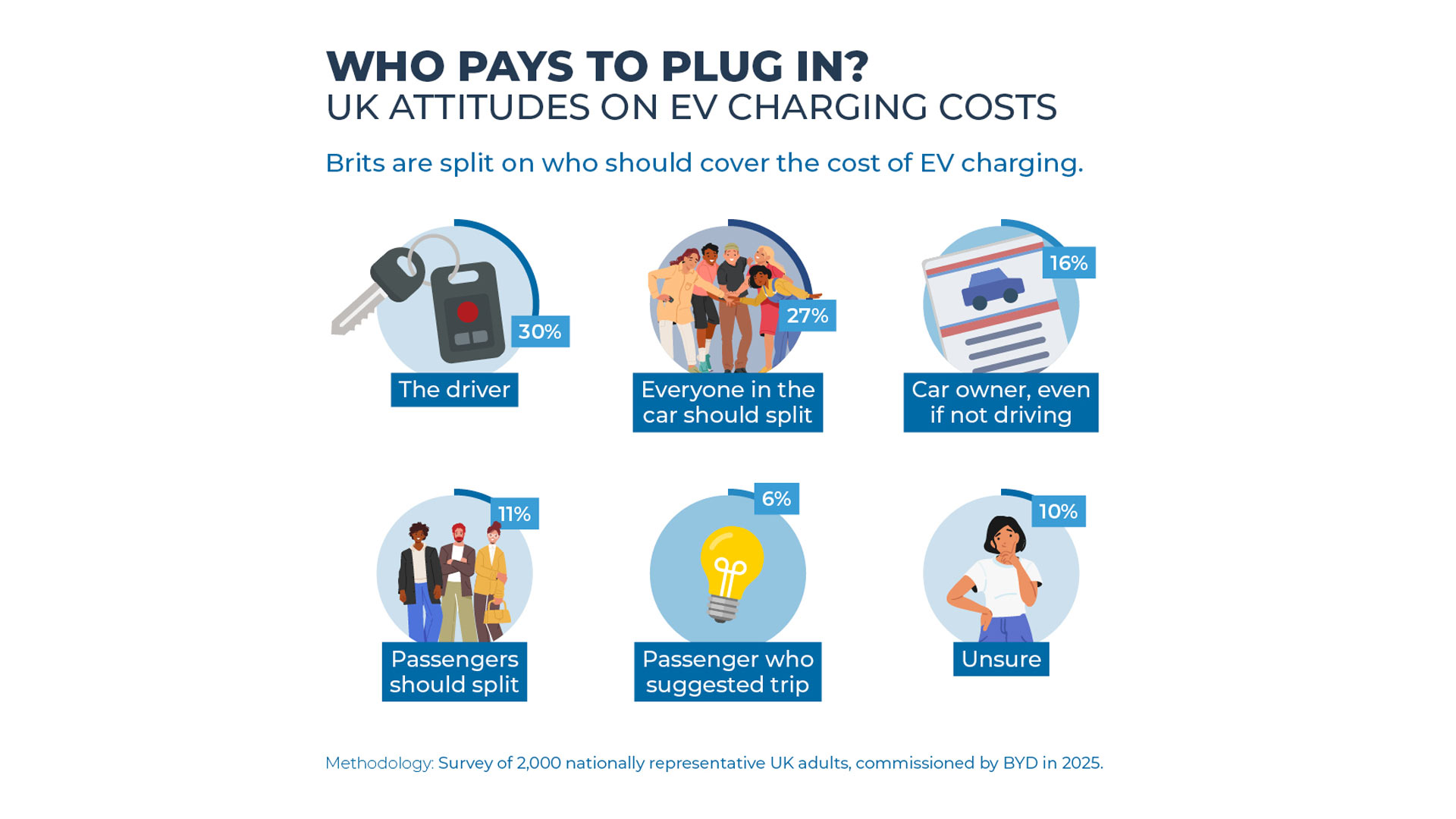
One in three (30 percent) of those surveyed by Chinese marque BYD said they believed the driver should be responsible for EV charging costs.
However, more than a quarter (27 percent) think that costs should be split evenly between everyone on the trip.
Some 16 percent argued that the car owner, not necessarily the driver, should pay for charging. And six percent said the passenger who suggested the journey should be responsible.
Younger generation say the driver should pay
Those aged between 18 and 24 were most likely to favour the driver paying, with 35 percent endorsing this option.
By comparison, 25 to 34 year olds (31 percent) and 35 to 44 year olds (30 percent) were the only age groups where most respondents thought the cost of electric car charging should be split between all passengers.
Overall, 10 percent admitted they simply don’t know the rules about sharing EV charging costs, with many navigating this issue for the first time.
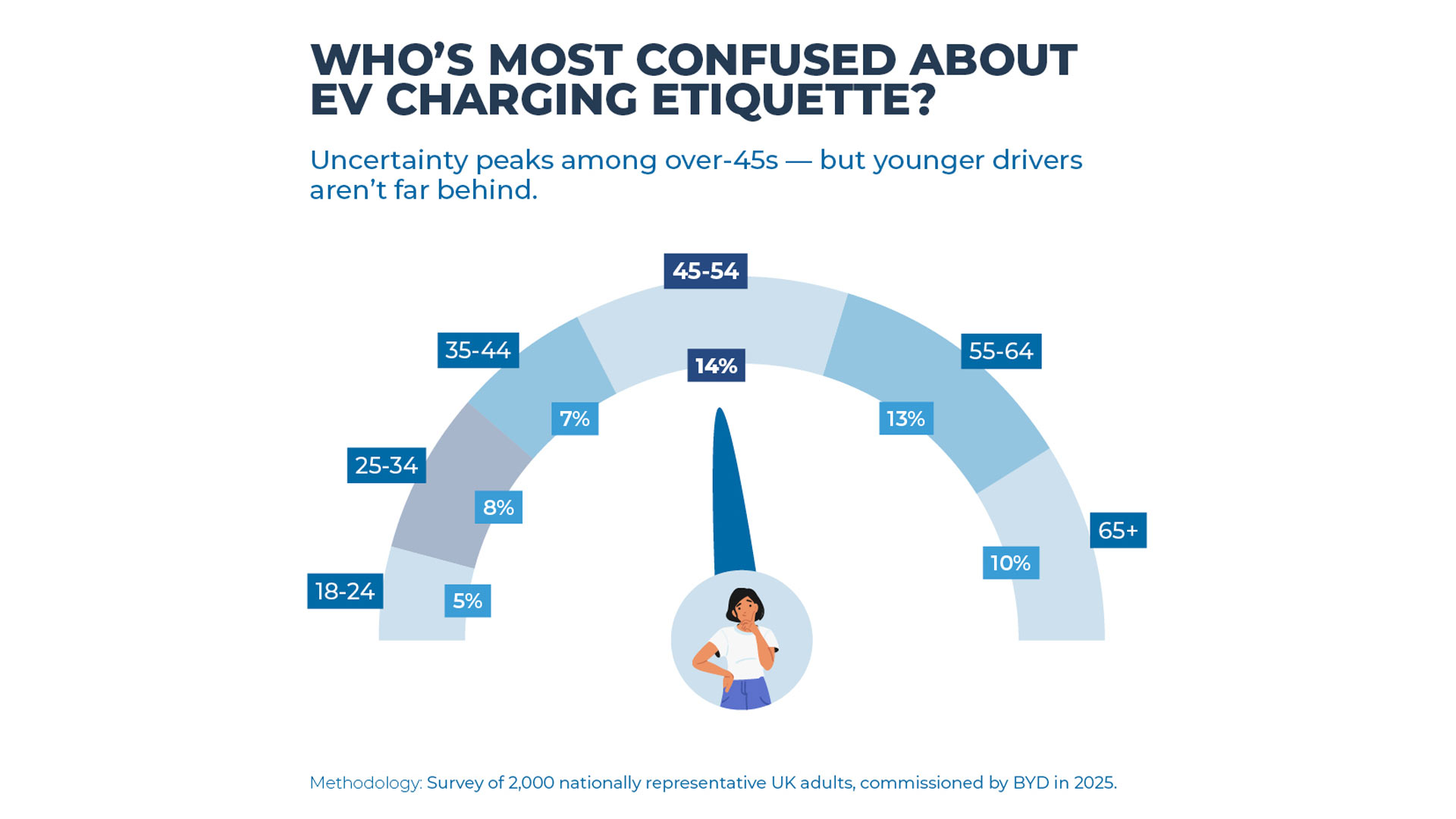
Survey respondents aged between 45 and 54 said they were most uncertain about the correct etiquette for electric car charging expenditure.
A new automotive cultural shift
BYD spoke to Laura Akano, an etiquette expert, who suggested: “The most polite way to raise the topic of EV charging costs with passengers is to propose splitting the cost equally, especially if you are the driver or owner of the vehicle.
“Drivers should let passengers know in advance if they are expected to chip in for charging costs. This helps to prevent any awkwardness or misunderstanding. It is in poor taste to retrospectively ask for a contribution towards charging after completing the journey.”
Steve Beattie, sales and marketing director at BYD UK, commented “We’re seeing a cultural shift play out in real time. As more people experience life in an electric vehicle, they’re questioning old assumptions about driving, including who pays, when and how.”
Choosing an electric car could potentially save UK drivers thousands of pounds – and thousands of calories – every year.
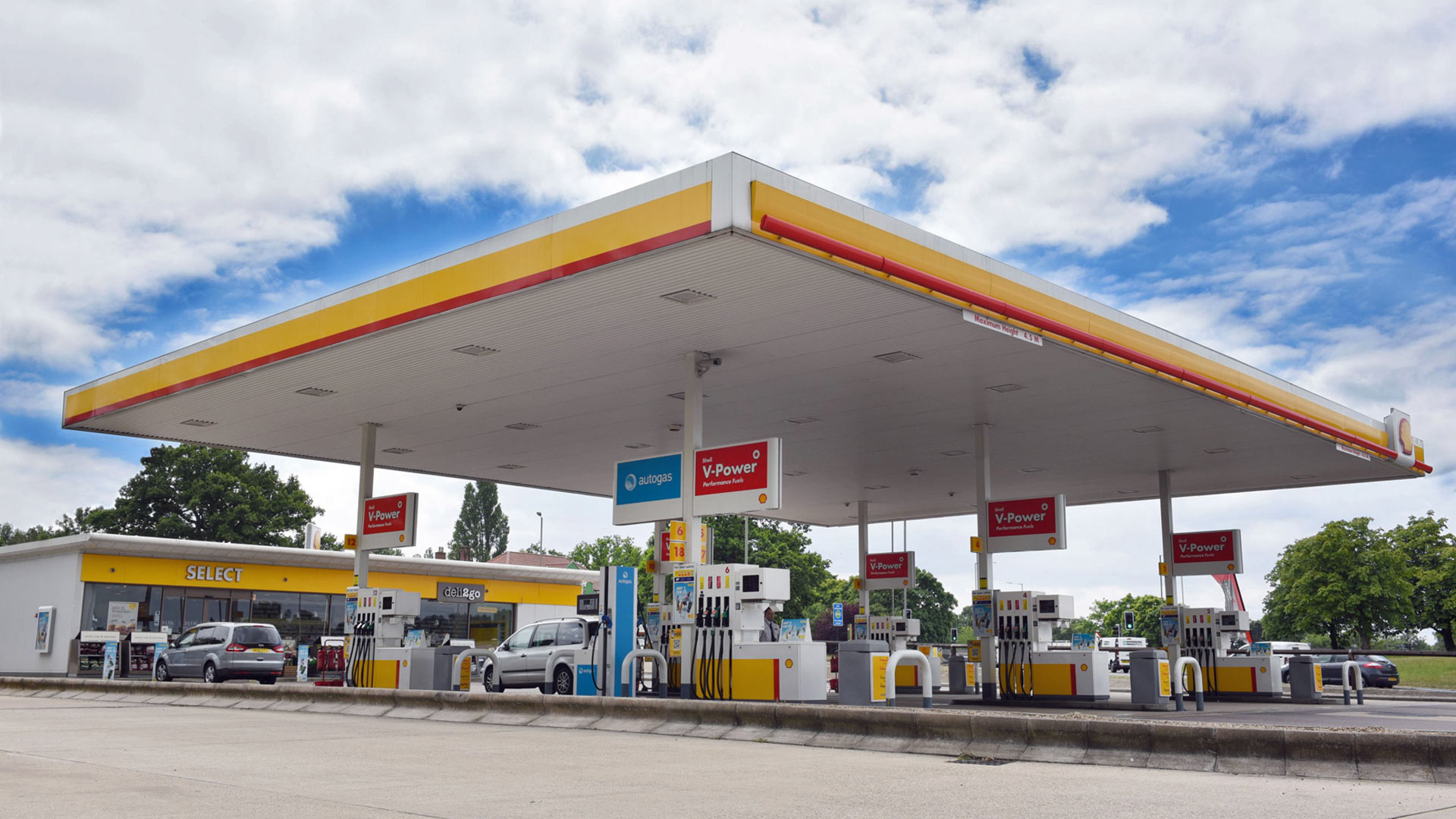
EV owners who recharge their car at home can avoid petrol station forecourts altogether, and avoid buying unnecessary snacks.
British EV charger brand Simpson & Partners highlighted YouGov research showing almost half (48 percent) of British drivers buy snacks and drinks when they stop to refuel.
With no need for petrol or diesel in the first place, electric car owners are less likely to submit to the temptation of a forecourt meal deal.
No unnecessary filling required
Simpson & Partners calculates that a weekly trip to refuel at a petrol station could result in close to 1,000 additional calories.
The company’s research found that a chicken and bacon sandwich, a smoothie and a chocolate bar typically equates to 801 calories.
There is also a substantial cost saving from not buying snacks when refuelling. YouGov’s data found that nearly two thirds (63 percent) of fuel stops saw expenditure of less than £5. However, 30 percent of drivers spend between £5 and £10 each visit.
Even at the lower end of the spending range, saving £5 each week equates to £260 over the course of a year.
Saving money, staying in shape
Mandy Simpson, co-founder of Simpson & Partners, said: “There’s so much talk in the media about weight loss drugs, how sugar isn’t healthy and how diabetes is on the rise.
“The hidden side benefit for EV drivers who home charge is that you don’t need to go to the petrol station and expose yourself to the temptations on the snack aisle. It’s like a passive benefit no one talks about.”
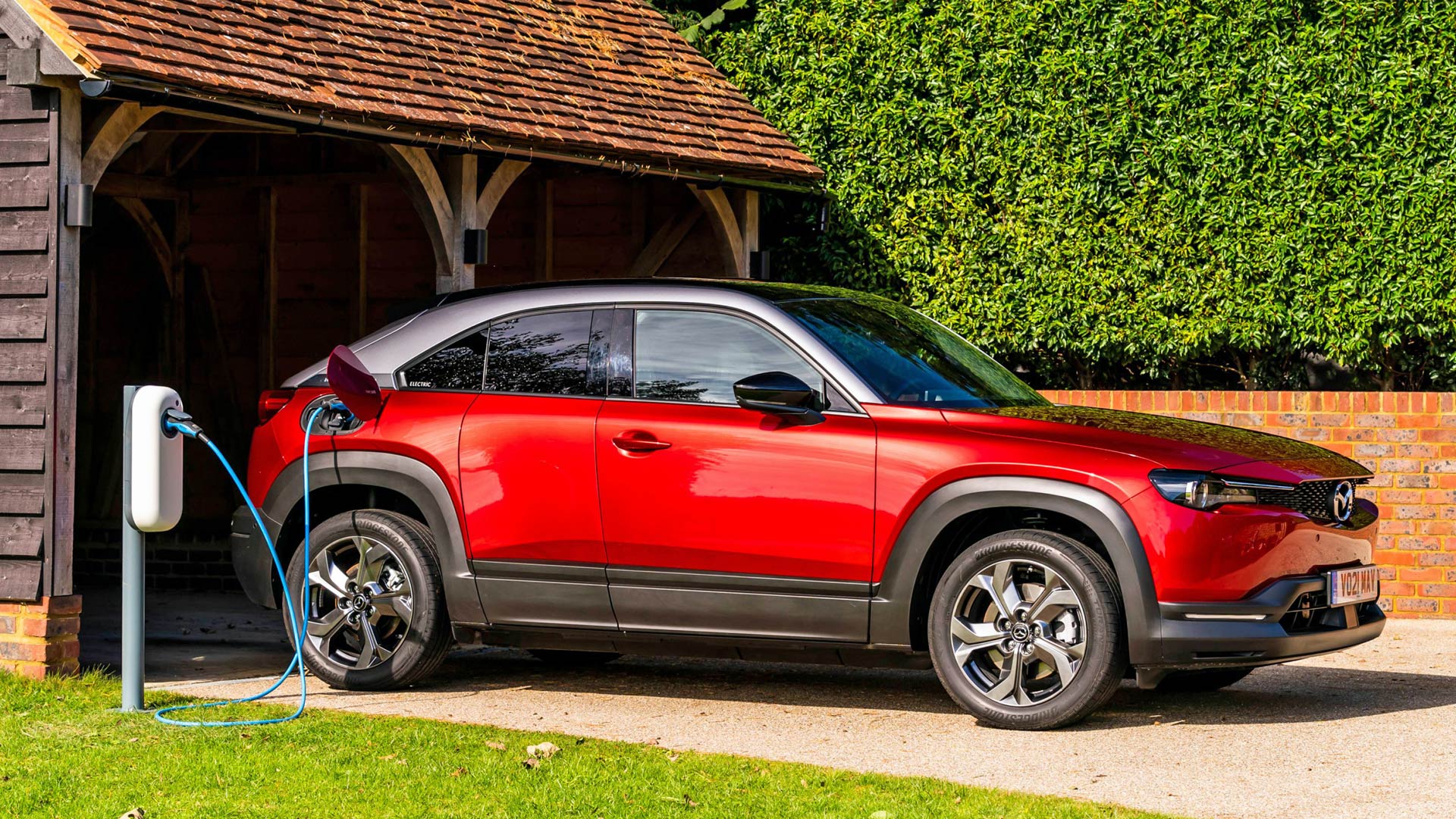
Home charging is generally the best option for electric car owners when possible, due to the lower cost of electricity compared to using public chargers. In addition, VAT is charged at 20 percent for public charging, instead of the five percent paid on domestic electricity.
“Once you experience the convenience of home charging, it’s hard to imagine going back,” adds Simpson. “You can top up your car while you sleep. It’s energy-efficient, time-saving and much less disruptive to your day. And turns out it’s kinder to your waistband too.”
European car buyers increasingly feel turned off by Tesla, according to new market research.
Data analytics firm Escalent discovered that sentiment towards the American EV manufacturer is now more negative than positive.
More than a third (38 percent) of those surveyed across Europe said the Tesla brand’s novelty had now worn off.
In addition, close to half (44 percent) disagreed that the number of people they see driving a Tesla makes them more inclined to buy one.
Tesla no longer seen as a market leader
Escalent’s research revealed that consumers still rate Tesla for its charging infrastructure and charging speed. However, design quality and emotional appeal are no longer attracting buyers.
A third (33 percent) of those surveyed agreed that ‘compared to other brands, it is not as far ahead as it used to be’. A further quarter (26 percent) thought that Tesla’s product offerings are no longer as competitive.
Notably, one in three respondents believe that Tesla is no longer a premium brand, regarding it as mainstream instead.
At the same time as interest in Tesla wanes, Escalent has found that Chinese car brands are seeing a growing level of consumer trust and interest.
Chinese brands in the ascent
Although German manufacturers were a top consideration for 89 percent of those surveyed, Chinese brands were of interest to almost half (47 percent). This represents a 16 percent increase during the past year alone.
Curiously, Escalent found that when consumers realise established names such as Volvo, MG or Smart are Chinese-owned, their interest dips slightly. However, being told that new-to-Europe brands such as BYD or Zeekr are Chinese leads to consumer interest actually increasing.
Commenting on the research, Mark Carpenter, managing director of Automotive and Mobility Europe at Escalent, said: “Once a badge of progressiveness, the Tesla brand now risks being seen as uninspiring and faces the same complacency that it once disrupted”.
Still searching for the ultimate bespoke Christmas gift? May we suggest a unique ‘station wagon’ version of the Lamborghini LM002?
Commissioned by the Sultan of Brunei for his extensive and legendary car collection, this is believed to be the only factory-supported LM002 Wagon ever produced.
Even among the thousands of cars that made up the Sultan’s record-breaking collection, the LM002 Wagon is a true rarity.
Stockholm-based specialist Motikon has now listed the LM002 on the Bring a Trailer auction platform – and it is already attracting plenty of attention.
A truly bespoke Lamborghini
The ‘Rambo Lambo’ LM002 was hardly a vehicle for shy and retiring types. However, the modifications commissioned by the Sultan of Brunei make this Wagon model even harder to ignore.
Delivered new via the Hong Seh Company in Singapore, the Lamborghini was sent to Italian coachbuilder Autocostruzioni Salvatore Diomante in 1989.
Diomante undertook a range of modifications, including the raised roofline and extended, estate-style bodywork. A power-operated sunroof was added, too.
Originally finished black, like many vehicles in the Sultan’s car collection, the LM002 Wagon was later repainted in silver.
A blast from the past
The interior of the LM002 Wagon was no less dramatic, with its new rear bodywork accommodating a U-shaped lounge seating area. If your dream is to own a V12-powered sitting room, look no further.
Black leather was used extensively throughout the cabin, along with acres of wood trim, including a wood-rimmed steering wheel.
Retro entertainment features include a centre console that houses a Pioneer CRT television and DVD player, plus a CD player mounted in the roof.
Motikon notes that the TV currently does not work, and that the car’s headlining is now sagging in places.
Prestigious provenance included
Diomante left the Lamborghini unchanged mechanically, which means a 455hp 5.2-litre quad-cam V12 breathing through six Weber carburettors.
This is connected to a five-speed ZF manual gearbox, plus a four-wheel-drive system featuring three self-locking differentials. There is also a dual-range transfer case for serious off-road action.
Around 11,000km (6,700 miles) have been recorded on the LM002’s odometer, with just 500 miles added by the current owner.
Bolstering the LM002 Wagon’s intrigue is that, following its royal ownership, it was purchased by Bernd Pischetsrieder. The German engineer and executive previously served as CEO of both BMW and Volkswagen.
Time to place your bids
During Pischetsrieder’s ownership of the Lamborghini, he sought official factory verification for the LM002 Wagon. It means the special 4×4 now comes with a ‘Certificato di Iscrizione’, confirming its full history.
Extensive provenance, including invoices and historic photographs, will also be included in the sale of this one-off LM002.
Filip Larsson, CEO of Motikon, commented: “Cars from the Brunei collection almost never leave private hands – and the factory-supported LM002 wagon is one of the most elusive of them all. The fact that it later spent years doing Swedish school runs makes it a once-in-a-lifetime story, not just a sale. It’s the kind of vehicle that reshapes a collection.”
Bidding for the LM002 Wagon will be live on Bring a Trailer until Monday 8 December 2025. Just in time for Christmas delivery, then…
Just over a year after being launched, the electric Renault 5 E-Tech has surpassed a major production milestone.
Renault’s Ampere ElectriCity plant, located in Douai near Lille, has assembled 100,000 examples of the retro-styled hatchback since October 2024.
As one of the factories responsible for building the original Renault 5, Douai factory holds an important place in the French marque’s history.
More than 5.7 million examples of the first Renault 5 were made between 1972 and 1985. So the new electric version still has plenty of catching up to do…
Shifting up to high speed
Some 900 vehicles leave Douai’s production lines each day. These include the Renault Megane and Scenic E-Tech, Alpine A290, Mitsubishi Eclipse Cross and new Nissan Micra EV.
However, the Renault 5 currently accounts for two thirds of the vehicles built at the factory, which has pivoted towards electric models.
Initially operating with two shifts, such is the demand for the Renault 5 E-Tech that a third night shift was added in October 2025.
The Ampere ElectriCity factory has two thirds of its suppliers within a 300km (186 mile) radius. Also located nearby is the Maubeuge plant, which produces the reborn Renault 4 E-Tech.
A new chapter in sustainability
Pierre-Emmanuel Andrieux, Douai plant director, commented: “A little over a year after its launch, the production of the 100,000th Renault 5 E-Tech electric in Douai stands as a testimony to the dedication of our teams and the trust of our customers.
“The Ampere site in Douai has undergone a profound transformation toward full electrification, driven by the passion and expertise of its workforce. Today, we celebrate far more than a number: we honour our collective ability to write a new chapter in sustainable innovation.”
Since going on sale in October 2024, the Renault 5 E-Tech has collected numerous trophies, including the 2025 European Car of the Year award. The EV supermini has also become the second-best selling vehicle across Europe, and claimed the position as the top electric car in the UK for October 2025.
The Porsche 911 was the most popular new and used luxury car bought using finance in 2025, according to new data.
Stuttgart’s iconic sports car topped the charts as the UK’s most frequently financed high-end vehicle during the past 12 months.
Porsche was also the most-purchased brand using finance overall, accounting for nearly a third (30 percent) of the second-hand luxury market.
The average price of a pre-owned luxury car has rocketed by 31 percent since 2021. The typical amount now paid is £127,000.
SUVs remain a popular choice
Automotive finance provider JBR Capital released the new market data as part of its 2025 Luxury Car Report.
It confirms the Porsche 911 was the single most popular car financed this year, accounting for 16 percent of all vehicles. Bought for an average price in excess of £121,000, both the current ‘992’ and previous ‘991’ generation models are in demand.
Luxury SUVs also continue to be popular, taking 35 percent of the luxury finance market in 2025. By comparison, 30 percent of the vehicles financed by JBR Capital were supercars.
In second place behind the Porsche 911 among individual models was the Range Rover Sport. The Lamborghini Urus made up the top three.
Car finance favourites in 2025
Across wider market sectors, JBR Capital revealed that the BMW M3 topped the table for sports saloons.
Porsche did finish first elsewhere in the 2025 Luxury Car Report, though, with the Taycan emerging as the electric performance car of choice.
In addition, pre-1994 versions of the Porsche 911 were the top classic car, ahead of the Lamborghini Diablo and Ferrari F355.
‘Luxury cars for a broader audience’
Although 10 percent of JBR Capital’s customers have an annual income of more than £350,000, two thirds (66 percent) of its customers fall into the £50,000 to £150,000 bracket.
By profession, sports players and athletes financed the most expensive cars, with an average value of £140,000.
JBR Capital founder Darren Selig commented: “This year’s report paints a clear picture of a market driven by passion rather than exclusivity. Porsche’s continued dominance and the resurgence of supercars underline strong confidence among enthusiasts, even as average prices climb by more than 30 percent since 2021.
“With most buyers earning between £50,000 and £150,000, luxury car ownership is no longer reserved for the ultra-wealthy – it’s becoming a reality for a much broader audience.”
Porsche has revealed its new Cayenne Electric at an exclusive event in London. The UK debut took place at the flagship Porsche Mayfair dealership on Piccadilly, W1.
Two versions of the SUV were unveiled: the 442hp Cayenne Electric and 1,156hp Cayenne Turbo Electric. Both use a 113kWh battery and offer blisteringly fast charging speeds of up to 400kW.
Porsche Formula E development driver Gabriela Jilkova pulled the wraps off the new Cayenne. Last summer Jilkova broke the SUV record at Shelsley Walsh hillclimb in a Cayenne Turbo Electric prototype. Her time of 31.28 seconds smashed the previous record, held by a Bentley Bentayga W12, by more than four seconds.
The most powerful Porsche
Occupying the prime spot inside Porsche Mayfair’s showroom window, the battery-powered, £130,900 Cayenne Turbo (pictured above) is the headline act. Its two motors – one for each axle – provide four-wheel drive and up to 857hp in normal driving.
Press the Sport Response ‘push to pass’ button and you unleash an extra 176 horses for 10 seconds at a time. Or you can activate launch control for the full 1,156hp and 1,106lb ft of torque: good for 0-62mph in a hypercar-baiting 2.5 seconds, plus a top speed of 163mph.
The four-figure output makes this Porsche’s most powerful production car ever, surpassing even the stripped-out Taycan Turbo GT – along with rivals such as the Lotus Eletre, BMW XM and Lamborghini Urus SE.
Up to 398 miles of range
At the more sensible end of the SUV spectrum, the regular £82,200 Cayenne Electric serves up 408hp, or 442hp when using launch control. With 2,525kg to shift (the Turbo weighs an even heftier 2,645kg), that’s sufficient for 0-62mph in 4.8 seconds and a 143mph maximum.
In terms of electric range, the standard Cayenne achieves 398 miles in the official test, while the Turbo manages 387 miles. Find an ultra-rapid 400kW charger and you can replenish the battery from 10-80 percent in just 16 minutes.
On the move, range is boosted by ‘Formula E levels of recuperation’ (up to 600kW). Indeed, Porsche says the electric motors can handle ‘97 percent of all braking operations’. PCCB ceramic-composite brakes are optional on the Turbo.
Both versions of the Cayenne ride on adaptive air suspension with PASM adaptive dampers, with the Turbo also gaining a PTV Plus torque vectoring rear differential. Further options include rear-axle steering and Porsche Active Ride, which counteracts body-roll when cornering.
New Cayenne Electric in London
The new Cayenne’s styling combines elements from the smaller Macan Electric and long-established Porsche Taycan. Despite its bluff and boxy silhouette, a drag coefficient (Cd) of 0.25 makes it one of the most aerodynamic SUVs on sale.
Eye-catching elements of the design are slim Matrix LED headlights, a sharp crease along the lower doors and illuminated ‘PORSCHE’ lettering on the tailgate. The Turbo has new ‘active aeroblades’ that jut out from the rear wings when you select Sport Plus mode, plus badges and brightwork in Turbonite – a darkened chrome finish unique to Stuttgart’s Turbo models, including the new 911 Turbo S.
Seen in the metal, the Cayenne Electric’s proportions are quite striking. It looks more purposeful than the existing petrol and hybrid models – which will continue to be sold alongside the EV – with a squat and purposeful stance that’s almost more estate car than SUV.
It’s worth taking your time on the configurator, though, as this Porsche is very spec-dependent. The entry-level Cayenne displayed in London looked rather anonymous in grey, but the Turbo in Mystic Green Metallic – and wearing 22-inch alloy wheels – drew an appreciative crowd all evening.
Deliveries in spring 2026
We also had a chance to sit inside the Cayenne Electric for the first time. Like many modern cars, its dashboard is dominated by screens, most notably the new curved ‘Flow Display’ that blends into the centre console. Combined with the (also curved) digital dials and optional 14.9-inch passenger screen, it creates the largest display area ever found in a Porsche.
Other innovations are a head-up windscreen display with augmented reality tech, plus an AI-powered voice control system that ‘responds like a real conversation partner’. Who needs friends anyway?
As you’d expect, the Porsche’s cabin is spacious and flawlessly finished. It has grown by 55mm in length versus the petrol model, creating more rear legroom than any previous Cayenne. Luggage capacity is an enormous 781 litres with the rear seats in place, supplemented by a further 90 litres beneath the bonnet. You can tow up to 3.5 tonnes, too.
After their brief appearance in Mayfair, the two Cayennes will be going on tour to Porsche dealerships across the UK. If you like what you see, orders are open now, with the first deliveries expected in late spring 2026.
The Renault 5 and Renault 4 are now eligible for the top-tier £3,750 Electric Car Grant (ECG) following a shift in battery production to France.
The long-range 52kWh is now being built in Renault’s gigafactory in Douai, rather than in China. This means it meets the sustainability part of the ECG, duly taking the grant up from £1,500 to the full £3,750.
This takes prices for the new Renault 5 Techno+ down to £23,945. Iconic Five+ models cost from £25,945 and Roland Garros+ are from £26,945.
Renault 4 prices now start from £23,445, with the ECG applied.
Renault has also taken the opportunity to tweak the spec of both Renault 5 and Renault 4, following early customer feedback.
Renault 5 Techno+ get a contrast black roof as standard, while Iconic Five+ and Roland Garros+ get a Harman Kardon stereo.
Renault 4 Evolution+ models get a new 18-inch steel wheel design, Techno+ have a contrast black roof and Iconic+ get the Harman Kardon stereo.
The 52kWh models now carry the ‘+’ designation to denote they use the Douai-made batteries – and benefit from the full £3,750 Electric Car Grant.
Alpine A290 also gets ECG boost
The Renault 5’s sporty sister car, the Alpine A290, also now qualifies for the full £3,750 ECG.
The entire Alpine A290 range – that’s GT+, GT Performance+ and GTS+ – now enjoy lower transaction prices, which start from £30,245.
“Earning the full £3,750 grant eligibility is fantastic news and I’ve no doubt will accelerate the already amazing interested we have had in the award-winning Alpine A290,” said head of Alpine Cars UK Nicola Burnside.
“The awarding of the top-tier £3,750 Electric Car Grant is great news for customers who are thinking about switching to electric,” added Renault Group UK MD Adam Wood.
“We are pleased to see that our focus on environmental accountability and investment in made-in-Europe battery manufacturing has been recognised.
“Since the grant was introduced, we have seen momentum build in the market, and this decision will further boost the UK’s rising EV sales even further.”
The Renault and Alpine models join other cars qualifying for the full £3,750 ECG, including the Ford Puma Gen-E and latest Nissan Leaf.
The overwhelming majority of UK motorists would support the introduction of alcohol interlocks to deter drink-driving.
Alcohol interlocks, also known as ‘alcolocks’, prevent a vehicle from being started or driven if alcohol is detected in the driver’s breath.
A survey undertaken by the RAC found that 82 percent of respondents would be in favour of alcohol interlocks being used in the UK.
Only seven percent of respondents were against the idea of interlocks for convicted drink-drivers, with 12 percent unsure.
Motorists want tough action on drink-driving
Alcolocks are already used in numerous countries around the world, including France, Belgium, New Zealand, Australia and the United States.
In these countries, a court can order an alcohol interlock to be fitted to a drink-driver’s vehicle as part of their sentencing.
Fully 71 percent of those surveyed by the RAC believe an alcolock should be mandated for every motorist caught over the drink-drive limit. Nearly a quarter (23 percent) believe it should be reserved for repeat offenders instead.
Support for alcohol interlocks was high amongst all age ranges. However, younger drivers (87 percent) were most in favour of their introduction.
Some 86 percent of respondents aged between 25 to 44 were supportive, along with almost three quarters (73 percent) of drivers aged over 65.
The latest Department for Transport statistics show that 260 people were killed in crashes involving drink-driving offences in 2023. A further 1,600 were seriously injured, too.
RAC road safety spokesperson Rod Dennis said: “Giving courts the power to mandate the fitting of alcohol interlocks – which prevent a convicted drink-driver from getting behind the wheel after drinking – is something that drivers believe warrants serious consideration as they’re telling us the current penalties aren’t working.
“Alcolocks are already in widespread use in other parts of the world and have the potential here in the UK to reduce the number of alcohol-related collisions and casualties, and the costs associated with them.
“The fact a huge majority of drivers support the use of alcolocks sends a clear message that they want to see more being done to tackle drink-driving. The Government will hopefully address this in its soon-to-be-published Road Safety Strategy.”
Alfa Romeo has unveiled extremely limited-edition versions of its Giulia and Stelvio Quadrifoglio models.
Declared by the Italian marque to be an ‘instant classic’, production of the Quadrifoglio Collezione will be limited to 63 examples worldwide.
The low build number is a reference to the classic Alfa Romeo Giulia Ti Super, launched in 1963.
The Ti Super was the first road-going Alfa Romeo to wear the now-legendary Cloverleaf badge, which made its motorsport debut decades earlier.
Honouring the Cloverleaf legend
Built at Alfa’s Cassino factory in the Lazio region of Italy, the Giulia and Stelvio Quadrifoglio Collezione will come in bespoke paint colours.
A reinterpretation of the’ Rosso Villa D’Este’ hue used on the 33 Stradale supercar, the paint can appear red or black depending on the lighting.
The commemorative duo will each use a special twist on this colour. ‘Rosso Collezione Giulia’ favours darker shades, while ‘Rosso Collezione Stelvio’ has a brighter red hue.
On the inside, both cars have leather and Alcantara upholstery, with red stitching used throughout. Sparco carbon fibre seats will feature the individual production number of each Collezione embroidered into their headrests.
Just two examples for the UK
Under the bonnet, Alfa Romeo has left the 520hp 2.9-litre twin-turbocharged V6 engine unchanged, although an Akrapovic exhaust system is fitted as standard, along with carbon-ceramic brakes.
Carbon fibre trim is used for the front badge, mirror caps, central tunnel and dashboard, with the roof also crafted from the lightweight material. ‘Instant Classic Certification’, issued by Alfa Romeo Classiche department, is also part of the package.
For UK enthusiasts, the chance to own a Giulia Quadrifoglio Collezione will be slight, with just two examples destined for our shores. And British Alfa fans will be denied any opportunity to own the Stelvio SUV.
Alfa Romeo has not confirmed prices for the Giulia Quadrifoglio Collezione, but expect a hefty premium over the £86,885 asked for the standard super saloon.