Porsche’s EV flagship, the new Taycan Turbo GT, has notched up another record-breaking achievement.
The extreme Porsche EV has become the fastest production electric car around the famous Interlagos race track in Sao Paulo, Brazil.
With up to 1,108hp on tap, the most powerful road-going Porsche ever made was clearly the right tool for the job.
Combining it with works Porsche sports car driver – and former F1 pilot – Felipe Nasr made for an unstoppable combination.
‘A real performance machine’
Driven by Nasr, the Taycan Turbo GT managed a lap time of 1 minute 42.1 seconds, slashing almost eight seconds from the previous record. Naturally, this record of 1 minute 49.8 seconds was set by a Porsche Taycan Turbo S in 2022.
“Coming to Interlagos and getting behind the wheel of the Taycan Turbo GT right after winning the 24 Hours of Daytona was an incredible experience,” said Brazilian-born Nasr. “I expected the strong acceleration and torque but, ultimately, it was the overall performance that really impressed me.
“The steering of the Taycan Turbo GT was very precise in the slow corners and remained stable even under heavy braking. The balance, the grip – it’s a real performance machine.”
The Turbo GT has already notched up two records, starting with a pre-production model setting a class best around the fearsome Nürburgring Nordschleife circuit last year.
Porsche development driver Lars Kern also used a Taycan Turbo GT to set the fastest lap in a road-legal electric car at the Laguna Seca racetrack in California.
And earlier this year, the less powerful Porsche Taycan GTS achieved a new Guinness World Record for the longest continuous drift on ice by an electric vehicle.
Many city cars have been discontinued and not replaced in recent years, as requirements for the latest driver assistance systems, coupled with the drive towards EVs, has made them less profitable for car makers. It’s why this list is shorter than it would have been just a few years ago. We’ve even included a few slightly larger, supermini-sized cars to boost the numbers.
On the plus side, the city cars left standing in 2026 are generally very well-rounded and capable. Here are the best ones you can buy right now.
Citroen Ami
The innovative Citroen Ami is a city car in the purest sense. Indeed, with an electric range of 46 miles and a top speed of 28mph, you would be brave/foolish (delete as appropriate) to venture much beyond the suburbs.
Priced from just £7,695 – or £100 a month on PCP finance – the Ami is probably cheaper than taking the bus. Its interior is very basic, but you do get a heater, a cupholder and a Bluetooth speaker atop the dashboard.
We said: ‘Like every EV, there are no gears to worry about: just press the Drive button and off you go. Visibility is very good and there’s even a glass roof to maximise the light inside. The Ami isn’t fast, but it’s quick enough for town use. And its manoeuvrability in tight spaces is unsurpassed.
‘Here, we should point out that the Citroen Ami is available only in left-hand-drive form. That’s not quite the issue you might think, because the vehicle is so compact it feels almost like you’re sitting in the centre anyway. Plus, it only has two seats. And, um, no boot. You must stuff your shopping bags into the spacious passenger footwell instead.’
In size terms, the Dacia Sandero is closer to being a supermini than a city car. However, it’s very much priced to compete with others here. The entry-level Sandero Essential comes with a 90hp engine, LED headlights, air conditioning, electric front windows and cruise control – all for £14,200. Even the most expensive model only costs a fraction over £16,000.
You can have your Sandero in crossover-style Stepway guise, with raised suspension and rugged body styling, or opt for a bi-fuel engine. The latter can use either petrol or LPG, for sizable cost savings. At the time of writing, LPG costs around 95p per litre (where available), compared to an average of £1.40 for unleaded petrol.
Driving the Dacia Sandero Stepway Bi-Fuel, we said: ‘Steering is a bit on the heavy side in town, but it’s positive and reassuring once up to speed. It feels natural in a way many small cars today do not. The Sandero Stepway is surprisingly comfortable at motorway speeds, with low tyre noise, excellent stability and a “planted” feel you don’t always get in small budget cars.
‘The turbo engine helps here. It’s ever-responsive, with good pulling power, and takes motorway speeds in its stride. It is refined, paired with a lovely five-speed gearbox, and serves up more than enough performance even over long journeys. The three-cylinder motor revs smoothly, too.’
There are now two versions of the Fiat 500. The first is the traditional 500 that’s been on sale for what feels like forever (albeit with a few updates over the years). It’s now sold solely with a 70hp 1.0-litre mild-hybrid petrol engine: good for 0-62mph in a leisurely 13.8 seconds.
Far more exciting is the 500e (pictured here), which features a fully electric powertrain. It’s available as a hatchback or roll-top cabriolet, with prices starting from around £25,000. The 93hp version with a 24kWh battery has an official range of 118 miles, while the 118hp, 42kWh model can manage 199 miles. Either way, the electric 500 is stylish, refined and enjoyable to drive around town.
Driving the 500e, we said: ‘In its segment, where it’s up against boutique small EVs like the Mini Electric and Honda e, the Fiat 500 stands up very well indeed.
‘Its blend of style, quality, comfort, range and price are spot-on – better, in fact, than the dated petrol model. Drive one. You’ll like it.’
It might be a supermini, but with prices starting from £18,500, the MG 3 is cheaper than some of the top-spec city cars on our list. Also, while many small cars make do with a mild-hybrid powertrain, the MG 3 is a proper hybrid, so you can look forward to pure electric driving in town and official fuel economy of 64mpg. That’s an impressive figure for a 1.5-litre petrol engine mated to a three-speed automatic transmission.
The entry-level SE version of the MG 3 has a 10.25-inch touchscreen infotainment system with Apple CarPlay and Android Auto connectivity, a seven-inch driver display, 16-inch alloy wheels, climate control air-con, rear parking sensors and a choice of driving modes. Upgrading to Trophy trim adds the likes of heated front seats, a heated steering wheel, keyless entry, LED headlights and leather-style upholstery.
Hyundai i10
The Hyundai i10 is arguably the best city car you can buy in 2026. It comes with a five-year, unlimited mileage warranty, the practicality of five doors and a range of efficient petrol engines. The 1.0- and 1.2-litre engines are perfect for the city, with fuel economy of up to 56.5mpg if you drive carefully.
We’re also fans of the i10 N Line, which features styling influenced by the brilliant (and sadly now discontinued) i20 N hot hatchback. Highlights include a distinctive grille, three-piece LED daytime running lights, 16-inch alloy wheels and N Line sports seats. It’s the only i10 to benefit from a turbocharged engine; the 1.0-litre three-cylinder unit serves up a zesty 90hp.
Standard spec across the i10 range includes air conditioning, high-beam assist, cruise control, Bluetooth, a DAB digital radio, a USB port and an eight-inch touchscreen with voice recognition, plus Apple CarPlay And Android Auto connectivity. There is a suite of driver assistance systems, too. The mid-range i10 Premium adds 16-inch alloy wheels, climate control air-con, heated front seats, a heated steering wheel, mood lighting and a wireless charging pad.
Kia Picanto
If any city car can rival the Hyundai i10 for excellent value for money, it’s the Kia Picanto. You get an even longer seven-year warranty, although the mileage limit is set at 100,000 miles. That said, few city cars will reach six figures within their first seven years.
The vast majority of Picantos are powered by a 1.0-litre petrol engine, which feels perfectly adequate in an urban environment. The racier GT-Line S model is available with a more powerful 1.2 turbocharged engine, giving the Picanto the feel of a junior hot hatchback. There are four trim levels in total: 2, GT-Line, 3 and GT-Line S.
When the basic 1 trim level was available, we said: ‘This is Kia’s cheapest car and therefore the lowest point of entry for that seven-year warranty. The range kicks off with the appropriately named Picanto 1, but we’d upgrade to the 2 for the benefit of air conditioning.’
It might look like an elongated Smart ForTwo that has suffered a mild frontal impact, but the Chinese-made Leapmotor 03 has value on its side. Indeed, at £15,995 – £1,000 less than the equivalent Dacia Spring – this four-seat hatchback is one of the cheapest EVs you can buy.
To drive, the 03 feels brisk and surprisingly mature – albeit without the feedback or fun-factor of the (much pricier) Mini Electric. Its driver assistance systems are also rather over-zealous, while the bluster of wind noise at motorway speeds soon becomes wearing. An electric motor driving the front wheels serves up 95hp and 117lb ft of torque: sufficient for 0-62mph in 12.7 seconds and an 80mph maximum. The 37.3kWh battery provides a WLTP-certified range of 165 miles, which seems acceptable for a city car.
There’s only one specification available and it comes crammed with standard equipment, including air conditioning, a 10.1-inch touchscreen and a panoramic sunroof. Overall, there is plenty to like here, given the low price, but drivers who regularly cover long distances should look elsewhere.
Toyota Aygo X
The previous Toyota Aygo city car had two near-identical siblings: the Citroen C1 and Peugeot 108. This time, Toyota has opted to go it alone. The Aygo X looks like a miniature SUV, with big wheels, beefy bumpers and raised ground clearance. However, it’s still impressively compact – and affordable, too. Prices start from around £16,500.
All versions use a 72hp 1.0-litre three-cylinder petrol engine, which offers up to 58.8mpg. A CVT automatic gearbox is optional to help reduce the stress of city driving.
We said: ‘This car absorbs potholes rather than letting them assault you. It has a stable, cushioned feel that never gets aggressive. The ‘X’ in Aygo X is actually pronounced ‘cross’. Driving this car makes you anything but.
‘Crossover-spec suspension travel helps here, but this doesn’t mean lots of body-roll in corners. Far from it: this is a lithe and lightweight car that handles in a charming, friendly way. It’s chuckable around town (with a turning circle similar to a black cab) and feels stable and assured on more open roads.’
As its name and the styling suggests, the Abarth 500e is a hot hatch version of the Fiat 500e city car. It uses the same 42kWh battery pack as the Fiat version, but features a 152hp electric motor sending power to the front wheels. As a result, the go-faster 500e can hit 62mph in just seven seconds.
One of the best things about the old Abarth models is their soundtrack, something you’d think would be missing from an EV. However, the 500e features an ‘Abarth Sound Generator’ that mimics the noise made by the tiny tearaway with a petrol engine. With prices starting from £30,000, the Abarth 500e isn’t cheap, but it is a lot of fun.
Dacia Spring
Not only is the Dacia Spring one of the UK’s cheapest new cars, it’s also comfortably the UK’s most affordable EV. Yes, the Citroen Ami is cheaper, but technically it’s a quadricycle, not a ‘proper’ car. Anyway, the Spring costs just £15,000 and offers 140 miles of driving range, a 308-litre boot and a choice of 45hp or 65hp electric motors.
The entry-level Spring Expression features manual air conditioning, a smartphone holder and rear parking sensors, while for an additional £2,000, the Extreme adds a 10.1-inch touchscreen infotainment system, front and rear parking sensors and copper/black wheel trims. Pretty basic, then, but this could be a glimpse into the future of electric city cars.
British driver Katherine Legge will race in the highest level of stock car competition this weekend. Guildford-born Legge will join the Shriners Children’s 500 NASCAR Cup Series race, which takes place at the Phoenix Raceway oval circuit on Sunday 9 March.
It marks the first time a female racing driver has taken part in a top-tier NASCAR Sprint Cup event for seven years.
Driver-turned-TV-pundit Danica Patrick was the most recent woman to compete in the Sprint Cup, having raced at the Daytona 500 in 2018.
A truly dynamic partnership
For this weekend’s 500-mile oval race, Legge will be driving the Live Fast Motorsport #78 Chevrolet Camaro, featuring sponsorship from Droplight and Sherfick Companies.
Live Fast Motorsports CEO Jessica McLeod said: “We’re happy to partner with Katherine for this race. The opportunity to have such a versatile and dynamic championship-winning driver join our programme is exciting for everyone on our team.”
During her wide-ranging career, Legge has competed in NASCAR’s second-tier Xfinity Series. She drove four races during the 2018 Xfinity season, followed by a single outing in 2023.
Earlier this year, Legge also took part in the opening race of the ARCA Menards stock car series at Daytona.
A dream come true
Legge’s adaptability has seen her compete in diverse events such as the Pikes Peak International Hill Climb, along with the famed Indianapolis 500 race.
She became the first female to win a major open-wheel race in North America, and holds the record for the fastest Indy 500 qualifying speed by a woman.
“Entering the NASCAR Cup Series is a dream come true,” said Legge. “I’m excited to team up with Live Fast Motorsports for Phoenix, and to represent our sponsors Droplight and Sherfick Companies. Racing stock cars has been an incredibly fun and new challenge that’s given me a renewed sense of vigour for this sport.
“As always, I’m grateful for the opportunity to do what I love and am inspired by all of the effort, preparation and behind the scenes work it takes to get here.”
Lotus has announced a revamp for its mid-engined Emira, three years after the sports car went on sale.
More than 10,000 examples of the Emira have now been produced by the factory in Hethel, Norfolk. Now, Lotus has removed the Emira First Edition from its lineup, meaning the range consists of the V6 model and newly introduced Turbo SE.
The latter will be a familiar name for Lotus enthusiasts. ‘Turbo SE’ badging was previously applied to the Esprit in the late 1980s and early 1990s.
Power now up to 400hp
Powering the Lotus Emira Turbo SE is an enhanced version of the 2.0-litre turbocharged four-cylinder engine supplied by Mercedes-AMG.
Peak output for the Turbo SE is 400hp: a 40hp gain versus the previous four-cylinder Emira – and equalling the V6-powered model. Maximum torque has also increased to 354lb ft.
With a Mercedes-AMG eight-speed dual-clutch transmission as standard, the Turbo SE can accelerate from 0-62mph in 4.0 seconds. Top speed has also increased by 11mph, with the Emira Turbo SE now capable of 180mph.
Adding some Special Equipment
Lotus has previously used the SE badge to designate models with higher levels of standard equipment. Its reappearance on the Emira continues this trend.
Sports suspension is fitted as standard, along with cross-drilled and ventilated two-piece brake discs, red-painted brake calipers and a launch control mode for the transmission.
New 20-inch V-spoke forged alloy wheels are painted in satin grey, while Zinc Grey becomes the trademark colour for the Turbo SE elsewhere.
New black Lotus branding and ‘Emira Turbo SE’ badges are also part of the £89,500 package.
A landmark Lotus
The 400hp Emira V6, powered by its 3.5-litre six-cylinder supercharged engine, remains the flagship of the sports car range, priced from £92,500.
Buyers of this model also have the option of a six-speed manual gearbox with a limited-slip differential, or indeed a six-speed automatic.
Reaching 10,000 examples of the Emira is a significant milestone for Hethel, with the car now having the fastest build-rate of any Lotus model.
Notably, Lotus has already built more Emiras than it did Esprits – despite the latter being produced for almost three decades.
Research by Skoda has found that dogs feel happier when travelling in electric cars. Under the supervision of This Morning’s resident vet, Dr Scott Miller, Skoda took to the former Top Gear test track in Surrey with three different vehicle types.
Skoda SUVs powered by petrol, diesel and electricity were used for the experiment – including the new Elroq EV (pictured above).
The heart rate of a one-year-old cocker spaniel, Mango, was taken after being driven on the track. The dog’s behaviour was also monitored during the ride.
A canine test pilot
Driven around the test track at speeds of up to 70mph, Mango’s heart rate was lowest while travelling in the Skoda Elroq.
The canine test pilot’s resting heart rate increased from 80 beats per minute (bpm) up to 100 bpm while being chauffeured in the electric Elroq. Such was his level of relaxation, Mango was observed to be lying down and almost falling asleep.
In the petrol-powered Skoda SUV, Mango’s heart rate peaked at 120 bpm, while in the diesel SUV it reached 125 bpm. Mango was noted to be more distracted and less settled, too.
Dr Scott Miller said: “The experiment clearly shows the health and psychological benefits of travelling in an EV for dogs. Observing Mango’s reactions while travelling at the same speed on the same track, but in different vehicles, made it clear the EV provided a smoother and more calming experience.
“The quiet mechanics, absence of gear changes, and the spacious interiors of electric cars create a soothing environment for dogs, ensuring a more relaxed and happy travel experience for our furry companions.”
The sound of silence
Animal behaviour expert Anna Webb, who previously helped Skoda create a ‘Happy Hounds’ playlist, explained more about why electric cars could be soothing for dogs.
“As dogs’ hearing is four times more acute than ours, they pick up on sound frequencies of the traditional engine noises that are inaudible to people,” said Webb.
“Similarly, the vibrations of the petrol and diesel cars can cause ‘motion sickness’, raising Mango’s heart rate by feeling nauseous.” Skoda’s canine research comes as the Crufts dog show gets underway, with the Czech brand a leading sponsor of the event.
The new Kia EV3 has been named UK Car of the Year 2025. Despite a field of strong contenders, the electric crossover managed to win the contest ‘by a clear margin’.
Already a winner before the final, the EV3 was voted the best Small Crossover by a panel of 31 automotive journalists, including Motoring Research’s own Tim Pitt.
It marks the second year in a row that a Kia has been victorious in the UK Car of the Year Awards (UKCOTY). The larger Kia EV9 SUV took the top prize in 2024.
Back-to-back wins for Kia
“Securing back-to-back successes in this competition has only been achieved once before, which shows the outstanding attributes and appeal of the Kia EV3,” said John Challen, co-chairman of the UK Car of the Year Awards.
“Kia has successfully grown its EV portfolio and the specification, driving range, and distinctive styling are all EV3 elements that impressed our panel of experts.”
Offered with a choice of 58.3kWh or 81.4kWh battery options, the EV3 comes with 400-volt battery technology, which allows recharging from 10 to 80 percent in just 30 minutes.
With prices starting from £32,995, Kia has designed the EV3 to make switching to an electric car a simple and relatively affordable process.
Futuristic looks and intuitive tech
UKCOTY judge Alex Grant explained: “The EV3 takes all of the best bits of the EV9 and distils them into a product targeting one of the UK’s biggest-volume segments.
“It’s futuristic to look at but intuitive to use, rides and handles UK roads brilliantly and offers a usefully long range of almost 400 miles. A very easy way for families to go electric.”
The Kia EV3 could yet bring more silverware to the South Korean marque’s trophy cabinet, as it remains in contention for the 2025 World Car of the Year prize.
Earlier this year, the EV3 also claimed a strong runner-up position in the 2025 European Car of the Year Awards.
Electric cars leading the way
Notably, Kia’s win marks the fourth year in succession that an electric car has claimed the top prize in the UKCOTY Awards.
Electrification featured prominently amongst the finalists for the 2025 UKCOTY prize, all of which are winners in their own respective categories:
The new Dacia Bigster SUV is now available to order in the UK, including via a range of affordable PCP finance deals.
The largest vehicle to date from the Renault-owned budget brand could be yours from just £141 per month.
Dacia announced list prices for the C-segment Bigster earlier this year, and it reports considerable interest from UK customers already.
More than 500 people have placed a £250 deposit for a Bigster, with the first completed cars set to be delivered this spring.
High riding, low prices
Dacia’s eye-catching £141 per month finance deal applies to a Bigster in entry-level Expression trim. Here, power comes from a 1.2-litre three-cylinder turbocharged TCe 140 petrol engine with mild-hybrid tech.
Unlocking the £141 per month deal requires a substantial deposit of £6,249, for a finance agreement with a 4.9 percent APR.
The deal is based upon a 24-month agreement, with customers limited to 6,000 miles per year in the family SUV.
Expression trim offers a generous level of standard equipment, such as 17-inch alloy wheels, keyless entry, front and rear parking sensors and a multi-view camera, plus a 10.1-inch central touchscreen with wireless Apple CarPlay and Android Auto phone connectivity.
Available to order now
Placing a smaller £360 deposit, and choosing a 48-month deal at 7.9 percent APR, will see monthly payments of £360 for the Bigster Expression TCe 140. Mileage in this example is also restricted to 6,000 miles per year.
Alternatively, opting for the more powerful hybrid 1.6-litre hybrid Bigster in Expression trim will require a customer deposit of £4,604. Spread across a 48-month payment period, with annual mileage capped at 6,000 miles, this version will cost £299 per month.
For those still undecided about the Bigster, Dacia demonstrators are due at dealerships in April. And Motoring Research’s Tim Pitt will be getting behind the wheel very soon.
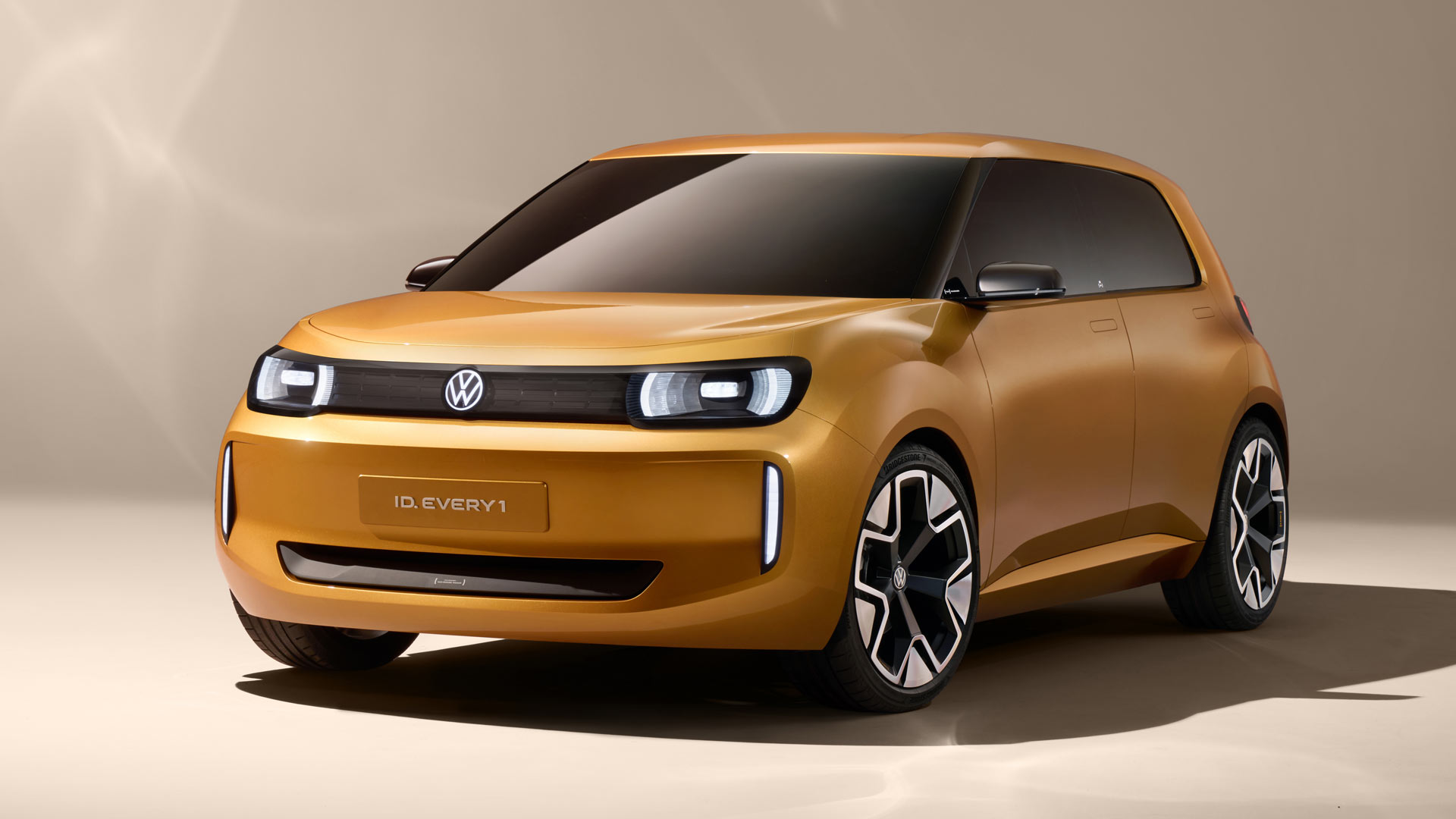
Volkswagen is aiming to democratise EV ownership, led by its new compact ID.EVERY1 electric car.
When the production vehicle arrives in 2027, Volkswagen intends for the ID.EVERY1 to cost around €20,000 (£16,500). This would make it one of the cheapest electric cars on sale.
The ID.EVERY1 will form part of Volkswagen’s ‘Electric Urban Car Family’, along with the ID.2all revealed in 2023. Both cars are keenly focused on affordability.
Thomas Schäfer, CEO of Volkswagen, said: “The ID.EVERY1 represents the last piece of the puzzle on our way to the widest model selection in the volume segment. We will then offer every customer the right car with the right drive system – including affordable all-electric entry-level mobility”.
New tech, familiar face
The ID.EVERY1 concept measures 3,880mm in length. This places it right between the now-discontinued Volkswagen Up city car and the ID.2all. It will also be the smallest model in the Electric Urban Car Family.
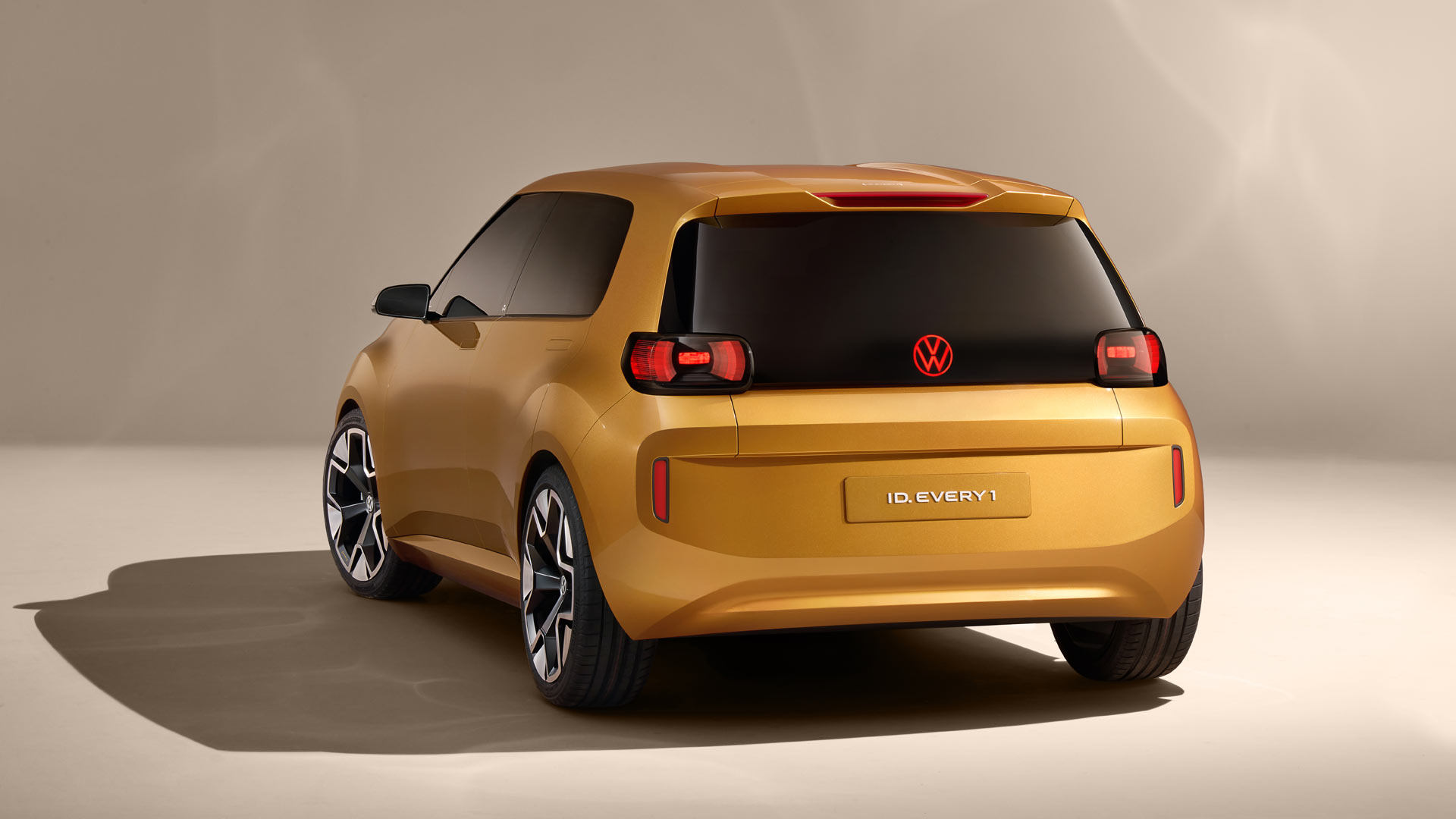
Visual links to the Volkswagen Up are evident in the ID.EVERY1’s design, such as its square shape to maximise interior space, plus the black lower surround for the rear window.
The shape of the C-Pillar is a deliberate nod to the iconic Golf, while the LED headlights and glass-covered front grille provide an instantly recognisable Volkswagen look. Illuminated VW badges are used, just in case anyone else needs an extra reminder.
Volkswagen’s head of design, Andreas Mindt, says the ID.EVERY1 “has a self-assured appearance but remains likeable – thanks to details such as the dynamic front lights and the ‘smiling’ rear. These design elements make it more than just a car: they give it character and an identity that people can relate to.”
Four new EVs on this platform
The ID.EVERY1 will make use of Volkswagen’s new modular electric drive (MEB) platform, which has a conventional front-wheel-drive layout.
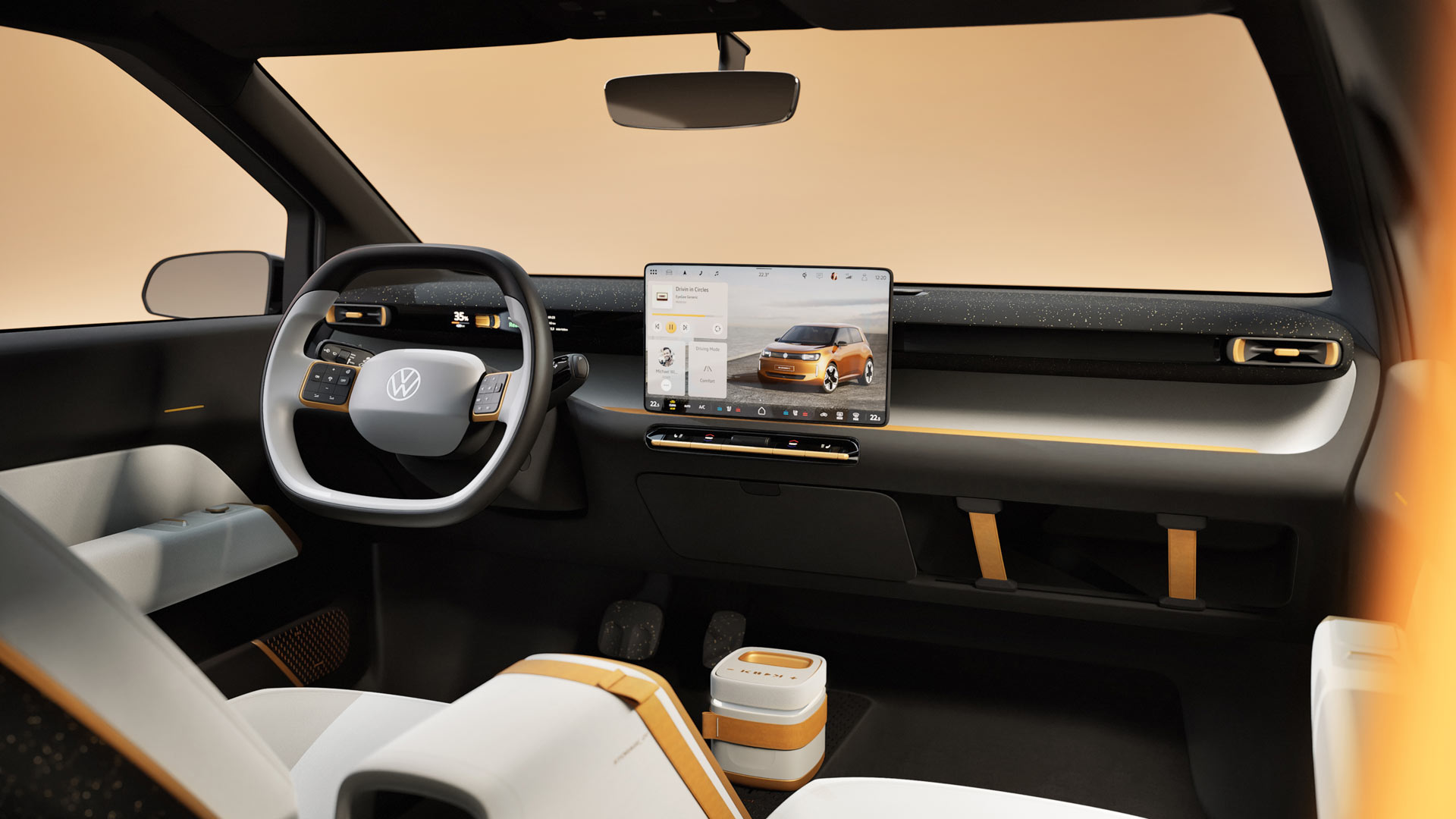
Volkswagen says this platform maximises efficiency and interior space, and will underpin four new electric models by 2027. Up to 305 litres of luggage space will be available in the ID.EVERY1. We spot proper physical buttons on the minimalist dashboard, too.
Although the ID.EVERY1 is still a concept, some details of its electric powertrain have been released. A 95hp motor will be mounted up front, allowing for a top speed of 81mph.
No details of the battery pack have been confirmed, but Volkswagen is already confident of the ID.EVERY1 being able to cover up to 155 miles when fully charged.
Aiming to be a world leader
Volkswagen is making the ID.EVERY1 part of a clear strategy to become a leader in the affordable electric car market.
The company will release nine new models during the next two years, starting with the production version of the ID.2all Polo-sized supermini EV – with a target price from €25,000 (£20,600).
“Our goal is to be the world’s technologically leading high-volume manufacturer by 2030. And as a brand for everyone – just as you would expect from Volkswagen,” said CEO Thomas Schäfer.
Elon Musk and his foray into politics are causing Tesla owners to feel embarrassed about driving their cars – and putting off new customers from buying one.
Research undertaken by car finance company Carmoola saw 2,000 UK adults surveyed about their views on Tesla and its controversial CEO, Elon Musk.
No examples of Musk’s recent statements or activities were included in the survey, meaning respondents answered solely on their existing knowledge.
Nonetheless, 70 percent of existing Tesla owners said Elon Musk’s actions made them feel ashamed about their choice of electric car.
Has Tesla lost its spark?
Along with causing concern for current Tesla owners, Musk’s behaviour is also deterring potential future customers for the American brand.
Almost three quarters (73 percent) of those surveyed agreed with the statement that ‘Elon Musk’s recent behaviour has put me off ever wanting to own a Tesla’.
Women were more likely to be dissuaded from buying a Tesla, with 89 percent turned off the idea. By comparison, more than two thirds (67 percent) of men said the same.
However, just over one quarter (27 percent) of respondents said Musk’s latest actions have made them more likely to buy a Tesla EV.
Tesla sales slide globally
The attitudes reflected in this survey appear to be translating into a real-world impact on Tesla sales, too.
Figures from the European Automobile Manufacturers’ Association (ACEA) show that registrations of new Tesla models fell by 45 percent across Europe in January 2025. The company sold 9,495 cars last month, compared to 18,161 during the same period in 2024.
The Electric Vehicle Council Australia also reported a Tesla downturn, with sales tumbling by 70 percent in February 2025 versus February 2024.
Interestingly though, Tesla sales actually rose 20 percent in the UK last month, with the Model 3 coming second and the Model Y placing third in the February 2025 new car registrations.
Aidan Rushby, founder and CEO of Carmoola, said: “It’s no secret that high-profile individuals can have an outsized influence – for good or ill – on the companies, brands or causes that they are associated with.
“Tesla certainly isn’t immune to this, and it’s been widely reported that Elon Musk’s political activism has drawn consumer backlash, resulting in falling sales across Europe.”
Rushby added: “Whether those effects are long-term is another question, but for now at least, it seems that for most UK adults, Tesla has lost its spark”.
This results in a supercar-rivalling 850hp, along with 650lb ft of torque. All of it channelled to the rear wheels…
Supercharged to the max
Hennessey’s tuning process for the Super Venom involves more than simply bolting on a supercharger, though.
Upgraded fuel injectors, a new fuel pump, a high-flow air induction kit and Hennessey’s own engine management system are part of the performance makeover – all of it nestling beneath a carbon fibre engine cover.
Whereas a standard Mustang Dark Horse can accelerate from 0-60mph in 3.7 seconds, the Super Venom slashes this to 3.2 seconds. Hennessey’s modified ‘Stang needs just 10.9 seconds to complete a quarter-mile run, 1.1 seconds quicker than the stock Ford.
New for the Super Venom is a bespoke aerodynamic kit, which features a motorsport-style carbon fibre rear wing, deep front splitter and side skirts. Carbon fibre is also used for the boot lid, active bonnet vent and new rear lip spoiler.
Available through US Ford dealers
More carbon fibre is used for the wing mirror caps, plus there are lightweight 20-inch wheels and a special exterior livery.
Prices for the Super Venom start at $149,950 (£118,000) for conversions based on a regular Mustang GT, increasing to $163,950 (£129,000) with a Mustang Dark Horse as the donor vehicle.
Company founder John Hennessey said: “Over the years we have only branded our most potent cars with our ‘Venom’ trademark: Venom Vipers, Venom GT and most recently our Venom F5. We are excited to unveil our Super Venom Mustang as it offers supercar performance and can now be ordered directly from Ford dealers with a full warranty.
“Further, we are excited to commemorate our company’s founding in 1991 by offering only 91 units and a unique ’91 Icon’ livery.”