The Scorpionissima can accelerate from 0-62mph in 5.9 seconds, while the regular 600e requires 6.2 seconds for the same sprint. Both cars have a top speed of 124mph.
No sting in the tail
Despite the strong performance available, the 600e is capable of covering up to 207 miles when fully charged.
Earlier this year, Abarth announced the 600e would receive a price cut before it even went on sale. The company slashed £2,100 from the list price of the 600e Scorpionissima, bringing it down from £41,975 to £39,875.
This saving means the Abarth 600e Scorpionissima avoids the ‘expensive car supplement’ for vehicle excise duty (VED – also known as road tax).
Those buying a new 600e Scorpionissima will therefore only pay VED of £195 a year, instead of being stung for £620 during the first five years of ownership.
Making a statement
Standard specification for the Abarth 600e includes performance upgrades such as Alcon brakes, a JKET Torsen mechanical limited-slip differential and suspension tuned by Stellantis Motorsport.
Big-bolstered Sabelt seats are found inside, along with a 10.25-inch infotainment touchscreen that offers dedicated performance pages. A two-spoke steering wheel with a flat bottom is fitted, too.
The Abarth 600e comes in a selection of bold paint colours, including Acid Green, Antidote White, Shock Orange and Venom Black.
Going for the flagship Scorpionissima means a choice between Acid Green or the exclusive Hypnotic Purple.
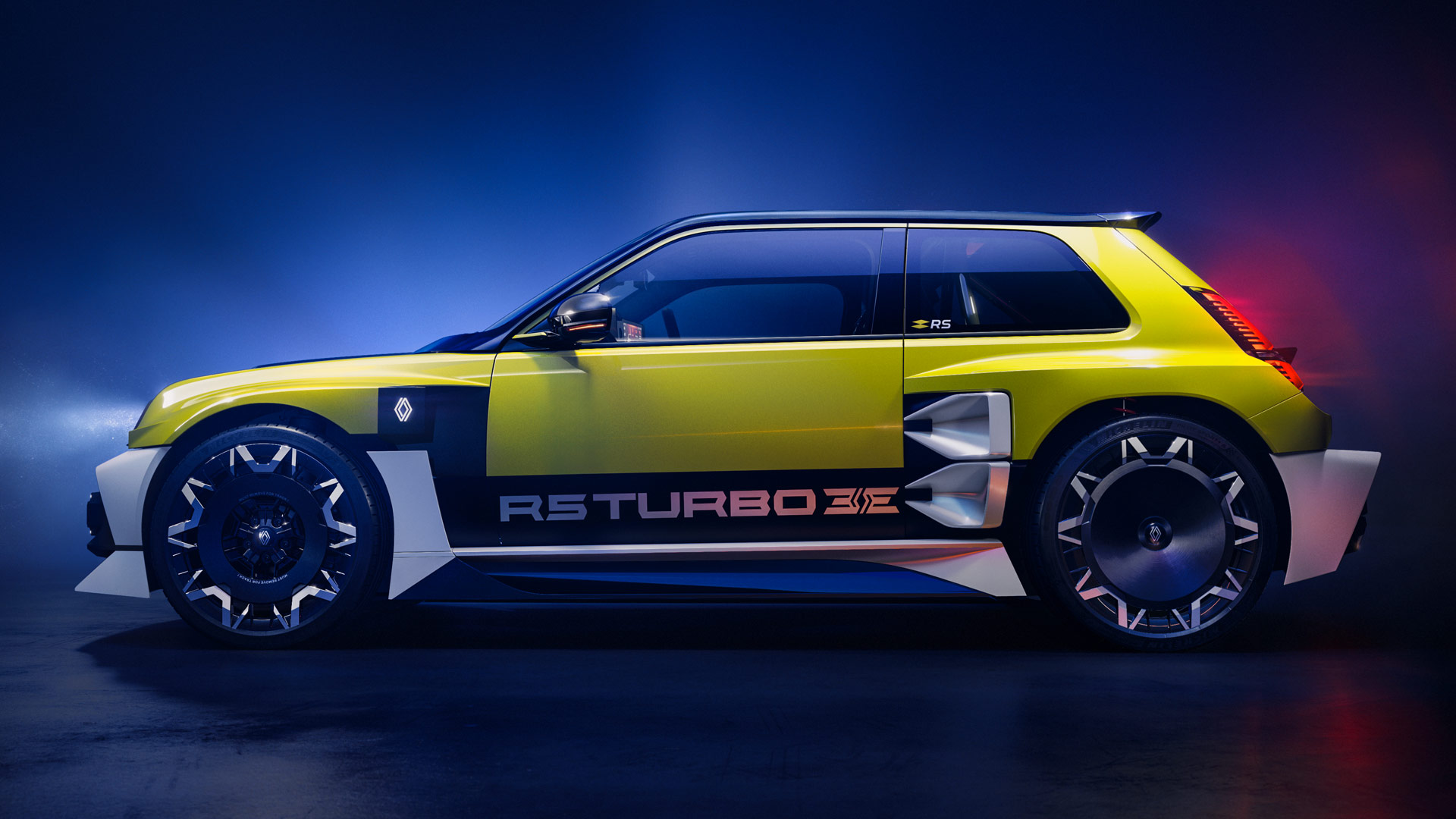
One of the most iconic hot hatchbacks of the 1980s will make a dramatic return as a ‘true electric pocket rocket’.
The Renault 5 Turbo 3E is a very deliberate homage to the original rally-bred, mid-engined 5 Turbo, but with a thoroughly modern take on performance.
Renault CEO Fabrice Cambolive explained: “By creating the new category of electric ‘mini supercars’ with the Renault 5 Turbo 3E, the Renault brand once again demonstrates the passion and spirit of boldness and innovation that has always driven it.
“With this car, Renault continues to make electric vehicles ever more desirable, further extending its ability to provide solutions for every need and every desire.”
A rapid nostalgia trip
Glance at the images of the Renault 5 Turbo 3E, and you could be forgiven for thinking this is another example of an electrified, classic-based restomod.
In fact, Renault has crafted a bespoke version of its new Renault 5 E-Tech EV, extending the wheelbase and shifting the windscreen rearwards.
Unlike the regular Renault 5, the Turbo 3E comes in three-door form, with a beefy roll cage found where you’d find the back seats in the regular hatchback.
The new platform supports a rear-wheel-drive layout, with Renault using in-wheel motors to transfer power to the road.
Drift action included
Powered by a 70kWh battery pack that should offer an official range of nearly 250 miles, the Renault 5 Turbo 3E uses lightweight materials to achieve a kerb weight of 1,450kg.
With the peak output of 540hp, the 3E should be able to accelerate from 0-62mph in just 3.5 seconds, and reach a top speed in excess of 165mph. A steering wheel-mounted button allows for an extra overtaking power boost.
Alpine engineers have been involved in tuning the suspension, and there are a variety of driving modes – Snow, Regular, Sport and Race – offered for a good measure. A ‘drift-assist’ feature and the prominent, rally-style vertical handbrake suggest Renault wants the Turbo 3E to go sideways on demand.
An 800-volt electric architecture means the 5 Turbo 3E can recharge from 15 to 80 percent in just 15 minutes when connected to a 350kW public charger.
Retro-futuristic inside and out
The interior of the Renault 5 Turbo 3E is no less dramatic than its exterior, thanks to the pair of bucket seats clad in Alcantara, plus the use of carbon fibre for key components.
A 10.1-inch digital instrument panel deliberately harks back to the square dials of the Renault 5 Turbo from the 1980s, while a second touchscreen operates the modern infotainment system.
Customers will be able to tailor the cabin to their own personal taste, with different finishes available for the seats, dashboard, door panels and centre console.
Along with classic exterior colours such as Rouge Grenade, as seen on the original Renault 5 Turbo, buyers have the chance to design a bespoke livery.
Get ready to place your order
Despite looking like a flight-of-fancy concept car, Renault is completely serious that the Turbo 3E will become a reality.
Production will be capped at just 1,980 examples, a number deliberately chosen to honour the year in which the original Renault 5 Turbo was launched.
Although Renault has made no mention of pricing, it notes that the ‘dealers who reserve the car will participate in its pre-financing’, suggesting that deposits being placed will ensure the Turbo 3E gets made.
Each of the 1,980 cars will be individually numbered, and customers can reserve a specific number when order books open in the coming weeks.
Renault has revealed the first special edition of its new electric supermini. The Renault 5 E-Tech only went on sale earlier this year, but the French brand has wasted no time in creating a commemorative model.
Named after the famous venue for the French Open tennis championship, the 5 E-Tech Roland-Garros was first revealed as a concept car back in 2023.
You could be forgiven for associating another French brand, Peugeot, with the Roland-Garros tennis championship.
Peugeot was previously an official sponsor for the event, and created a host of special editions themed around it. This partnership ended in 2022, when Renault became a new ‘premium partner’ for the French Open.
Marking the tennis-inspired Renault 5 E-Tech out from other models is the Cross of Saint Andrew on the base of the front doors, which incorporates the Roland-Garros logo.
Buyers can choose from Arctic White, Midnight Blue or Diamond Black paint colours, plus the exclusive matte shade of Shadow Grey – none of which seem particularly reminiscent of tennis…
A satin chrome roof line and a set of bespoke 18-inch diamond-cut alloy wheels are also included.
Aiming to be a smash
Things take a more obvious Roland-Garros turn on the inside. Details include a gear lever inspired by the grip of a tennis racket, and a clay-coloured wireless smartphone charger in the centre console.
More clay-coloured detailing (in honour of the clay courts at Roland-Garros) can be found on the carpet mats, while the satin metal-trimmed dashboard features a backlit Roland-Garros graphic.
Based on the Comfort version of the Renault 5 E-Tech, the Roland-Garros is equipped with a 52kWh battery and 150hp electric motor. Fully charged, it offers a range of up to 252 miles.
Available to order now for Renault R Pass customers, prices for the 5 E-Tech Roland-Garros start from £29,995.
The number of automatic cars on UK roads has risen by 118 percent in a decade – and autos now make up almost one in three cars in use.
The statistic is a stark contrast to a little over a decade ago. Back in 2014, automatics comprised only 16.3 percent of the cars on Britain’s roads.
This means the number of automatics has increased from 7.1 million to more than 15.5 million in just a decade.
The number of manual cars has only increased by 2.4 percent, from 36.6 million to 37.5 million.
Automotive data specialist CAP HPI says the volume of automatics has increased ‘exponentially’ every year since 2014 – while manual numbers have fallen for the past five years.
Last year, more than 1.5 million new automatic cars were registered, a near-tripling of 2014’s 538,000 cars.
Manual cars, meanwhile, have plummeted during the last decade, from 708,000 in 2014 to a mere 274,000 last year.
Brands that are among the automatic leaders include Kia, which accounts for 5.1 percent of all automatic registrations, Land Rover with 4.0 percent and MG with 3.9 percent.
Automatic appeal
“Changing driving habits, especially in congested urban areas, have made automatics more appealing to drivers,” said CAP HPI senior data director Stacey Warn.
“Advances in technology over the past decade have also greatly improved automatic transmissions’ efficiency and responsiveness.
“The rise in popularity of EVs, which are always automatic, has significantly contributed to the increasing shift towards automatics over manual.”
Car makers have responded by reducing manual gearbox line-ups – with some big brands eliminating them entirely.
What’s more, growing numbers of new drivers are opting for automatic-only driving licences. In 2022, there were 550,000 drivers with auto-only licenses; by 2022, this had more than doubled to over 1.1 million.
“Estimates suggest that by next year, a quarter of learners will qualify with a license limited to automatic cars only,” added Warn.
British sports car manufacturer Longbow has unveiled what it describes as the world’s first ‘Featherweight Electric Vehicle’ (FEV).
Created by a team with experience of developing EVs, including at Tesla, Lucid and BYD, the Longbow will be built entirely in the UK.
With a company motto of ‘Celeritas Levitas’ – translated as ‘the speed of lightness’, the aims of Longbow are clear.
The company’s plan is to channel the spirit of British icons such as the Jaguar E-Type and Lotus Elise, putting driving enjoyment at the heart of the Longbow experience.
Light car, heavyweight performance
The Longbow team is targeting a kerb weight of less than 1,000kg for both the Speedster and Roadster models: exceptionally light for an EV.
A bespoke aluminium chassis underpins the Longbow, with the fully open Speedster version planned to enter production first. This windscreen-free model will weigh just 895kg, putting it on a par with a third-generation Lotus Elise.
Longbow has not confirmed battery capacities or electric motor specifications so far, but it makes some bold claims for the Speedster’s performance.
Accelerating from 0-62mph should take just 3.5 seconds, with the potential to cover an official, WLTP-certified range of 275 miles.
The closed-cockpit Roadster will follow later, with its extra bodywork increasing kerb weight to 995kg – and adding 0.1 seconds to the 0-62mph time.
Shooting from the hip
Prices for the Longbow Speedster will start at £84,995, with production set to be capped at 150 examples.
Those wanting more exclusivity can opt for one of 25 Autograph Edition models, or claim one of the 10 Longbow Luminary 1st Editions.
Owning the less extreme Longbow Roadster will be considerably more affordable, with prices starting from £64,995.
Reservations for both the Longbow Speedster and Roadster are open now, with the first cars expected for delivery to customers in 2026. Sooner than the long-promised new Tesla Roadster, that’s for sure…
Bentley has revealed its latest one-off customer commission for the coachbuilt Batur coupe.
Only 18 examples of the ultra-exclusive Batur will be produced, and ‘The Black Rose’ is one of three cars in right-hand drive.
Each Batur is personalised to its buyer’s chosen specification by the Bentley Mulliner Bespoke Studio. However, this particular car takes individual customisation a stage further.
Along with Satin Rose Gold exterior detailing, the Batur’s cabin features an industry-first demonstration of 3D printing with 18-carat rose gold.
Black and gold
On the outside, a unique ‘Black Rose’ colour scheme uses Beluga Black metallic paint for the majority of the car’s body.
Vast amounts of Satin Rose Gold feature on the dramatic front grille, door mirror caps, lower sections of the body kit and 22-inch alloy wheels.
The so-called ‘endless bonnet line’ is also finished in Satin Rose Gold, as are the lower air intakes and rear diffuser.
The Black Rose’s crowning glory, though, is Bentley’s gold Additive Manufacturing 3D printing technique. This sees 210 grams of hallmarked 18-carat rose gold added to the car’s interior.
All that glitters is gold
A collaboration with goldsmiths Cooksongold, based in Birmingham’s Jewellery Quarter, the rose gold is used for the drive mode selector dial, organ stop air vent controls and a special insert on the steering wheel.
The remainder of the Batur’s cabin is trimmed in Beluga black leather and charcoal grey tweed fabric. Its dashboard veneers are painted in Black Rose metallic paint to match the exterior paintwork.
Mechanically, the Black Rose is the same as the other Batur coupes. That means a 740hp 6.0-litre twin-turbo W12 engine, which is amplified by a titanium exhaust system.
Bentley has not revealed a price for The Black Rose commission, but the starting figure for a Batur is £2 million. The ‘standard’ solid gold interior trim also adds at least £20,000.
Government policy on electric cars is not encouraging British drivers to buy them, says new research undertaken by the AA.
The breakdown company surveyed more than 14,000 UK motorists to discover their views on EVs, and their thoughts about buying one.
More than one in five (22 percent) of respondents said they totally reject the idea of owning an electric car, and will never buy one.
A similar proportion (20 percent) claimed to be neutral on EV ownership, and would likely stick with a petrol or diesel car for as long as possible.
Turning doubters into adopters
Notably, the majority (52 percent) of those surveyed by the AA said they were likely to buy an electric car in the near-future. An additional seven percent already own or drive an EV.
The AA says such responses show that ‘more needs to be done’ to help increase the rate of EV adoption in the UK.
Relying on supply-side interventions, such as the zero emission vehicle (ZEV) mandate, to reduce the level of non-EV choice in the market will not be sufficient, in the AA’s view.
Time for an EV intervention?
Instead, the motoring organisation says direct government intervention is needed to make drivers better informed about EVs, while also incentivising them to switch to electric.
Suggested government action should include awareness campaigns, says the AA, citing a survey finding that 73 percent of respondents have no experience of electric cars at all.
The AA also believes the government should intervene to reduce the cost of electric cars, such as via loans or tax breaks for buying them. Cutting the 20 percent VAT on public EV charging to five percent is also suggested.
Other key AA suggestions include battery health passports for used electric cars (to improve trust in the second-hand EV market), plus allowing plug-in hybrids to be sold until 2035.
Standardising signage for public chargers is another important recommendation, with the AA having previously campaigned about the need to make this clearer.
‘More needs to be done’
Jakob Pfaudler, CEO of the AA, said: “From opening the first filling station and erecting the first road signs, the AA has always led on motoring innovation.
“Our message to government is that more needs to be done to make EVs accessible for everyone. Generally, drivers are hesitant, but most are not hostile to the change. The AA is in a unique position to help, as we deal with drivers throughout the driving life-cycle from learning to drive, buying, insuring and repairing their cars.
“Our research shows many people are confused by the transition, which is not surprising as the main catalyst for change, the ZEV mandate, only governs supply but does little to encourage demand for EVs.
“The ambitious goal of the Climate Change Committee that 80 percent of cars and 74 percent of vans should be electric by 2040 shows how much needs to be done to get there.”
New research finds that worries about the public charging network are preventing British business from opting for electric vehicles.
A survey of 2,000 UK fleet operators was undertaken by Vauxhall, with the results published in its new ‘Electric Van Adoption Report’.
Of those questioned, a substantial 90 percent said they plan for their fleets to be fully electric by 2035.
However, nearly a quarter (23 percent) admitted the lack of dependable on-street charging has delayed them from adding EVs to their fleets.
On-street charging a concern
In the UK, 40 percent of households do not have access to off-street parking, meaning they will be entirely reliant on public EV charging.
Among fleet operators, some 90 percent said their drivers would need to make use of residential charging if they switched to electric vans.
This figure highlights the growing trend of van drivers and other fleet users taking their vehicles home, rather than leaving them at a workplace.
Notably, 81 percent of businesses said it wouldn’t be practical for them to install dedicated electric charging facilities at their operating bases.
Fleets see electric benefits
Despite the concerns about charging, 83 percent of fleets that currently use electric vans say they ‘bring positive benefits’ to their business.
An overwhelming 91 percent of businesses also said an all-electric fleet would have a beneficial impact on customer perceptions.
Vauxhall is encouraging businesses and drivers who want to switch to electric vehicles, but lack off-street parking, to register on its Electric Streets of Britain website. This aims to let local authorities, and charging providers, know where demand for on-street charging is greatest.
For those able to charge at home, Vauxhall offers a free Octopus Ohme Pro wallbox, including installation. The incentive is available to small-to-medium-sized enterprise (SME) customers who buy an electric van.
Morgan has affixed a ‘Supersport’ badge to go-faster versions of its existing cars since 1927. However, after 98 years, the Supersport has become a model in its own right, replacing the Plus Six at the top of the Morgan range.
With bold design, new technology and even somewhere to put your shopping, Morgan hopes the Supersport will appeal to a new breed of customers. “The idea is to broaden our portfolio,” says managing director Matthew Hole. It might even conquer a few sales from the Porsche 911, reckons chief designer Jonathan Wells. Fighting talk from a company that hand-builds around 800 cars a year…
My rendez-vous with the Supersport took place at Morgan Works London, the charming, boutique-style dealership tucked away on a cobbled mews in Kensington. There, I was given a secret preview of the new flagship, plus insight into what comes next for one of Britain’s oldest car companies.
‘Future-focused design’
From its fulsome front wings to its flat, triple-wipered windscreen, the Supersport could only be a Morgan. But look closer and many of its details are unapologetically modern. Jonathan Wells talks about “clashing” between the flowing bodywork and “technical and precise” details, such as the visible satin grey-painted sills or the rear diffuser.
In profile, the Supersport’s purposeful stance and elegantly tapering tail evoke the Morgan Midsummer, last year’s coachbuilt, limited-run project with Pininfarina. As MD Matthew Hole points out, though, the relationship is the other way around: “This car was in development first, so it actually informed the Midsummer’s styling.”
Combining what Wells calls “classic character and future-focused design,” the Supersport is arguably cut from a similar cloth to the new Ferrari 12Cilindri. Both resemble the future as imagined from the past; the Ferrari a radical wedge of supercar from the 1970s, the Morgan a jet-age roadster concept from the 1950s.
Styling the Supersport
Wide-eyed round headlights, a ‘horseshoe’ grille and a centrally-hinged bonnet give the Supersport a familiar Morgan face, but the bonnet’s traditional, hand-pressed cooling louvres are replaced by a 911 GT3-style central vent with a dark matte finish, along with subtle apertures in front of the doors.
At the rear, LED lamps are concealed within a full-width black panel alongside a contemporary take on traditional bumper over-riders, while twin tailpipes jut from the centre of the diffuser. There’s also a ‘Morgan’ script on the tail for the first time – “to help people identify the car on the road,” says Wells. The new font is called ‘HFS’ (after company founder Henry Frederick Stanley Morgan) and inspired by the first Morgan ‘wings’ logo from 1909.
The Supersport rides on 18-inch flow-formed ‘Superlite’ alloys as standard, but you’ll definitely want the optional 19-inch forged ‘Aerolite’ rims seen here. Weighing in at 9.7kg per corner, each wheel is more than 4kg lighter than those fitted to the Plus Six. Either way, they come wrapped in Michelin Pilot Sport 5 rubber, which provides a good balance of cornering grip and wet-weather performance.
Priced from £102,000
In a process that Wells calls “21st century coachbuilding”, the Supersport’s aluminium body is hand-formed over an ash wood frame. Its new ‘CXV’ platform is an evolution of the ‘CX’ architecture that underpinned the Plus Six, but now 10 percent stiffer and made from 60 percent recycled aluminium.
Customers can spec their Supersport with a manually folding mohair soft-top roof for £102,000, or a carbon composite hard-top for £105,000. Or they can have both for £107,000. The removable hard-top is painted in body colour and has a huge curved rear screen that bathes the cabin in light. Its shape also gives the car a flowing, fastback silhouette akin to the much-loved Morgan Aeromax.
The Supersport still has detachable side screens, but their design is much improved, with more precise fitment and tighter seals to keep out the wind and rain. Even the door hinges are much-modernised. “They feel less like a garden gate and more like a Golf,” quips Wells.
Optional Nitron handling pack
One thing that hasn’t changed is the Supersport’s engine. Its 3.0-litre BMW ‘B58’ inline six is carried over from the Plus Six, and drives the rear wheels via an eight-speed ZF automatic gearbox (unlike the smaller Plus Four, there is no manual option). It marks Morgan’s 25th year of using BMW engines – a relationship that began with the Aero 8 in 2000.
Morgan hasn’t quoted any performance figures for the Supersport yet, but having 340hp and 369lb ft of torque in a package that Wells says weighs “1,170kg with a full tank of fuel” means it won’t hang about. For reference, the Plus Six could hit 62mph in 4.2 seconds.
Notably, the new car will be available with the Dynamic Handling Pack that totally transformed how the Plus Four drives. Here, it features compression and rebound adjustable Nitron dampers tuned specifically for the Supersport, plus a mechanical limited-slip differential. “We aren’t trying to make a direct rival for the Porsche 911,” says Wells, “but we do want to offer a credible alternative.”
Craftsmanship with modern tech
Part of that credibility also means offering up-to-date technology. So the Supersport is the first Morgan to offer hands-free Bluetooth connectivity, using three microphones hidden in the centre console. Active noise cancellation means you can have a “clear conversation at 70mph with the roof down”, promises Wells.
There’s also a wireless phone charging tray and a high-spec Sennheiser audio system, complete with decorative speaker grilles and actuators in each seat to “enhance the bass sensation”. The analogue dashboard dials use the same crisp ‘HFS’ font as the boot badge.
Speaking of the boot, this is the first Morgan to feature one in more than a decade. It can be opened remotely using the key fob and is large enough to carry the two side screens – or enough luggage for a week away. As a cool finishing touch, the car’s ash wood frame is revealed when you look inside. “We wanted to create a Morgan that can be used 365 days a year,” adds Wells. That sounds like our kind of challenge…
What’s next for Morgan?
Disappointingly, the new Supersport won’t be sold in the US. “Under the replica car rule, we can only sell 325 cars over in the States each year,” explains Matthew Hole. “And the Plus Four should fill that order bank. The [three-wheeled] Super 3 is homologated as a motorcycle, so that is treated differently.”
As for next steps, Hole says: “The investment needed for plug-in hybrids means they are totally off the table for us, so EVs are the only option. And that effectively means we’re being forced to go electric five years before everybody else” [in 2030, rather than 2035].
However, while Morgan is “committed to going electric eventually”, Hole is confident that an exception suited to Britain’s many small-volume car manufacturers can be achieved. “The government is listening and open to dialogue. It’s a complex issue, but I’m sure we’ll reach a solution.”
In the meantime, it seems only right to appreciate characterful cars like the new Morgan while we can. Come back to Motoring Research for our review soon – we’re hoping to drive the Supersport next month.
Police forces across the UK can now order the revised Skoda Octavia vRS. Following updates made last year, the vRS is the most powerful example of the Czech brand’s hot hatchback and estate.
The fourth-generation Octavia vRS serves up 265hp and 273lb ft of torque from its 2.0-litre turbocharged four-cylinder petrol engine.
With an increase of 20hp over the previous version, the Skoda now matches the Volkswagen Golf GTI for power output.
Back on the beat
Skoda believes this boost in performance makes the Octavia even better suited to life on the beat, with the police-specification vRS now available to order in both hatchback and estate body styles.
All versions of the vRS come with a seven-speed DSG dual-clutch transmission, along with a ‘VAQ’ electrohydraulic differential. The hatchback can accelerate from 0-62mph in 6.4 seconds, while the estate version requires an extra 0.1 seconds.
In standard production form, the Octavia vRS can reach a top speed limited to 155mph, which should be sufficient for even the most extreme emergencies.
Sports suspension lowered by 15mm is fitted, with the option of Dynamic Chassis Control for police fleets that want a greater variety of handling options.
Ready for police duty
We imagine emergency services fleets will be less concerned about the revised styling on the Octavia vRS, which includes new front and rear bumpers, along with 19-inch ‘Elias’ alloy wheels.
Second-generation LED Matrix headlights with ‘Crystallinium’ elements and 36 individual matrix segments will likely be more important than a revised 13.0-inch infotainment screen, too.
Skoda UK can supply examples of the Octavia vRS fully converted for emergency use, including for the police, fire and ambulance services.
The Octavia vRS Estate, with its 640-litre boot capacity, has already passed MET brake safety tests, and is also approved for police fleets.