Research by Skoda has found that dogs feel happier when travelling in electric cars. Under the supervision of This Morning’s resident vet, Dr Scott Miller, Skoda took to the former Top Gear test track in Surrey with three different vehicle types.
Skoda SUVs powered by petrol, diesel and electricity were used for the experiment – including the new Elroq EV (pictured above).
The heart rate of a one-year-old cocker spaniel, Mango, was taken after being driven on the track. The dog’s behaviour was also monitored during the ride.
A canine test pilot
Driven around the test track at speeds of up to 70mph, Mango’s heart rate was lowest while travelling in the Skoda Elroq.
The canine test pilot’s resting heart rate increased from 80 beats per minute (bpm) up to 100 bpm while being chauffeured in the electric Elroq. Such was his level of relaxation, Mango was observed to be lying down and almost falling asleep.
In the petrol-powered Skoda SUV, Mango’s heart rate peaked at 120 bpm, while in the diesel SUV it reached 125 bpm. Mango was noted to be more distracted and less settled, too.
Dr Scott Miller said: “The experiment clearly shows the health and psychological benefits of travelling in an EV for dogs. Observing Mango’s reactions while travelling at the same speed on the same track, but in different vehicles, made it clear the EV provided a smoother and more calming experience.
“The quiet mechanics, absence of gear changes, and the spacious interiors of electric cars create a soothing environment for dogs, ensuring a more relaxed and happy travel experience for our furry companions.”
The sound of silence
Animal behaviour expert Anna Webb, who previously helped Skoda create a ‘Happy Hounds’ playlist, explained more about why electric cars could be soothing for dogs.
“As dogs’ hearing is four times more acute than ours, they pick up on sound frequencies of the traditional engine noises that are inaudible to people,” said Webb.
“Similarly, the vibrations of the petrol and diesel cars can cause ‘motion sickness’, raising Mango’s heart rate by feeling nauseous.” Skoda’s canine research comes as the Crufts dog show gets underway, with the Czech brand a leading sponsor of the event.
The new Kia EV3 has been named UK Car of the Year 2025. Despite a field of strong contenders, the electric crossover managed to win the contest ‘by a clear margin’.
Already a winner before the final, the EV3 was voted the best Small Crossover by a panel of 31 automotive journalists, including Motoring Research’s own Tim Pitt.
It marks the second year in a row that a Kia has been victorious in the UK Car of the Year Awards (UKCOTY). The larger Kia EV9 SUV took the top prize in 2024.
Back-to-back wins for Kia
“Securing back-to-back successes in this competition has only been achieved once before, which shows the outstanding attributes and appeal of the Kia EV3,” said John Challen, co-chairman of the UK Car of the Year Awards.
“Kia has successfully grown its EV portfolio and the specification, driving range, and distinctive styling are all EV3 elements that impressed our panel of experts.”
Offered with a choice of 58.3kWh or 81.4kWh battery options, the EV3 comes with 400-volt battery technology, which allows recharging from 10 to 80 percent in just 30 minutes.
With prices starting from £32,995, Kia has designed the EV3 to make switching to an electric car a simple and relatively affordable process.
Futuristic looks and intuitive tech
UKCOTY judge Alex Grant explained: “The EV3 takes all of the best bits of the EV9 and distils them into a product targeting one of the UK’s biggest-volume segments.
“It’s futuristic to look at but intuitive to use, rides and handles UK roads brilliantly and offers a usefully long range of almost 400 miles. A very easy way for families to go electric.”
The Kia EV3 could yet bring more silverware to the South Korean marque’s trophy cabinet, as it remains in contention for the 2025 World Car of the Year prize.
Earlier this year, the EV3 also claimed a strong runner-up position in the 2025 European Car of the Year Awards.
Electric cars leading the way
Notably, Kia’s win marks the fourth year in succession that an electric car has claimed the top prize in the UKCOTY Awards.
Electrification featured prominently amongst the finalists for the 2025 UKCOTY prize, all of which are winners in their own respective categories:
The new Dacia Bigster SUV is now available to order in the UK, including via a range of affordable PCP finance deals.
The largest vehicle to date from the Renault-owned budget brand could be yours from just £141 per month.
Dacia announced list prices for the C-segment Bigster earlier this year, and it reports considerable interest from UK customers already.
More than 500 people have placed a £250 deposit for a Bigster, with the first completed cars set to be delivered this spring.
High riding, low prices
Dacia’s eye-catching £141 per month finance deal applies to a Bigster in entry-level Expression trim. Here, power comes from a 1.2-litre three-cylinder turbocharged TCe 140 petrol engine with mild-hybrid tech.
Unlocking the £141 per month deal requires a substantial deposit of £6,249, for a finance agreement with a 4.9 percent APR.
The deal is based upon a 24-month agreement, with customers limited to 6,000 miles per year in the family SUV.
Expression trim offers a generous level of standard equipment, such as 17-inch alloy wheels, keyless entry, front and rear parking sensors and a multi-view camera, plus a 10.1-inch central touchscreen with wireless Apple CarPlay and Android Auto phone connectivity.
Available to order now
Placing a smaller £360 deposit, and choosing a 48-month deal at 7.9 percent APR, will see monthly payments of £360 for the Bigster Expression TCe 140. Mileage in this example is also restricted to 6,000 miles per year.
Alternatively, opting for the more powerful hybrid 1.6-litre hybrid Bigster in Expression trim will require a customer deposit of £4,604. Spread across a 48-month payment period, with annual mileage capped at 6,000 miles, this version will cost £299 per month.
For those still undecided about the Bigster, Dacia demonstrators are due at dealerships in April. And Motoring Research’s Tim Pitt will be getting behind the wheel very soon.
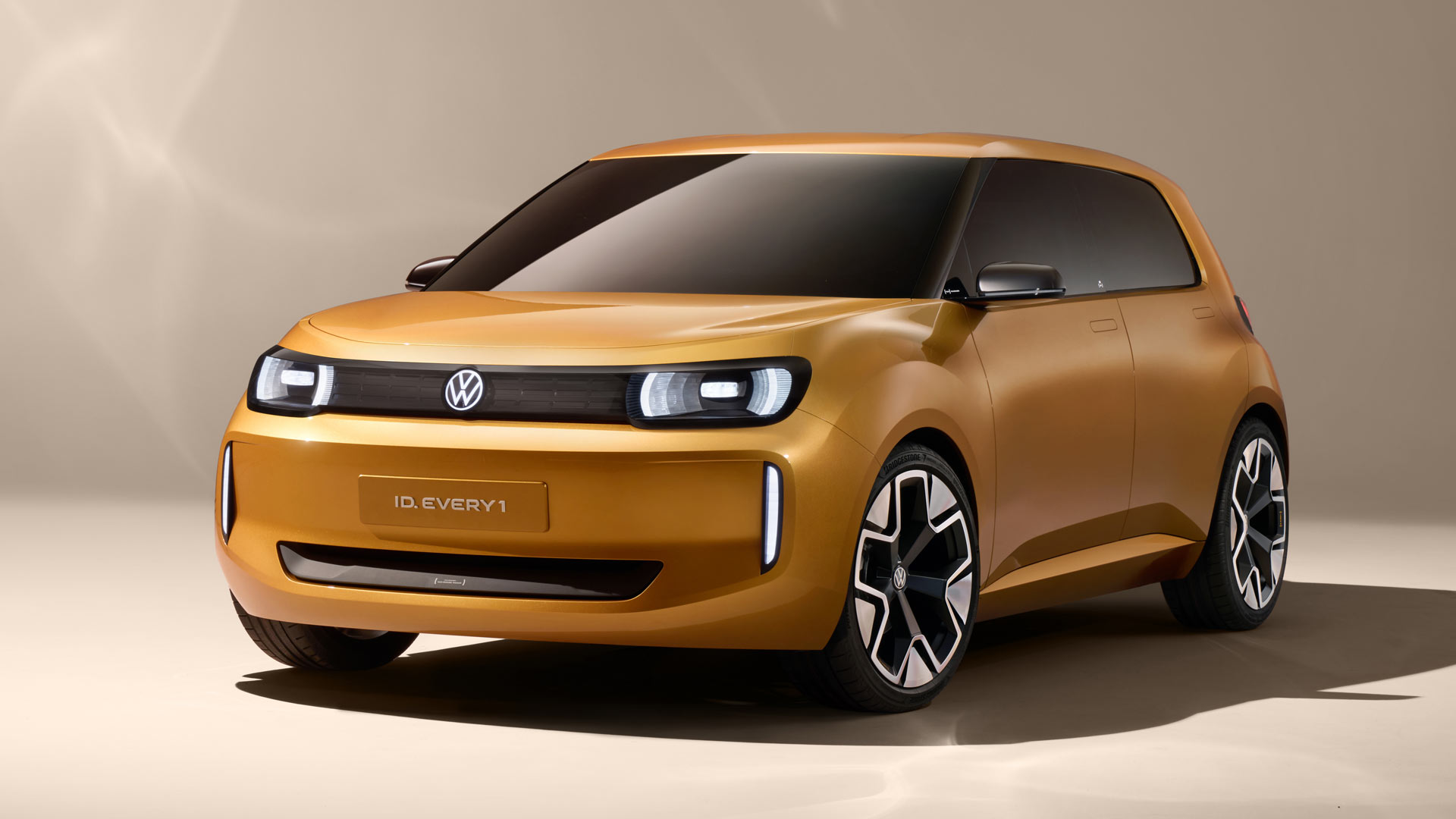
Volkswagen is aiming to democratise EV ownership, led by its new compact ID.EVERY1 electric car.
When the production vehicle arrives in 2027, Volkswagen intends for the ID.EVERY1 to cost around €20,000 (£16,500). This would make it one of the cheapest electric cars on sale.
The ID.EVERY1 will form part of Volkswagen’s ‘Electric Urban Car Family’, along with the ID.2all revealed in 2023. Both cars are keenly focused on affordability.
Thomas Schäfer, CEO of Volkswagen, said: “The ID.EVERY1 represents the last piece of the puzzle on our way to the widest model selection in the volume segment. We will then offer every customer the right car with the right drive system – including affordable all-electric entry-level mobility”.
New tech, familiar face
The ID.EVERY1 concept measures 3,880mm in length. This places it right between the now-discontinued Volkswagen Up city car and the ID.2all. It will also be the smallest model in the Electric Urban Car Family.
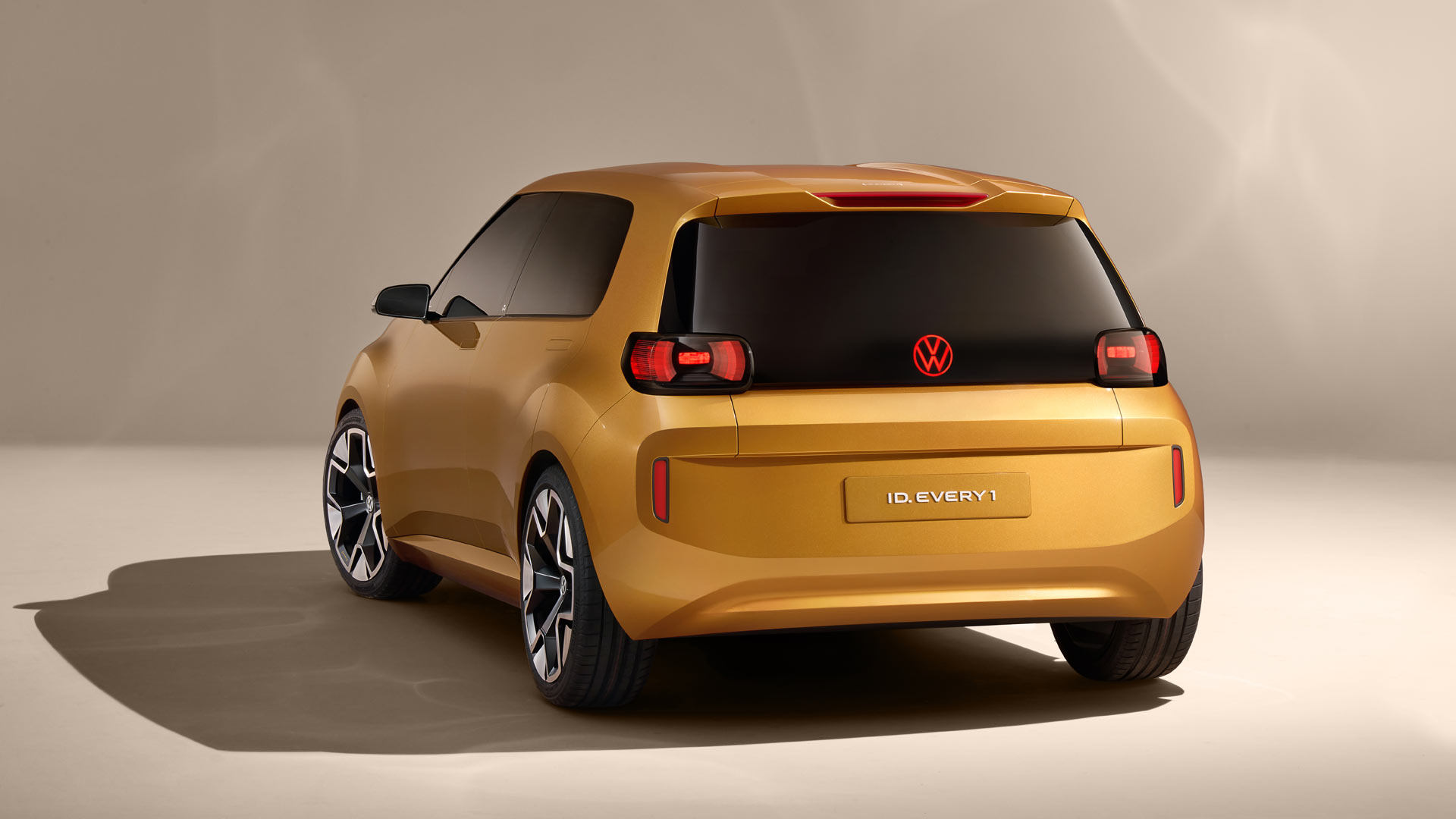
Visual links to the Volkswagen Up are evident in the ID.EVERY1’s design, such as its square shape to maximise interior space, plus the black lower surround for the rear window.
The shape of the C-Pillar is a deliberate nod to the iconic Golf, while the LED headlights and glass-covered front grille provide an instantly recognisable Volkswagen look. Illuminated VW badges are used, just in case anyone else needs an extra reminder.
Volkswagen’s head of design, Andreas Mindt, says the ID.EVERY1 “has a self-assured appearance but remains likeable – thanks to details such as the dynamic front lights and the ‘smiling’ rear. These design elements make it more than just a car: they give it character and an identity that people can relate to.”
Four new EVs on this platform
The ID.EVERY1 will make use of Volkswagen’s new modular electric drive (MEB) platform, which has a conventional front-wheel-drive layout.
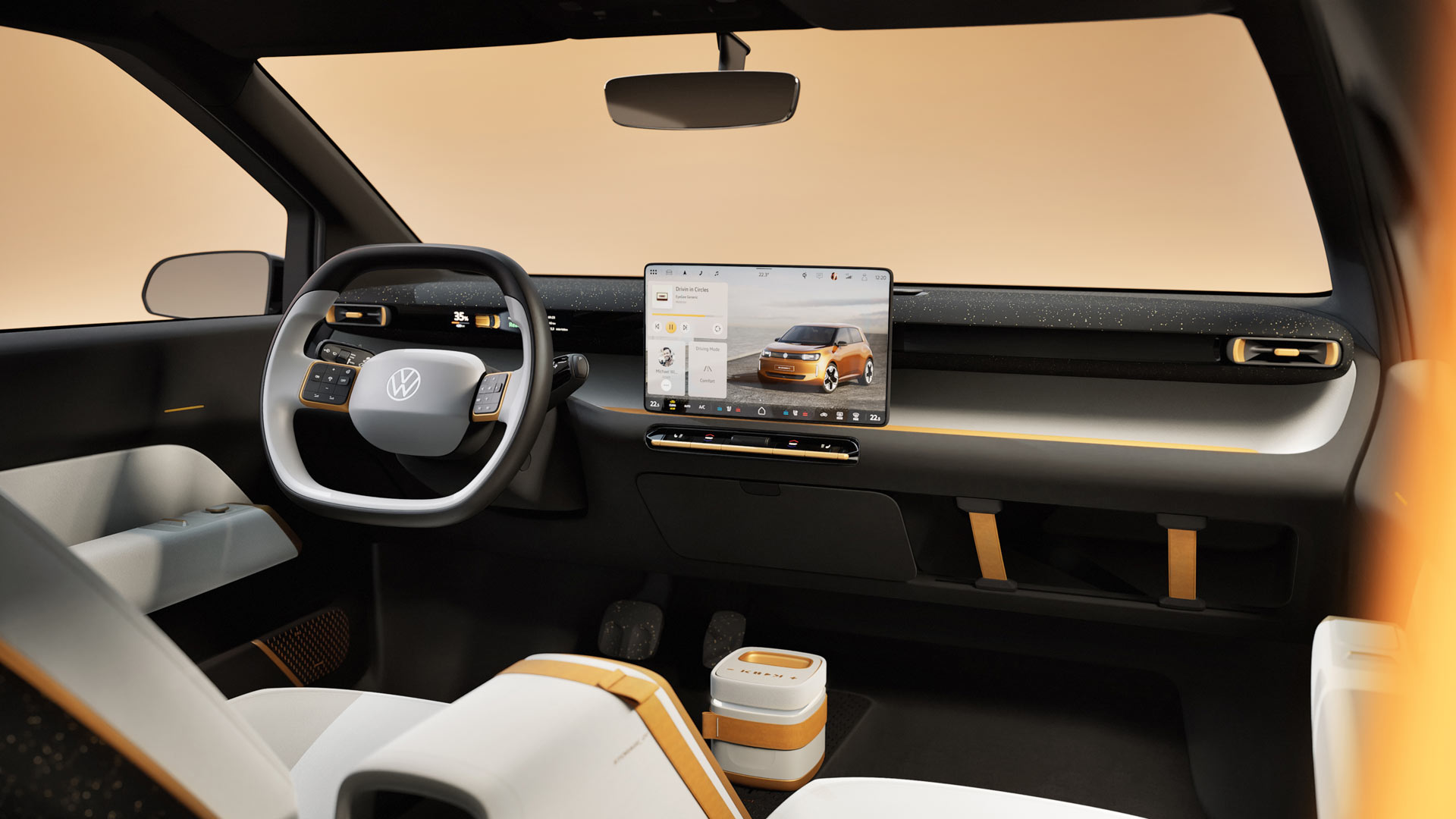
Volkswagen says this platform maximises efficiency and interior space, and will underpin four new electric models by 2027. Up to 305 litres of luggage space will be available in the ID.EVERY1. We spot proper physical buttons on the minimalist dashboard, too.
Although the ID.EVERY1 is still a concept, some details of its electric powertrain have been released. A 95hp motor will be mounted up front, allowing for a top speed of 81mph.
No details of the battery pack have been confirmed, but Volkswagen is already confident of the ID.EVERY1 being able to cover up to 155 miles when fully charged.
Aiming to be a world leader
Volkswagen is making the ID.EVERY1 part of a clear strategy to become a leader in the affordable electric car market.
The company will release nine new models during the next two years, starting with the production version of the ID.2all Polo-sized supermini EV – with a target price from €25,000 (£20,600).
“Our goal is to be the world’s technologically leading high-volume manufacturer by 2030. And as a brand for everyone – just as you would expect from Volkswagen,” said CEO Thomas Schäfer.
Elon Musk and his foray into politics are causing Tesla owners to feel embarrassed about driving their cars – and putting off new customers from buying one.
Research undertaken by car finance company Carmoola saw 2,000 UK adults surveyed about their views on Tesla and its controversial CEO, Elon Musk.
No examples of Musk’s recent statements or activities were included in the survey, meaning respondents answered solely on their existing knowledge.
Nonetheless, 70 percent of existing Tesla owners said Elon Musk’s actions made them feel ashamed about their choice of electric car.
Has Tesla lost its spark?
Along with causing concern for current Tesla owners, Musk’s behaviour is also deterring potential future customers for the American brand.
Almost three quarters (73 percent) of those surveyed agreed with the statement that ‘Elon Musk’s recent behaviour has put me off ever wanting to own a Tesla’.
Women were more likely to be dissuaded from buying a Tesla, with 89 percent turned off the idea. By comparison, more than two thirds (67 percent) of men said the same.
However, just over one quarter (27 percent) of respondents said Musk’s latest actions have made them more likely to buy a Tesla EV.
Tesla sales slide globally
The attitudes reflected in this survey appear to be translating into a real-world impact on Tesla sales, too.
Figures from the European Automobile Manufacturers’ Association (ACEA) show that registrations of new Tesla models fell by 45 percent across Europe in January 2025. The company sold 9,495 cars last month, compared to 18,161 during the same period in 2024.
The Electric Vehicle Council Australia also reported a Tesla downturn, with sales tumbling by 70 percent in February 2025 versus February 2024.
Interestingly though, Tesla sales actually rose 20 percent in the UK last month, with the Model 3 coming second and the Model Y placing third in the February 2025 new car registrations.
Aidan Rushby, founder and CEO of Carmoola, said: “It’s no secret that high-profile individuals can have an outsized influence – for good or ill – on the companies, brands or causes that they are associated with.
“Tesla certainly isn’t immune to this, and it’s been widely reported that Elon Musk’s political activism has drawn consumer backlash, resulting in falling sales across Europe.”
Rushby added: “Whether those effects are long-term is another question, but for now at least, it seems that for most UK adults, Tesla has lost its spark”.
This results in a supercar-rivalling 850hp, along with 650lb ft of torque. All of it channelled to the rear wheels…
Supercharged to the max
Hennessey’s tuning process for the Super Venom involves more than simply bolting on a supercharger, though.
Upgraded fuel injectors, a new fuel pump, a high-flow air induction kit and Hennessey’s own engine management system are part of the performance makeover – all of it nestling beneath a carbon fibre engine cover.
Whereas a standard Mustang Dark Horse can accelerate from 0-60mph in 3.7 seconds, the Super Venom slashes this to 3.2 seconds. Hennessey’s modified ‘Stang needs just 10.9 seconds to complete a quarter-mile run, 1.1 seconds quicker than the stock Ford.
New for the Super Venom is a bespoke aerodynamic kit, which features a motorsport-style carbon fibre rear wing, deep front splitter and side skirts. Carbon fibre is also used for the boot lid, active bonnet vent and new rear lip spoiler.
Available through US Ford dealers
More carbon fibre is used for the wing mirror caps, plus there are lightweight 20-inch wheels and a special exterior livery.
Prices for the Super Venom start at $149,950 (£118,000) for conversions based on a regular Mustang GT, increasing to $163,950 (£129,000) with a Mustang Dark Horse as the donor vehicle.
Company founder John Hennessey said: “Over the years we have only branded our most potent cars with our ‘Venom’ trademark: Venom Vipers, Venom GT and most recently our Venom F5. We are excited to unveil our Super Venom Mustang as it offers supercar performance and can now be ordered directly from Ford dealers with a full warranty.
“Further, we are excited to commemorate our company’s founding in 1991 by offering only 91 units and a unique ’91 Icon’ livery.”
Producing a worthy successor to the McLaren F1 and P1 is a challenge akin to, well, winning the F1 Constructors’ World Championship. McLaren has already achieved the latter, beginning the 2025 season as the Formula 1 team to beat. Will its new roadgoing flagship, the £2 million W1, also lead the field?
With 1,275hp and 988lb ft of torque from its petrol-electric powertrain, this hybrid hypercar gets off to a flying start. Zero to 62mph takes 2.7 seconds, a quarter-mile flies past in 9.6 seconds and top speed is limited to 217mph. Accelerate to 186mph and the W1 has already gained three car-lengths on the next fastest McLaren ever made.
However, according to Alex Gibson, vehicle line director for the W1: “The emotional aspects of a supercar are just as important as the facts and figures… Extreme acceleration alone is exciting, but we have learned from pure EV powertrains that drivers want more.”
From the MP4-12C of 2011 onwards, the cars produced by McLaren Automotive have never been short of speed. Yet delivering this alongside what Gibson calls “authentic theatre” required more than simply turning the engine up to 11. We joined some of Woking’s senior engineers for a deep dive into the W1’s state-of-the-art powertrain – and what potentially makes it the greatest McLaren ‘1 car’ yet.
New V8 revs to 9,200rpm
The W1’s pounding heart is a 4.0-litre, flat-plane crank V8, mounted in the middle of its carbon fibre Aerocell chassis. While the mechanical recipe sounds familiar, this MHP-8 engine is a clean-sheet design, unrelated to the M840T V8 found in the McLaren 750S, with a smaller 92mm bore and longer 75mm stroke.
Four years in the making, the new engine produces an incredible 233hp per litre, for 928hp in total – more than the P1 managed with hybrid assistance on top. It also has up to 30 percent more torque than the M840T from just 2,500rpm, and revs higher than any McLaren engine to date. “We have a power curve that urges the driver to chase the redline at 9,200rpm, then do so again and again,” says Gibson with a grin.
The V8 also uses “technology derived from the highest levels of motorsport, taking advantage of McLaren’s expertise in Formula 1, Indycar and Formula E”. A combination of both direct and port fuel injection helps to deliver Euro 7-compliant emissions and “epic power” respectively, with twin-scroll turbochargers to quicken throttle response.
As chief powertrain engineer Richard Jackson explains, much effort was expended to reduce the engine’s weight, including the use of hollow intake valves, plasma-spray cylinder liners, hollow camshafts, closer bore spacing and a shorter chain drive. Mounting the turbochargers outside the engine, rather than inside a ‘hot vee’ also helped lower the powertrain’s centre of gravity.
Stealth mode to Sprint mode
The other key components of the W1’s drivetrain are a brand new eight-speed dual-clutch transmission, a “motorsport-derived” radial flux electric motor and a 1.4kWh battery evolved from that used in the McLaren Speedtail. In total, the hybrid system contributes 347hp and 324lb ft of torque. “That’s 90 percent more power in a 40kg lighter package than the P1,” adds Jackson. “It really shows how we’ve managed to push the technology on in a relatively short time”
Where the hybrid tech in the McLaren P1 was focused on ‘torque fill’ – i.e. compensating for lag from the twin-turbocharged engine – here it is mainly about providing more power. In Comfort mode, drive comes primarily from the petrol engine, but switching into Sport releases all 1,275 wild horses.
Arrive at a circuit in your W1 and you can also press a switch in the overhead console to engage Race mode. Illegal for road use, this lowers the front suspension by 37mm and the rear by 17mm, also extending the ‘Active Long Tail’ spoiler rearwards by 300mm to generate up to 1,000kg of downforce.
Drivers can then choose between GP mode, which conserves battery charge for an extended track session, or Sprint mode, which throws everything at a single, go-for-broke qualifying lap. There’s also a ‘Boost’ button on the steering wheel to temporarily deploy maximum power for overtaking.
Lastly, if all the excitement gets too much, EV mode (Gibson calls it “stealth mode”) offers a fully electric range of around 1.6 miles – enough for a quiet getaway without disturbing your neighbours.
The soundtrack of a supercar
According to Marcus Waite, head of performance and attributes, the W1 shouldn’t only be capable of compressing your internal organs. It should also provide a “a fully immersive experience”, including a soundtrack that gets your endorphins rushing.
Part of the “pure driver connection” that Waite and his team aimed for stems from rear-wheel drive, which sets the W1 apart from its 4WD hypercar rivals: the Ferrari F80 and Aston Martin Valhalla. In addition to saving 60-80kg in weight, having an undriven front axle means McLaren can retain its trademark hydraulic power steering – renowned for its fabulous feedback.
Additionally, many hours have been spent on acoustic tuning. Long, equal-length runners for the manifolds help generate a sense of crescendo as the revs rise, plus Waite promises plenty of “exhaust crackling on downshifts”. Both intake and exhaust sounds are piped into the cabin, but there is no artificial enhancement via the speakers. Quite right, too.
McLaren W1: already an icon?
Many hypercars spend their lives posing in city traffic – or simply locked away in dehumidified garages. The proof will be in the driving, of course, but the W1 clearly deserves more. The engineers at McLaren are passionate about creating a car that is not only blisteringly quick and crushingly capable, but also visceral, engaging and incredibly exciting.
Only 399 examples of the W1 will be made, priced at £2 million each including taxes but before options and MSO personalisation – and all are already allocated to customers.
Time will tell if the car achieves the revered status of the 1992 F1 or 2013 P1. However, with time running short for combustion powertrains, we may never see its like again. Let’s hope McLaren’s ‘once-in-a-generation 1 car’ goes out on a high.
Logbook loans can be an easy and quick way of getting cash. You temporarily transfer ownership of your car to the loan provider in exchange for money upfront.
Essentially, your car acts as security against the loan. This means if you don’t keep up with your loan repayments, the provider can legally take your car away.
Some companies will show you how much you can borrow simply by entering your car registration number into an online calculator tool.
How much can I get a logbook loan for?
We have found companies online offering logbook loans for anything from £500 to £150,000. Obviously, it depends on the value of your car. Don’t expect to borrow £100,000 and use a £500 banger as security.
Some companies are picky about the type of car they use as security, too. Many insist it has to be less than 10 years old, and won’t accept anything obscure.
Even if you’re adamant your rotting old Peugeot 205 GTI would make tens of thousands at auction today, logbook loan companies would prefer a nearly-new Nissan Qashqai they can easily sell on if required.
How much interest do I pay on a logbook loan?
A lot. Some companies charge as much as 450 percent APR, meaning there are much better ways to borrow money. These loans can generally be split over one to five years, with payments made monthly or weekly.
We found a representative example for one loan offered at 190.3 percent APR (bear in mind, this is one of the better logbook loans available). If you borrow £1,000 over 12 months at a fixed flat rate of 70 percent a year, you’ll make 12 monthly payments of £141.67 – totalling £1,700.04 over that year. That’s a £700 fee to borrow £1,000.
A scout around reveals more conventional loans for a similar amount available at just 9.5 percent APR. This means you’ll pay £87.52 a month – totalling £1,050, including £20.23 interest at 3.7 percent fixed and a £30 fee. Much more reasonable, if you need the money.
How quickly can I get the cash?
Generally, most logbook loan providers will transfer the money into your account the same day as you apply.
Logbook loans often appeal as they aren’t subject to the same credit checks as an unsecured loan. As long as your car covers the value of the loan, you’ll usually be able to get one, no matter what your credit rating looks like.
What are the dangers of a logbook loan?
The main danger is a pretty obvious one: if you can’t afford the repayments, somebody could come along and take your car away. It will then be sold at auction, and if it sells for less than the money you owe, you could be taken to court for the rest of the cash.
With some lenders demanding weekly repayments – and not all accepting direct debits – it’s also easy to lose track of a logbook loan, meaning you could be hit with hidden charges.
Check the terms and conditions. Some lenders won’t let you pay back the loan early if you find the cash from elsewhere, or will hit you with heavy early repayment charges.
Oh, and if your car is on finance, forget it. Technically it still belongs to the finance company until fully paid off, so you won’t be able to use it as security on a logbook loan.
What if I buy a car used to secure a logbook loan?
One of the dangers of a logbook loan is what happens if the car used to secure a loan is then sold.
Legally, if you buy a car with a logbook loan against it, the loan company is well within its rights to send a truck around to take it away if the previous owner doesn’t keep up their repayments. You have no rights to that car because the seller wasn’t entitled to sell it.
The only way to stop this happening is to stump up for an HPI history check (or similar) before you buy a car. This costs around £20, but also reveals things like whether a car has been stolen or crashed.
Kia has used its EV Day event to reveal a concept version of the EV2. The compact SUV will become the smallest vehicle in the South Korean marque’s electric range.
The EV2 will slot beneath the existing Kia EV3, and features similarly bold design themes, albeit on a smaller scale.
Although Kia has yet to confirm dimensions for the EV2, it should be around the same size as the Inster electric SUV from sister brand Hyundai.
Kia says the ‘clean design projects a unique, confident character’, adding that the ‘EV2’s upright stance reflects the car’s bold, sophisticated focus’.
An innovative interior
The EV2’s boxy dimensions are intended to maximise practicality. The concept also comes with rear-hinged doors and no central B-pillar, making access to the back seats easier.
The rear bench folds down, while the front bench can slide across the flat floor to provide vast amounts of legroom. Kia even envisages EV2 owners using the car as a makeshift dining room.
Pop-up sliding luggage dividers are included, and occupants can even project text messages onto the windows to communicate with other drivers and pedestrians. Don’t hold your breath on that becoming a production reality…
Triangular design elements are found throughout the EV2’s cabin. These include patterned LED lights running across the dashboard, plus removable triangular speakers mounted in the door trims.
An expanded EV lineup
Enhancing the idea of the EV2 as a mobile entertainment centre is the inclusion of Vehicle-to-Load (V2L) charging. This allows domestic appliances to be powered by the EV2’s main battery – a function more commonly been found in larger electric vehicles.
Expect more details of the EV2’s powertrain to be revealed as the car gets closer to production, which should commence in 2026.
Kia also used its EV Day to announce more information about the EV4 saloon and hatchback, due on sale later this year.
A Long Range version of the four-door EV4 will be able to cover 391 miles when fully charged. The equivalent EV4 hatchback manages 367 miles.
The new Kia PV5 electric van has been revealed ahead of the upcoming 2025 Kia EV Day event next week.
Marking Kia’s first move into the commercial vehicle sector, the new PV5 van will be sold in both Cargo and Passenger derivatives.
The load-carrying Kia PV5 Cargo will rival the Volkswagen ID.Buzz Cargo and other small electric vans, while the Kia PV5 Passenger will challenge the Vauxhall Combo Life Electric, Citroen Berlingo Electric – and the stylish Volkswagen ID.Buzz.
It is the first commercial vehicle to be launched as part of the Kia PBV strategy – that’s ‘Platform Beyond Vehicle’.
The Ford Transit range outsells most regular cars here in the UK, and Kia is now keen for a slice of this lucrative CV market.
Notably, the new Kia PV5 van will have the same seven-year, 100,000-mile warranty that has made the firm’s passenger cars so popular.
Acclaimed Kia design chief Karim Habib says the new vans follow Kia’s ‘Opposites United’ design philosophy: “Each model confidently expresses a solid, bold, futuristic character and a highly capable attitude”.
A stylish way to carry cargo
At the front, the new Kia PV5 has a clean upper area punctuated by Kia’s signature LED lighting. This integrates with the A-pillar to give a high-tech look. The contrasting black bonnet is a stylish touch.
Lower down, the detailing is more robust and technical-looking, to better shrug off city scrapes. The EV charging flap is at the front, with square LED headlights hidden either side of it.
The geometric wheelarch claddings and rocker panels give an “ultra-capable, almost off-road-like appearance”. Handles for the front and sliding rear doors meet neatly at the side. Cleverly, the corners of the lower bumper are interchangeable, so they are easy to replace.
The Kia PV5 Passenger has a more refined appearance. This includes ultra-large side windows with a low beltline.
More details at Kia EV Day
While the new Kia PV5 Passenger has a lift-up tailgate at the rear, the new Kia PV5 Cargo has twin side-opening tailgate doors. These are easier to use for busy delivery drivers.
For now, Kia is only showing us the exterior design of the new PV5. It is promising a similarly high-tech interior, however, which will be revealed in full at the 2025 Kia EV Day in Spain on 24 February. More details about batteries and EV driving range will be confirmed as well.
The firm will also reveal more details of its strategic plans for the PBV business. Come back to Motoring Research next week to find out more about Kia’s new foray into the world of vans.