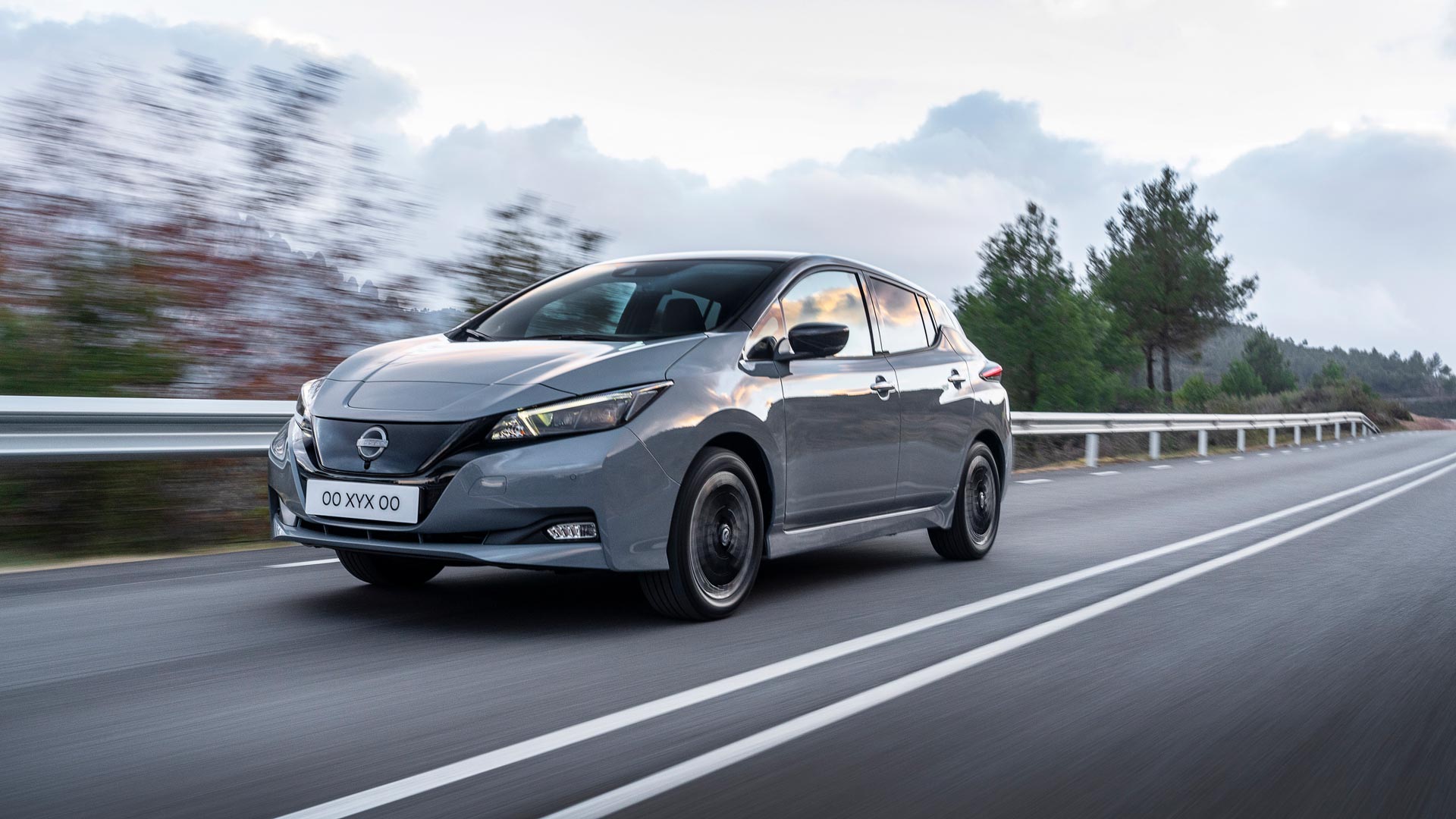
Nissan has announced a range of updates for its popular Leaf electric car.
Formerly the world’s best-selling EV, Nissan is keen to keep the Leaf as competitive as possible in this growing sector.
The revised styling is intended to reflect Nissan’s latest corporate identity, while also keeping the Leaf looking fresh.
Wear the badge with pride
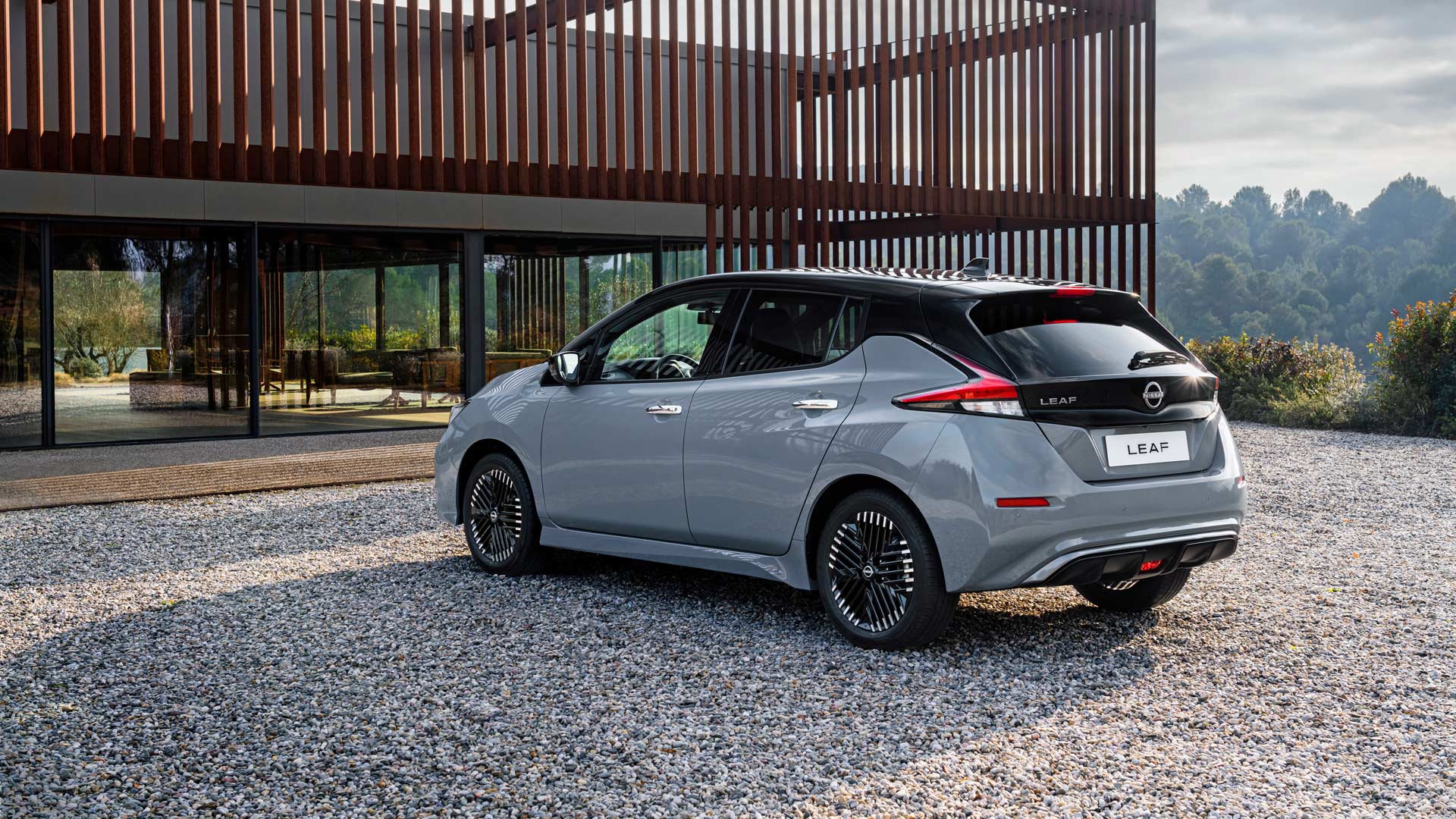
The biggest exterior change is the adoption of Nissan’s new badge, ensuring the Leaf matches the rest of the range. This appears on the front grille, boot and alloy wheel centre caps.
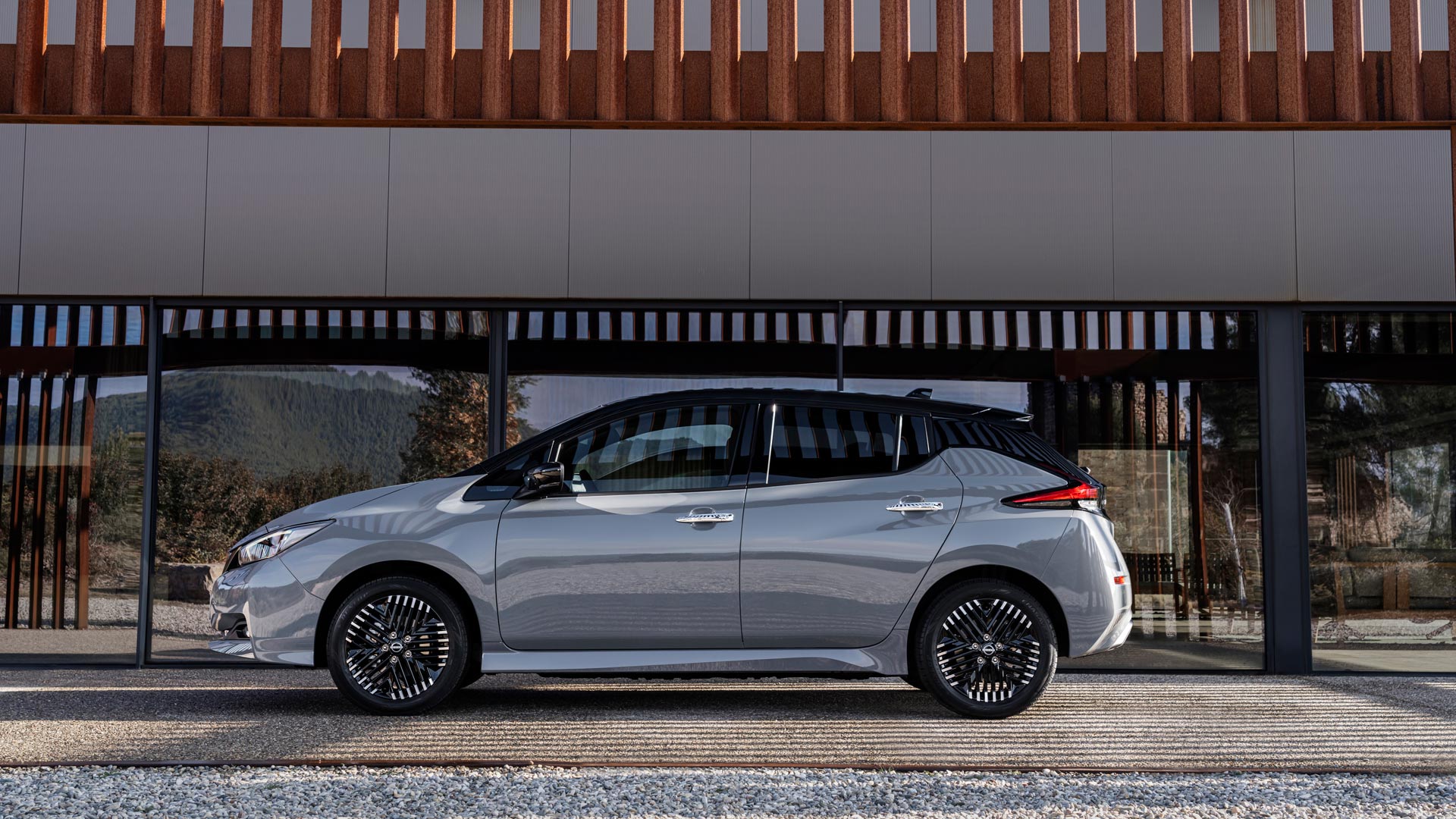
New 16- and 17-inch alloy wheel options have also been introduced. These incorporate an elaborate multi-spoke design, with gloss black contrasting against silver details.
Customers also have an expanded range of paint colour choices for the Leaf. Nissan has revealed two new shades of blue, in addition to the existing five monotone and five dual-tone options.
Pearl Blue and Magnetic Blue have previously been seen on the latest Qashqai, plus the forthcoming Ariya electric SUV.
“Hey, Alexa…”
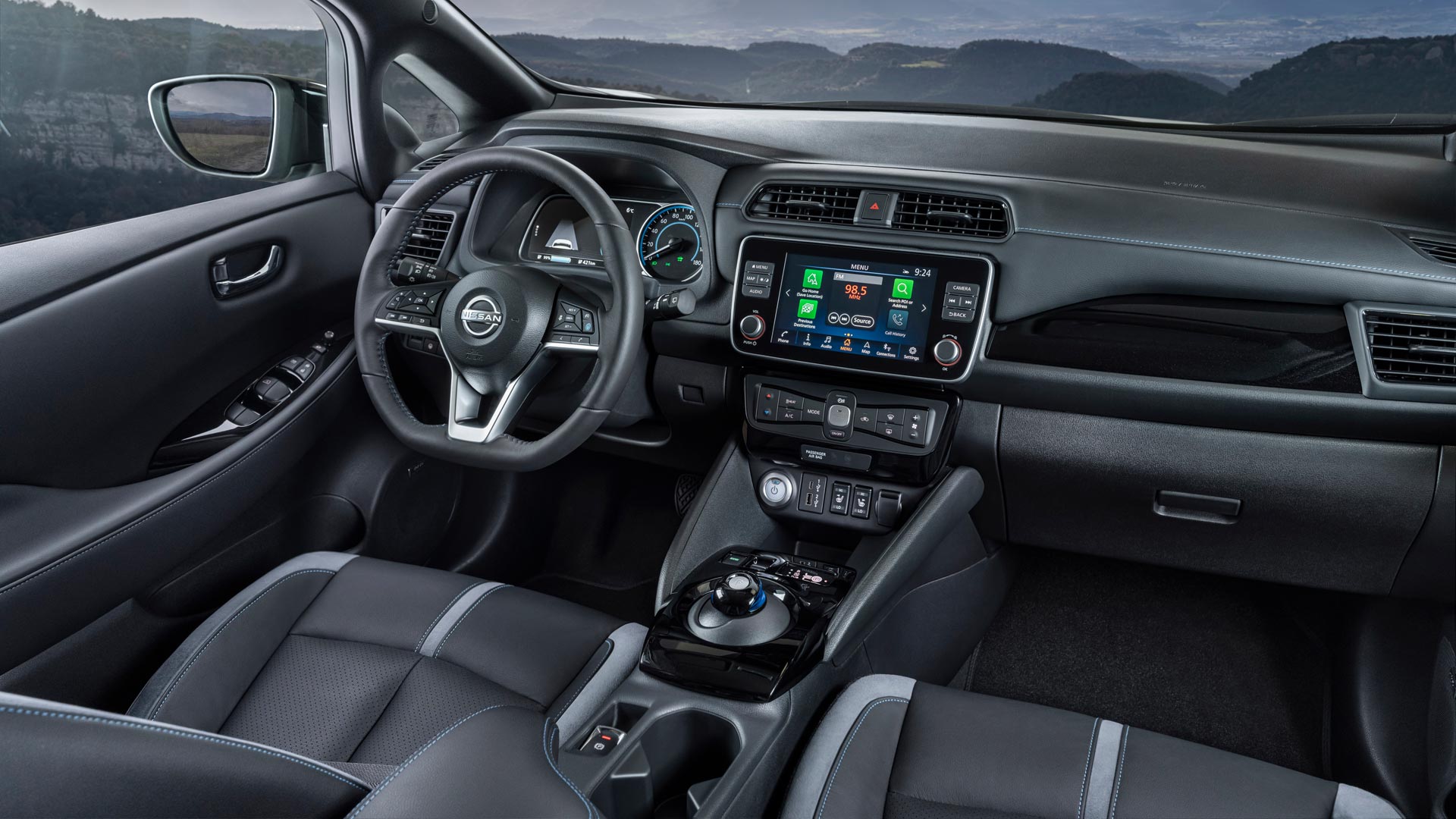
Inside, Nissan has left the Leaf relatively unchanged for 2022. Its ProPilot driver assistance system remains available on selected models, along with Nissan Connect smartphone integration.
The latter includes Apple CarPlay and Android Auto connectivity, with certain models allowing the climate control settings to be operated remotely. Customers can also link their Leaf to Amazon’s Alexa service, albeit only on cars built later in 2022.
Battery options remain unaltered, with an official range of up to 239 miles in the Leaf e+ version.
577,000 made and counting
The revised 2022 Leaf will join Nissan’s expanding range of electrified models. The company aims to launch 23 new electrified cars, including 15 EVs, by 2030.
Arnaud Charpentier of Nissan said: “The Nissan Leaf has always been about making advanced technology and the thrill of electric driving accessible to everyone, with over 577,000 customers worldwide. The Leaf has been designed around families’ needs, to offer seamless connectivity and an efficient powertrain”.
Pricing for the revised 2022 Nissan Leaf will start at £26,995, once the Plug-In Car Grant has been applied. Orders can be placed from 1 March 2022, with first deliveries expected in April.
ALSO READ:
AA wants VAT cut for electric car drivers without off-street parking
New figures from the Driver and Vehicle Licensing Agency (DVLA) show the UK has a record number of licensed drivers over the age of 70.
More than 5.7 million people aged over 70 now have a full driving licence, an increase of 10 percent since March 2021.
Fuelling the increase is the ‘Baby Boomer’ generation, defined as those born between 1946 and 1964. It also comes as the number of younger drivers has decreased, a decline blamed on the pandemic.
Centenarians on the road
Analysis of DVLA data by insurance comparison website Quotezone shows the very oldest drivers are growing fastest in number.
The number of drivers aged between 90 and 99 has increased by 12 percent during the past year, with almost 133,000 holding licences. More impressively, the number aged over 100 has jumped by 23 percent. There are now 505 centenarians who hold a licence in the UK, with the oldest aged 108.
DVLA rules require drivers to renew their licence every three years once they turn 70. This is to ensure that any changes in health conditions are recorded.
Premium benefits
There is an added benefit for some drivers aged over 70, according to Quotezone’s research.
Based on average quotes, those aged between 70 and 79 pay £303 for their annual insurance premium. Once drivers hit 80, however, this increases to an average of £436 per year. This is still likely to be lower than drivers in their 50s, though.
Greg Wilson, founder of Quotezone, says that older drivers have a number of options to offset rising premiums. These include “switching cars to one with a smaller engine, to help lower costs”.
Wilson adds: “Drivers who are tempted to put younger relatives on their policy should remember that they will not only be paying more, but if the younger person does have an accident in their vehicle, as the policyholder, they could lose their no-claims bonus.”
Dacia has announced a new special-edition version of its affordable Duster SUV.
Called the ‘Extreme SE’, Dacia promises bespoke styling enhancements and features previously unseen on UK-spec Dusters.
The Extreme SE is offered with a wide range of engines, including Dacia’s Bi-Fuel LPG system. Orders will open in April 2022.
Added orange flavouring
The most obvious addition to the Duster Extreme SE is an exclusive Urban Grey paint colour. Dacia offers a choice of seven other colours, but the new hue contrasts neatly with the 17-inch gloss-black alloy wheels.
The Extreme SE’s signature finish is Quartz Grey trim, which is applied to the wing mirrors, roof bars and front grille.
Completing the look is a host of orange detailing, including the ‘Duster’ wording on the roof bars.
Inside continues the same combination, with orange stitching on the charcoal grey seats. More orange highlights can be found on the doors and air vents, with the centre console finished in piano black.
Extreme value for money
Standard equipment for the Duster Extreme SE includes climate control, a surround-view camera, blind-spot warning, an acoustic windscreen and heated front seats. An 8.0-inch multimedia touchscreen features satellite navigation and wireless smartphone connectivity.
Buyers can pick from three turbocharged petrol engines, a diesel, or Dacia’s LPG Bi-Fuel option.
Prices start at £17,495 for the Extreme SE TCe 90 4×2 petrol model, rising all the way to £21,645 for the Extreme SE Blue dCi 115 4×4 diesel.
Dacia aims to make the first customer deliveries in May 2022.
Morgan is back on three wheels. Meet the new Super 3: follow-up to the 3-Wheeler – and the British marque’s first clean-sheet design since the Aero 8 of 2000. Exciting, extroverted and eccentric, it’s billed as “the antidote to a daily-driver”.
Henry Frederick Stanley Morgan’s first car was a three-wheeler, built in 1909. His company stuck with the format for four decades before the 3-Wheeler made a comeback in 2011. The ‘Super’ name also has its roots in Morgan’s past, and nods to American popular culture of the 1950s and 1960s.
“It shifts Morgan’s three-wheeler design language from the biplane era to the jet age,” explains senior designer Harvey Fulford. We’re inside a closely guarded workshop at Bicester Heritage for an in-depth preview of the Super 3 before production starts in April. Here’s what you need to know.
Three wheels, three cylinders
Unlike the outgoing 3-Wheeler and its motorcycle-sourced V-twin, the Super 3 uses a car engine. Its 1.5-litre three-cylinder Ford ‘Dragon’ motor drives the rear wheel via the snappy five-speed gearbox from a Mazda MX-5.
“We looked at using bike power again, but that would have meant a sequential gearbox – rather than a traditional manual,” explains Fulford. “We wanted the car to be as analogue as possible.” The Ford engine allows Morgan to meet Euro 5 emissions standards, too.
With 120hp and a modest 635kg to shift, the Super 3 reaches 62mph in 7.0 seconds and a (presumably quite blustery) top speed of 130mph. Morgan also promises plenty of smiles per mile, thanks to its expertise as a ‘global leader in the dynamic behaviour of three-wheeled vehicles’.
The Super 3 has been future-proofed to accept an electric powertrain, if customers or legislators demand it. In time, it could be Morgan’s first electric production car, following the stillborn EV3 concept of 2016.
Back to the future
“Retro-futurism is an expression we use a lot,” says Fulford, walking me around two very different interpretations of the Super 3: one in trad British Racing Green, the other in eye-popping Coral Orange. “This car deliberately challenges the traditional concepts of Morgan design.”
Without a V-twin out front, the Super 3’s face is defined by bug-eyed headlights, pushrod suspension and a mesh grille that clearly reveals the engine within. Fulford points out how the cowl is level with the centre-line of the wheels, like a classic Bugatti. “It means the wheels are always leading.”
Upright sideblades are another striking design feature – and provide a mounting point for luggage panniers if needed. They can be painted in contrasting colours, too.
The aero screens, optionally tinted in yellow, offer some protection, although I’m told most 3-Wheeler drivers wear helmets. You can fit a (detachable) full-width windscreen for longer road-trips.
Morgan goes monocoque
The Super 3 uses the first monocoque chassis in Morgan’s history. This ‘Superformed’ platform offers benefits in terms of rigidity, weight and packaging (yep, there’s even a small boot under the rear clamshell).
Fulford says the distinctive 21-inch alloy wheels are “somewhere between an 1980s rally car and a salt-flat racer”. They’re shod with retro-look Avon Speedmaster tyres that are unique to the Super 3.
You’ll also spot the front mudguards, which extend down to almost ground level. This is so, unlike in the 3-Wheeler, you don’t get a face-full of rainwater whenever you turn a corner…
Ready for British weather
The Super 3’s cabin is rated at an ingress protection level of IP64. In English, this means it “can be hosed down inside”, with even the USB sockets protected against water damage. Recognising that many 3-Wheeler owners stand on the seat base to clamber aboard, the seats and armrests are also trimmed in “military-grade technical fabric” or hard-wearing leather. A storm cover that uses bungee cords to stretch over the whole car is supplied, with a fitted tonneau on the options list
This is the first Morgan with a cupholder, but it’s not all about mod-cons. “We wanted to design in quirks and things you have to learn. Those eccentricities are what make you fall in love with a car,” says Fulford. “The dashboard is a weird balance of different eras. The digital gauges have aluminium surrounds that look like they come from an old aircraft. And the joystick switches underneath are like something from a retro arcade game.”
The Super 3’s seats are fixed, but the pedal box slides and the steering wheel adjusts for tilt and reach. “My knees were around my ears in the old 3-Wheeler,” jokes the 6ft 4in designer. “This is so much more comfortable.”
Tailored and swift
Morgan describes the Super 3 as its ‘most configurable car ever’, with an ‘almost endless combination of options and accessories’. Buyers are encouraged to visit the factory in Malvern, Worcestershire, to see their car being built.
One of the most interesting extras is the minimalist Beeline sat-nav, which clips on above the steering wheel and pairs to your smartphone. You can also specify a Quad Lock phone mount, heated seats, under-seat storage boxes and a luggage rack. Morgan has worked with Malle London on a range of bespoke bags and cases.
And if the Super 3 isn’t head-turning enough, there’s a range of graphics packages inspired by motorsport, aviation and more.
A Morgan adventure
Morgan built around 800 cars in 2021 and will be “pushing towards 1,000 cars a year” once the Super 3 enters production. We’re also told the Super name could be applied to other cars as a new pillar in the Morgan range, alongside the existing Plus models.
Fulford says the company was constantly surprised by how far customers drove their 3-Wheelers: “People have crossed America, one guy drove around India, and several others did a tour of New Zealand.” The Super 3, he hopes, is ready for similar adventures. “Morgans aren’t garage queens, they’re designed to be used.”
We don’t anticipate crossing the USA, but we hope to drive the Super 3 later this spring. The configurator is now live and the car is available to order, priced from £41,995.
Loyalty to their existing car insurance company potentially cost UK drivers £830 million in 2021.
Research by price comparison website MoneySuperMarket finds that 52 percent of drivers allowed their insurance policy to renew automatically last year.
This led to an average cost increase of £49 for each of the 17 million drivers that remained with the same insurer.
Drivers are on autopilot
MoneySuperMarket surveyed 2,000 drivers, with 52 percent of those asked stating they didn’t bother shopping around for a new insurance quote. This represents a 27 percent increase from the 41 percent who auto-renewed in 2020.
A quarter (25 percent) of those questioned said they did get other quotes, but opted to remain with their insurer for ease. This marked a 20 percent increase compared to the year before.
Some 14 percent believed changing insurer takes too much effort, with almost one in five (19 percent) arguing there is no real saving.
Worryingly, 48 percent said they did not recall seeing their insurer compare their new policy price to the previous one. This is despite a change in FCA rules to make this mandatory when renewing.
Shop around to save
The average price rise for car insurance premiums also jumped by 17 percent, from £42 in 2020 to £49 last year. One in 10 of those surveyed saw an increase in their annual policy of between £50 and £75. Some 12 percent of drivers saw between £76 and £100 added to their premium.
Drivers in London reported the largest increases, with an average of £79 added. Welsh motorists escaped with the smallest price rise, typically seeing £31 extra charged.
Sara Newell, car insurance expert at MoneySuperMarket, commented: “While we have seen the introduction of the FCA’s new rules on price walking – which are intended to level the playing field for consumers – it’s important that drivers don’t rely on such measures to reduce their premiums.
“We’ll monitor the impact of the FCA’s new measures over the coming months, but the fact remains that shopping around is always going to be the most effective way of keeping your costs down.”
Following her title wins in 2019 and 2021, Bath-born Chadwick will look to make it three championships in a row.
This year’s W Series sees races held in support of eight Formula 1 weekends, further raising the profile of the single-seater championship. A round of the W Series will also take place in Asia for the first time, at the famous Suzuka circuit in Japan.
Expect more wins in 2022
Beating the reigning champion will require a concerted effort by other W Series competitors. Of the 14 races held to date, Chadwick has won six and taken podium finishes in six more.
Her dominance in the W Series was shown by a convincing double win at the Circuit of the Americas, securing her second championship in 2021.
Such success has earned Chadwick important FIA Super Licence points, a requirement for racing in Formula 1.
The 23-year-old is currently a development driver for the Williams Racing F1 team.
Going for W Series gold
For 2022, Chadwick will be driving for the brand-new Jenner Racing team. The outfit is owned and operated by 1976 Olympic decathlon gold medalist, Caitlyn Jenner.
The American debut of the W Series in 2021 caught the attention of Jenner, who has competed in motorsport previously. Having won a celebrity race at the Long Beach Grand Prix in 1979, Jenner went on to compete in the 24 Hours of Daytona and spent six years as a factory Ford GT driver.
Speaking about her return for 2022, Chadwick said: “I am really excited to be returning to W Series to defend my title. To be asked to return by Jenner Racing was an opportunity I didn’t think twice about. Together, we are focused on doing all we can to win title number three. I have spoken to Caitlyn Jenner and her vision for the team is amazing. I have zero doubt that she will be able to help take my career to the next level and open doors for me internationally.”
The 2022 W Series will kick off on 8 May in Miami.
The all-electric ID Buzz will officially be revealed on 9 March 2022, following five years of development.
Before its debut, Volkswagen has taken disguised pre-production versions of the ID Buzz on a European tour to test public reactions.
London, Paris and Amsterdam
Volkswagen originally displayed a Microbus concept at the 2001 Detroit Auto Show. This was followed by the electric Bulli concept in 2011 and the Budd-e of 2016.
The 2017 Detroit Auto Show saw the reveal of the ID Buzz concept, created on Volkswagen’s all-electric MEB platform. In 2018, the ID Buzz Cargo van was displayed at the IAA Mobility Show in Hannover.
Both prototype versions of the five-seat ID Buzz passenger model, and the Buzz Cargo van, are taking part in Volkswagen’s road-trip. Test runs have been conducted in London, Paris, Amsterdam, Copenhagen, Hamburg and Hannover.
Despite the European focus for final testing, Volkswagen will sell the ID Buzz in the United States. The company notes that fans in San Francisco are likely to be excited about the return of the iconic ‘hippy’ van.
Retro styling, modern construction
Although the design of the ID Buzz is a deliberate homage to the original Microbus, the engineering underneath is all new. Volkswagen will use the MEB platform, which already underpins the ID.3, ID.4 and multiple other models.
An 82kWh battery pack will supply power to a 150kW electric motor. Like the classic version from the 1960s, the ID Buzz will be rear-wheel drive. Top speed is limited to 90mph, but instant torque should make it feel more sprightly than the air-cooled original.
Like the rest of the ID family, the Buzz will benefit from over-the-air software updates, automatic parking capability and crowdsourced data for traffic hazards.
Following its public debut in March, production of the ID Buzz begins in the first half of 2022. A European launch will follow in September.
The additional roles are due to the successful launch of the Aston Martin DBX707 SUV.
Billed as the world’s most powerful luxury SUV, the new car requires extra skilled automotive technicians to meet demand.
A little bit Xtra
The St Athan plant was first announced in 2016, and is the home of the DBX SUV. Built on the former RAF St Athan base, the 90-acre site began production in 2019.
Initially employing 600 workers, the Welsh site will increase to 750 staff once operating at full capacity.
Revealed earlier this month, the DBX707 is the company’s flagship SUV. A modified 4.0-litre twin-turbocharged V8 endows it with 707hp and 663lb ft of torque.
This allows the DBX707 to accelerate from 0-62mph in just 3.3 seconds, with a top speed of 193mph.
A vote of confidence for Wales
Delivering employment for the Welsh community has been central to the St Athan project.
Tobias Moers, CEO of Aston Martin Lagonda said: “As we ramp-up production of DBX707, we are delighted to have the opportunity to increase our team at St Athan and create more employment opportunities for the local community.
“Our DBX SUV is the first Welsh-built production car for nearly 50 years and these new positions are an opportunity to join a team delivering our truly incredible new DBX707 derivative, which is setting new benchmarks for performance in the luxury segment.”
Simon Hart, secretary of state for Wales said: “The creation of more than 100 jobs working with a world-class and globally-recognised brand is a huge vote of confidence in the skills and expertise of the Welsh workforce.
“Wales remains a highly attractive location for cutting-edge automotive technologies and the UK government will continue to work to secure and support the investment of companies like Aston Martin Lagonda as they drive economic growth and create jobs.”
Land Rover specialist Twisted has created an all-electric version of the classic Defender.
With a bespoke design and build process, the Defender EV results from thousands of hours of work by the North Yorkshire company.
The Defender was designed in response to demand from Twisted’s customers. Some 20 percent of enquiries to the firm over the past two years have related to electric vehicles.
Charging into the wilderness
Twisted has designed its electric drivetrain as a modular setup. This allows it to be used with Defender 90, 110 and 130 chassis. The battery packs are mounted beneath the bonnet, and also where the fuel tank would be in a conventional Defender.
The short-wheelbase Defender 90 uses a 61kWh battery, allowing a range of 140 miles when fully charged.
Opting for the larger Defender 110 increases battery size to 81kWh. As a result, overall range improves to an estimated 180 miles.
All versions use a Type 2 charging plug, mounted where the fuel filler would usually be. Replenishing the battery packs is said to take less than three hours, depending on the charger type used.
Engage Sport (or Eco) mode
A Dana TM4 Sumo electric motor powers the EV Defender, generating 268hp with a mighty 885lb ft of torque. Drivers have the option of switching between Sport and Eco modes.
“There is something extremely special about the Twisted EV. It has incredible power, yet still the charm of the classic Defender,” says Twisted Automotive founder, Charles Fawcett. “The Eco mode effortlessly accelerates to 60mph and, with Sport mode engaged, it just pulls and pulls. It’s incredibly fun to drive.”
The electric components in the Twisted Defender have an IP67 waterproof rating. This allows for a 900mm wading depth, outperforming a conventional classic Defender.
Being fully electric, and therefore ULEZ (Ultra Low Emission Zone) compliant, will likely make the Defender EV appeal to London drivers. Last year, Twisted opened a new showroom in Kensington.
Defending a British icon
Prices for the Twisted EV Defender start at £270,000 (£225,000 plus VAT), with a personal commissioning service allowing each vehicle to be fully tailored.
The new model will be sold internationally, including via Twisted showrooms in Texas and Dubai.
Charles Fawcett adds: “Twisted has an established reputation as the market leading modifier of Defender and I am excited that we have the ability to future-proof a treasured British icon.
“The fully electric Twisted has been a labour of love for the whole team, with thousands of hours invested into its development. With an estimated 70 percent of all Defender and Series Land Rovers ever made still being on the road, it is one of the most recyclable vehicles on the market and Twisted has now future-proofed this British icon even further.”
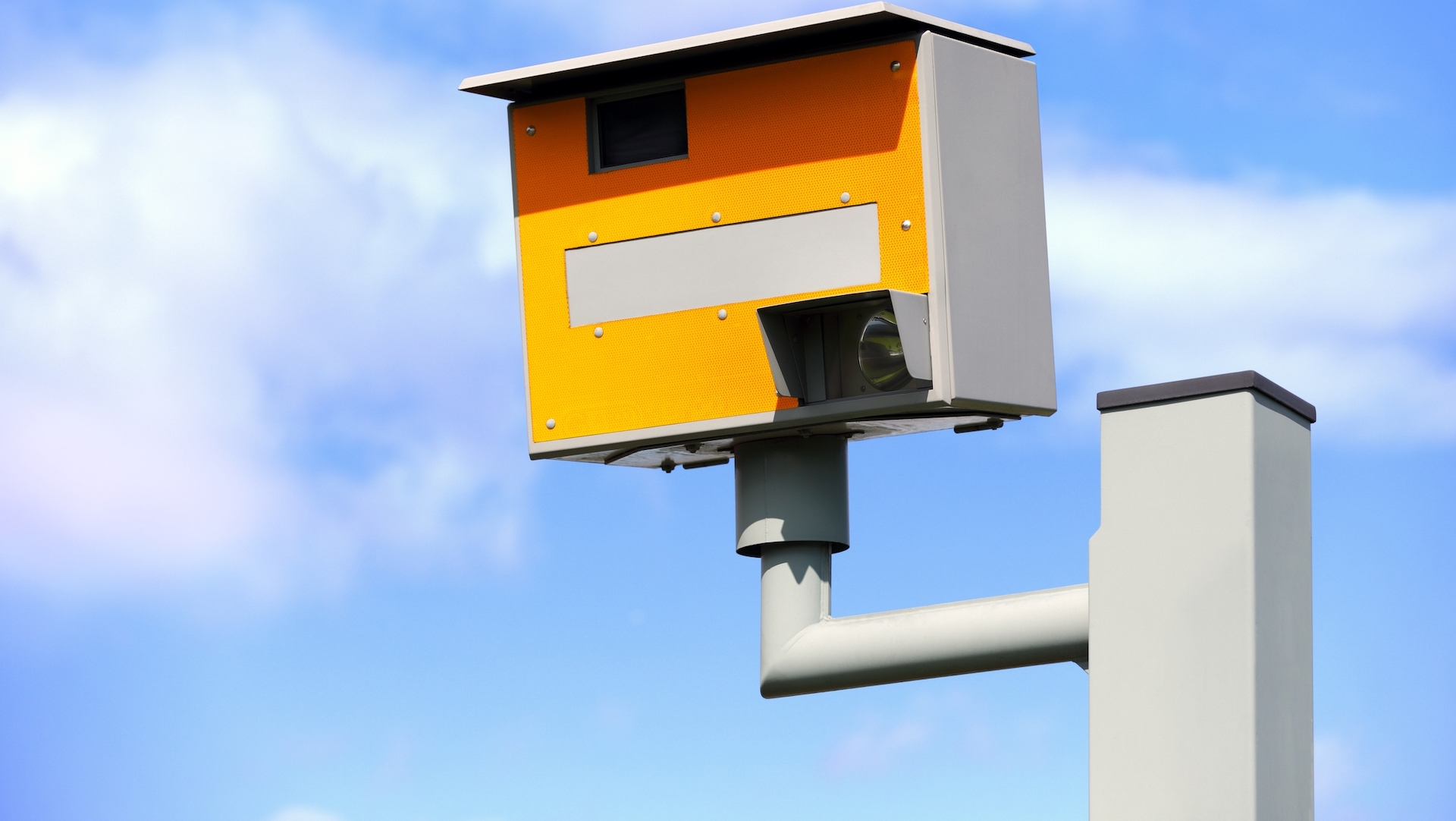
Drivers have become less likely to approve of speeding, reveals new research by IAM RoadSmart.
The independent road safety charity published the findings in the latest edition of its Safety Culture Report.
Of the 2,000 motorists surveyed, 42 percent believed it was acceptable to drive at 80mph on a motorway. This is down from 56 percent who gave the same response in 2016.
Speeding out of fashion
More than a fifth (21 percent) of those questioned for the 2022 report believed driving above 80mph was acceptable. But this represents a decline from 28 percent six years ago.
Interestingly, just 17 percent of those in the North East thought speeds above 80mph on a motorway are fine. By comparison, 25 percent of drivers in the East of England found them acceptable.
The East of England also accounts for the highest percentage of drivers who accept driving at 5mph above a residential speed limit.
More than a quarter (27 percent) of that region’s motorists found it acceptable, with the North East again the least accepting, at 16 percent.
Numbers down, but more to be done
Self-reported speeding by drivers was lower in the latest Safety Culture Report. Only 10 percent of respondents admitted to driving at 5mph over the speed limit on a residential street, compared with 17 percent in 2016.
Neil Greig, IAM RoadSmart’s director of policy and research, says more needs to be done: “Acceptability of speeding on motorways is still far too high, but the downward trends of drivers’ opinions are a positive sign. Actual speeding behaviour in towns and cities has also improved, as more and more drivers appear to understand the link between speed and serious injury.
“Those who believe it is acceptable to drive at speeds greater than the limit are simply not listening to the warnings or taking notice of the frequent police messaging. Speeding is responsible for around 12 deaths each day on UK roads. We clearly need to do more to educate drivers on the fatal consequences of speeding.”