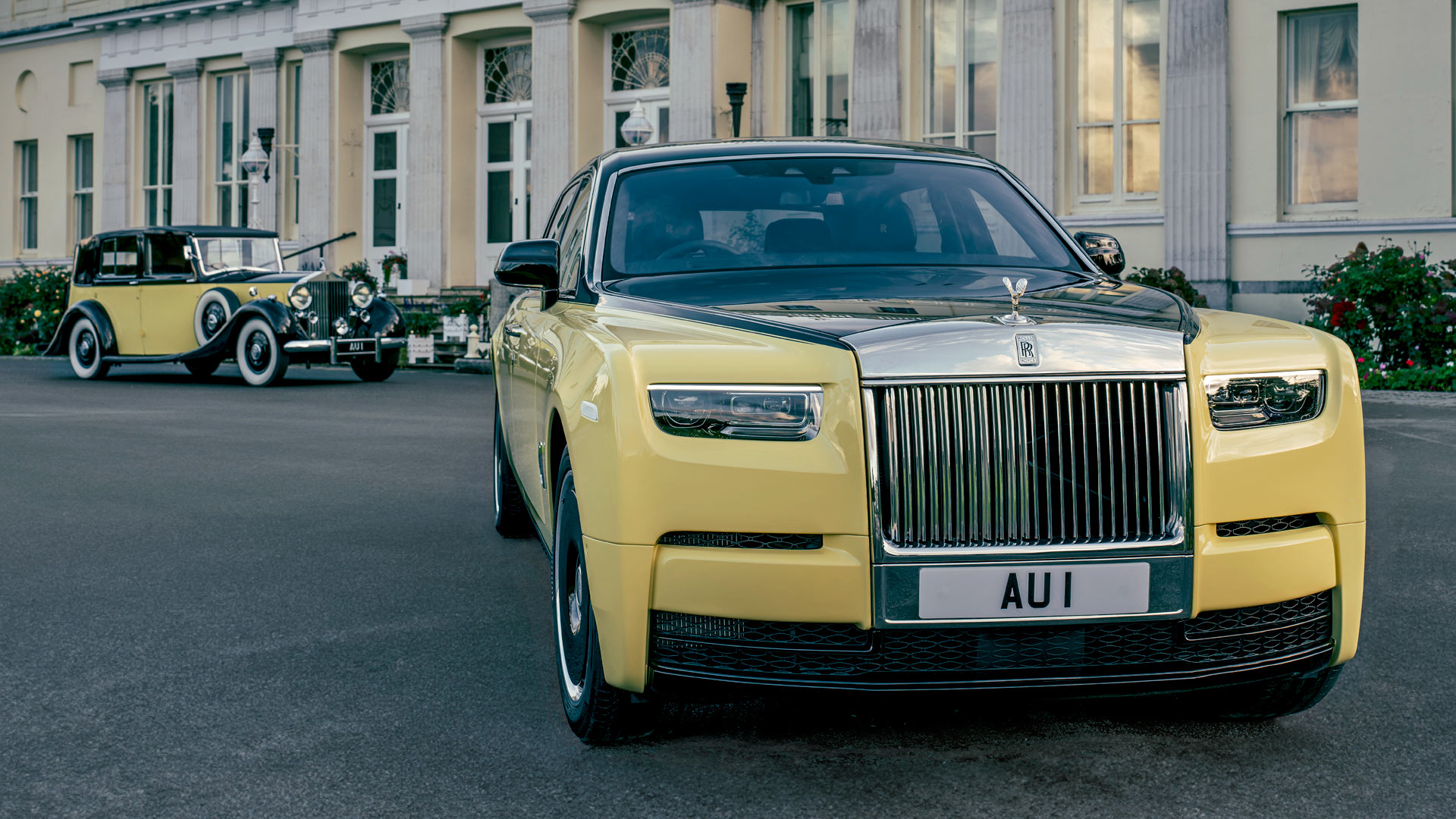
The Rolls-Royce Phantom celebrates an important birthday this month, 100 years after the luxury saloon was first introduced.
Now into its eighth generation, the Phantom has long been the flagship of the Rolls-Royce range. It has also earned an important place in automotive history.
Although the Phantom line saw breaks in production during the last century, the model has endured to become one of the longest-running nameplates of all.
To celebrate this centennial year, Rolls-Royce has reflected on the car’s storied history, commissioning its design team to create a series of original artworks with the Phantom as their subject matter.
In that year, artist Charles Sykes was asked to produce six original oil paintings for the Rolls-Royce brochure of the time.
Sykes depicted cars in environments such as arriving at the opera, or outside large country houses, reflecting the lifestyles of Rolls-Royce owners at the time.
For the modern artworks, the designers considered a wider range of Rolls-Royce customers, such as the Phantom V models owned by John Lennon and Elvis Presley.
Fit for kings and queens
The Phantom IV, launched in 1950, is the rarest of the model lineage, with only 18 examples produced. Rolls-Royce only sold a Phantom IV to clients deemed worthy enough to own one.
These included heads of state, such as the British royal family, who took ownership of the very first completed Phantom IV – depicted in one of the new illustrations (see below).
Commissioned by the Duke of Edinburgh as a more formal car for himself and the young Princess Elizabeth, the Phantom IV was tailored to the late Duke’s personal design requirements.
It marked the beginning of an association between Rolls-Royce and the royal family, which lasted until the turn of the 21st century.
‘A means of personal expression’
One constant throughout the Phantom’s history has been the emphasis on personalisation. From the earliest coachbuilt examples, through to bespoke commissions of the latest Phantom VIII, these cars have always been tailored to their owners.
Reflecting on the Phantom’s centenary, Chris Brownridge, chief executive of Rolls-Royce Motor Cars, said: “Phantom is much more than a motor car. It is a cultural phenomenon, both reflecting and influencing the world around it.
“Since its earliest days, the marque’s pinnacle product has been among the most desired rewards for success and a potent symbol of power and prestige on the world stage. Above all, it has provided a means of personal expression for its owner, often becoming a work of art in its own right.
“These fascinating stories – and the exquisite images they have inspired our designers to create – offer a glimpse of Phantom’s extraordinary reach, and the world-changing people and events it is associated with.”
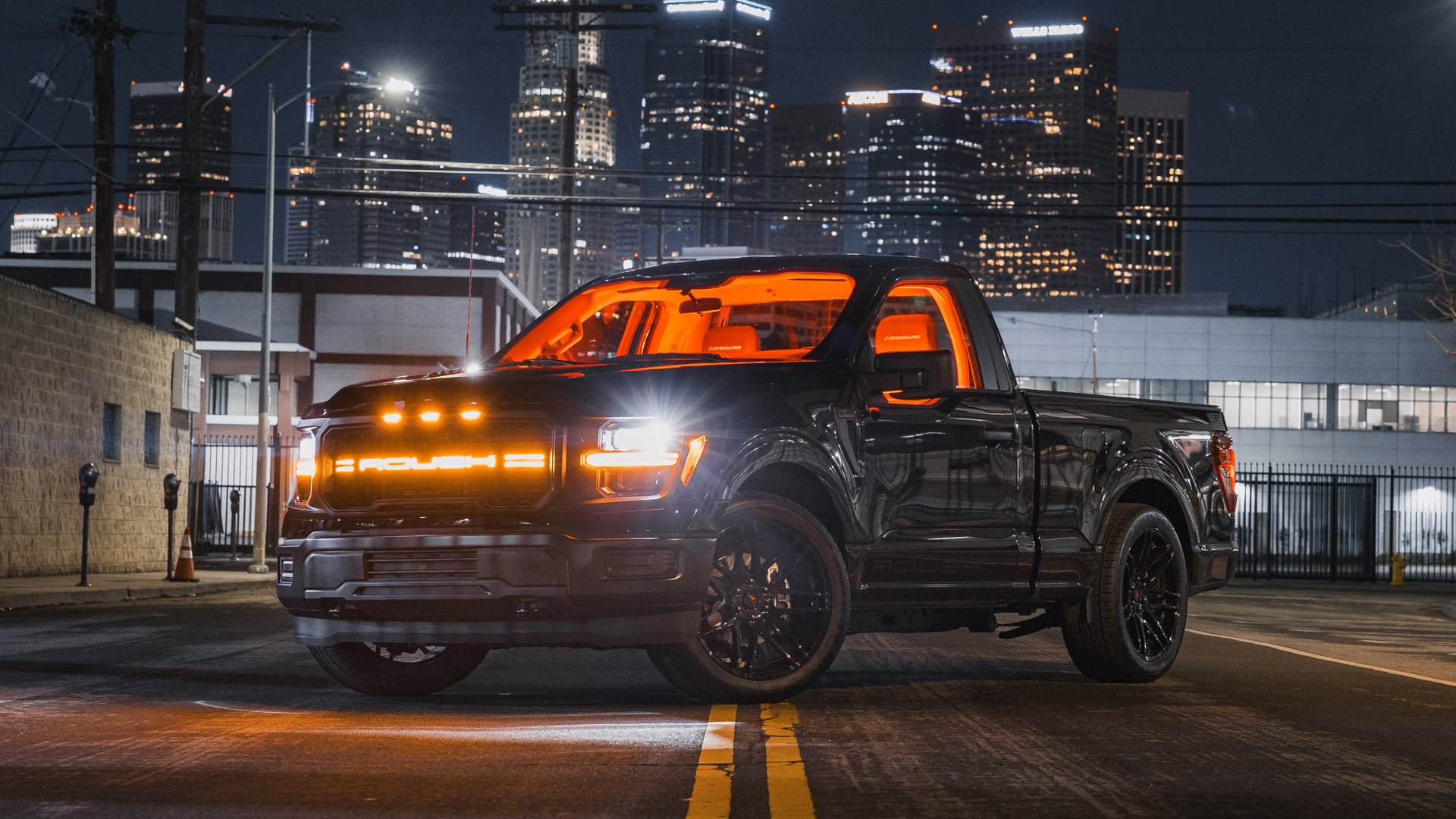
Tuning specialist Roush Performance has revealed its latest take on the Ford F-150 pickup.
The 2025 Roush Nitemare has been engineered to “dominate the street”, with custom design elements and a major focus on handling.
Available for the F-150 in XL and XLT trim, the Nitemare package adds $19,999 to the base cost of a new truck.
For those who want more, however, Roush’s supercharger package can boost the Ford’s 5.0-liter V-8 to 705 horsepower and 635 lb-ft of torque – all for an extra $8,650.
Built for the street and track
The Nitemare’s dynamic prowess is aided by coilover suspension, featuring twin-tube dampers and progressive rate springs. Slotted brake rotors are also part of the package.
The F-150 Nitemare is lowered by three inches at the front and five inches at the rear, giving it a mean stance on standard 22-inch gloss black wheels.
Upgraded sway bars and General Tire G-Max AS07 all-season tires help the Nitemare to reach a peak of more than 1.0 G when cornering on a circuit.
Roush also fits a bespoke, cat-back exhaust system to the Nitemare. Its black tailpipe tips are said to provide an “unapologetically bold” sound.
A head-turning truck
Roush’s signature front grille features integrated amber lighting, while the rear has new LED marker lights and blacked-out Ford tailgate lettering.
There is also a bespoke Roush Nitemare graphics package, along with custom Raven Black leather with red detailing. Aluminum pedals are fitted, with real carbon fiber trim on the options list.
“We engineered the Nitemare to be more than just a head-turner – it’s one of the best-handling trucks we’ve ever built,” said Jack Roush Jr.
“Our lowered suspension system and precision-tuned handling components will let drivers carve the track with confidence while maintaining the everyday drivability expected from a Roush vehicle.”
When it comes to power and performance, the plug-in hybrid Ferrari 296 GTB and open-top 296 GTS hardly fall short.
However, that has not stopped Maranello’s engineers from developing a hardcore Speciale version, intended to set a ‘new benchmark’ for road-legal driving excitement.
Unusually, Ferrari has launched both the 296 Speciale coupe and open-top 296 Speciale A together from the outset.
As with past icons such as the 360 Challenge Stradale and 430 Scuderia, the Italian marque has followed a familiar path of more power and reduced weight.
Given the already high starting point for the 296 GTB, the new Speciale brings hypercar-grade horsepower to the party. Let’s dig in to the details…
Boosted hybrid performance
Combined power from the Ferrari’s twin-turbocharged 3.0-litre V6 engine and electric motor now stands at a colossal 868hp – 50hp more than the 296 GTB.
Technology from the 296 Challenge race car has enhanced the V6 combustion engine, while the electric motor is tweaked to deliver an extra kick.
The result is a 0-62mph time of just 2.8 seconds, with 0-124mph taking 7.0 seconds. Top speed is in excess of 205mph.
With track driving likely to be on the agenda for 296 Speciale owners, a new ‘Qualify’ mode has been added to the eManettino. This deploys extra power from the electric motor when exiting a corner, bringing some ‘Hammer Time’ to your hot laps.
Track-focused aerodynamics
Maximising performance does require dipping into the options list, however. Opting for the lightweight package shaves some 60kg, using carbon fibre for the car’s bumpers and engine cover – and reducing dry weight for the fixed-top Speciale to 1,410kg.
Much of the 296 Speciale’s bodywork is new, with a major focus on improving aerodynamic performance. Ferrari says the upgraded car boasts 20 percent more downforce than a 296 GTB.
This includes the use of an ‘aero damper’ integrated into the bonnet, along with new winglets on the rear bumper. The active rear spoiler now has three different downforce settings, and can switch between them more rapidly.
Ferrari engineers have not forgotten the suspension either, lowering the 296 Speciale by 5mm. Finely tuned springs and dampers are said to reduce the maximum roll angle by 13 percent when cornering.
Tailored to your taste
Carbon fibre and Alcantara are used extensively throughout the 296 Speciale’s cabin. This includes making the door panel from a single piece of carbon, which feeds into the road-going racer image.
As with all new Ferrari models, customers are able to customise and tailor their car to exact design specifications.
This includes choosing the new Verde Nurburgring paint colour, developed especially for the 296 Speciale, which can be combined with racing numerals and full-length body stripes.
Production of the 296 Speciale will not be capped, but Ferrari does say fewer examples of the open-top Speciale A will be sold. The Ferrari online configurator has already been updated to help you plan your ultimate 296.
It was already dubbed ‘the supercar of SUVs’. Now Aston Martin has announced a new flagship – and even faster – version of the DBX.
The DBX S offers more horsepower then the DBX707 (which continues on sale), plus new options that can shave almost 50kg from the luxury SUV’s kerb weight.
Adding an ‘S’ suffix to the DBX continues an Aston Martin naming convention that dates all the way back to 1953 – and the upgraded DB3S Le Mans race car.
More recently, the S badge has been used to denote high-performance versions of the V8 Vantage and Vanquish models.
Turbo tech from the Valhalla
Powering the DBX S is the existing 4.0-litre V8 engine, now using turbocharger technology derived from the forthcoming Valhalla hypercar. The result is a peak output of 727hp: a 20hp boost compared to the DBX707.
Peak torque remains at 664lb ft, but the extra power reduces the 0-124mph time by 0.3 seconds. A 0-62mph sprint time of 3.3 seconds and 193mph top speed remain identical to the DBX707.
Juggling the power is a nine-speed automatic transmission, but with new shift points to reflect the enhanced rev range of the DBX S. Downshifts in Sport and Sport Plus modes are said to be ‘even more aggressive’.
A modified exhaust system brings ‘more character to the natural voice of the thunderous V8 engine’, while the quad tailpipes are now vertically stacked.
Heavyweight performance, lightweight options
For those who want to save weight on their 2.2-tonne SUV, the DBX S offers a variety of new options. A carbon fibre roof – the largest single-piece carbon fibre element ever fitted to an Aston Martin – helps remove some 18kg by itself. It also helps lower the car’s centre of gravity for improved dynamics, and sees the roof rails removed.
Magnesium wheels are a first for the luxury SUV sector, with the optional 23-inch rims cutting unsprung mass by 19kg.
For the final weight-saving measure, buyers can specify a polycarbonate honeycomb front grille, along with carbon fibre components for the redesigned front bumper and rear diffuser.
Selecting all the lightweight options will save 47kg, and cut the kerb weight of the DBX S to 2,198kg.
Sporting design inside and out
On the inside, the DBX S has a bespoke interior theme, with a distinctive herringbone pattern on the seats. This can also be extended to the headlining, should buyers choose the optional carbon fibre roof.
Alcantara trim is standard, covering the seats, headlining, centre console and instrument panel. Semi-aniline leather is used for areas subject to higher wear, such as the seat bolsters.
An ‘S’ logo is embroidered onto the seats, along with an Aston Martin badge that is both embossed and debossed. Customers can specify red seat belts for an extra sporting touch.
Exterior paint options include special livery designs, with either Rosso Corsa Red, Trophy Silver or Podium Green highlights used to pick out the new front splitter, side sills and rear diffuser.
‘A powerful statement of intent‘
Speaking about the DBX S, Aston Martin CEO Adrian Hallmark said: “Over the last two years, Aston Martin has introduced an entire core collection of next-generation sports cars as well as a new DBX; all with a new, entirely bespoke infotainment system designed in-house.
“The introduction of DBX S not only reaffirms our commitment to producing the most exciting, rewarding and beautiful cars, it also sends a powerful statement of intent about our ambitions not just for DBX, but for the Aston Martin brand.”
The Aston Martin DBX S is available to order now, with the first completed cars expected for delivery to customers in late 2025.
Land Rover Classic has revealed the latest version of the original Defender to receive an official restomod makeover.
The Land Rover Classic Works Bespoke department has treated the classic Defender Soft Top to new V8 power, along with a host of other upgrades.
It marks the first time Land Rover has built an open-top Defender since 2016, and follows the launch of the marque’s Works Bespoke service last year.
For those who want a restored Defender with the official Land Rover seal of approval, the Soft Top pays homage to classic models from the 1990s.
Bikini is optional
Creating a Defender V8 Works Bespoke Soft Top starts with sourcing a suitable donor vehicle for the restomod build. Land Rover Classic uses the last examples of the Defender as a basis, focusing on vehicles made between 2012 and 2016.
Hundreds of hours of work go into creating each V8 Works Bespoke model, with buyers able to tailor the vehicle’s specification to their personal taste.
A bespoke canvas hood is included, and comes in a choice of four colours. Said to be inspired by the last Defender model, the side and rear sections can be unzipped and rolled up for open-air driving. Extra tie‑down points have been added to keep the roof stable at higher speeds.
Buyers are also able to specify a smaller ‘bikini’ hood, which only protects the front-seat occupants from the elements.
Prices from £234,000
Providing the power is a thoroughly modern 5.0-litre V8 engine, producing 405hp and 380lb ft of torque. An eight-speed ZF automatic transmission is standard, as is the traditional Land Rover four-wheel-drive system.
Land Rover Classic also adds Bilstein suspension dampers, Eibach anti-roll bars and Alcon brakes to improve how the Defender drives.
Customers can choose from 49 different exterior colours, or commission an individual hue from a sample. Numerous leather upholstery options are available, while the extensive list of options includes an on-board wine cooler.
The open-top Defender of your dreams does not come cheap, however. Prices start at £234,000, which includes a one-year, unlimited-mileage warranty.
The exciting new Kia PV5 electric van has been shown for the first time in the UK. The PV5 is the first in a whole range of EV vans from the popular Korean car firm.
Stealing the headlines at the 2025 CV Show in Birmingham following its global reveal, the new Kia PV5 will be available for pre-orders next month. The first vehicles are expected in the UK by the end of the year.
And the new Kia PV5 Cargo has certainly caused a stir in terms of pricing, with the entry-level version costing from just £27,645 + VAT.
What’s more, the new Kia PV5 Cargo qualifies for the government’s Plug-in Van Grant, which will save owners a further £5,000. This takes the price down to just £22,645 + VAT.
For comparison, the cheapest diesel-powered Ford Transit Custom – Britain’s best-selling van – is almost £10,000 more.
These prices mean the new Kia PV5 Cargo costs less than other small electric vans such as the Vauxhall Combo Electric – and significantly less than arguably its direct rival: the Volkswagen ID.Buzz Cargo. Prices for the Volkswagen ID.Buzz Cargo, before the Plug-in Van Grant, start from £36,380 + VAT.
The new Kia PV5 Cargo also has a head-turning design that is more than a match for the retro-modern VW. Indeed, Kia bosses believe this will be one of the new van’s strongest selling points.
What is the Kia PV5?
The Kia PV5 Cargo is classified as a small van, sitting below the medium-sized Ford Transit Custom in terms of size.
The Kia isn’t that much smaller though, measuring 4,695mm long. A height of 1,923mm also makes it appear more like a ‘proper’ van than rivals such as the Vauxhall Combo Electric.
At launch, it will be offered with a 51.5kWh standard-range battery or a 71.2kWh long-range option. There is a £2,500 price walk between the two batteries. The charging point is found in the van’s nose.
The new Kia PV5 Cargo standard range has a 121hp electric motor, which drives the front wheels. The long range has a beefier 163hp motor, again driving the front wheels. Both have a gearshifter mounted on the steering column.
The new Kia PV5 Cargo uses an architecture called E-GMP.S. This is a commercial version of the acclaimed platform that underpins the World Car Award-winning Kia EV9 and Hyundai Ioniq 5.
Crucially, it is a dedicated EV architecture, so is able to offer a best-in-class cargo load height of 419mm at the rear.
In launch L2/H1 configuration, the Kia PV5 Cargo has a cargo volume of 4.4 cubic metres, so can easily accommodate two Euro-pallets.
For comparison, the Ford Transit Custom has a cargo volume from 5.4 cubic metres – and the Volkswagen ID.Buzz Cargo starts at 3.9 cubic metres.
All new Kia PV5s have a sliding nearside rear side door. An additional sliding offside rear side door is available as an option (it costs £355 plus VAT). A split rear door opening with detatchable hinges is standard.
Kia will also offer a range of accessories including racking, flooring and additional security features.
What is the EV range of the Kia PV5 Cargo?
The Kia PV5 Cargo has a 181-mile range with the standard battery, and 247 miles with the long-range battery. Both boast 150kW rapid charge capability, taking them from 10-80 per cent in under 30 minutes.
Kia expects launch customers to mainly be small businesses, who generally cover shorter daily distances than national fleets, so this range should not be a hindrance.
As for payload, the Kia PV5 Cargo has a 790kg limit with the standard battery, or 690kg with the long-range battery.
A version with a payload of over 800kg will follow – along with an L2/H2 version with a 5.1 cubic metre load volume, plus an L1/H1 version with a 4.0 cubic metre volume. More details of these will follow in 2026.
Why is the Kia PV5 Cargo so special?
The Kia PV5 Cargo has been designed from the ground up as an electric van, rather than converted from an existing diesel model.
This helps with space efficiency, range and dynamics, but also means the design can be completely new – and genuinely different.
Overseen by Kia global design chief Karim Habib, it benefits from the same innovative approach that has created vehicles such as the World Car Award-winning Kia EV3 small SUV. It is certain to stand out in the UK electric van sector.
The new Kia PV5 Cargo also has a modern interior. All models feature a 12.9-inch touchscreen powered by Android Automotive OS, which offers wireless Apple CarPlay and Android Auto connectivity.
It is the first Kia to use the new Android Automotive OS infotainment system, with an ‘open source’ design that allows third-party apps to be used.
Standard equipment includes automatic air conditioning, keyless go, over-the-air functionality and seven years of free Kia Connect services.
Along with entry-level Essential trim, there will also be a new Kia PV5 Cargo Plus grade, which adds heated front seats and a heated steering wheel, a wireless smartphone charger and extra safety tech, plus vehicle-to-load capability – so tradesmen can plug in their tools.
Crucially, the new Kia PV5 Cargo also gets the same seven-year, 100,000-mile warranty as every Kia passenger car. The battery comes with an eight-year warranty, too.
As for body colours, Solid White is standard, with White Pearl, Midnight Black, Cityscape Green, Steel Grey and Mint Green each costing £625 + VAT. Inside, all new Kia PV5 Cargo have cloth seats finished in dark blue.
Where will the Kia PV5 be sold?
The Kia PBV commercial vehicle range, including the new Kia PV5, will be sold through a retailer network dedicated to professional van users.
They will have van specialists on the staff, plus tailored service facilities. At launch, there will be around 45 Kia PBV centres, expanding to around 60 sites by the end of 2026.
Many of them will be existing Kia partners with experience of commercial vehicles from other brands. The Kia PBV centres will open from Q4 2025, coinciding with first deliveries of the new Kia PV5.
Is there a Kia PV5 for car drivers?
Alongside the new Kia PV5 Cargo, there will also be a Kia PV5 Passenger model. This will start from £32,995, with VAT included.
The Kia PV5 Passenger will initially be offered with five seats, as a direct rival to vehicles such as the Vauxhall Combo Life Electric. A seven-seat version follows later.
Visually, it differs from the Kia PV5 Cargo thanks to its full-length windows, framed by black trim. This gives it a stylish ‘floating roof’ look.
Again, the new Kia PV5 Passenger will offer two battery sizes. The 51.5kWh standard range version will have a 179-mile range, while the 71.2kWh long range will have a 249-mile range.
Impressively, the new Kia PV5 Passenger has a gigantic 1,320-litre boot even with all five seats in use. Fold the second row and it expands to 2,315 litres – that’s bigger than any conventional estate car.
As with the new Kia PV5 Cargo, the new Kia PV5 Passenger will be sold through the specialist Kia PBV dealers, not the entire network.
What next for Kia vans in the UK?
The Kia van line-up goes under the Kia PBV tag – that’s ‘Platform Beyond Vehicle’.
The Kia PV5 range will be followed by a larger Kia PV7 in 2027. This model is designed to go head-to-head with the all-conquering Ford Transit Custom line-up. An even larger Kia PV9 will be launched in 2029.
Meanwhile, there will be more variants of the new Kia PV5, including Crew Cab and Chassis Cab. The former offers an extra row of seats, while the latter allows for custom conversions such as pick-ups or even camper vans.
The government wants to bring forward the ban on the sale of petrol and diesel cars from 2035 to 2030, arguing the transition to zero-emission vehicles “will play a critical role in reducing carbon emissions and improving our energy security”.
Regardless of whether the ban comes into force in 2030 or 2035, however, the days of new combustion-powered cars appear to be almost over. Furthermore, the infrastructure that supports the running of petrol and diesel cars will shrink, as investment is ploughed into electric cars and the charging network.
At the very least, we’re likely to see a reduction in the number of filling stations. The cost of filling your tank will also increase as traditional fuels become less mainstream. In extreme circumstances, petrol and diesel could be banned or rendered socially unacceptable by environmental lobbyists.
This is where synthetic fuels come in. But what are they – and could they save cars as we know them? With the help of researcher Eloise Methven, we have explored all you need to know about synthetic fuels.
What are synthetic fuels?
As the name suggests, synthetic fuels are liquid or gaseous fuels that are produced artificially, rather than extracted from crude oil or natural gas. In the case of cars, the most common type is called e-fuel, which is designed to be compatible with internal combustion engines without modification.
Rather than taking hydrocarbons (hydrogen and carbon) from crude oil, synthetic fuel uses a process that combines hydrogen harvested from water with carbon dioxide taken from the air. This is then refined into petrol and diesel to be pumped into your fuel tank.
Because carbon was extracted from the air during the production process, this helps to offset the carbon emissions during combustion, making synthetic fuels a more sustainable solution.
In other cases, e-fuels are produced using waste materials, including used vegetable oil and food waste, which is mixed with ethanol to produce biofuel.
How is synthetic fuel produced?
To produce synthetic fuel you need electricity, ideally from a renewable source, which separates the oxygen and hydrogen particles of water by electrolysis to create renewable hydrogen.
This is combined with carbon dioxide captured from the oil or via an industrial facility. The resultant synthetic fuel can be used to power cars, commercial vehicles, boats and aircraft.
Who is using synthetic and e-fuels?
While you can’t drive into your local petrol station to fill up with synthetic fuel, it has been embraced in classic car and motorsport circles. Take Mazda UK, which is using sustainable petrol from Coryton Fuels to fuel the 15 cars on its heritage fleet.
Coryton’s Sustain biofuel is created using 80 percent agricultural waste, such as straw, by-products and waste from crops. These materials wouldn’t be used for animal or human consumption, and the UK-based company says it offers a reduction of at least 65 percent in greenhouse gas emissions when compared to fossil fuels.
In 2022, Porsche invested more than 100 million US dollars in a new e-fuels pilot plant in Chile, with the aim of producing 130,000 litres of sustainable fuel. The plan is to increase that to 55 million litres by 2026, then 10 times that amount by 2028. Basing the plant in Chile was a strategic decision, as the high density of sun and wind makes it an ideal location for the production of renewable energy.
Michael Steiner, Porsche research executive, said: “The potential of e-fuels is huge. There are currently more than 1.3 billion vehicles with combustion engines worldwide. Many of these will be on the roads for decades to come, and e-fuels offer the owners of existing cars nearly a carbon-neutral alternative.”
Audi is another company at the forefront of e-fuel development, particularly in the field of HVO (hydrotreated vegetable oil). By incorporating hydrogen, waste cooking oil from the food industry or residues from agriculture are converted into aliphatic hydrocarbons to make them suitable for use in diesel engines.
HVO diesel is available at around 600 filling stations in Europe, with most of them located in Scandinavia, where environmental requirements are particularly stringent.
What’s good about synthetic fuels?
The advantages of synthetic fuels include:
Lower carbon footprint – they can be carbon-neutral if produced using captured carbon dioxide and renewable energy
Compatible with existing petrol and diesel engines – no modifications required
Reduces our reliance on oil, making it a viable alternative to fossil fuels
A familiar experience – the car will sound, feel and behave like a traditional petrol- or diesel-powered vehicle
What’s bad about synthetic fuels?
The disadvantages of synthetic fuels include:
E-fuels are expensive due to cost and complexity of production
Limited availability – synthetic fuel technology is still relatively new, so fuels are not readily available
Not totally green – synthetic fuels still emit gases that are harmful to the environment, such as carbon monoxide and nitrogen oxide, and require large amounts of energy to produce
Can synthetic fuels save the combustion car?
Right now, at between £2.50 and £3.50 per litre (before local taxes), synthetic fuels are too expensive to be a realistic alternative to traditional petrol and diesel. However, as the tech improves and demand increases, the cost is likely to come down.
At the very least, synthetic fuels should give car enthusiasts hope that they continue to enjoy their cars for many years to come.
But the biggest issue is the environmental impact, especially if the electricity required for production isn’t sourced from renewable energy. The carbon-neutral nature of its carbon dioxide emissions is a positive – as is the reduction in demand for fossil fuels – but a car running on synthetic fuel will not offer the same air quality benefits as an electric car.
So, they aren’t a saviour for the car as we know it, but synthetic fuels could be the alternative when the oil wells run dry.
Electric van uptake is being held back in the UK by operators having to wait up to 15 years for grid connections to their depots.
This is leaving businesses ‘grid-locked’, with the grid connection queue growing tenfold over the past five years alone.
Trade body the Society of Motor Manufacturers and Traders (SMMT) is now demanding immediate action. It wants a recent government promise to fast-track grid connections for data centres, wind farms and solar power installations to be extended to transport depots.
Mike Hawes, SMMT chief executive, said, “We cannot deliver net zero and improve air quality without decarbonising commercial vehicles. But if operators have to wait up to 15 years just to be able to plug them into their depots, there is no case for investment.
“Prioritising grid connections, alongside reform to planning and action on energy costs, would reduce barriers to adoption, ensuring commercial vehicles continue to carry the loads that keep our economy on the move whilst doing the heavy lifting the nation needs to reach net zero.”
Hawes was speaking at the CV Show 2025 in Birmingham, the country’s biggest annual show for the commercial vehicle industry.
Zero emission van targets
The fact that electric van uptake is being delayed is bad news for the UK’s ZEV Mandate. Along with electric cars, there are strict ZEV Mandate targets for vans too. In 2025, 16 percent of new van sales are meant to be electric.
Sales are, however, running at little more than half that, at 8.3 per cent so far in 2025. And while the mix might reach 25 percent by the end of 2027, this is still below the mandate target of 34 percent.
By 2030, 70 percent of new van sales in the UK are supposed to be electric – and from 2035, all new van sales must be electric.
The industry believes that without action to speed up infrastructure, these government targets simply won’t be met. Indeed, one company, FleetCheck, is warning the government may have to revisit the ZEV Mandate for vans as soon as 2026.
“By next year, it seems likely that it will become clear the gap between the real van maket and ZEV Mandate projections are unbridgeable, and that further action will have to be taken,” said FleetCheck MD Peter Golding.
Commercial vehicles in Britain
As well as 36 million cars, there are 5.1 million vans on UK roads – and around 626,000 trucks.
They transport more than 80 percent of all domestic freight, adding £13.5 billion to the economy each year.
Overall, commercial vehicles make up 14 percent of all the vehicles on Britain’s roads. However, their higher mileages and poorer efficiency mean they are responsible for more than a third of all road transport CO2 emissions.
Overall, commercial vehicles are responsible for 12 per cent of the UK’s total carbon footprint. Transitioning the entire fleet would deliver a CO2 savings greater than the total carbon footprint of Sweden.
Following the car’s debut earlier this month, Skoda has confirmed a UK starting price for its hot Elroq vRS electric SUV.
Set to become the fastest production Skoda ever when it arrives this summer, the Elroq vRS features a pair of electric motors that generate a total of 340hp.
This can see the all-wheel-drive Elroq vRS accelerate from 0-62mph in 5.4 seconds, and reach a top speed of 111mph.
Green hype machine
When order books for the Elroq vRS open in mid-June 2025, prices will start from £46,560. And as the flagship model in the Elroq range, the vRS will offer plenty of standard equipment.
Bespoke front and rear bumpers mark the vRS out from the regular Elroq EV, along with 20-inch ‘Draconis’ black alloy wheels. Gloss black is used for the roof rails, side mirror caps and window surrounds.
The Elroq’s distinctive ‘Tech Deck’ front grille also receives the gloss black treatment, and comes with illuminated elements for good measure. Eye-searing Hyper Green paintwork is an exclusive option for the vRS.
Elroq and roll
Inside, the Elroq vRS has sports seats upholstered in microsuede and artificial leather, complete with lime green stitching. Carbon fibre-effect trim furthers the sporty image.
A 5.0-inch digital instrument cluster is combined with a 13.0-inch central touchscreen. A head-up display, surround-view camera and high-spec Canton audio system are standard, too.
The Elroq vRS has a maximum charging speed of 185kW. Using such a DC rapid charger can replenish its 84kWh battery from 10 to 80 percent in 26 minutes.
After testing more than 8,000 electric cars in long-term use, a large leasing company has released evidence that EV batteries are lasting ‘well beyond manufacturer warranties’.
Arval studied 8,300 EV batteries between March 2023 and November 2024. More than 30 different car brands were assessed, across eight countries, with each vehicle given a battery health certificate.
The cars were tested as they were taken off the Arval fleet, typically after a two- or three-year lease.
Giving batteries a boost
Of the 8,300 electric cars tested, the average battery health was 93 percent. What’s more, the vast majority of battery health statuses were above 80 percent.
The leasing company found that the average battery state of health after 43,500 miles is 93 percent. Beyond 124,000 miles, it averages close to 90 percent.
This is well in excess of the 80 percent charge most car manufacturers guarantee after eight years or 100,000 miles.
‘Building consumer trust’
The decision to issue battery health certificates on used EVs was in response to concerns about the range of EVs and the health of their batteries, said Arval.
‘Reassurance and transparency are key,’ the company added. ‘The findings of this analysis show that electric vehicle batteries maintain their performance over time.’
The firm now hopes the broader used car sector will follow its lead and generalise the use of battery health certificates.
“A transparent approach is essential to build consumer trust and stimulate a still-developing used market,” said Arval CCO Bart Beckers.