Online marketplace eBay has announced its list of the 10 most expensive car part sold via its website during 2024.
The impressive haul of components and accessories includes everything from complete engines and gearboxes through to seats and exterior styling parts.
The top 10 list demonstrates the sheer diversity of parts available on eBay, with numerous high-end items for luxury vehicles and supercars up for grabs.
Fitting not included
The single most expensive car part sold on eBay in 2024 was the engine from a 2012 Audi R8. Producing 525hp and 391lb ft of torque, the 5.2-litre V10 had covered 36,000 miles when sold.
Auctioned for £16,567, sadly eBay does not mention where the sonorous V10 engine ended up after it was purchased.
Occupying positions two to four on the top 10 list were bucket seats taken from high-performance Porsche vehicles.
Claiming second place was a pair of carbon fibre seats taken from a 991-generation Porsche 911 GT3, which sold for £13,086.
Making £11,962 on eBay, a similar set of carbon fibre seats, originally fitted to a Porsche 718 Cayman GT4, rounded-out the podium places.
From bucket seats to front splitters
Another set of Porsche carbon fibre bucket seats, taken from a different 991-generation 911 GT3, achieved a marginally lower price of £11,076.
In fifth place, a not-inconsiderable £10,049 was spent on a 3.0-litre V6 engine taken from a Porsche Macan, with the same amount achieved for the thumping V8 from a Mercedes-AMG E63.
A rally-prepared bodyshell for a Ford Escort Mk2 sold for £9,146, with a carbon fibre front splitter from a McLaren MP4-12C going for £9,051.
Although (presumably) not purchased for a car, eBay also notes that one bidder paid £10,189 for a Rolls-Royce Turbofan engine, as used in a Sea Harrier jump jet.
eBay’s automotive top 10 of 2024
Abir Tewari, UK director for parts and accessories at eBay, said: “It has been another interesting year for eBay parts and accessories, with a wide mixture of products making our top 10 most expensive list in 2024.
“From premium sports and supercar powertrains to rare and lightweight sports seats, the UK’s motoring enthusiasts are well and truly spoilt for choice.”
The full top 10 of car parts sold on eBay during 2024 is below:
Roundabouts have been a feature of British roads since 1909, when the first junction of this type was constructed in Letchworth Garden City. The aim of a roundabout is to keep traffic moving at busy intersections. Statistics show they are safer than more traditional junctions, such as crossroads.
The modern concept of a mini-roundabout was developed in the early 1970s as a means to improve road capacity and reduce delays at existing junctions. Mini-roundabouts are also used as traffic calming measures, particularly in residential areas.
We all learn how to negotiate a roundabout as part of our driving lessons. Many aspects will be familiar, such as travelling in a clockwise direction, giving way to traffic from the right and using the car’s indicators to signal your intentions.
Choosing the correct lane on an unmarked roundabout is a little trickier, however, and it depends on your intended direction of travel. It also means that you need to move your car into position before you reach the roundabout.
Rule 186 of the Highway Code is clear on certain aspects of using a roundabout, but ambiguous on others. Let’s run through the various options.
Taking the first exit (left)
Signal left and approach in the left-hand lane.
Keep to the left on the roundabout and continue signalling left to leave.
Exiting to the right or going full-circle
Signal right and approach in the right-hand lane.
Keep to the right on the roundabout until you need to change lanes to exit the roundabout.
Signal left after you have passed the exit before the one you want.
Taking an intermediate exit
Select the appropriate lane on approach to the roundabout.
You should not need to signal on approach.
Stay in lane until you need to exit the roundabout.
Signal left after you have passed the exit before the one you want.
In all cases, the advice is valid unless signs or road markings say otherwise. The Highway Code also states: ‘When there are more than three lanes at the entrance to the roundabout, use the most appropriate lane on approach and through it’.
The general rule of thumb is to use the left-hand lane to go straight ahead if the exit is in the ‘12 o’clock’ position. Anything beyond this requires the use of the right-hand lane, unless you are told otherwise. This is the advice given in the book The official DVSA guide to driving: the essential skills.
Use your common sense
As with all driving on the road, some common sense is required. On a roundabout with three exits (not including the entry road), the left-hand lane could be used for the second exit, even if it’s beyond the ‘12 o’clock’ position. There is no right or wrong lane – you should use your own judgement and be aware of other road users.
Use the right-hand lane (or keep to the right of the lane) when taking the third exit. Signal your intentions after you have passed the second exit, moving across to the left while using your mirrors to keep an eye on other road users. Remember, somebody joining the roundabout after you could be in your blind spot on the left-hand side.
A mini-roundabout might feature a single lane, but the same principles of signalling and road positioning still apply. It’s important to use the mini-roundabout in the correct manner; driving straight over the central island to go straight on isn’t permitted. You must also circumnavigate the roundabout to turn right – do not simply cut the corner.
Some roundabouts make it easier. For example, if there are three entry lanes and three exits, you use the left-hand lane to turn left, the middle lane to go straight on and the right-hand lane to turn right.
In some cases, particularly if the exit at ‘12 o’clock’ has two lanes, you could find somebody using the middle or right-hand lane to go straight on. Keep an eye on your mirrors and stick to the left-hand side of the roundabout.
The Alfie’s Driving School website is helpful on this topic. It says: ‘A good rule of thumb is to use the middle lane for anything between the first and last exit – on a five-exit roundabout you would stay in the middle lane for exits two, three, and four.’
Chancellor Rachel Reeves has announced a substantial £65 million investment to boost the roll-out of electric car charging points.
Connected Kerb, the London-based EV infrastructure specialist, will receive the money, helping to support its ambitious plans to expand public charger access.
The National Wealth Fund (NWF), formerly known as the UK Infrastructure Bank, will provide £55 million of the money pledged for EV charging provision.
A further £10 million of funding for Connected Kerb will come from Aviva Investors, the global asset management business of Aviva plc.
Bringing charging to the kerbside
Last year, registrations of new electric cars increased by 21 percent in the UK, while the provision of EV charging devices grew by 38 percent according to data from ZapMap. However, the total number of 73,699 public chargers is remains well short of the government’s target of 300,000 by 2030.
Connected Kerb aims to grow its charging network from 9,000 charging sockets at present to a substantial 40,000 across the UK.
Unlike (150kW+) rapid-charging EV devices, which grew in number by 84 percent during 2024, Connected Kerb is focused on slower 7-22kW chargers.
Typically placed on urban streets, Connected Kerb’s devices aim to help address the challenges of EV ownership faced by the 55 percent of people without access to dedicated off-street parking.
Helping those without a driveway
Following the Chancellor’s announcement, Chris Pateman-Jones, CEO of Connected Kerb, said: “This investment combines Connected Kerb’s proven hardware and advanced software infrastructure with the financial resources of NWF and Aviva to deploy public charging at scale, to all corners of the UK.
“This is a game-changing investment that will give individuals and businesses the confidence to make the switch to driving electric, dramatically reducing carbon emissions and air pollution. We are delighted to have such high-profile investors who are deeply aligned with our sustainability and ethical goals.”
John Flint of the National Wealth Fund said: “To get to net zero, we need to make it as easy as possible for people to change the way they do things. Providing convenient and reliable on-street charging is key to helping those without driveways make the switch to electric vehicles.
“Our investment in Connected Kerb will support one of the UK’s leading public charge point operators to continue its network expansion and deploy this much-needed EV charging infrastructure at pace and at scale to homes and businesses across the country.”
The modern supermini needs to tick many boxes. It must be small enough to cope with tight and congested city streets, comfortable on long motorway journeys, as safe as a larger family car, and packed with the latest technology. All this while being cheap to buy and affordable to run. A case of super by name and super by nature, then?
We’ve chosen the best 10 small cars to buy in 2026, with our choices presented in no particular order.
Audi A1 Sportback
The Audi A1 isn’t the cheapest supermini you can buy, but it pays to look beyond the purchase price. Even the entry-level Sport model features 16-inch alloy wheels, LED headlights, LED rear lights, dynamic rear indicators, a 10.25-inch ‘Virtual Cockpit’ driver display and a 10.1-inch infotainment system with Apple CarPlay and Android Auto connectivity.
S line and Black Edition versions are more lavish, and it’s easy to spend nearly £35,000 on an A1 if you get carried away with the options list. However, the Audi A1 is arguably best in its most basic form, which means it costs around £24,500.
We said: ‘Predictably, the interior is superb, with genuine wow-factor that’s rare in the supermini segment. Some of the plastics feel cheap, which makes it harder to justify the price of the more expensive versions, but gloss is added by the range of personalisation options. The A1 remains one of the most desirable cars in its class.’
The Sandero is based on the Renault Clio – another car in our top 10 – but it costs considerably less. In fact, with prices from £14,200 at the time of writing (or £120 a month on PCP finance), it’s one of the UK’s cheapest new cars. There are just three trim levels, Essential, Expression and Journey, but even the base model comes with cruise control, air conditioning, a DAB radio, Bluetooth phone connectivity and electric front windows.
Most will opt for the 90hp 1.0-litre TCe petrol engine, which is available with a six-speed manual gearbox or CVT automatic. To save even more money, the 100hp Bi-Fuel version can run on liquefied petroleum gas (LPG). If you prefer your Sandero with a little off-road attitude, the Stepway version has chunky bumpers and added ground clearance.
The Dacia is practical, pleasant to drive and seriously good value. Its Achilles’ heel is a two-star Euro NCAP crash rating for the Sandero Stepway. This compares to the Clio’s five-star score, and is mainly due to a lack of active safety technology. This aside, you will need to buy used to get more supermini for your money.
Honda Jazz
The Jazz has always felt like more than just a supermini. Its spacious interior and clever ‘Magic Seats’ combine to create a car that’s able to muscle in on the family hatchback and small MPV segments. With its seats folded down, the Jazz offers 1,205 litres of luggage space – on par with a Volkswagen Golf. Impressive stuff.
You can flip and fold the Magic Seats like collapsible dining room chairs, creating enough room across the back for a mountain bike. They also fold into the floor, turning the Jazz into something resembling a van.
This latest model features hybrid technology to deliver fuel economy of 62.8mpg and CO2 emissions of just 102g/km. There’s also a more rugged Jazz Crosstar, which features the styling of an SUV. The Jazz isn’t cheap, but consider its standard equipment, hybrid technology and likely reliability.
We said: ‘The surprise will come to those lumbered with the old one, which was an authentic Jazz in terms of looks and space, but built down to a budget that made it feel cheap. This one rectifies that. Better still, it brings in an ingenious hybrid drivetrain that really works. A worry-free electric car impersonator that you don’t even have to plug in. With perfect practicality, a back-up-to-scratch drive and a genuinely welcoming cabin, the allure of the Honda Jazz has returned at last.’
Since the last Ford Fiesta rolled off the production line in 2023, you might be searching for another supermini to add to your shortlist. You could do a lot worse than the Hyundai i20, not least for its comprehensive five-year/unlimited mileage warranty.
But there’s more to the i20 than peace of mind. It looks great following a facelift and all models come with a generous level of equipment. Even the entry-level Advance boasts 16-inch alloy wheels, LED headlights and a 10.25-inch infotainment system with Apple CarPlay and Android Auto connectivity. There’s also a fabulous i20 N (now used-only) for hot hatch thrills.
Reviewing the i20 N, our Tim Pitt said: ‘On balance, the Fiesta ST has livelier steering and handles with slightly more finesse. The Hyundai counters with more up-to-date tech and a five-year, unlimited mileage warranty. It’s a close call, but I’m giving the new car the win. Long live the compact hot hatch king.’
Launched in 2024, the new Suzuki Swift feels like an evolution of the old model. That’s no bad thing, because the Swift has always been one of our favourite superminis – and it’s even more appealing since the demise of the Ford Fiesta. Its 1.2-litre three-cylinder mild-hybrid powertrain delivers an excellent blend of performance and fuel economy, with around 55mpg achievable in daily use.
There are just two trim levels, Motion and Ultra, but because the top-spec model costs just £1,100 more than the entry-level version, we’d be tempted to choose the latter. That said, the Motion does have air conditioning, heated seats, adaptive cruise control and a suite of driver assistance systems.
That said, the Ultra has climate control, polished alloy wheels, electrically folding door mirrors and a heater outlet for rear-seat passengers. The three-pot engine is noisy when pushed hard, but many people will enjoy its raspy soundtrack.
As for negatives, the interior trim feels a bit cheap, the boot is on the small side and Suzuki won’t be building a Sport version. Still, it’s almost as good to drive as a Fiesta and it costs around £20,000. Bargain.
Renault Clio
Fresh from a facelift at the end of 2023, the already-brilliant Renault Clio is now good enough to challenge the Volkswagen Polo in terms of quality and the Ford Fiesta in terms of how it drives. Little wonder it’s one of the most popular small cars in Europe.
There’s enough room inside for four adults, while a 391-litre boot is impressive for this size of car. Luggage capacity is reduced in hybrid versions, but the Clio remains competitive in terms of practicality. You even get a five-year warranty.
We said: ‘The 1.0-litre turbocharged petrol is the range sweet-spot, offering a terrific blend of punch and efficiency. The cabin is more upmarket than before, there’s a wealth of new technology and it’ll be cheap to run.’
Like the Clio, the Skoda Fabia is a grown-up and sensible supermini. Essentially, it’s a Volkswagen Polo underneath, but with cheaper prices and plenty of neat ‘Simply Clever’ design features. Examples include a pop-out umbrella within the door and an optional roof-mounted USB port for charging devices attached to the windscreen.
We’d avoid the weedy 80hp 1.0-litre petrol engine and go for the turbocharged 1.0 TSI instead. It’s available in 95hp and 110hp outputs – the latter with an optional automatic gearbox. Also look out for the 150hp 1.5-litre petrol engine, which can propel the little Skoda to 62mph in just 7.9 seconds. The Fabia is roomy inside and has a practical boot. It also comes with the safety and infotainment technology you’d expect, including Apple CarPlay and Android Auto connectivity.
The Fabia majors on refinement and comfort rather than pin-sharp handling. It’s the kind of car that could fit effortlessly into your life. The Polo has a stronger image, but Skoda isn’t far behind. Aside from a lack of excitement – including the demise of the vRS hot hatch – there’s very little to complain about here.
Toyota Yaris
All things considered, the stylish and reliable Toyota Yaris is possibly our favourite supermini of the moment. Even the entry-level Icon trim features 16-inch alloy wheels, Apple CarPlay, Android Auto, a reversing camera and a pre-collision system with pedestrian and cyclist technology.
Power is sourced from an efficient 1.5-litre petrol hybrid drivetrain, which delivers between 57.3mpg and 70.6mpg, as well as offering pure electric power at speeds up to 80mph. One electric motor is used to drive the wheels, while the other one starts the car and charges the batteries.
We said: ‘Now into its fourth generation, the Toyota Yaris has been transformed from dull to dynamic. Bold, head-turning styling is combined with a distinctive, high-quality interior and latest-generation tech. Toyota hasn’t forgotten what made the Yaris so popular. All the inherent strengths of previous models are intact: superb space efficiency, brilliant reliability, an easy drive and long-lasting quality.’
With prices starting from around £18,000, we have a feeling the new Citroen C3 will sell like hot cakes. Not only does it manage to undercut the Renault Clio, the crossover styling feels trendy and very 2026. At a stroke, the new car has made the outgoing C3 look outdated and outmoded.
Power is sourced from a 1.2-litre petrol engine (a hybrid version is on the way), although a fully electric E-C3 is also available. You can expect to see around 50mpg from the petrol version, while the electric version promises up to 199 miles of range from a fully charged battery. Impressive for an EV costing £22,000.
Like the larger and more expensive Citroen models, the C3’s unique selling point is excellent ride comfort, which is achieved courtesy of Advanced Comfort seats and suspension. If you’re after a comfortable supermini, the C3 has to be at the top of your shopping list.
Because it’s longer and taller than most other superminis, the C3 is also good for growing families, who will appreciate the rear legroom, headroom and sizable boot. ‘Plus’ is the only trim level available at launch, but it features the likes of LED headlights, 17-inch alloy wheels, 10.25-inch touchscreen infotainment system and air conditioning.
Volkswagen Polo
The Volkswagen Polo feels every inch the scaled-down Golf. All versions have a quality feel throughout, with power sourced from efficient 1.0-litre petrol engines. It’s a tad expensive, but the Polo’s image remains second-to-none.
The entry-level Polo Life features 15-inch alloy wheels, an eight-inch digital instrument panel, Apple CarPlay, Android Auto, air conditioning, cruise control and autonomous emergency braking. At the opposite end of the range, the Polo GTI is an underrated hot hatch.
The Black Edition (pictured) sits above the R-Line trim and features 17-inch alloy wheels, matrix LED headlights, two-tone paint, black styling pack, heated front seats and wireless smartphone charging.
We said: ‘The 1.0-litre three-cylinder turbocharged petrol engine, which injects the Polo with some added pep, would be our choice. It’s not cheap, but the price is offset by competitive finance deals and strong resale values.’
Businesses are calling for an official deferral for MOT tests on electric vans after fleet operators reported they are ‘impossible’ to book.
Electric versions of regular large vans often fall within the 4.25-tonne derogation rules. It means they are treated as a heavy goods vehicle (HGV) for the MOT. This requires them to be tested at one year old, rather than three.
There are now a growing number of electric vans on UK roads. However, HGV testing capacity is generally very poor, and even fewer test stations are equipped to handle electric vehicles.
It means many companies have not been able to book in their vehicles for an MOT. “This is going to have a serious impact on our business,” said Speedy Hire fleet and logistics director, Aaron Powell. “We’re going to have to take these vans off the road, and no doubt many other fleets are finding themselves in the same situation.”
Call for MOT to be deferred
Trade body the Association of Fleet Operators (AFP) is calling for electric van MOTs to be deferred. It argues that the vehicles do not require the more rigorous HGV tests.
“These vehicles are simply 3.5-tonne vans with bigger batteries,” said AFP vice chair, Lorna McAtear. “It’s questionable whether 4.25-tonne electric vans require HGV tests, an argument we have been making to government for some time.”
While the situation is being resolved, she would like to see some form of dispensation similar to that created during the pandemic.
This would allow fleets to defer tests for a period of six or 12 months on 4.25-tonne vans for the first and second year of testing. This would give them time to find and book MOT tests without vehicles having to be taken off the road.
“It is disappointing that businesses working in good faith to electrify their light commercial vehicle operations are being affected in this manner,” added McAtear.
First printed in 1931, The Highway Code urged all road users to be careful and considerate towards others, with a strong emphasis on improving roadsafety. Its purpose remains the same today.
When that first booklet was published, there were only 2.3 million motorised vehicles in the UK, yet more than 7,000 road users were killed every year. For comparison, there were 1,624 road casualties in 2023.
A third of the original Highway Code focused on the various hand signals used by the police and road users. Today, just a single page is devoted to hand signals.
Mirrors were not mentioned in the 1931 edition of the Highway Code, but drivers were advised to use their horn when overtaking other vehicles. Drivers of horse-drawn vehicles were told to ‘rotate the whip above the head; then incline the whip to the right or left to show the direction in which the turn is to be made’.
Needless to say, the Highway Code has changed a little since 1931. Colour was introduced to the book in 1954, followed by the inclusion of motorway driving in the late 1950s. Photographs and 3D illustrations were added for the sixth edition of 1968.
Depending on when you passed your driving test, it might be a while since you picked up a copy of the Highway Code. With this in mind, here are a few of the road rules you may have forgotten.
Middle-lane hogging
The Highway Code states that you should always drive in the left-hand lane when the road ahead is clear. If you are overtaking vehicles, you should return to the left-hand lane as soon as you are safely past.
On-the-spot fines and three penalty points await those drivers who are caught flouting the rules, such as by ‘middle-lane hogging’ on the motorway.
Driving too slowly
Yes, you could be fined £100 and given three penalty points if you are deemed to be driving at a speed low enough to endanger other road users. However, contrary to common belief there is no minimum speed limit on UK motorways.
If a court decides that you have also been driving without due care and attention, the penalty could be increased to a £5,000 fine and nine penalty points.
Speed camera awareness
Flashing your headlights to warn oncoming drivers of a speed camera or roadside speed trap is against the law.
Anyone caught doing so could receive a £1,000 fine for ‘wilfully obstructing a constable in the execution of his/her duty’.
Red lights
Motorists and cyclists should both stop at a red light. When an advanced stop line for bikes is present, cyclists must still adhere to the same rules of the road.
It is an offence to ride through an amber light, unless not doing so would likely cause a collision.
Snow on your roof
It is illegal to start your journey with snow on the roof of your car. If it falls forward onto the windscreen, it could obscure your view, while chunks of snow flying off your car could impede those following behind.
Offending motorists are likely to be given a fine and three penalty points, so allow extra time and prepare your car properly before setting off.
Careless and furious cycling
Careless cycling without due care and attention can result in fines of £1,000 and £2,500 for careless and dangerous cycling respectively. ‘Furious cycling’ came into UK legislation in 1861 and applies to drivers of vehicles or carriages who cause bodily harm to anyone by making furious progress.
A fine of up to £1,000 can be issued for cycling furiously, although you cannot be prosecuted for speeding on a bicycle.
Cycling on the pavement
It is an offence to drive a carriage on ‘any footpath or causeway by the side of any road made or set apart for the use or accommodation of foot passengers’. The rules apply to adults and children, but a child under the age of 10 (or eight years old in Scotland) cannot be prosecuted.
Want to brush up further on your knowledge of The Highway Code. You can buy a copy of the booklet for £4.99 via the Safe Driving for Life website.
Porsche has claimed a new Guinness World Record, using an electric Taycan GTS to drift continuously for 17.503km (10.876 miles) on ice.
A special frozen circuit in Levi, Finland – around 93 miles north of the Arctic Circle – was the venue for the world record attempt.
Completing 132 laps of the track in a controlled drift, the Taycan entered the record book for the ‘Longest Continuous Vehicle Drift on Ice (Electric Vehicle)’.
The achievement means that Porsche’s performance EV now holds a total of four different Guinness World Records.
Sliding into automotive history
Porsche Experience instructor Jens Richter was behind the wheel of the 700hp Taycan GTS for the record-breaking drift.
Porsche has operated its Ice Experience in Finland since 1996. It allows participants to learn how to control their sports car on frozen surfaces. A Hermann Tilke-designed circuit forms the centrepiece of the current location in Levi.
For the record attempt, however, Porsche created a bespoke 59-metre drift circuit. Commercially available Michelin spiked tyres were fitted to both axles of the all-wheel-drive Taycan GTS. A GPS monitor tracked the distance, G-forces and driver inputs throughout the drift run.
Frozen with determination
Richter’s first attempt saw the ice track begin to deteriorate faster than expected, so he was forced to stop after 81 laps.
Fortunately, once the track had refrozen, Richter was able to make another attempt. He perfectly balanced the car’s throttle and steering inputs for 46 minutes in total.
This gave Porsche and Richter the record-setting distance of 17.503 km (10.876 miles), beating the previous record of 14.809 km (9.202 miles). It’s also notably further than the 7.351 km (4.568 miles) achieved by a Skoda Kodiaq iV vRS in 2023.
Completing 132 laps of the frozen circuit fully drained the battery of the Taycan GTS. This compares to the official range of up to 390 miles.
The Taycan’s latest world record
Christian Lehwald, managing director of the Porsche Arctic Centre, said: “Our experiential marketing approach involves always trying out unusual things. In the Porsche Arctic Centre, we find exceptionally good conditions for drifting on ice.
“With the new Taycan GTS, we have one of the most powerful electric vehicles on the market. So we were pretty confident that we could break the world record with this combination and accepted the challenge”.
The ice drift adds to the Taycan’s existing haul of records, which includes the greatest altitude change by an electric car – achieved in 2023.
Back in 2020, another Porsche Experience instructor, Dennis Retera, drifted a Taycan for 42.171 km (26.205 miles) at the Hockenheimring in Germany.
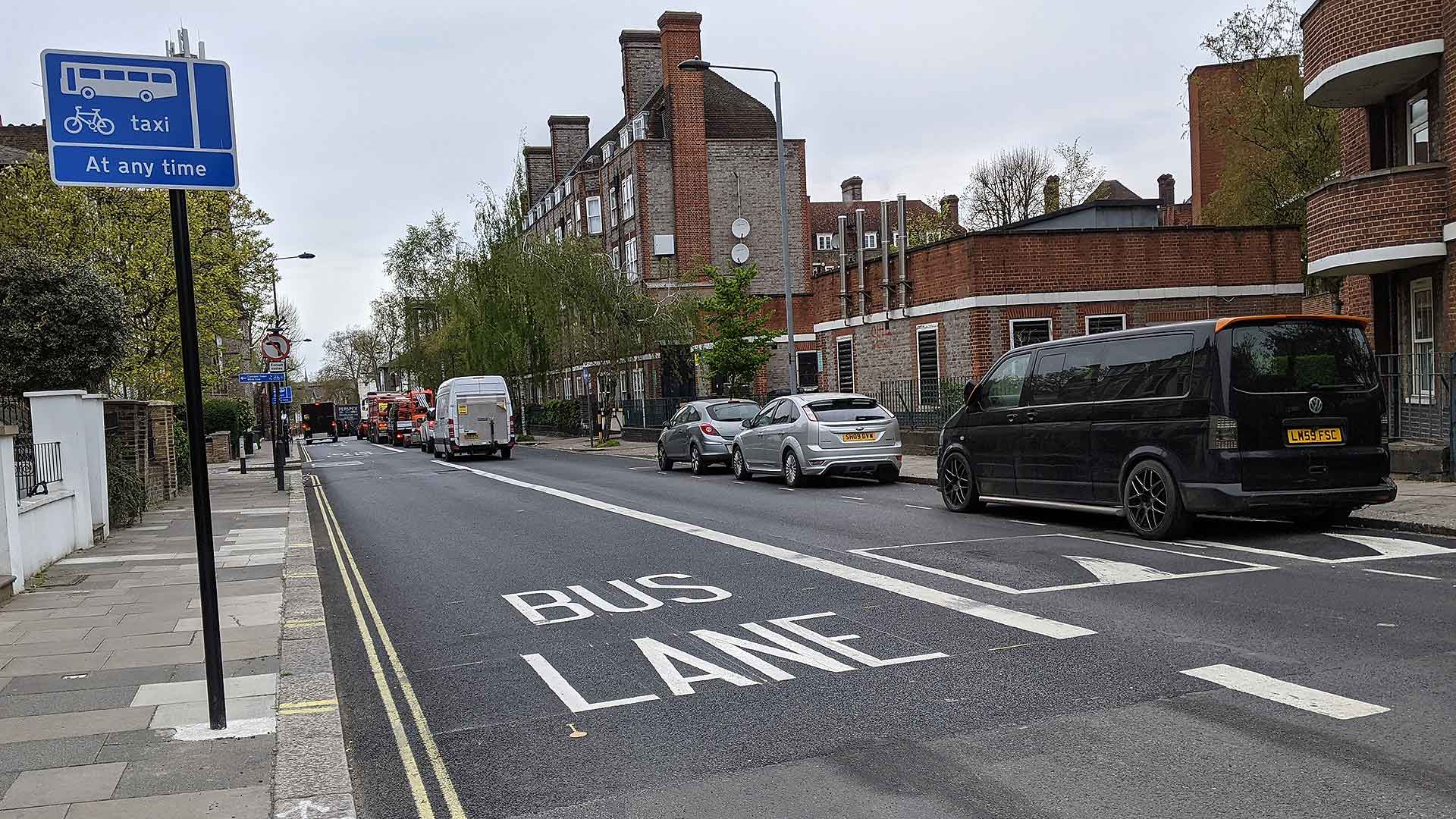
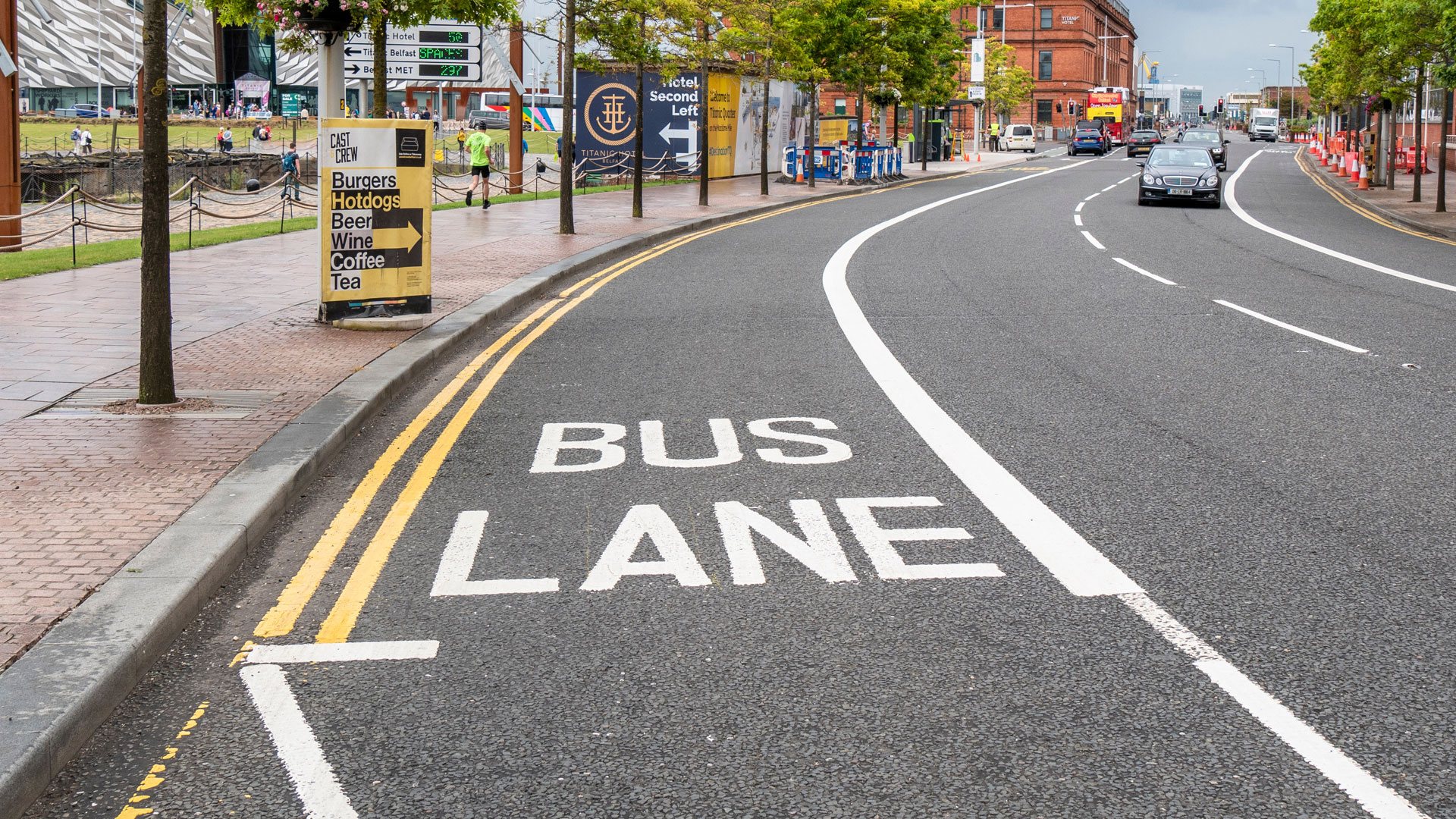
More than a third of motorists have accidentally driven in a bus lane due to confusing signs, road markings or operating times.
Alarmingly, 42 percent of these drivers said they were caught on camera and subsequently fined.
As a result, some 85 percent of drivers now want councils to issue a warning letter for first-time offenders driving in a bus lane – rather than progressing straight to an instant fine.
The RAC is backing up this call to councils. It points out the research shows only four percent of motorists admit to deliberately choosing to drive in a bus lane.
In contrast, 28 percent say they never drive in bus lanes, regardless of whether they are only operational at certain times. In most cases, drivers have been caught out either by missing the signs or being confused by them.
Signs are ‘difficult to understand’
More than half of motorists think that signs for bus lanes operating at certain times of the day are inadequate. Concerns include signs carrying too much information to read and take in while also trying to drive safely. Drivers also feel there aren’t enough signs to warn of bus lanes, along with the signs being too small.
“We have always maintained that the majority of drivers don’t deliberately set out to drive in bus lanes, so it’s good to see this research confirming that,” said RAC head of policy, Simon Williams.
Drivers are expressing “considerable concerns about signs often being hard to spot and difficult to understand,” Williams added.
“Bus lanes are more common in urban environments where the driver’s job in spotting and comprehending bus lane signage is arguably even harder. There is so much else to take in, from vehicles and other road users, to traffic lights and warning signs.”
The RAC has renewed its call for councils to write to drivers who stray into bus lanes for the first time. “Our research shows that far too many drivers end up driving in bus lanes unwittingly, most probably because the signage really isn’t good enough. We therefore feel there’s a good case for this guidance to be updated.”
The irony, Williams adds, is that with so many motorists are avoiding bus lanes altogether due to the fear of being caught out, road space is not being used to its full capacity, with a detrimental impact on traffic flow and local air quality.
Ferruccio Lamborghini wasn’t a fan of motorsport. While Enzo Ferrari sold road cars primarily to bankroll the Scuderia’s racing teams, his rival on the opposite side of Modena saw things differently.
Launching the Lamborghini Miura in 1966 – widely regarded as the world’s first supercar – Ferruccio said: “Every one I build [will be] like winning a Grand Prix, and people will talk about it for long after they have forgotten who won the race.”
Despite its founder’s misgivings, though, Lamborghini did dabble in racing over the years. It supplied 3.5-litre V12 engines to the Larousse, Modena and Ligier F1 teams between 1989 and 1993, then competed at Le Mans in the early 2000s with the Murcielago R-GT.
On-track with Squadra Corse
The turning point came in 2013, with the establishment of Squadra Corse. Literally translated from Italian as ‘Racing Team’, Lamborghini’s in-house motorsport division developed a GT3 version of the Huracan that won titles in the British GT Championship and Blancpain GT Series, among others. The company also threw its weight behind a one-make Super Trofeo race series for wealthy ‘gentlemen drivers’, using the Lamborghini Gallardo at first, then the Huracan from 2014.
The Lamborghini World Finals is the season finale for the three Super Trofeo championships now staged each year: in Europe, Asia and North America. The latest event brought together 73 cars, 121 drivers and more than 10,000 spectators at the Circuito de Jerez near Seville – originally built to host the Spanish Grand Prix.
After three days immersed in all things Lamborghini, I came away with ears ringing and adrenaline coursing, ready to sell the house, remortgage the children and begin a glamorous new life as a Super Trofeo driver. None of those things happened, of course, but here is what did…
Anatomy of a race car
Day one (Friday). I arrive in Jerez and immediately bump into Stephan Winkelmann, Lamborghini’s effortlessly stylish CEO, in the hotel lobby. He has little time for small-talk, however, and I’m due at the track to drive some cars. All I need to do first is register for the event, write out the same details several times over and sign numerous forms promising not to crash and die. If Italians do one thing even better than hedonistic supercars, it’s head-scratching bureaucracy.
At the circuit, qualifying is already underway and the air quakes with a combined chorus of unsilenced V10 engines. I’m given a coveted access-all-areas lanyard, then ushered through to a busy pit garage, where one of Squadra Corse’s tame racing drivers joins me for a closer look at Lamborghini’s current Super Trofeo racer: the Huracan EVO2.
It might look like a Huracan STO in sponsorship warpaint, but the EVO2 is a very different beast to the road car. Its enormous diffuser and swan-neck spoiler boost downforce, while a rear dorsal fin enhances stability at speed. The car’s body is made entirely from carbon fibre – easier to repair than aluminum, as it can be patched and retain its strength – and its 18-inch centre-lock wheels are shod with Hankook slick tyres.
Sideways in a Sterrato
Inside, the Huracan EVO2 looks brutally basic, with no carpets or trim: just an FIA-spec roll cage, custom switch panel and single hard-shell seat. The steering wheel is a detachable, F1-style yoke with colourful buttons that allow the driver to adjust traction control and ABS settings, activate a pit lane speed limiter, communicate with the race engineer and a bewildering amount besides.
The Huracan’s heart is the same 5.2-litre naturally aspirated V10 found in showroom-spec cars, although here it runs on refined racing fuel and drives the rear wheels via a six-speed X-Trac sequential manual transmission (as opposed to a seven-speed dual-clutch automatic). Peak power of 620hp at 8,250rpm means the Super Trofeo EVO2 can actually outpace a Huracan GT3 on the straights – and makes it one of the quickest one-make race cars (a lot of) money can buy.
As the qualifying session roars and rumbles to its conclusion, I’m ushered outside to a waiting Huracan Sterrato. Ironically, recent rain has made the on-site rally stage “too muddy” for skidding about in Lamborghini’s off-road supercar, so an empty car park dotted with traffic cones has to suffice. Still, with a damp surface, knobbly Bridgestone Dueler tyres and that maniac V10 yammering inches behind my ears, I have no difficulty going sideways. Hilariously sideways, in fact. Note: some cones were harmed during the making of this paragraph.
Hybrid theory in a Urus SE
It’s then time to ‘test the agility’ of the new Urus SE on Jerez’s go-kart circuit. And no, a tightly coiled track designed for vehicles with lawn mower engines isn’t the natural playground for a 2.5-tonne SUV. But that doesn’t mean hurling the ‘Rambo Lambo’ around isn’t riotous, tyre-torturing fun. Go kart handling? That’s a stretch, but rear-wheel steering and active anti-roll bars do make the brutish Urus respond like a smaller, lighter car. A proper road test is lined up for tomorrow.
Day two (Saturday). Lamborghini’s press cars are parked outside the hotel like a colourful assortment of pick-n-mix. Elbowing my way into the gaggle of journalists as keys are dished out, I’m allocated a Urus SE for the outward journey, then a Revuelto – Sant’Agata’s latest V12 supercar – for the drive back. Well, it’s probably best to start slowly…
‘Slowly’ is a relative term in an 800hp, 194mph Lamborghini, though. The plug-in hybrid Urus SE replaces the old S and Performante models, retaining their brawny 4.0-litre twin-turbocharged V8 but adding a 25.9kWh battery and rear axle e-motor. The result is arguably the best of all worlds: thunderous performance combined with 37 miles of silent electric range and tax-dodging CO2 emissions of 51g/km.
We can slide away
On the road, the Urus can play the mild-mannered family holdall, but its wild side is never far beneath the surface. Switch into Sport mode and the new electronic rear differential lets it all hang out, dialling down the stability control for ‘on-demand oversteering’. Alternatively, another click of the huge ‘tamburo’ lever selects Corsa mode, tightening the reins for greater steering precision and iron-clad body control (ideal if you happen to be chasing lap times at a go-kart track).
For all its speed and bombast, however, the Urus can’t hold a (Roman) candle to the Revuelto. If Lamborghini’s SUV is like watching the reformed Oasis in 2025, its flamboyant flagship takes you back to Knebworth in 1996, when every note felt more vital and visceral. The drama starts from the moment you glimpse the exposed V12 engine, lift the trad-Lambo scissor door and twist your hips into the low-slung seat. Everything about the Revuelto feels exotic.
With a faintly ludicrous 1,015hp from its 6.5-litre engine and three electric motors – good for 0-62mph in 2.5 seconds and 217mph – the Revuelto smashes through the glass ceiling between supercar and hypercar. Find a sufficiently long straight, bury your right foot and it sucks in the road like a strand of spaghetti. However, while driving a 1990s Lamborghini Diablo was like being strapped to a low-flying missile, now you feel confidently in control, helped by nuanced steering, supple damping and tenacious four-wheel-drive traction.
Make mine a V12
Back at Jerez, a test session is underway for owners of the Lamborghini Essenza SCV12. A track-only evolution of the Aventador developed by Squadra Corse, only 40 Essenzas were made – and seven of them are here at the World Finals. With my brain still scrambled by the Revuelto (appropriately, its name means ‘scrambled’ in Spanish) I lean on the pit wall, sip a strong coffee and let the primal howl of each 830hp V12 wash over me. This extreme machine makes even a Huracan Super Trofeo sound subdued.
Day three (Sunday). With the Lamborghini World Finals champions due to be decided, today is all about the racing. Each Super Trofeo race lasts for 50 minutes, with a compulsory pit stop around half-time that most teams will use to change drivers. Contested in professional (Pro), amateur (Am) and combined (Pro-Am) categories, the action is fast-paced and fiercely competitive.
I wander along the bustling grid, doing my best Martin Brundle impression, when one of Lamborghini’s PR team offers a ride in the Urus SE safety car. We lead out the field on its formation lap, my driver clearly pushing quite hard, but the Huracans that fill our mirrors weave back-and-forth impatiently to warm up their tyres. However fast an 800hp SUV might feel, these fully fledged race cars aren’t even breaking sweat.
Doing it the Lamborghini way
After a day of daring overtakes, close calls and crunched carbon fibre, Egor Orudzhev of the Art-Line team claims the Pro title. Leipert Motorsport’s Brendon Leitch and Anthony McIntosh win in Pro-Am, while Renaud Kuppens of Boutsen VDS lifts the Am trophy. Lastly, GT3 Poland’s Holger Harmsen takes victory in the Lamborghini Cup.
The Huracan EVO2 has one year left to race before the V8-powered Temerario becomes the basis for Lamborghini’s new one-make racer in 2026. Squadra Corse might still be a minor player in motorsport overall, but the successful Super Trofeo series and World Finals have allowed Lamborghini to forge its own path – just as it always did. I think the late Ferruccio would have approved.
Growing demand for custom colours has led Jaguar Land Rover (JLR) to invest £65 million in expanding its factory paint shops.
Buyers of the Range Rover and Range Rover Sport can currently choose from hundreds of bespoke and ‘elevated palette’ paint options.
Interest in these personalised hues has more than doubled since 2022, with customer uptake for the exclusive Range Rover SV up by 100 percent in the past financial year.
A total of £41 million will be invested at the Castle Bromwich Jaguar site in the UK, with a further £24 million allocated for the Land Rover Nitra facility in Slovakia. This investment will double JLR’s capacity for bespoke paint orders, allowing it to cater for more than just the Range Rover brand.
Going big on bespoke
New state-of-the-art paint booths will be installed at Castle Bromwich this year, with automated spraying robots that cut paint waste by 30 percent.
Investment in Slovakia will mean the Land Rover Defender and Discovery can be painted in custom colours. The upgrade includes new fully electric paint booths and curing ovens.
Some 120 new jobs will be created as well, with the first customised SUVs set to leave the line in 2026.
The ultra-exclusive SV Bespoke Paint matching service will also be enhanced. This will allow more customers to have paint colours matched to any shade they desire. This typically adds £70,000 to the average £202,000 paid for a Range Rover SV.
Boosting sustainable customisation
Andrea Debbane, JLR’s chief sustainability officer, commented: “JLR is seeing a significant increase in clients wanting to personalise their vehicles, so we are preparing to expand our facilities and offer thousands more paint options across our brands, but doing so in the most sustainable and efficient way possible.”
Jaguar Land Rover is the latest company to invest heavily in catering to demand for enhanced personalisation. Earlier this year, Rolls-Royce announced a £300 million plan to expand its Goodwood facility, increasing its capacity for its ‘Bespoke’ and ‘Coachbuild’ services.
Similarly, Lamborghini has built a new paintshop at its Sant’Agata factory, ensuring customers can order the Urus SUV and new Revuelto supercar in more wild hues.