Home Blog Page 218

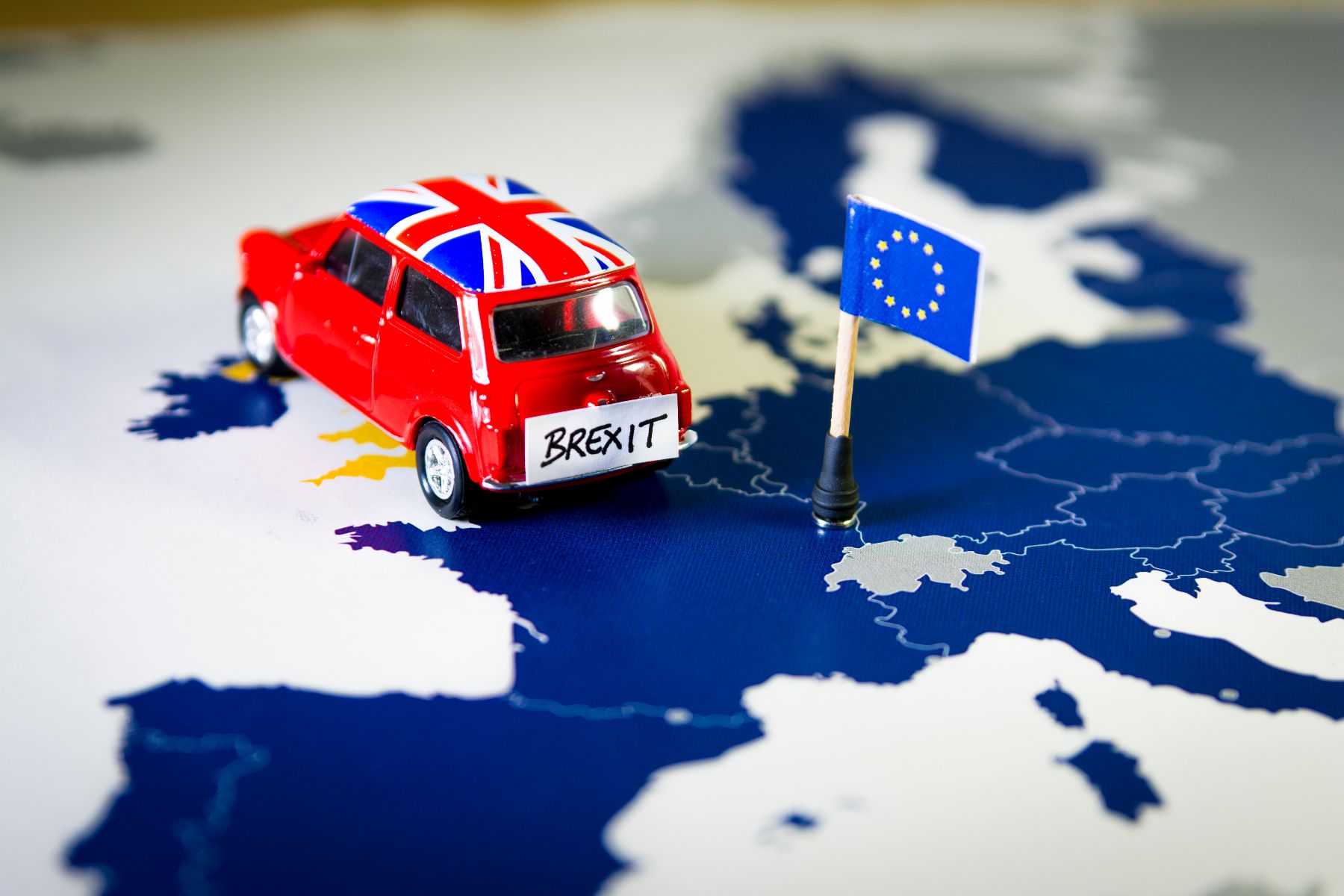
Here’s what a no-deal Brexit will mean for UK drivers

0

Brexit

The EU has abandoned the 13 December Brexit negotiating deadline. This means talks could continue as late as 30 December to allow the UK and EU parliaments to vote on any deal before the deadline of 31 December.

A no-deal Brexit will have serious implications for UK motorists planning to drive in Europe in 2021. Whatever the outcome, driving in the EU will be more difficult than during the transition period in 2020.

In the event of a no-deal Brexit, you will almost certainly need to acquire an insurance Green Card to drive in the EU. This also applies to EU citizens wishing to drive in the UK.

A Green Card is an intentional certificate of insurance issued by providers to guarantee that the motorist has the minimum car insurance required for that country. Without one, you could be refused entry to the country or accused of driving without insurance.

There’s no cost, but the government suggests asking for a Green Card a month before you plan to travel. Most insurance companies recommend applying no later than a fortnight before the date of travel. A Green Card will be required for driving into Ireland from Northern Ireland and vice versa.

You won’t require a Green Card if you’re driving in the EU with a car hired in the UK. However, you will need a VE103 certificate to prove that you’re allowed to drive it abroad. This certificate is available for a free from the British Vehicle Rental and Leasing Association (BVRLA), Freight Transport Association (FTA), RAC Motoring Services or Road Haulage Association (RHA).

Will we be able to drive in the EU after Brexit?

An International Driving Permit (IDP) might be required to drive in countries where a UK driving licence is not considered sufficient on its own. The official GOV.UK website states: ‘The type of IDP that you may need will depend on the countries you will drive through. Further detail on this will be available later in 2020.’

There are three versions of the IDP: 1926, 1949 and 1968. The 1926 and 1949 permits last for a year, while the 1968 permit lasts for three years or until your UK driving licence expires, whichever comes first.

Click here to find out which IDP you need.

How do I get an International Driving Permit?

Brexit

You can get an IDP over the counter at the Post Office. They cost £5.50 and you must live in Great Britain or Northern Ireland, have a full UK driving licence and be 18 or over.

Negotiations are ongoing, so things could change before the end of 2020. However, the days of boarding a cross-Channel ferry with just a passport and driving licence are over.

READ MORE:

Hyundai launches no-deal Brexit price promise

Aston Martin Zagato Twins are the supercars sold as a pair
Advertisement

Ineos takes stake in Mercedes-AMG F1 team

0
Mercedes-AMG F1

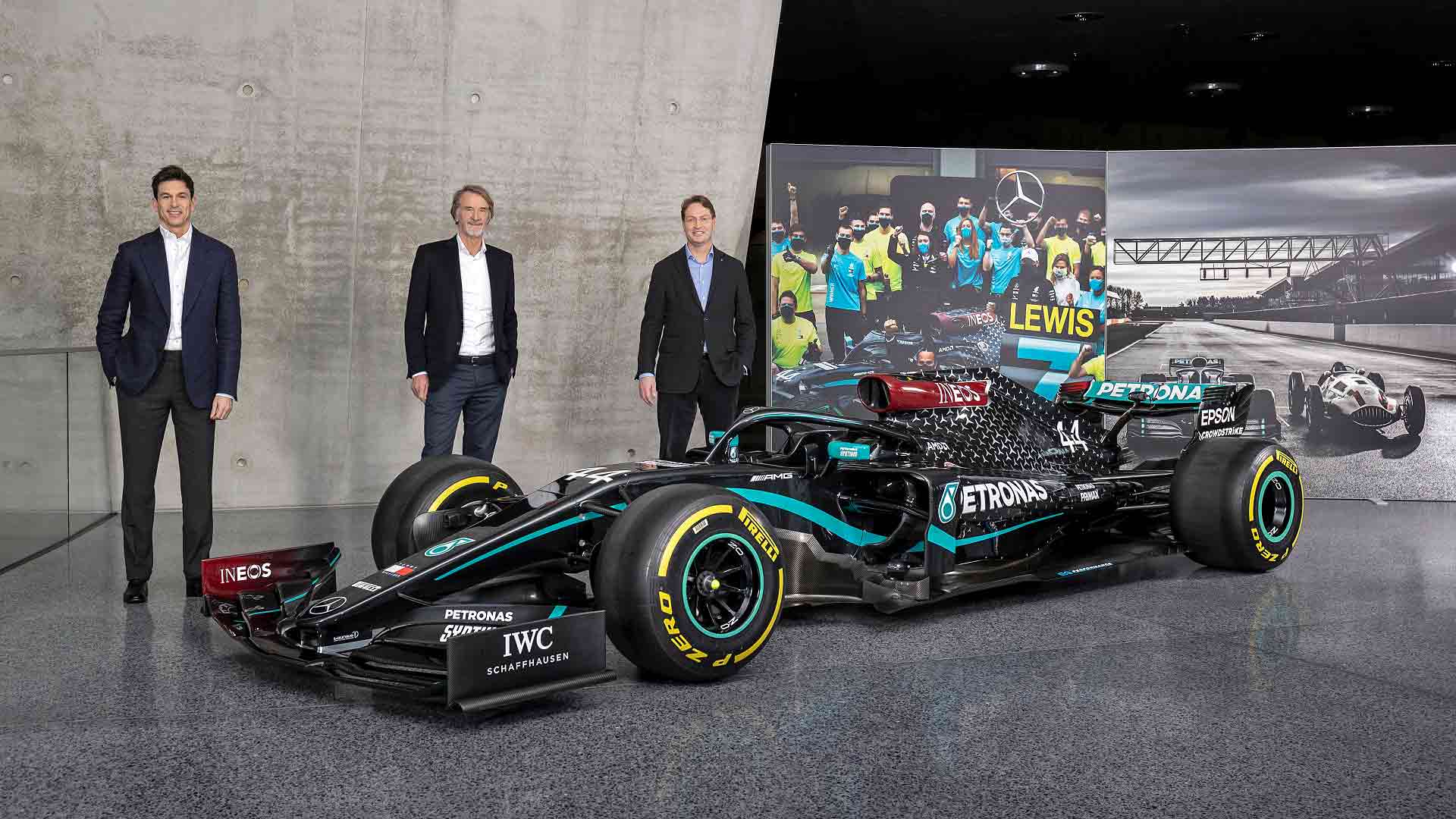
British chemical giant Ineos has become a one-third shareholder in the title-winning Mercedes-AMG F1 team, along with Daimler AG and team boss Toto Wolff.

The UK-based team, which this year powered Lewis Hamilton to his seventh Driver’s Championship, has been in Formula 1 since 2010. It’s won seven consecutive double world championships since 2014.

The investment by Ineos sees Mercedes-Benz parent company Daimler AG’s stake reduced from 60 percent.

Team principal and CEO Toto Wolff’s stake is increased from his current 30 percent to ensure all three owners have equal shares.

Mr Wolff will continue in his role for another three years – and the news is expected to see British champ Hamilton finally sign a new agreement to continue racing for the team.

“This team is like a family for me,” said Mr Wolff. “We have been through so many highs and lows together that I cannot imagine working with a better group of people in this sport – and I am very happy to continue together into this new era.”

Daimler AG chairman Ola Kallenius praised the strength of the F1 operation in Brackley, and said there will now be an even closer alignment with the Mercedes-AMG performance road car division, beginning in 2021.

“When we entered Formula 1 earlier this year, we chose to do so with a Mercedes team that had set new benchmarks,” said Ineos chairman Sir Jim Ratcliffe. “Since then, we have been in discussions about how we could increase our involvement.

“This is a unique opportunity to make a financial investment in a team at the very top of its game, but which still has rich potential to grow in the future.”

The team will continue to race as the works F1 team of Mercedes-Benz, but Ineos branding is likely to feature more prominently.

The news comes after Ineos confirmed the purchase of Daimler’s Smart factory in France, to produce the Grenadier SUV.

Ineos previously planned to build a brand new factory in Wales to produce the vehicle. These plans have now been abandoned.

ALSO READ

Mercedes-AMG One: F1 hypercar named

Our favourite Mercedes-AMG road cars

4 in 5 vehicle-related thefts happen at night

Advertisement

4 in 5 vehicle-related thefts happen at night

0
Keyless theft

Vehicle-related thefts increase by 10 percent during longer nights. That’s according to UK car insurance theft claims data for 2019.

The report found that around 80 percent of vehicle-related thefts happen during the hours of darkness. Alarmingly, 79 percent of vehicle-related thefts occur at the driver’s home, with vehicles parked on the street (39 percent) most at risk. Despite this, around a quarter (23 percent) of drivers don’t always lock their vehicles.

Indeed, figures from the Office for National Statistics (ONS) Crime Survey show that in cases where a vehicle was taken, 14 percent were unlocked. Of the total vehicles stolen in England and Wales, 72 percent were not returned, but of those that were, 48 percent were damaged.

Aviva says it receives more claims for theft between October and December when the days are shorter. The difference is as much as 29 percent compared to June, when the insurance provider receives the lowest number of claims.

car theft claims at seven year high

Sarah Applegate, risk and governance lead at Aviva, said: “Criminals take advantage of the cover of darkness. Sadly this means there can be more opportunities for vehicle crime when nights are longer. We’ve seen this trend in our home insurance claims and the same appears to be the case for vehicle-related thefts.

“But there are simple steps people can take to reduce their risk. Simply locking vehicles and not leaving items on show inside reduces the risk, while items like steering locks, parking posts and garages put physical barriers in the way of a possible theft.

“Only around a third of drivers with garages store their vehicles in them all the time — and almost the same percentage never put their vehicles in their garage. Taking a few extra minutes to lock up and secure a vehicle can make a big difference in the eyes of a thief.”

Aviva has issued the following advice to reduce the risk of vehicle-related thefts:

  • Always lock the doors, even if you’re leaving the vehicle unattended for a few minutes. Close the windows and sunroof.
  • Keep your vehicle keys in a secure place. There is specific advice for combating keyless car theft.
  • Don’t leave anything in your vehicle. Valuables are the most commonly stolen items (39 percent), followed by exterior fittings (19 percent), electrical equipment (13 percent) and tools (10 percent).
  • Consider additional security. Only 16 percent of people use a car key protector to prevent keyless car theft. A car alarm is the most common deterrent (54 percent), but 13 percent of motorists use a physical device, such as a steering wheel lock.
  • Park on a driveway or in a garage. This will reduce the risk of theft or a break-in. Locked gates are used by 10 percent of motorists, while 6 percent use a parking post or retractable bollard.

READ MORE:

How to prevent catalytic converter theft from cars

Land Rover Defender thefts on the rise AGAIN

Vehicle theft rises 56% in four years

Advertisement

James Bond Mercury Cougar movie car sets new auction record

0
Bonhams James Bond Mercury Cougar

The James Bond movie franchise may typically be associated with Aston Martin, but other brands have starred alongside them on screen, too.

Used in the 1969 film On Her Majesty’s Secret Service, this rare Mercury Cougar XR7 smashed the pre-sale estimate with a new world record price. 

When the hammer fell at the Bonhams Bond Street Sale, the rare muscle car achieved an amazing £365,000 ($495,000). 

This is said to be the highest amount ever paid at auction for a Mercury Cougar.

Shaken, not stirred

Released in December 1969, On Her Majesty’s Secret Service was the only James Bond film to see George Lazenby play the role of agent 007. 

Having to follow several impressive previous Bond performances by the late Sir Sean Connery would always be a tough call. It means Lazenby is often glossed over in movie history.

Fittingly, the Mercury Cougar had to play second fiddle to the attention grabbing Ford Mustang. However, collectors have made the luxurious pony car a desirable item today.

Welcome to Cougar Town

Bonhams James Bond Mercury Cougar

Eon Productions ordered three Mercury Cougar convertibles for filming duty, delivered in matching specification. 

Power comes from the 428-cubic inch Cobra Jet V-8 engine, sending 335 horsepower and 440 lb-ft of torque to the rear wheels. A three-speed automatic transmission is in charge of handling all the power. 

It is said to be one of only 127 Cougar XR7 convertibles built for 1969 with this engine combination.

Red paintwork contrasts with a black convertible. Red leather is on the inside, whilst the producers fitted a set of Kneissl skis on the custom luggage rack. 

Who needs four-wheel drive, anyway?

Bonhams James Bond Mercury Cougar

Although a torque-heavy pony car may not seem like the obvious vehicle for a trip to ski slopes, the Cougar was given a special role in the film. It was driven by Bond’s love interest, Contessa Teresa ‘Tracy’ di Vicenzo, played by the late Diana Rigg. 

The particular car sold was used in the famous ‘barn scene’ during the movie. Movie buffs will know this as where Bond proposes to di Vincenzo. 

After filming, the Cougar passed through various owners, before appearing in a classified listing in the 1980s. The vendor purchased the car, and submitted it to a thorough ‘nut and bolt’ restoration. 

After 30 years of maintenance, the Mercury is now said to be in concours condition.

‘An important piece of film history’

Bonhams James Bond Mercury Cougar

Ahead of the sale, a price of between £100,000 to £150,000 ($133,000 to $200,000) had been estimated for the Cougar. 

However, opportunities to purchase a Cobra Jet-powered Cougar XR7 are few and far between. Especially ones which starred on the silver screen. 

This clearly pushed the movie star Mercury way beyond all estimates, resulting in the new world record price.

ALSO READ

Badge engineering: rebranded cars revealed

Frank Stephenson on the rights and wrongs of car design

We take a Rolls-Royce to find Britain’s best fish and chips

Advertisement

These are the cities with the biggest catalytic converter theft increases

0
Catalytic converter theft cities

Car crime has seen a resurgence in the United Kingdom over the past three years, with catalytic converter thefts a growing problem.

Criminals have discovered the potential to make quick money by stealing the exhaust components for the precious metals contained within. 

New research has uncovered the locations across the country that have seen the biggest increases in stolen catalytic converters.

London tops the charts

Catalytic converter theft cities

The research, undertaken by Compare the Market, was based upon a series of Freedom of Information requests made to police forces. This analysed information for catalytic converter thefts for the previous three years. 

Unsurprisingly, London has the largest total of catalytic converter thefts. More shocking is that 12,483 of the 15,237 total thefts in the capital happened in the last year alone. 

Away from London, the overall numbers of catalytic converter thefts fall substantially. Birmingham and Coventry are the next highest, with 320 and 287 stolen ‘cats’ in the past three years respectively. 

However, it is the upward trend in these locations that is now causing concern.

Cat thefts on the rise

Catalytic converter theft cities

Warrington tops the charts for the biggest rise in thefts. Jumping from a single stolen catalytic converter in 2018/19, to 28 in 2019/20, makes for a 2,700 percent year-on-year increase.

Cities in the West Midlands complete the top three, with both Wolverhampton (1,475 percent increase) and Coventry (652 percent increase) included. 

Compare the Market also investigated the London boroughs with the largest rises. Sutton in south London recorded a 1,608 percent year-on-year increase, followed by Bromley and Havering.

Metal prices through the roof

Catalytic converter theft cities

Driving the increase in catalytic converter thefts are the metals found inside them. The values of platinum, palladium and rhodium have all seen huge rises, making them an attractive commodity for thieves. 

The lower emissions from hybrid cars have made them a particular target. Criminals believe the precious metals inside their catalytic converters suffer less corrosion, boosting their value. 

Dan Hutson, head of motor insurance at Compare the Market, commented that: “These statistics are high and the value of metals has gone up significantly, resulting in a car part which was previously of little interest to thieves suddenly becoming very valuable, which explains the spikes.”

Along with having comprehensive insurance, drivers can take a number of measures to protect their catalytic converters. This includes parking your car in a garage, installing CCTV, or fitting a dedicated ‘cat lock’ device.

READ MORE:

How to prevent catalytic converter theft from cars

Car dashboard warning lights: what do they mean?

The hidden secrets of everyday motoring

Advertisement

Kia Sportage JBL Black Edition includes free portable speaker

0
Kia Sportage JBL Black Edition

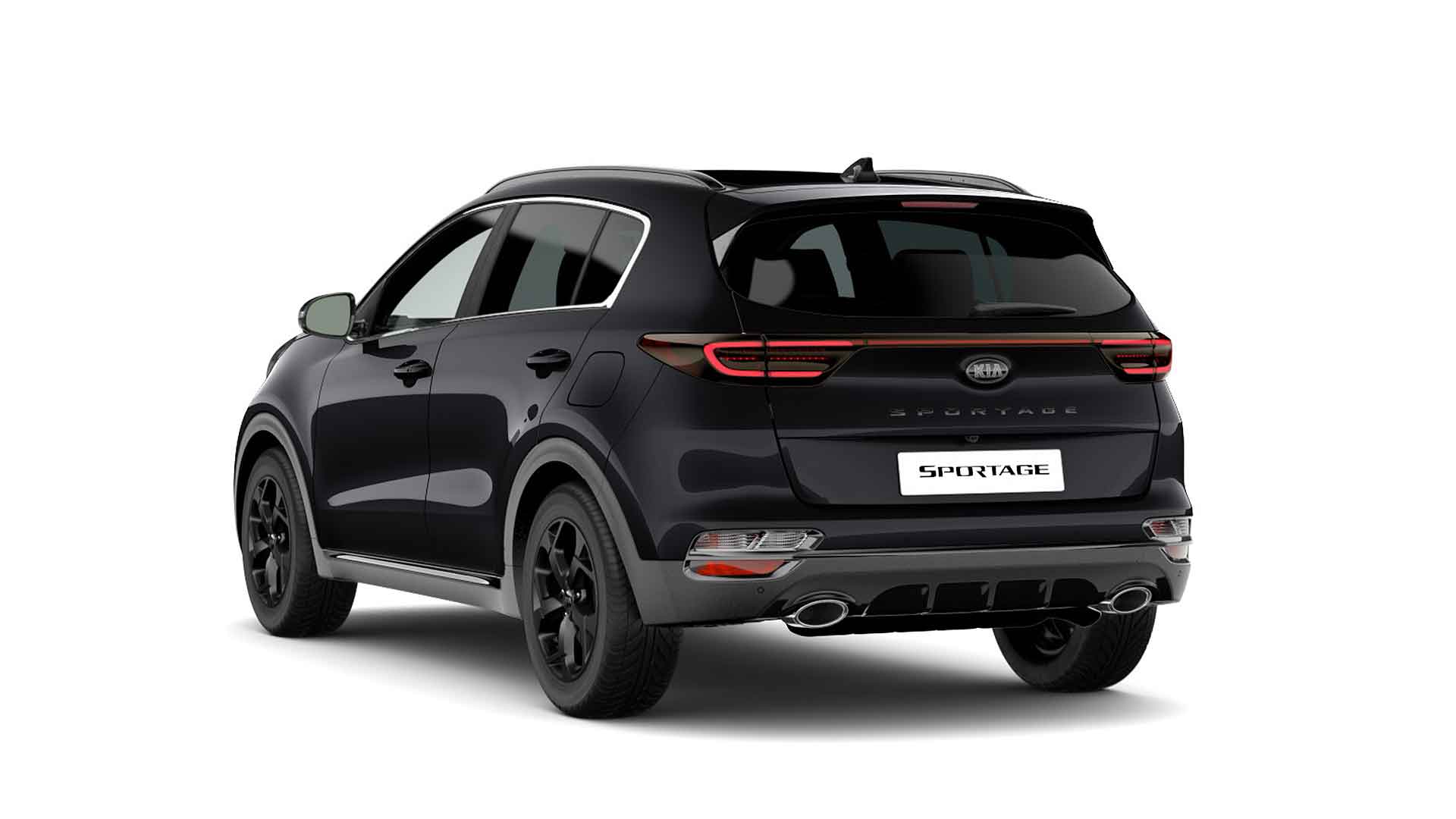
Kia has launched a new special edition Sportage JBL Black Edition that comes with a unique feature – a free portable Bluetooth JBL speaker.

This is in addition to a standard eight-speaker JBL premium audio system that includes external amplifier, subwoofer and front centre speaker.

The free JBL Flip 5 device effectively gives the new model a nine-speaker setup, and allows owners to enjoy premium audio away from their vehicle.

JBL Flip 5 speaker

Priced from £28,545, the new JBL Black Edition lives up to its name with a full ‘black pack’ makeover.

There’s a new black front grille, front and rear skid plates, headlights and fog lamps, gloss black roof rails – even the side sill finishers are now finished in black.

Kia has darkened the front and rear badges and switched silver Sportage lettering on the tailgate for gloss black (and located it centrally across the bootlid). Black alloy wheels and doorhandles complete the Black Edition appearance.

Available with a 174hp 1.6-litre turbo petrol or 136hp turbodiesel – both with either manual or automatic gearboxes – the Sportage JBL Black Edition is based on Sportage ‘3’ grade.

Kia Sportage JBL Black Edition

This includes panoramic roof, LED headlights and tail lamps, keyless entry, heated front and rear seats plus an 8.0-inch touchscreen with Android Auto and Apple CarPlay.

Kia says ordering is open now – and adds that owners will get their free JBL Flip 5 speaker after setting up a MyKia account.

ALSO READ

DAB must be standard on new cars from December 2020

Waze integrates Apple Music into sat nav app

2020 Kia Sportage update: full prices and specs

Advertisement

Cazoo buys Drover in car subscription push

0
Cazoo car transporters

Online used car retailer Cazoo has bought new car subscription platform Drover as part of its plans to launch a subscription service in 2021.

The acquisition means Cazoo can now offer motorists the ability to buy, finance or subscribe to any of its cars.

Drover offers car subscription contracts ranging from one to 24 months. A single monthly payment covers the car, maintenance, servicing, tax and breakdown cover. All motorists have to pay for is fuel.

It is described as a “flexible and hassle-free alternative to car ownership”.

Volkswagen and Drover

In 2019, Drover partnered with Volkswagen to launch subscriptions of new cars: a Volkswagen Golf subscription cost from £528 a month, and a Volkswagen Tiguan was priced from £643 a month.

Other car companies on the Drover platform include Citroen, DS, Peugeot, Jaguar, Land Rover and Lexus.

Cazoo says ‘cars-as-a-service’, a fast-growing market, will now form a core part of its wider strategy.

Already calling itself the ‘Amazon of cars’, Cazoo believes the purchase will also allow it to become the ‘Netflix of cars’.

The company has achieved a valuation of over £2 billion and has delivered 10,000 cars in the year since its launch.

Earlier in 2020, Cazoo purchased car retail group Imperial Cars, converting the dealership sites into ‘customer centres’. 14 have been opened during the past 14 weeks.

Subscription customers will be able to use the customer centres too, if they don’t want to have their car delivered to their door.

The Drover brand and platform will now be integrated into Cazoo.

Financial details of the acquisition were not disclosed.

ALSO READ

Bentley boss: ‘My ideal Christmas present is an EU deal’

Driving tests HALVE due to coronavirus

New van safety rating slams 1 in 4 models

Advertisement

Bentley boss: “My ideal Christmas present is an EU deal”

0
Adrian Hallmark

“My ideal Christmas present would be a deal with the European Union,” says Bentley CEO Adrian Hallmark. Nonetheless, he explains the British luxury carmaker is prepared for no-deal, stockpiling a month’s supply of production parts where two days is the norm. “We don’t welcome a hard Brexit, but we’re ready for it.”

This has been a turbulent year for Bentley, which achieved record profits in the first quarter, followed by a record loss – and the announcement of up to 1,000 job cuts – in the second quarter. The company has also ceased all motorsport activities as a cost-cutting measure.

Despite the twin challenges of Covid-19 and Brexit, Hallmark says Bentley ends 2020 in “good shape”, breaking even and with an order bank 50 percent larger than at the start of the year.

“My favourite description of crisis management is ‘doing everything in a six-month period that you should have done over the past five years’ – and there are so many examples of that here,” he explains. So what comes next?

‘Luxury is a growth trend’

Bentley Beyond 100

“Luxury is a growth trend across all categories, not just cars,” says Hallmark, “and I think that will continue.”

In the longer term, he cites Bentley’s ‘Beyond 100’ strategy for sustainability as a major potential advantage. “We only build small numbers of cars, so it’s easier for us to decarbonise our footprint and choose materials that are ethically and environmentally transparent.”

One example is the 5,000-year-old river wood used in the Bentley EXP 100 GT concept car, a waste product from farming, which is preserved in peat. 

Discussing the social effects of the pandemic, Hallmark says: “We’ve all learned that you don’t have to travel all the time. But when you do, isolation is not a bad thing. It’s created even more need for a private bubble – a haven, if you like.”

‘Electrification is an obligation’

Bentley EXP 100

Bentley has stated it will only sell plug-in hybrid vehicles from 2026, and will go fully electric by 2030. “Electrification isn’t an option, it’s an obligation,” Hallmark believes.

The shift to battery power is also more straightforward for a luxury brand, he says. Most Bentley customers have access to a charging point at home or work, and 39 percent are already considering an EV for their next car.

“The inter-city charging network is the next frontier. If you look at the rate of ramp-up for charging points, it will support 30 percent of the total UK vehicle fleet by 2030. If we create innovative charging solutions on top of that – such as inductive charging or a lorry with batteries in the back that gives you a boost while you have lunch – we can make it work.”

Vorsprung durch Bentley

Bentley at Crewe

One consequence of Bentley’s shift to electric vehicles will be closer alignment with Audi. In the past, the marque has shared more platforms and hardware with Porsche (all three brands are part of the Volkswagen Group).

Bentley will formally move under Ingolstadt’s wing in the second quarter of 2021 and will benefit from Audi’s new Artemis initiative for electric, highly automated cars.

“It makes sense to find the best organisation for synergies,” explains Hallmark. “Whether the Audi solution will be shareholding or simply governance is not yet determined. But we see this as an opportunity, not a risk.”

Bentleys are for driving

Bentley at Crewe

Hallmark says the idea of Bentleys being chauffeur-driven cars is a myth. “That was the case 50 years ago, it’s not the case today. Even in China, more than 90 percent of our cars are driven by the owner.”

“The driving feel of a Bentley is one of the top three attributes cited by our customers for buying one,” he reveals. “Autonomous cars are definitely on the agenda, but we want to orientate around the driver, with autonomous features that take the stress out of the boring bits – e.g. junction-to-junction on the motorway or complex parking manoeuvres.”

A return to motorsport is also on the cards eventually. “Racing was one of the key foundation stones for building the image of Bentley. It was the proving ground for [company founder] W.O. and for the people around him.

“For Bentley never to race again would be difficult to imagine, but it has to be relevant. Endurance racing with renewable energy is where we’d want to be.”

READ MORE:

Bentley Bentayga (2020) review

Bentley Flying Spur (2020) review

British brawn: The history of Bentley

Advertisement

Driving tests HALVE due to coronavirus

0
Driving test coronavirus precautions

The number of driving tests conducted in the period from July to September was down 53.8 percent compared with the same period in 2019. This is according to figures released by the Driver & Vehicle Standards Agency (DVSA).

A total of 188,520 people took a practical driving test in the quarter. This followed the cancellation of driving tests for non-critical workers for a four-month period from 20 March until 22 July. Driving theory tests were suspended on 19 March, but restarted on 4 July when lockdown measures were eased.

The reduction in the number of theory tests was smaller: 455,177 tests were conducted in Great Britain. This represents an 8.4 percent reduction compared to the same period in 2019.

Pass rates are up, with 50.1 percent of candidates passing in quarter two. That’s a 3.9 percent increase on the same period in 2019. The DVSA says this is likely to be a result of priority testing for critical workers, who may have received additional training.

The pass rate for theory tests was 56.3 percent – an increase of 8.2 percent. According to the DVSA, this is due to the candidates being better prepared and motivated, due to the suspension of tests earlier in the year.

A face mask is required

hardest place to pass the driving instructor test

Candidates can book a driving test up to 18 weeks in advance. The online service is available from 6am until 11.40pm, but a face mask is required unless you have a ‘good reason’ for not wearing a mask. If you cannot wear a mask, you may not be able to take your test at the test centre of your choice.

Driving and theory tests were were suspended in England from 5 November until 2 December when the government announced new national restrictions. The DVSA said: “We are emailing everyone with a test booked in England to let them know their test has been put on hold and they will need to reschedule it.”

Driving tests are taking place in England and Wales, but there are regional variations in Scotland. Tests continue in council areas under protection levels 0 to 3, but are suspended in level 4 areas.

Click here to read the latest updates and to check the safety precautions in place.

Advertisement

New van safety rating slams 1 in 4 new models

0
Euro NCAP commercial van safety ratings

A surge in home deliveries means the UK van market is booming – but new tests by Euro NCAP and Thatcham Research suggest many new models are failing to meet even minimum standards for safety.

The two organisations have, for the first time, conducted safety tests on vans, similar to the Euro NCAP crash tests already carried out on new cars.

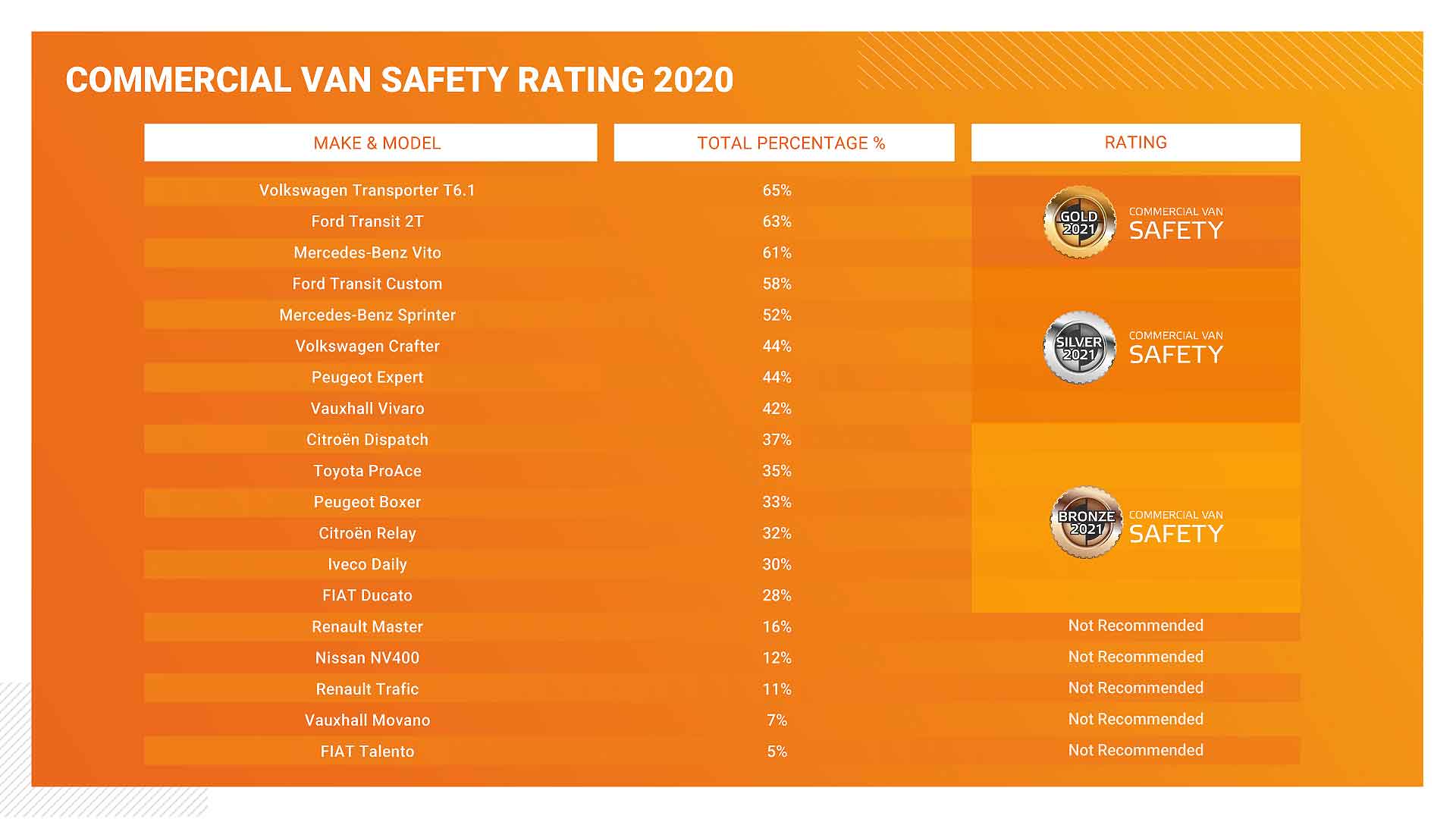
Alarmingly, from the group of 19 vans to first go through the new testing regime, five performed so poorly they failed even to achieve a basic ‘bronze’ rating and were thus deemed ‘not recommended’.

Only three new vans earned the top gold rating.

As vans are involved in more accidents causing fatal injuries than any other vehicle on UK roads, the results are alarming.

“The first batch of test results show the fitment of crucial safety technology on vans is woefully low,” said Thatcham Research director Matthew Avery.

“It’s a serious issue that needs addressing urgently, particularly with van numbers increasing.”

Vans ‘less safe than cars’

The organisations chose 19 vans in the first commercial van safety rating tests. These represent 98 percent of the new van market in the UK.

Less than 13 percent of new vans feature autonomous emergency braking (AEB), they discovered. For cars, the fitment rate is 2 in 3 new models, and rising all the time.

“There is a definite lack of parity between the levels of collision avoidance technology on vans compared to cars. Modern cars have lots as standard, but vans have barely any,” said Mr Avery.

Accusing vehicle manufacturers of withholding safety technology on vans to keep costs down, Mr Avery called it a “ridiculous situation because the systems already exist and could be fitted if they wanted them to be”.

There were more than four million vans on UK roads in 2019, with numbers increasing all the time thanks to the surge in home deliveries caused by the coronavirus.

Fitting more safety technology to vans will “reduce collissions, create parity between cars and vans, and help protect the public from serious injury and death”.

2020 commercial van safety rating results

Gold

Volkswagen Transporter: 66%

Ford Transit: 64%

Mercedes-Benz Vito: 62%

Renault Master: 17%

Nissan NV400: 13%

Renault Trafic: 11%

Vauxhall Movano: 8%

Fiat Talento: 5%

Commercial van safety ratings

ALSO READ:

Calls for 50 percent tax on most polluting vehicles

Thousands not sure if they drive a car or a van

2020 Toyota Yaris ‘a safety benchmark’ says Euro NCAP

Advertisement