Police forces are now able to instantly access driving licence photos to confirm motorists’ identity at the roadside, saving time and reducing the number of arrests.
The new tech developed by the DVLA enables officers to access the organisation’s photograph database almost immediately via a handheld smart device
This compares to a wait of up to 16 minutes for officers to confirm identity without the new tech.
In some cases, it has taken so long, it has resulted in an arrest as the motorist is taken to the station to complete the checks.
The DVLA estimates the technology, which has been used in pilots by selected forces since August 2019, has saved more than 14,000 hours for Road Police Unit Officers.
It has made roadside checks up to 66 percent faster.
18 police forces are already using the tech, with 10 more in coming weeks – and the service set to roll out across all 46 police forces across the UK.
The innocents
“This development will not only free up valuable police time but also make sure innocent drivers can get back on their journeys quicker,” said roads minister Baroness Vere.
DVLA chief executive Julie Lennard said the new tech is something that will “directly benefit citizens.
“The ability to support quicker and more robust roadside checks for motoring offences through the better use of technology is something we were pleased to help deliver.”
The DVLA says photographs are accessed via sourcing the motorists’ driving licence number from the Police National Computer.
This allows them to access the correct image from DVLA records.
The police officer receives the images solely to complete the check – they are only accessible during the enquiry and are not retained.
Nearly 90,000 driver images have already been accessed by police during the trails.
Aston Martin has traditionally been defined by brutish, front-engined GT cars. Think Sean Connery in a DB5, Pierce Brosnan in a Vanquish or Daniel Craig in a DBS. Now, the British brand has aimed its Walther PPK straight at Ferrari – and it has a view to a kill.
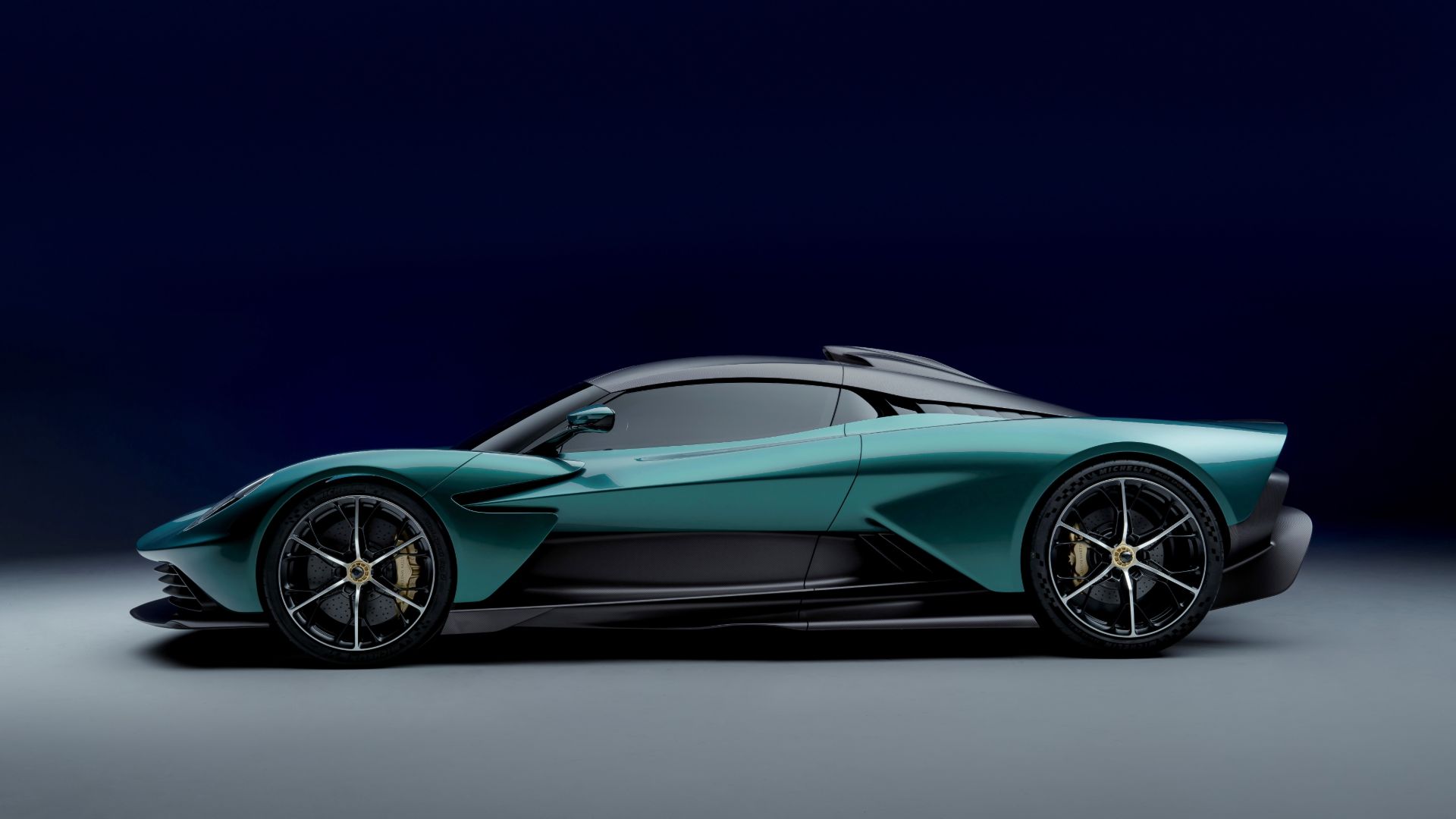
Enough with the Bond puns. You’re looking at the new Valhalla, Aston Martin’s answer to the Ferrari SF90 Stradale. With a hybrid powertrain, carbon fibre tub, active aerodynamics and F1-style pushrod suspension, there’s nothing traditional here.
Fittingly, our first glimpse of the Valhalla was at Silverstone, home of the Aston Martin Cognizant F1 team. This Sunday, the circuit hosts Aston’s return to the British Grand Prix after more than 60 years.
But first, there are Covid-friendly elbow-bumps, drinks, speeches and – finally – a new supercar to swoon over.
Extreme performance
Supercar? Frankly, the Valkyrie accelerates headlong through the glass ceiling into hypercar territory. The combined punch of its 4.0-litre twin-turbo V8 and 150kW hybrid system serves up 950hp and a mighty 1,000Nm (738lb ft) of torque.
The flat-plane V8 contributes 750hp and revs to 7,200rpm. It drives the rear wheels and breathes through top-exit tailpipes for an ‘authentic Aston Martin sound character’.
The remaining 200hp of electric drive is split between front and rear axle motors, with up to 100 percent sent rearwards for maximum performance. The headline figures are 0-62mph in 2.5 seconds and a top speed of 217mph.
Aston Martin is also targeting a Nurburgring lap-time of less than 6min 30sec. For context, the current road-legal record is 6min 38.8sec, set by a Manthey-modified Porsche 911 GT2 RS.
Developed by F1 drivers
When you aren’t blitzing Bergwerk or nudging Vmax at Döttinger Höhe, the Valhalla offers a zero-emissions range of 9.3 miles: key to achieving predicted CO2 emissions of just 200g/km.
Top speed in EV mode is 80mph and the electric motors also function as a reverse gear.
The other key component of the powertrain is a new – and fiendishly complex – eight-speed dual-clutch transmission. Impressively, the V8 and electric motors can run different gears simultaneously to boost torque.
An electronic limited-slip differential on the rear axle delivers ‘maximum traction and handling agility’, says Aston Martin. With development drivers including Sebastian Vettel, Lance Stroll and Nico Hulkenburg, we’re inclined to believe them.
Low-flying jet
The Valhalla’s sculpted, dramatic styling is little changed from the AM-RB 003 concept car, first seen at the Geneva Motor Show in 2019. Unmistakably mid-engined, it resembles the love child of a Le Mans prototype and Typhoon fighter.
A slatted grille is perhaps the only hat-tip to Astons of old, framed by full LED matrix headlights and a jutting splitter. A roof scoop and slash-cut side vents feed air directly to the hungry V8.
Access is via upwards-opening dihedral doors, while the lack of a rear window means relying on the surround-view cameras (and possibly prayer) for parking manoeuvres. Mind that carbon fibre…
The car’s interior hasn’t been revealed yet, but we’re promised an ‘innovative new central touchscreen’ with Apple CarPlay and Android Auto connectivity. The seat bases are fixed, so you adjust the pedals and steering column to find the right driving position.
Attack the track
A target dry weight of ‘less than 1,550kg’ undercuts the SF90, even if the Italian car has the lightweight Assetto Fiorano pack fitted. ‘F1 inspired’ active aerodynamics and underbody venturi tunnels muster 600kg of downforce at 150mph.
The Valhalla’s carbon tub is suspended by pushrods at the front and a multi-link design at the rear, with inboard components to reduce unsprung mass. Multimatic variable springs and spool valve dampers ‒ also seen on the Aston Martin Vulcan – provide a range of adjustment, including a belly-scraping Track mode.
Tyres are bespoke Michelins (20-inch front, 21-inch rear) and the Valhalla is reined in by huge carbon-ceramic discs with brake-by-wire tech.
Premium Bond
Want one? Expect to stump up somewhere between £600,000 and £700,000 and join a long waiting list. The first year of a two-year production run is already sold out, and deliveries won’t begin until 2024.
New Aston Martin CEO Tobias Moers said: “With Valhalla, not only have we stayed true to our commitment to build a world-beating supercar, but we have exceeded our original aims. The result is a pure driving machine – one which exists right at the cutting edge of performance and technology, yet allows the driver to feel the emotion and thrill of complete connection and control.”
It all adds up, we hope, to an era-defining supercar that will leave you shaken and stirred (sorry, couldn’t resist).
Look out for the Valhalla’s screen debut in No Time to Die this September.
A week of action by police and Highways England with an unmarked HGV ‘supercab’ on the M6 motorway saw more than 600 motorists caught committing driving offences.
The undercover truck, which allows police to look down and spot offending motorists, patrolled the entire length of the M6 during the week-long campaign, dubbed ‘Operation Vertebrae’.
Actions taken by police include words of caution, fixed penalty notices… and eight arrests.
The most common offence was not wearing a seatbelt, while 1 in 6 motorists were also caught using their mobile phone illegally.
One driver was playing online poker; another was FaceTiming his partner.
PC Jamie Blood led the campaign in Warwickshire. “Once again, it is terribly disappointing that we encountered so much poor driver behaviour on our roads.”
Some of the most dangerous drivers were spotted in the region, including someone who had no driving licence or car insurance, who was not wearing a seatbelt… and neither was a four-year old sat on someone’s lap in their car.
Another motorist in Warwickshire had 22 points on their licence, and no insurance.
Elsewhere, the Central Motorway Police Group pulled over a car near to junction 10 of the M6.
It had false plates and no documents, while the driver only had a provisional licence. They were reported to the courts and the vehicles was seized.
Highways England head of road safety Jeremy Philips said the campaign has “raised awareness that those who engage in high-risk behaviours can expect to be spotted and, if an offence has been committed, action will be taken by our enforcement partners”.
Since the Operation Tramline HGV supercab initiative launched in 2015, almost 22,000 motoring offences have been spotted – with the most common being using a mobile phone and not wearing a seatbelt.
Fancy yourself as a smartphone snapper? Want to attempt more than selfies and pictures of your breakfast? Here’s how to take your Instagram car photography to the next level.
By teaming up with pro photographer Julian Calverley, Skoda has offered tips on how to get the best out of whatever photo equipment you have.
The shot begins before you’ve even opened the camera app, preferably with a good-looking car in some stunning scenery. We’ll let you draw your own conclusions about the Skoda Octavia (above), but a moody morning in Wales seems a good place to start.
Below are five steps that Calverley insists will improve your Instagram photography. Like and follow, etc…
1. See the bigger picture: Make sure your shoot is suitable as a thumbnail. Use dramatic locations if possible and apply the rule of thirds, mentally dividing the photo into nine equal squares (helpfully, most phone cameras do this for you).
2. Start early and follow the sun: They don’t call it ‘golden hour’ for no reason. Dawn and dusk provide the most photographically sympathetic light levels. The middle of the day is often too harsh and bright.
3. Perfect weather isn’t always perfect: Equally, clear skies can make for bad photos. The calmness of a cool overcast or rainy day is the smartphone photographer’s friend.
4. Find the best angle: Move around the car, don’t zoom in. Once you’ve set the scene, you’re free to shoot from whatever angle you like. Tiny changes make a difference.
5. Cars have eyes, too: The headlights are a nice point of focus, like eyes on a person. If you’re shooting the front of the car, use sidelights only – no main beams. If you’re shooting from the rear, switch the lights on.
Add it all up and Julian reckons you have the makings of some great Instagram photography. Good luck!
It will also feature the debut of F1’s new Sprint Race qualifying format, intended to bring extra excitement to proceedings.
Best of British on track
The special video sees a championship-winning 2011 Red Bull Racing RB7 pitted against six (mainly) classic British vehicles.
Rivals range from a London bus, to a black cab and even a car full of festival goers. However, the star of the show is an RAF Supermarine Spitfire.
Capable of close to 400mph, almost double the top speed of the RB7 F1 car, the Spitfire is a worthy adversary.
We will let you watch the video to see whether 1940’s engineering can vanquish a modern Formula 1 machine…
Fans back in the Silverstone stands
Red Bull Racing CEO and Team Principal, Christian Horner, said that his personal ‘winner’ from the race “has got to be the Spitfire – the sound, the grace it has in the air, it is fantastic to see”.
Significantly, this weekend’s British Grand Prix will feature a full-attendance crowd. Horner commented: “We have really missed fully attended races and I think this is the first time we are going to see a proper crowd and I think that it is tremendously exciting.”
He added: “It’s always a great thrill to race in front of the British public – I live only 10 minutes from Silverstone, so for me, I get to sleep in my own bed! I’ve always loved the British Grand Prix, so I’m looking forward to seeing everybody there.”
Max Verstappen, Red Bull Racing driver and current F1 championship leader, is looking forward to having fans back.
He said: “When we were at Silverstone last year, the track was amazing, but the atmosphere was missing. To have the British crowd back again in full attendance will be really special and I hope that the race is going to be just as exciting.”
More than 9 in 10 car buyers say the test drive is a crucial part of the purchase process – but 7 in 10 say they would prefer unaccompanied test drives to continue.
Solo test drives became commonplace during the pandemic as it was not possible to reliably practice social distancing with the salesperson in the car.
But as restrictions ease, car buyers are calling for unaccompanied test drives to continue, as it allows them to concentrate on the car and not be distracted by the salesperson.
Young drivers aged 18-24 are particularly keen on solo test drives.
It also allows for longer test drives without tying up a busy sales executive: two in three car buyers say from 15 minutes to two hours is ideal – and one in five want test drives to last longer than two hours.
Track test
AX Innovation is a company that manages the vehicle tracking systems necessary to make solo test drives possible.
This includes alerting car dealers about driver behaviours and misuse, and removing disputes around speeding fines and other charges car buyers may receive during the test drive.
MD Vince Powell said: “Driving an unfamiliar car requires an extra level of concentration, particularly when you are trying to determine whether or not the car is right for you, and many buyers clearly don’t welcome the distraction of a salesperson.
“However, it’s perfectly understandable for dealerships to have concerns that some customers may mistreat vehicles without the supervision of a salesperson.
“This is where telematics devices play an important role, deterring customers from driving vehicles inappropriately.”
Apple’s digital car key is now available to use. The function was introduced as part of the iOS 13.6 update in mid-2020.
The car key brings the ability to unlock and start your car, simply by using your iPhone or Apple Watch.
Read on for a full explanation of how it works, along with the cars that currently support this new technology.
Which Apple smartphones support the car key function?
Apple’s newest iOS smartphones are the ones which offer car key functionality.
To use the digital key, you will need one of the following iPhones:
iPhone SE
iPhone 11 (including Pro and Max)
iPhone XS (including Max)
iPhone XR
The phone will need to be updated to the latest iOS 14.6 operating system. You will also need to be signed in to the iPhone using your Apple ID, and have access to your iPhone password protected.
What about using my Apple Watch?
Only Apple’s latest version of Watch range is currently able to work as a digital car key.
That means you will need to have a new Apple Watch Series 5, ideally running the latest Watch OS 7.5, to use the functionality it brings.
What cars support Apple car keys?
At the moment, BMW is the only manufacturer to offer support for Apple’s digital car key.
The German marque does at least offer it for a broad range of vehicles. The 1, 2, 3, 4, 5, 6, and 8 Series models are all compatible, along with the X5, X6, X7 and iX3.
The relevant car will need to have been manufactured after 1st July 2020, and be fitted with the Comfort Access (SA 322) option. Connected Drive Services will also need to be active on the car.
When will other cars use Apple car keys?
Apple is yet to confirm any other manufacturer opting to offer the digital car key function.
Apple is part of the Car Connectivity Consortium, which also includes Volkswagen, General Motors and Hyundai, so these companies may follow BMW in adopting the technology.
Although other companies include standalone digital key apps, the new Apple version sees access fully integrated into the wallet function of the iPhone. Using the wallet function means greater security, and the enhanced usability.
What else do I need to use Apple car keys?
Users need to download the BMW Connected app to their chosen Apple smartphone. This is needed to create a BMW ID, or link an existing BMW ID, to your compatible car.
After creating a BMW ID, and adding your BMW to the Connected app, you can then create the digital car key.
BMW requires users to be inside the car, and with both physical keys present, to prove your ownership. The Connected app will then take users through the steps to add your Apple device as a digital key.
What does the Apple digital car key actually do?
The digital car key offers two functions with compatible cars. Users can unlock and lock the car with their Apple device, and also start the car once inside.
This is as simple as holding the Apple device near to the door handle to unlock, or lock, the car. Only the driver’s-side door will be unlocked with the digital car key.
Once inside, users can place their Apple device in the smartphone charging tray, then press the engine start button.
An ‘Express Mode’ allows owners to use the digital car key without the need to enter a passcode, or use Face ID on the Apple device.
Can I still use Apple car keys if my iPhone battery is flat?
Yes. Apple has pre-empted worries about how to unlock your car if your iPhone battery runs flat.
When the iPhone battery gets very low, it enters a special ‘Power Reserve’ mode. This setting will see the iPhone retain enough charge to use the digital car key function for up to five hours.
If you manually turn your Apple device off, it will need to be turned back on to use the digital car key.
How can I share my Apple car key with others?
One of the more impressive functions of the Apple car key is the option to share it with up to five other people.
Users will need a compatible iPhone. The main user can then send an Apple iMessage from their device, inviting the new driver to add the digital car key to their wallet.
Access conditions can be set, including limiting the maximum speed and preventing the stability control from being turned off – if your son or daughter is borrowing the car, for example. The original owner can also revoke access to the digital car key at any time.
Are Apple car keys safe to use?
Apple says that the digital car key is saved within the secure section of the iPhone. It is also protected by a passcode or Face ID. This makes it extremely tough for others to get their hands on.
BMW also notes that the Apple car key uses near-field communication technology (NFC). This means both the Apple device and car must be in very close proximity for it to work.
Should you lose your Apple device, the digital car key can be deleted from iCloud or Find My iPhone.
The radical new mid-engined Chevrolet Corvette can now officially be ordered by UK enthusiasts – in right-hand drive form.
After being unveiled at the 2021 Goodwood Festival of Speed, both the coupe and convertible versions are up for grabs.
Although the Corvette has been offered in the UK before, this is the first time it has appeared in right-hand drive form.
Right-hand drive at last
A move to a mid-engined layout shocked American Corvette purists. But, the new packaging makes a right-hand drive model simpler to build, letting Chevrolet offer the Corvette to more markets.
Japan has already taken delivery of the first right-hand drive C8 Corvettes, with the UK and Australia to follow later this year.
Unlike unofficial imports, European-specification Corvettes will be homologated to meet emissions regulations. Helping achieve this is the addition of a gasoline particulate filter.
Performance packs as standard
Being fully homologated for Europe has affected the 6.2-litre LT1 V8 engine powering the new Corvette.
Output is still a considerable 469hp and 452lb-ft of torque, with all versions using an eight-speed dual-clutch transmission.
However, full-fat American versions of the Corvette offer 495hp and 465lb-ft of torque, when fitted with the optional Z51 Performance Package.
All UK cars will at least come with the Z51 package. This means Brembo brakes, an electronic limited slip differential, and Michelin Pilot Sport 4S tyres come as standard.
Despite the lower power output, a UK-specification Corvette will still be capable of 0-62mph in 3.5 seconds. Top speed will be a respectable 184mph, too.
Competitive pricing included
UK and European Corvettes will start at the higher-specification 2LT trim. This includes a Bose sound system, rear-view camera, and a performance data recorder.
Initial launch models, offered in a selection of 16 different interior and exterior colour combinations, will use the top 3LT specification. Carbon fibre detailing, and magnetically adjustable suspension, mark out these cars.
UK prices for the launch edition Corvette Stingray coupe begin at £81,700, with the Corvette Convertible priced at £87,110. Choosing additional colour combinations will add £1,750 to the price tag.
Chevrolet promises that the eighth-generation Corvette will hit dealerships – including the single UK Chevrolet retailer in Virginia Warter, Surrey – across Europe from October 2021.
We’ve all been there. That familiar feeling of emptiness, when you stare at the 80 or so vehicles in your collection, knowing that something is missing. For Alexander Klein, manager of the Classic Car Collection at the Porsche Museum, this would have been a daily occurrence.
You see, the museum lacked one vital piece of Porsche 911 ancestry: the 901. But everything changed in August 2014, when Klein received the kind of telephone call you can only dream of.
Two 911s had been found in a barn in Brandenburg, Germany, and would he like first refusal?
The person on the other end of the phone happened to mention that one of the ‘barn-finds’ wore chassis number 300 057: one of the first 911s ever produced, as a 1964 Porsche 901. A golden opportunity to complete the Museum’s 911 jigsaw.
Ferry Porsche’s brief was simple: build a car with a more powerful engine sound and refined road behaviour than the Porsche 356. And Ferdinand Porsche certainly delivered, creating one of the most iconic vehicles of all-time.
Zeroes and ones
A show car was unveiled as the 901 at the 1963 Frankfurt Motor Show before a production-ready version was produced a few weeks later. But things didn’t go entirely according to plan.
Peugeot lodged a complaint, arguing that it owned the rights to the three-digit type designation with a zero in the middle, forcing Porsche into a rethink. But rather than raise the alarm, Porsche simply changed the car’s name to ‘911’.
One benefit of this pragmatic solution was that it prevented extensive changes being made to print layouts that had been prepared for sales and marketing copy, operating instructions and official documents.
Ferry gave the order for the name to be changed on 22 October 1964, but number 300 057 was already in production as the third and last vehicle built on this day. It left the Stuttgart-Zuffenhausen factory as a ‘Typ 901’ vehicle, but was marketed as a 911.
In the first model year, 236 911s were built, and the first 82 cars were produced with the ‘Typ 901’ designation. This makes ‘300 057’ a rather special Porsche.
Brandenburg state
The barn-find vehicles were in a severe state of disrepair, having languished at the back of a former farm for many years. The 901 was covered by a thick layer of dust, with large sections of the vehicle eaten away by rust. Worse still, the interior consisted of mere fragments, and, perhaps unsurprisingly, the engine was seized.
Crucially, the chassis number was pristine and proved beyond all doubt that the Porsche was an original 901 from 1964. The other vehicle – a 1968 Porsche 911L – was in a similar state of disrepair.
Following an inspection in Zuffenhausen, two independent valuation reports set the prices at a staggering €107,000 for the 901 and €14,500 for the 911L, making a tidy sum for the seller. Further proof that there’s cash to be made from genuine barn-finds.
The 911L will remain in its as-found-in-Brandenburg condition, acting as a tribute to barn-finds across the world, or, as Porsche labels it, like a slice of ‘unwashed, living history’.
Chemical romance
Chassis number 57, on the other hand, has been treated to a makeover of epic proportions, with Porsche going to great lengths to retain as much originality and authenticity as humanly possible. It kinda helps when you’ve got access to Porsche’s top bods.
First, ‘Number 57’ was wholly disassembled before the body was placed into a chemical bath for de-rusting and paint removal. Before the process, Porsche assumed that 50 percent of the body had been destroyed, but it transpired that over half of the sheet metal was worth preserving.
Any parts that needed to be replaced were sourced from a 1965 Porsche 911, thereby guaranteeing the composition and characteristics of the sheet metal. In a painstaking process, it took the engineers about a year to mould and weld the steel and sheet metal.
When complete, the body was resprayed in Signal Red 6407 paint, using environmentally-friendly water-based paints and more modern methods. The six-cylinder engine was restored over the course of 120 working hours.
Rebuilding the past
“Many of the features only included in the very first models have been preserved in the car,” said Kuno Werner, head of the museum workshop. One example is the leather sleeve around the shift lever, which was only installed during the 901 era.
Some of the problems experienced by the restoration team were incredibly complex and detailed, such as the shape of the screw that had initially been used to mount the indicators.
It took a total of three years to return the 901 to its original condition, and it takes pride of position in the Porsche Museum as the oldest 911. For the Museum director, Achim Stejskal, it fills a massive hole in the collection.
“This is exactly what has been missing,” he explained. It completes our collection of all the important production cars from Porsche.”
Paris residents have only a few weeks to prepare for the imposition of new lower speed limits.
Since 2016, Anne Hidalgo, the Socialist mayor of the French capital, has overseen 60 percent of the city’s roads limited to 30kph (19mph).
From the end of August, only the Boulevard Périphérique ring road, and key routes such as the Champs-Elysées, will escape the 30kph limit.
According to the Financial Times, angry Parisians believe that the new speed limits will only add to the challenges of driving around their congested city.
La révolution verte
The reasons for the reduction in speed limits from 50kph (31mph) to 30kph (19mph) are familiar ones.
Acting to mitigate climate change, reducing traffic noise, and improving safety for cyclists and pedestrians are the factors behind the changes.
Mayor Hidalgo has made no secret of wanting to eradicate the space dedicated to cars in the confines of Paris. Plans are already in place to cut public parking spaces from 140,000 down to 60,000. Scooters and mopeds will also soon be required to pay for parking, having enjoyed years of free rates.
Next year will see Paris take even stricter anti-car measures. Traffic in the four central arrondissements will be limited to pedestrians, cyclists, and public transport only.
Parisienne Walkways
BBC News highlighted earlier this year how Mayor Hidalgo aims to transform Paris into a “15-minute city”. Instead of a reliance on cars, the aim is to have everything within a 15 minute walk or cycle from home.
Earlier in 2021, Hidalgo approved a £225million scheme to halve the number of car lanes on the Champs-Elysées. Replacing cars will be pedestrianised areas, featuring an abundance of trees and gardens.
Despite the concerns of some Parisians, lower speed limits are unlikely to trouble many. As one of Europe’s most congested cities, average driving speeds rarely exceed 15kph (9mph).