Home Blog Page 87

Wagons roll! BMW M5 Touring gets the M Performance treatment

0
BMW M5 Touring M Performance

The BMW M5 Touring has only just returned to the German marque’s range, but already there are opportunities to modify it. 

For those who find the 727hp estate car a touch too subtle, BMW has introduced a host of M Performance exterior styling parts.

Customers will also be offered various interior accessories to further personalise their M5 Touring – and add to its £113,000 asking price.

Clothed in carbon fibre

BMW M5 Touring M Performance

As for the M5 saloon, BMW M Performance parts are mostly made from carbon fibre. They include a deeper two-piece chin spoiler, said to showcase the ‘central air intake to even more eye-catching effect’. Watch out for speed humps!

More carbon fibre is found on the M Performance sill extensions, and can be combined with matt black side decals. The latter make an even bolder statement when combined with a dramatic colour like the orange on BMW’s demonstrator, seen here. 

The muscular flared wheelarches at the rear of the M5 Touring already provide plenty of visual drama. However, for even more menace, a two-piece carbon fibre diffuser can be fitted.

Framed within the diffusers are M Performance exhaust tailpipes, finished in a combination of carbon fibre and titanium. A subtle M5 logo is visible on the exhaust trims.

The track day-ready estate

BMW M5 Touring M Performance

There is no shortage of locations on the BMW M5 Touring that can be clad in carbon fibre, such as the M Performance fuel filler cap made from the lightweight material.

An M Performance key case uses a mix of carbon fibre and Alcantara. And you can have a set of M Performance floor mats, with leather-look edging in BMW M colours. 

To make use of the M5 Touring’s combined load carrying ability and track day potential, BMW will even sell you a set of M Performance tyre bags.

UK prices for the M Performance parts have yet to be confirmed. However, M5 Touring customers will be able to specify them when placing an order.

ALSO READ:

Ultimate fast family car? The BMW M5 Touring makes a comeback

10 never-before-seen BMWs revealed

BMW M3 Touring review

Advertisement

Lotus Theory 1 concept signposts future of electric sports cars

0
Lotus Theory 1 concept

The wraps are off a radical new electric concept car from Lotus, designed to showcase the ‘future of intelligent performance vehicles’.

The Lotus Theory 1 demonstrates the British company’s new design manifesto – and reveals new technological innovations. 

From robotic textiles and haptic feedback on the inside, to recycled materials for its exterior, the Theory 1 feels a world away from traditional notions of a Lotus sports car.

However, Lotus has made it clear the Theory 1 will put the driver at the heart of the experience, this time with 1,000hp of electric power at their disposal.

Creating a new Lotus DNA

Lotus Theory 1 concept

Lotus set itself the goal of using only 10 main materials in the construction of the Theory 1 (compared to approximately 100 in most road cars). The vehicle’s body is made from recycled chopped carbon fibre and cellulose-based glass fibre, along with recycled glass.

The big benefit of these materials is to save weight. Even with a 70kWh battery pack and all-wheel drive, Lotus quotes a kerb weight of less than 1,600kg for the Theory 1.

Although clearly not a featherweight in terms of Lotus history, this makes the Theory 1 much lighter than many EVs.

It also translates into serious performance, with 0-62mph in less than 2.5 seconds and a potential top speed of nearly 200mph.

‘Lotuswear’ connects driver with the car

Lotus Theory 1 concept

A new Lotus design manifesto will incorporate ‘DNA’ into its forthcoming cars. Standing for ‘Digital, Natural and Analogue’, these guiding principles are intended to keep the driver fully involved in the experience.

Inside the Theory 1, a ‘Lotuswear’ system can communicate directly with the occupants. Pods on the seats inflate automatically when more lateral support is needed, while the steering wheel can give haptic prompts when the driver should start turning.

Lightweight robotic textiles, developed in collaboration with MotorSkins, are used for the first time in an automotive setting. 

Lotuswear also extends to the 3D-printed lattice-style headrests, which reduce weight while ensuring comfort and safety. A KEF binaural audio system is integrated into the headrests, too.

Design innovation inside and out

Lotus Theory 1 concept

Further innovations in the Theory 1 include LEDs mounted on the front suspension modules, which can be seen from the interior. These illuminate red or green, alerting the driver to the need for braking or acceleration

Laser lights on the dashboard also work with the inflatable seat bolsters to indicate left or right corners. 

Active and passive aerodynamics are incorporated into the car’s bodywork, along with a contoured underbody and motorsport-style sidepods to guide airflow effectively. 

As a technological tribute to the legendary Lotus 49 Formula One car, the motor and battery act as stressed members, reducing weight and complexity. The Theory 1’s rear spoiler also mounts directly onto its electric motor.

An immersive driving experience

Lotus Theory 1 concept

Ben Payne, vice president of design at Lotus Group, said: “With Theory 1, we’ve built on everything Lotus has achieved so far in its 76-year history, to push the boundaries for what it means to drive a performance vehicle. We wanted to demonstrate that you don’t need to compromise – with both digital and analogue capabilities working harmoniously in the future car. 

“In doing this, we are able to set a new benchmark for raw emotion, functionality and connection, bringing drivers the best possible immersive driving experience.”

Despite its long history, Lotus has created relatively few concept cars. It makes the unveiling of the Theory 1 even more interesting, particularly as the brand pivots towards total electrification. 

Sadly, the Theory 1 is not destined for production, but many of the innovations seen here will filter into future Lotus models over the coming years.

ALSO READ:

Lotus Emira I4 review

Lotus Eletre review

Best sports cars to buy in 2024

Advertisement

New Volkswagen Transporter van is diesel, hybrid or fully electric

0
Volkswagen Transporter T7

The new seventh-generation Volkswagen Transporter van has been unveiled at the IAA Transportation Show in Hannover, Germany.

It represents the first time the long-serving Transporter van will be offered with an electric powertrain, and the first time it has shared a platform with another vehicle in its 75-year history.

A collaboration with Ford means the new Transporter T7 uses the same underpinnings – along with some body and interior parts – as the latest Ford Transit Custom.

It continues the partnership between the two car companies, which recently led to the retro-inspired electric Ford Capri on Volkswagen’s MEB platform.

More space and up to nine seats

Volkswagen Transporter T7

The new Volkswagen Transporter is notably larger than its predecessor, translating into more space inside. Offered in two wheelbases, compared to the old T6 van, the standard-length version boasts a 10 percent increase in cargo capacity – now 5.8 cubic metres. 

In high-roof, long-wheelbase form, the new Transporter T7 panel van can carry 9.0 cubic metres of cargo.

There are multiple seating and layout options available, including a nine-seater Caravelle minibus specification.

Volkswagen says the new Transporter T7 completes its iconic ‘Bulli’ range, being sold alongside the electric ID.Buzz and the Multivan.

Seven powertrain options, including electric

Volkswagen Transporter T7

Transporter T7 customers can choose from seven different powertrain options, ensuring almost every base is covered.

Diesel remains very much on the menu, with three versions of the 2.0-litre TDI four-cylinder engine offered. Power outputs of 110hp, 150hp and 170hp are available. The latter is equipped with an eight-speed automatic gearbox as standard.

Plug-in hybrid drive comes from a Ford-supplied eHybrid setup, with a considerable combined output of 232hp.

The all-electric e-Transporter and e-Caravelle models come with a 64kWh battery, plus the choice of 136hp, 218hp and 286hp power outputs.

A mobile modern workplace

Volkswagen Transporter T7

For those who need extra traction, Volkswagen’s 4Motion all-wheel drive-system can be specified with the 150hp and 170hp diesel engines. Both the Transporter van and Caravelle come with the popular option of off-road-ready PanAmericana trim, too.

On the inside, the new Transporter follows the Volkswagen approach of ditching the majority of physical buttons for touchscreen controls. A 13-inch central infotainment display is combined with a digital instrument panel.

LED headlights, keyless entry, multiple USB charging sockets and cruise control will be included as standard equipment on all versions.

UK pricing and full specifications for the new Transporter T7 will be announced closer to when first deliveries begin in 2025.

ALSO READ:

New Volkswagen ID.Buzz GTX gets 340hp and all-wheel drive

Volkswagen reveals spacious ID.7 Tourer electric estate

Volkswagen Grand California review

Advertisement

Lando Norris laps Silverstone in a McLaren P1 made of LEGO

0
Life Size Lego McLaren P1

A collaboration between McLaren Automotive and Lego has created a life-size, driveable version of the McLaren P1 hypercar, assembled from Lego Technic pieces.

Setting it apart from previous Lego projects, the P1 was driven by F1 World Championship contender Lando Norris around a lap of the Silverstone circuit.

This marks the first time a Lego scale build has been driven around a race track, and the first time a Formula One driver has been behind the wheel.

A life-size Lego McLaren

Life Size Lego McLaren P1

Designing and building the life-size Lego McLaren P1 involved 23 specialists from different teams. Staff from both companies worked on the project, which required a total of 8,344 hours from start to finish.

The end result was an accurate scale replica of the McLaren P1, constructed from 342,817 Lego Technic pieces. Some 393 different Lego parts were used, including 11 developed especially for this car.

Measuring 4,980mm in length and 2,101mm in width, this is clearly not your average Lego model. A kerb weight of 1,220kg also means the Technic P1 is only 270kg lighter than the original McLaren version.

McLaren P1 goes electric

Life Size Lego McLaren P1

The Lego Technic P1 does without the 916hp twin-turbocharged hybrid V8 found in the road car, relying instead on electric propulsion.

Lego has used eight electric motor packs, with each pack housing 96 individual Lego Function Motors. It makes for a combined total of 768 Lego electric motors, which are powered by Technic Function batteries and a 12-volt car battery.

Such complexity means the full-size Lego Technic McLaren can travel further than any Lego model before it – and was capable of completing the 3.66-mile Silverstone circuit with Norris driving.

An automotive icon

Life Size Lego McLaren P1

Ben Gulliver, test and development director at McLaren Automotive, said: “Having worked on the original P1 programme for McLaren, it’s amazing to see so many of the elements from the original car brought to life so realistically by the Lego Technic team for the full-scale model. 

“The P1 was an icon of its time. I hope that through this collaboration with the Lego Group, we are able to inspire the next generation of designers and engineers to push the boundaries of automotive innovation.”

Although the life-size Lego Technic McLaren P1 is strictly a one-off, fans can purchase the (slightly smaller) 1:8-scale version launched earlier this year. With a mere 3,893 parts, the Lego Technic model – priced at £389.99 – should take less time to build, too.

ALSO READ:

The classic Lamborghini Countach is now available in Lego

McLaren pays tribute to Senna with F1 livery and custom supercar

McLaren 750S review

Advertisement

What is the margin of error for speed cameras in the UK?

0

Speed limits exist for a reason, and you should adhere to them as carefully as possible. However, we have all edged a few miles per hour over the limit at times – occasionally followed by a heart-stopping moment when you spot a roadside speed camera.

All speed cameras have a margin of error that allows for small excesses of speed. However, this threshold varies depending on the speed limit itself.

So what are the facts about cameras and speed limits in the UK? Read on for a simple explanation.

Speed camera tolerances

Speed camera sign

Auto Express magazine did some digging on this issue, procuring figures from many of the UK’s police forces via Freedom Of Information (FOI) requests.

Nearly all the police forces that responded quoted a threshold of ’10 percent plus 2mph’. That applies for both the ‘Gatso’ and ‘Truvelo’ style cameras, along with average speed check zones using multiple cameras at regular intervals.

Doing the maths, that means ‘accepted’ speeds (i.e. without a ticket being issued) could be as high as:

  • 79mph in a 70mph limit
  • 68mph in a 60mph limit
  • 57mph in a 50mph limit
  • 46mph in a 40mph limit
  • 35mph in a 30mph limit

Note the quote marks around ‘accepted’, though. This threshold is optional for police forces and certainly shouldn’t be treated as a speed to aim for.

Interestingly, two forces who responded reported a ’10 percent plus 3mph’ threshold: Lancashire and the London Metropolitan Police. So you could add another mile per hour to each of the numbers above.

According to Auto Express, the reason for this higher tolerance in London is due to the higher traffic volume. In Lancashire, it’s just to allow a little more wiggle-room.

Why do cameras have a margin of error?

Speed cameras UK

Different car speedometers display speeds to varying levels of accuracy. Some will show you’re doing 60mph when you’re actually travelling at 57mph, for example.

Construction and use regulations for cars specify that the speedo can over-read by 10 percent, but under-read by zero percent

The threshold is there, effectively, so that drivers have no excuse if caught. If you are flashed by a camera, it’s more likely you are deliberately breaking the limit than drifting just beyond it. It serves the interests of fairness and reduces workload for the justice system.

ALSO READ:

How to drive safely on the school run

Can you be fined for parking your car with the engine idling?

Read all our car reviews

Advertisement

Hennessey Venom F5-M is the world’s most powerful manual car

0
Hennessey Venom F5-M Roadster

Texas-based Hennessey Special Vehicles has revealed the world’s most powerful production car with a manual gearbox.

Determined to combat the declining number of manual transmissions in the sports car world, Hennessey has added a clutch pedal to its 250mph+ Venom F5 hypercar.

Only 12 examples of the Venom F5-M (‘M’ for manual) Roadster will be made, with all the cars already sold in advance.

Sticking with it

Hennessey Venom F5-M Roadster

The ‘regular’ Hennessey Venom F5 makes use of a seven-speed automated manual transmission with steering wheel-mounted paddle shifters. And converting the F5 to a six-speed manual gearbox has been no easy task.

A team of Hennessey engineers, led by Brian Jones, has worked to remap the 1,817hp 6.6-litre twin-turbocharged ‘Fury’ V8 to work with the three-pedal setup. 

This included matching the engine to new gear ratios, ensuring the Venom F5-M could cope with the ‘scientific realities of manually transferring’ all its power to the rear wheels.

John Hennessey, company founder and CEO, commented: “We believe the Venom F5-M Roadster will be the most intense, immersive and extreme driving experience on the planet, and a dozen lucky customers get to join us for the ride.”

More than just three pedals

Hennessey Venom F5-M Roadster

A host of design changes are part of the Venom F5-M Roadster package, including a new bespoke livery. Exposed carbon fibre trim is paired with contrasting accent stripes, which extend rearwards to a dorsal fin spoiler.

The F5-M’s six-speed open gate is crafted from solid billet aluminium, while the gear lever itself combines carbon fibre and aluminium. Making space for the manual gearbox also required new air vents, along with fighter jet-inspired window switches.

Buying a Venom F5-M Roadster will cost $2.65 million (around £2 million), and each car will be painted in a unique, one-off colour. Once a certain hue has been used, Hennessey deletes it from the Venom F5 configurator, ensuring exclusivity for owners.

ALSO READ:

Hennessey celebrates Independence Day with special V8 pick-ups

The tyre-smoking story of Hennessey Performance

Best supercars to buy in 2024

Advertisement

New Bentley Flying Spur Speed debuts with 782hp hybrid V8

0
Bentley Flying Spur Speed Hybrid

Bentley has revealed its new, fourth-generation Flying Spur saloon, described as nothing less than a ‘four-door supercar’.

Launched in high-performance Speed specification, the 2024 Flying Spur certainly has the vital statistics to back up Bentley’s bold claim

Indeed, the new Flying Spur becomes the most powerful saloon in Bentley’s 105-year history, with a total of 782hp.

Sharing a plug-in hybrid powertrain with the latest Continental GT also means the new Flying Spur Speed can drive silently on electric power alone.

A four-door Bentley supercar

Bentley Flying Spur Speed Hybrid

Powering the Flying Spur Speed is a 600hp twin-turbocharged V8, bolstered by a 190hp electric motor. Their combined efforts reach the wheels via an eight-speed dual-clutch gearbox, resulting in 782hp and 738lb ft of torque.

This makes for a 147hp increase versus the old W12-powered Flying Spur: good for 0-62mph in just 3.5 seconds. 

The Flying Spur Speed’s 25.9kWh battery allows it to run in pure electric mode for up to 47 miles, reaching speeds of 87mph. It also means CO2 emissions of just 33g/km in the official WLTP test.

With its batteries fully charged and fuel tank brimmed, the Flying Spur Speed can potentially cover up 515 miles. Perfect for a luxurious, trans-continental adventure…

The sound of progress

Bentley Flying Spur Speed Hybrid

Bentley’s Performance Active Chassis comes as standard on the Speed, featuring twin-valve suspension dampers to boost comfort and tighten body control when required. All-wheel steering and an electronically controlled limited-slip differential are included, too.

Although the new Flying Spur shares a platform with its predecessor, Bentley has given it a fresh look. The Speed gains a bespoke front grille and rear diffuser, with the option of exposed carbon fibre trim.

Interior changes include redesigned seats with 3D diamond quilting, along with a new ‘Dark Chrome’ specification for the metal detailing.

Audiophiles can choose from three different sound systems, starting with a 10-speaker 650w setup. A 1,500w 16-speaker system with illuminated speaker grilles is next on the list, aimed at ‘lifestyle-oriented customers’.

A Naim 2,200w, 19-speaker audio system with ‘Active Bass Transducers’ built into the front seats is the ultimate audio option.

This time it’s personal

Bentley Flying Spur Speed Hybrid

Personalisation will play an important part in Flying Spur ownership, with customers offered a standard range of 101 paint colours. However, this can be expanded almost infinitely thanks to bespoke paint matching. 

Interior leather colour combinations run to more than 700 choices, plus there are eight varieties of wood veneer.

The Bentley configurator is now live, so customers can plan their perfect Flying Spur – with tens of billions of possible outcomes. 

Prices have not been confirmed yet, but delivery of the first completed cars is expected by the end of this year.

ALSO READ:

Bentley Bentayga Apex Edition stakes claim as the ultimate SUV

Bentley Batur review

10 things you didn’t know about Bentley

Advertisement

How to drive safely in summer rain

0
How to drive in summer rain

Summer rain can create hazardous driving conditions – particularly if it arrives after a prolonged dry spell.

Whatever the temperature outside, the same advice for driving in rain applies. You should slow down, used dipped headlights, switch on your windscreen wipers and keep your distance from the vehicle in front.

The Highway Code says that in wet weather, stopping distances will be at least twice those required for stopping on dry roads. This is because your car’s tyres have less grip on a wet surface.

However, as an American motoring organisation points out, drivers are at greater risk in the moments immediately after it starts raining. Dr Bill Van Tassel, AAA national manager of driving training programmes, said: “Conditions are most dangerous during the first 10 minutes of a heavy downpour, as oil and debris first rise to the road’s surface, then wash away.

“Knowing how to handle poor traction reduces the potential for hydroplaning [also known as aquaplaning], skidding or sliding off the road completely.”

Increased risk of skidding

Summer driving in the rain

This view was echoed by Howard Robinson, former chief executive of the Road Surface Treatments Association (RSTA), who said: “Wet roads after a prolonged hot, dry period can become slippery. In addition to ensuring that their tyres are in good condition and properly inflated, motorists should slow down and drive with care.

“During periods of prolonged hot weather, the bitumen in asphalt roads ‘bleeds’ through to the surface, reducing the texture depth and wet skidding resistance.”

Prepare your car for summer rain

Skoda Yeti in the rain

The preparation for driving in summer rain begins before you start your journey; it’s too late if you get caught in a sudden downpour on the motorway. The following pointers should keep you safe:

  • Check your windscreen wipers and replace them if necessary. Drivers of older vehicles could consider upgrading to newer ‘aero’ wipers.
  • Ensure that you have sufficient windscreen washer fluid. Road grime, dead insects and dust can leave a greasy film on the car’s windscreen, which could restrict your vision with the wipers turned on.
  • Check your tyres. Although the legal tyre tread depth is 1.6mm, we recommend changing your tyres when the depth reaches 3mm. Also ensure that tyres are inflated to the correct pressure.
  • Check the weather forecast. If possible, time your journey to coincide with dry weather.

Driving safely in summer rain

Ford Fusion in the rain

You’ve set off into the summer sunset, but the weather has other ideas. Here are some tips for driving more safely in wet and warm conditions.

  • Used dipped headlights – don’t switch to automatic headlights.
  • Don’t rely on your daytime running lights. These could dazzle oncoming drivers in low-light conditions.
  • Don’t use fog lights, which can mask brake lights and dazzle other motorists.
  • Slow down to give yourself more time to react to hazards such as queuing traffic and standing water. The faster you drive, the greater the risk of aquaplaning (when a layer of water builds up between the car’s tyres and the road).
  • Allow at least twice the stopping distance between you and the vehicle in front.
  • Do not use cruise control.

Find more driving advice elsewhere on the Motoring Research website and stay safe, whether driving in summer rain.

ALSO READ:

How to keep cool when driving in summer heat

Is it legal to drive after taking hay fever tablets?

Merging in turn or jumping the queue? A motorist’s guide

Advertisement

VW reveals prices for sporty ID.Buzz GTX and new 7-seat model

0
Volkswagen ID Buzz GTX UK Prices

Following the announcement of the Volkswagen ID.Buzz GTX earlier this year, UK prices and specifications have now been confirmed. 

Producing a high-performance version of an electric MPV might seem an odd move, but Volkswagen is determined to ensure all bases are covered with its new GTX trim level. 

Along with accepting orders for the 340hp GTX, Volkswagen has also revealed prices for the long-wheelbase version of the ID.Buzz. 
For those who need to carry more passengers, this introduces the option of a seven-seat electric MPV.

Go faster, go larger

Volkswagen ID Buzz GTX UK Prices

UK prices for the Volkswagen ID.Buzz GTX 4Motion start at £67,435 for the standard wheelbase model with five seats. The six-seat layout costs an extra £150, while opting for the long-wheelbase, seven-seat ID.Buzz GTX ups the price tag to £67,945.

In standard form, the ID.Buzz GTX comes with a 79kWh battery, allowing a maximum range of up to 262 miles. The long-wheelbase GTX is equipped with a bigger 86kWh battery, extending the official, WLTP-tested range to 295 miles.

The smaller battery is compatible with 185kW rapid-charging devices, while the 86kWh version can support speeds of up to 200kW. Replenishing either battery from 10 to 80 percent capacity potentially takes less than 30 minutes.

An EV suited to towing

Volkswagen ID Buzz GTX UK Prices

In terms of performance, the 340hp all-wheel-drive ID.Buzz GTX takes 6.1 seconds to sprint from 0-62mph in standard-wheelbase spec. The extra weight of the long-wheelbase GTX extends this time to 6.5 seconds.

Choosing the smaller GTX also sees the ID.Buzz able to pull braked trailers weighing 1,800kg – some 200kg more than the long-wheelbase version.

Standard specification includes 21-inch alloy wheels, a panoramic glass sunroof, matrix LED headlights and a Harman Kardon sound system. ‘ArtVelours’ upholstery with red stitching and piping can be found inside, along with a sporty multi-function steering wheel.

Orders for both versions of the ID.Buzz GTX can be placed with Volkswagen now. The first customer deliveries are expected by the end of 2024.

ALSO READ:

New Volkswagen ID.3 GTX electric hot hatch to cost from £46,225

GTI goes electric! Volkswagen reveals ID. GTI hot hatch concept

Aehra names first two EVs due in 2025

How to drive safely in summer rain

British-built Arcade Sojourn reinvents the classic Mercedes G-Wagen

Advertisement

2025 Volvo XC90 revealed: new family SUV won’t be going electric

0
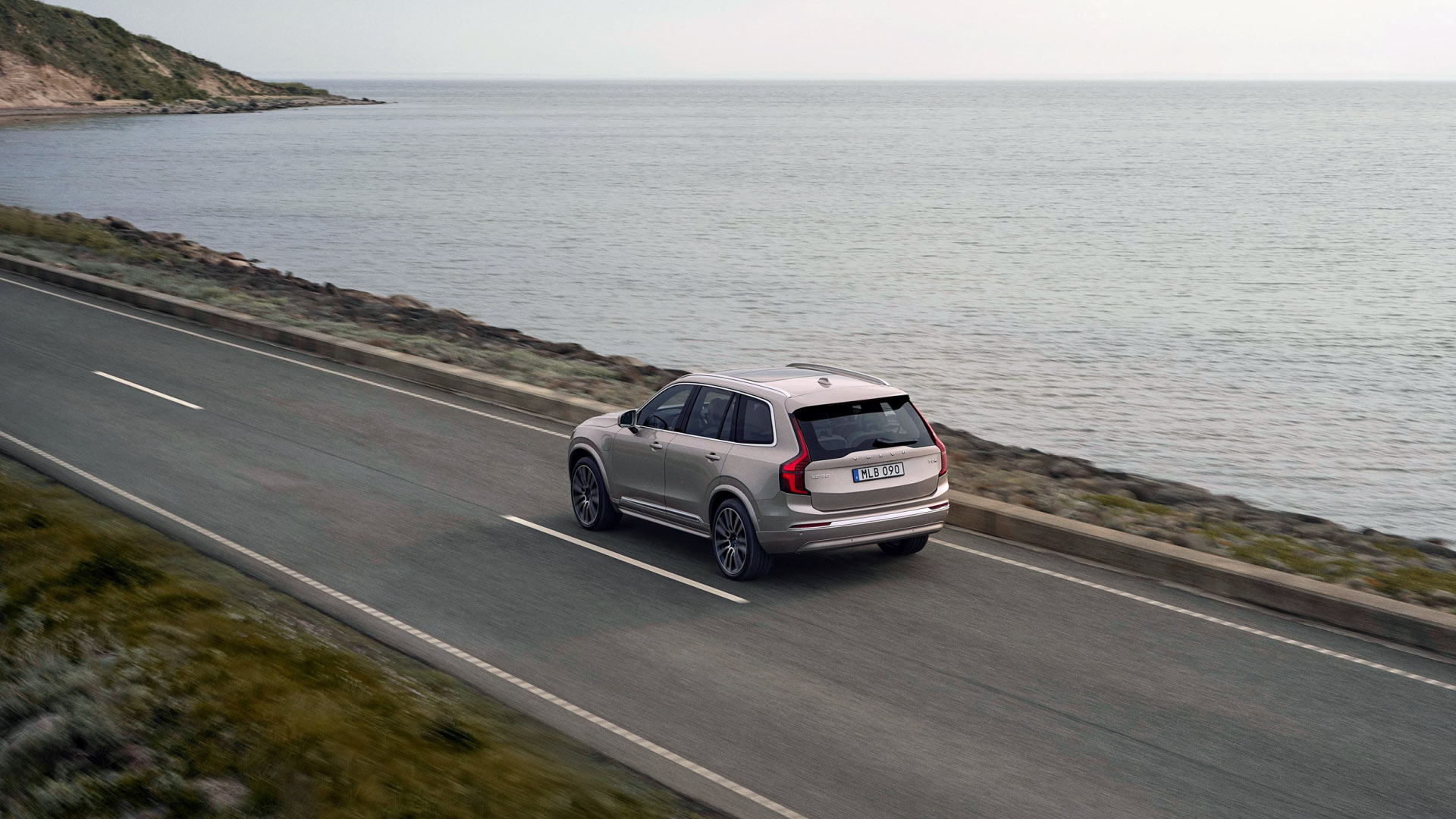
New 2025 Volvo XC90

The Volvo XC90 has received another facelift, as the Swedish marque aims to improve one of the best SUVs on sale.

First launched in 2015, this is the second time Volvo has treated the long-lived XC90 to an update. The changes aim to keep the BMW X5 rival competitive, as Volvo also reassesses its electrification strategy.

“The new XC90 exudes confidence, and why wouldn’t it? Our hybrid flagship has been one of our best-selling models for years and it’s still a favourite among many customers,” says Jim Rowan, CEO of Volvo Cars. 

“Whether it’s comfort, space, luxury, versatility or hybrid efficiency you look for, the XC90 delivers on all accounts. Put together, the XC90 and its fully electric EX90 sibling provide customers with the options that suit them best and equip us with a balanced portfolio as we continue our transition towards full electrification.”

Hybrid, but not electric

New 2025 Volvo XC90

Design changes to the outside of the XC90 are a lesson in Scandinavian subtlety. A new front grille, plus revised LED headlights and tail lights, are the most noticeable updates for a car that was last facelifted in 2019.

The UK model range kicks off with mild-hybrid B5 and B6 petrol engines, both with all-wheel drive as standard. However, Volvo is gently nudging buyers towards the 455hp T8 plug-in hybrid, promoting its 44 miles of all-electric range.

Prefer to go fully electric? You’ll need the new EX90 SUV instead. Volvo had previously committed to being a ‘pure electric car company’ by 2030. However, a slowdown in the number of drivers switching to EVs has caused the company to reevaluate its ambitions. 

Instead, Volvo now aims to have upwards of 90 percent of its global sales by 2030 made up of electrified cars. This distinction includes both fully electric and plug-in hybrid models, with mild-hybrid vehicles accounting for up to 10 percent of the mix.

New infotainment experience

New 2025 Volvo XC90

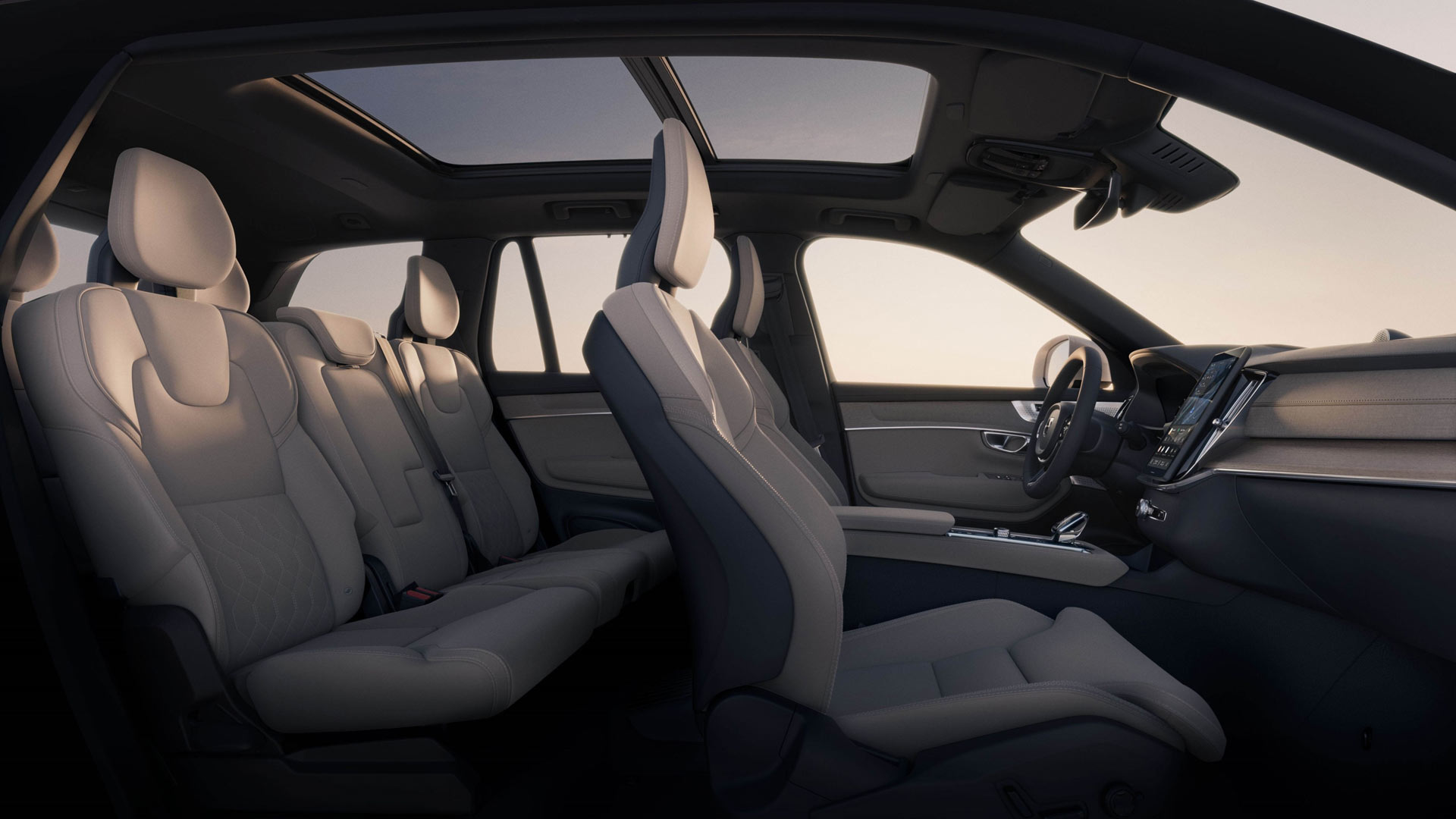
Changes inside the XC90 were led by Volvo owners, including more interior space and a redesigned dashboard. There’s now more space for wireless smartphone charging, an extra cup holder and improved ambient lighting. 

The biggest difference, though, comes in the form of Volvo’s latest infotainment system – making its debut in the new XC90 and electric EX90.

A larger 11.2-inch portrait-style screen is found inside the XC90, with the most commonly used apps accessed directly from the infotainment system’s home screen. 

Plug-in hybrid drivers can switch driving modes more easily, plus there is a new ‘contextual menu bar’ that alters depending on the situation. The icon to access the parking cameras will appear automatically at low speeds, too.

Order books open soon

New 2025 Volvo XC90

UK prices for the XC90 will start from £63,790 for the B5 mild-hybrid in entry-level Core specification. This includes Matrix LED headlights, wireless smartphone charging and Volvo’s Pilot Assist semi-autonomous driving system.

Opting for the plug-in hybrid XC90 T8 requires at least £72,650 in Core trim, with the range-topping Ultra priced from £84,150. The latter comes with Volvo’s incredible Bowers & Wilkins high fidelity audio system.

Orders for the updated Volvo XC90 can be placed by UK buyers from October 2024. The first customer deliveries are expected by the end of the year.

ALSO READ:

Volvo launches cut-price version of new EX30 electric SUV

Volvo XC40 Recharge long-term test review

What a comeback! The story of Volvo estate cars

Advertisement