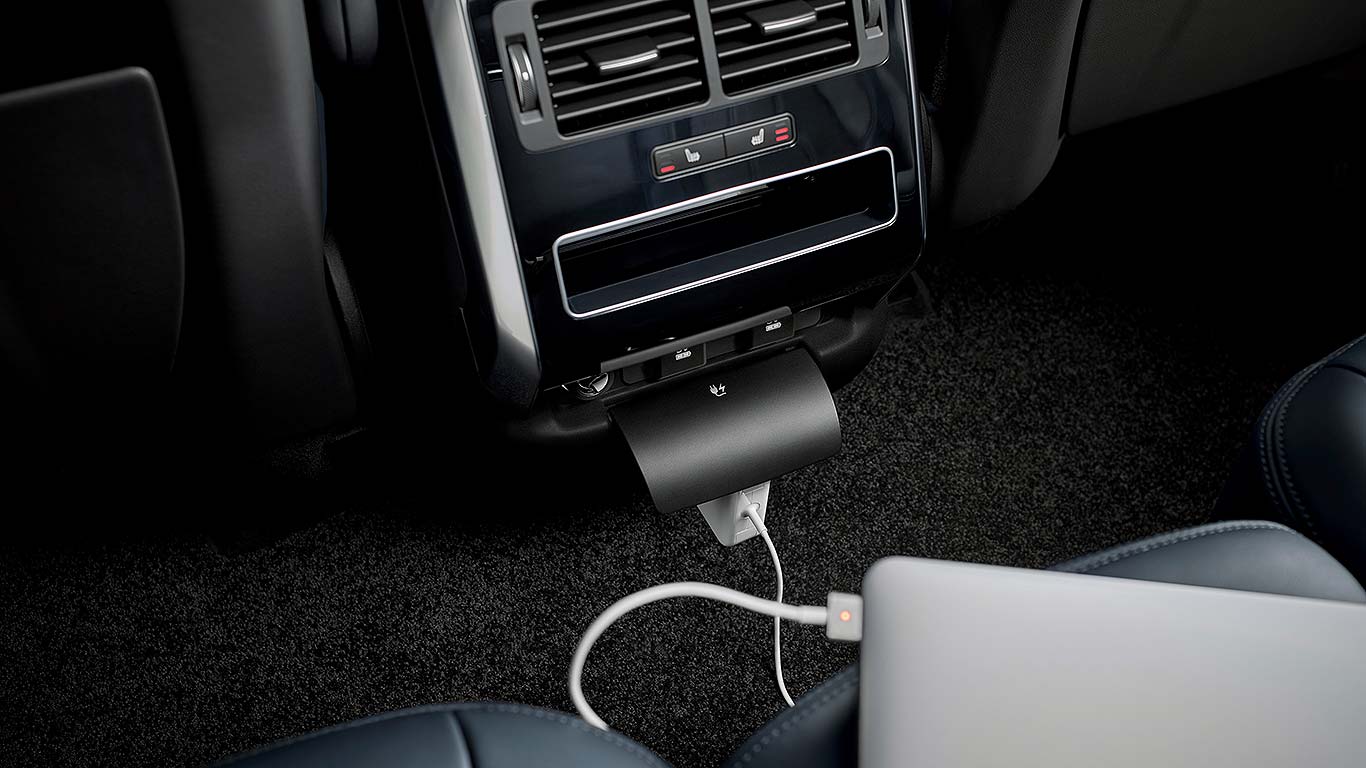
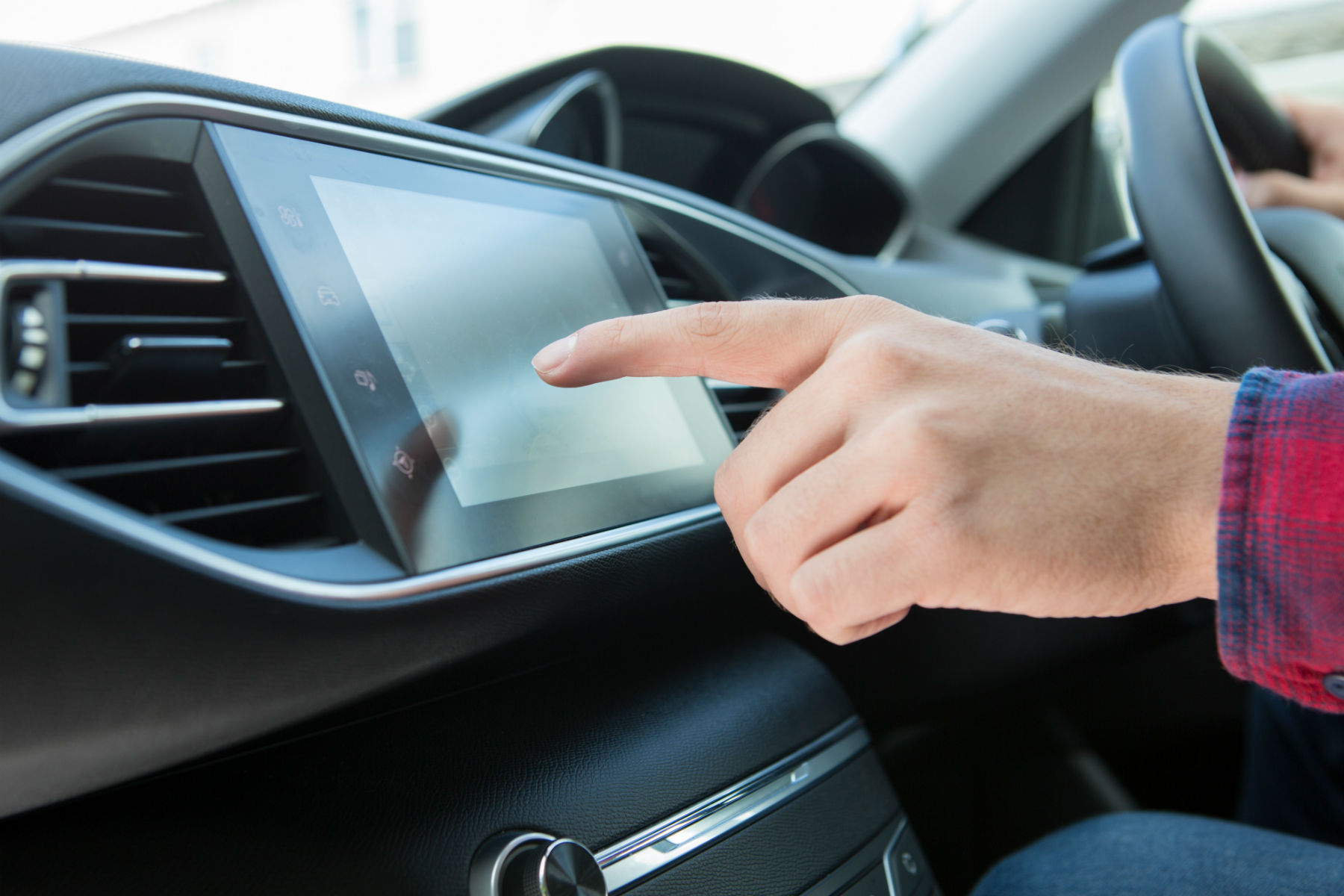
New cars come with umpteen sockets for charging 12V and USB devices, but what about if you need to plug in something you’d ordinarily hook up at home? Land Rover thinks it’s stolen a march on the competition here – by introducing its first model with built-in three-pin plug sockets.
The new 2018 Range Rover Sport now comes equipped with two three-pin plug sockets. There’s one domestic socket in the rear of the centre console, for back-seat passengers, and Land Rover has also fitted one in the load compartment.
The idea is to allow passengers to charge up laptop computers, and owners to plug in, say, portable coolboxes in the boot – although the possibilities are endless: if it has a plug, plug it in. The car won’t quite have the electrical oomph of a domestic socket, but it should easily handle a power-hungry laptop while you sip your motorway service station coffee.
The addition of two domestic sockets takes the total connection points on board the new Range Rover Sport up to 14 (yes, they’ve counted them). In the front, there are USB, HDMI and 12V connections in the front cubby, plus another 12V socket in the glovebox.
In the rear, there’s another suite of 12V, USB and HDMI sockets, plus the domestic plug socket, and the boot carries both the second three-pin plug socket and yet another 12V hub.
Swelling the 2018 Sport’s plug and play credentials yet further is the introduction of a new P400e plug-in hybrid version – whose petrol-electric drivetrain and extra-capacity lithium ion batteries give the big SUV 101mpg claimed fuel economy potential and the ability to run for 31 miles as a pure EV.
Making the new Range Rover Sport the most plugged-in new car on sale?
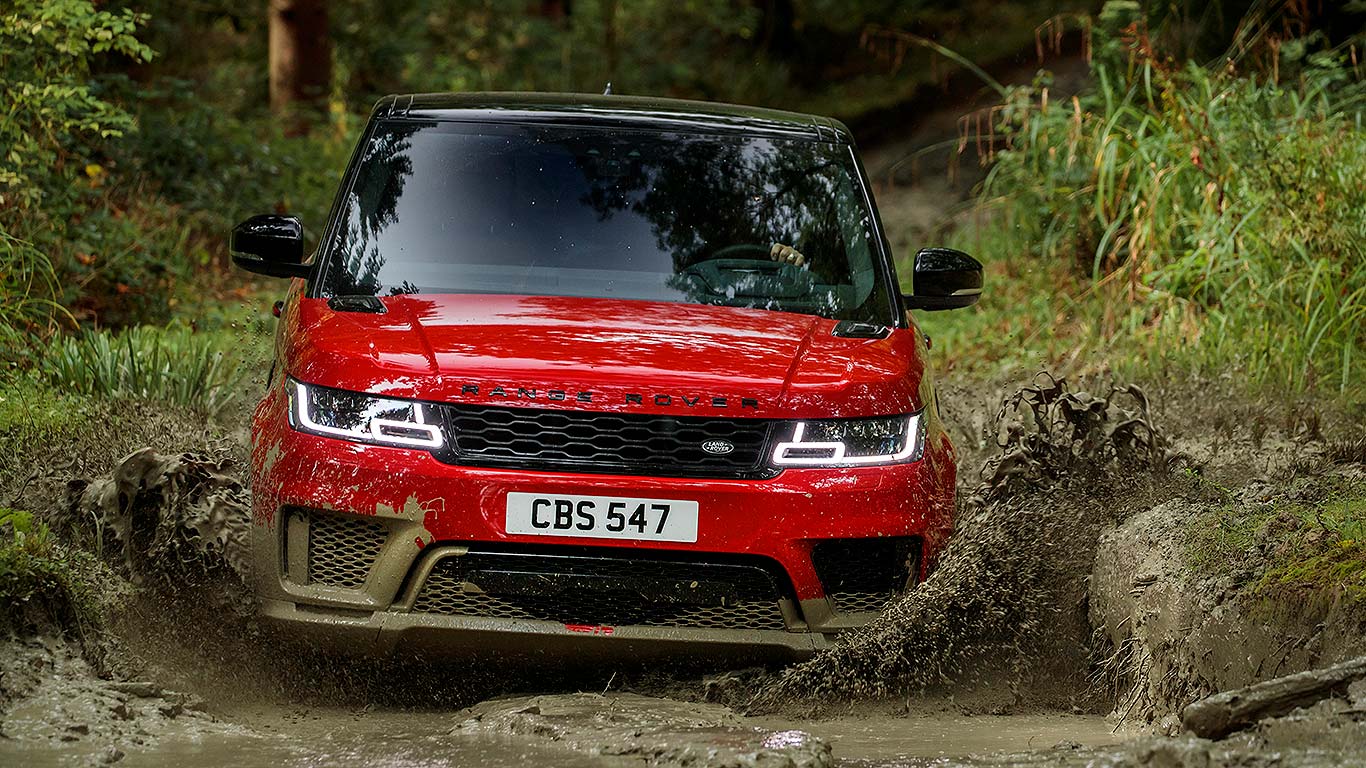
Land Rover has launched the first-ever Range Rover Sport plug-in hybrid, one that combines a 404hp total power output with official fuel economy of 101mpg and an all-electric driving range of up to 31 miles. It joins the range in a series of updates for the 2018 model year.
The new Range Rover Sport P400e pairs a 300hp 2.0-litre four-cylinder turbo Ingenium engine with an 85kW electric motor. Combined with permanent four-wheel drive, this gives it a 0-62mph time of 6.7 seconds and a top speed of 137mph.
Yet the Range Rover Sport P400e PHEV also officially emits 67g/km – making it easily the best-ever Land Rover or Range Rover for exhaust emissions.
A 13.1kWh lithium ion battery gives it enough juice to travel over 30 miles as a pure EV, which also makes it the first time a zero-emissions Land Rover has ever been offered. Owners can even programme the sat nav to work out when best to swap between engine-on and engine-off modes, by using GPS data along the route.
Land Rover hasn’t given it umpteen confusing driving modes though, choosing instead to keep things simple – either Parallel Hybrid mode, which juggles engine and electric motor automatically, or EV mode, which runs the Range Rover Sport as a pure EV until the batteries are low.
The batteries take 7 hours 30 minutes to charge from a home socket, or 2 hours 45 minutes from a dedicated wall box.
The off-road Terrain Response 2 tech has been reprogrammed as well, so it’s able to make best use of the high-power, instantly-accessible electric motor’s output. And it performs so well, it’s led Nick Collins, JLR vehicle line director to exclaim: “The introduction of our advanced plug-in hybrid powertrain is a watershed moment in the history of our performance SUV.”
By 2020, all new Jaguars and Land Rovers will be offered with an electrified drivetrain: the Range Rover Sport PHEV is thus just the first of many new JLR plug-ins, hybrids and full EVs to come.
2018 Range Rover Sport revisions
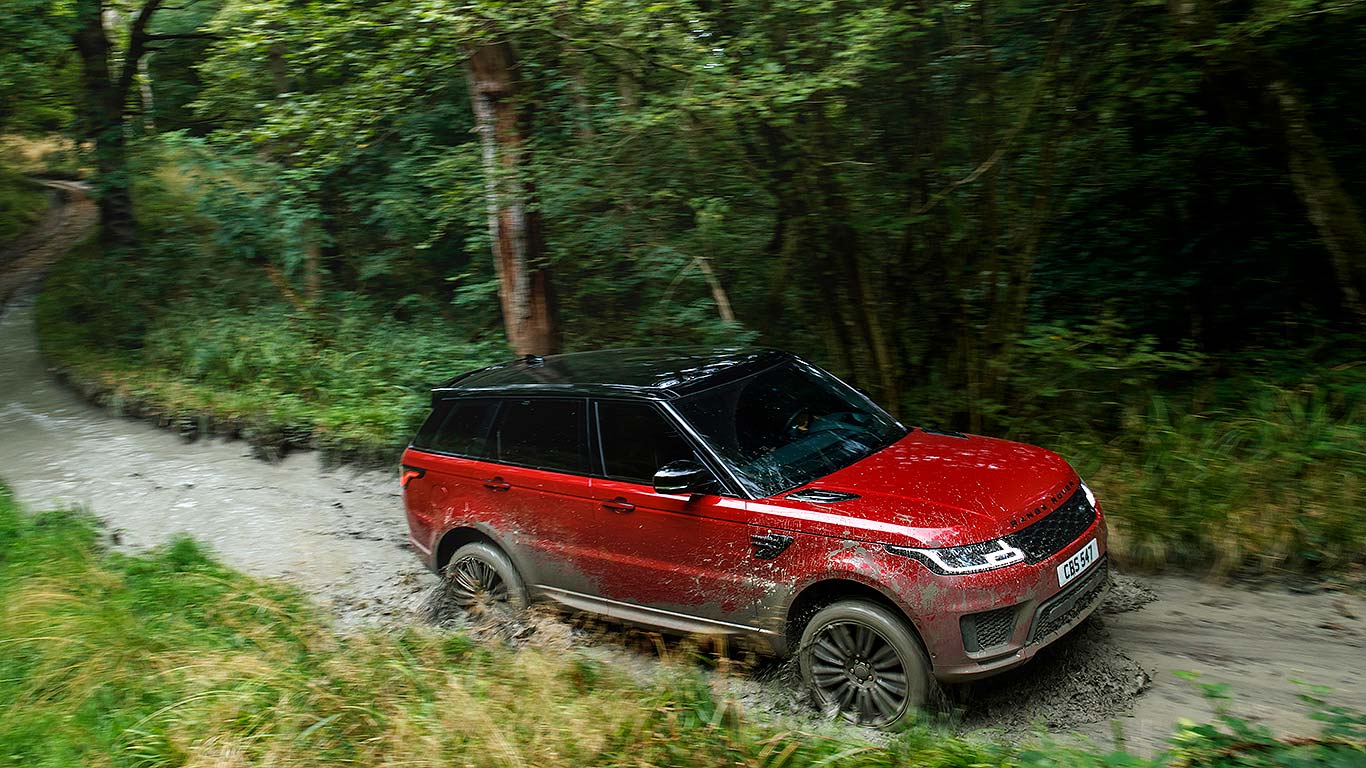
Since launching it in 2005, Land Rover has sold 732,000 Range Rover Sport – and almost 50,000 of the latest 2013 model in the UK alone. This mid-life facelift aims to continue its strong sales with mildly tweaked looks and more tech.
Slimmer new Matrix Pixel LED headlights sit astride a redesigned grille, while a new front bumper gets a sportier style. On PHEV models, the 7kW charger socket is hidden behind the Land Rover badge on the grille. At the rear, a new roof spoiler has more slots, and is claimed to keep the rear window cleaner in grotty weather.
Land Rover’s introduced a new colour, Byron Blue, and a new carbon fibre exterior detailing pack. There are three new alloy wheel choices too, including 21-inch and 22-inch designs.
Inside, all new Range Rover Sport get the Touch Pro Duo ‘twin screen’ infotainment system first seen in the Range Rover Velar. There also up to 12 power points, including two domestic plug sockets, and a new gesture-controlled sunblind. The front seats are slimmer and more supportive, and have ‘a more technical appearance’.
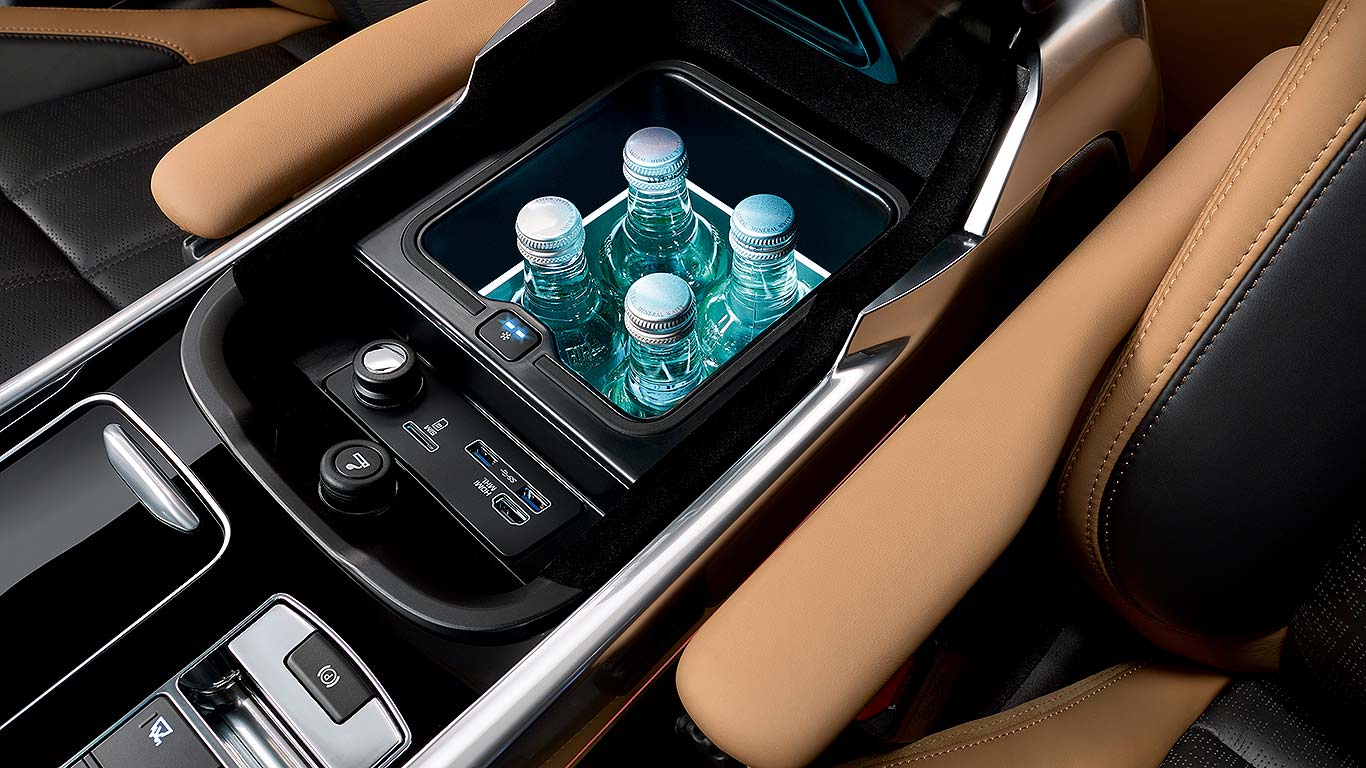
A neat touch is a bigger central cubby, up from 5.8 litres to 7.8 litres. Land Rover says it can not only swallow four 500ml drinks bottles, optional cooler functionality can ‘rapid chill’ them down to 5 degrees C in minutes.
At the top of the line, the Range Rover Sport SVR’s power has been upped to 575hp: 0-62mph in 4.5 seconds makes it the fastest Range Rover ever.
Ordering is open now, with first deliveries of the revised Range Rover Sport due in early 2018.
You wouldn’t sell your mobile phone without giving it a hard reset to clear important data such as call records and messages – but many company car drivers are happy to hand their vehicles back without removing such information.
Until now, firms that handle the remarketing of secondhand cars haven’t been under any pressure to delete these records, meaning they could soon be passed onto the car’s second owner. However, new data protection rules set to be introduced in May 2018 could give remarketers a headache, the Vehicle Remarketing Association (VRA) has warned.
“Anyone who has bought a used car in the last few years will know data such as satnav and phone records from the previous owner is often not removed when a vehicle is sold,” said the VRA’s deputy chair, Sam Watkins.
“It’s probably a good idea in general that this data should be deleted – it provides a very good indication of a person’s movements, work and social activities – but GDPR [General Data Protection Regulation] makes it a legal responsibility. At some point in the supply chain, it has to be deleted. The question is – who should be responsible for doing this?”
General Data Protection Regulation will replace the Data Protection Act 1998 in May 2018. It is European legislation designed to unify the separate EU member states’ regulations and to give people living in the EU more control over their personal data. It’s fundamentally the same as the Data Protection Act, but with a higher degree of emphasis on accountability and transparency.
“We have been aware of the GDPR legislation for some time and preparing for this legislation in a number of areas,” said Tim Bailey, fleet services director at Auxillis Services, a vehicle rental company providing replacement vehicle services. “Since the end of last year, on collection of vehicles from our customers, we remove all previous sat nav and in-car phone records as a matter of course. Given the varying methods employed by the manufacturers, this is no easy task, but is essential nevertheless.
“Any record that can be tied back to an individual needs to be dealt with in accordance with GDPR and your company’s resultant control policies.”
Deleting all sat-nav and phone records from your car can be a fairly simple task, depending on the car. Consult your owner’s manual for detailed advice – and let us know how easy it is with your car.
What’s your favourite movie car chase? Steve McQueen screeching through San Francisco in Bullitt? Gene Hackman racing a New York High Line train in The French Connection? Or perhaps – for younger readers – Vin Diesel blasting through the desert in The Fast and the Furious?
Modern movies are increasingly filmed in front of green screens, with computers filling in the gaps, yet the art of the stunt driver is alive and well. Which is how I ended up in a dreary car park in Dagenham, being shouted at by an actor with a clipboard and a fake upper-class accent. Welcome to stunt school.
Learning to Go Faster
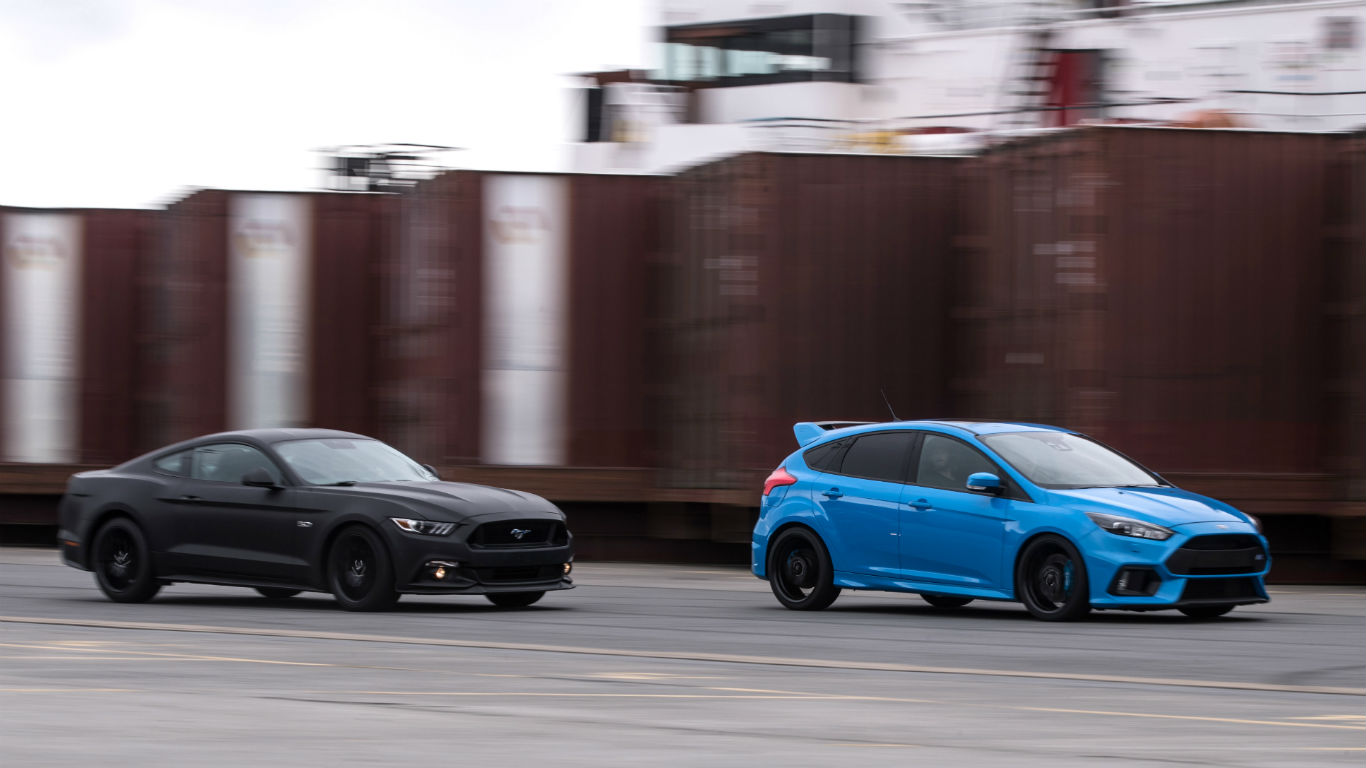
I was among the guinea pigs for Ford’s Go Faster experience, which takes place in East London from 13-22 October. For a very reasonable £99, you spend half a day torturing tyres in a Focus RS and Mustang V8, being taught manoeuvres such as drifting and J-turns by stunt professionals.
As an added twist, your finest moments are filmed, then spliced together into a heist movie trailer that you can download to show your friends. You play the part of ‘Wheels’, a cool-as-ice getaway driver with nothing to lose. And the Go Faster staff stay in character as your accomplices and film crew throughout the day, which makes for some hilarious off-camera conversations.
The J-turn
The first move I learned was the J-turn, where the car is reversed at speed then spun around to face forwards. Useful for escaping unexpected roadblocks or dead-end alleyways – or so my henchmen told me.
Starting with your right arm across the steering wheel in the nine ‘o’ clock position, you hit the gas hard in reverse – not something that feels natural, even in an empty car park. Then, you dip the clutch to disengage the engine and hook the wheel around 180 degrees so your right hand is back at three ‘o’ clock. As the car rotates, use your left hand to select second gear, then lift the clutch and go, go, go!
I found getting the Focus RS to rotate on its axis quite straightforward, but stalled several times trying to grab second for the getaway. After my fifth attempt, however, I had this one nailed.
The getaway
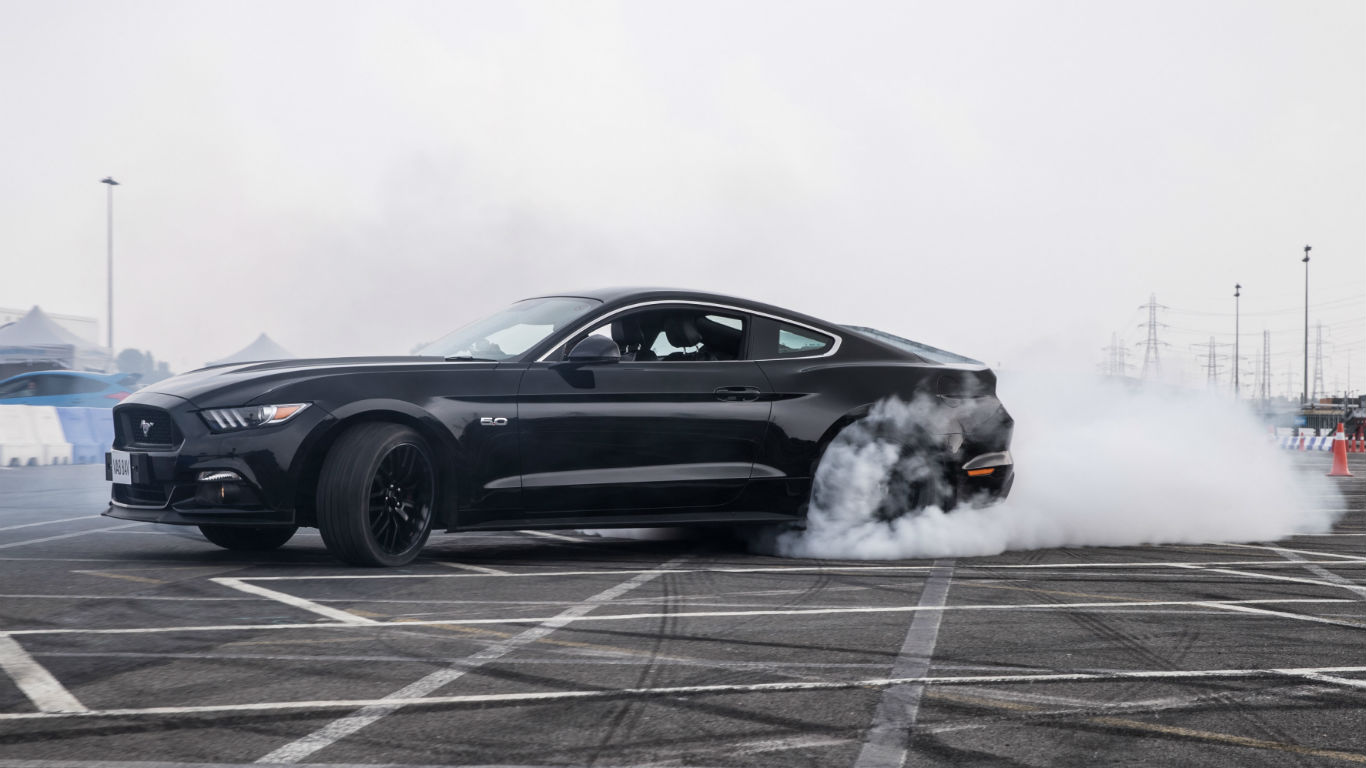
For the next stunt – the getaway – I jumped into the brawny Mustang V8. This was a tricky, technical slalom against the clock, including two smoky 360-degree donuts. And it would scatter my early confidence in a trail of plastic cones.
After a brief run-through, my instructor jumped into the passenger seat, grabbed the remote engine cut-off switch (just to be sure) and started the stopwatch. The Mustang lunged back and forth through the slalom as I juggled the steering from lock to lock. It felt big, but not unwieldy, with ample grip on the dry tarmac.
So far, so good: the problem came when I had to overwhelm said grip for the donuts. I stabbed at the throttle to dislodge the Mustang’s back end and felt it slide gracefully sideways. But I failed to counter-steer quickly enough, resulting in a stalled engine and multi-cone carnage. Great fun, but with five seconds added to my time for each toppled cone, I ended up near the bottom of the lap-time leaderboard.
The powerslide
What Ford calls a powerslide, the rest of us would probably call a handbrake turn. But hey, we’re making movies, so a little artistic licence is allowed.
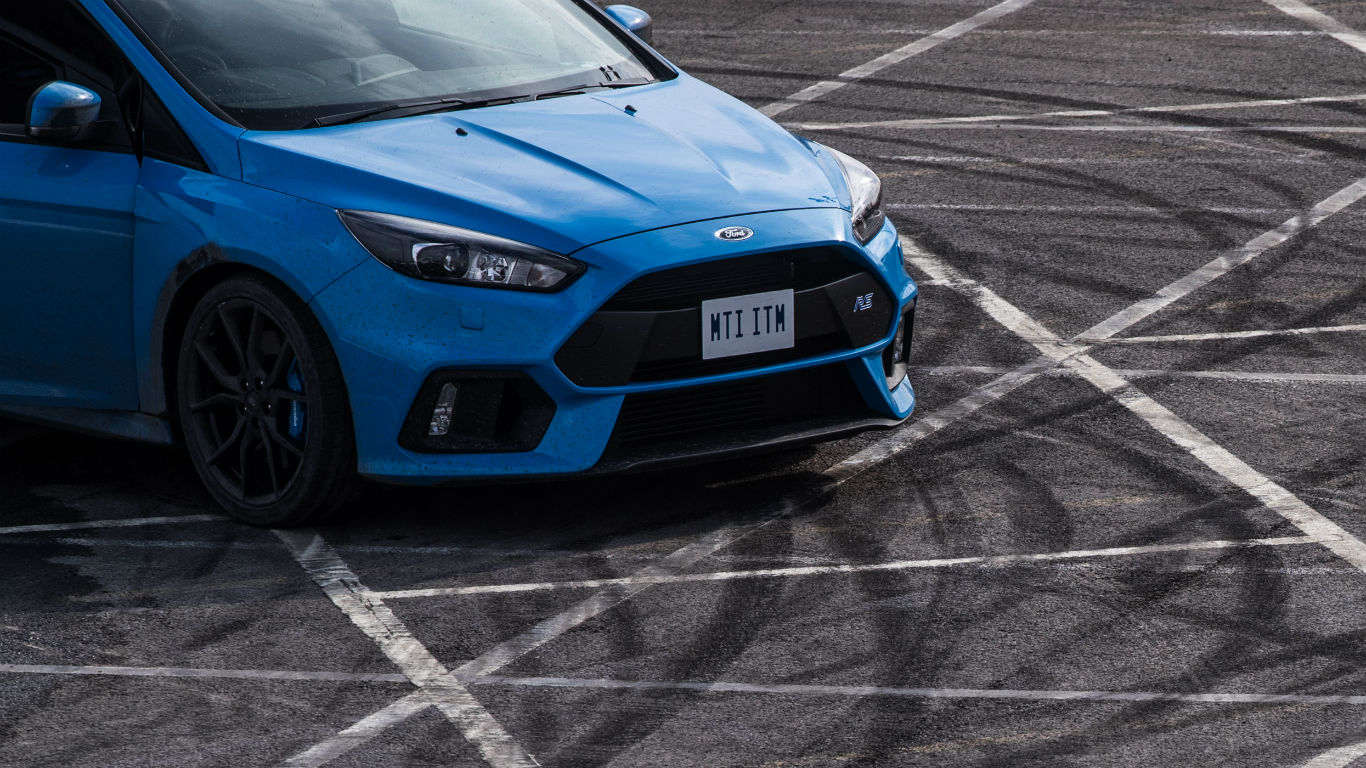
This manoeuvre takes place at slower speed than the J-turn. Again, you position your right hand at nine ‘o’ clock, then accelerate to around 25mph before dipping the clutch, swinging the wheel through 180 degrees (so your right hand is back at three ‘o’ clock) and pulling on the handbrake. The Focus RS stunt cars have beefed-up hydraulic handbrakes to make the process easier, but you still need to yank the lever with all the force your left bicep can muster.
I find getting the car to powerslide is relatively easy, but positioning it in the ‘box’ of cones is much harder. Only on my final attempt do I get the RS lined up correctly. Shame they weren’t filming that one…
The drift
Unless you only get your car reviews from Sensible Driver magazine, you’ll be aware the Focus RS has a Drift Mode. Intended for track use only (it says here), this sends 70 percent of the Ford’s 350 horses to those poor, unsuspecting rear tyres. Goodbye 4WD hot hatch; hello RWD hooligan.
Steering slowly around a cone, I bury my right foot to kick off the drift. It’s incredibly easy to make this car go sideways, but holding the slide – via a delicate balance of steering and throttle inputs – takes plenty of practice. Too little power and you’ll understeer (run wide), too much and you’ll spin.
Eventually, I manage a full drift-lap of the cone. I step out of the RS in a cloud of tyre smoke, grinning ear-to-ear and feeling like a hero.
Making movies
Finally, it was time to prove my skills (or otherwise) as a getaway driver by filming the trailer. This combined all of the above, with a few moody looks to camera and a ‘safe cracking’ shot thrown in. Watch the end result below and let us know what you think.
I also sat inside a mock-up car for the movie poster – another great memento of the day, and perfect for sharing on social media.
Overall, I had a fantastic morning, learned some new skills and gained a real insight into the life of a stunt driver. All from the very people who powerslide, drift and crash cars for a living. If you ever find yourself trapped down a dead-end alleyway, you’ll be glad you heeded their advice.
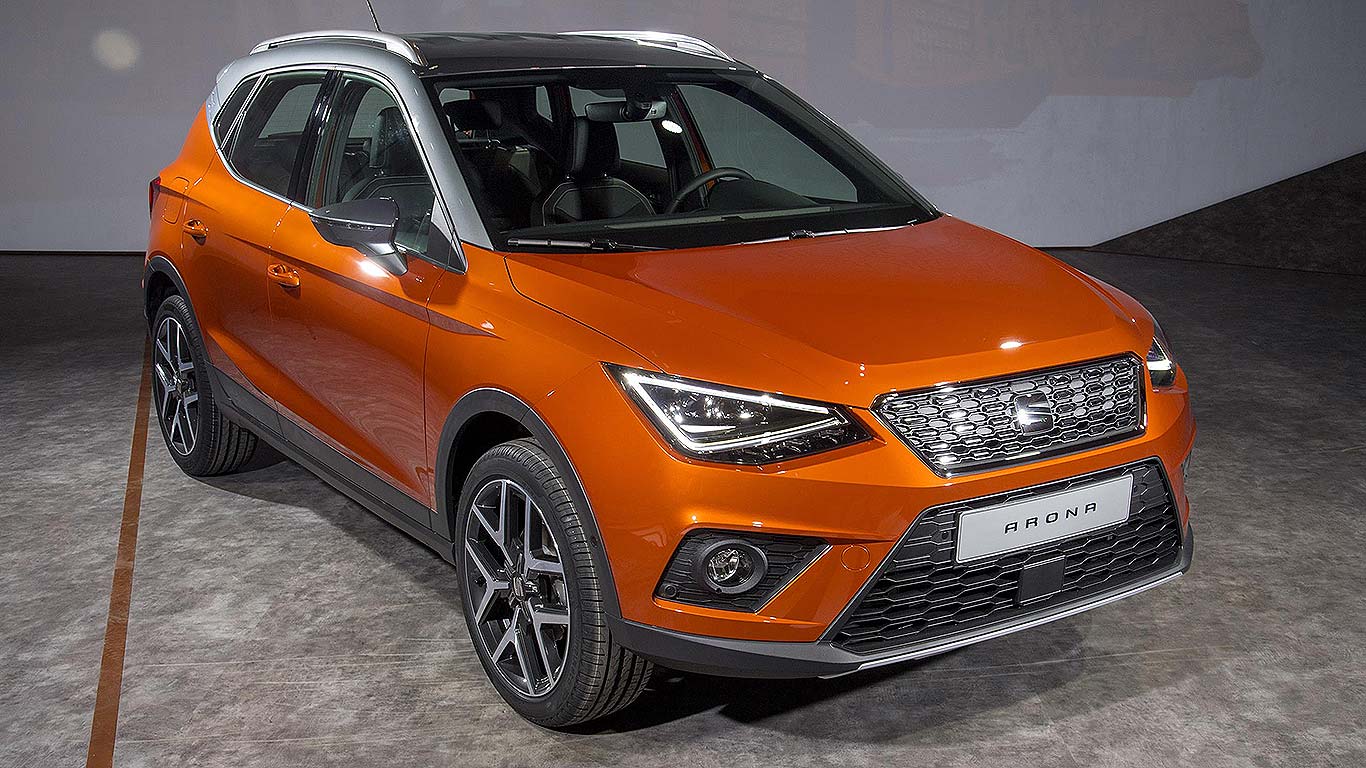
The new Seat Arona small crossover SUV will launch in UK dealers on 17 November 2017 with prices starting from £16,555, the firm has now confirmed.
Seat’s Ibiza-derived rival to the Nissan Juke and Renault Captur is its smallest crossover yet, sitting below the smash-hit Ateca, and follows the now-established trend of offering several ‘First Edition’ launch specials.
The core model range of SE and SE Technology, FR and FR Sport, Xcellence and Xcellence Lux will be joined by an £18,730 SE First Edition and £22,020 Xcellence First Edition, which will be the key cars dealers will be showing to customers from mid-November.
Seat says the model range has been tailored to be easy and straightforward: instead of making buyers fret with configurators over options and other choices, they simply choose the trim level, engine and colour. It is, reckons the firm, “an innovative new approach to simplifying customer choice for easier car buying”.
Regardless of this, buyers can still pick up to 30 colour combinations, including three different roof colours – and metallic paint is standard on every Arona, even the base SE.
Five engines are offered, a 1.0 TSI 95 or 115, a 1.5 TSI Evo 150, and either a 1.6 TDI 95 or 115. Manual and DSG gearboxes are available but you can’t get an all-wheel-drive Seat Arona.
2018 Seat Arona: standard equipment
SE: 17-inch alloys, bi-colour roof, LED running lights, air con, five-inch touchscreen
SE Technology: Connectivity Pack Plus (eight-inch touchscreen with nav, Apple CarPlay, Android Auto), wireless charging, rear parking sensors, two SD card slots
SE Technology First Edition: Storage pack, Winter pack, auto wipers, climate control, adaptive cruise control, folding door mirrors, auto-dim rear-view mirrors
FR: full LED headlights, sport front seats, flat-bottom steering wheel, sports suspension, rear disc brakes
FR Sport: 18-inch alloys, Alcantara upholstery, Dynamic Chassis Control
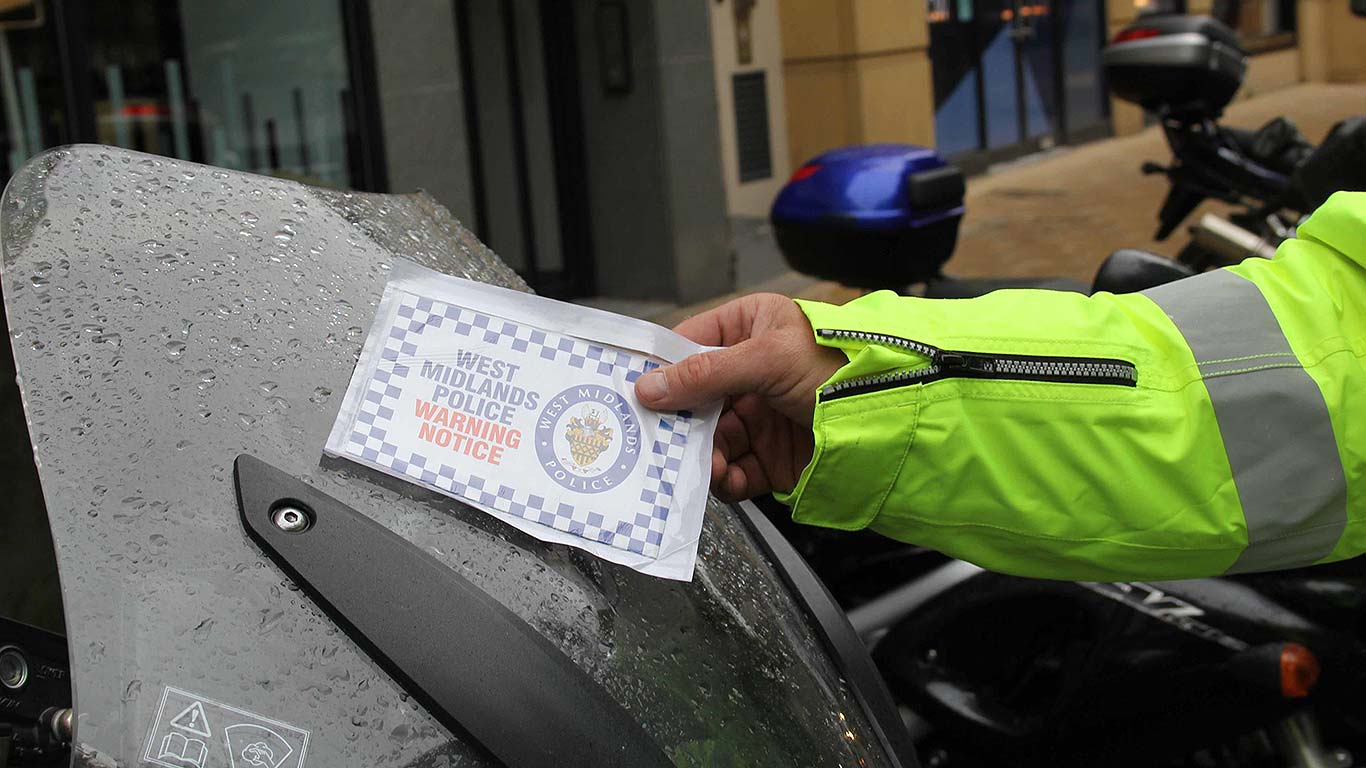
Earlier this summer, thefts of motorcycles and scooters in Birmingham shot up. In response, the city council came up with a novel strategy – ticketing at-risk machines.
These were not real parking tickets, though (despite how official-looking they appeared). Rather, they were reminders to owners about the importance of extra security measures, and were only stuck on motorcycles lacking any form of security.
The ‘polite’ reminders were part of the ‘lock it or lose it’ initiative, run as part of the Motorcycle Industry Association’s ‘MASTER’ security scheme.
PC Paul Ennis from West Midlands Police admitted that “people can get a little defensive when they are approached by a cop, but I have been very impressed by the supportive comments and gratitude shown to us all… it has been a really positive experience”.
Officers also noted down the mix of motorcycles with or without extra security fitted. When the scheme was launched in early August, just 40 percent of Birmingham’s motorcycles were protected with security devices such as a chain or disk lock.
And now? More than 90 percent of machines are carrying extra security measures.
“When we set out on this campaign,” said PC Ennis, “we had one simple objective: to make riders aware of the risk of theft when parking a motorcycle and to use some additional security.
“When we started this, the majority of motorcycles in this area were inadequately protected. Today the majority are well protected.”
Indeed, it’s been such a success, there are plans for the campaign to continue into the autumn. So, riders, if you park up in Birmingham and return to find a ticket on your machine, don’t worry. But maybe consider buying some extra security tech for next time…
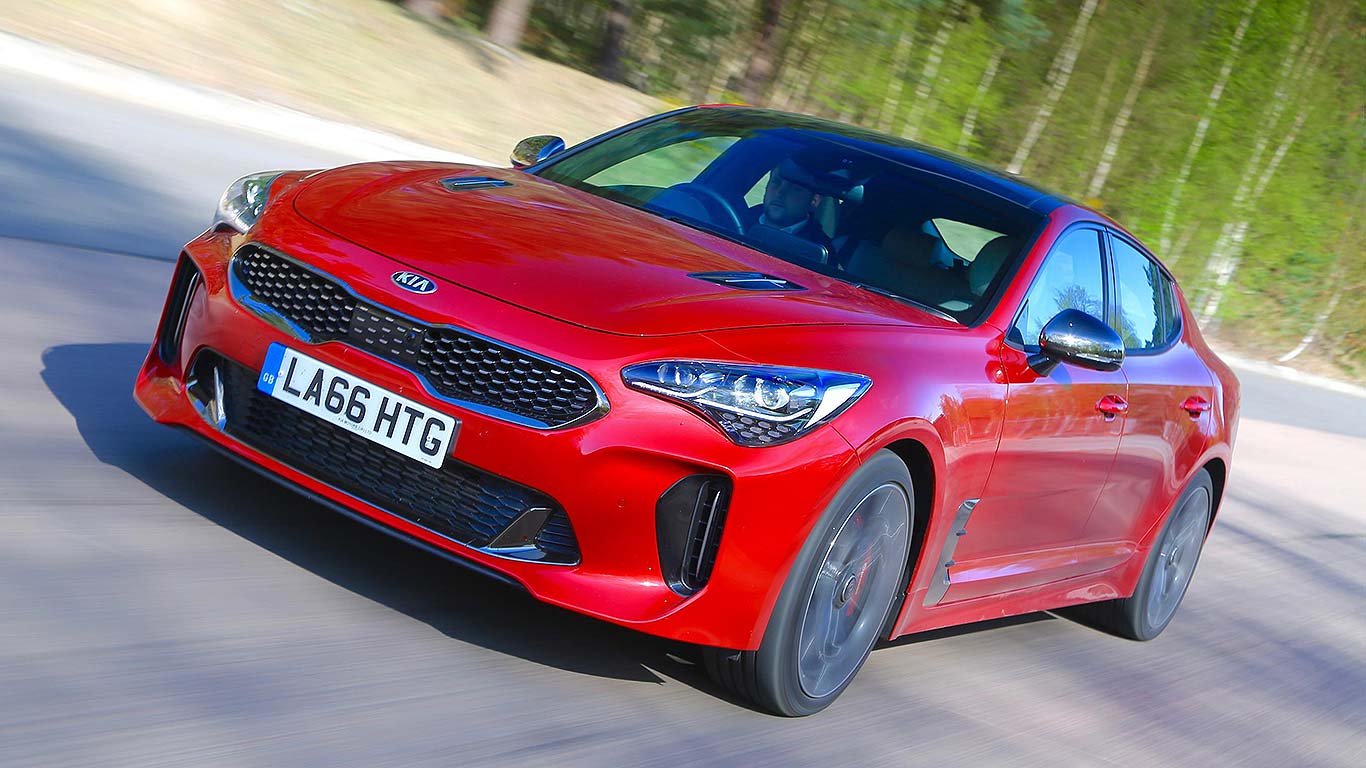
The striking new Kia Stinger is now available to order in the UK with prices starting from £31,995. Deliveries of the large new four-door GT coupe begin on 1 January 2018.
One of the most ambitious new Kias yet, the Stinger GT firmly pushes the brand upmarket – not least thanks to the top-spec model’s very potent 365hp 3.3-litre twin-turbo V6 engine. This hurtles the rear-wheel drive car from 0-62mph in just 4.7 seconds; top speed is a fiery 168mph.
Kia’s shock new Stinger will be coming to Europe with a diesel engine
Kia scrappage scheme cuts Picanto price to £7,450
Kia teases GT4 Stinger concept
But despite the headlines, V6 versions will make up a small slice of sales. Most Stingers will be powered by four-cylinder engines, either a 197hp 2.2-litre CRDi turbodiesel, or a 244hp 2.0-litre T-GDi turbo petrol. An eight-speed automatic gearbox is standard on all; Kia’s only bringing rear-wheel drive Stingers to the UK, despite all-wheel drive versions being offered in Europe. Because the UK is a driver-focused market, we get a standard limited-slip differential instead.
Oh, and the four-cylinder models are not exactly slothful, either: the petrol will do 0-62mph in 5.8 seconds, and even the diesel will run it in 7.3 seconds, despite also averaging 50.4mpg and emitting less than 150g/km CO2.
First seen as the GT Concept way back in 2011, the Stinger is being described as a game-changer by Kia, which rather breathlessly describes UK pent-up demand as “reaching fever pitch”. Hence its decision to open ordering early, ahead of the January on-sale launch.
Three trim lines – GT-Line, GT-Line S and GT-S – will pad out the range to a five-model line-up, with prices starring from £31,995; the top-spec V6 is £40,495.
Kia Stinger: specification
All UK Kia Stingers come with 8.0-inch touchscreen infotainment with standard sat nav, Apple CarPlay and Android Auto. A 7.0-inch TFT display is standard, as are all-round parking sensors, reverse parking camera and even a head-up display.
The standard sound system is a nine-speaker system with a subwoofer under the front seat; GT-Line S and GT-S come with a 15-speaker Harman/Kardon setup boasting subwoofer, external amp and a front centre speaker. Leather upholstery is standard too, upgraded to Nappa leather on the GT-S.
Premium-like features abound as standard: the D-shaped steering wheel is adjusted electrically, the dashboard is clad in leather, the headlining is suede and heated front seats are backed up by heated rear seats in the GT-Line S and GT-S – which also include ventilated front seats.
Wheels? 18-inch on the GT-Line and GT-Line S, 19-inch on the GT-S – which also has Porsche-line mixed tyre sizes: 225/40 on the front, 225-35 on the rear. The GT-S also has electronic suspension.
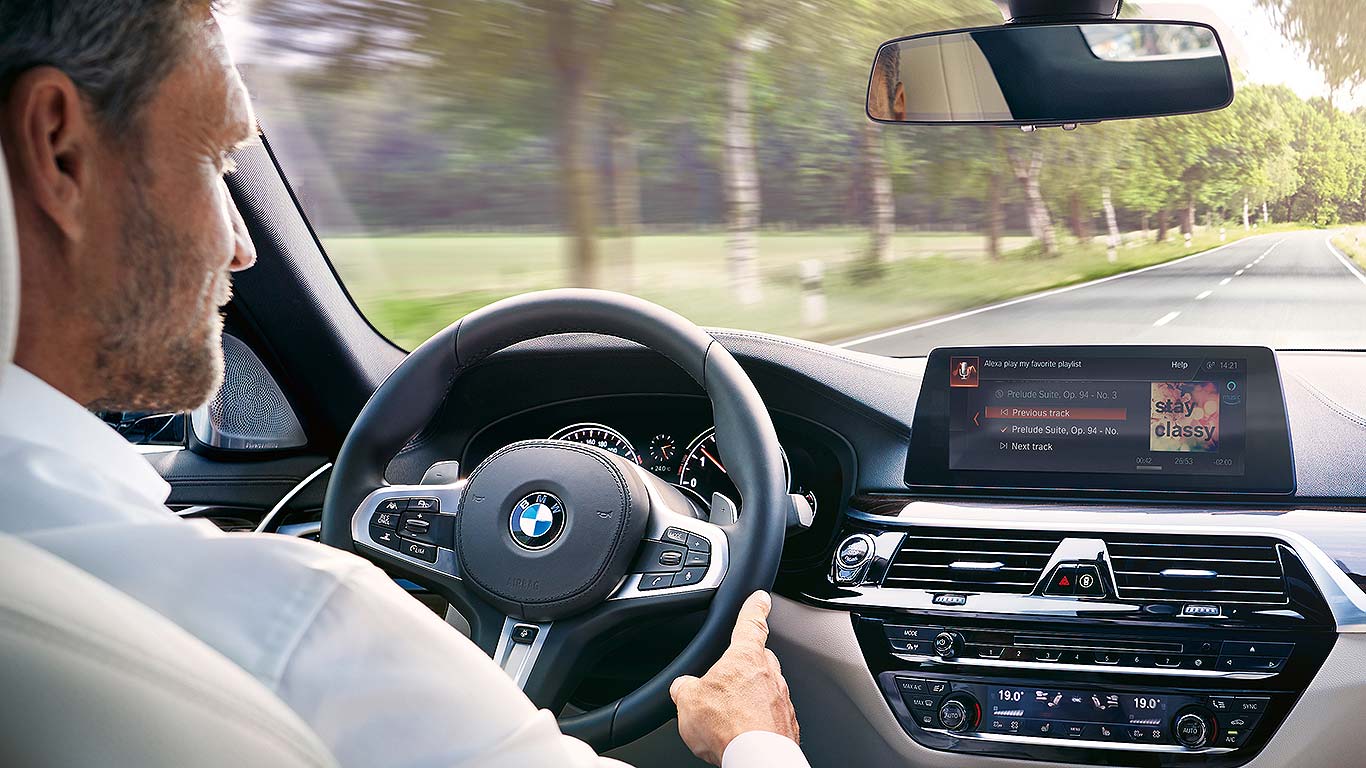
Amazon Alexa is to be integrated into all new BMW and Mini models from 2018 – and users won’t even need to hook up their smartphone in order to use it.
Because all new BMWs and Minis come with a built-in SIM card, the firm is able to fully integrate Alexa and deploy it en masse; it means everything that Alexa users do from Amazon Echo devices, they’ll soon be able to do in their car too.
It’s presumably as easy as saying, “Alexa…”
The move is a development of the BMW Connected Alexa ‘skill’, that’s been offered for around a year: it allows BMW and Mini owners to ‘ask’ Alexa questions such as the state of charge in their electric vehicle, or how much fuel is in their diesel or petrol.
Full integration will bring the home-based convenience of Alexa into the car, says BMW. Adding a digital ecosystem “will open up all sorts of new possibilities that customers can access quickly, easily and safely from their car,” said Dieter May, senior vice president of digital services and business models at BMW.
Examples include asking Alexa which movies are on at the local cinema (and what times they’re shown), listening to playlists or checking the weather at their destination. Naturally, as it’s an Amazon product, online orders can be made while driving.
“We are excited to work with BMW to bring the Alexa experience to their drivers,” said Ned Curic, vice president, Alexa Automotive. “Using your voice to enjoy content and interact with Alexa makes a great driving experience even better.”
Independent watchdog Transport Focus has called on Highways England to up its game in educating motorists how to use smart motorways.
Citing research that shows few drivers know for sure what to do if they break down on a motorway with no hard shoulder, the organisation wants Highways England to roll out a more concerted driver education programme.
Anthony Smith, chief executive of Transport Focus, said: “What’s been missing until now is an understanding of how road users experience smart motorways.
“The message to Highways England is that many millions of drivers successfully use smart motorways, but there is more to do to improve their understanding of how they work and what you should do if you break down.”
Opinion: Motorways are smart. Pity drivers aren’t
Worryingly, not many motorists think about safety at all when discussing smart motorways – it only arose when prompted by Transport Focus during research.
The organisation thus wants Highways England to:
Help drivers understand smart motorways and their various features
Reassure them that motorways with no hard shoulder are safe even if you break down
“Road users tend to trust that ‘the authorities’ would not allow motorways without a hard shoulder if it was unsafe” said Smith. “Highways England must remain vigilant that their trust is not misplaced.”
What do motorists say about smart motorways?
Some of the feedback from Transport Focus’ research showed that although millions of people are using smart motorways, worryingly few of them actually understand them.
“I still see at least once a week someone driving on the hard shoulder when there’s a red X on it. It’s obvious but I get the feeling many drivers don’t know about it.” Leeds, frequent business user
“Touch wood, I’ve never broken down on a motorway. If I did break down, yes, I can see there being some risk of someone coming into the back of you.” Birmingham, infrequent leisure user
“The smart motorway network is good for me because I’m used to it. I feel confident driving [on them].” Birmingham, HGV
“I didn’t know that you could get penalised for being in a red X, even though it is self-explanatory and wouldn’t be doing it.” Leeds, frequent leisure user
Are you unsure about how to safely use a smart motorway – or do you have concerns about the number of people using them incorrectly? Share your thoughts and observations with us below.
The so-called ‘Ditch Diesel’ protest was designed to mark two years since the Dieselgate scandal and followed a publicity stunt at the Frankfurt Motor Show a week earlier. Since then, the bad news has kept on flowing for Volkswagen.
Belfast-based Edwards and Co Solicitors has issued proceedings to the High Court that could see up to 70,000 Northern Irish Volkswagen drivers affected by Dieselgate awarded compensation.
Dorcas Crawford, a senior partner at the firm, said: “In the context of this truly global dispute, we wanted to ensure that the rights of our current clients, and Northern Ireland consumers in general, were not left behind – hence the issue of proceedings today.
“We are pursuing the Volkswagen Group, and a number of its subsidiaries, in the Northern Ireland High Court, in what will ultimately proceed as a group action. This will enable us to represent all those affected within the framework of one case.”
In a separate development, a former high-ranking engineer has been arrested over his role in Volkswagen’s diesel emissions scandal. Wolfgang Hatz was head of engine development between 2001 and 2007, and head of research and development at Porsche in 2011.
Hatz was suspended when news of the deception first broke before leaving Porsche by mutual consent in 2016. His arrest follows the search of offices and houses and it’s the first time anyone has been taken into custody in connection with Dieselgate.
The total cost of the diesel emissions scandal is set to reach $30 billion, as Volkswagen faces another $3 billion bill to fix around 500,000 2.0-litre diesel cars in the United States. “We have to do more with the hardware,” a Volkswagen spokesperson said, before admitting customers would have to wait longer for their cars to be repaired.
Volkswagen shares fell by up to 3% on Friday, with Evercore IS analyst, Arndt Ellinghorst, saying the news was unwelcome, “not only from an earnings and cash flow perspective but also with respect to the credibility of management.”
In the great scheme of things, the Greenpeace protest, while about as welcome as a wasp at a picnic, isn’t the worst thing to have happened to Volkswagen in the two years following Dieselgate. Indeed, while environmentalists were inevitably behind the high-profile publicity stunt, others were less supportive of their actions.
Tom Callow, director communications and strategy at Chargemaster, questioned the protesters’ mode of transport, by tweeting:
Still no response from @GreenpeaceUK as to whether protestors traveled on diesel coach to go and protest against diesel… https://t.co/vjHXgluupX
Others pointed to the number of petrol and hybrid vehicles on board the Elbe Highway, along with Volkswagen’s Scrappage scheme, which offers savings of up to £6,000 when you trade in any make or model diesel car registered before the end of 2009.
While the activists were successful in boarding the ship and gaining access to the vehicle park, their wider ambition was left unfulfilled. “They won’t give up until VW commits to send it’s [sic] toxic cars away from the UK and ditch diesel for good,” proclaimed a statement on the Greenpeace website.
In fact, Volkswagen told Motoring Research that the ship moved out to sea and finally docked in Sheerness on the evening of the 22 September 2017. The keys were handed back to VW and Greenpeace had “helpfully labelled the keys and the cars with matching stickers to assist us in pairing them together.”
As a result, Volkswagen says the action “has not had a negative effect on any customer deliveries.”
Commenting on the Greenpeace website, Theresa Adams countered VW’s claim that deliveries would be unaffected while criticising the actions of the environmental group, saying:
“I think Greenpeace has shot themselves in the foot with this campaign. I have a 17 year old diesel car that belches poison everywhere I drive as it has no DPF, so I decided to trade it in for a brand new petrol VW due to the generous scrapage [sic] scheme. My car is on that boat and delivery will now be next month, not this month.
“So instead of reducing pollution by taking my lung poisoning car off the road this month I now have to drive it round [sic] town for another month. Times this by the thousands of people doing the same thing and it now looks like Greenpeace isn’t so environmentally friendly as they think they are.”
Following the Greenpeace demo, two women and a man were arrested on suspicion of aggravated trespass, while a man and a woman were arrested under the Merchants Shipping Act 1995 on suspicion of entering a vessel. Those charged were bailed until 19 October.
Some people turned to social media to question the decision to single out Volkswagen for the protest, to which Greenpeace pointed to Dieselgate. On its Facebook page, it said: “VW is the largest carmaker in Europe but have [sic] made measly promises on electric and zero promise to ditch diesel. They were also responsible for fitting cars with devices to cheat diesel emisssions [sic] test in what became known as the dieselgate scandal.”
 New cars come with umpteen sockets for charging 12V and USB devices, but what about if you need to plug in something you’d ordinarily hook up at home? Land Rover thinks it’s stolen a march on the competition here – by introducing its first model with built-in three-pin plug sockets.
 Land Rover has launched the first-ever Range Rover Sport plug-in hybrid, one that combines a 404hp total power output with official fuel economy of 101mpg and an all-electric driving range of up to 31 miles. It joins the range in a series of updates for the 2018 model year.




 What’s your favourite movie car chase? Steve McQueen screeching through San Francisco in Bullitt? Gene Hackman racing a New York High Line train in The French Connection? Or perhaps


 The new Seat Arona small crossover SUV will launch in UK dealers on 17 November 2017 with prices starting from £16,555, the firm has now confirmed.
 Earlier this summer, thefts of motorcycles and scooters in Birmingham shot up. In response, the city council came up with a novel strategy – ticketing at-risk machines.
 The striking new Kia Stinger is now available to order in the UK with prices starting from £31,995. Deliveries of the large new four-door GT coupe begin on 1 January 2018.


 Amazon Alexa is to be integrated into all new BMW and Mini models from 2018 – and users won’t even need to hook up their smartphone in order to use it.
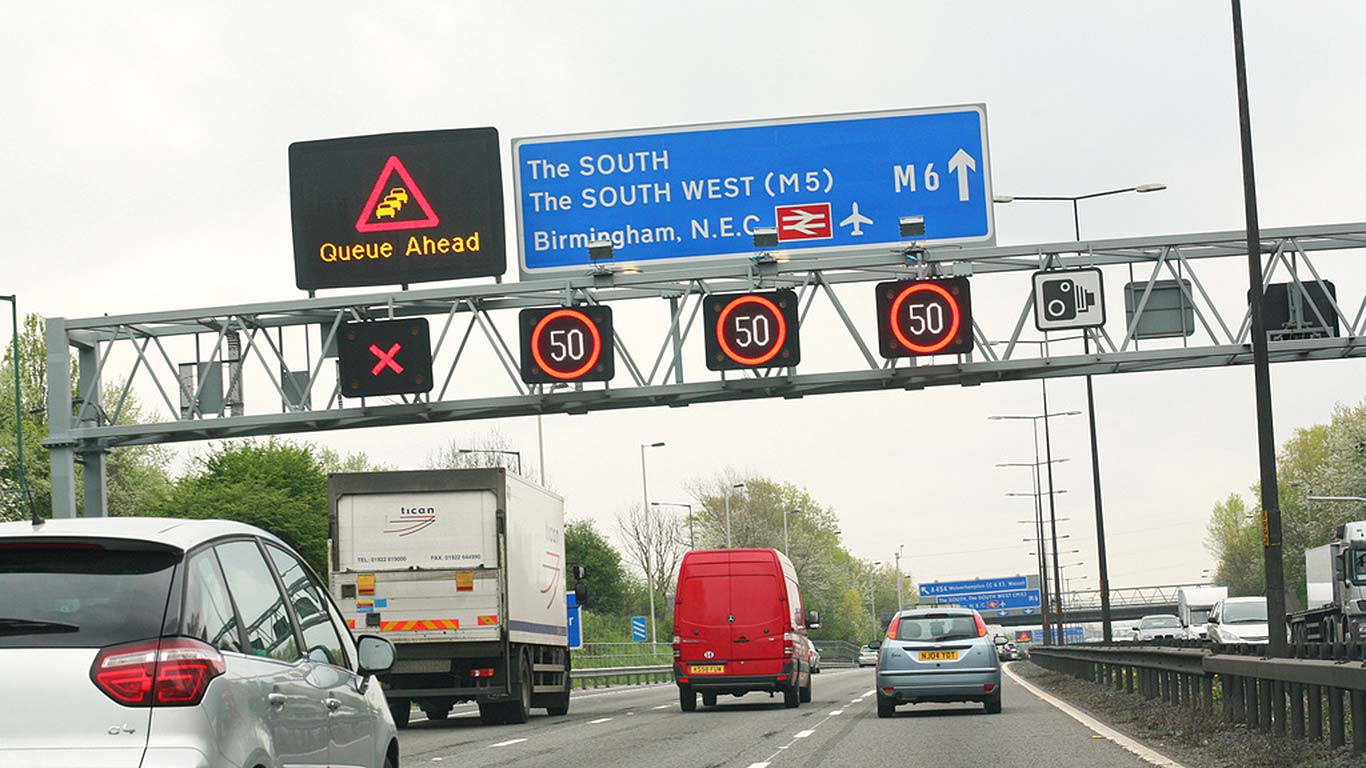 Independent watchdog Transport Focus has called on Highways England to up its game in educating motorists how to use smart motorways.