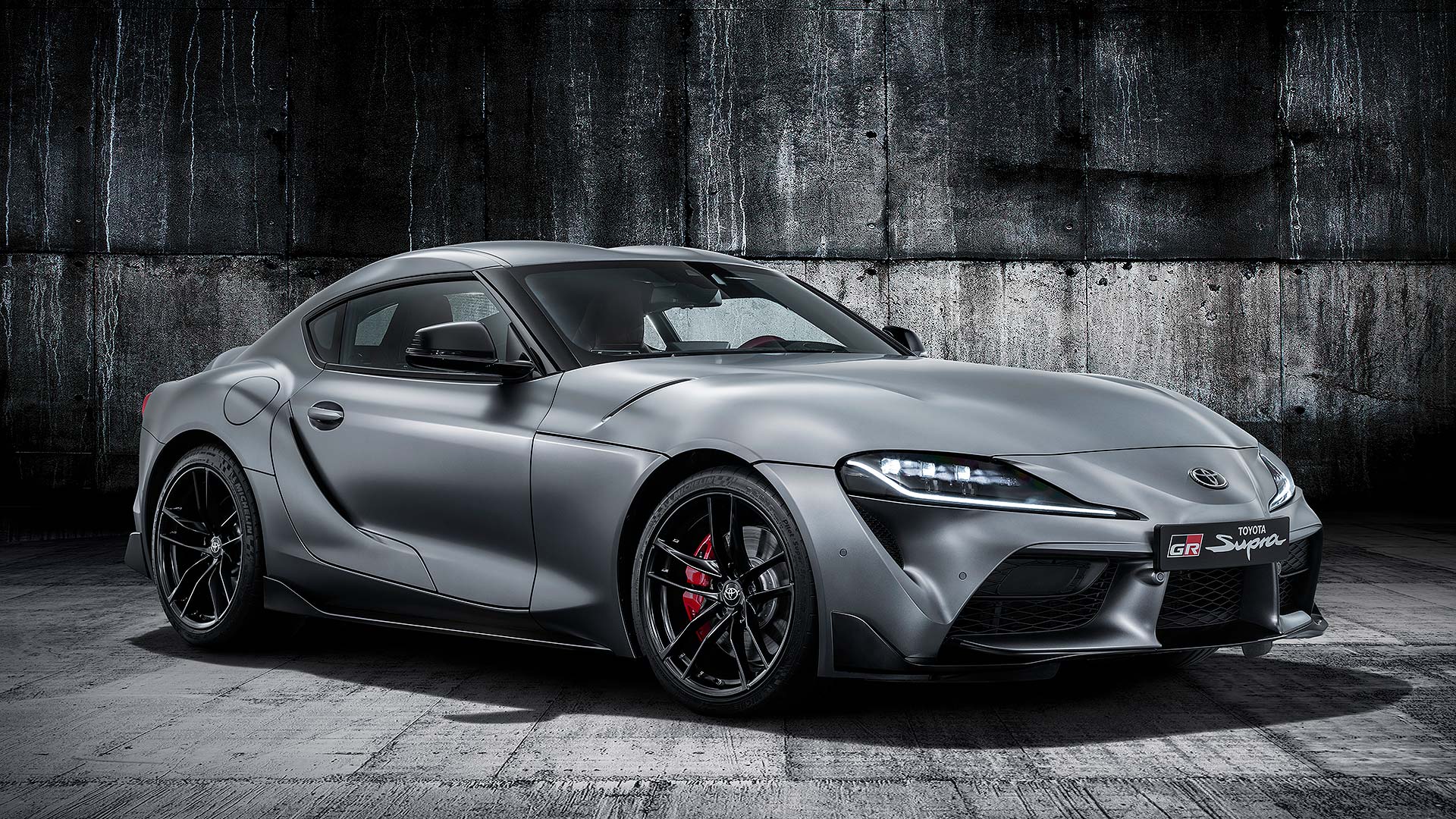
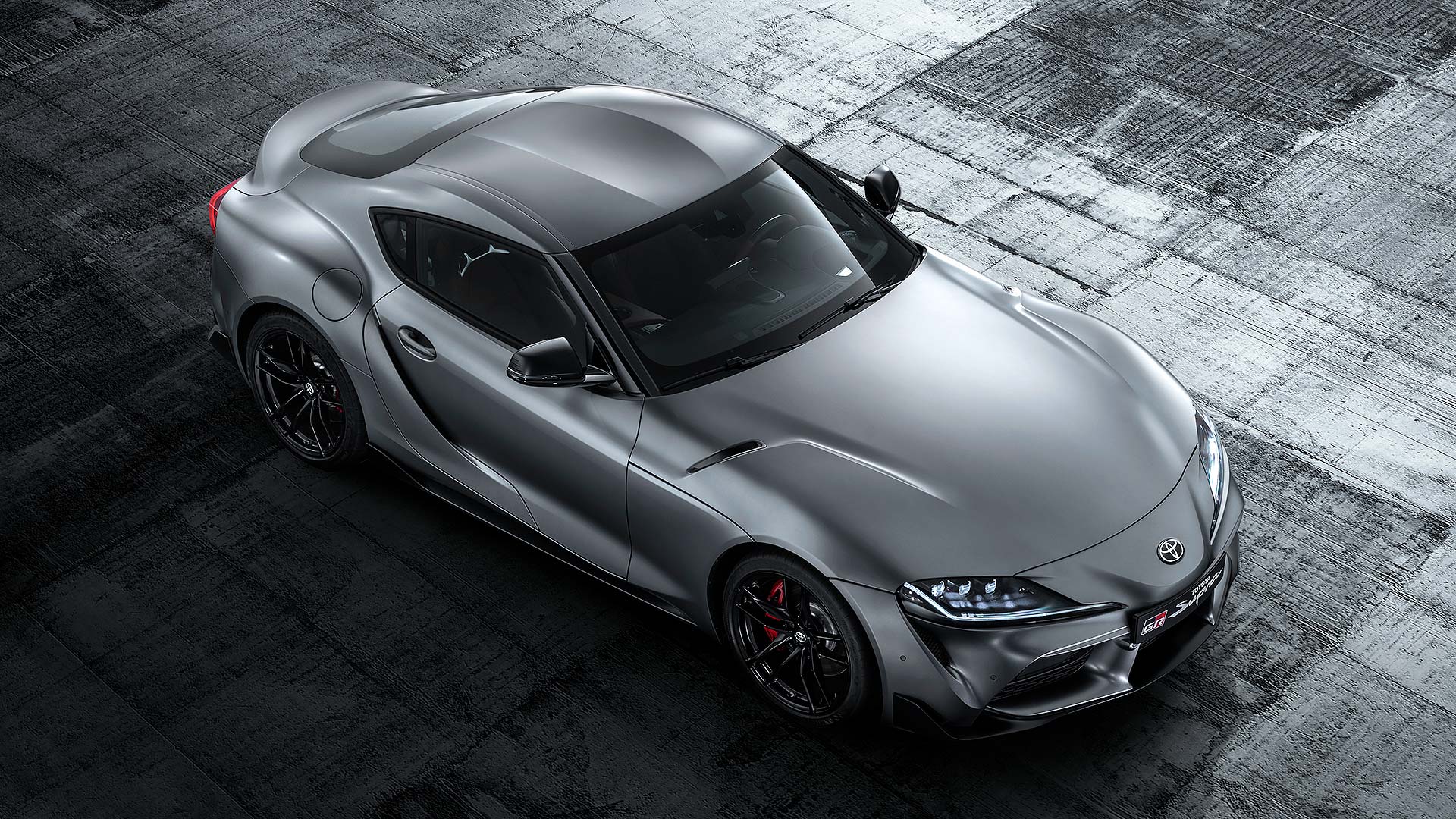
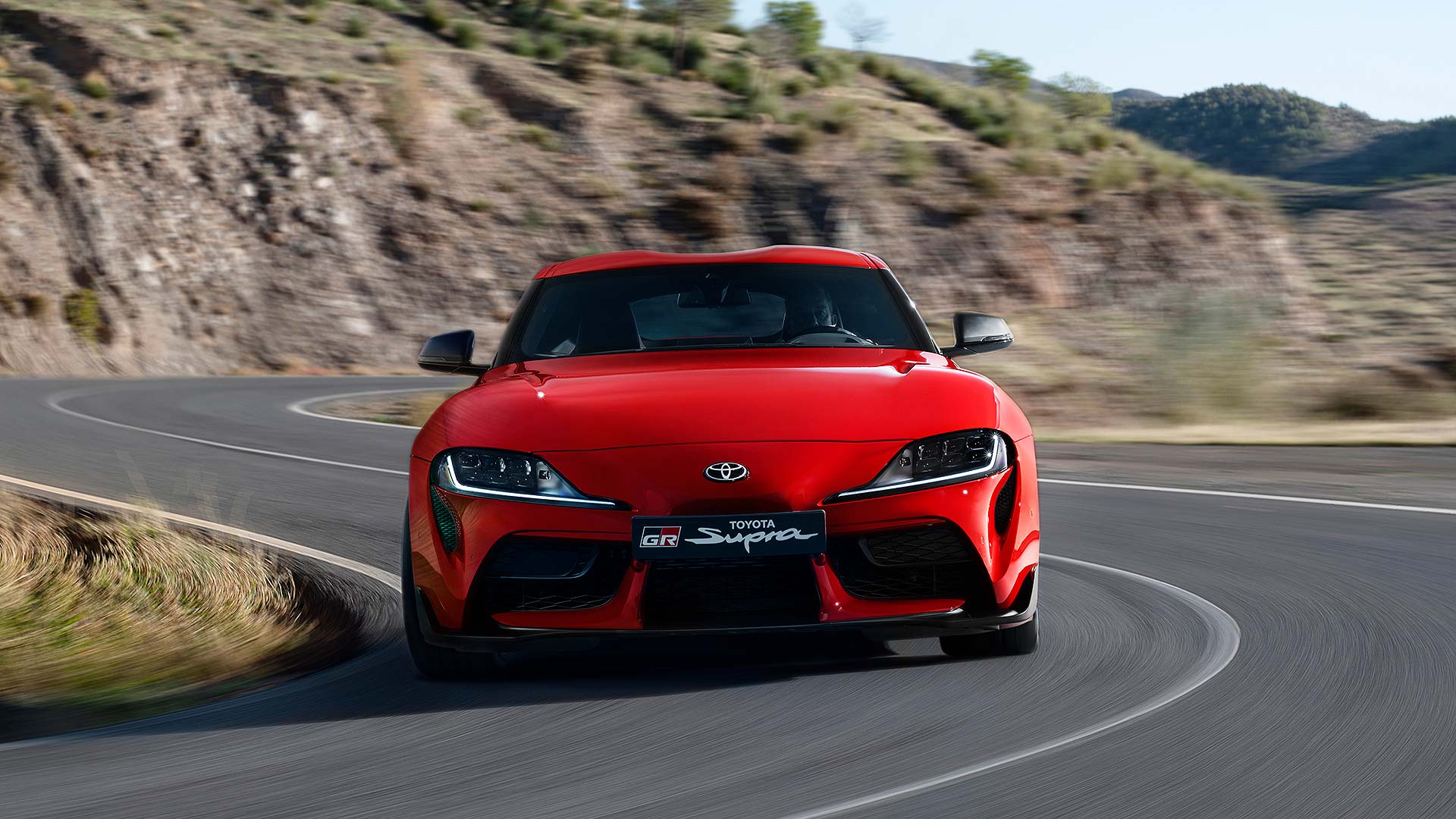
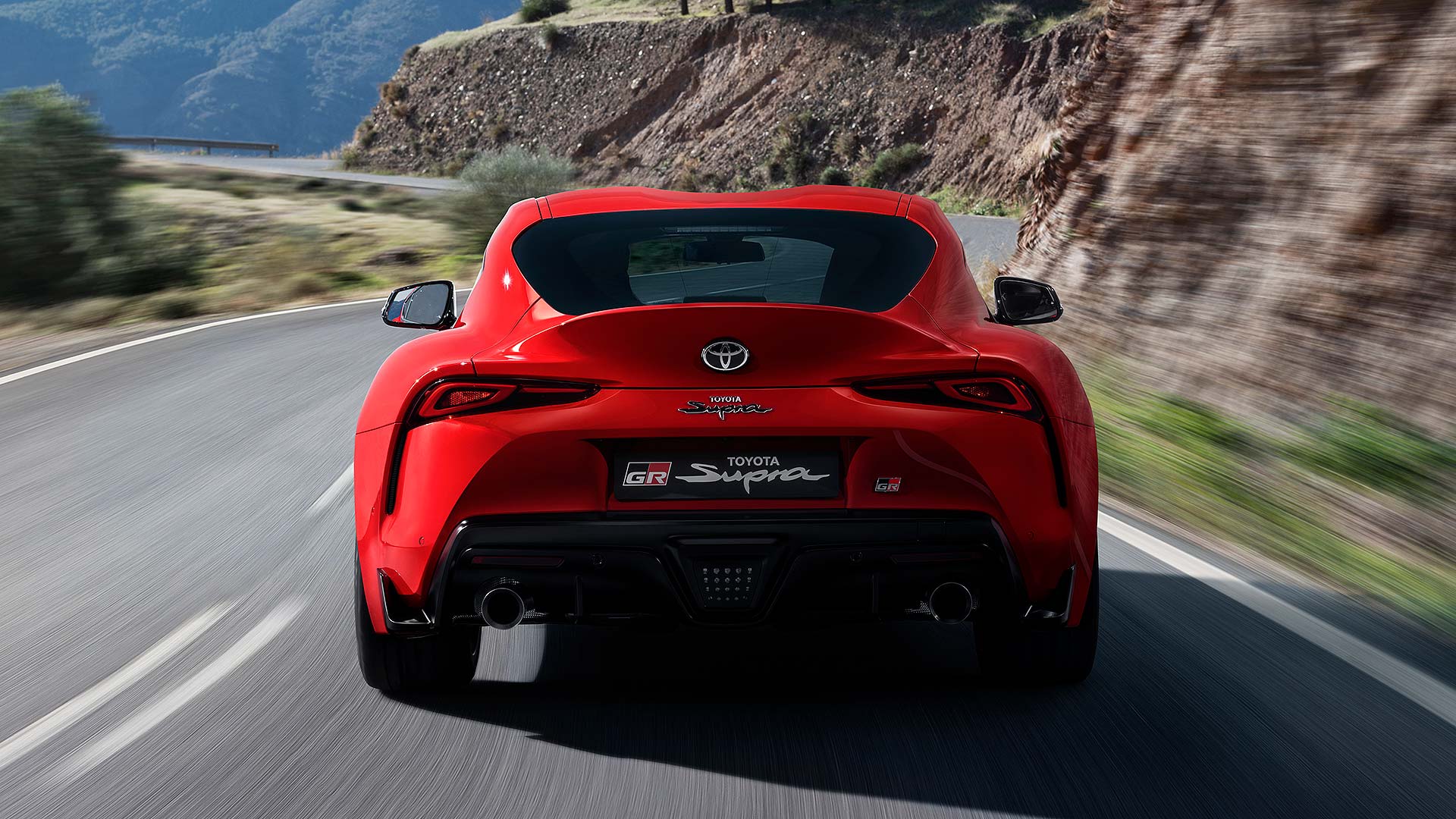
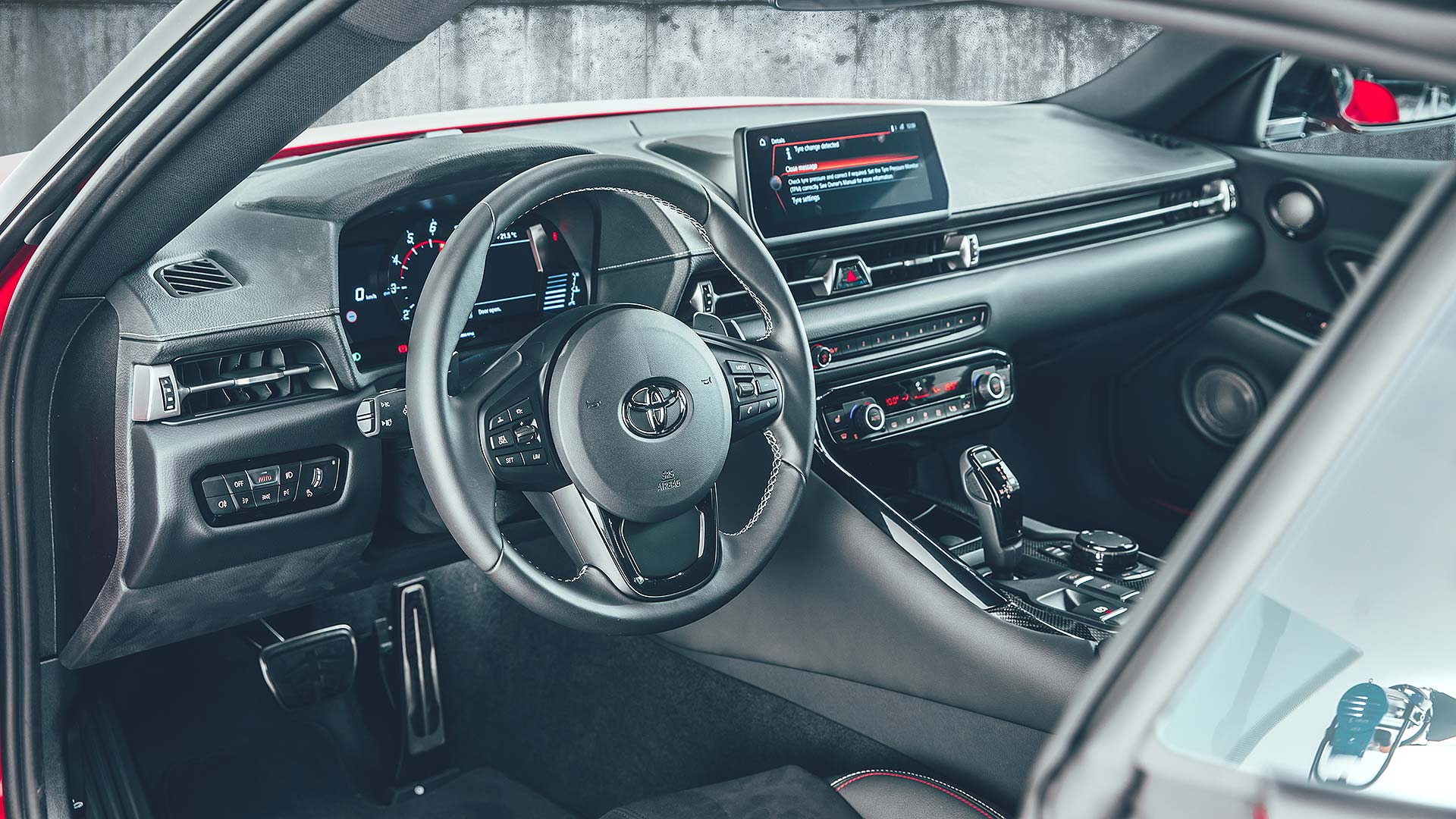
The new Toyota GR Supra has been revealed at last, making its world debut at the 2019 North American International Auto Show in Detroit. First customer deliveries are due from later this summer.
Prices for the new Supra start from £52,695. We list full details of models and specifications below.
The eagerly-awaited new two-seat sports car uses a front-mounted 335bhp 3.0-litre straight-six turbo engine, driving the rear wheels. It’s a classic configuration that builds upon the heritage of previous Supras – and it’s not the only way the new car harks back to the past.
However, it’s no retro recreation: Toyota calls its design ‘Condensed Extreme’, which looks forward as well as evoking “the romance of classic styling”.
Toyota is promising driving enthusiasts “an exhilarating blend of power, agility and precision handling, achieved thanks to the car’s combination of a short wheelbase and wide track, light weight, low centre of gravity and highly rigid body”.
Rather impressively, Toyota CEO Akio Toyoda himself gave the final green light to the car’s handling, after testing it at the Nürburgring. He is one of the rare breed of highly talented Toyota Master Drivers.
“Back in the day, I spent countless hours driving an old Supra at the Nürburgring to become a Master Driver,” said Toyoda-san. “Supra is like an old friend that holds a special place in my heart.
“The new GR Supra was born through testing at the Nürburgring, and I can honestly say that it is a a car that is fun to drive and better than ever.”
GR stands for Gazoo Racing and the new GR Supra is the Toyota division’s first global model. It’s also the sister car to the new BMW Z4 and will be built in the same factory in Graz, Austria.
2019 Toyota Supra engines and specs
All GR Supras feature the same 335hp 3.0-litre BMW-derived straight-six engine, driving an eight-speed automatic gearbox. Zero to 62mph takes 4.3 seconds and top speed is limited to 155mph.
CO2 emissions are 170g/km, and NEDC-compliant fuel consumption is to be confirmed. Let’s hope it’s decent, as the fuel tank is only an average-sized 52 litres.
Kerbweight? That’s 1,495kg minus the driver, 1,570kg according to ECE regulations. The new GR Supra is 4,379mm long, 1,854mm wide and just 1,292mm tall.
Toyota will offer the new Supra in eight different colours, including red, yellow and blue shades.
A special edition car will be painted in Matt Storm Grey, described as a matt finish with a hint of blue. Large 19-inch alloys (with Michelin Pilot Super Sport tyres) will be standard.
All new GR Supras will have adaptive suspension, an active differential and high-performance brakes. Inside, dual-zone climate control, 8.8-inch infotainment with sat nav, adaptive cruise control and power-adjustable Alcantara seats will be standard, along with LED headlights, rain-sensing wipers and a rear-view camera.
Toyota reckons the GR Supra Pro will form the vast majority of UK sales. This adds black leather upholstery, a 12-speaker JBL sound system, head-up display and wireless smartphone charging.
The GR Supra A90 Edition is a launch special, limited to just 24 cars for UK customers. This will come in Matt Storm Grey, with matching matt black alloys and, inside, contrast red leather. Otherwise, the spec is as for the Pro.
Uniquely, Toyota is only offering the A90 Edition to UK customers who have placed a pre-sales reservation. “The first to convert their reservation into a vehicle order will have the option to specify a Supra A90 Edition as their model choice.”
And they’ll be able to do this from tomorrow: 15 January. That’s when ordering opens for UK customers.
They’ll be joining a special club, too – Toyota is rolling out a ‘dedicated rewards programme’ for Supra buyers, ‘giving access to special Supra-themed activities, events and branded items’.
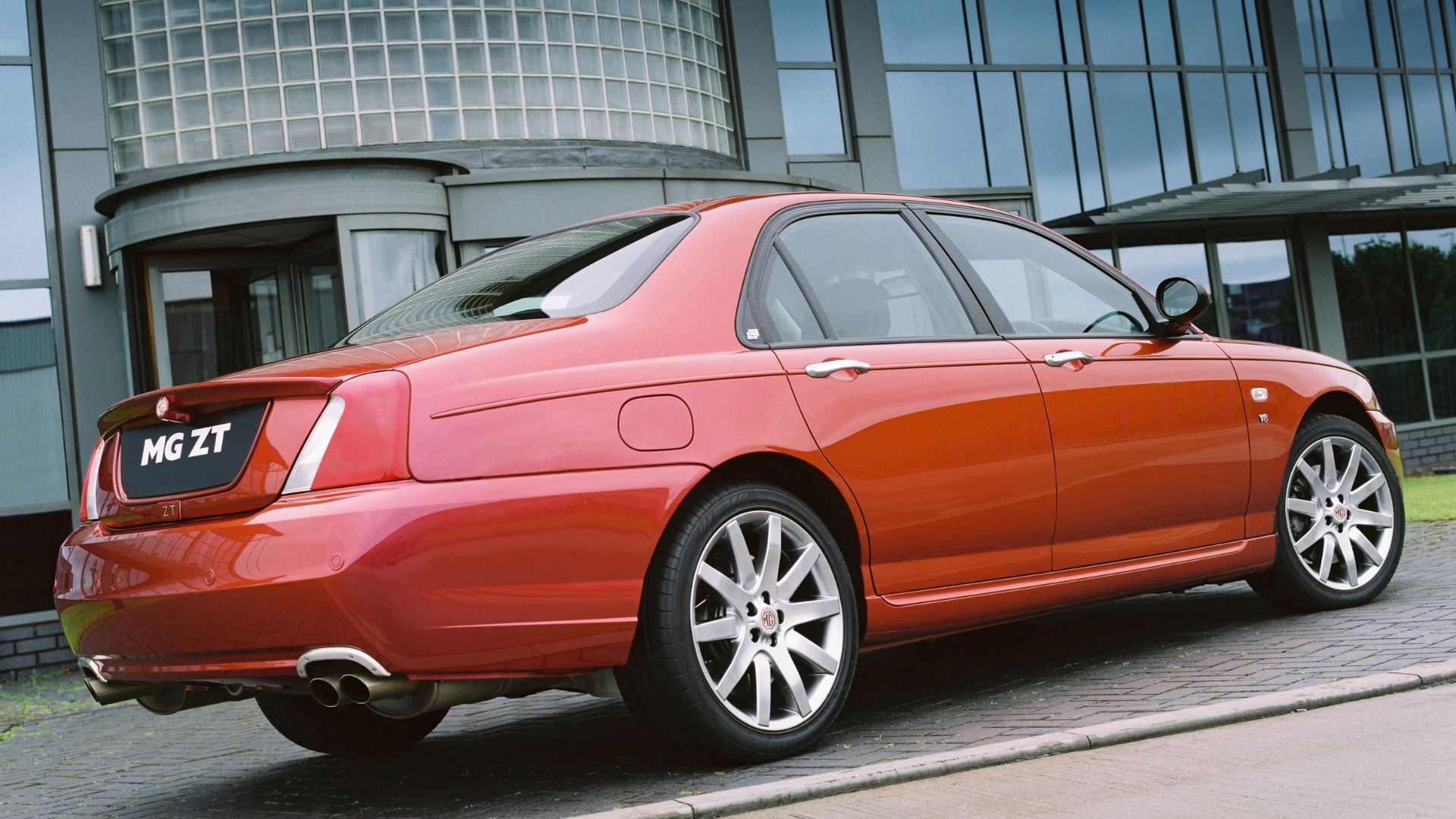
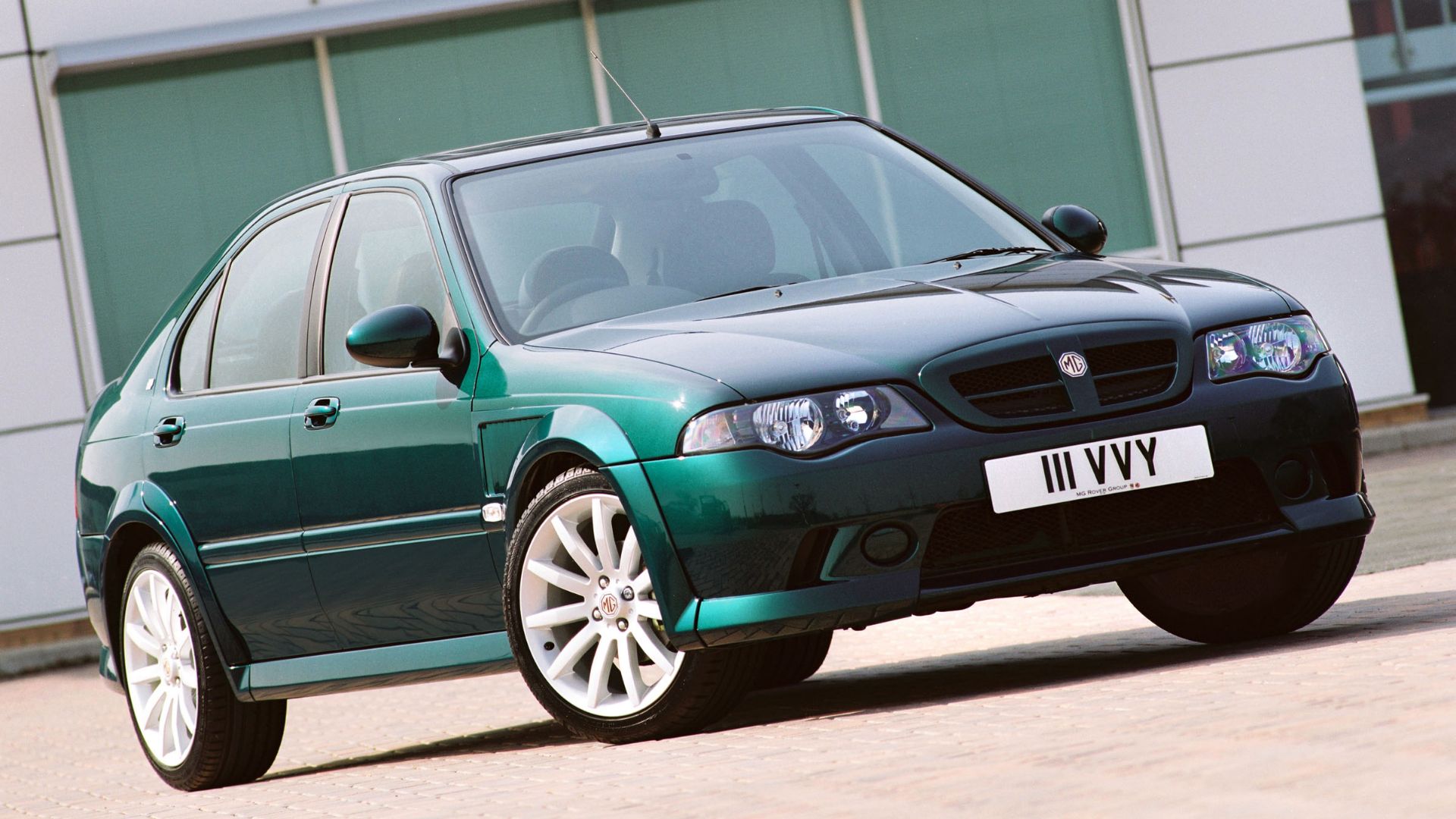
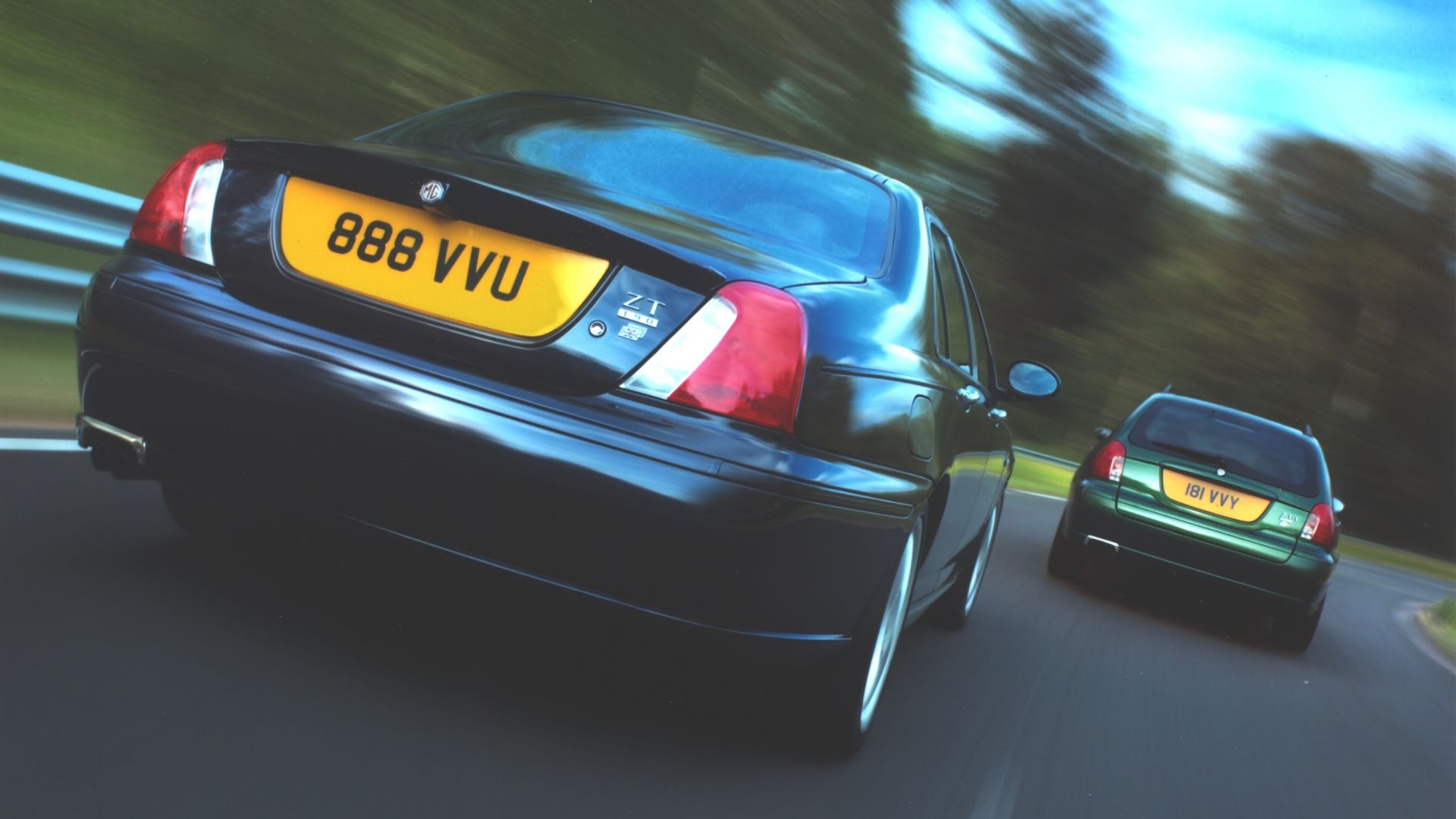
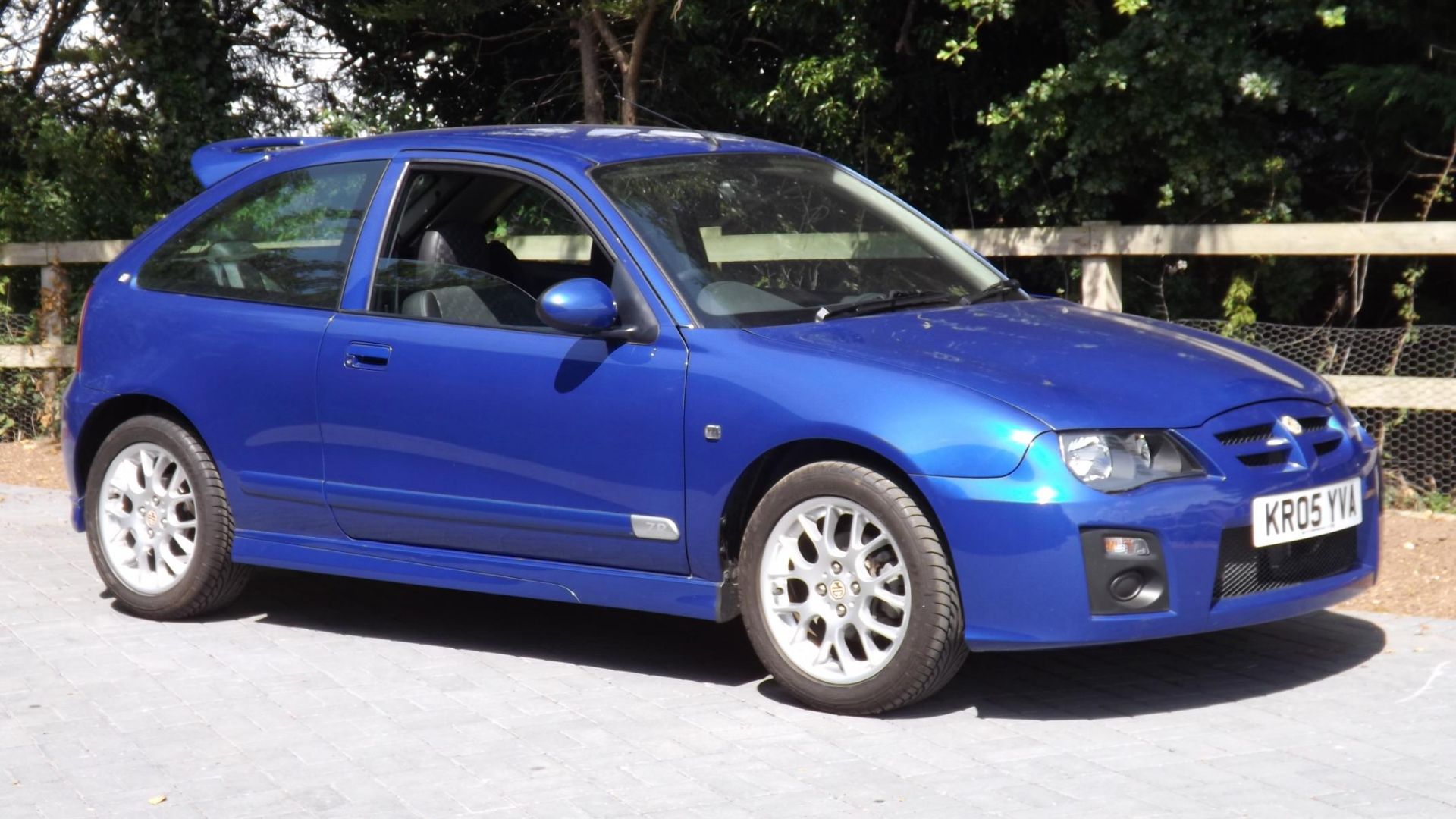
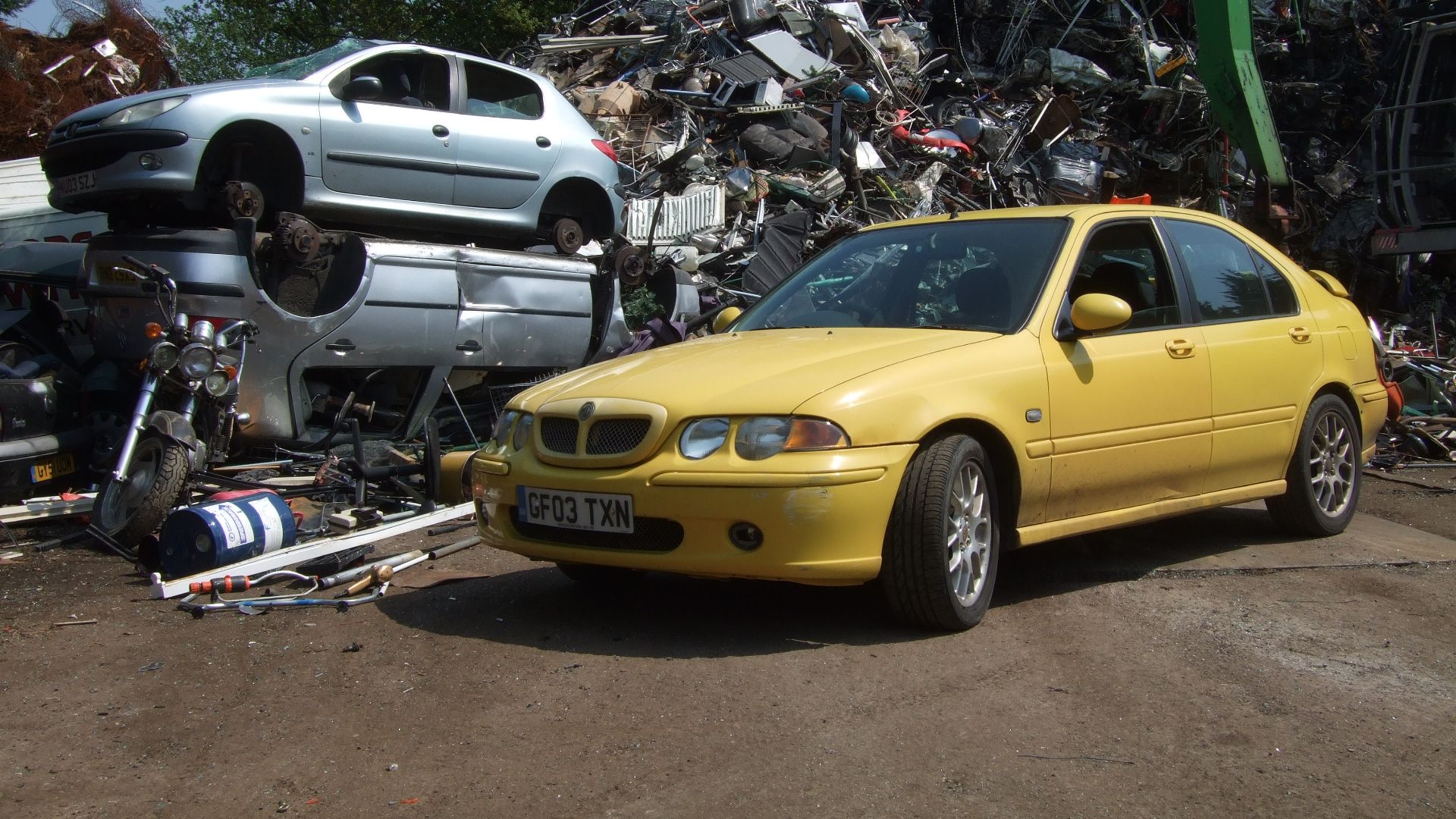
Joining the giant panda, tiger and the whooping crane in the list of endangered species is the ‘Z’ range of MGs from the early 2000s.
Numbers of ZT, ZR and ZS models are dwindling fast. So who can save them? Possibly the MG Car Club and the Zed register, with their new ‘Save Our Zeds’ campaign.
The campaign looks to raise awareness of the decline in ‘Z cars’ and help educate and assist owners to keep their cars on the road – and off the scrapheap.
Adam Sloman, General Manager of The MG Car Club, highlights the issue: “This decline in Zed cars is something we as a Club have heard many stories about.
For sale: the ultimate collection of modern classics
“We are concerned that an important part of the MG brand’s heritage is going to be lost, and future generations are going to miss out on these much-loved cars.”
It would seem they are dropping like flies, with Z numbers falling by 78 percent between 2006 and the third quarter of 2018 – down from 90,191 to 19,618.
The biggest sufferer is the ZR, having crashed by 84 percent, from 51,116 to 7,964. The ZS and the ZT haven’t fared quite so badly, with 72 and 67 percent drops respectively. There are 14,577 ZS models and 12,844 ZTs remaining, according to data from HowManyLeft.
“Today’s culture of financial incentives to scrap older cars when purchasing cars on PCP or lease deals versus the cost of repairing an older car appears to rule out repairs as a viable option,” said John Thompson, Chairman of the Zed Register.
“There are many quality MG specialists and parts businesses across the UK, and the MG Car Club offers member discounts with some of these suppliers. So repair really is a good choice.”
Of course, the ZS name lives on in the form of the current MG crossover. We suspect the Zed Register and the MG Car Club don’t think that counts, though…
Read more:
Mondeo Man is dead – long live ‘Golf John’
Ford ‘Robutt’ simulates 10 years of sweaty seat use
Hardcore Lexus RC F Track Edition wows Detroit Show
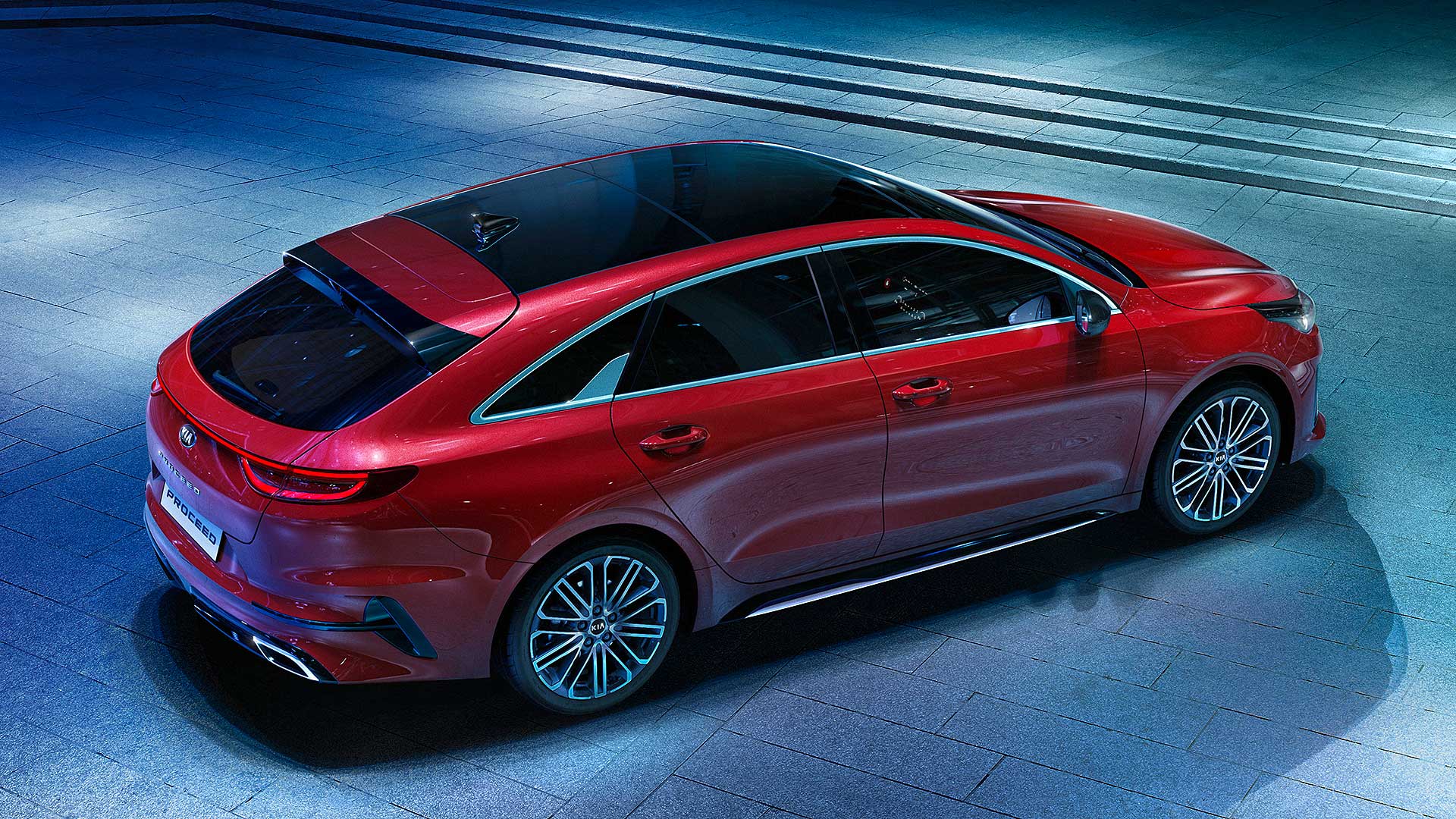
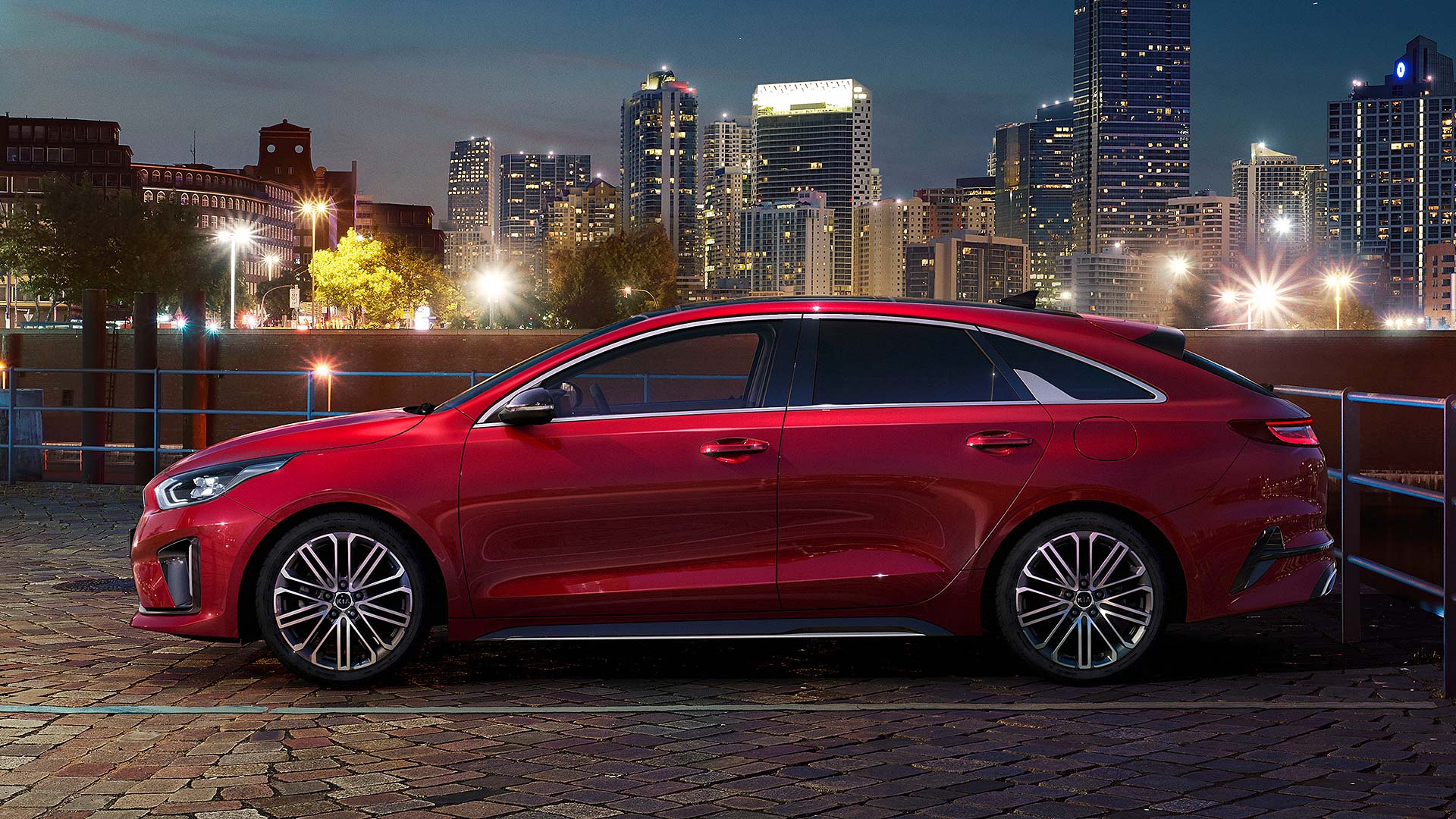
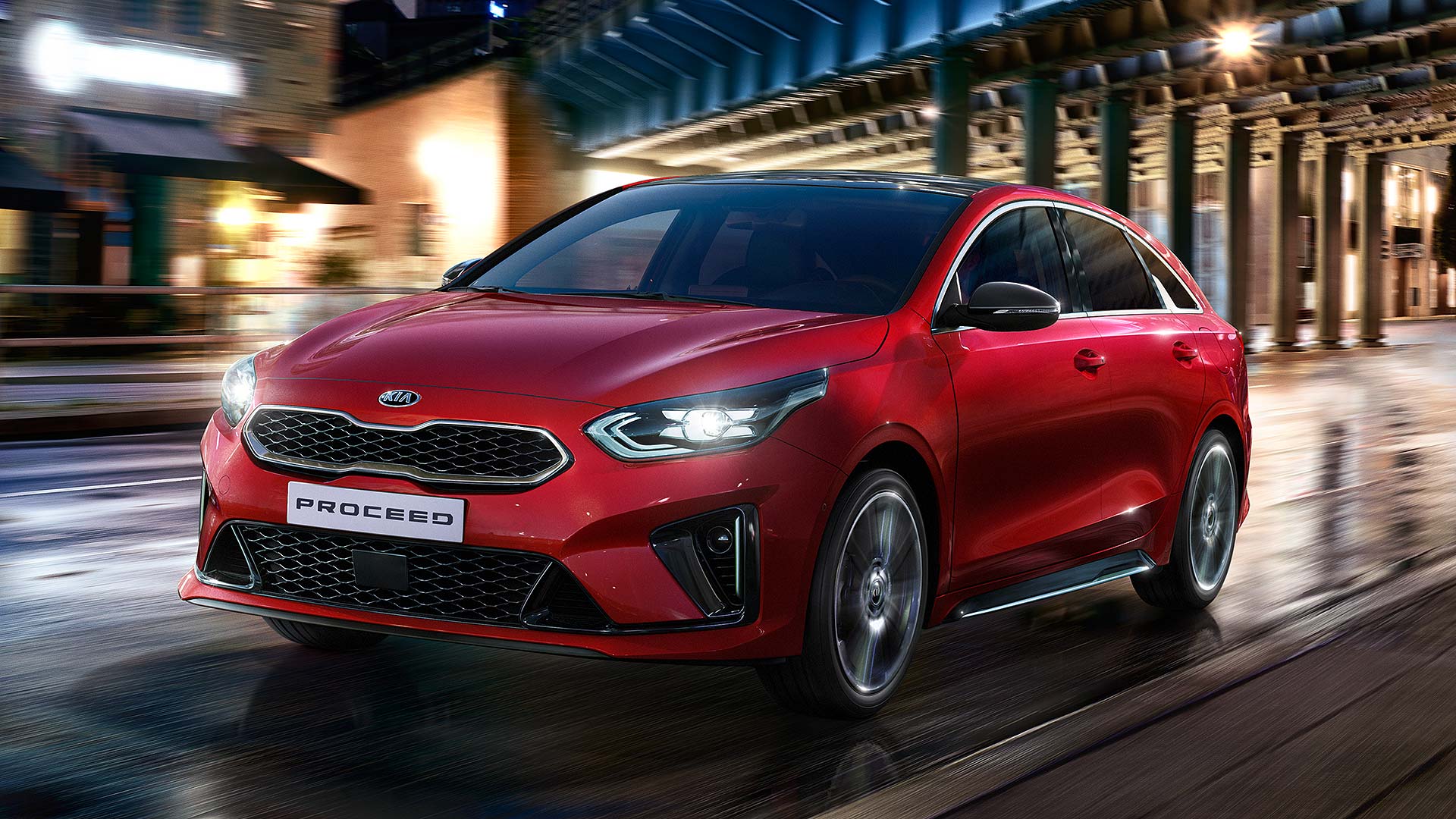
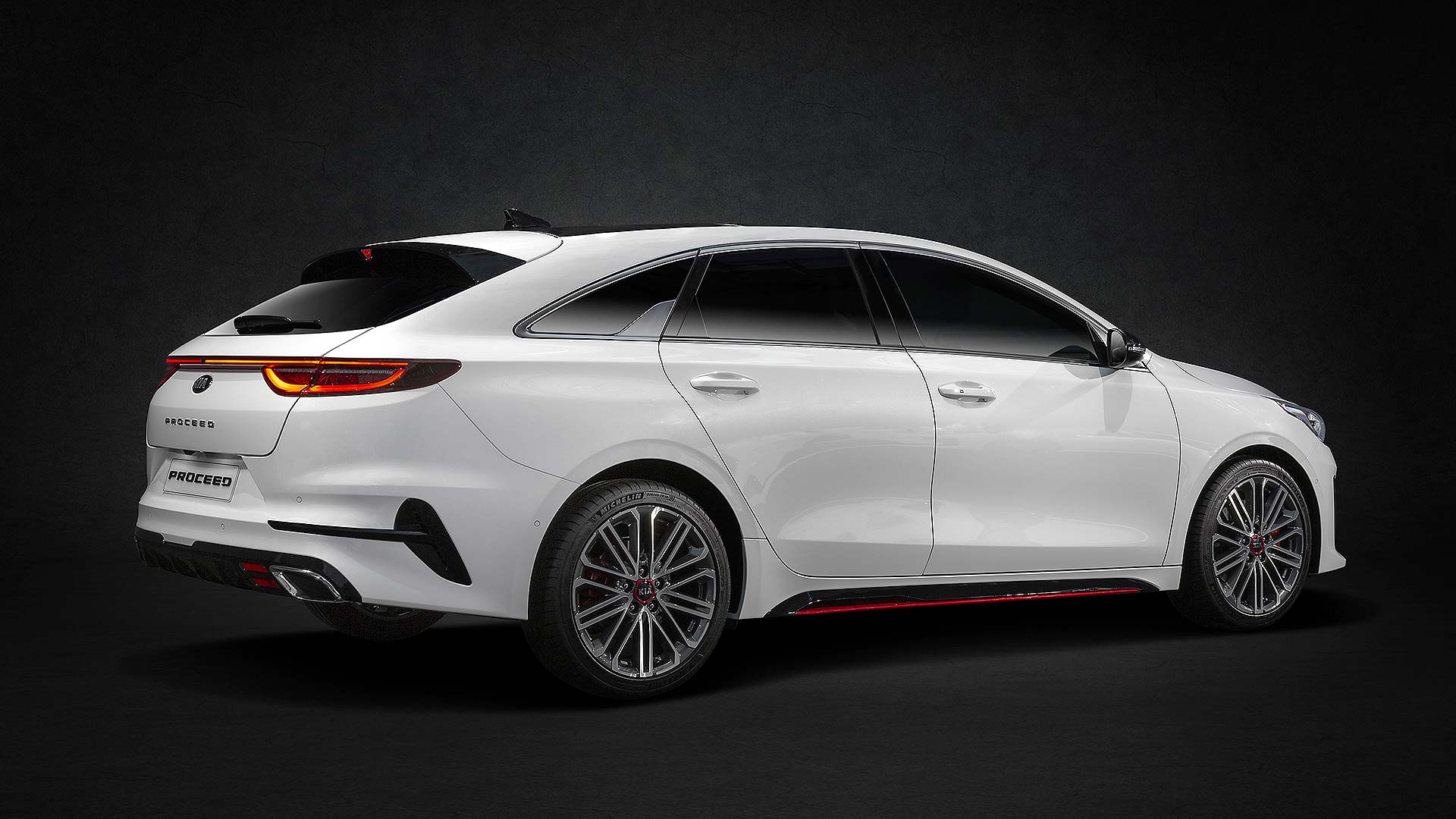
The new Kia Proceed goes on sale in the UK from 21 January 2019 with prices for the shooting brake starting from £23,835.
Not only has Kia simplified the name – pro_cee’d becomes Proceed – it’s also rethought the concept, turning a three-door coupe into a five-door shooting brake estate.
It’s a more svelte load-lugger, trading some of the Kia Sportswagon estate’s capacity for more Mercedes-Benz CLS Shooting Brake-style curves. Kia says it’s targeting couples and young families – people who need space and versatility, with a bold dose of style on top.
“Europe’s shrinking market for three-door hatchbacks brought the future of the pro_cee’d in question,” said Kia Europe design chief Gregory Guillaume.
“We needed to reinvent the pro_cee’d to ensure that all its vitality and vibrancy wasn’t simply lost. It had to be a model that not only sat at the top of the current Ceed family, but one that was also immediately identifiable as the most emotionally engaging car in the range.”
Underlining the Proceed’s position as a genuine range-topper, it is offered only in GT-Line, GT-Line S and GT spec. All get ‘ice cube’ daytime running lights and alloy wheels at least 17 inches in diameter (most will come with 18s). The Proceed sits 5mm lower than a standard Ceed, too.
Make that a practical range-topper. The 594-litre boot is 50 percent larger than a Ceed hatch, and a lower ride height plus the lack of a boot lip mean it’s easier to load.
2019 Kia Proceed engines and specs
Kia’s offering two core engines in the Proceed, a 138hp 1.4-litre T-GDi turbo petrol and a 134hp 1.6-litre CRDi ‘Smartstream’ turbodiesel.
Smartstream tech is new for Kia and the Proceed is the first car to get it. This emissions-reducing new tech includes SCR selective catalytic reduction and should help keep NOx exhaust emissions under control.
The top-line Proceed GT gets a 201hp 1.6-litre T-GDi turbo petrol, for reasonable warm hatch kudos; Kia has no plans to introduce a more powerful Proceed than this. It’s only offered in seven-speed DCT auto guise; the 1.4 T-GDi in GT-Line S guise is also only offered as an auto (while only the base GT-Line offers the diesel alternative).
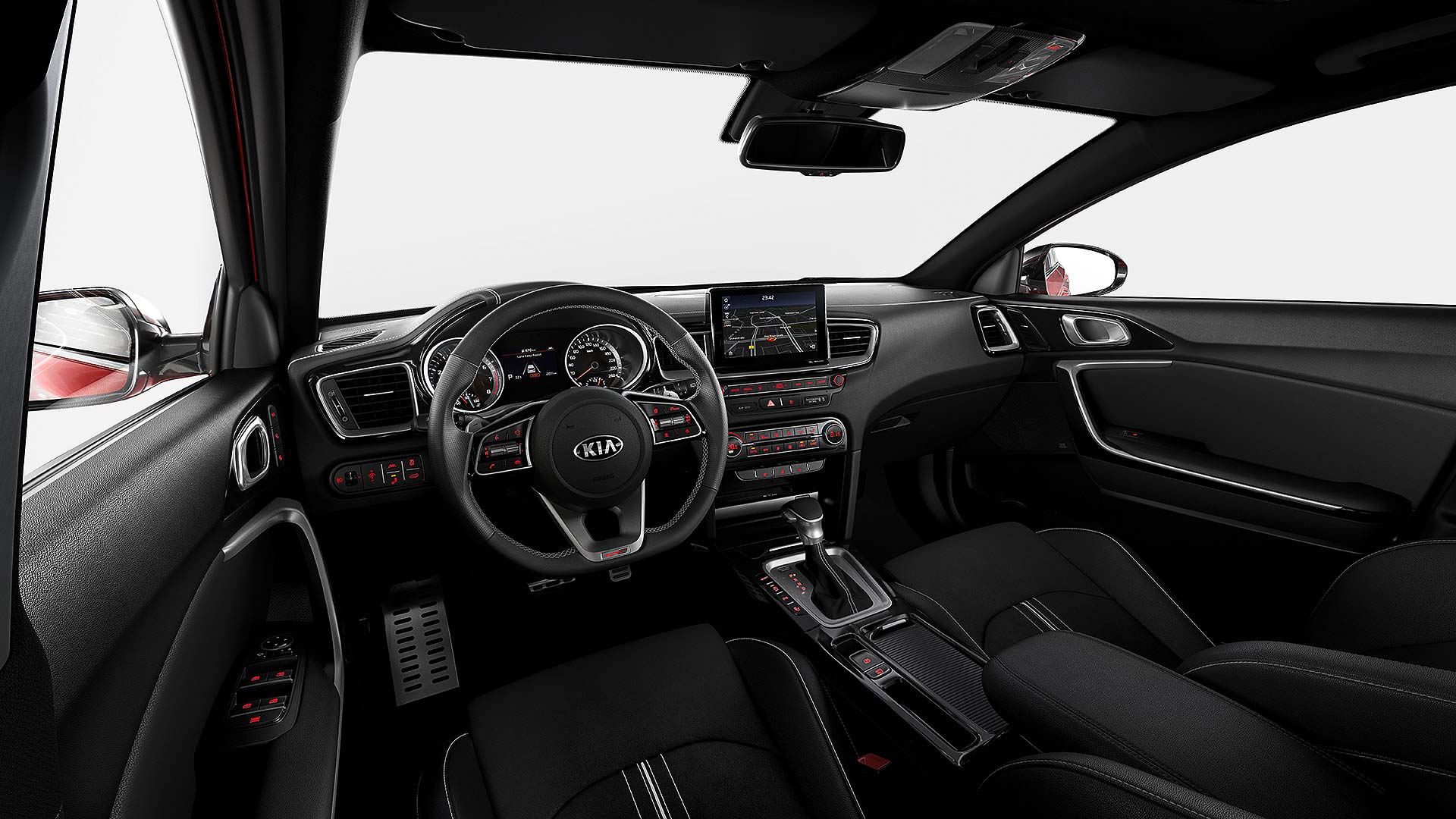
GT-Line models have privacy glass, automatic headlights and wipers, folding door mirrors, high-gloss black exterior trim outside and, inside, heated cloth and faux leather seats. Climate control, cruise control, 8-inch infotainment with sat nav, Apple CarPlay and Android Auto and more gloss black trim are also standard.
GT-Line S Brings bigger 18-inch alloys, LED headlights, panoramic sunroof, electric seats with better bolstering and real leather (but faux suede) trim, plus smart cruise control with stop-go functionality. Front and rear parking sensors, wireless smartphone charging and a JBL sound system are also included.
The performance GT has more red detailing outside, red contrast stitching and a series of chassis upgrades that followed a six-month development programme on European roads.
Ordering opens on January and full prices are listed below.
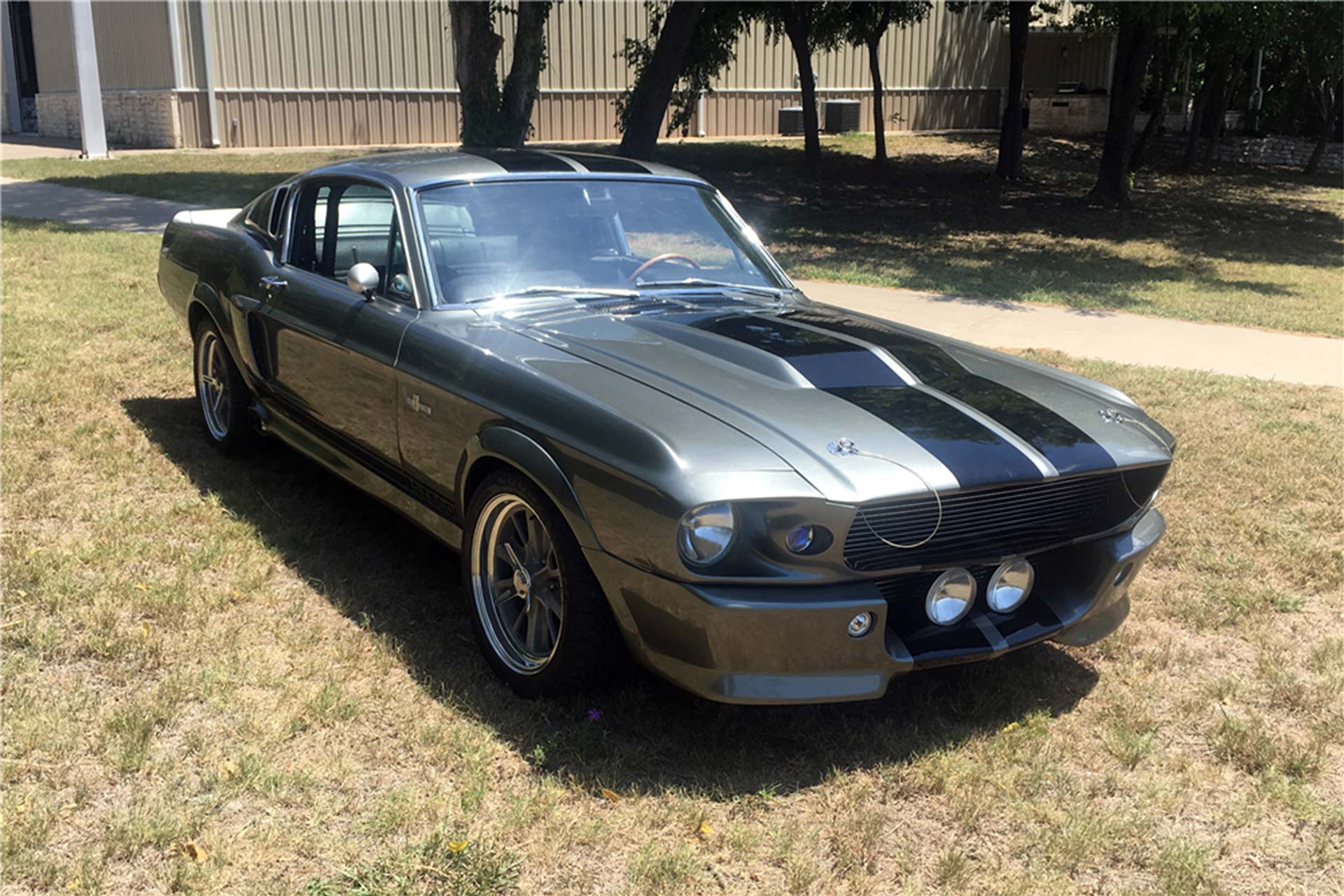
Arguably one of the most famous motoring movie stars of the past two decades, a 1967 Ford Mustang Fastback from Gone in 60 Seconds is coming up for auction.
Known as ‘Eleanor’ in the 2000 remake of the 1974 original, the customised Shelby GT500 became the main feature of the film for Nicolas Cage’s character, Memphis Raines.
The popularity of the film has seen an industry created in building ‘Eleanor’ clones, but the car for sale at the 2019 Barrett-Jackson Scottsdale event is the real deal.
What’s a unicorn?
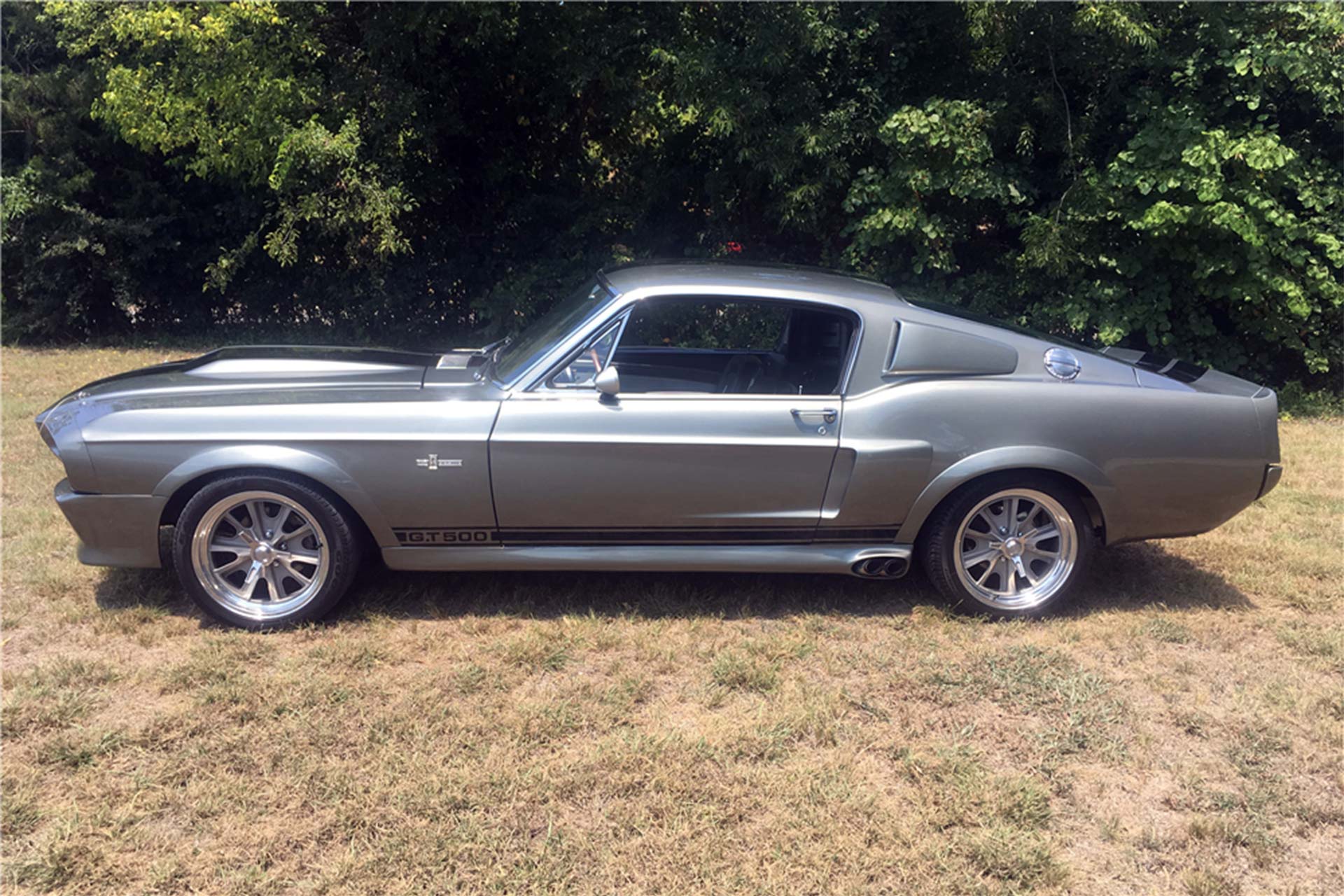
Depending on sources, either 11 or 12 examples of Eleanor were created for filming. Hot Rod illustrator Steve Stanford created the concept, with the late Boyd Coddington responsible for making the ideas come to life.
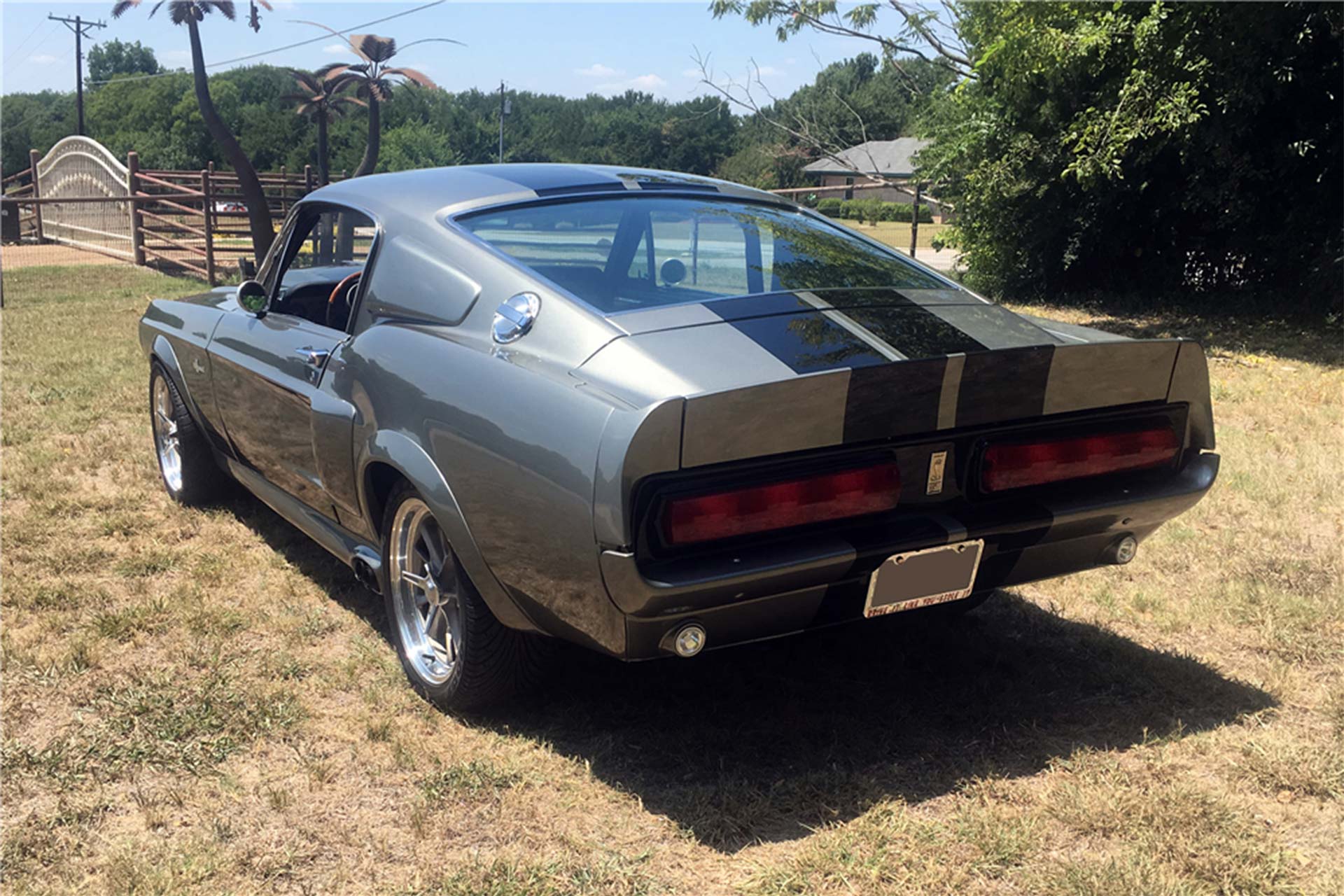
A deep front splitter, wider wheel arches, larger rear spoiler, and a pair of prominent spotlights below the grille were part of the package. Distinctive 17-inch wheels hide six-piston performance brakes, with the suspension swapped for adjustable coilover units at the front.
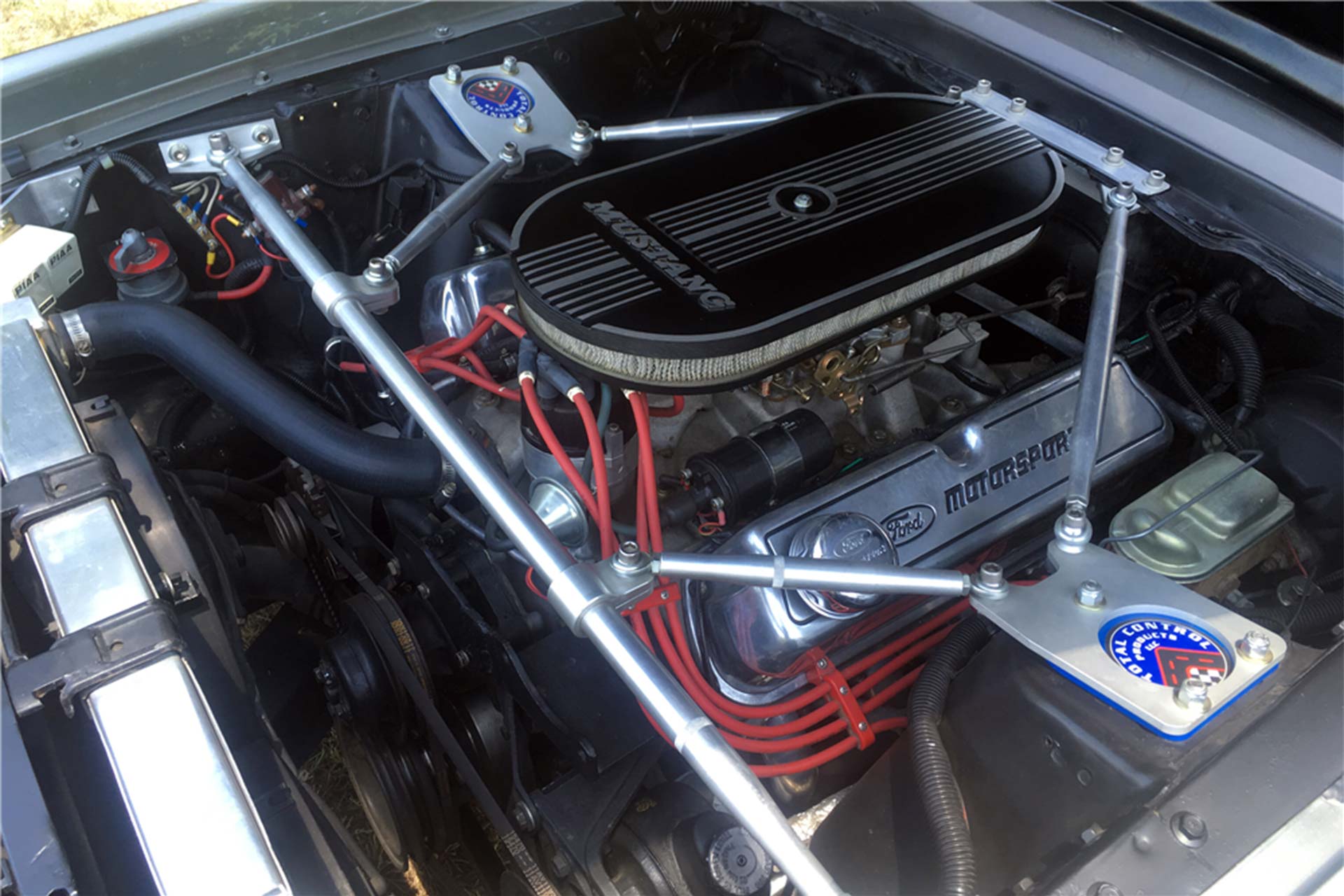
Under the bulging bonnet is a 351-cubic inch (5.7-litre) Ford Racing engine, connected to a three-speed automatic gearbox. Unlike in the movie, there is no nitrous oxide injection system fitted here. Sorry! There is a giant tachometer in the dashboard at least.
Go, baby, go!
Of the 12 cars built, five were destroyed during filming in stunts and action scenes. This particular car lived a more pampered life, being reserved for street scenes with actors behind the wheel.
The car comes complete with a signed certificate of authenticity by Cinema Vehicle Services. This was the company responsible for building the initial twelve cars, and has certified only two others previously offered for sale.
Our car in question has previously been sold at auction, exactly a decade ago in the same location. At the 2009 Barrett-Jackson Scottsdale auction, this exact ‘Eleanor’ sold for an impressive $216,000 (£169,000).
Boosted for profit
The current owner may well be looking to make a significant return on that investment in the 2019 sale.
In 2013, one of the other ‘Eleanor’ Mustangs used for hero scenes featuring actors sold for an incredible $1million (£779,000) at auction. That car did have a four-speed manual gearbox, and is the one believed to have featured the most on-screen.
With the sheer number of vehicles on sale at the Barrett-Jackson Scottsdale 2019 sale, you could potentially tick off the 50 cars featured in the 2000 remake. Alternatively, take home the four Chevrolet Camaros from the Transformers franchise as well, and this could be the opportunity to start a real movie car collection.
‘Eleanor’ is due to cross the auction block on the 19th January, meaning you’ve still got time to start making space in the garage.
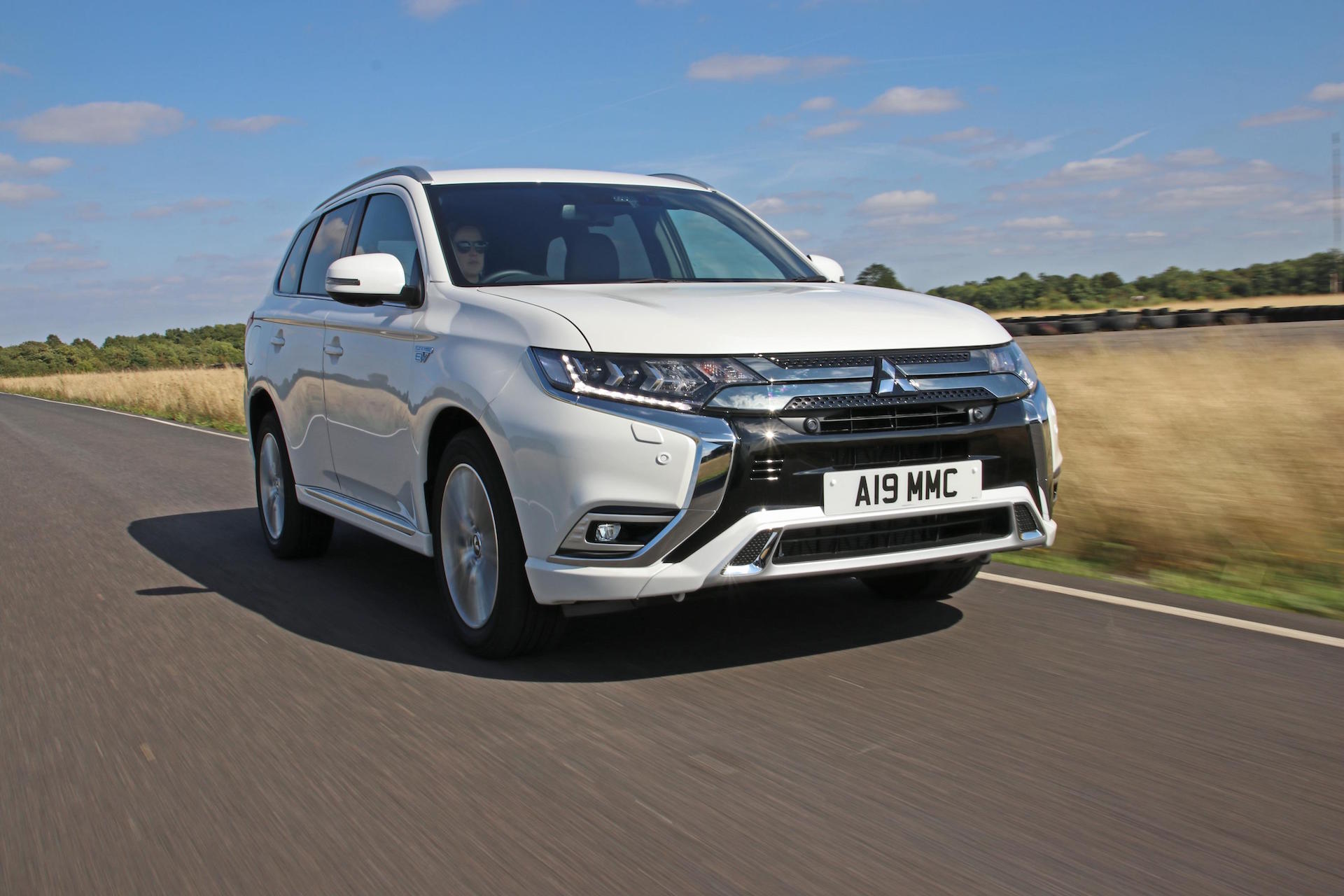
The Advertising Standards Agency (ASA) has dismissed two complaints that an advert for the Outlander PHEV could potentially mislead consumers.
First aired in September 2018, the complainants argued that the advert voice-over placed repeated emphasis on the electric elements of the Outlander PHEV.
The voice-over in question stated: “What is the new Mitsubishi Outlander plug-in hybrid? It’s electric and petrol power combined. It’s electric and a practical SUV. It’s electric and 4 wheel drive. It’s electric and delivers up to 159 miles per gallon. New Mitsubishi Outlander PHEV. It’s electric and more. Drive your ambition. Mitsubishi Motors.”
According to the two complainants, this could lead viewers to think the popular Mitsubishi SUV was powered mainly by electricity, and not the petrol engine.
Together in electric dreams
However, in considering the complaints, the ASA ruled that the content of the advert was more than sufficient to prevent viewers from being confused.
This meant the ad was found not in breach of rules regarding misleading advertising, substantiation, exaggeration, and environmental claims.
When defending the advertisement, Mitsubishi argued that “the ad did not state that the vehicle was purely electric and highlighted the fact that the vehicle had an electric only mode”.
In addition, the company also pointed out that: “the name of the vehicle included the acronym PHEV (Plug-In Hybrid Electric Vehicle) which informed consumers of the vehicle category”, which should have made it clear.
Hybrid theories and facts
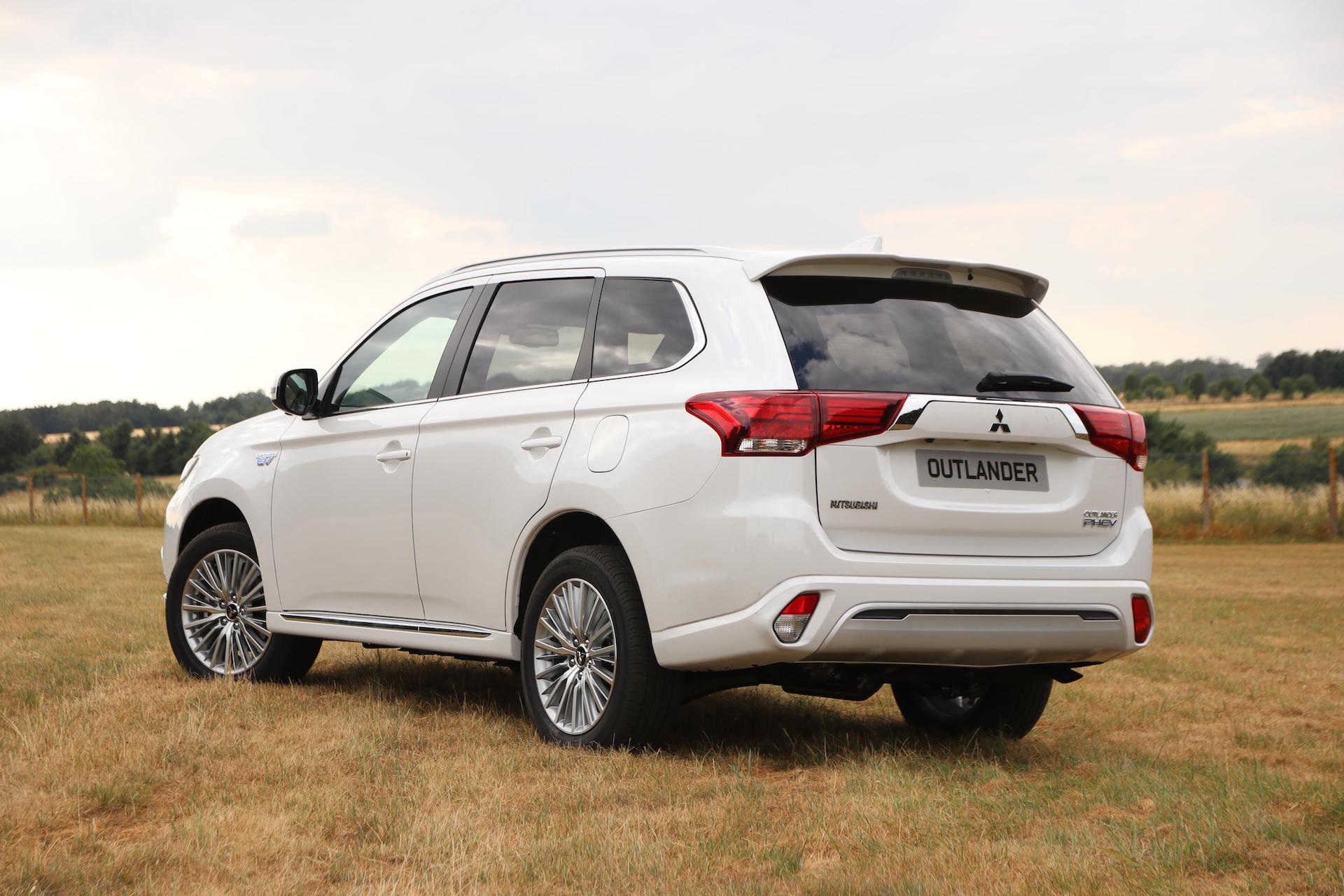
The Outlander PHEV has cemented its position as the UK’s best-selling plug-in hybrid. Revisions made in September 2018, as highlighted by the advert in question, kept the Outlander from being affected by the new WLTP regulations.
Previous rulings from the ASA have treated claims about hybrid cars with particular caution.
A Facebook advert post for the BMW i3 was banned, after the ASA ruled that it could not be called a ‘clean car’ with a range-extending petrol version on offer.
Social media has been awash with rumour and panic about the nation’s speed cameras. Specifically, whether limits and thresholds for being flashed have tightened up.
It’s been suggested that on midnight on January 7, motorway cameras in variable limit zones were switched on permanently. The M1, M25, M6 and M42 were specifically referenced, the reports saying that, even without any display on the signs and the national speed limit in place, you can be flashed at speeds from 72mph.
Tickets were claimed to be ‘auto-generated’, with the advice below saying, ‘watch your speed and tell everyone else’.
It’s not the first time similar rumours have proliferated, with a spate a few months back claiming speed limits were becoming absolute, without any leeway.
Are the speed limits not absolute?
The motorway speed limit, unless otherwise instructed by signage, is 70mph. The same is true with any other limit. However, there is a grey area within which you are unlikely to be flashed.
That’s the first clue that this 72mph rumour is bogus. Speeds displayed, from car to car and camera to camera, can vary somewhat; indicated speed versus what you’re actually doing can differ by a few miles per hour either way. Such things are not taken down to the decimal points, or indeed one or two miles per hour.
The government is not trying to catch you out
Lots of questions about supposed new speeding fines ie “SMART cameras on M1, M6, M42 and M25 now active, they are set at 72mph. The auto ticket generating system issues a 6 point penalty and hefty fine.” Yes cameras are active but the standard fixed pen…https://t.co/136k879CEP
It was suggested that the information was first passed on to taxi drivers by Transport for London.TfL has since debunked these rumours. Regardless, immediately, there should be your second clue that these rumours have no merit.
No matter how much tongue-in-cheek humour exists about those that uphold the rules of the road, ultimately, it is a service. Anything we need to know about as drivers would be openly and clearly disclosed, even advertised, by the government.
What are the facts when it comes to speed cameras?
Speed limits are absolute, which sounds like common sense. Highways England has always maintained that cameras are active and will react to relevant limits, whether the smart gantries have a lower limit in place or not.
The agency in charge of the motorways has stated that it is ‘unaware of any changes’ being made to how the cameras work.
Treat speed cameras as if they are always on. Just because there aren’t any notifications displayed on smart gantries, doesn’t mean you should fly through them at 80mph. As ever, speeders ought to keep an eye in their rear-view mirrors for the tell-tale flash.
There is a grey area spanning a couple of miles per hour when it comes to getting caught. Without wishing to promote any form of speeding, if you’re doing an actual 72mph, it is unlikely that you’ll get flashed – contrary to what the rumours would suggest.
The percentage size of such grey areas is commensurate with increases in the limit. For yours and others’ safety – and for the sake of your licence and bank balance – keep within all limits on the road.
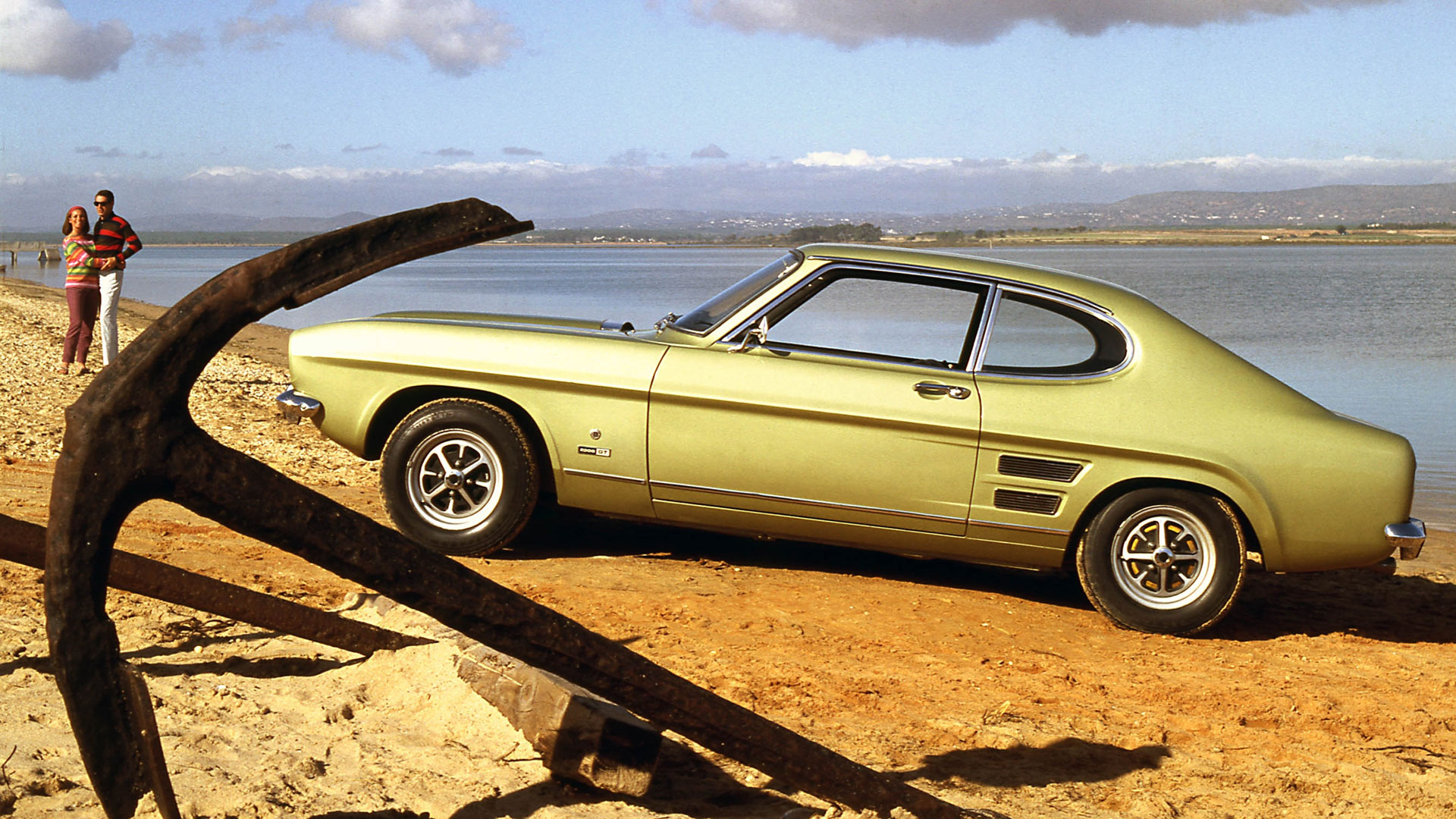
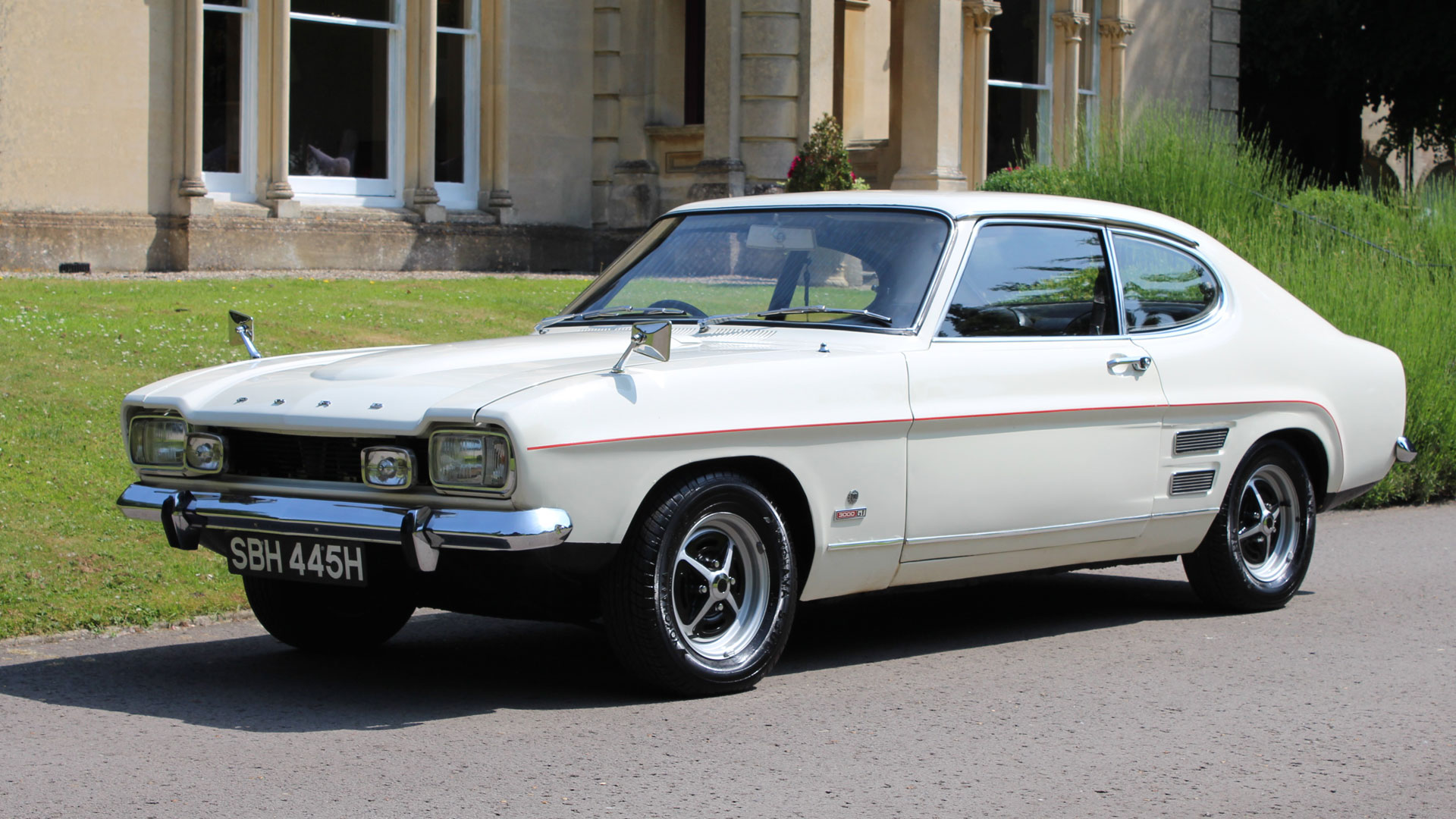
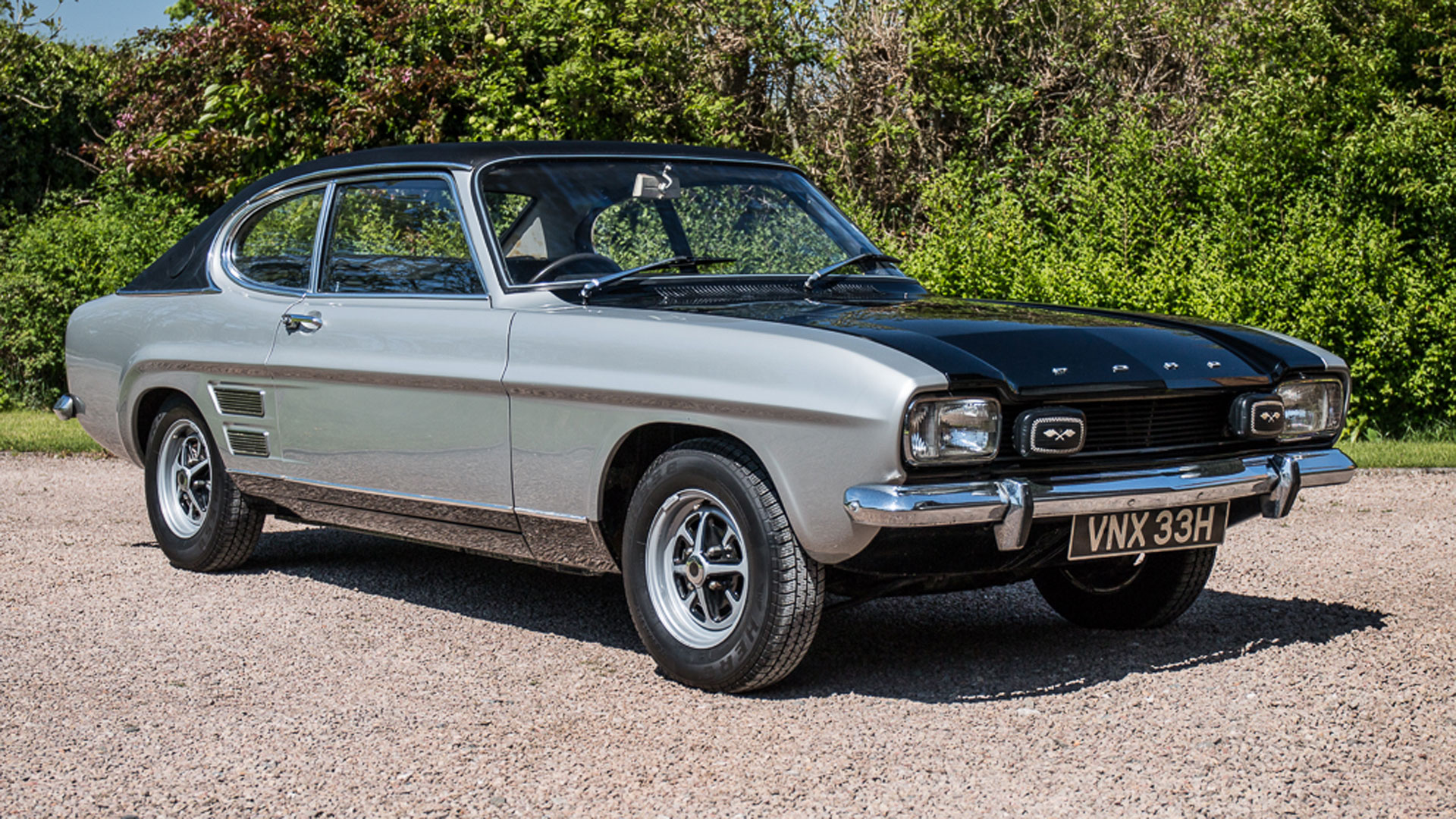
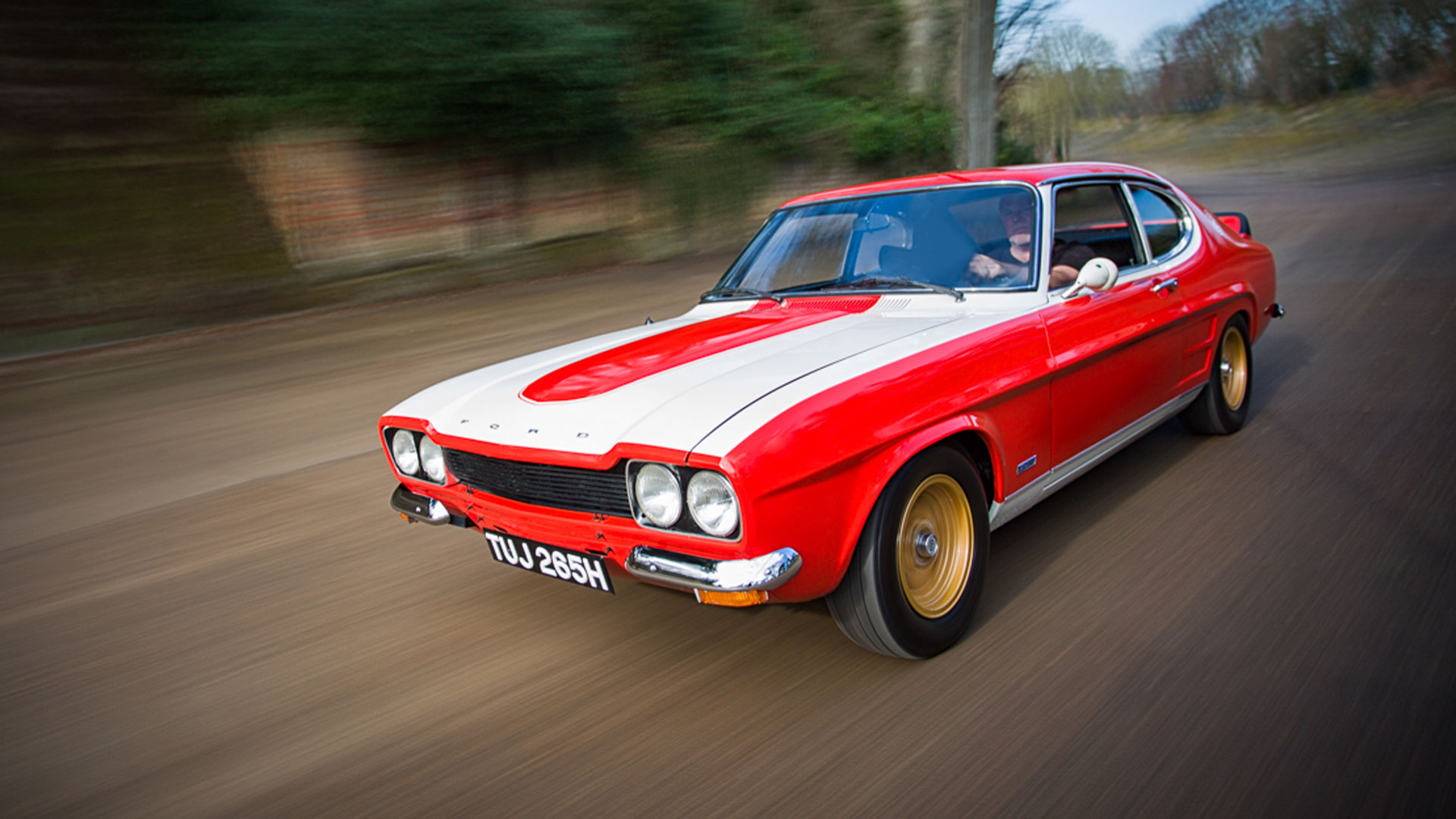
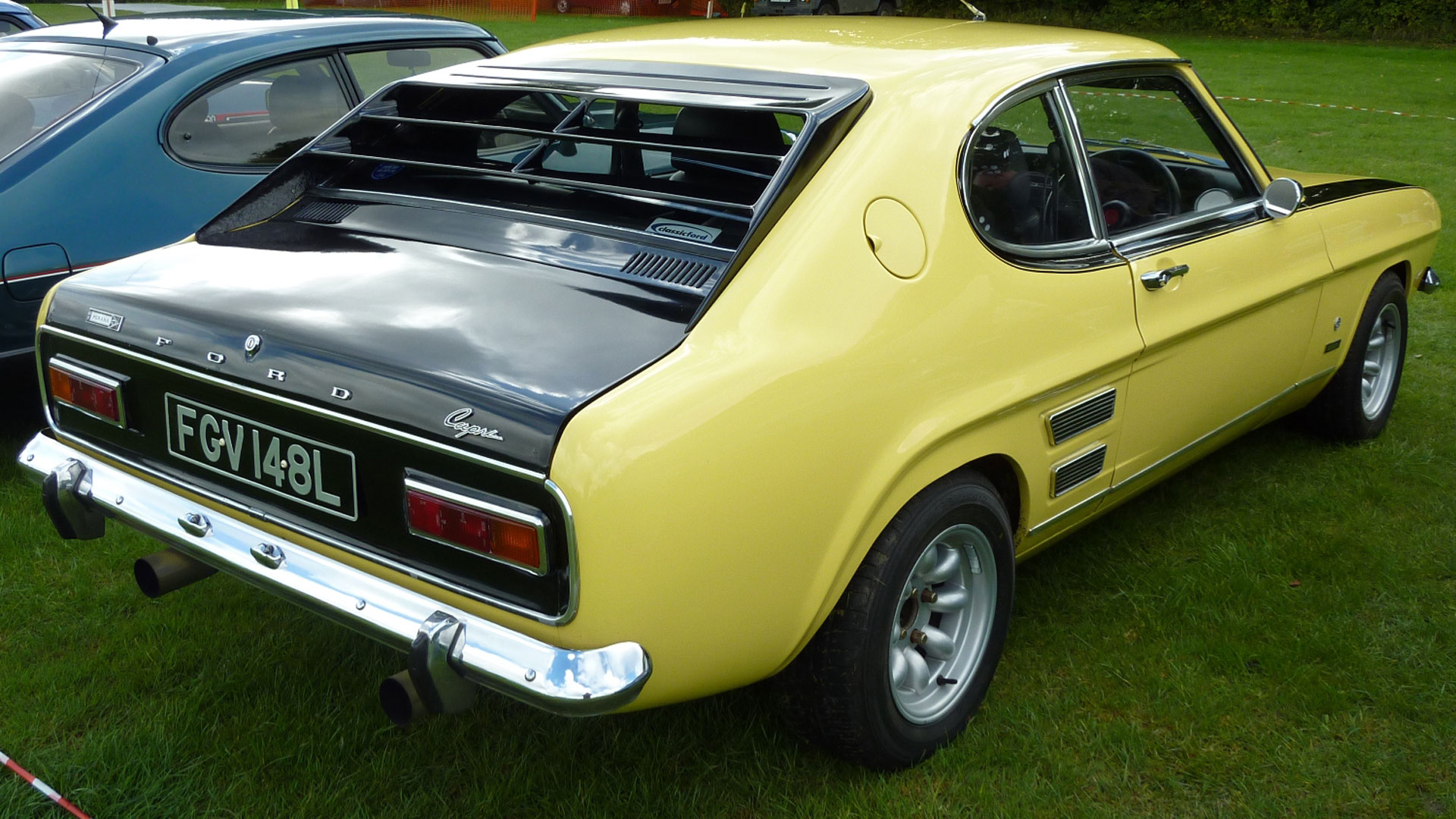
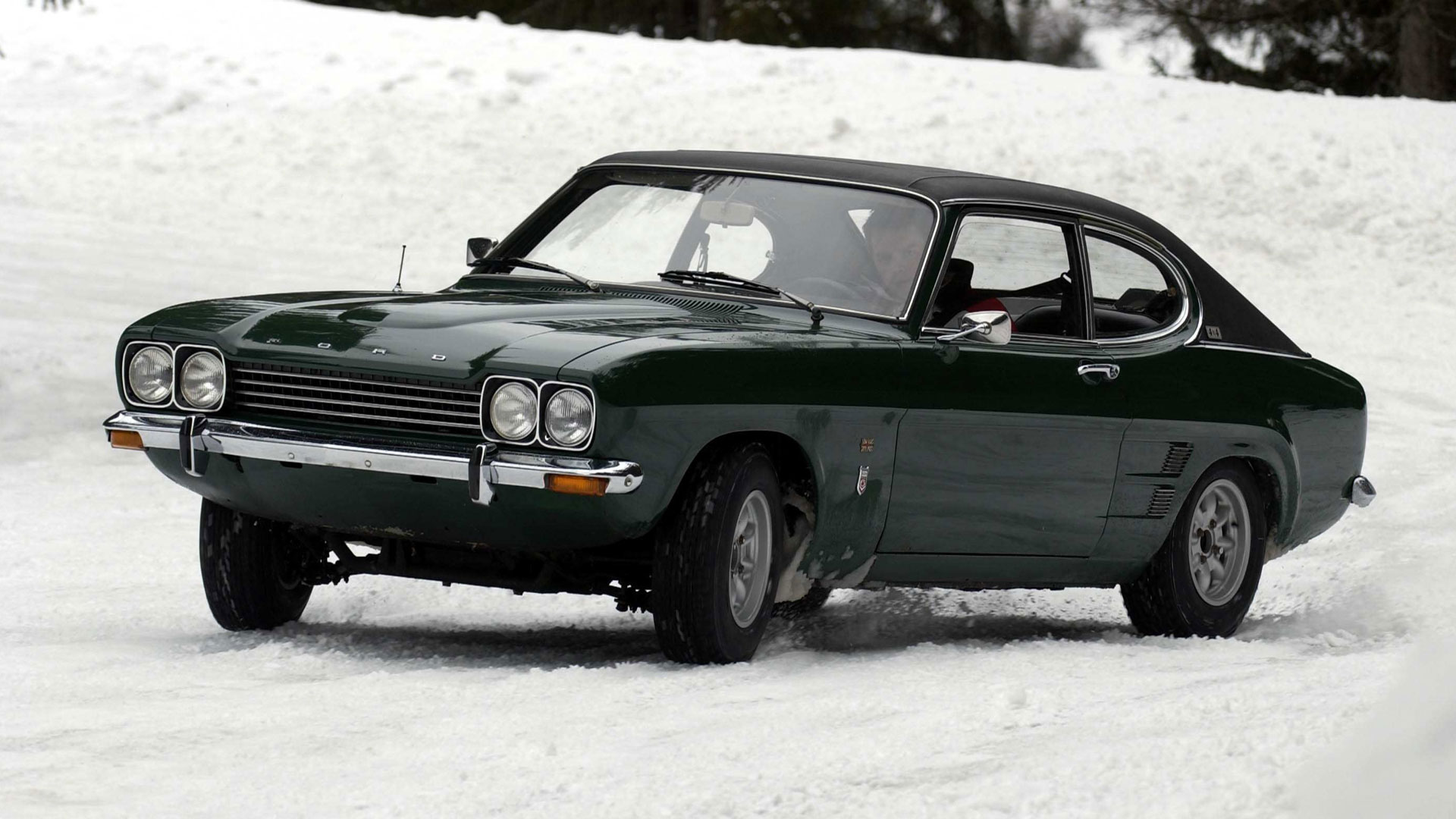
Few cars were as loved, loathed and ridiculed as the Ford Capri. In a production run spanning 18 years, ‘the car you always promised yourself’ amassed sales approaching 1.9 million, upset the establishment on the race tracks of Europe, and appeared in more television shows than Ian McShane.
To mark the car’s 50th anniversary, we take a look at Britain’s love affair with the Ford Capri.
Inspired by the Ford Mustang
As pointed out by Jeremy Walton in his excellent book Capri: The Development and Competition History of Ford’s European GT Car, the success of the Capri was down to two major influences: the Mustang and the wealth of the buying public. Like so many success stories, it was the right car at the right time.
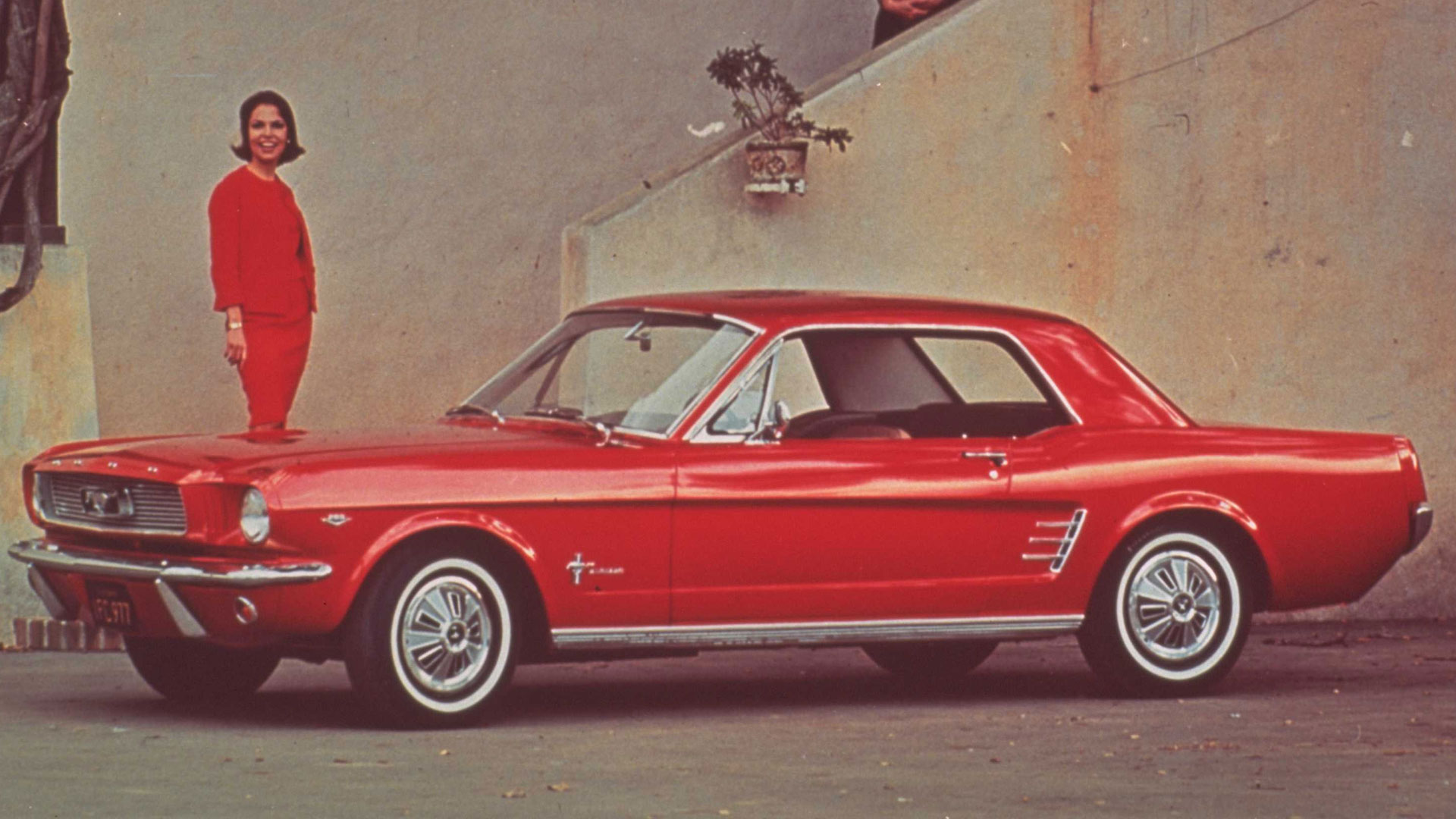
Ford launched the Mustang in 1964, using the relatively mundane Falcon compact car as a platform. It broke the mould, offering American baby boomers an affordable four-seat sporty car that majored on style and personalisation. Could a similar recipe be used to woo European buyers?
Launched in January 1969
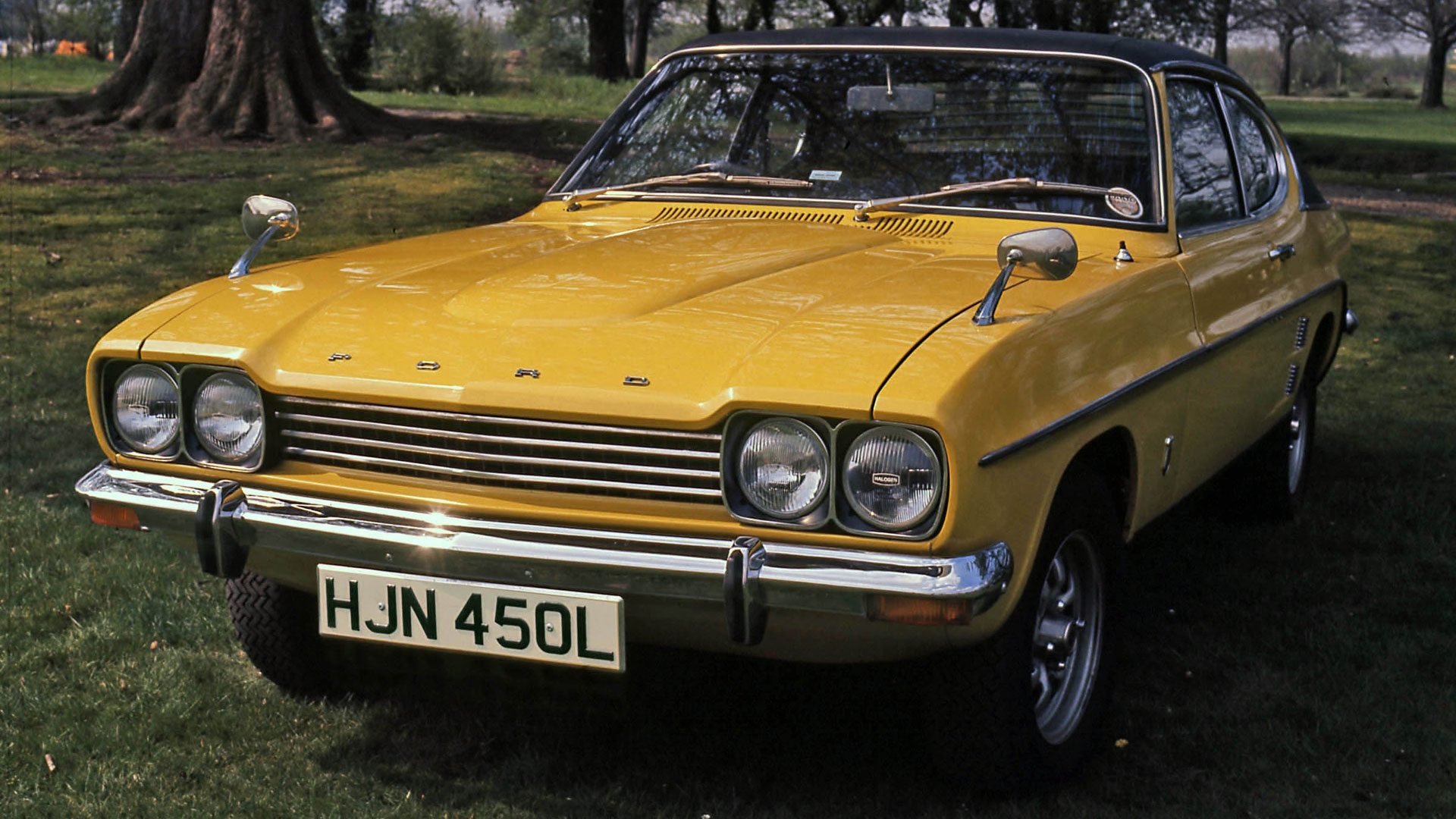
To create the Capri, Ford used the humble Cortina as a platform and used a similarly evocative name to deliver some exotic showroom glamour. Project Colt was given the go-ahead in July 1966, with the launch taking place just three years later at the Brussels International Motor Show in January 1969.
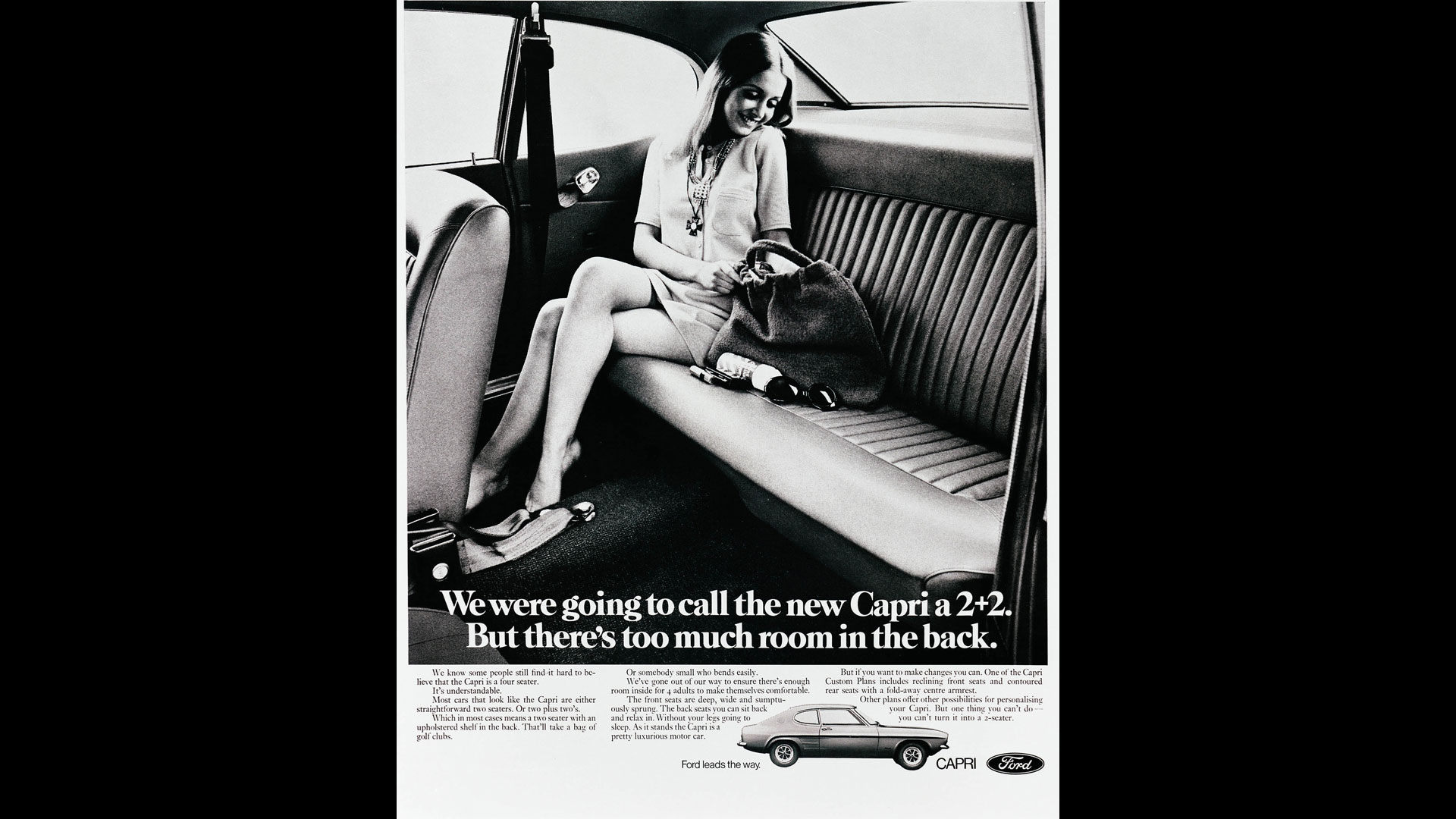
The similarities with the Mustang were not surprising, but the Capri offered a better use of space. It might have been shorter and narrower than its American cousin, but it offered more room inside. This was important for Ford, as it wanted to market the coupe as a true four-seater.
The car you always promised yourself
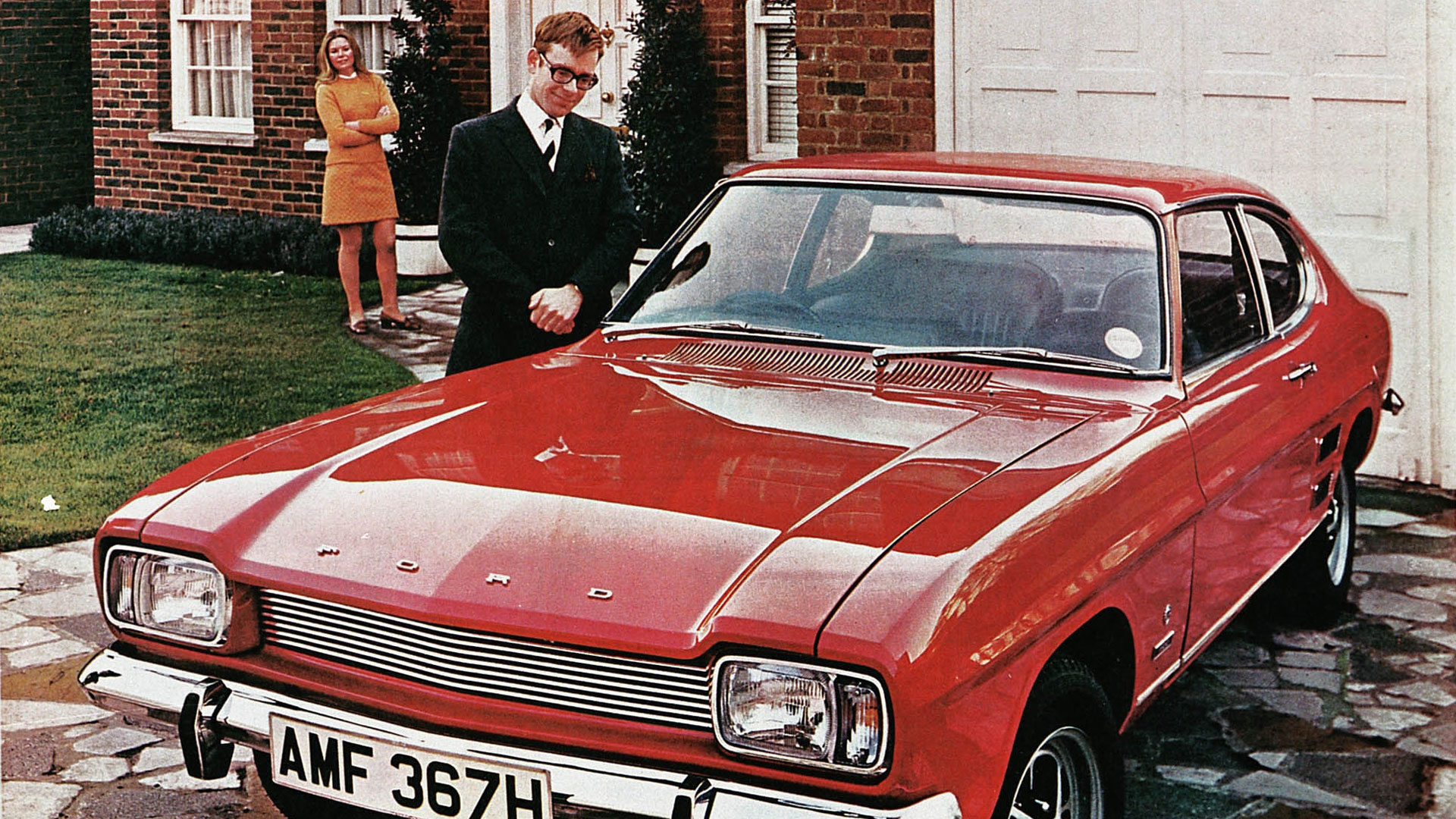
‘The new Ford Capri is the kind of car you’ve probably been hoping someone would make ever since you first put foot to clutch pedal,’ proclaimed the press advert in 1969. ‘A genuine fastback. That doesn’t cost a fortune. Handles like a sports car. And holds 4 people,’ it continued.
It looked a million dollars and offered a taste of glamour for the family man who would have otherwise been faced with driving a common saloon or estate car. And we do mean family man. Ford used the ‘sex sells’ approach to marketing, positioning the Capri alongside attractive women in exotic places. Later ads toned it down a little – the children and mother-in-law made an appearance – but there’s little doubt that Ford saw the Capri as a man’s car.
The best car Ford had produced?
‘Forgetting the racy fastback shape for a moment, it is the best car that Ford [has] ever produced,’ claimed Autocar in February 1969. ‘They will sell a million, and quickly at that,’ it continued.
Autocar wasn’t wrong. It took just four years, six months and five days for the Capri to amass a million sales, with the car proving to be particularly popular in the United Kingdom. Germany was another prime territory for Ford, while the Capri was even sold alongside the Mustang as the ‘Sexy European’ in the US.
There was a Capri to suit all budgets
Part of the Capri’s success was its ability to offer glamour and sex appeal, regardless of what lay beneath the long and protruding bonnet. At launch, it was available in 1300, 1600 and 2000 flavours – the 3000 arrived in October 1969 – with the 1.3 offering the same level of style as the 3.0, albeit without the performance.
Not that the Zodiac-sourced 3.0-litre unit was necessarily the engine you always promised yourself. It may have offered the grunt and a huge amount of straight-line speed, but it was also heavier, meaning the Capri 3000 was prone to understeer.
Your Capri, your way
The Ford Mustang was successful, in part, thanks to a wide range of personalisation options. Colours, trims, options and accessories meant that it was possible to create a car that felt tailored to you. Ford took a similar approach with the Capri, offering a number of ‘custom packs’ from the outset.
L, XL, R-pack, X-pack, etc. – you could ensure that your Capri didn’t look the same as the Capri owned by Mr and Mrs Jones across the road. The Capri faced many imitators over the years, but none captured the hearts and minds quite like the Ford. By the time it went out of production in 1986, it seemed like everyone had an opinion on the Capri, and not all of these impressions were positive.
The Mk1 Capri makes its mark
Not that the Mk1 Capri had to worry about a potential image crisis. In the early 1970s, it appeared to be riding on a crest of a wave, consistently appearing in the UK top 10 sales chart. The UK was the Capri’s biggest and best market, with 42,000 units sold in 1972. This was 11,000 more than in Germany and 15,000 more than the rest of Europe combined.
It even got off to a good start in the US, with Ford taking $3 million worth of orders following the Capri’s debut at the 1970 New York Auto Show. Not that it remained popular for long. Sales of the German-built Capri declined in North America, with no more cars imported after 1978.
Ford Capri RS2600
The first Capri RS was given the go-ahead in 1969, with the task of bringing the RS2600 to market left to the team at the Ford Advanced Vehicle Operation (FAVO) plant in South Ockendon. The RS2600 first appeared as a partial mock-up at the Geneva Motor Show in March 1970, before going on sale in September of the same year.
Following the construction of three prototypes, a further 50 were developed for homologation purposes, with RS2600 production taking place in Cologne and Saarlouis. In total, 3,532 cars were built, including the prototypes and homologation specials.
Ford Capri RS3100
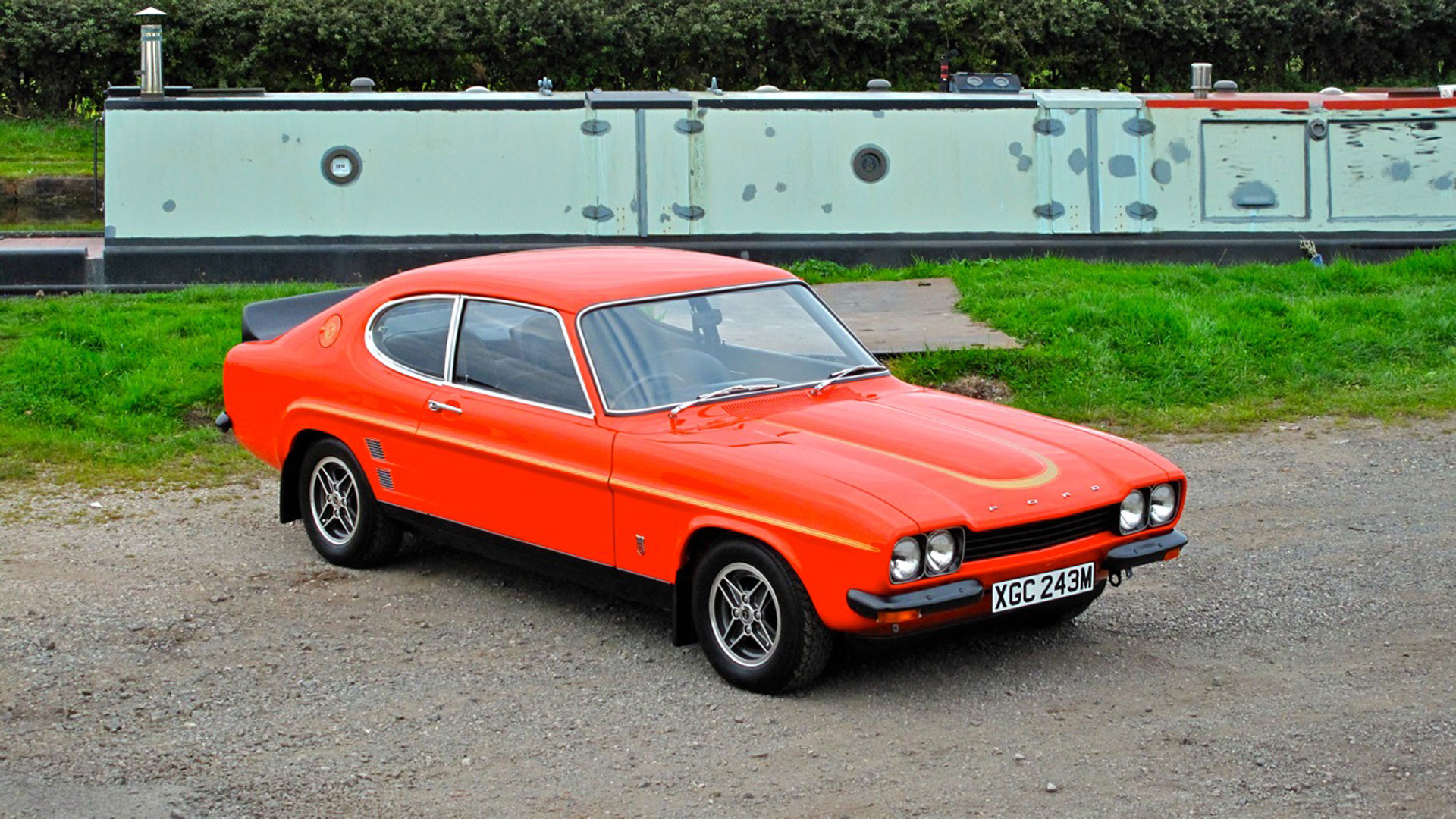
In 1973, the second Capri RS arrived in the form of the Halewood-built RS3100. By now, the Mk1 Capri was living on borrowed time, while a number of external factors meant that an expensive and specialist performance Capri was a hard sell. Although 250 RS3100s were built, some had to be exported to Australia, while others were driven by Ford area sales managers.
It used the standard 3.0-litre Essex V6 engine, with the bore enlarged to create 3,091cc. Even with a 125mph top speed, a 0-60mph time of 7.3 seconds and a unique ‘Ducktail’ rear spoiler, Ford struggled to shift the RS3100. In the wake of the fuel crisis, a list price of £2,450 seemed like an exorbitant indulgence, resulting in some sizeable discounts.
Enter the Capri II
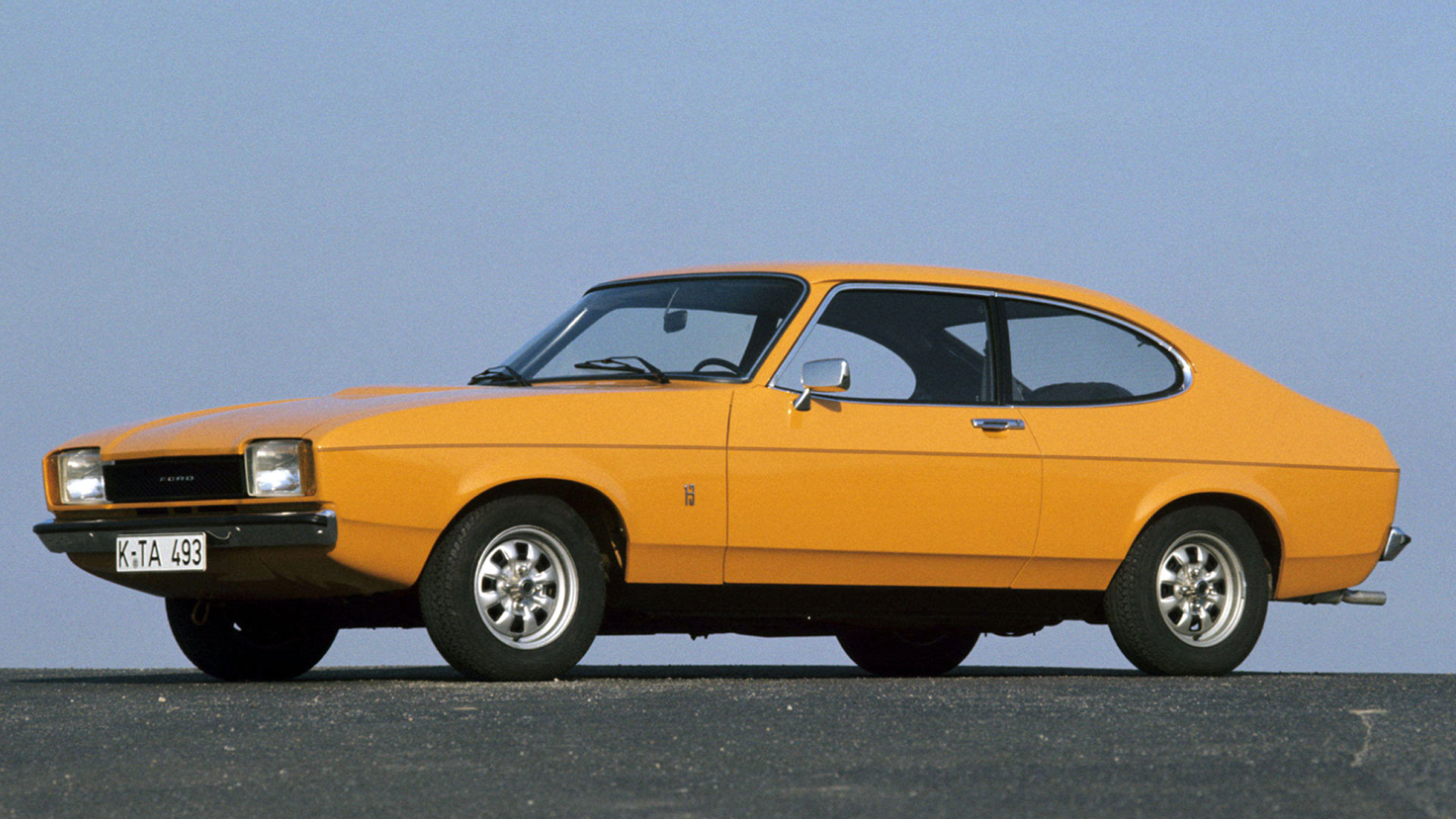
As Ford struggled to shift the RS3100, the Capri II started to appear in showrooms. The company began working on the second-generation model in 1970 with the project going under the name of ‘Diana’. Ford had a habit of using girls names for its project cars – the restyled Escort was called ‘Brenda’, while the later Mk3 Capri was known as ‘Carla’.
If the RS3100 appeared out of touch, the Capri II seemed perfectly in-tune with the market created by the oil crisis of 1973. The Capri had already seen its best single year in terms of sales volume – 238,913 units found homes in 1970 – and accumulative sales had hit the million mark in 1973. But, after a good year in 1974, when the Mk2 sold 183,706 units, the Capri’s popularity was on the wane.
Practical, not glamorous
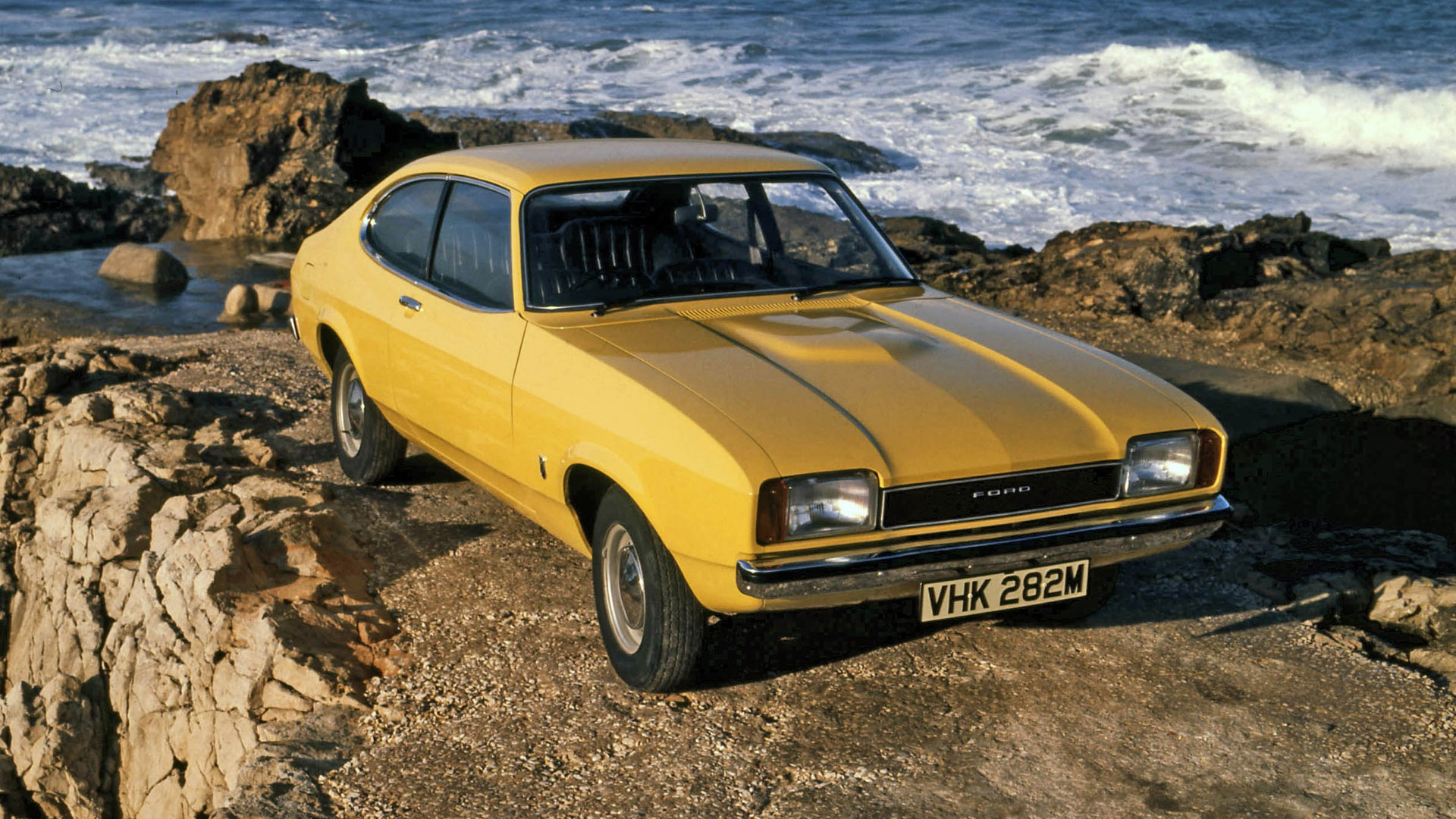
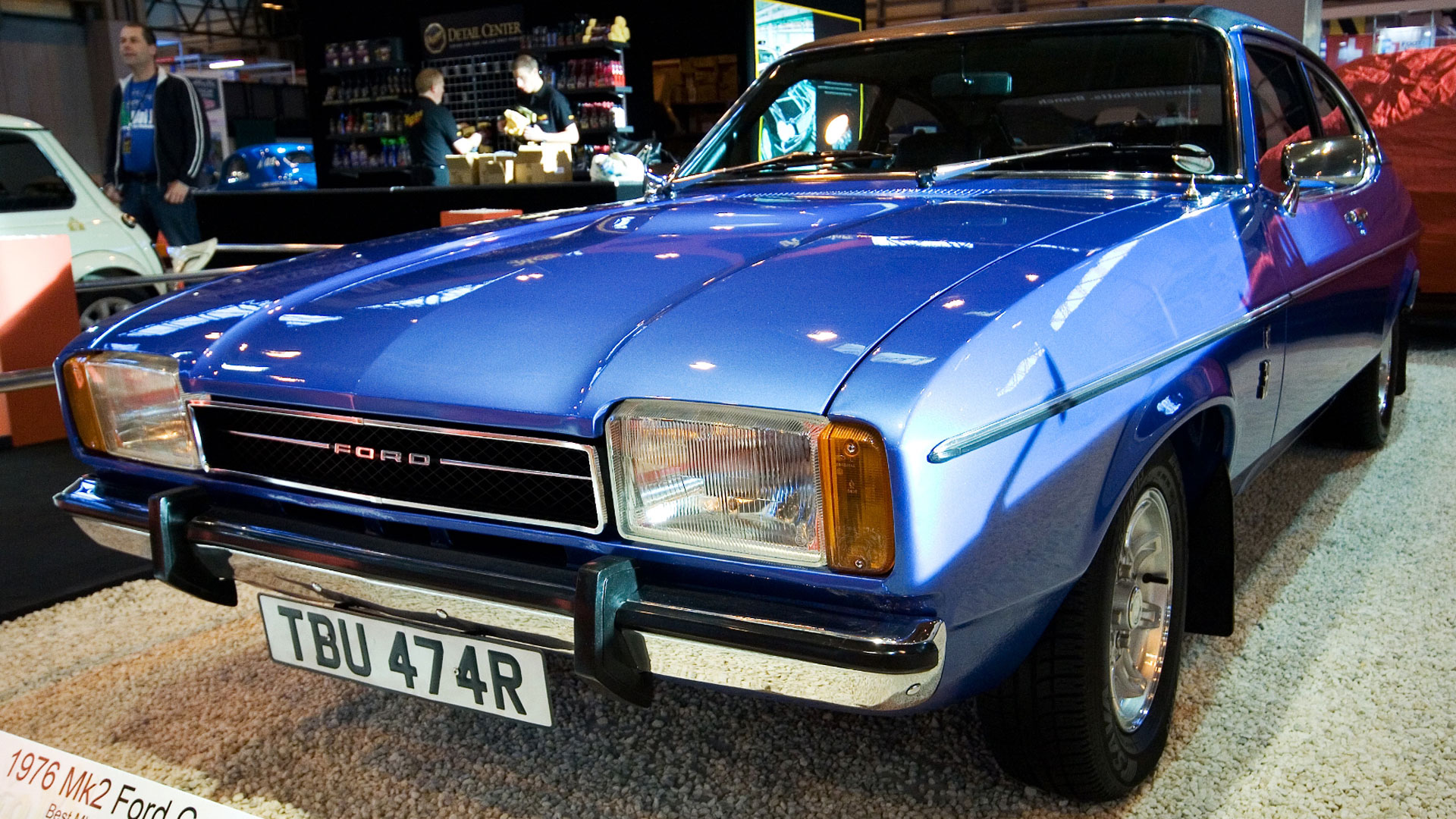
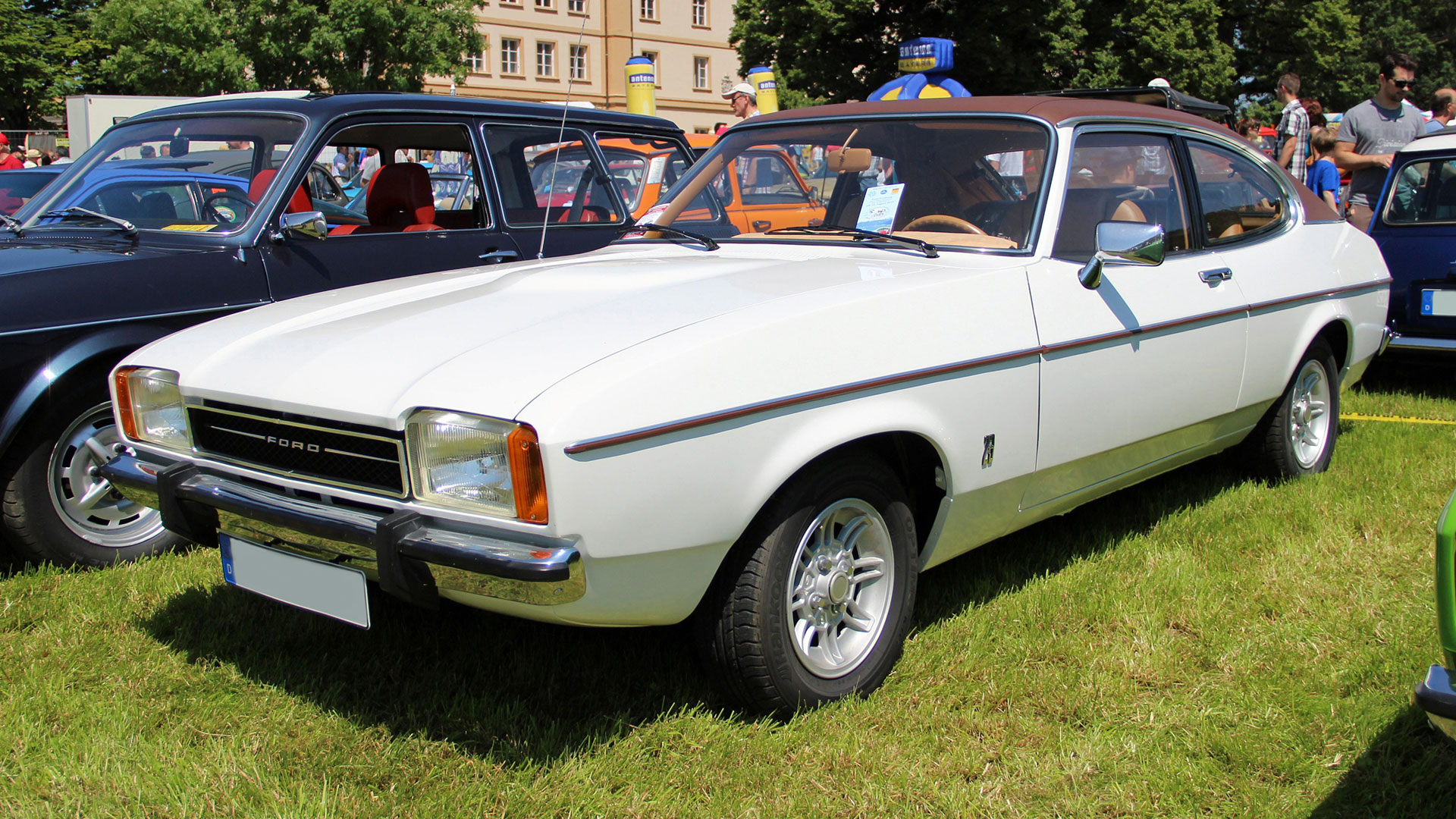
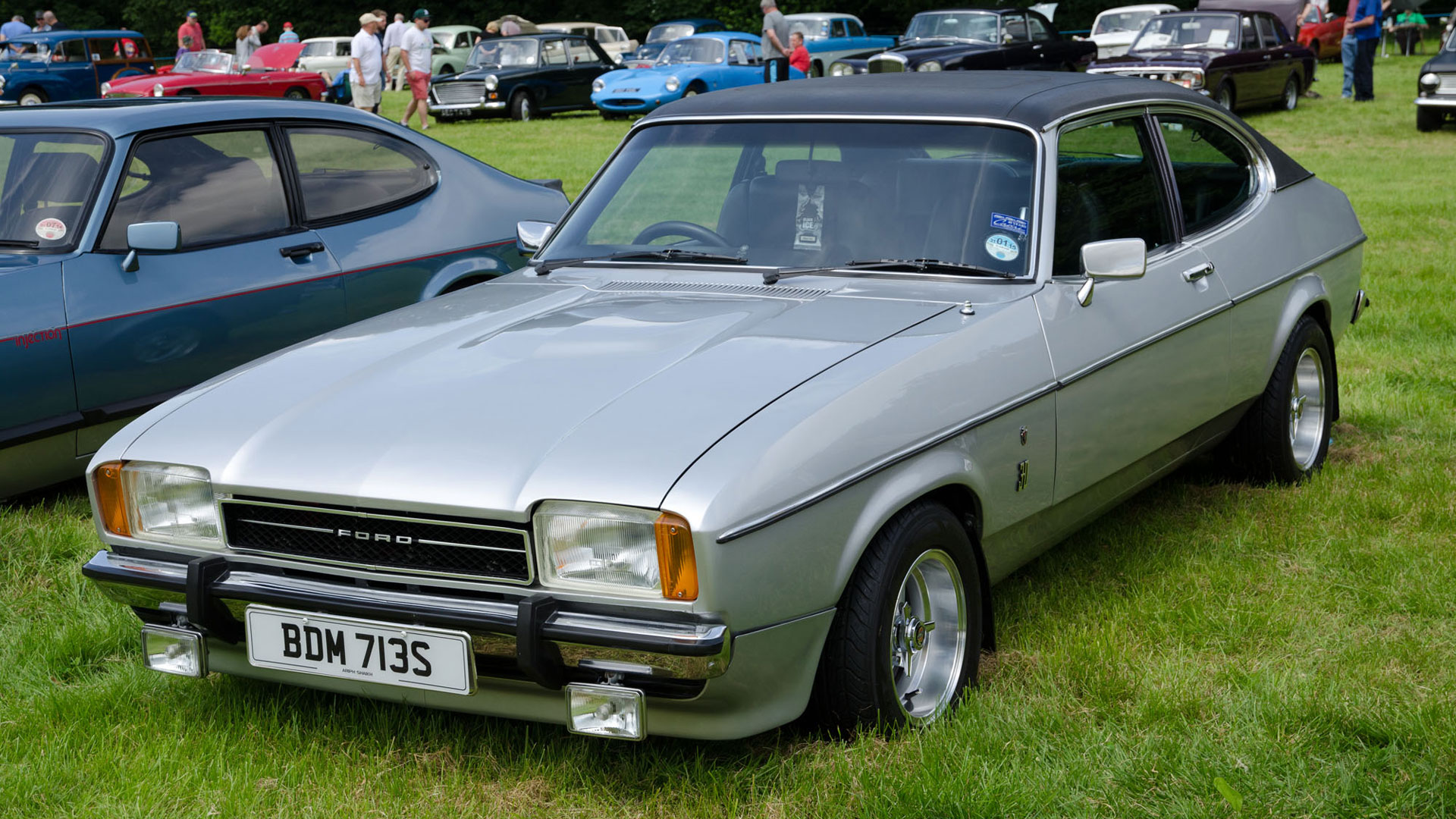
Much like its owners, the Capri had grown a little older and, dare we say, a little flabbier. The Capri II could boast 151 modifications, but the most obvious change was the introduction of a third door, or large tailgate. This may have been influenced by the American Ford Pinto, but there were also echoes of the Reliant Scimitar GTE and Volvo 1800ES in the car’s rear end.
Whatever, the third door answered two of the Capri’s key problems – a lack of luggage space and poor rearward visibility. The Capri II was a softer proposition, growing heavier, a little larger and, in the right trim, a touch more luxurious.
The Capri Ghia, Rodney
The introduction of the Ghia was a sure sign that the Capri was getting softer. In many ways, this highlighted the importance of the UK market, where buyers preferred a more family-oriented Capri, as opposed to the audience in Germany, who fancied a more sporting flavour.
The German-built Capri Ghia – available with 2.0-litre and 3.0-litre engines – played on Ford’s ownership of the Turin coachbuilders and offered a range of extras, such as deep-pile carpet, tinted glass, metallic paint and alloy wheels. In Mk3 guise, the Capri Ghia had a starring role in Only Fools and Horses.
S’Express
But the Ford Capri wasn’t quite ready to slip into full ‘pipe and slippers’ mode. With the oil crisis over, Ford was able to give the Capri a more sporting flavour with the launch of the new S model.
Unveiled at the 1975 Geneva Motor Show under the codename of ‘Midnight’, the S featured all-black coachwork and, when combined with gold striping, it had more than a hint of John Player Special (JPS) about it. Announced as a limited production special, the Capri S proved to be so popular, it became a regular model by the end of the year. And while 1.6-litre and 2.0-litre versions were available, the 3.0S was the range sweet spot, and arguably one of the Capri’s finest variants.
Germany goes it alone
The final year in which Capri sales hit the six-figure mark was 1976 and, aside from a positive blip in 1979, registrations declined year-on-year until the car’s death in 1986. UK production at the Halewood plant ceased in October 1976, with 337,491 units built since production began in 1968.
This left Cologne as the only factory producing the Capri, with the German factory ceasing production of the ‘Federal’ Capri in August 1977. Did this signal the end for the Ford Capri?
The beginning of the end
In 1978, Capri production had slumped to 69,112 – around a third of the total in 1969. There are many factors contributing to the decline and it would be unfair to suggest that the Capri II was the primary reason for the car’s downfall. Yes, it was heavier, arguably less attractive and less sporting than the original, but there were other forces at play.
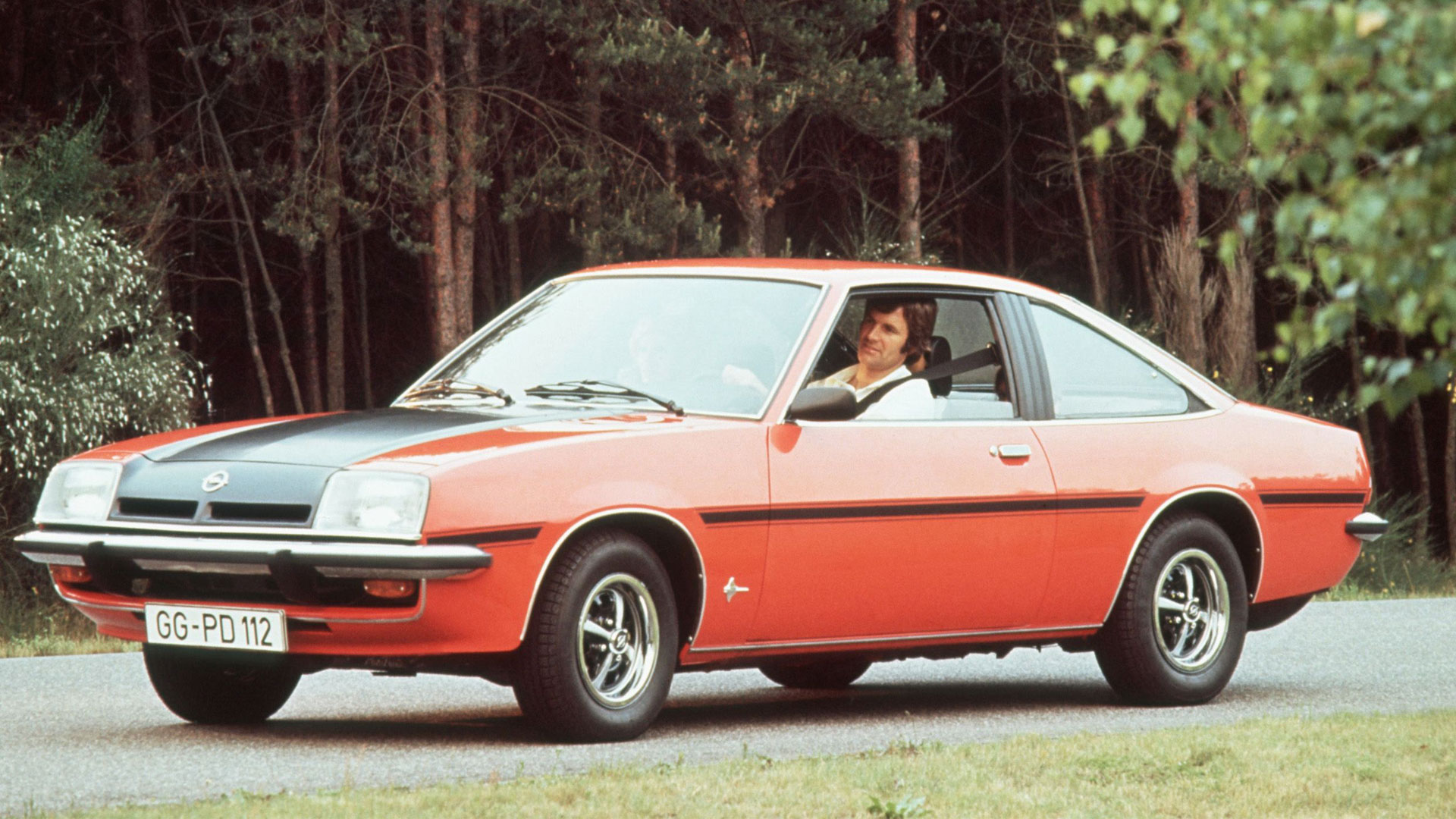
Buying a Capri was driven by desire and by 1978 there were other cars competing for the buying public’s pound and deutschmark. The Opel Manta, for the example, along with the Volkswagen Scirocco and Toyota Celica, to name but three. We were also witnessing the birth of the hot hatch, a body style that would eventually stick a stake through the Capri’s heart.
Project Carla
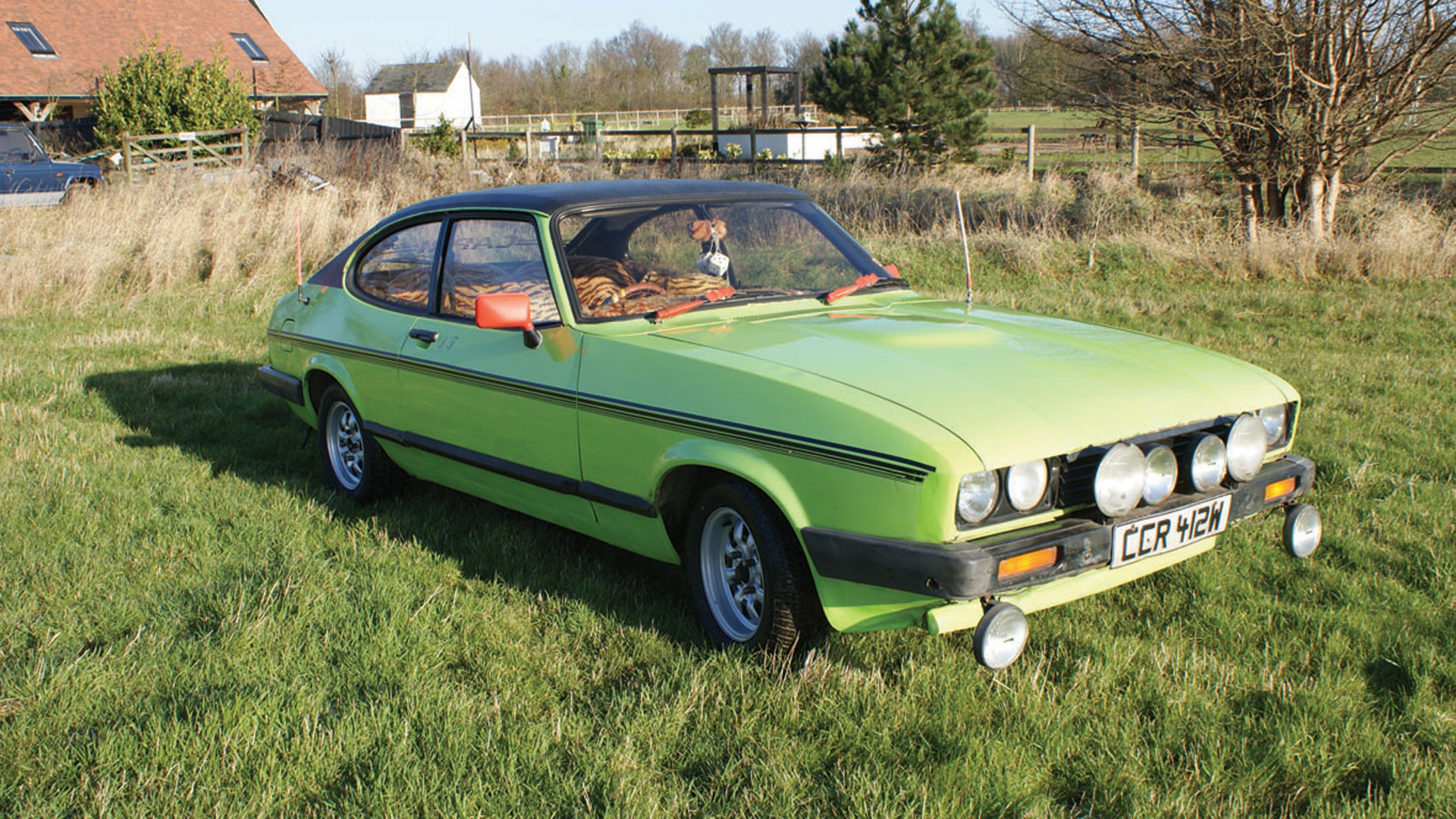
But there was still time for the Capri to enjoy a few more years in the limelight. Officially, the Mk3 was little more than a facelifted Capri II – Ford called it a ‘freshened’ Mk2 – but it must have struck a chord with the buying public. In its first full year of production, the Capri Mk3 achieved sales totalling 85,420, an increase of around 15,000 from 1978.
Sure, it was little more than a momentary blip – sales dropped to 41,755 in 1980 – but the initial enthusiasm showed a genuine desire for a refreshed Capri, even if the car was all but forgotten beyond the shores of Britain.
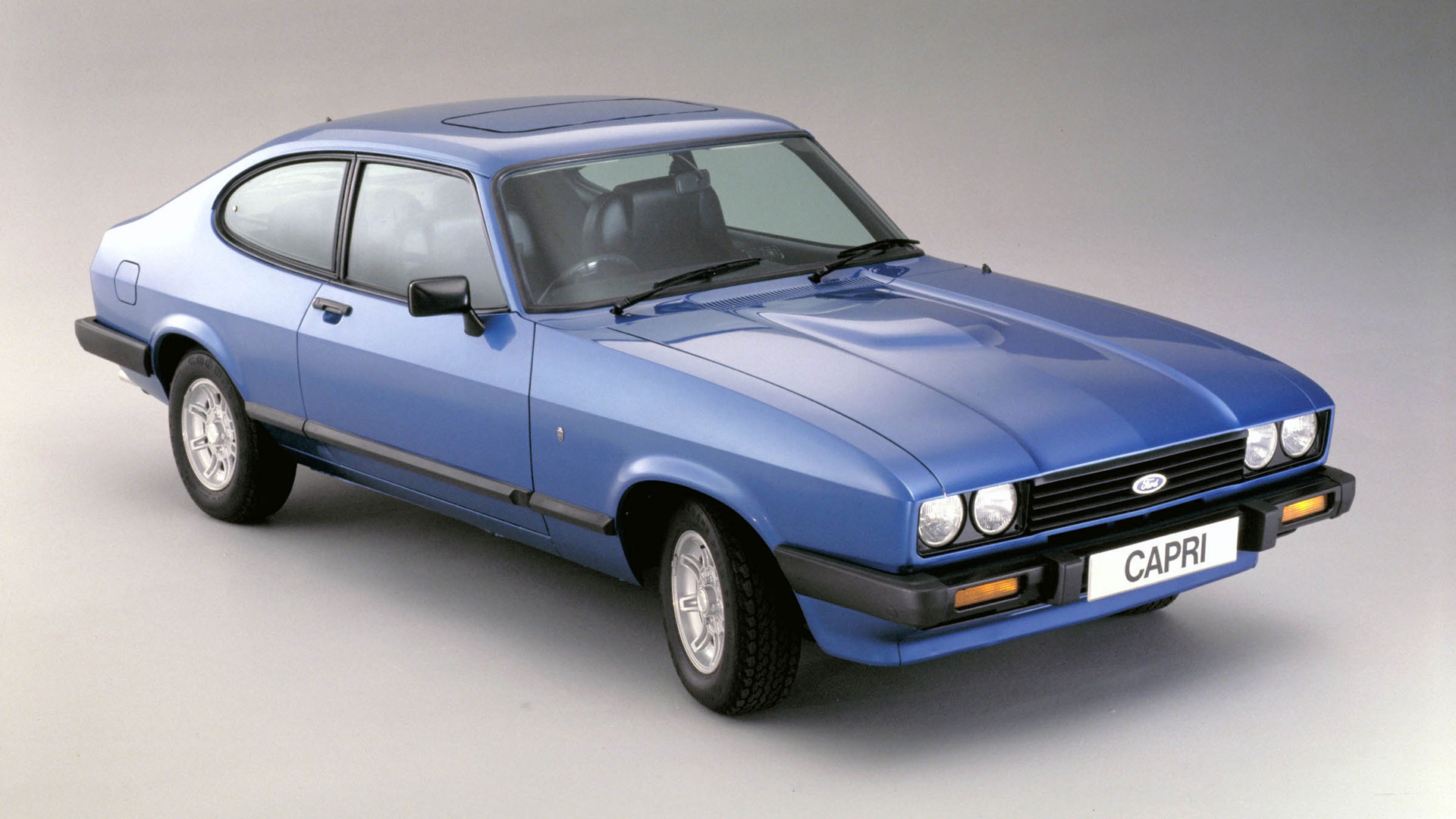
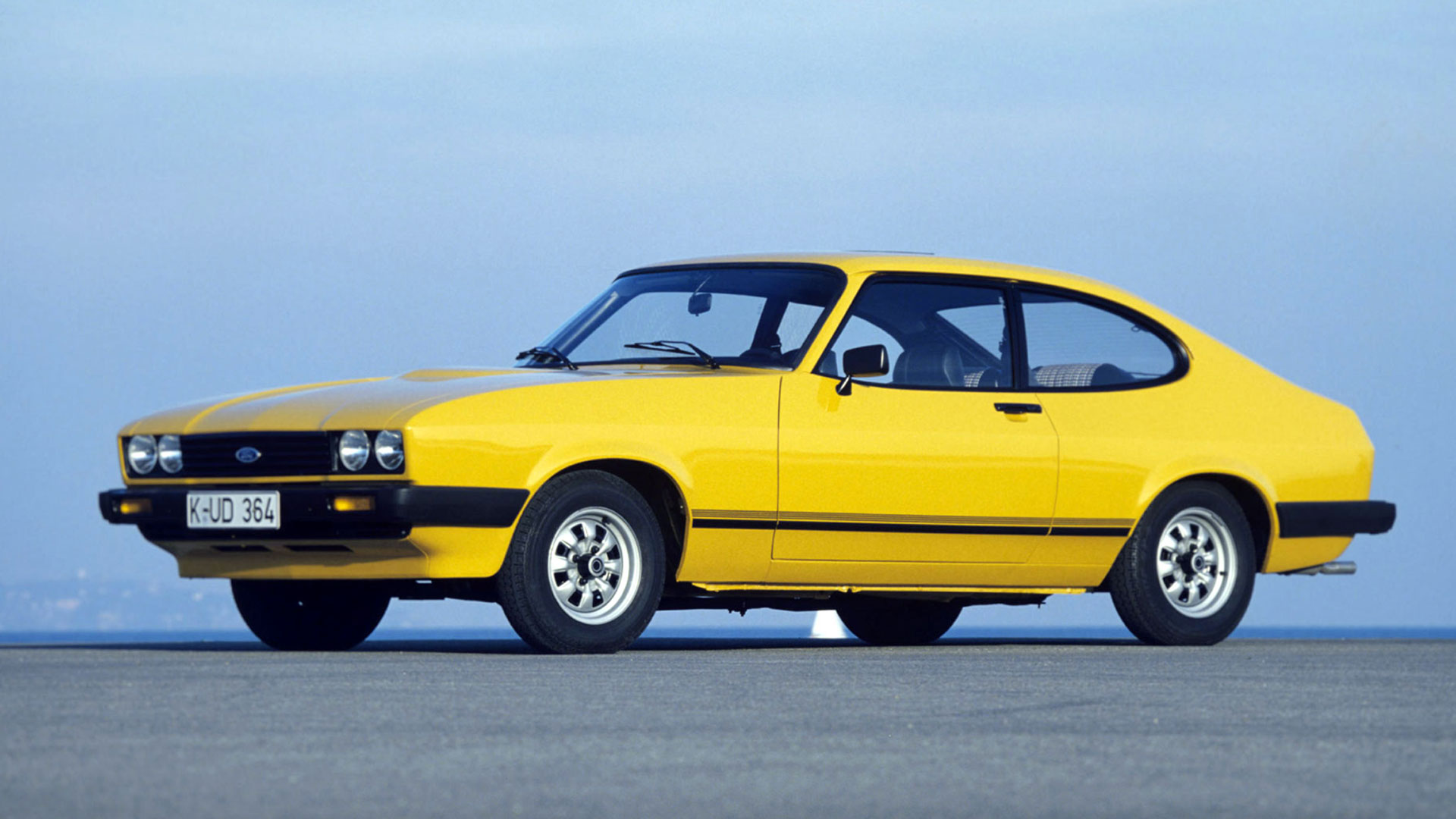
The Mk3 Capri
The Mk3 Capri was the best-resolved model since the RS2600, offering a terrific blend of sporting intent, lower running costs and better all-round performance, including improved fuel economy.
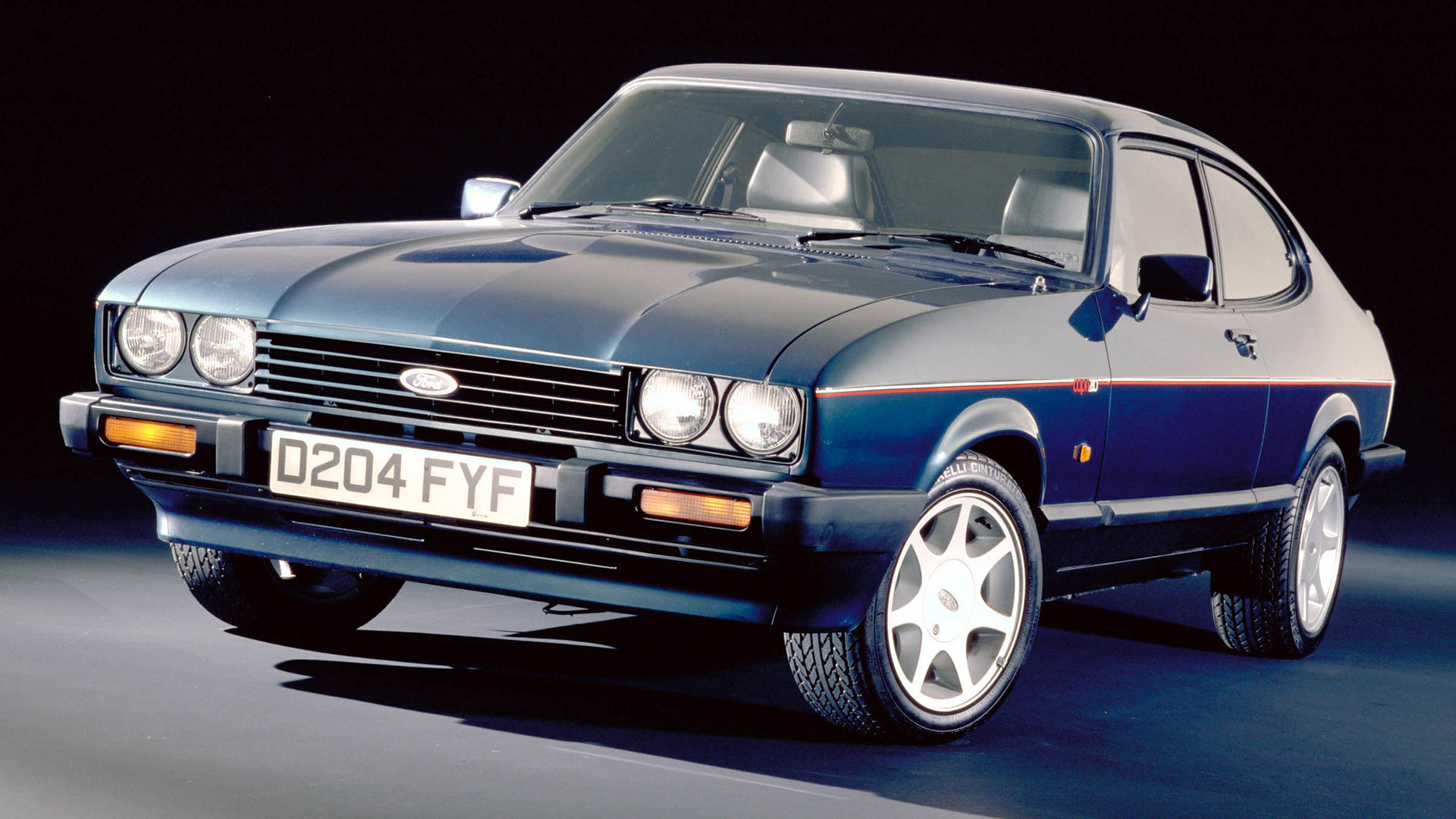
It also looked the part, helped by the four headlights, which harked back to the RS models and the Federalised car sold on the other side of the Atlantic. The Mk3 also featured the corporate grille, as seen on the Fiesta and Granada, along with Mercedes-like rear lights: ribbed for your pleasure.
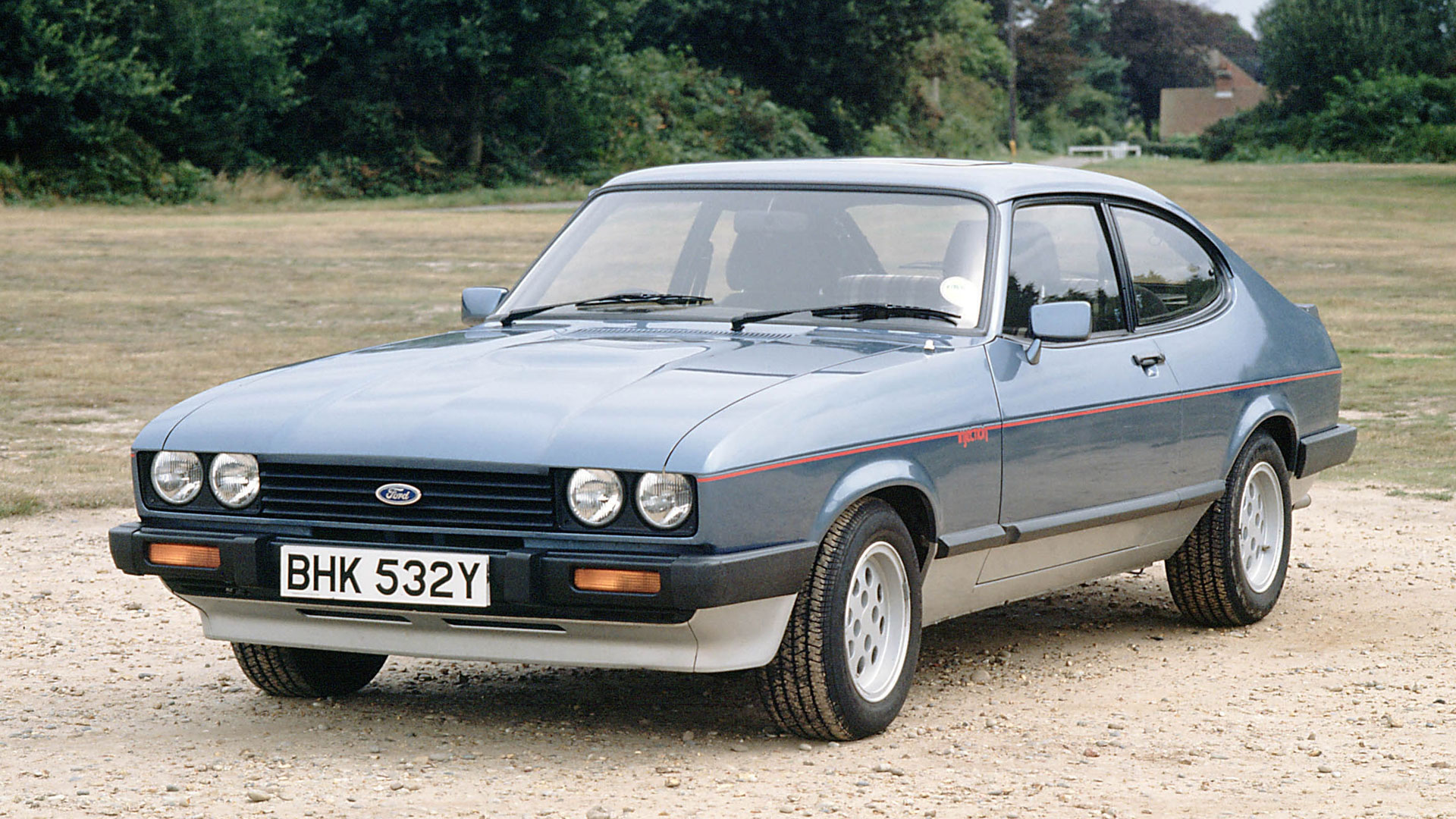
The 2.8 injection
In 1980, Ford established a new Special Vehicle Engineering (SVE) division. Its first brief was to develop a fuel-injected V6 Capri. A new flagship was required, as the 3.0-litre engine was essentially dead, save for its use in the Ford Transit, and the Capri needed a performance version to survive.
The result was the 2.8 injection, initially with a four-speed gearbox and later with a five-speed. It was an immediate success, even earning the Capri a place in the sales top 10 in August 1981. The SVE department went on to develop many fast Fords, including the Fiesta XR2 and XR2i, the Escort XR3 and XR3i, and the Escort RS1600i.
On borrowed time
The 2.8i – and later 2.8i Special – may have been a welcome addition to the range, but by the mid-1980s, the Capri was on borrowed time. Sales in Europe were on the floor, while even in the UK, where the Capri remained popular, the car was beginning to suffer from an image crisis.
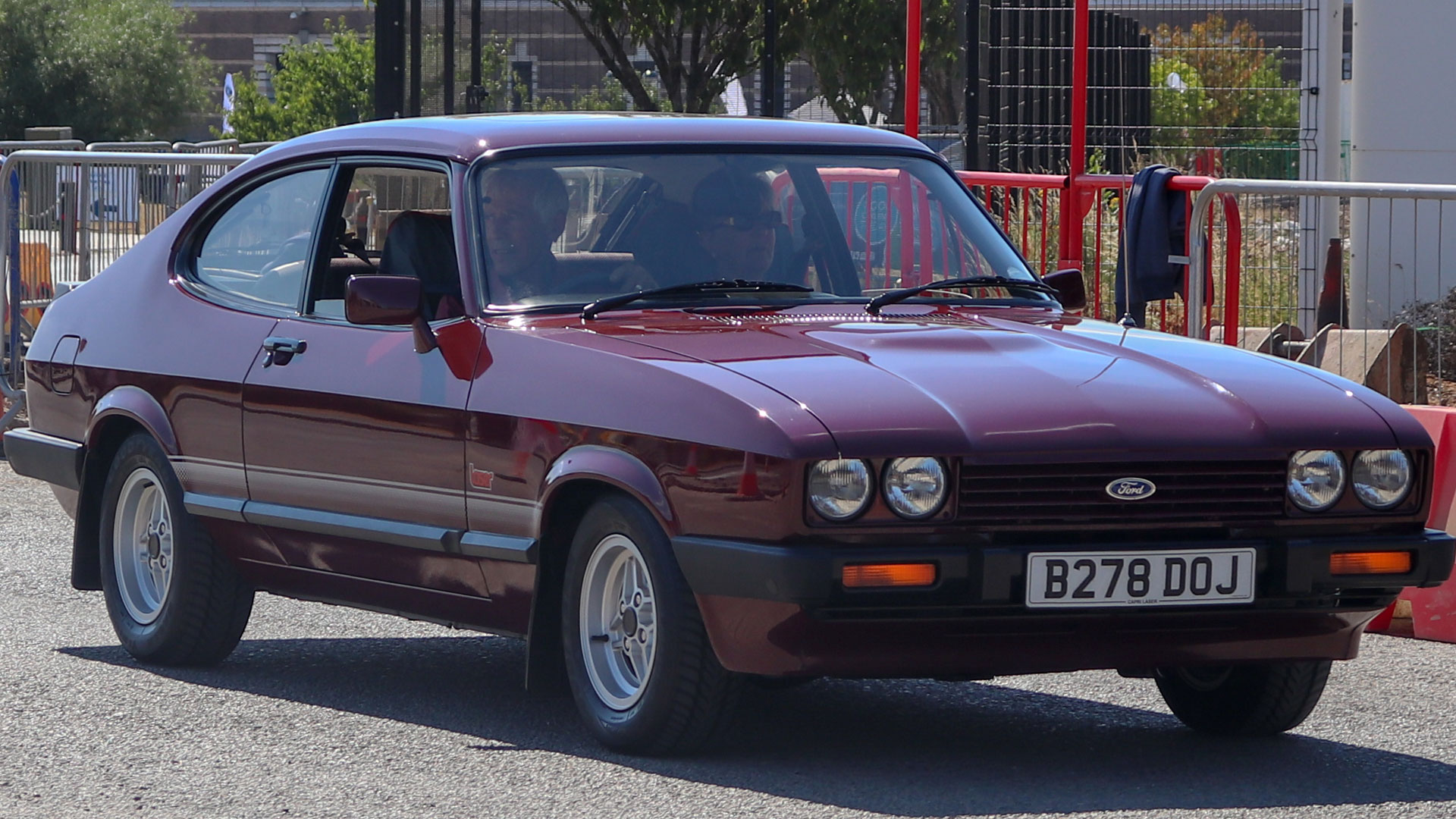
Ford did its best to keep the Capri on a life support machine, unveiling a succession of special editions to maintain interest and keep dealers happy. First came the 1.6 Calypso and 1.3 Cameo, followed by the 1.6 Cabaret, before the Laser of 1984 became the final throw of the dice for the four-cylinder models. In November 1984, only right-hand-drive production remained.
Bye-bye, Capri
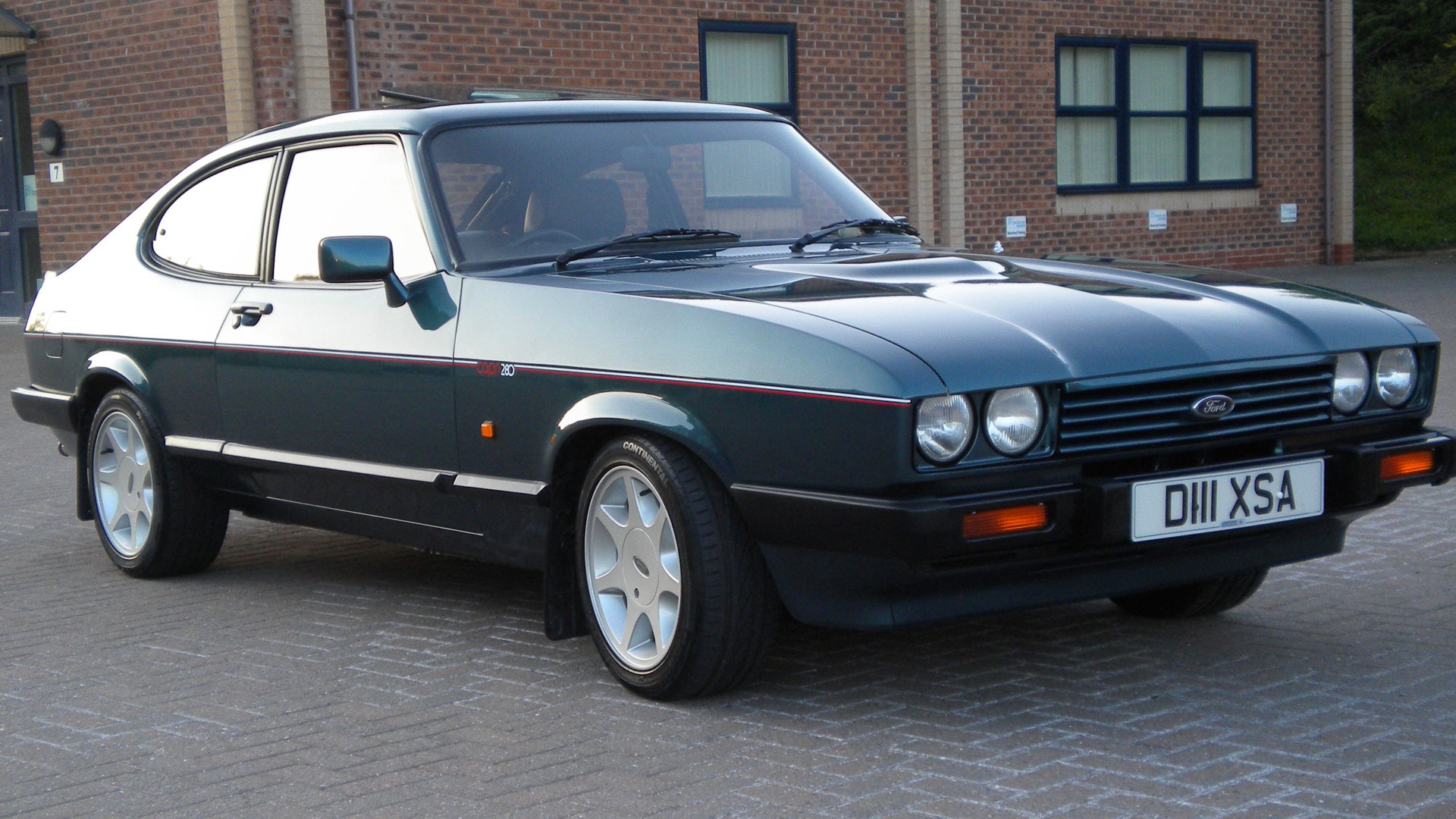
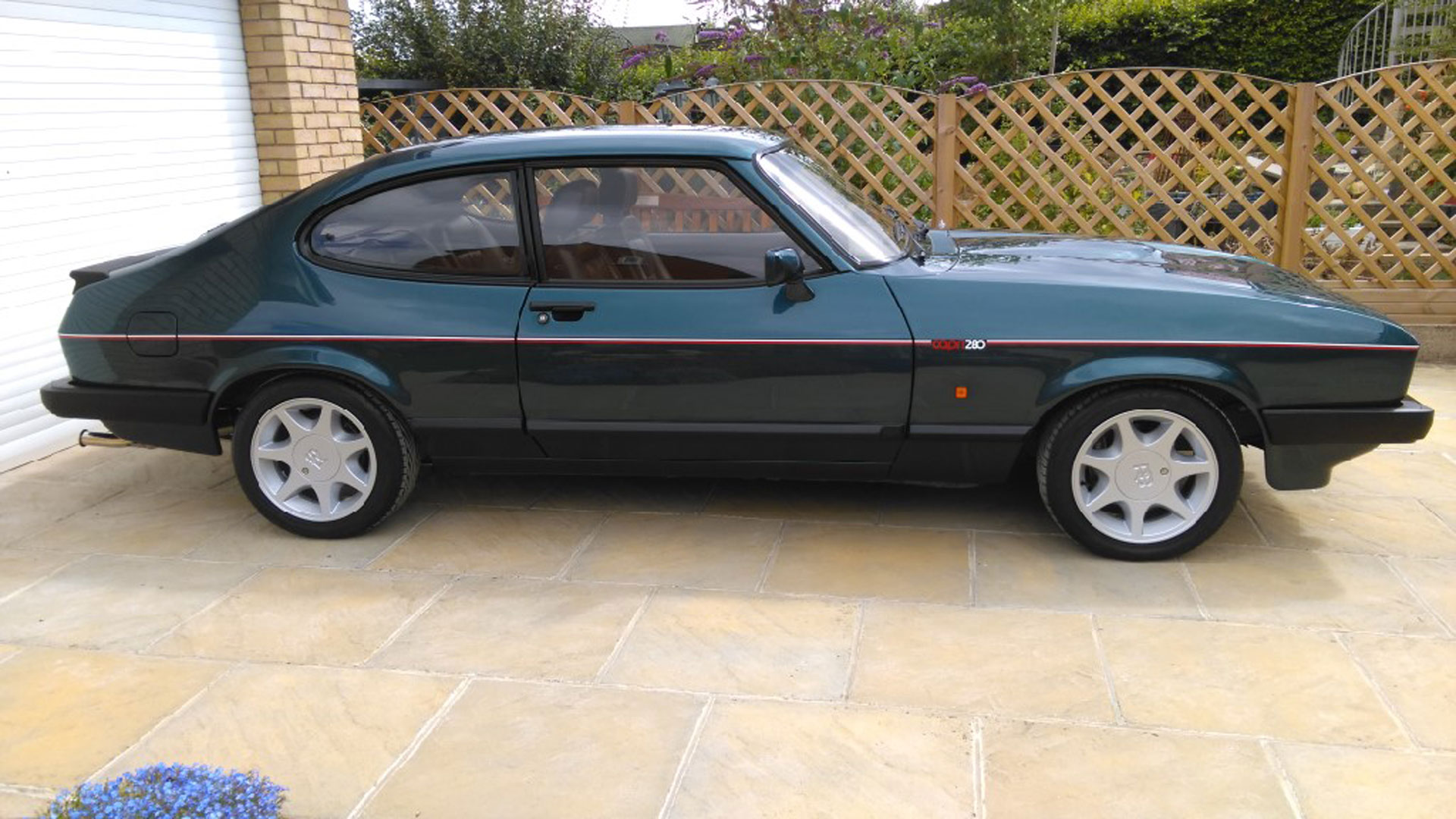
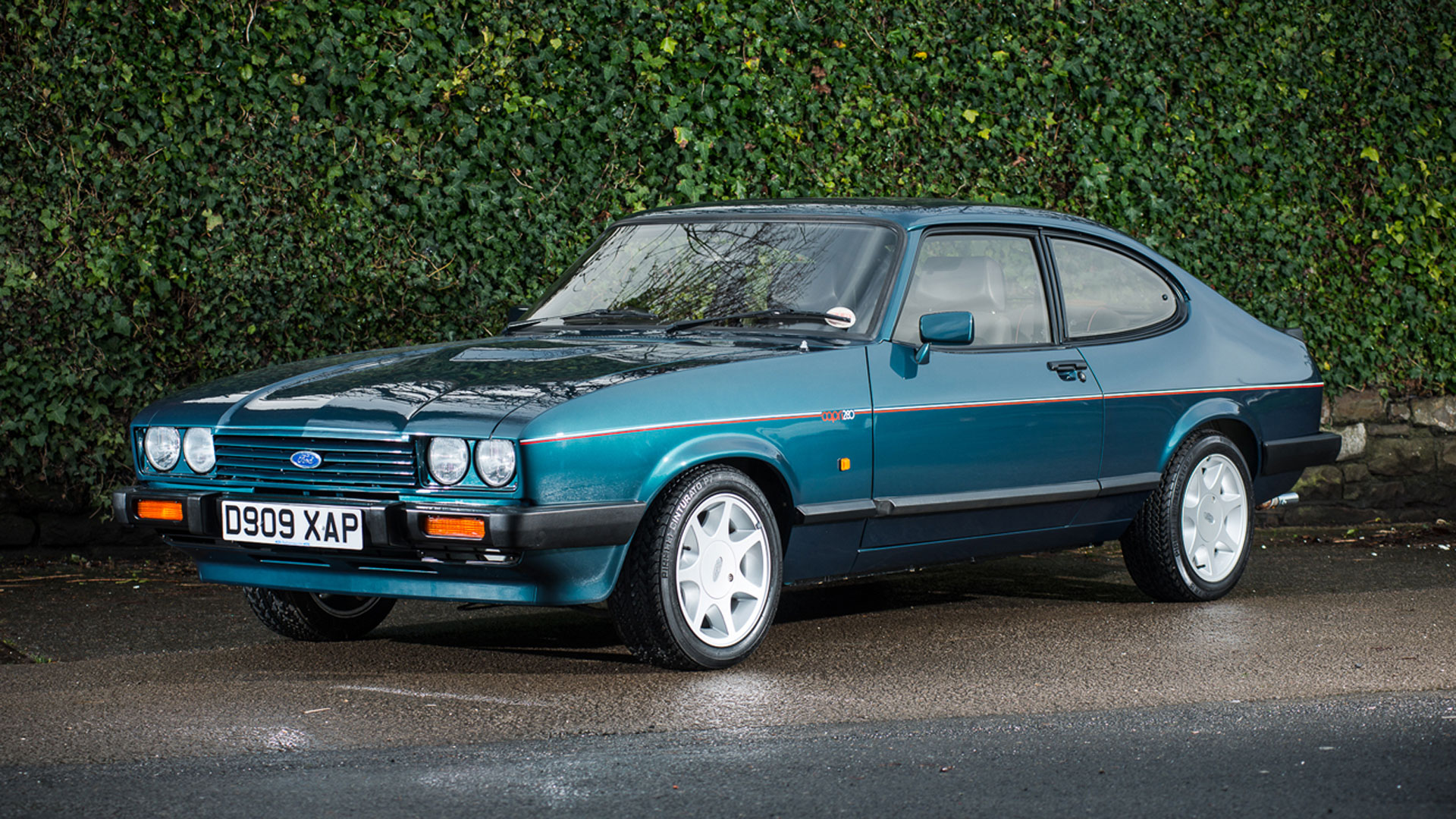
Two years later, in December 1986, the final Capri left the factory in Cologne, bringing to an end 18 years of production. Sales actually increased from 9,262 in 1985 to 10,710 in 1986, as customers grabbed the final opportunity to buy a new Capri. Some took the plunge on the Capri 280, although the final edition was nowhere near as successful as Ford would have hoped.
The original plan was to build 500 last-of-the-line Capri 2.8i Specials, under the project banner of Capri 500 SVP. All would be sold in the UK and all would command a sizeable premium over the standard 2.8i Special.
Capri 280
Ultimately, Ford decided to ship 1,038 Capri 280s to the UK – the 500 badge was hastily redrawn to take account of the change – but history shows that sticking to the original plan might have been a better option.
Too few people were willing to stump up the £11,999 required for what was chiefly a cosmetic upgrade over the standard 2.8i – 15-inch wheels, ‘Brooklands’ green metallic paint, grey leather with red piping and 280 decals. Some cars remained unsold well into 1988, even with a discounted price of £9,995.
An image problem
It didn’t take long for the Capri to lose its lustre. Almost overnight, the car you always promised yourself seemed to fall out of favour; its image steadily declining in the late 80s and throughout the 90s. Values plummeted, particularly of the four-cylinder models, and it became increasingly hard to sell all but the most legendary models. But more on this in a moment.
In the meantime, the Capri was becoming an object of ridicule. Appearances in The Professionals and Minder, while cool today, only served to cement a reputation of being past it – a car driven by wideboys, ‘Jack the lads’ and men with open shirts who found it hard to resist ploughing through stacked boxes left by the side of the road. When Del Boy needed a car to boost his image, it had to be a Capri Ghia, Rodney.
Crayford convertible
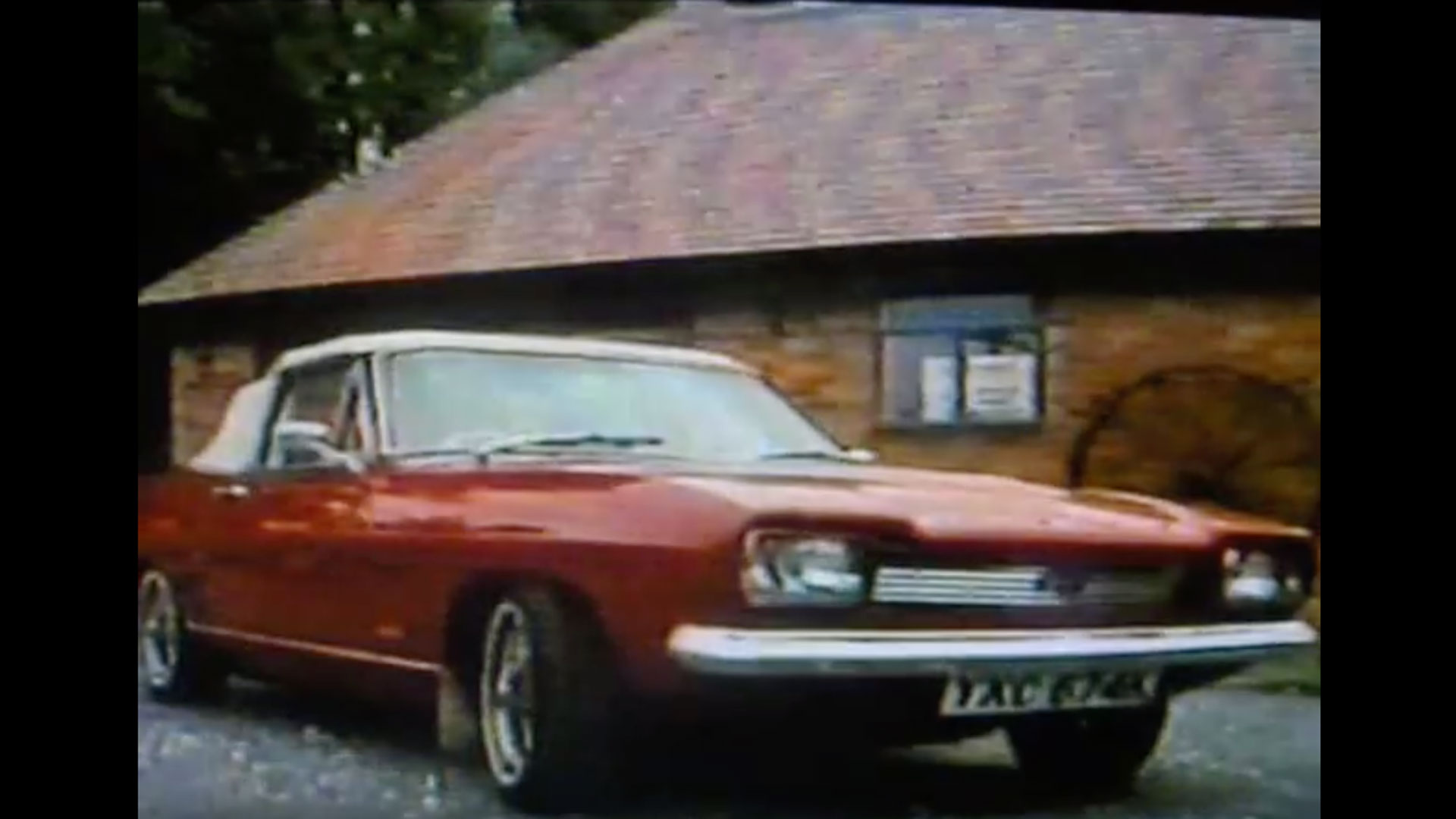
We’ll come back to the rise, fall and rise again of the Ford Capri, but before we do, it’s worth remembering some of the rather special variants built during the car’s lifetime. There were a few Capri convertible conversions, but the Crayford was perhaps the most famous.
It arrived in 1969, and with a price tag of £2,421 for the 3000E, it wasn’t exactly a cheap – this was more money than an E-Type. According to the Crayford Convertible Club, 37 Capris were sold, each one built in Germany. Abbotts of Farnham received 50 orders for its own Capri Convertible Drophead Coupe, but the company built and sold seven cars before the business collapsed.
Perana V8
Arguably the best Capri not to be officially sold in the UK, the Perana was the only Capri V8 to be sanctioned by Ford. Between 500 and 550 were built, each one sold via South African Ford dealers and with a full Ford warranty.
The Perana was based on the Mk1 3000 XL and powered by an uprated 5.0-litre V8 from the Mustang. Top speed was a smidgen over 142mph, while the 0-60mph time was eclipsed in just 6.1 seconds.
Four-wheel-drive Capri
Long before the Audi Quattro was changing the face of world rallying, Ford toyed with the idea of building a four-wheel-drive Capri. A total of 17 prototype Ferguson four-wheel-drive Capris were built, with at least five used in competition.
“I suppose it really was the wrong image for Capri. In most potential customers’ minds, 4WD was just something you put in for off-road use. There would be few who would pay the premium for the extra safety such a system gives on the road,” said FAVO supervisory engineer, Rod Mansfield.
Zakspeed Capri
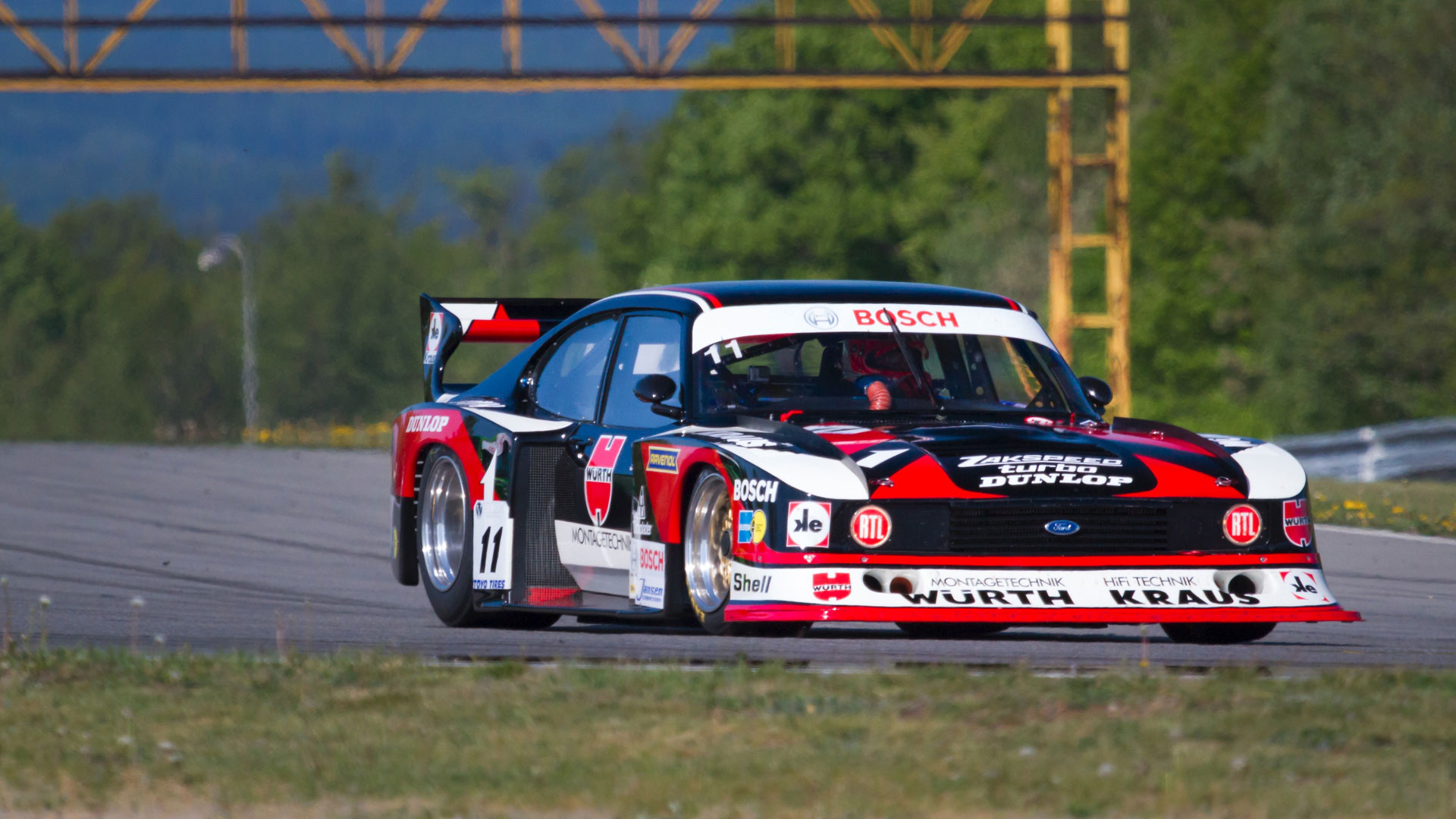
The Capri proved to be a formidable force in motorsport, with the car securing race victories as early as February 1969 and then continuing to be successful throughout the 70s and 80s. This gallery doesn’t focus on the Capri in motorsport, but it’s worth mentioning one particular legendary race car: the Zakspeed Capri.
Built for Group 5 racing in Germany, the Zakspeed Capri caught the eye thanks to its low and imposing Kevlar 49 plastic bodywork, deep front spoiler and rear wing. And if that wasn’t enough, the Zakspeed Capri would often be seen with fire coming out of the side-mounted exhaust. Magic stuff.
Tickford Capri
The Tickford Capri made its debut at the 1982 Birmingham Motor Show, with an initial price of £14,985, some £6,000 more than the standard 2.8i. In fairness, Tickford carried out a comprehensive makeover – including mounting a Japanese IHI turbocharger to the V6 engine – but this was an awful lot of money for a blue-collar hero.
Standard features included a walnut dashboard, an alarm and electric windows, but extras such as full leather, Wilton carpets and a stainless steel exhaust were optional.
Turbo Technics Capri
The Tickford wasn’t the only turbocharged Capri. In Germany, Ford teamed up with Zakspeed to offer the Capri Turbo, complete with flared arches, rear wing and front spoiler. Oh, and the small matter of a 200hp 2.8-litre turbocharged engine.
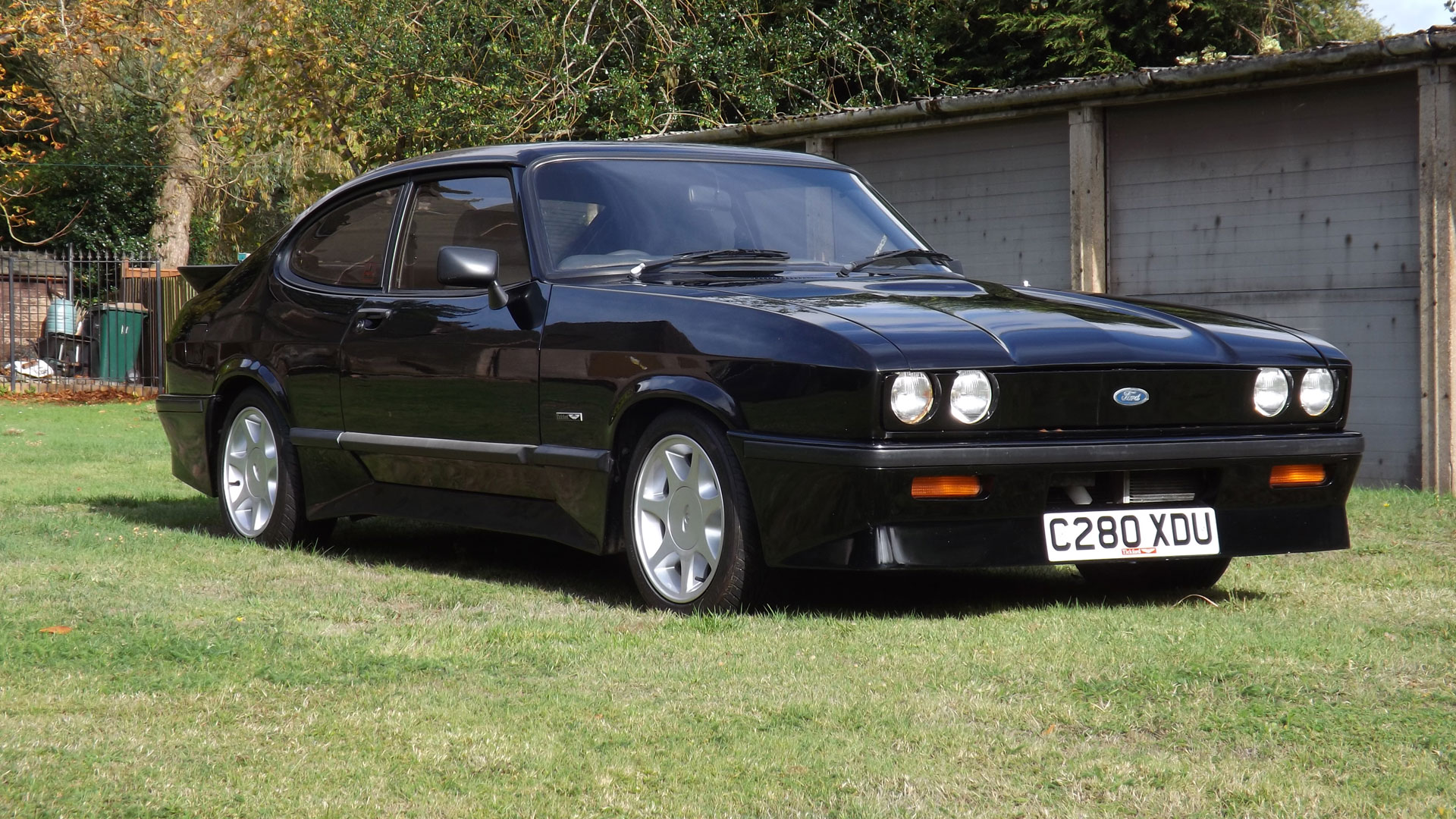
Meanwhile, UK buyers were offered a turbocharged Capri thanks to a Ford-backed Turbo Technics conversion. The Northamptonshire firm offered braking upgrades to cope with the extra power, which ranged from 200hp to 230hp. This photo shows a Capri 280 with a Turbo Technics conversion.
You could barely give them away
It took a while for the Ford Capri to recover from its image problem. I remember a time when it seemed almost impossible to sell a Capri, especially if it had a four-cylinder engine. I owned a succession of Capris – a brace of 1.6 Lasers, a 2.0 Ghia, a pair of 2.8s and a 280 ‘Brooklands’ – and on each occasion my purchases were greeted with ridicule.
Today, I could take a year off work and enjoy a few trips around the world if I owned that little lot. Heck, the Capri 280 is almost a passport to print money. In March 2016, a Ford Capri 280 sold at auction for a world record price of £54,000. One thing’s for sure: the days of Capris appearing in the ‘bargain basement’ section of the classifieds are long gone – it’s now a gilt-edged classic car. And rightly so. After all, the Ford Capri really did keep its promise.
Read more:
10 overrated fast Fords
Ford Capri 280 ‘Brooklands’: Retro Road Test
Road and race cars at Autosport International 2019
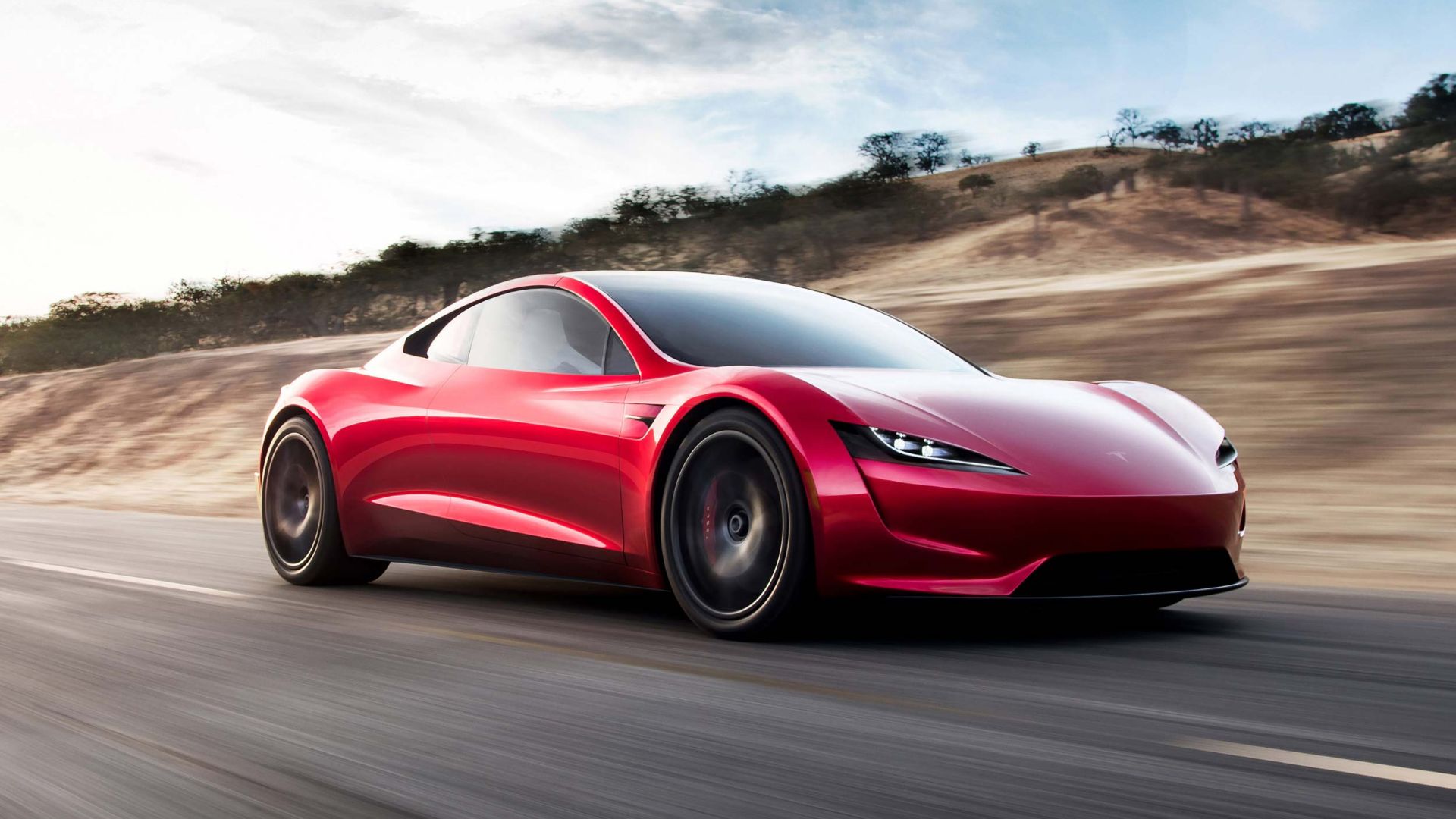
Tesla boss Elon Musk says one of the options available for the next-generation Roadster will be a ‘SpaceX package’. And that means – in theory – the car will be able to fly.
He’s serious, too. Musk commented on how cold-air thrusters could be used to aid braking, acceleration, top speed and cornering. He also adds that such a system would “maybe even allow a Tesla to fly”.
As standard, the new Roadster is claimed to hit 60mph in 1.9 seconds, plus a top speed of more than 250mph. It’s also said to have 620 miles of range.
Acclaimed tech YouTuber Marques Brownlee, a known friend of Musk’s and avid Tesla supporter, echoed the suspended disbelief of us all, saying: “The thing is I feel like you’re not joking”.
I’m not. Will use SpaceX cold gas thruster system with ultra high pressure air in a composite over-wrapped pressure vessel in place of the 2 rear seats.
Musk naturally responds with detailed jargon on how he’d get a Tesla to fly. How does a “SpaceX cold gas thruster system with ultra high-pressure air in a composite over-wrapped pressure vessel in place of the two rear seats” sound?
In response to another reply depicting a certain famous DeLorean with its wheels sideways and rocket power, he said: “the new Roadster will actually do something like this”.
Plus, you can basically accelerate at the limit of human endurance
It’s not been established whether Musk was consuming herbal refreshments – similar to those he famously enjoyed on Joe Rogan’s podcast – when he claimed the next Roadster could go vertical.
Love him or lump him, the automotive and technological worlds are undoubtedly more interesting thanks to Musk. He certainly makes a change from the grey-suited, PR-hardened automotive execs we’ve become used to.
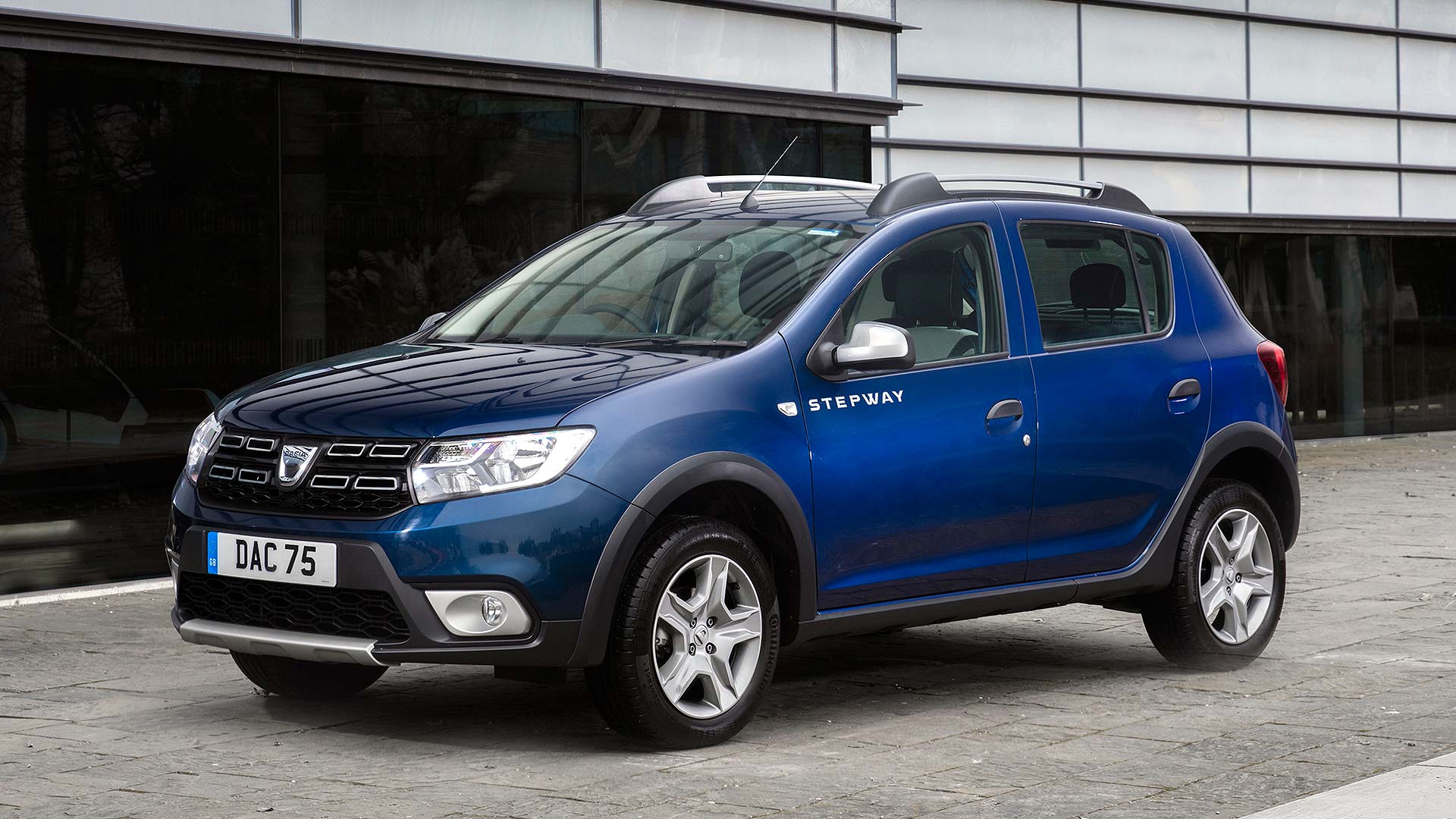
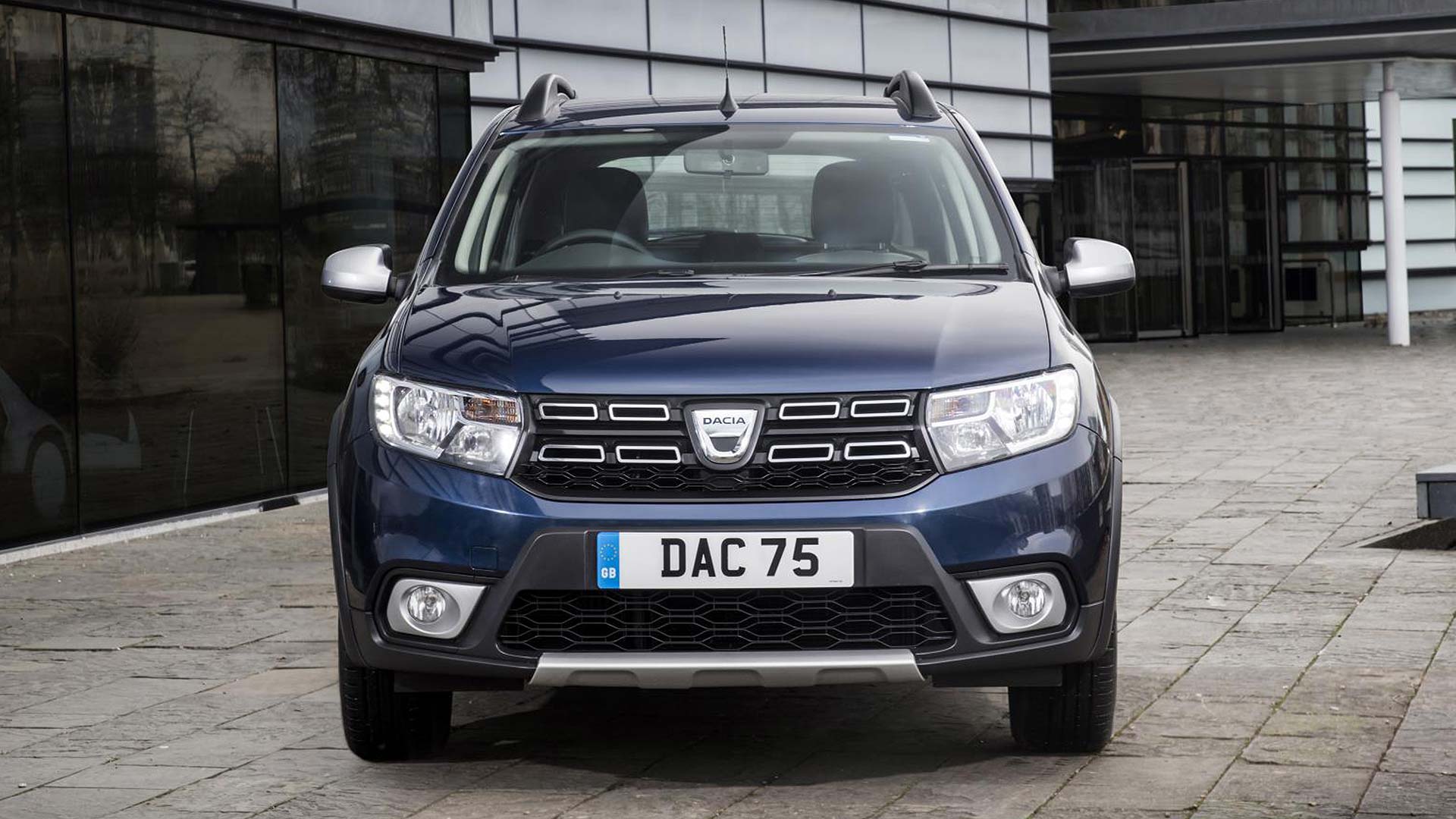
The best-selling Dacia in Britain is the crossover-infused, value-priced supermini Sandero Stepway. And now the jacked-up five-door hatch has become even better value with the launch of a new entry-level engine.
The 1.2-litre SCe 75 is certainly no ball of fire. 0-62mph takes a yawning 16.7 seconds and it can’t even crack 100mph flat-out. The TCe 90 that it sits below is a full 5.6 seconds faster from 0-62mph, and has half as much pulling power again.
But never mind the performance, just look at the prices. The Sandero Stepway SCe 75, in base-level Essential trim, costs just £8,995, making it one of the most affordable new cars in Britain. AND you get a car with plenty of style-conscious SUV body cladding to boot.
It’s 40mm higher than the regular Sandero hatch, and the roof bars plus satin finish chrome front and rear skid plates are standard.
Mind you, if its limp performance really is an issue, the TCe 90 isn’t exactly budget-busting: it costs from £9,995, just £1,000 more. It’s the diesel variant that makes little sense these days: it may well do 58.8mpg, but it also costs from £11,595, £1,600 more than the TCe 90 (which does 42.2mpg).
The diesel has by far the highest insurance group, too – 13E, compared to 6E for the SCe 75 and 8E for the TCe 90.
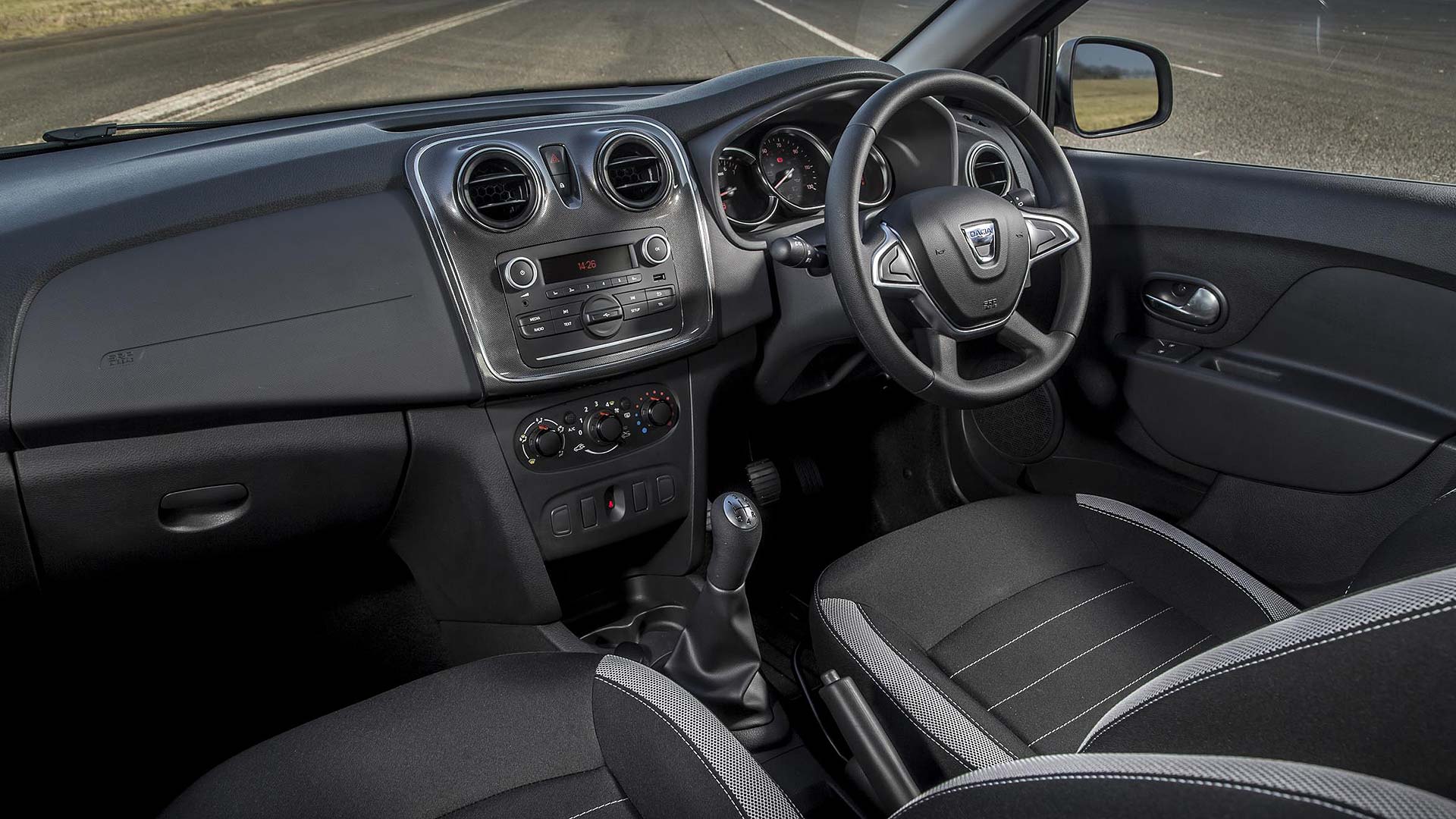
The new Essential trim line has been introduced to give everything the budget-conscious new car buyer needs for a competitive price. It has the all-important air con as standard, plus DAB radio, Bluetooth connectivity, electric front windows, body coloured bumpers and ‘alloy-look’ wheels.
Comfort is new, too: priced from £10,995, it has touchscreen MediaNav sat nav with Apple CarPlay and Android Auto, cruise control, rear parking sensors, electric rear windows and electric door mirrors.
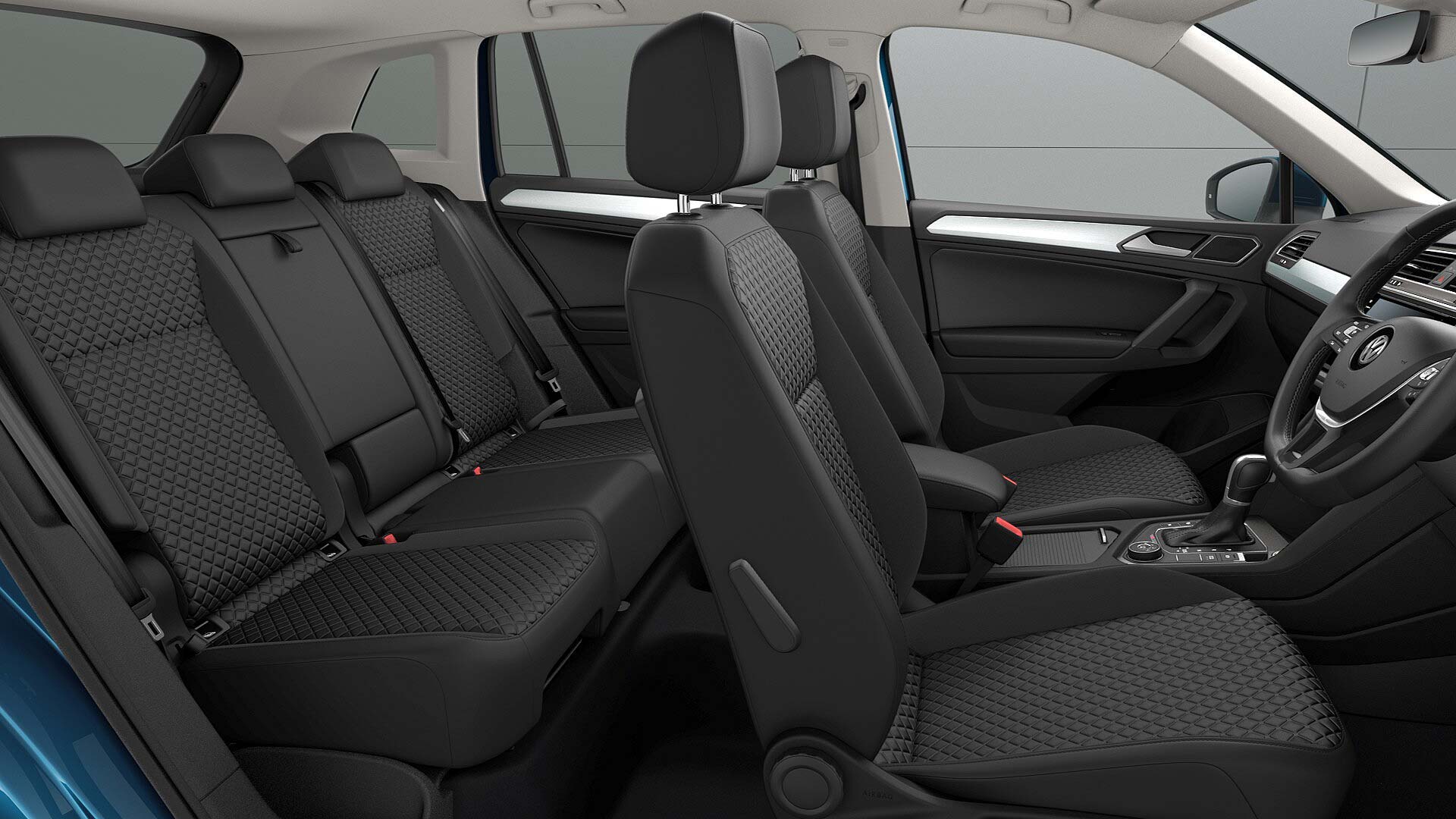
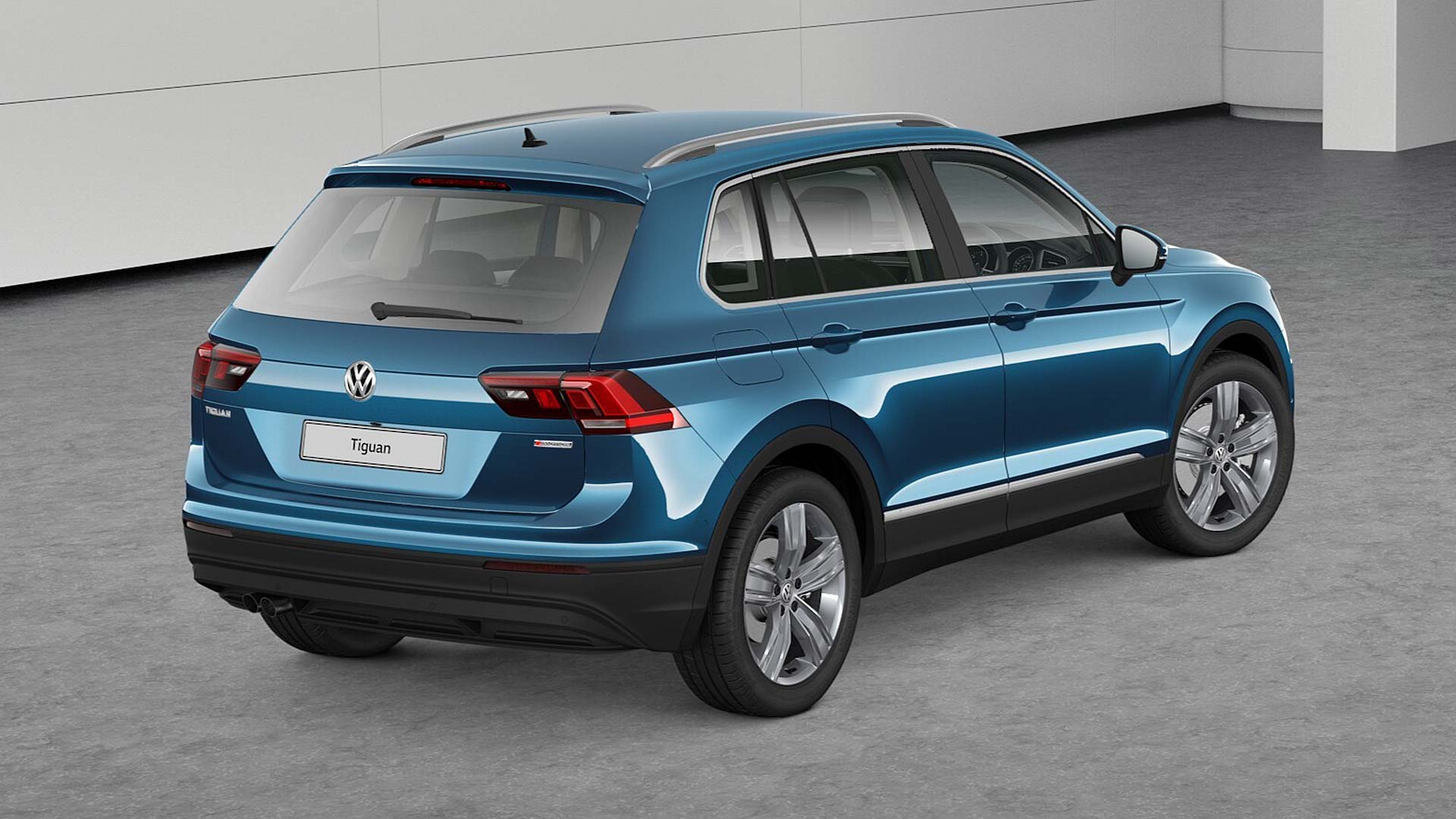
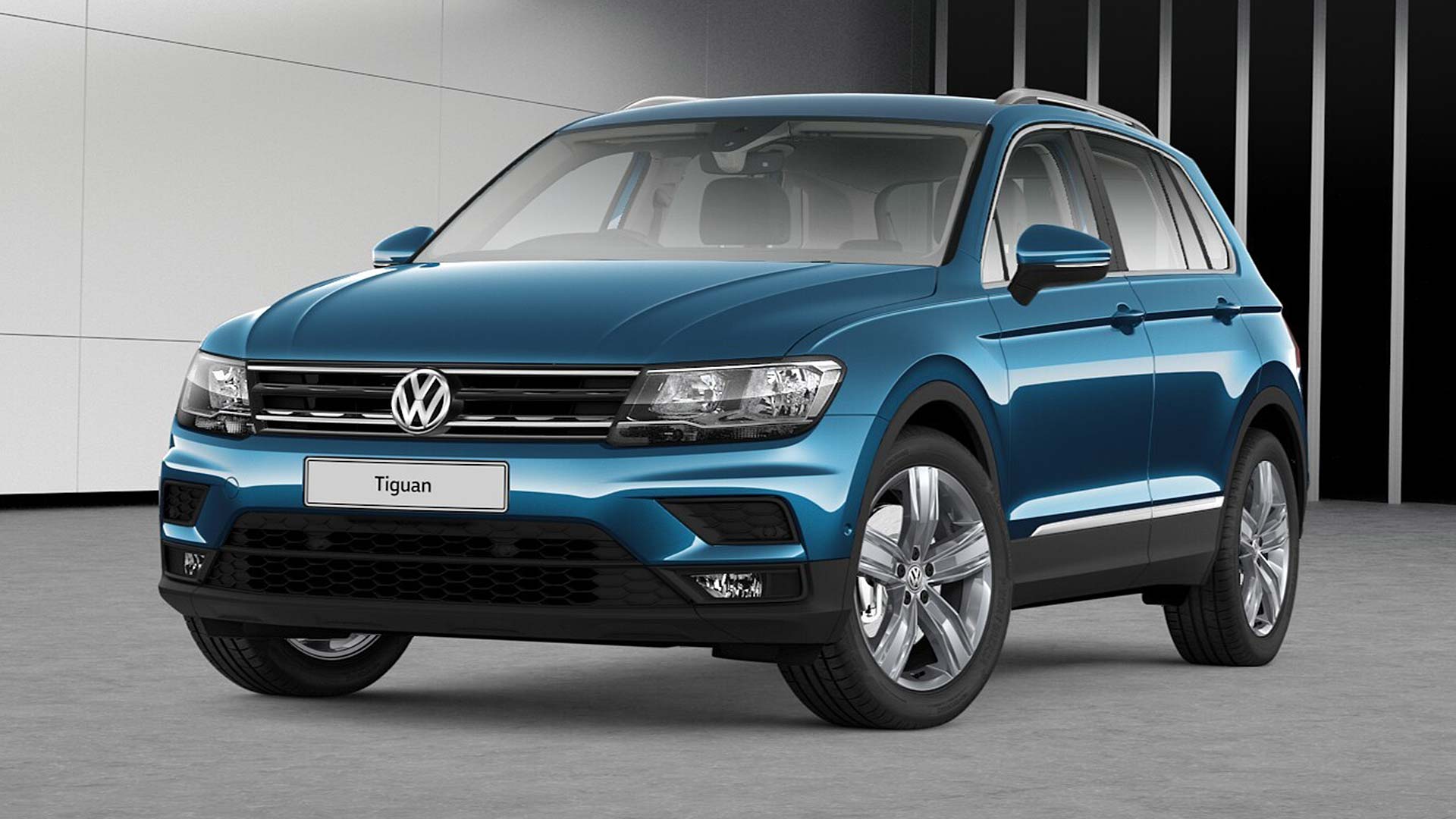
Match is Volkswagen-speak for extra features and cash savings. The Tiguan Match thus replaces two models, SE and SE Nav, and brings in more equipment than either of them.
It’s added a rear view camera, park assist, keyless entry and big 19-inch ‘Victoria’ alloys onto the standard spec of SE Nav (which, as its name suggests, also includes sat nav).
Volkswagen’s calculated that the total customer saving totals £1,130, even when the “small price revision” (i.e. £200 price increase) over the old SE Nav is factored in.
Prices for the Tiguan Match start from £26,750 for a 1.5 TSI Evo 130, in front-wheel drive manual guise. DSG autos and 4Motion all-wheel drive can be added, and buyers can also pick from 1.5 TSI Evo 130, 2.0 TSI 230, 2.0 TDI 150 and 2.0 TDI 190 engines. It’s offered in regular Tiguan and Tiguan Allspace, too.
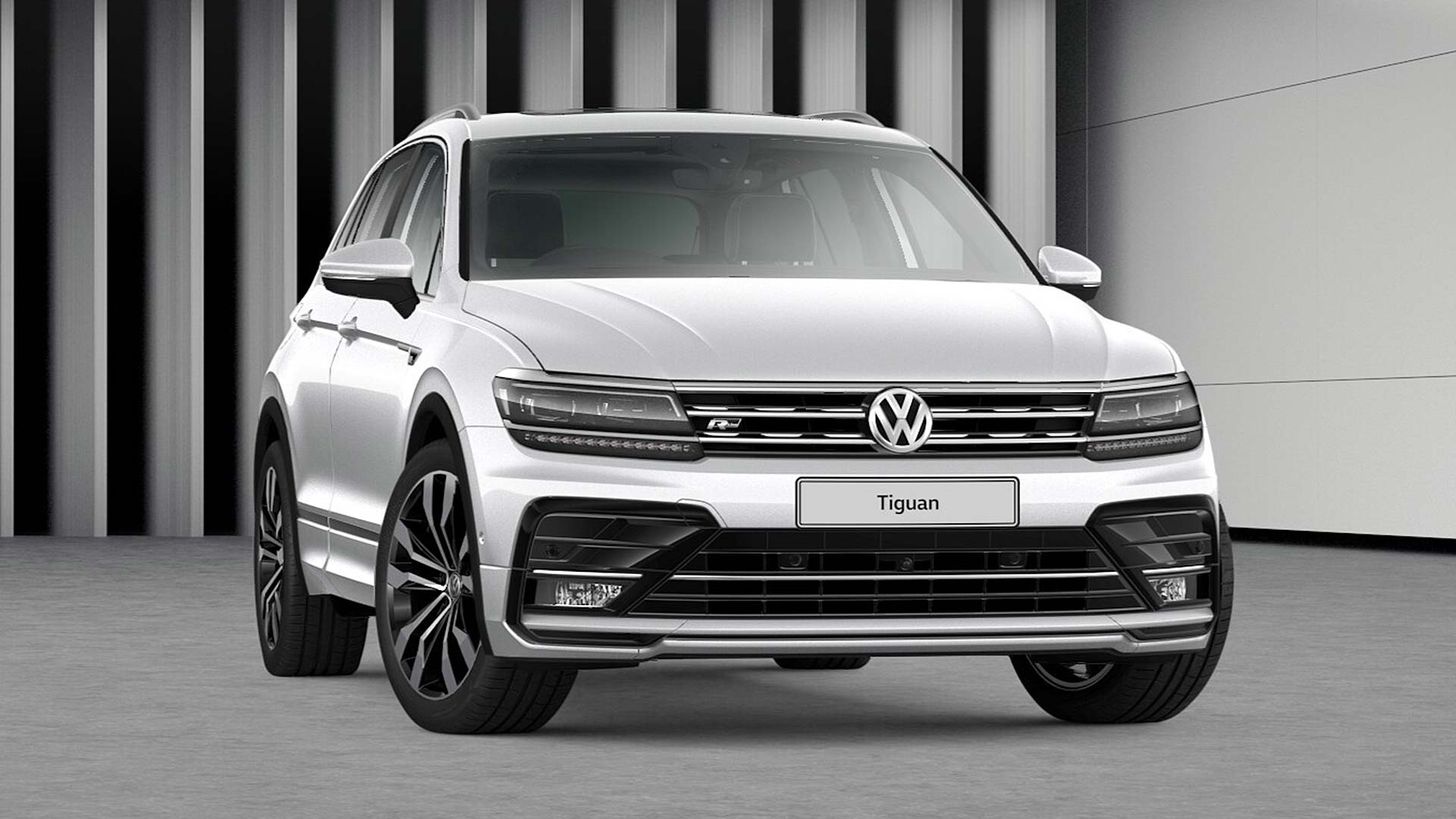
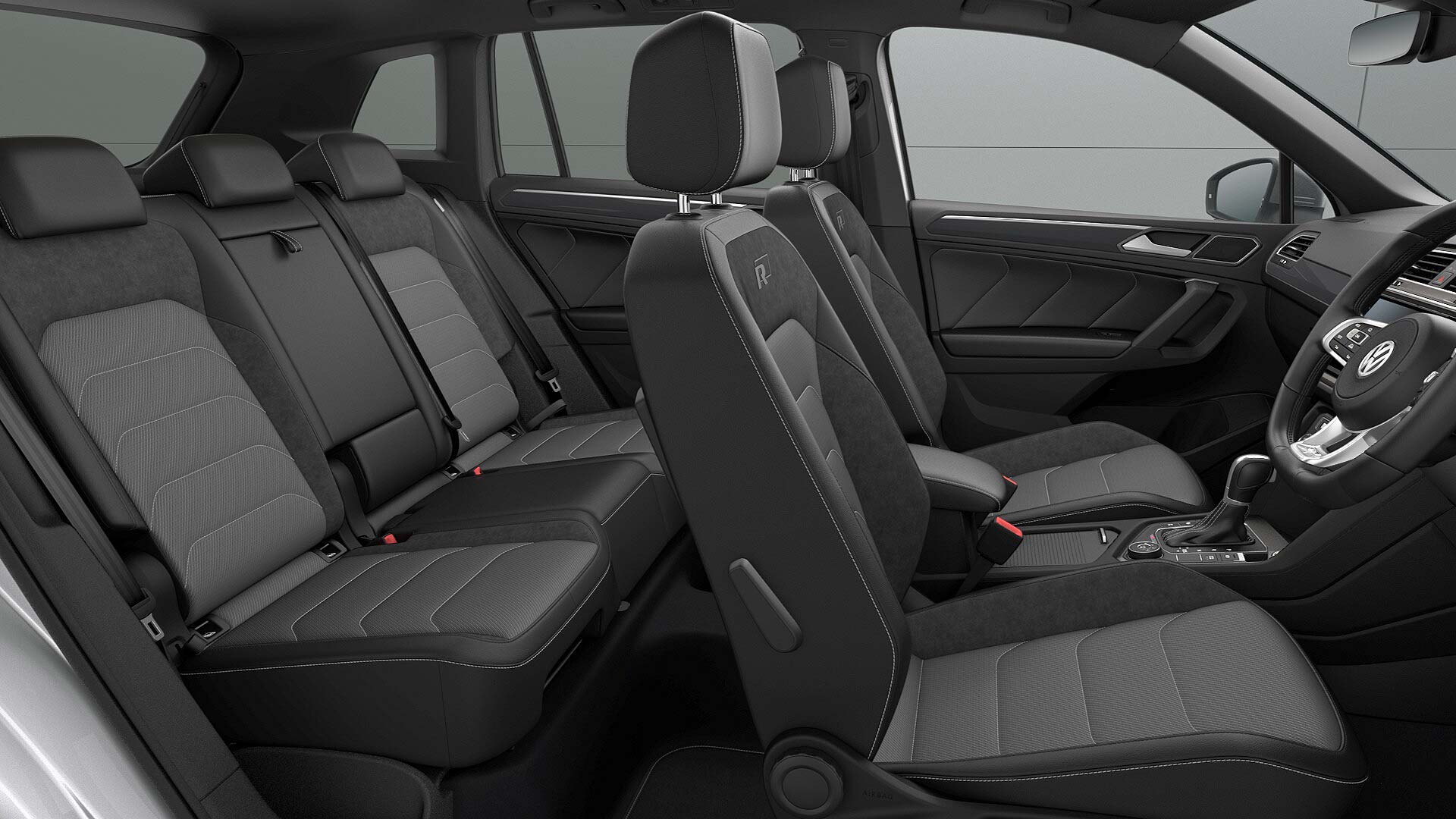
It’s not only at the value end of the range that Volkswagen is revising trims, though. At the top of the line, R-Line has been replaced by R-Line Tech, which comes wtih £1,485 of options.
The extras? ‘Area view’ (a fancy rear-view camera), park assist, keyless entry and full electric tailgate operation. Again, it has a price hike of £200, making the total saving £1,285. Prices for the R-Line Tech start from £33,150.
The petrol range now stretches right up to £38,335, for an new range-topping 230hp 2.0-litre TSI 4Motion. Why would you want it? For a combination of 36.7mpg and 0-62mph in 6.3 seconds, that’s why.
Remember, it’s basically the engine that’s already used in the Volkswagen Golf GTI.
“The Tiguan is already a favourite with UK car buyers,” said product manager Brian Luckie, “being our third best-selling model behind the Golf and Polo.
“This addition of over £1,000 of extra equipment and extra value only strengthens its case. With this equipment included, not only is the Tiguan better value, but even more convenient.”
Ordering for both new Tiguans is open now with deliveries due later in the month.
 The new Toyota GR Supra has been revealed at last, making its world debut at the 2019 North American International Auto Show in Detroit. First customer deliveries are due from later this summer.
 The new Kia Proceed goes on sale in the UK from 21 January 2019 with prices for the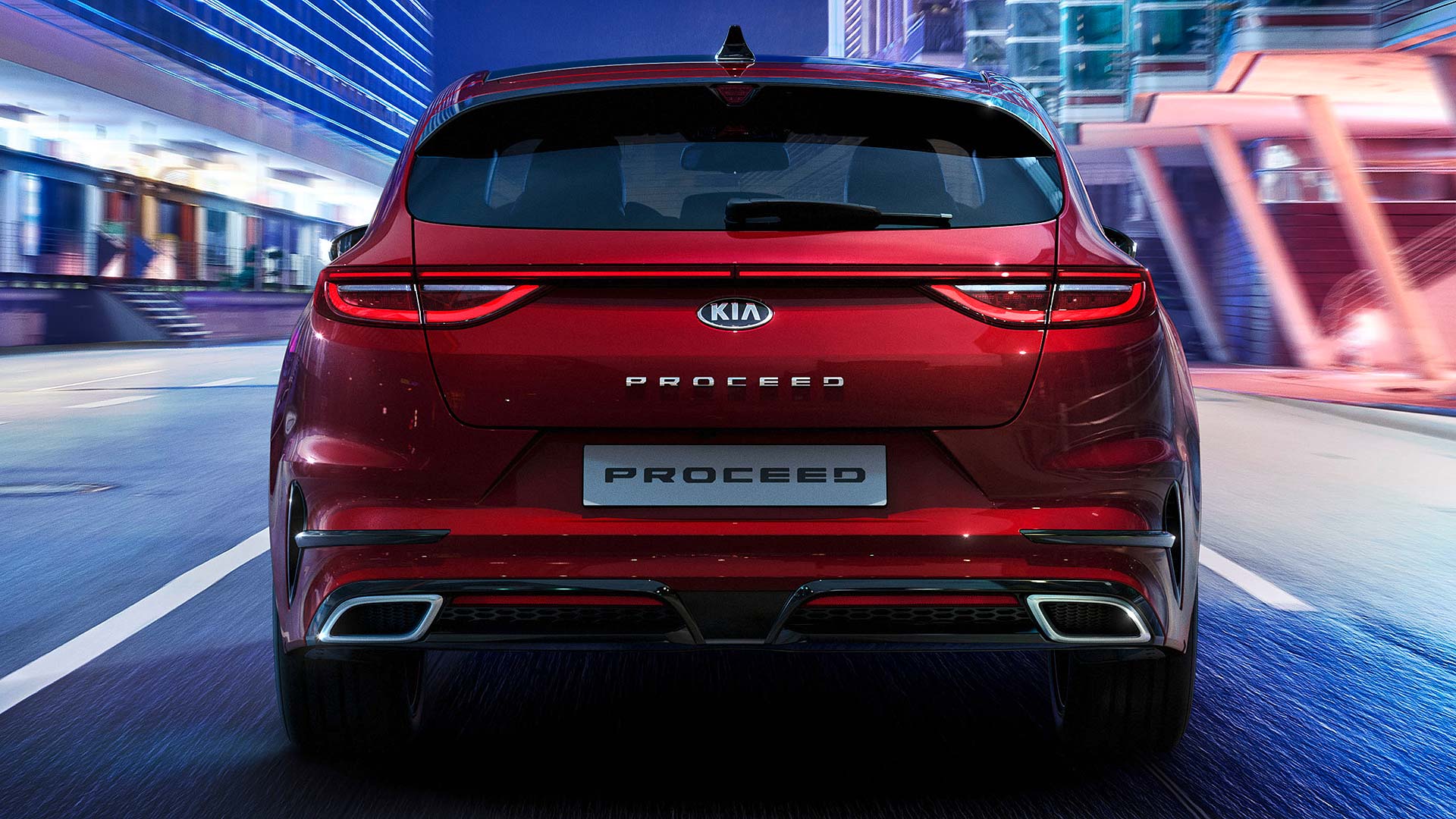
 Arguably one of the most famous
  Depending on sources, either 11 or 12 examples of Eleanor were created for filming. Hot Rod illustrator Steve Stanford created the concept, with the late Boyd Coddington responsible for making the ideas come to life.
 Of the 12 cars built, five were destroyed during filming in stunts and action scenes. This particular car lived a more pampered life, being reserved for street scenes with actors behind the wheel.
 The current owner may well be looking to make a significant return on that investment in the 2019 sale.
 The
The 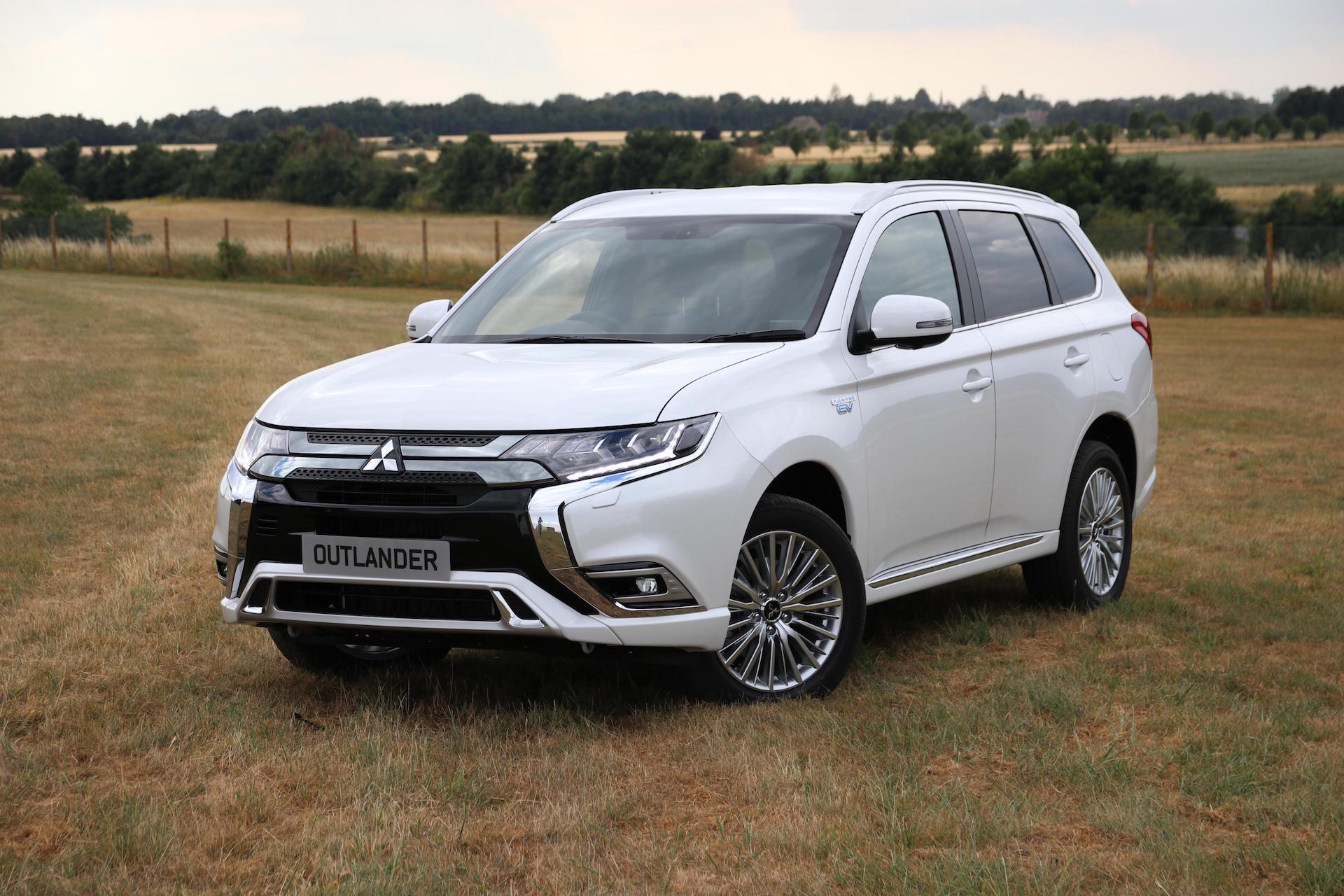 However, in considering the complaints, the ASA ruled that the content of the advert was more than sufficient to prevent viewers from being confused.
 The Outlander PHEV has cemented its position as the UK’s best-selling plug-in hybrid. Revisions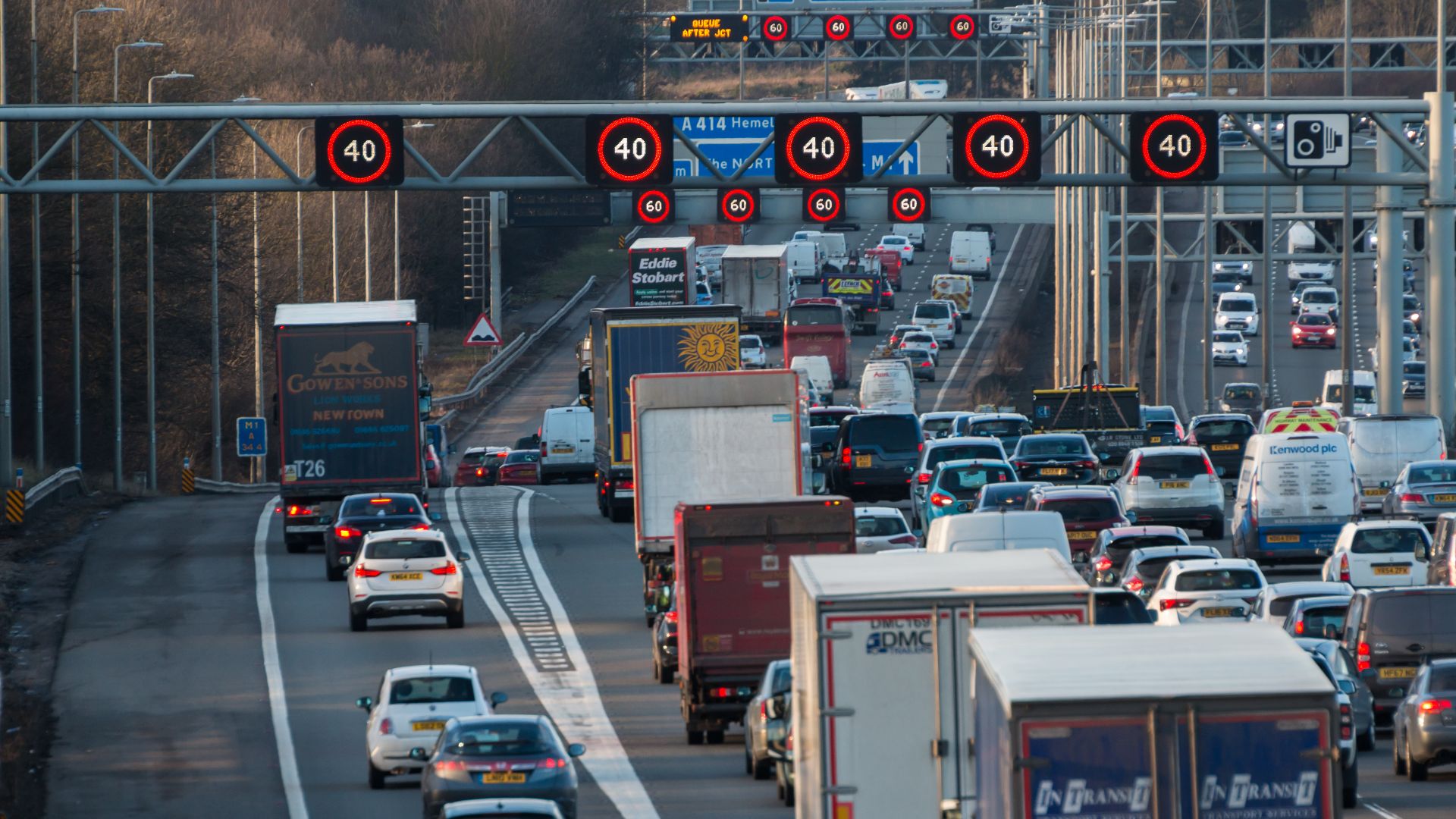

 The
The 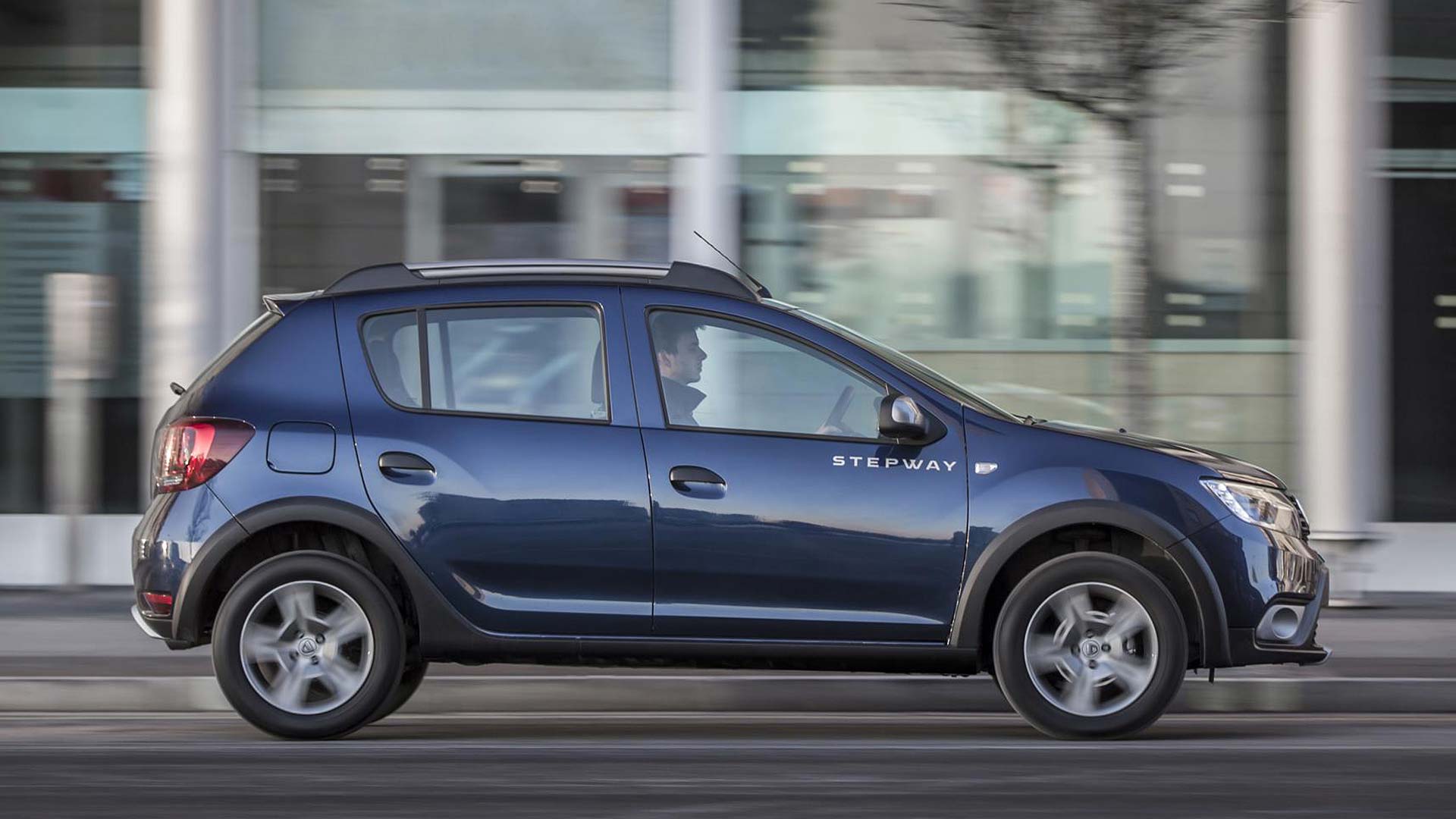
 The
The