Home Blog Page 165

Driving tests for towing a trailer to be scrapped

0
New 2021 trailer towing rules

The government has decided to scrap the requirement for drivers to take an additional test to tow a trailer. 

It follows a public consultation aimed at getting more heavy goods vehicle drivers (HGV) onto the road. 

Along with other measures, the Department for Transport believes that an additional 50,000 tests could be made available annually.  

The new rules will take effect in the autumn.

What are the current rules on towing a trailer?

New 2021 trailer towing rules

At present, the law states that those who passed their driving test after 1 January 1997  can drive a car or van up to 3,500kg MAM (maximum authorised mass) towing a trailer of up to 750kg MAM (up to 4,250kg in total).

Alternatively, they can tow a trailer over 750kg MAM, as long as it does not exceed the unladen weight of the towing vehicle (up to 3,500kg in total)

Licenses issued from 19 January 2013 allowed for towing a trailer over 750kg MAM, as long as the combined MAM of the trailer and towing vehicle is no more than 3,500kg.

To tow anything heavier, drivers would need to pass a trailer test

Those who obtained a driving licence before January 1997 have been allowed to drive a vehicle and trailer combination up to 8,250kg (MAM), without a test.

What will the new trailer towing rules allow?

New 2021 trailer towing rules

When the law changes in the autumn, drivers who have passed their test after 1 January 1997 will be allowed to tow trailers up to 3,500kg MAM without taking an additional car and trailer driving test.

The DVLA will automatically update driving licence records to reflect the changes. When a driving licence is renewed, it will show the ‘BE’ category upon it.

There should be no need to contact the DVLA directly to gain the updated category.

The changes will apply to England, Wales, and Scotland only. As Northern Ireland issues licences through the separate Driver and Vehicle Agency, the new rules will not affect residents there.

What can I tow before the new rules come into force?

New 2021 trailer towing rules

The government has not set an exact date for the new rules to come into force. Until that date, drivers must abide by the current limitations on their driving licence. 

Towing a trailer heavier than permitted by your licence can result in a fine of up to £1,000.

Drivers can continue to use L-plates to be supervised towing heaving trailers.

What if I already have a trailer test booked?

New 2021 trailer towing rules

To address the HGV driver shortage quickly, the DVSA will stop all trailer tests after 20 September 2021. 

For tests booked before the 20 September, drivers can opt to take the test as planned. Alternatively, tests can be cancelled, with a refund of the fee available from the DVSA. 

Tests booked for after 20 September 2021 will be cancelled and refunded automatically by the DVSA.

No compensation will be paid for any private lessons on training undertaken to prepare for cancelled tests.

Will the rule changes affect road safety?

New 2021 trailer towing rules

As reported last month, road safety charity IAM RoadSmart was concerned by the government’s proposals to remove the licence test requirements. 

Neil Greig of IAM RoadSmart commented previously that: “People need proper training to be able to drive an articulated vehicle, particularly when they are doing so for the first time.”

As part of the changes in legislation, the government will still recommend that drivers take trailer lessons from a professional instructor before towing for the first time.

What other changes are being made to driving tests?

New 2021 trailer towing rules

Estimates suggest the new trailer rules will allow an extra 30,000 HGV tests to be conducted each year. 

HGV tests themselves will also be made simpler, with a reversing element and ‘uncoupling and recoupling’ exercise removed. Instead of being tested by the DVSA, these will be evaluated by a separate third party. 

Finally, HGV drivers will be able to progress straight to using an articulated vehicle, without having to obtain a licence for a smaller vehicle first. This will free up capacity for an additional 20,000 tests each year. 

According to the Road Haulage Association, the UK currently has a shortage of around 100,000 professional HGV drivers.

ALSO READ

The best new cars for towing in 2021

Motorists urged to ‘check it before towing it’

Highways England issues towing advice for motorists
Advertisement

Supercharged Sutton Mach 1 Mustang has 767 hp

0
Ford Mustang Mach 1 767 Edition

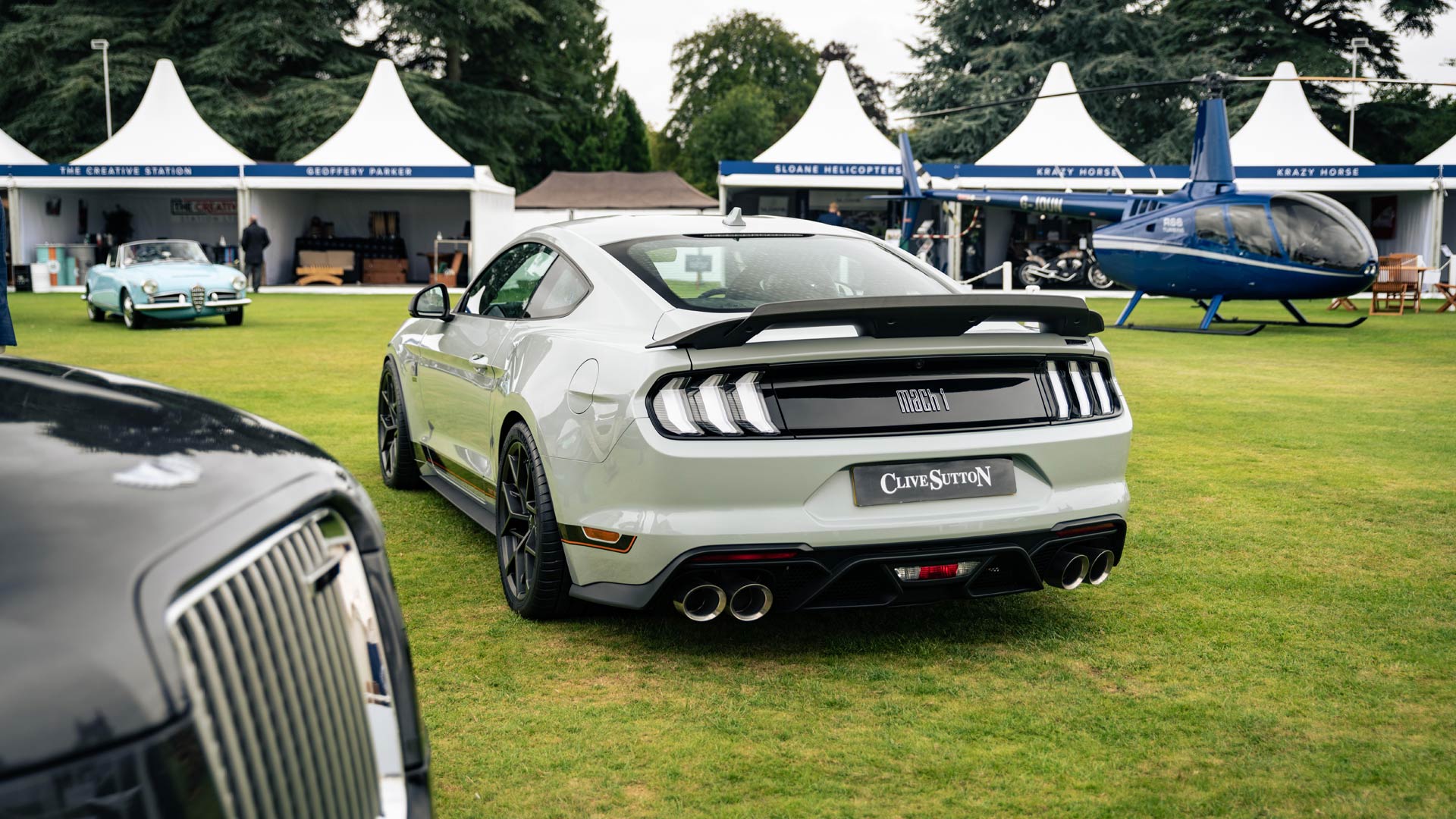
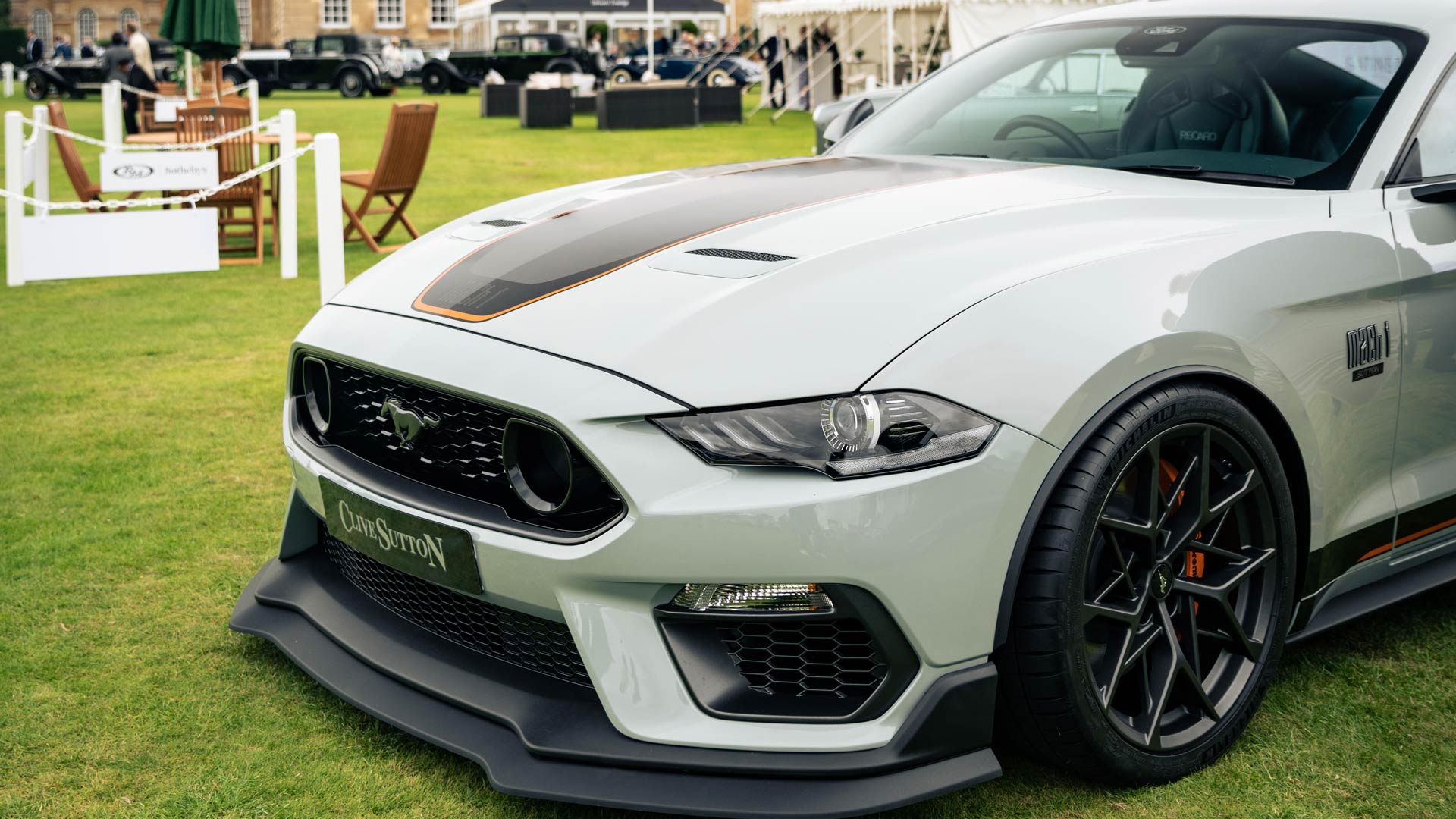
Luxury car specialist Clive Sutton has created an extreme, highly-modified version of Ford’s potent Mustang Mach 1. 

A host of performance upgrades have seen the Sutton Mach 1 – 767 Edition add more than 300 hp over the regular car. 

Revealed at the Salon Prive Concours d’Elegance show, the first completed example has already found a new owner.

Aiming for the speed of sound

Ford Mustang Mach 1 767 Edition

The regular Mustang Mach 1 represents an already impressive example of Ford’s muscle car icon. With a 5.0-litre ‘Coyote’ V8 engine, the Mach 1 benefits from 460 hp and parts from Shelby performance models. 

However, this was not enough to satisfy Clive Sutton. 

The Mach 1 – 767 Edition benefits from a 3.0-litre supercharger, with a substantial dual-pass charge cooler, and an upgraded exhaust system for good measure. 

Such modifications see the Coyote V8 engine pushed to an incredible 767 hp. It means the already potent Mustang Mach 1 moves into serious supercar territory.

More muscle for your money

Ford Mustang Mach 1 767 Edition

Sutton also installs improved subframes, enhanced suspension components, a new spoiler and splitter, plus a set of Ford Performance ‘Bird Nest’ alloy wheels.

Interior modifications for the 767 Edition include bespoke mood lighting, a custom starter button, a unique arm rest, and Sutton badging.

As with the standard Mustang Mach 1, buyers can pick between a six-speed manual gearbox or a ten-speed automatic. 

Prices for the 767 Edition begin from £96,000 on the road, representing an additional £40,000 expenditure over the standard Mustang Mach 1.

ALSO READ

Toyota GR buyers get special Issho toy

Ford builds electric Mustang Mach-E police car

You could buy this ex-Raikkonen McLaren MP4-17 F1 car

Advertisement

Toyota GR buyers get ‘adorable yet adventurous’ Issho toy

0
Toyota GR Ishoo Mascot

Toyota customers collecting their new GR or GR Sport car will get an extra gift to help them celebrate. 

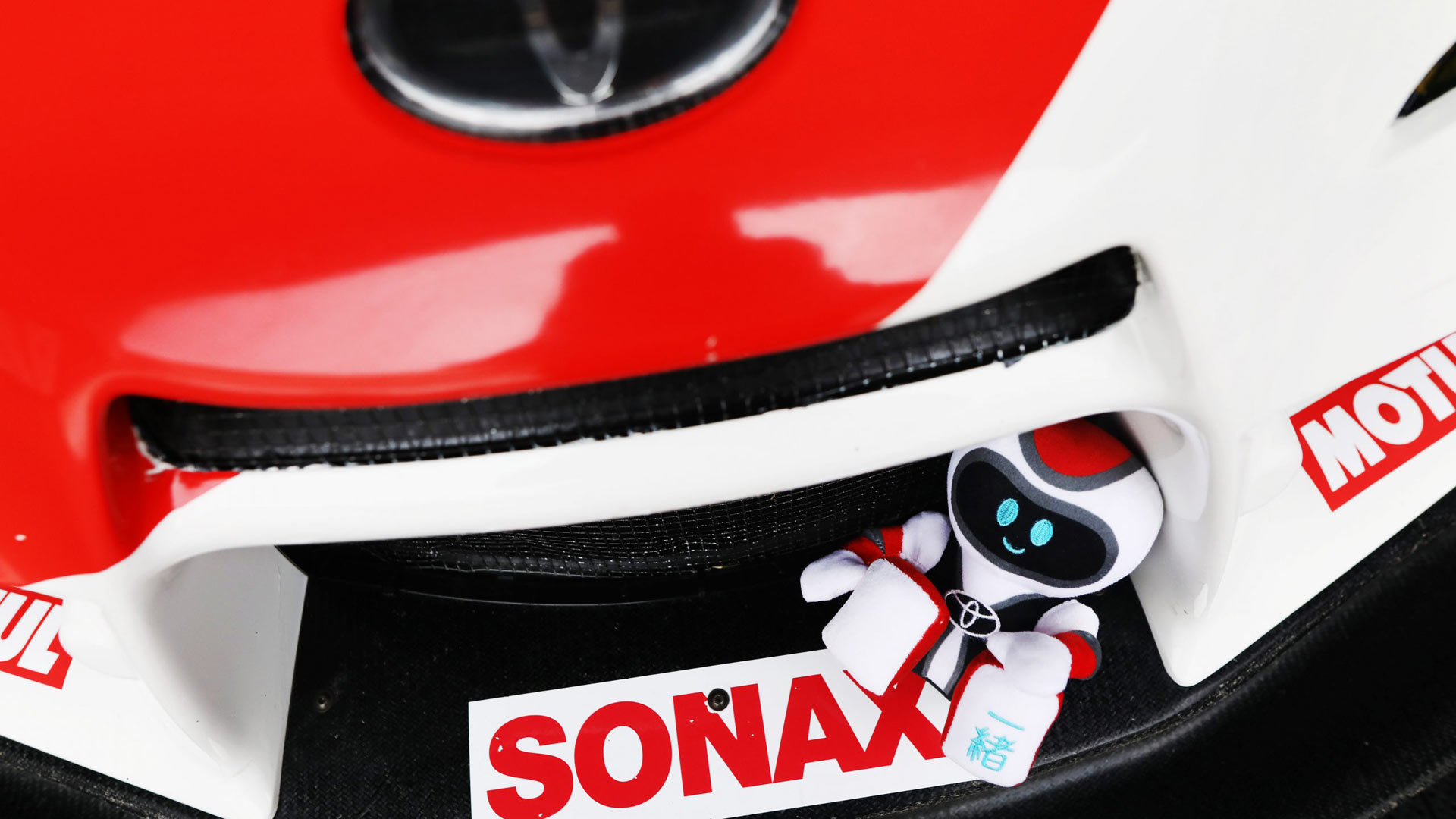
Issho, the ‘adorable yet adventurous’ mascot will be offered to new owners by participating Toyota dealerships. 

The company explains that the word Issho means ‘together’ in Japanese, with the toy meant to accompany drivers on journeys

Celebrating motorsport heritage

Toyota GR Ishoo Mascot

The plush mascot stands around six inches tall. Toyota says it’s the perfect size to be placed in a cup holder or on a seat. 

Supplied in a presentation box, Issho comes with a leaflet that explains the history of Toyota’s Gazoo Racing team. 

Founded in 2007 to compete at the Nurburgring 24 Hours race, the Gazoo Racing (GR) brand has expanded considerably. The name is now used on Toyota’s performance models, including the wildly popular GR Yaris hot hatch.

Ready to explore

Toyota GR Ishoo Mascot

Those lucky enough to have secured a place on the waiting list for a GR Yaris can expect to receive an Issho mascot. 

Buyers of GR Supra, Toyota’s other current member of the GR range, will also get the cuddly toy, as will those purchasing GR Sport models, including the Corolla and C-HR. 

Anyone considering a new GR or GR Sport Toyota should contact their dealer to check they are taking part in the offer. Toyota’s social media team is also keen to see people exploring with Issho. Photos can be tagged with ‘@ToyotaUK’ on Facebook, Instagram and Twitter.

ALSO READ:

Toyota chief Akio Toyoda is 2021 World Car Person of the Year

Toyota GR Yaris review

Listers Toyota Supra 450hp review

Advertisement

Lotus gets serious with hand-built Emira GT4 racer

0
2021 Lotus Emira GT4

Lotus has announced it will build a racing version of the new mid-engined Emira sports car. 

Designed to GT4 specification, the racer is primed to continue the successful legacy of Lotus in sports car events. 

It follows the successful launch of the roadgoing Emira earlier this year, including a starring role at the prestigious Monterey Car Week in California.

Hand-built for motorsport

2021 Lotus Emira GT4

Lotus has teamed up with Northamptonshire-based RML Group, makers of the Ferrari-based RML Short Wheelbase, to develop the harder, faster Emira. RML has extensive experience in motorsport, and will hand-build each new GT4 model. 

The Emira GT4 uses the same 3.5-litre Toyota-sourced V6 engine as the road-legal model, with a peak output of 400hp.

Motorsport upgrades will include a six-speed paddle-shift gearbox, Ohlins coilover suspension, a Motec digital dashboard and an FIA-standard roll cage. 

Bespoke aerodynamic bodywork will also be added to the car, along with Pirelli GT4-specification tyres.

Family honour to uphold

2021 Lotus Emira GT4

The new Emira will have high standards to live up to when it takes to the track. Its predecessor, the Evora GT4, claimed victory in multiple championships across the globe. 

Among its successes were class wins in the Dubai 24 Hours, Barcelona 24 Hours, British GT Championship and Pirelli World Challenge.

Lotus will formally launch the Emira GT4 at its Hethel test track later this year. A limited number of cars will be produced for the 2022 season, followed by larger run for 2023.

A return to the world stage

2021 Lotus Emira GT4

With a distinguished motorsport pedigree behind it, Lotus has recently made commitments to engage further with racing activities. 

Lotus Engineering, the company’s consultancy arm, is now working with JBXE, the Extreme E race team led by former F1 World Champion Jenson Button

Richard Selwin, race programme manager at Lotus, commented: “The all-new Emira GT4 is an exciting next step following the hugely successful launch of the Emira road car. We have worked hard with the team at RML Group to ensure this next-generation of Lotus GT car will deliver race-winning performance.”

Gavan Kershaw, director of vehicle attributes for Lotus and a former GT racing driver, has been involved with development of the Emira GT4.

He added: “The all-new chassis on which the Emira has been developed is the perfect starting point for a high-performance race car. Everyone at Lotus is so excited to be returning to world motorsport and to be doing so with such a competitive race car.”

ALSO READ:

Lotus Emira revealed: new era sports car takes on Cayman and 911

Lotus Esprit S3 review: Retro Road Test

‘My dad borrowed a Bond car’ – chief engineer on a life at Lotus

Advertisement

Ford builds electric Mustang Mach-E police car

0
Ford Mustang Mach-E Police Car

The all-electric Ford Mustang Mach-E is being tested by several police forces across the UK.

The police-specification Mach-E made its public debut at this week’s Emergency Services Show, held at the NEC in Birmingham.

It follows the announcement earlier this year that Tesla has created a special Model 3 demonstrator for police evaluation.

Electric blue

Ford Mustang Mach-E Police Car

Interest from police forces across the country led Ford to creating a Mach-E demonstrator. SVP Safeguard, based in Essex, was responsible for converting the electric Mustang to blue-light specification.

Along with a bespoke reflective livery, the police Mustang Mach-E features an array of lights and sirens. All the lights are LEDs, and are powered by the conventional 12-volt battery, rather than the lithium-ion cells.

This initial demonstrator is based on an AWD Long Range model, which manages 0-62 mph in 5.1 seconds. Ford will consider testing other Mach-E versions after initial feedback.

What’s the charge, officer?

Ford Mustang Mach-E Police Car

The Metropolitan Police has already tested an unmodified Mustang Mach-E, but now intends to fully evaluate the marked Ford concept.

Other forces interested in the car include Sussex, Surrey, South Wales, Dyfed Powys, Devon and Cornwall, and Police Scotland.

Previous generations of the Mustang Mach-E’s muscle car namesake have been used as police cars in North America. Between 1982 and 1993, some 15,000 Special Service Package versions of the third-generation Ford Mustang were built for police pursuit use.

ALSO READ:

Ford Mustang Mach-E RWD Extended Range 2021 review

Steeda Ford Mustang Q500 review: brawn in the USA

The most overrated fast Fords

Advertisement

RML Short Wheelbase: the story behind Britain’s retro supercar

0

RML Short Wheelbase

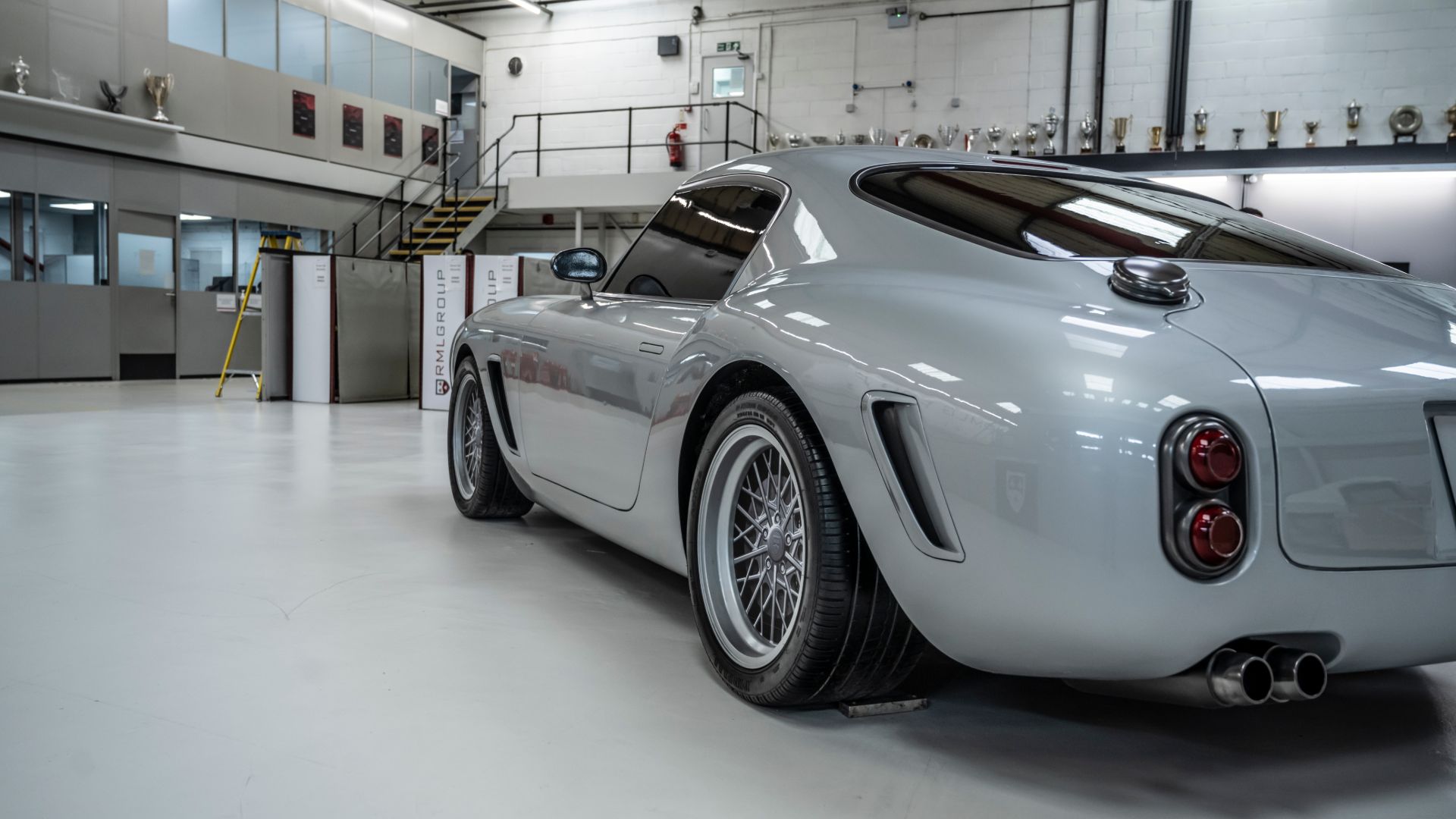
The RML Short Wheelbase is not a restomod. It isn’t a classic, a recreation or a continuation. This is effectively a brand new car. Even though it looks like a classic.

“The only comparison I can think of, with similar levels of research and development, is the Singer DLS,” says Michael Mallock, CEO of RML Group. “That car is clearly inspired by the Porsche 911, but almost every detail is different.”

More car reviews on Motoring Research

Here, inspiration comes from the 1959 Ferrari 250 GT Berlinetta SWB. As one of the three most beautiful cars ever built – the others are the Lamborghini Miura and Citroen DS, in case you wondered – it seems an auspicious place to start.

Made to measure

RML Short Wheelbase

Despite appearances, the RML Short Wheelbase shares nothing tangible with the original SWB. Its V12 engine, manual gearbox and lower body structure come from a Ferrari 550 Maranello (built between 1996 and 2002), body panels are carbon fibre and the all-mod-cons interior is entirely bespoke.

Indeed, the whole car is around 14 percent larger than the Ferrari. “I’m 6ft 4in and can hardly fit into an SWB,” explains Mallock. “I found it uncomfortable to drive for more than a few minutes. Our car has been packaged around me wearing a racing helmet. That set the roofline, then the other proportions flowed from there.”

There’s also a significant difference in price. The RML Short Wheelbase costs around £1.3 million, depending on spec, with first deliveries due in spring 2022. A real 250 GT SWB could set you back anything up to £20 million, if you can find one. No wonder most of the SWBs racing at Goodwood are replicas.

White-label work

RML Short Wheelbase

Granted, £1.3 million seems a lot for a car made by a company most people have never heard of. But RML Group is no flight-of-fancy supercar start-up. It has designed, engineered and assembled vehicles for major manufacturers and motorsport teams since 1984.

“In most cases, we can’t talk about what we do,” explains Mallock, who left school at 16 to become a professional racing driver. “These are white-label projects that we make happen.”

RML-developed cars he can mention include the Nissan Juke R, a small SUV with Nissan GT-R running gear, and the Saleen S7, arguably America’s first supercar. It also produces a kit to make the Aston Martin Vulcan road-legal, and offers a similar service for Aston’s ‘continuation’ cars: DB5 Goldfinger, DB4 GT and DB4 GT Zagato. Rumours suggest RML was behind the Nurburgring record-breaking NIO EP9 electric hypercar, too.

In motorsport, the company has won five World Touring Car Championships for Chevrolet and supported Aston Martin at Le Mans. It currently supplies the shared components for the entire BTCC grid.

‘A very analogue experience’

RML Short Wheelbase

Quite a pedigree, then – and that’s part of the reason for the Short Wheelbase. “The car showcases the breadth of our engineering talent. It’s nice to have something we can shout about.”

A mega-horsepower hypercar might have been the obvious shop window, but Mallock seems underwhelmed by the idea: “Many high-end cars aren’t really accessible or usable, with too much power and grip to enjoy on the road. This is the type of car I’d love to drive. It’s fast enough to get your heart going, but offers a very analogue experience.”

Sadly, we won’t sample the finished article until later this year, but ‘Car Zero’ is already being built in the clinically clean workshop beneath Mallock’s office. Time for a closer look.

Past master 

RML Short Wheelbase

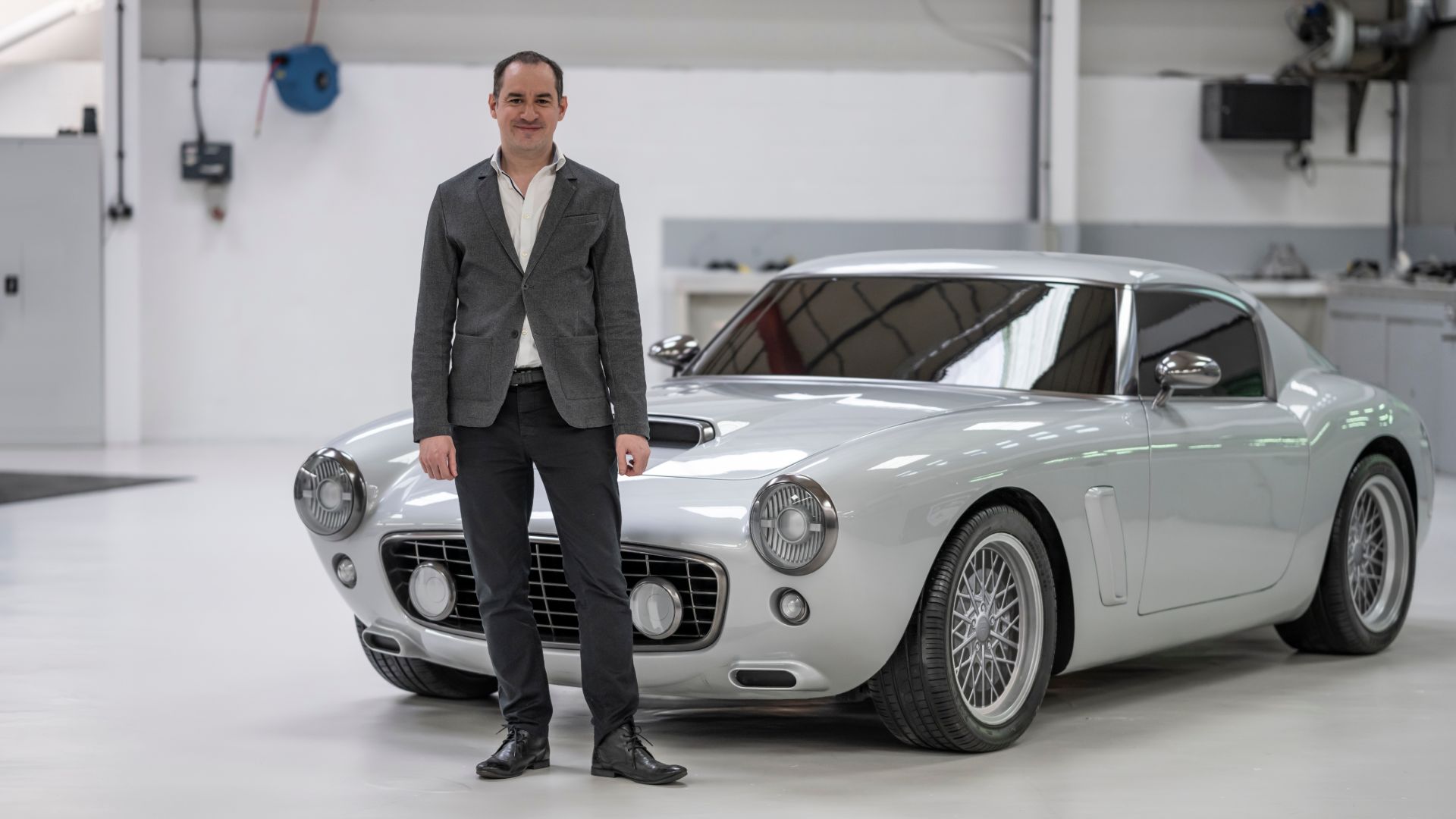
I’m greeted by designer Jonathan Bowen (pictured), who shows me a series of CAD drawings. Some early proposals look a bit bland, others more contrived; the importance of getting the car’s proportions spot-on is evident.

He then uncovers a full-size clay model, which reveals exactly how the production car will look. And… it’s stunning: a faithful recreation of Pininfarina’s masterpiece. In isolation, the Short Wheelbase seems quite large, but Bowen shows me photos of the styling buck ‘parked’ alongside a new BMW 3 Series, which looks similar in size.

Details that catch my eye include the pop-out door handles and LED headlights with vertical ribs that evoke halogen lamps. RML has also repurposed the real SWB’s roof vent into a recess for the high-level brake light.

The dished alloys are 18 inches in diameter, their cross-spokes inspired by classic wire wheels. As for bumpers, they’re optional: quarter units on the front, with a full-width design at the back.

No plastic allowed

RML Short Wheelbase

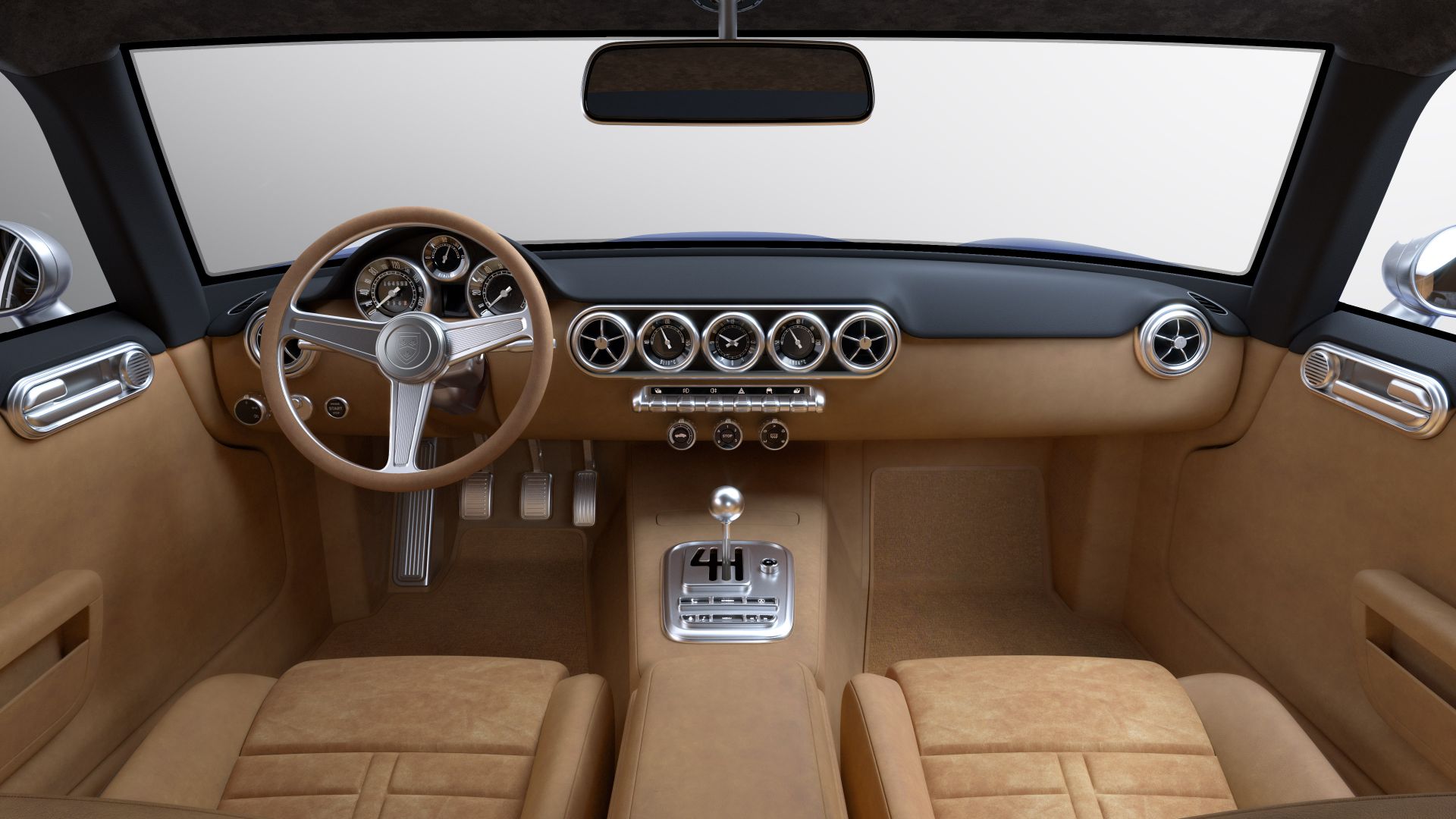
I then sit inside the interior mock-up. The trim is made from clay and wood, but everything is positioned as per the production car. It feels spacious and airy, with an upright windscreen and large rear window promising good visibility.

The slim dashboard houses a compact air-con unit, while the tall transmission tunnel has a pop-up touchscreen for infotainment (including Apple CarPlay and Android Auto connectivity). There are also proper door pockets and even a pair of cupholders – notably absent from the 1959 original.

The dials are conical with etched markings and all the switchgear is specially made. “There are more bespoke components here than on most OEM [car manufacturer] sports cars,” says Bowen. “We could have used an off-the-shelf air vent and saved tens of thousands of pounds, but it would have been plastic. Our touch-points are either leather or machined aluminium.”

Interestingly, the open-gate manual gearbox – so long associated with Ferrari – wasn’t actually a feature of the 250 GT SWB. But would you want your Short Wheelbase any other way?

Testing to 200mph

RML Short Wheelbase

Lastly, I take a look at the chassis for Car Zero. There’s not much of the donor 550 Maranello left, but maintaining the car’s basic structure means it can keep its original identity – important for the US market, which would demand new-car homologation (i.e. emissions and crash tests) if not.

The 485hp naturally aspirated V12 isn’t modified because, frankly, it doesn’t need to be. In a car that weighs around 200kg less than the 550 (target dry weight is 1,485kg), performance should be plentiful. Expect 0-62mph in 4.1 seconds and a top speed “in excess of 185mph”.

“We’ve tested the car up to 200mph in our virtual CFD wind tunnel,” explains Bowen. “The next step is testing it on the road.”

More projects to come

RML Short Wheelbase

Mallock says the Short Wheelbase is a very different proposition to the forthcoming GTO Engineering Squalo – another car revealed this year that, coincidentally, also uses the 250 GT SWB for inspiration. “That will probably offer a more ‘1960s’ driving experience. Our car is more modern and comfortable – and it arrives sooner [the Squalo is due in 2023].”

No more than 30 examples of the Short Wheelbase will be made, so production is very small-scale. But this could be the start of something much bigger.

“This is the first of several projects,” Mallock continues. “We’ll be working with Short Wheelbase customers to determine what the next RML Group car will be. It won’t be Ferrari-based, though. We don’t want to be pigeonholed.”

ALSO READ:

GTO Engineering 250 GT SWB Revival 2021 review

Ferrari 812 GTS 2021 review

Best supercars to buy in 2021

Advertisement

Mercedes-Benz reveals all-electric G-Class concept

0
Mercedes-Benz EQG Concept

Mercedes-Benz has released an all-electric concept version of the legendary G-Class SUV.

Launched as part of the 2021 IAA Mobility event (better known as the Munich motor show), the EQG is said to be nearly production ready.

Although it retains the classic styling of the G-Class, first launched in 1979, the EQG points firmly to the future of Mercedes-Benz.

Keeping a promise to Arnold

Mercedes-Benz EQG Concept

At the launch of the current-generation G-Class in January 2018, then Chairman of the Board of Management of Daimler AG, Dieter Zetsche, made a promise to Arnold Schwarzenegger.

Zetsche told the Hollywood legend, and major G-Class fan, that the off-roader would be included in electrification plans by Mercedes-Benz. 

Since then, Mercedes-Benz has committed to being ready to ‘all electric’ by the end of the decade. 

Creating an electric version of the G-Class delivers on that commitment, and on a promise to the former governor of California.

Classic design electrified

Mercedes-Benz EQG Concept

With more than 400,000 G-Class examples produced to date, recreating a battery-powered version of the original required careful consideration. Although the EQG resembles a regular G-Class, Mercedes has made subtle changes for the electric version. 

With no need for a radiator grille, the EQG features a black panel with multiple illuminations. The three-pointed star logo has a 3D design, with animated blue ‘squircles’ surrounding it on the grille. 

At the rear, an illuminated lockable box replaces the usual spare wheel cover. Mercedes says that the design resembles a wall-mounted charging box, and that it could be used to store charging cables.

A set of 22-inch wheels, and LED lights integrated into the roof rack, complete the EQG’s concept styling.

Still ready to off-road

Mercedes-Benz EQG Concept

Retaining a ladder frame chassis means the EQG is designed with the ability to off-road like any other G-Class. 

Four electric motors will be integrated into the EQG, with the battery pack mounted low in the chassis. The power sent to each wheel can be controlled individually, allowing for extra precision in the dirt. 

A selectable two-speed transmission will also allow extra control when off-roading. 

Mercedes-Benz is yet to confirm for the EQG to enter production, but the concept version suggests a launch date will be in the not too distant future.

Advertisement

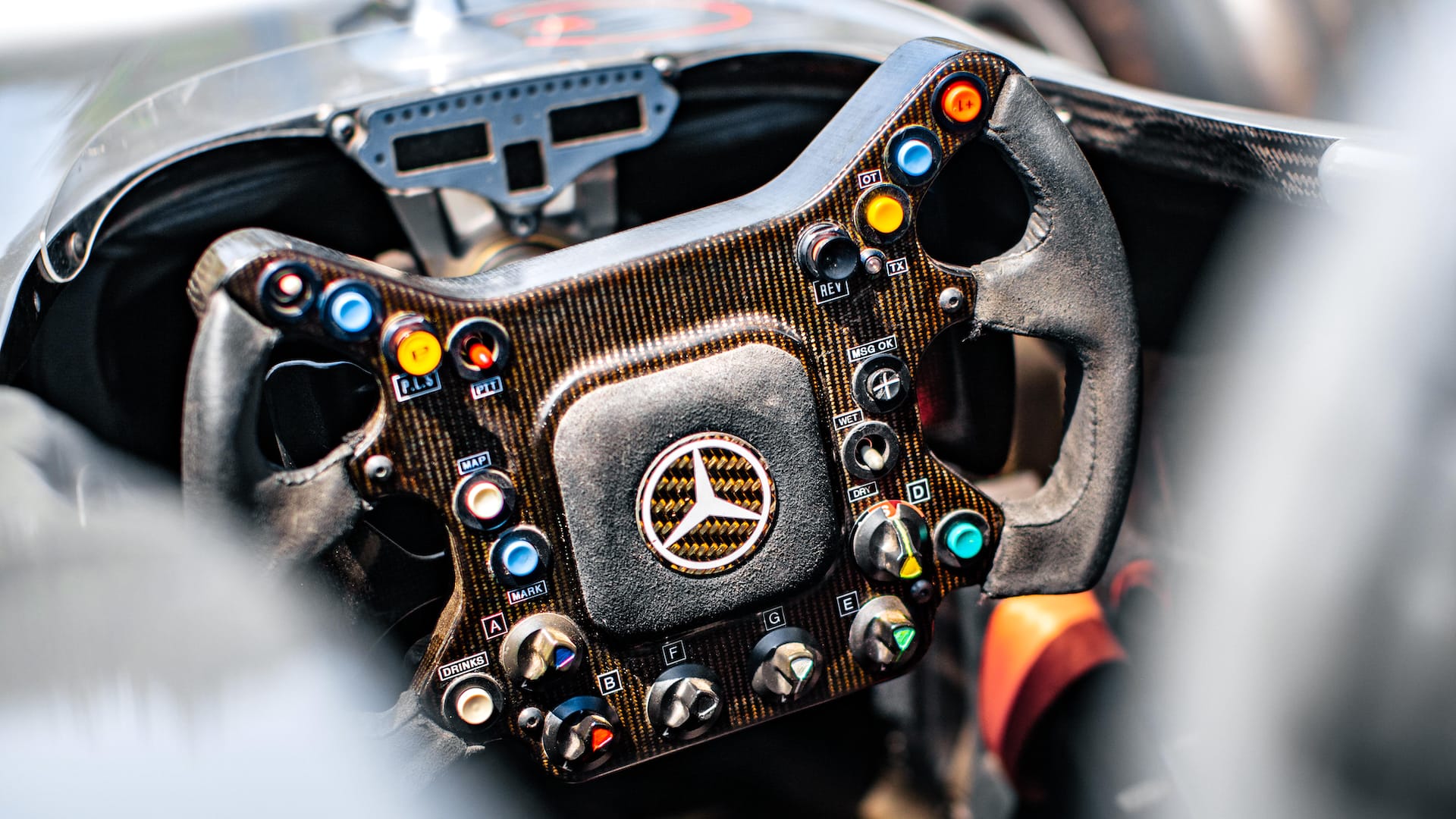
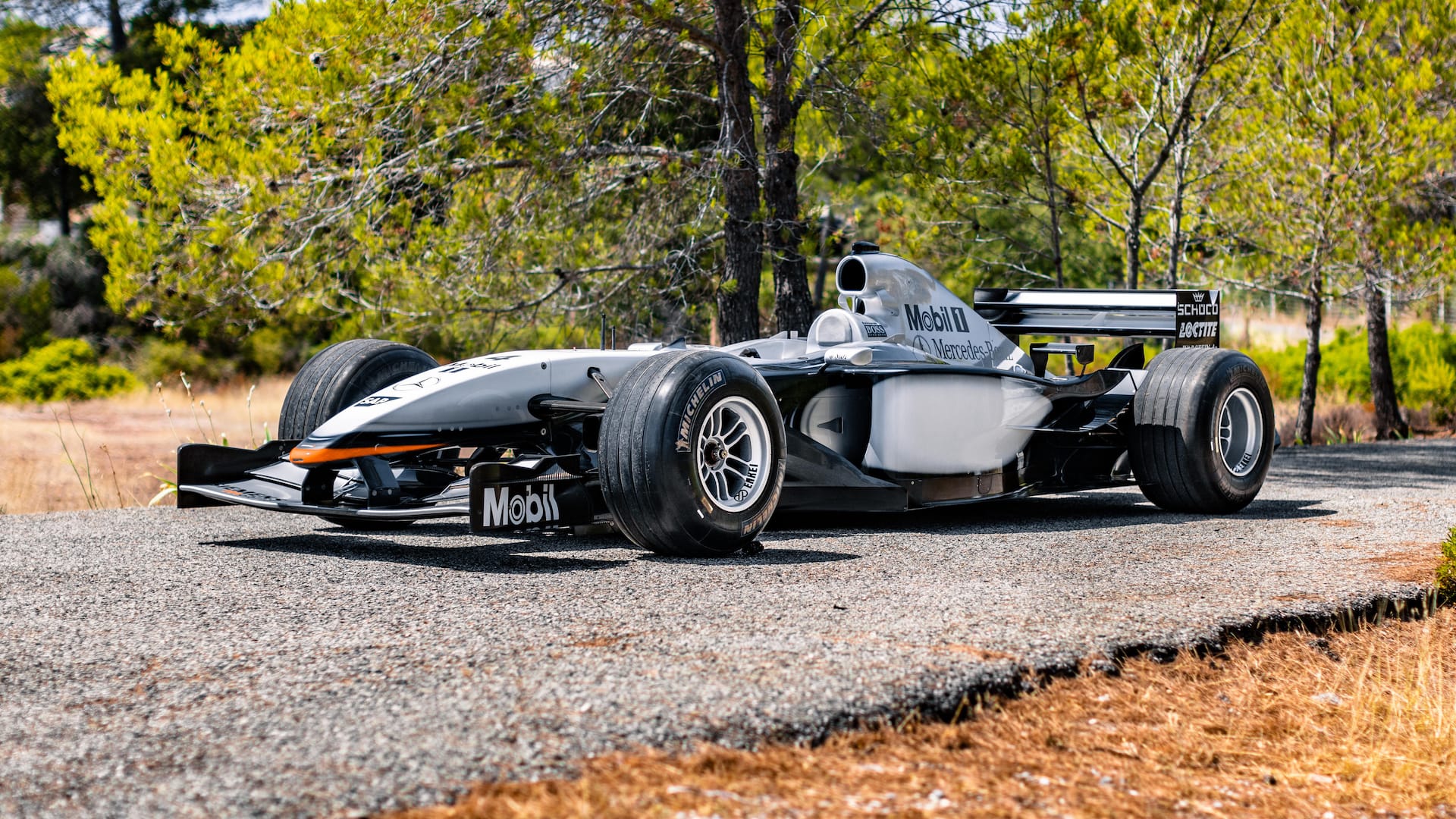
You could buy this ex-Raikkonen McLaren MP4-17 Formula 1 car

0
2002 McLaren MP4 17 Auction

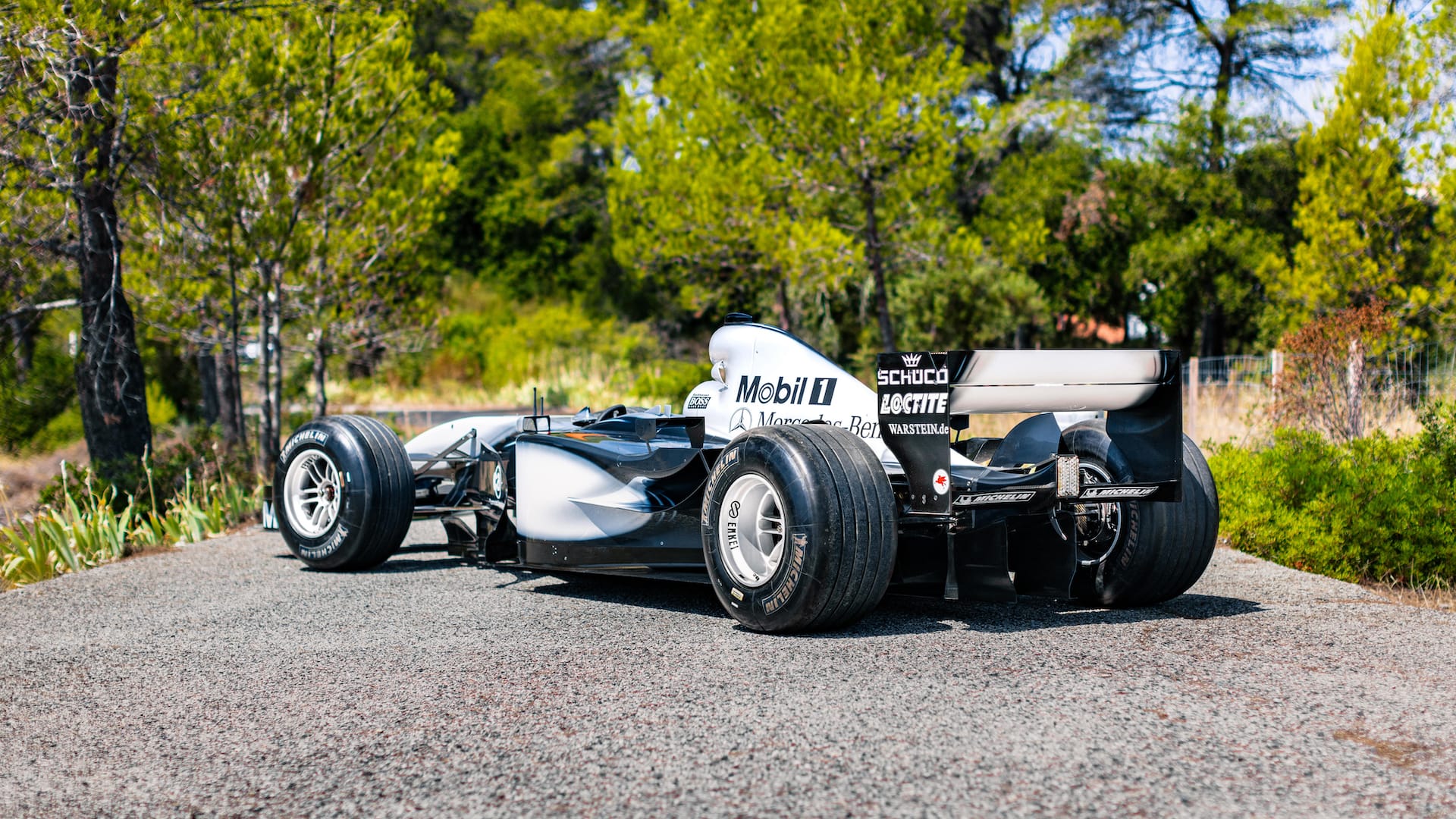
A genuine McLaren Formula 1 race car is ready for auction this month, as part of the RM Sotheby’s St. Moritz 2021 event.

The McLaren-Mercedes MP4-17 was used by Kimi Räikkönen and David Coulthard throughout 2002 and 2003. It scored a race win, and multiple podiums, on track.

With news that Räikkönen is set to retire from F1 at the end of this season, it could be the chance to grab a working memento of the Finnish driver.

Great expectations

2002 McLaren MP4 17 Auction

Following a second-place finish in the 2001 Formula 1 World Championship, McLaren had high hopes for the 2002 season.

Created under the supervision of legendary designer Adrian Newey, the MP4-17 was shaped in McLaren’s new wind tunnel. 

Powering the MP4-17 would be a Ilmor-engineered version of the Mercedes-Benz FO110M V10 engine. The naturally aspirated 3.0-litre unit produced an impressive 845 hp, and was connected to McLaren’s own seven-speed sequential gearbox.

Premium components throughout

2002 McLaren MP4 17 Auction

Other key elements included the double wishbone front and rear suspension, featuring dampers developed with Penske. A combination of Hitco brake discs, and AP Racing calipers, provided the stopping power.

Hailing from an era when Formula 1 was embroiled in a tyre war, the MP4-17 wore Michelin rubber. 

The finishing touch was the West McLaren Mercedes livery, first introduced by the team in 1997. It meant the stage was set for a successful 2002 season.

Swept beneath a red wave

2002 McLaren MP4 17 Auction

Pre-season testing at Barcelona saw the McLaren MP4-17 give the team further hope. David Coulthard managed to set record times with the new car, raising expectations ahead of the season-opening race in Australia. 

The reality of the 2002 F1 season would be less successful, however. A dominant combination of Michael Schumacher and Ferrari swept to victory, with other teams unable to get anywhere close to challenge them.

Highlights for McLaren would come with David Coulthard taking victory at the blue ribbon Monaco Grand Prix. A range of podiums would help the team to third place in the Constructors’ Championship.

A more successful second season

2002 McLaren MP4 17 Auction

The car up for auction raced seven times during the 2002 season. A second place for Kimi Räikkönen at the French Grand Prix would be the best result for chassis MP4-17-06.

Following the abandonment of the radical MP4-18 for the 2003 season, McLaren converted its 2002 car to MP4-17D specification.

These upgrades brought the car more success, taking David Coulthard to victory in the 2003 Australian Grand Prix. It means whoever buys this car will secure a race-winning Formula 1 machine.

Get your Swiss bank account ready

2002 McLaren MP4 17 Auction

Following the car’s final outing at the 2003 Japanese Grand Prix, where it secured second, chassis MP4-17-06 has returned to how it looked in 2002.

Unlike the various show cars and display models that become available, this is an Formula 1 car that enjoyed genuine success on track.

The McLaren MP4 is set to cross the auction block in St. Moritz on 17 September. Buying a piece of history will not be cheap, with a pre-sale estimate of CHF 2,000,000 to 2,500,000 (£1,500,000 to £1,900,000).

ALSO READ

Land Rover Defender V8 Bond Edition revealed

Fuel now costs motorists 20p more than a year ago
Jaguar E-type to be restored after 40 years in hiding

Advertisement

Fuel now costs motorists 20p a litre MORE than a year ago
0
August 2021 Fuel Prices

After nine months of continuous increases, fuel prices remained relatively static during August according to RAC Fuel Watch data.

It marks a welcome respite for drivers, who had endured substantial jumps in the cost of fuelling their car over the past year. 

The average price for unleaded petrol fell marginally during August, dropping by 0.27p per litre to 135.02p. 

Diesel costs fell by even less, with a 0.01p reduction to a still substantial 136.65p per litre.

A summer of ‘staycation’ costs

August 2021 Fuel Prices

Filling the 55-litre tank of a family car with petrol will now cost £74.26, with a diesel-powered car needing a spend of £75.16.

In comparison to the June to August period in 2020, drivers are now paying an average of 20p more per litre of fuel. It only adds to the potential costs paid for a UK staycation holiday.

Northern Ireland and the North East were the UK regions with the cheapest fue last month. London and the South East remained the most expensive places to refuel.

Filling up at a supermarket was also likely to bring the biggest savings on fuel, with petrol at 132.09p per litre and diesel 133.91p per litre.

No immediate price cuts expected

August 2021 Fuel Prices

This week saw the launch of E10 bioethanol petrol across Great Britain, intended to help reduce CO2 emissions. However, the RAC states this should not have an impact on prices, with bioethanol having been included in wholesale fuel costs for some time.

RAC spokesman Rod Dennis commented: “While an end to rising prices is to be welcomed, it remains the case that there’s little immediate sign that pump prices are actually going to come down.

“Key to what happens next is how the oil price changes. In the last few days, we’ve actually seen it increase once again after OPEC+, which represents many of the largest oil producing nations, decided to stick with its current plan to increase output only very slightly in the coming weeks.”

He added: “What isn’t in dispute is just how much more expensive this second ‘staycation’ summer has been for drivers compared to 2020. With so many of us covering long distances this year, the effect of paying around 20p more per litre for petrol and diesel is likely to have been widely felt.”

ALSO READ

New Dacia Jogger: budget seven-seat MPV revealed

1 in 5 drivers used Covid MOT extension

Less than 1 in 2 know how to safely transport their dog

Advertisement

New Dacia Jogger: budget seven-seater revealed in full

0
New 2021 Dacia Jogger

Dacia has revealed details of the Jogger, its brand new seven-seat family car. 

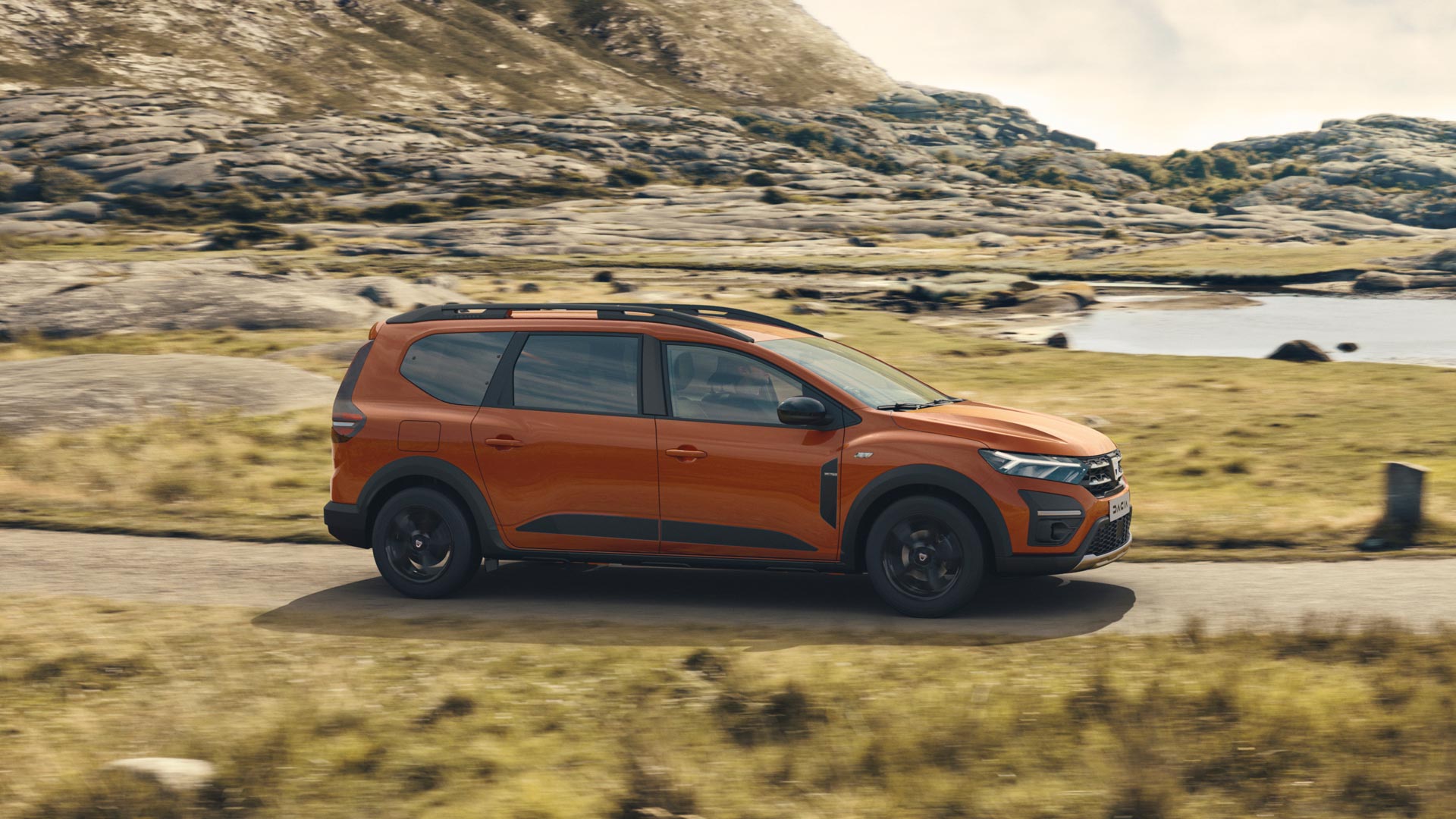
Described as a mix between an estate car, MPV and SUV, the Jogger aims to deliver maximum practicality for a budget price. 

From being the longest Dacia model to date, to being the brand’s first car with a hybrid powertrain, the Jogger breaks plenty of new ground.

Following the online reveal, we have all the details on how Dacia wants to redefine the seven-seat sector.

Ready for the great outdoors

New 2021 Dacia Jogger

Dacia has tried hard to avoid pigeonholing the Jogger as being just an MPV. Instead, the car adds elements from estate cars and SUVs into the mix.

Compared to the seven-seat Lodgy it replaces (not sold in the UK), the 4.5-metre-long Jogger certainly looks more dynamic. LED headlights flank a wide front grille, while the vertical tail lights appear Volvo-influenced. 

A raised ride height creates 200mm of ground clearance, with underbody protection designed for rough roads. Alloy wheels are optional, but the Jogger comes as standard with robust ‘Flex Wheels’ instead.

A launch-ready Extreme model offers more obvious off-road styling cues. Available in five body colours, the Jogger Extreme features contrasting black exterior details.

60 different interior layouts

New 2021 Dacia Jogger

With three rows of seats, the Jogger should be able to accommodate seven adults within its 2.9-metre wheelbase. Longer rear doors allow access to the folding third row, which is said to boast some of the best headroom and legroom in the class.

The five rear seats can all split and fold independently, offering up to 60 different interior layout combinations. Boot space ranges from 213 litres with all seats in use, up to a van-like 1,819 litres with all the seats down. 

Practical goodies include six cup holders and a large, seven-litre glovebox. All seven seats have their own interior light, with sizeable door pockets and cargo hooks also included. 

Patented modular roof rails can carry up to 80kg, and can adapt to take mountain bikes or skis.

Generously simple

New 2021 Dacia Jogger

Up-front, the interior of the Jogger sticks to Dacia’s mantra of simple pragmatism. Forget touchscreen controls for the air conditioning; the Jogger sticks with traditional knobs and dials.

Lower-specification Joggers will offer multimedia functions through a universal smartphone mount. This will allow personal devices to control music, navigation and radio through a bespoke Dacia app.

Higher-specification models gain an 8-inch multimedia touchscreen, which offers Apple CarPlay and Android Auto connectivity. 

All Joggers come with six airbags, including curtain and side airbags, along with a range of driver assistance systems.

Less sprinting, more jogging

New 2021 Dacia Jogger

At launch, the Jogger will come with the choice of petrol or bi-fuel LPG power.  

The new TCe 110 is a turbocharged three-cylinder petrol engine, offering 110hp and 148lb ft of torque. Dacia says it majors on fuel economy, and comes as standard with a six-speed manual gearbox.

Fans of LPG will be able to opt for the TCe 100 Bi-Fuel version. It combines a 40-litre LPG tank, plus a 50-litre petrol tank, to deliver a maximum range of 621 miles.

The Jogger Hybrid will hit the market in 2023, and is likely to become the most affordable seven-seater hybrid on sale. A 1.6-litre petrol engine will be matched with two electric motors and an automatic transmission. 

Dacia believes the Jogger Hybrid will spend up to 80 percent of its time on urban roads in full-electric mode.

Order in November for 2022 delivery

New 2021 Dacia Jogger

Prices for the Jogger are yet to be confirmed. However, given Dacia’s track record, they should be firmly at the affordable end of the market.

UK orders can be placed from November 2021, with the first customer deliveries expected in the first quarter of 2022. 

Following the UK launch of the Dacia brand in 2013, more than 200,000 cars have been sold to-date. The Jogger looks likely to add plenty more to that total.

ALSO READ:

Ford reveals prices for new electric E-Transit van

Hot Wheels wants a new car to immortalise in die-cast form

What you need to know before driving in Europe

Advertisement