For the seventh year running, the London Concours welcomed nearly 100 rare and exotic cars into the heart of the city. Hosted in the enclosed garden of the Honourable Artillery Company, close to Liverpool Street, the three-day event drew in car enthusiasts and curious office workers alike.
For 2023, London Concours marked the 50th anniversary of Porsche’s Rennsport sports cars, with around 50 RS-badged 911s gathered together – from air-cooled rarities to the latest 992 GT3 RS.
Other displays included ‘Grand Tourisme’, a celebration of innovative French cars such as the Citroen SM and Renault 5 Turbo, and ‘Golden Age Coupes’, epitomised by the Mercedes-Benz 300SL and Aston Martin DB5 Vantage.
A question of Rennsport
The highlight for us, though, was the celebration of all things Porsche and RS. The story began with the iconic 911 Carrera 2.7 RS of 1973, which introduced the concept of a lighter, faster and more focused 911 road car – along with the oft-imitated ‘ducktail’ rear spoiler.
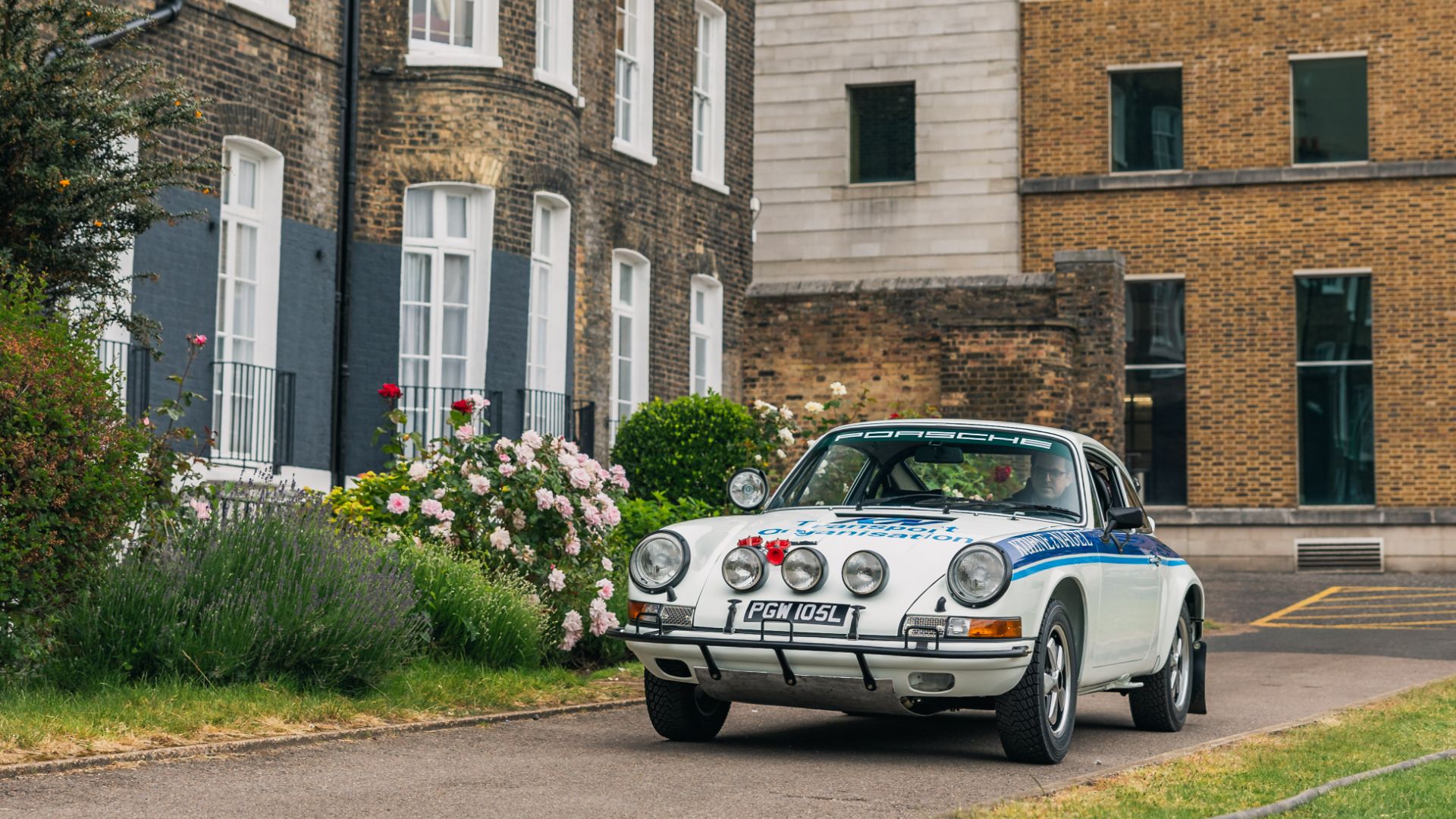
Among several examples of the 2.7 RS at London Concours was a rally car restored by Tuthill Porsche (pictured above). Not seen in public for more than 40 years, it boasted a host of period accessories, from mudflaps to an analogue Halda ‘rally computer’.
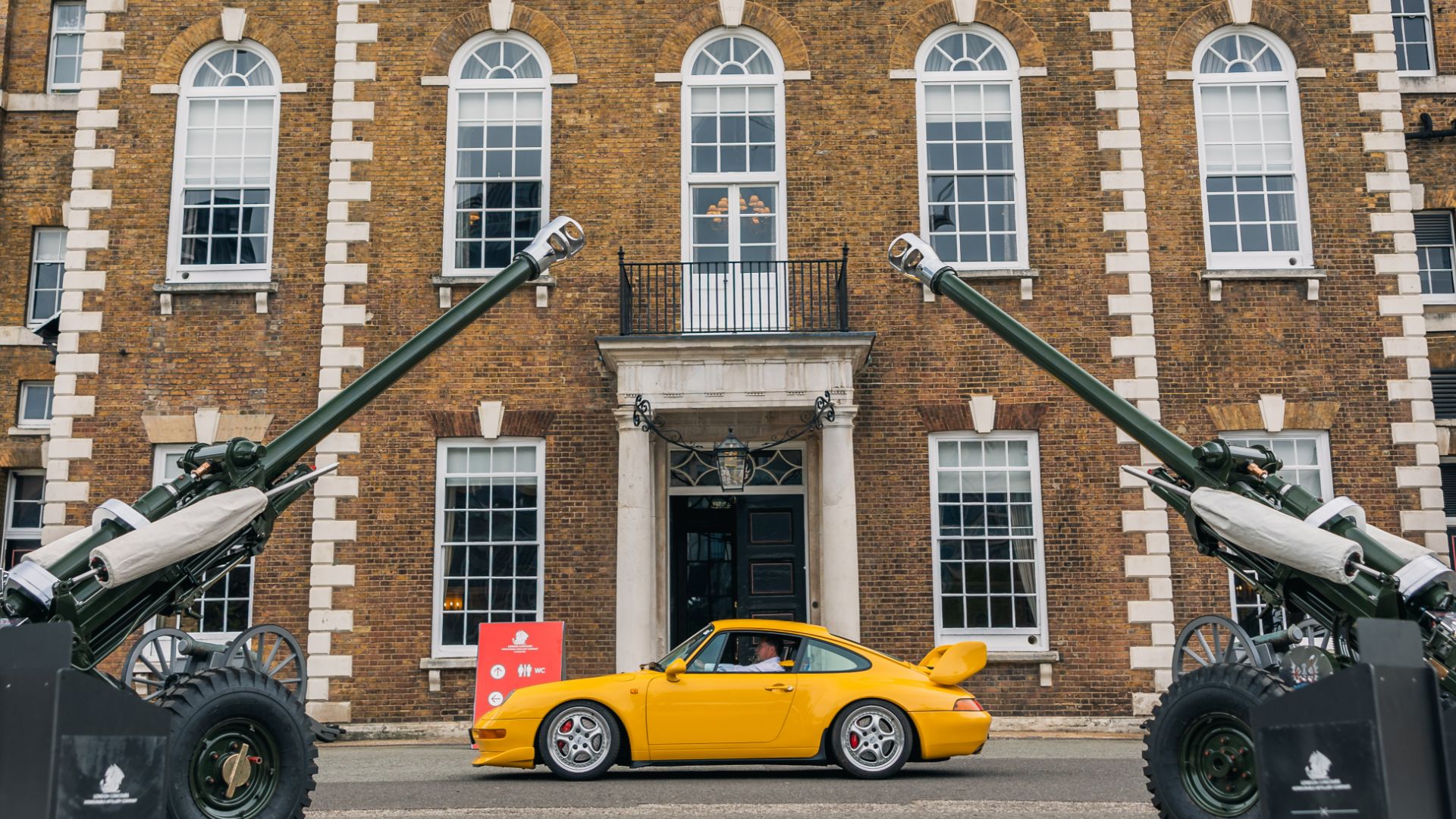
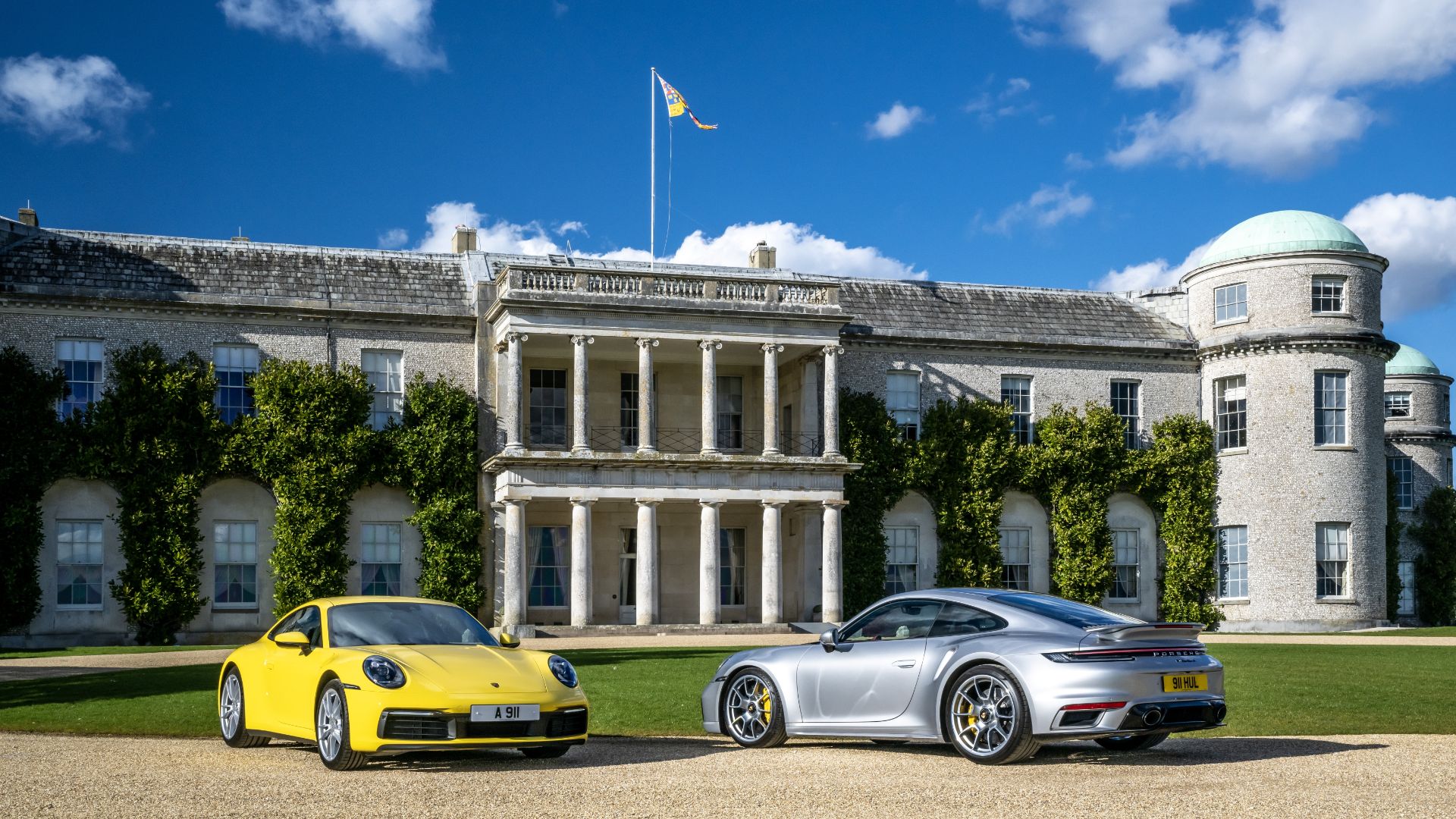
Other standouts included a stunning 993 Carrera RS in Speed Yellow (seen at the top of this page), plus a sizeable number of post-2003 water-cooled cars, with increasingly elevated rear wings and monstrous power outputs.
There was even a plucky Cayman GT4 RS amidst the many 911s, representing one of the newest cars with a dash of ‘Made in Flacht’ magic.
From Le Mans to London
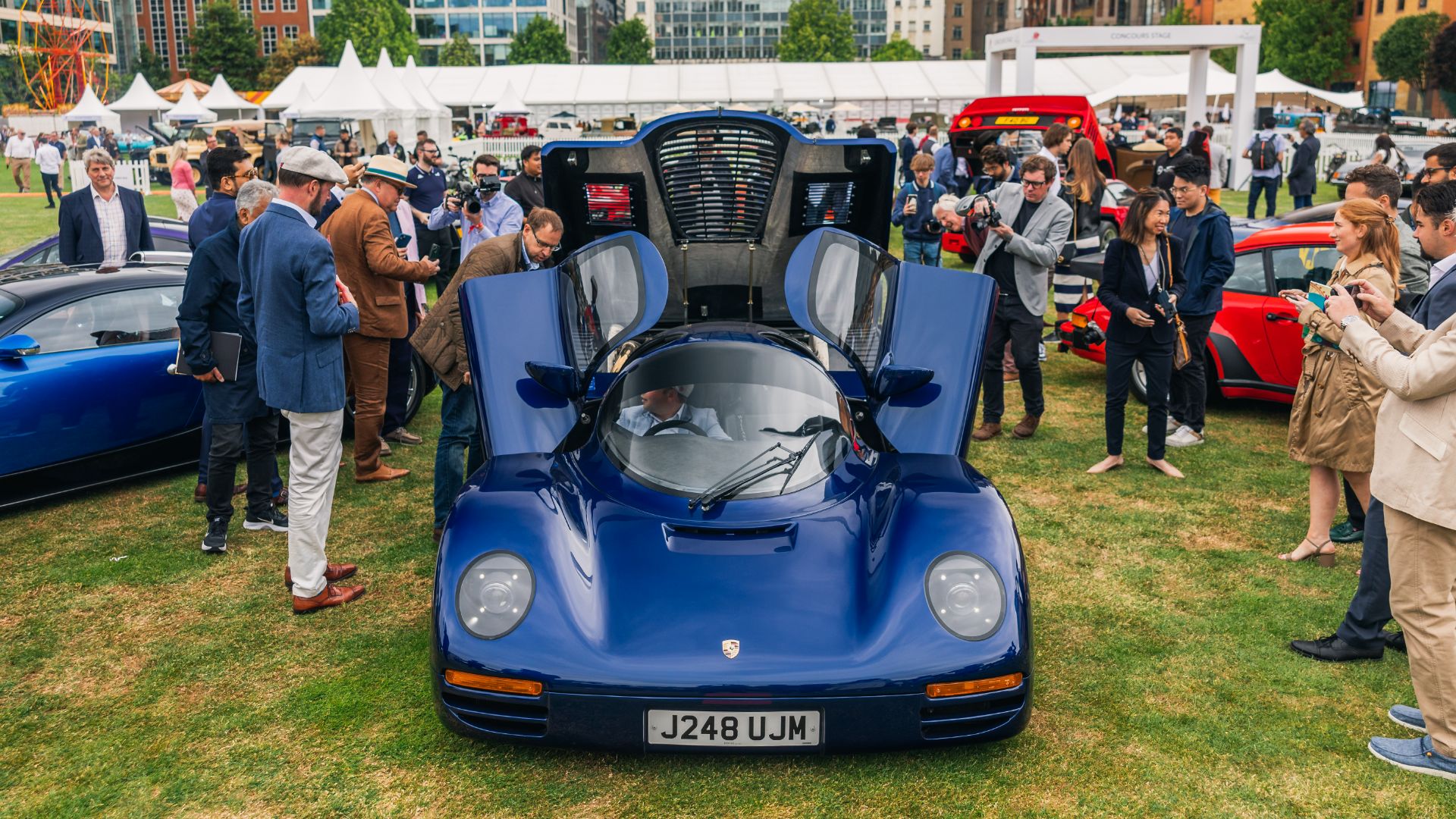
The Best in Show winner at London Concours also wore a Porsche badge, although it was built in High Wycombe, rather than Stuttgart. The Schuppan 962CR P1 (pictured above) is essentially a road-legal version of the hugely successful Porsche 956/962, which dominated Le Mans in the mid-1980s.
A mid-mounted 608hp 3.3-litre turbocharged flat-six and five-speed manual gearbox gave the Schuppan a top speed of 230mph – insane performance for 1992. It also looked every millimetre the Group C racer, with a carbon fibre monocoque chassis and canopy-style cockpit.
Porsche Carrera GT was converted to GTZ spec by Zagato in 2019.
It retains the stock 612hp NA V10, but bespoke panels make it slightly lighter than OEM spec. pic.twitter.com/fpk924Tvoz
Sadly, only six examples of the 962CR were made before Schuppan was declared bankrupt in 1994. However, Porsche would introduce its own motorsport-influenced hypercar a decade later: the V10-engined Carrera GT.
Sure enough, there was one present at the Honourable Artillery Company, complete with bespoke bodywork by Italian coachbuilder, Zagato. It was perhaps the Porsche we most wanted to drive home, albeit preferably not through London traffic…
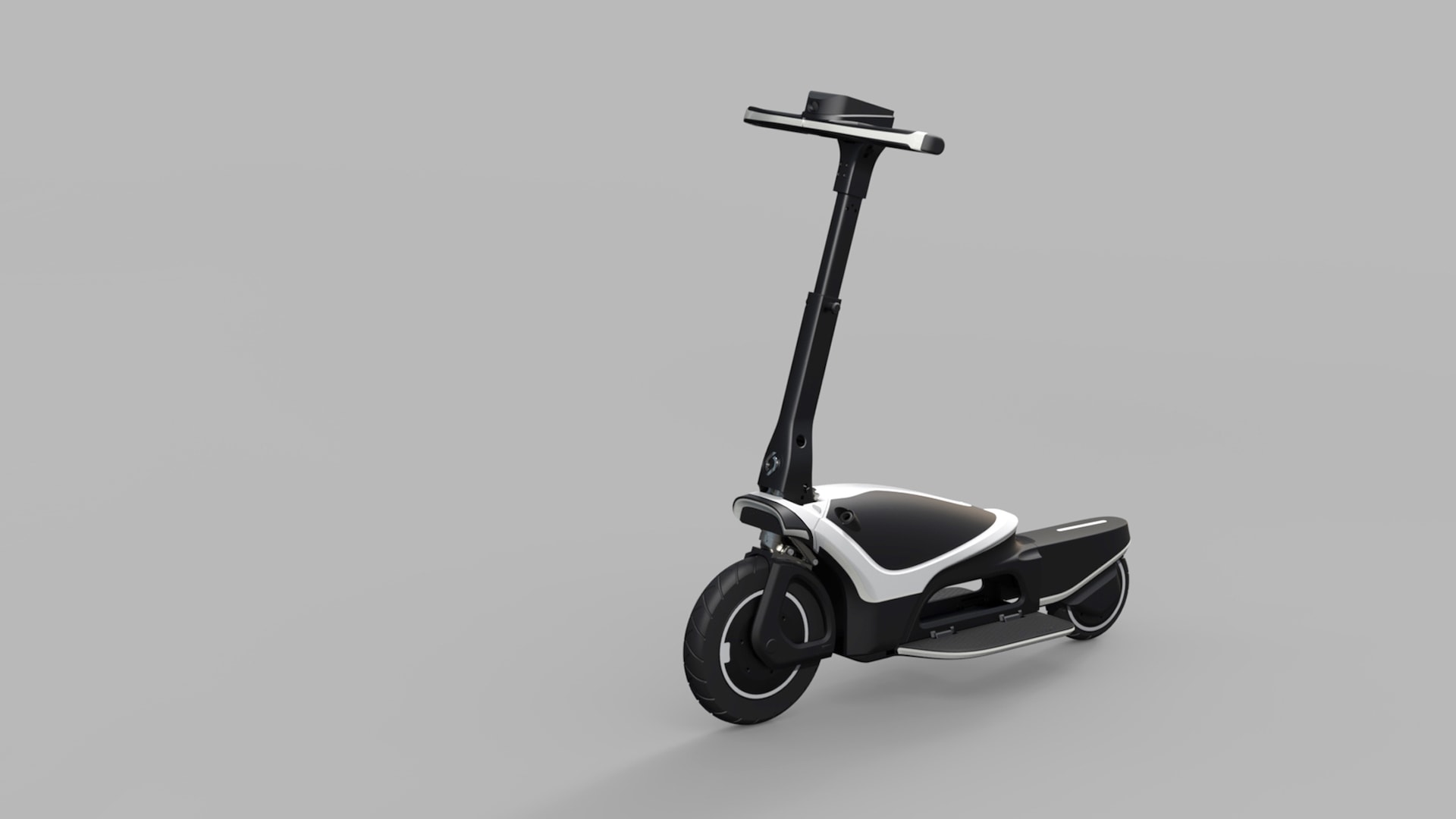
Lotus Engineering has been involved in designing the scooter, while Hilo itself was co-founded by the former CEO of Aston Martin, Dr. Andy Palmer.
Safer handling as standard
Dr. Palmer commented: “E-scooters have faced challenges with safety and public perception. The Hilo One is an e-scooter that addresses these concerns head-on. I believe in the potential of e-scooters to revolutionise urban transportation. I also understand the importance of safety, comfort and rider experience.”
The Hilo One comes fitted with a large 12.5-inch front wheel, chosen to help clear potholes and remove the twitchy handling of some e-scooters. Extensive user trials helped determine the most confidence-inspiring steering geometry.
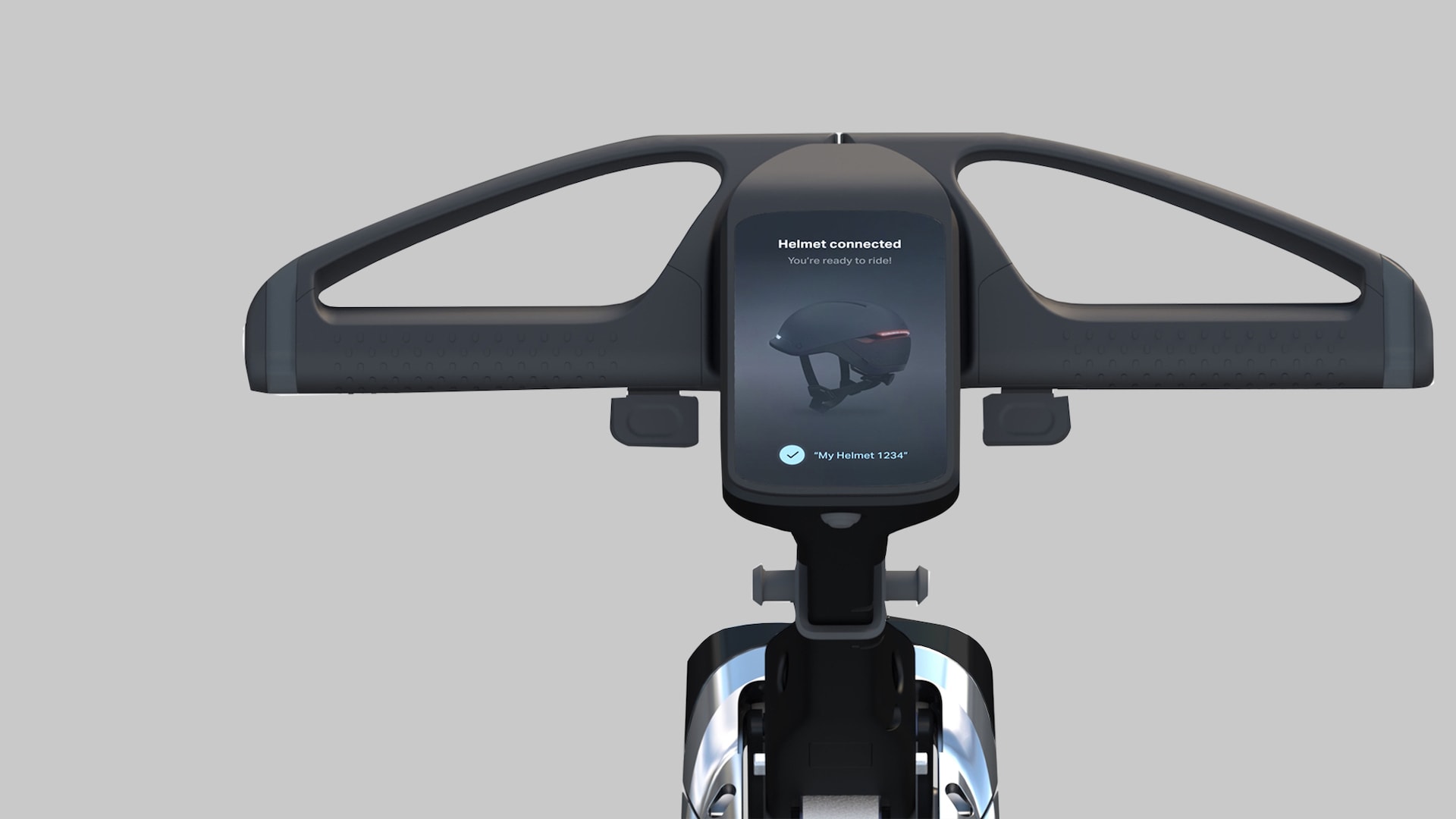
Central to rider safety is the Hilo One’s illumination system, which is controlled by artificial intelligence (AI). This alerts the rider to potential dangers, using visual and audible warnings, plus haptic feedback through the handlebars.
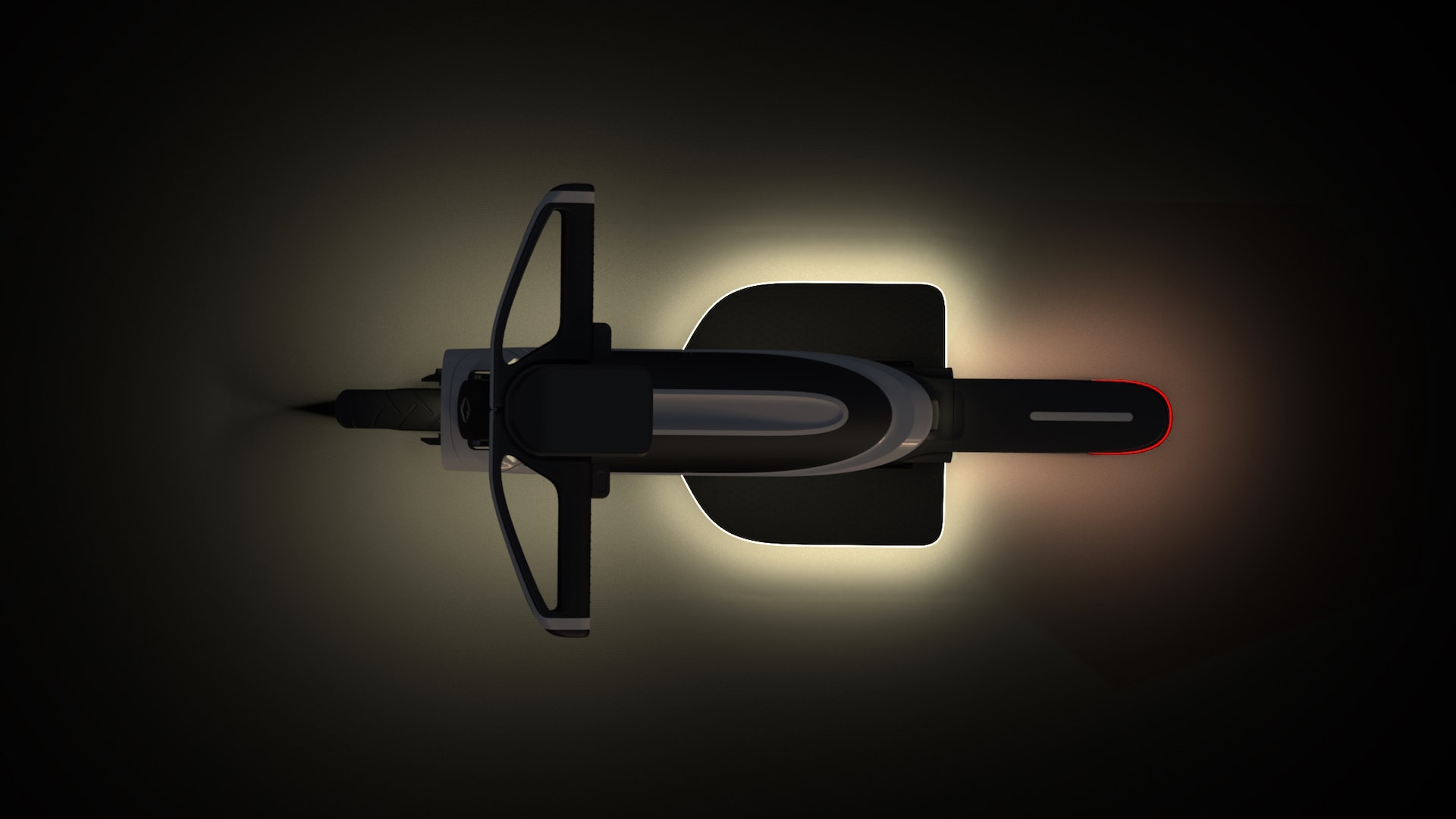
Perimeter illumination helps ensure the Hilo One can be seen at night, with a pool of light making the scooter appear larger to other road users, such as car drivers.
In-car compatibility included
Equipped with 350w electric motors, the Hilo One can reach a top speed of 15.5mph. Fully charged, the e-scooter has a range of up to 25 miles.
Charging can be done at home, or through a dedicated in-car charger. Android Auto compatibility allows navigation and range information to be shared between the car and the Hilo One.
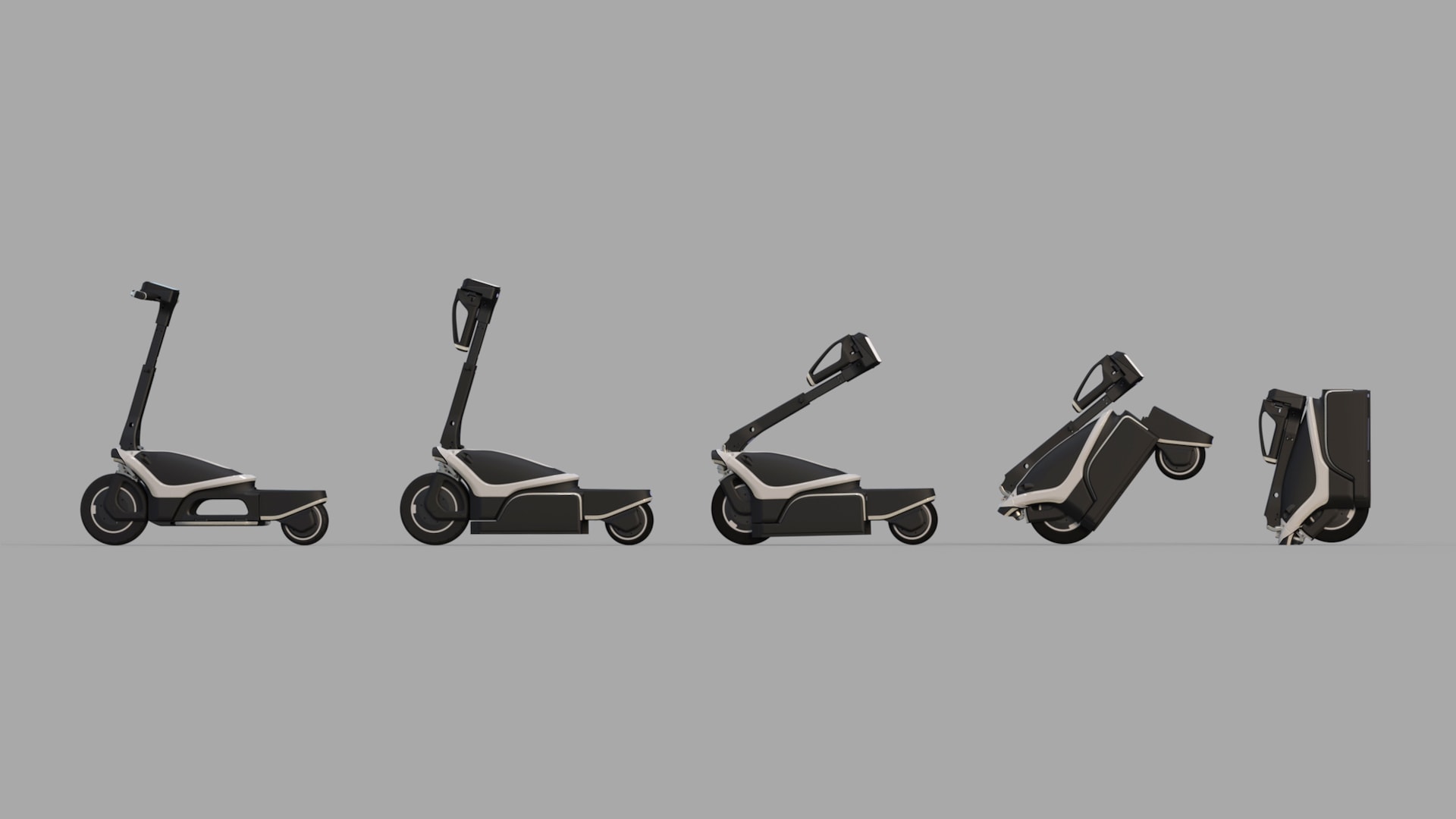
Lotus Engineering has contributed to the overall design of the Hilo One, including the patent-pending folding system.
This sees dirty wheels enclosed within the body of the e-scooter, and allows the Hilo One to be carried or wheeled using the telescopic handle.
‘Redefining micromobility‘
Robin Harris, CEO of Hilo, added: “Hilo was founded to tackle the challenges faced by micromobility and e-scooters, such as safety, lack of innovation and, quite frankly, not necessarily all, but most e-scooters looking the same.
“We have a progressive vision to redefine safety micromobility, creating class-defining products that leverage the latest AI road-scanning technology and perimeter safety lighting. Hilo’s ambitious goal to create an e-scooter that stands out, without compromising safety and the ride experience, was appealing in a sector still in its infancy and is likely to see an exponential increase in innovation.”
Prices for the Hilo One are expected to start from £1,750, with interested customers able to pre-order now. First deliveries are due in the third quarter of 2024.
If you own a modern diesel car, you will probably have heard about diesel particulate filters. But what are these components – and why can they be a problem?
A diesel particulate filter (DPF) is designed to capture and store exhaust soot, reducing emissions from a diesel car. It prevents harmful particulate matter from being released into the atmosphere.
A DPF has been a requirement of all new diesels since 2009 when the ‘Euro 5’ emissions standard came into force. However, particulate filters date back to 1985, when Mercedes-Benz became the first car manufacturer to introduce them on the 300D (sold in California).
In 2000, Peugeot re-introduced the principle when it used a cerium-based fuel additive for regeneration on the 607 2.2 HDi.
Today, there are two main types of DPF: passive regeneration and active regeneration.
Passive regeneration
Passive regeneration uses normal exhaust temperatures and nitrogen oxide (NO2) as the catalyst to oxidise particulate matter in the DPF. This tends to occur at high speeds, typically on a motorway or A-road, with the engine running for 30 minutes or more.
The main advantages of passive regeneration are that it requires no input from the driver, the process takes place automatically and there are fewer components.
However, it relies on the driver making regular trips on faster-flowing roads – without this, problems can occur. It’s for this reason that manufacturers introduced so-called active regeneration.
Active regeneration
Active regeneration uses the car’s ECU to sense when the filter is getting clogged with soot and injects extra fuel into the engine to raise the temperature of the exhaust, triggering regeneration.
This tends to occur around every 250 to 300 miles and will take up to 10 minutes to complete. In theory, this shouldn’t cause any issues, but problems will occur if the system is unable to complete the regeneration.
If the process is interrupted too many times, the DPF warning light will illuminate and you’re advised to take the car to a motorway, dual carriageway or A-road for 15 minutes of steady driving. If you continue to ignore the warning light, the car will go into ‘limp home’ mode.
There is a third form of DPF, which uses a fuel additive to lower the ignition temperature of the soot particles to enable regeneration at a lower temperature. The additive is stored in a separate tank or ‘bladder’ and should be replaced every 70,000 to 100,000 miles.
Make sure the tank is refilled when a warning light appears on the dashboard because, without the fluid, the DPF will become blocked.
Oil dilution
A significant disadvantage associated with active regeneration is the dilution of the engine oil caused by a small amount of diesel during the post-injection cycles, where fuel is injected into the cylinder after the regular combustion. A thin layer of fuel can build up on the cylinder walls, which leads to premature engine wear, and drivers are warned to consider shorter oil service intervals.
There have been various studies into the engine oil dilution issue and the scale of the problem varies according to the make and model of the diesel car in question. Evidence suggests that the problem is worsened when the regeneration process is halted prematurely, or when a car is only used for short trips.
Modern systems should alert the driver via a dashboard message when the oil dilution reaches a certain level, but regular servicing remains critical to the long-term health of the engine. There have been some high-profile issues concerning some major car brands.
The problems of a blocked DPF
If regeneration doesn’t take place, the DPF will need to be cleaned or replaced, landing you with a bill upwards of £1,000. A quick trawl of some forums and discussion threads suggests you could be charged up to £5,000, which might be more than the car is worth.
That means it’s vitally important to look after your DPF and to pay close attention if you’re buying a high-mileage diesel car. A well-maintained DPF should have a life of 100,000 miles. But it could be significantly less if the car has been used for shorter trips and regular regeneration hasn’t taken place.
How to avoid a blocked DPF
To avoid a blocked DPF, you can start by not buying an inappropriate car. Typically, if you drive less than 12,000 miles a year, a petrol, hybrid or electric car would be more suitable for your needs.
Diesel cars tend to be more economical on longer trips, making them unsuitable for short trips and urban driving.
If you’re driving a diesel car with a DPF fitted, read the manual to understand whether your vehicle uses passive or active regeneration, and make sure you know how to look after the filter. Using the right engine oil is very important.
The RAC says performance modifications can damage a DPF, as can the use of low-quality fuel. Even running the car low on diesel can cause problems, as the car may avoid regeneration to save fuel.
Can you remove a DPF?
It is an offence to use a vehicle modified in a way that no longer complies with the emissions standards it was designed to meet. The removal of a DPF could thus land you with a £1,000 fine for a car or £2,500 for a light goods vehicle.
Further issues include an immediate MOT fail if the DPF has been removed, along with invalid insurance as the car has been modified from original specification.
Obviously, you need to be on your guard if you’re buying a high-mileage diesel car. Check the latest MOT details – the information is stored online – and check the DPF is present.
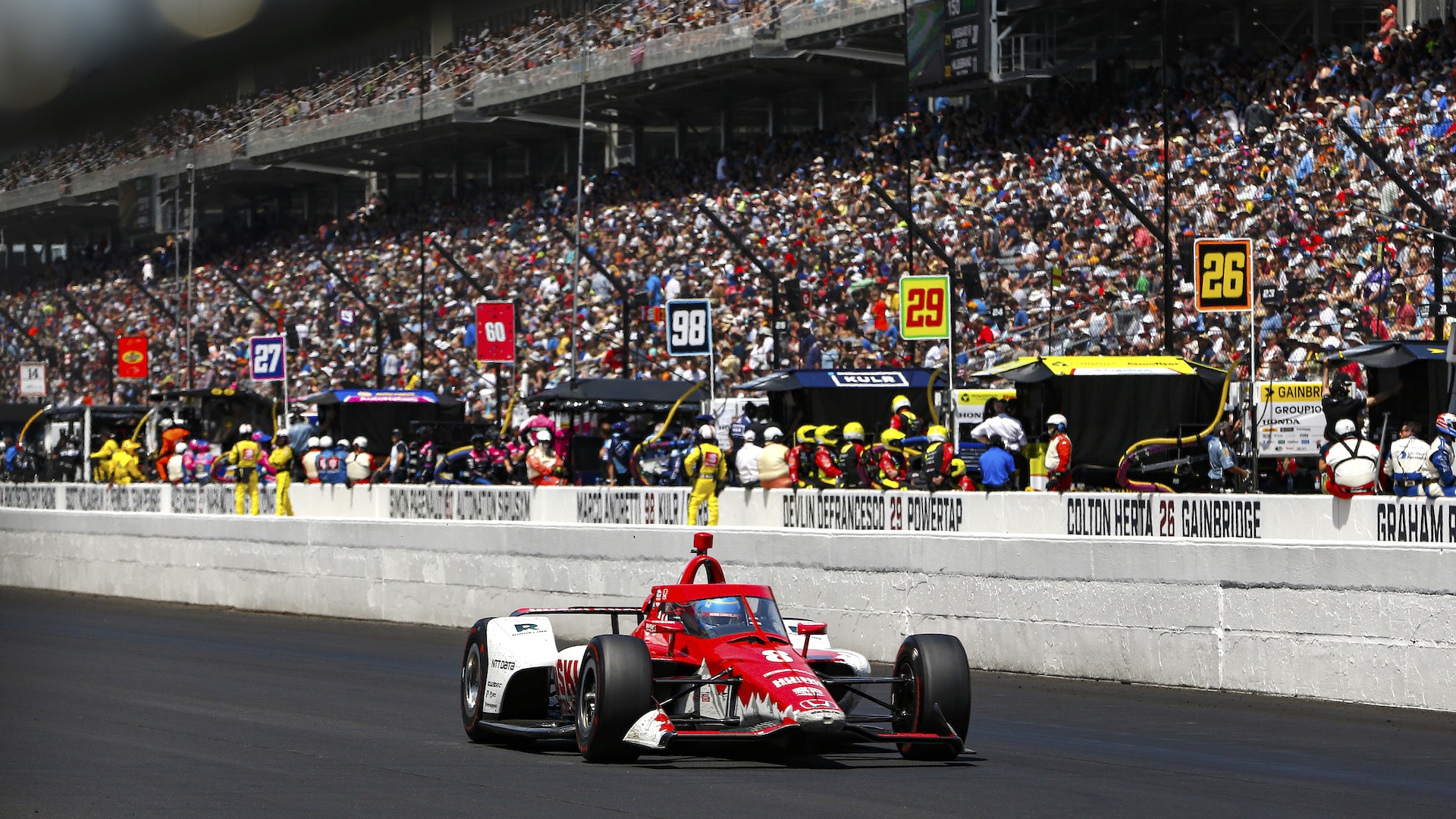
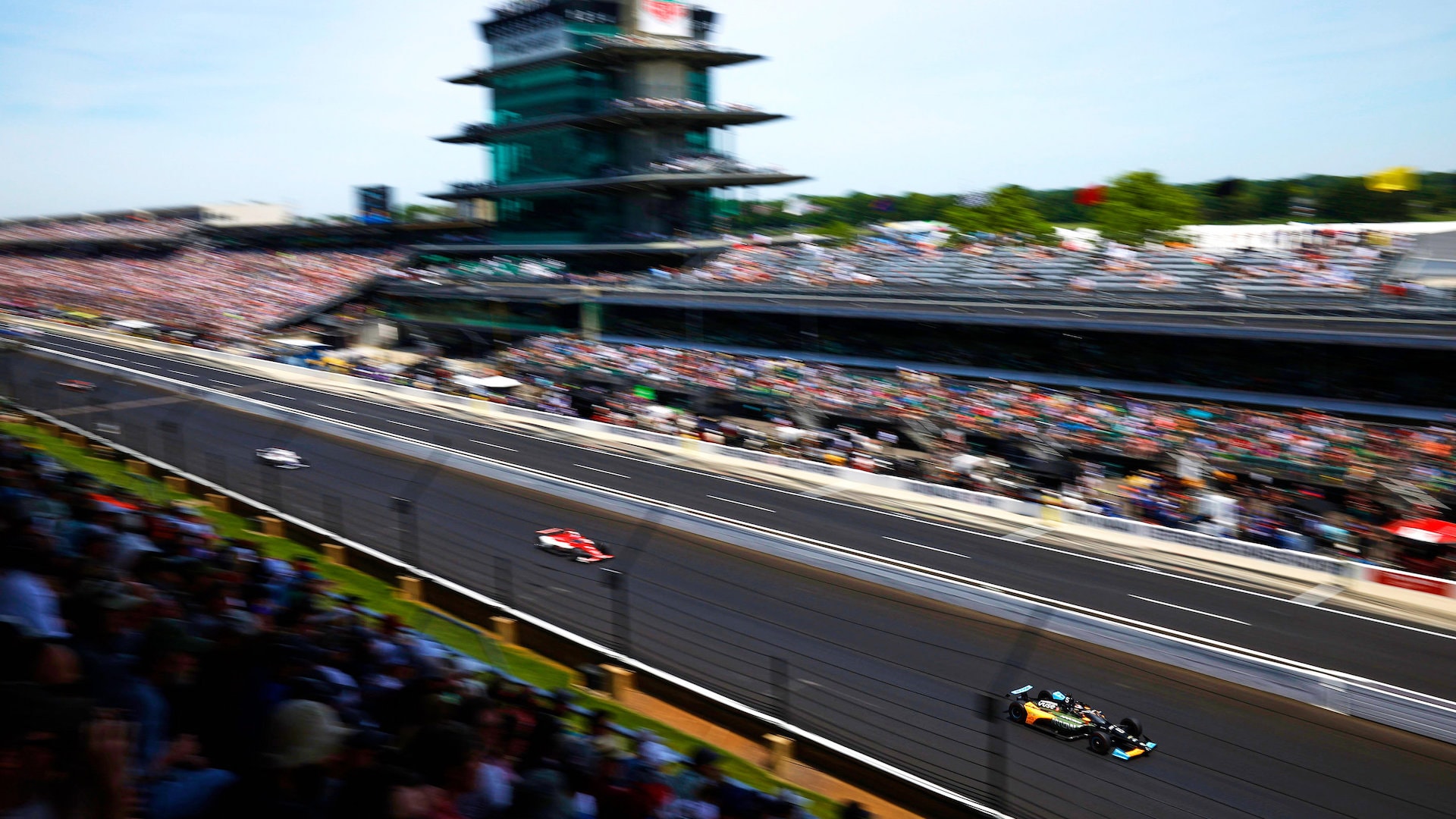
Billed by American enthusiasts as ‘the greatest spectacle in racing’, the 107th Indianapolis 500 takes place this weekend.
The race will see 33 IndyCar drivers fight it out over 500 miles for one of the top prizes in motorsport. Expect plenty of high-speed action, close competition, and even a celebratory bottle of milk.
Our full guide contains all the key information you need to watch the Indy 500 – and enjoy a big slice of American racing here in the UK.
How can I watch the 2023 Indy 500 in the UK?
Sky Sports has the sole UK broadcast rights to the 2023 Indianapolis 500.
Sky Sports subscribers will be able to watch live via the Sky Sports F1 channel, following the conclusion of the Monaco Grand Prix. All the important build-up to the Indy 500 will air on the Sky Sports Arena channel.
General Sky subscribers can use the SkyGo app on their smartphone or mobile device to watch. Non-subscribers can purchase a Now TV Sky Sports day pass to watch the race. This can be used with a smart TV or compatible mobile device.
Is there a live stream for the 2023 Indy 500?
Sadly there is no official internet livestream for those wanting to watch the Indy 500 in the UK.
Viewers in the United States can watch online through the NBC Sports App, or via the NBC Sports website. NBC’s Peacock service will also cover the race in the USA.
What time does the 2023 Indy 500 start in the UK?
The Indy 500 starts relatively early in the United States, with race day traditions beginning at 9am local time on Sunday in Indianapolis. Cars will start appearing on the grid at around 10:30am – equivalent to 3:30pm British Summer Time (BST).
Sky’s coverage of the build-up to the Indy 500 will begin on Sky Sports Arena at 3:30pm BST, with Sky Sports F1 airing the race from 5:30pm BST.
After all the elaborate processions and ceremonies have taken place, the racing should finally begin at 12.45pm local time, or 5.45pm BST.
How many fans will be at the 2023 Indy 500?
Coronavirus meant that the 2020 Indy 500 took place without any fans present in the gigantic grandstands. And in 2021, the race was limited to 135,000 spectators.
Although this may sound like a large crowd, it meant the Indianapolis Motor Speedway was only operating at 40 percent capacity.
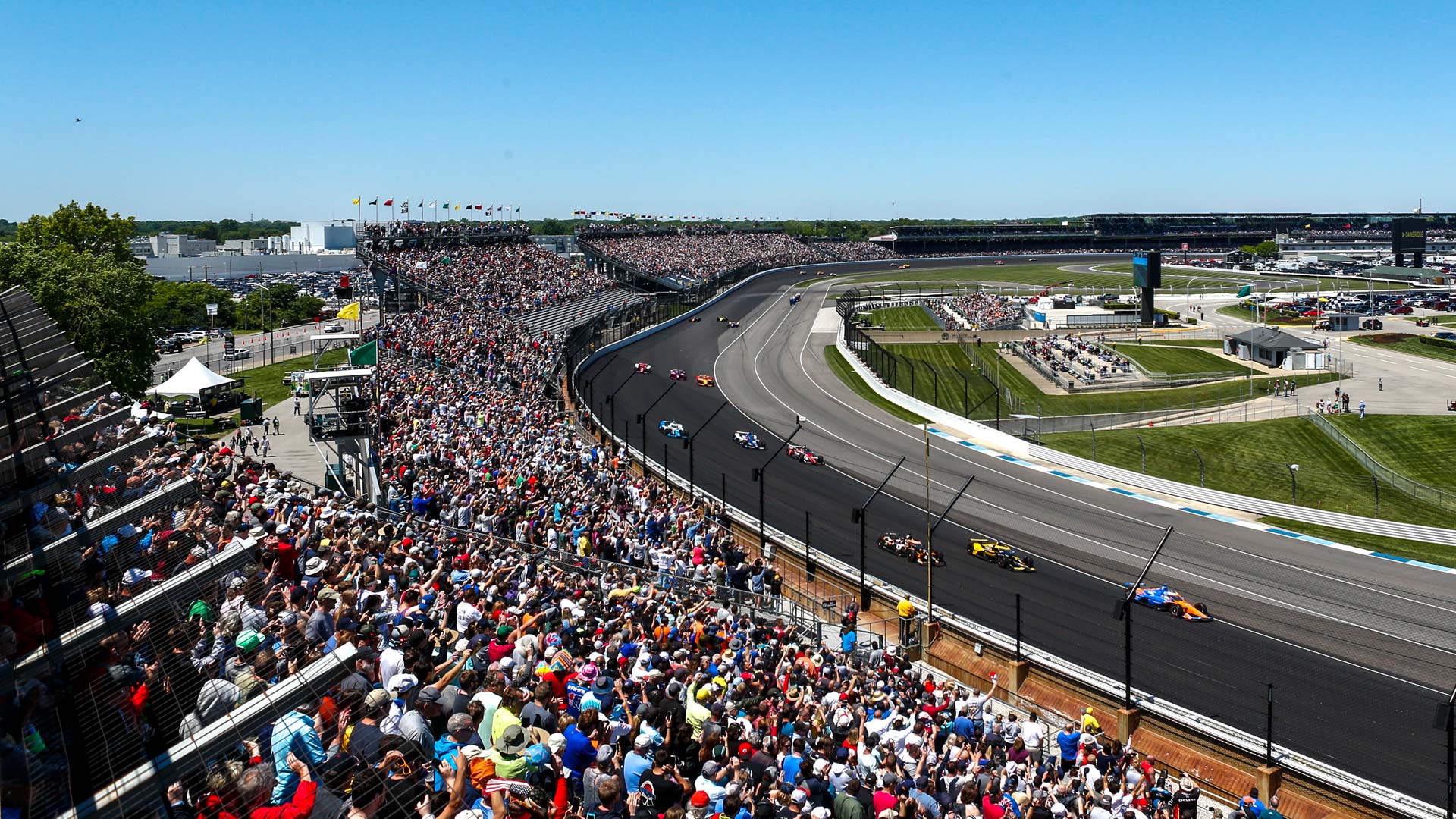
Last year, the crowd returned to full size – and for 2023 this should deliver an expected attendance of 300,000 spectators.
Who is on pole position for the 2023 Indy 500?
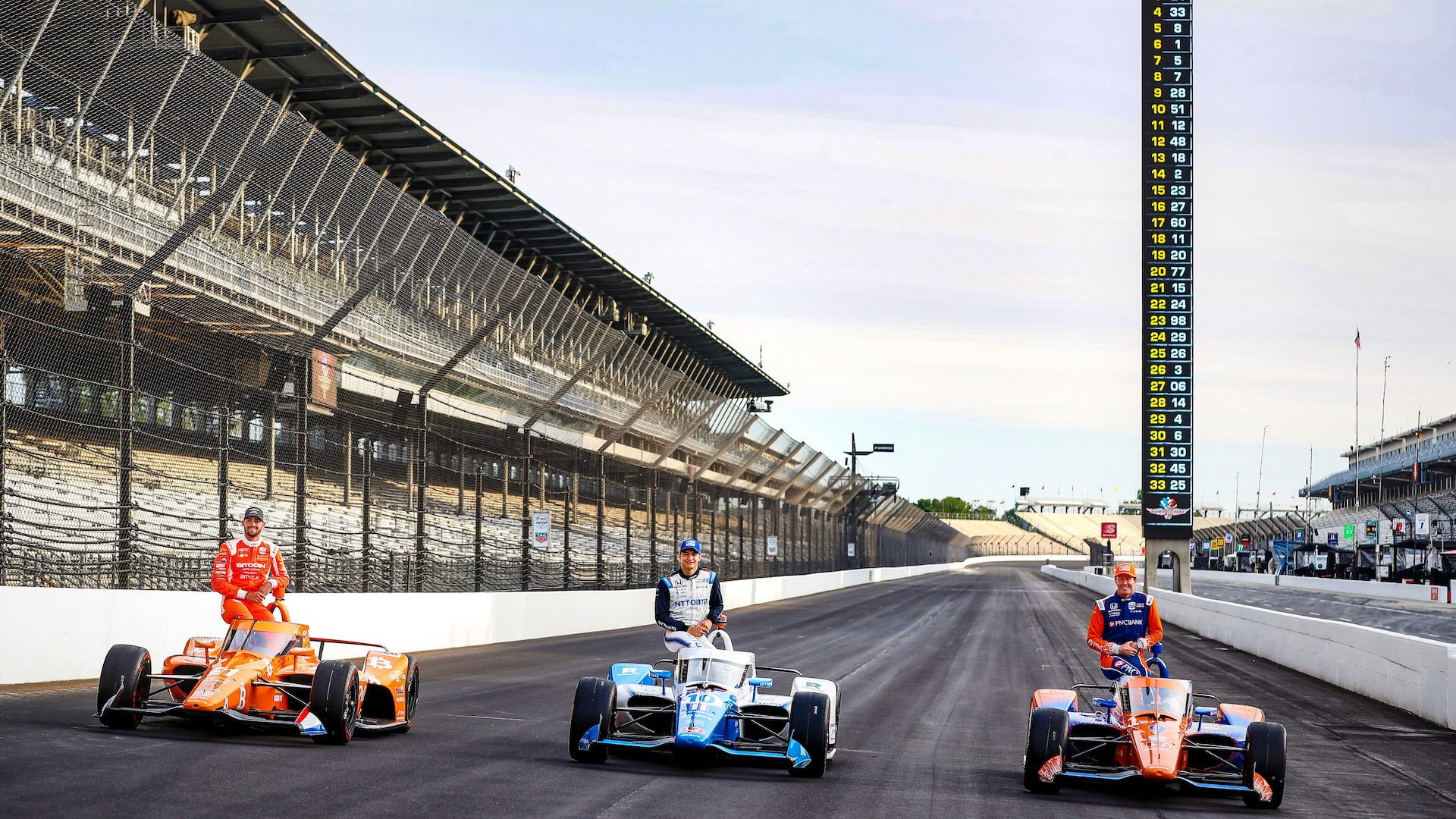
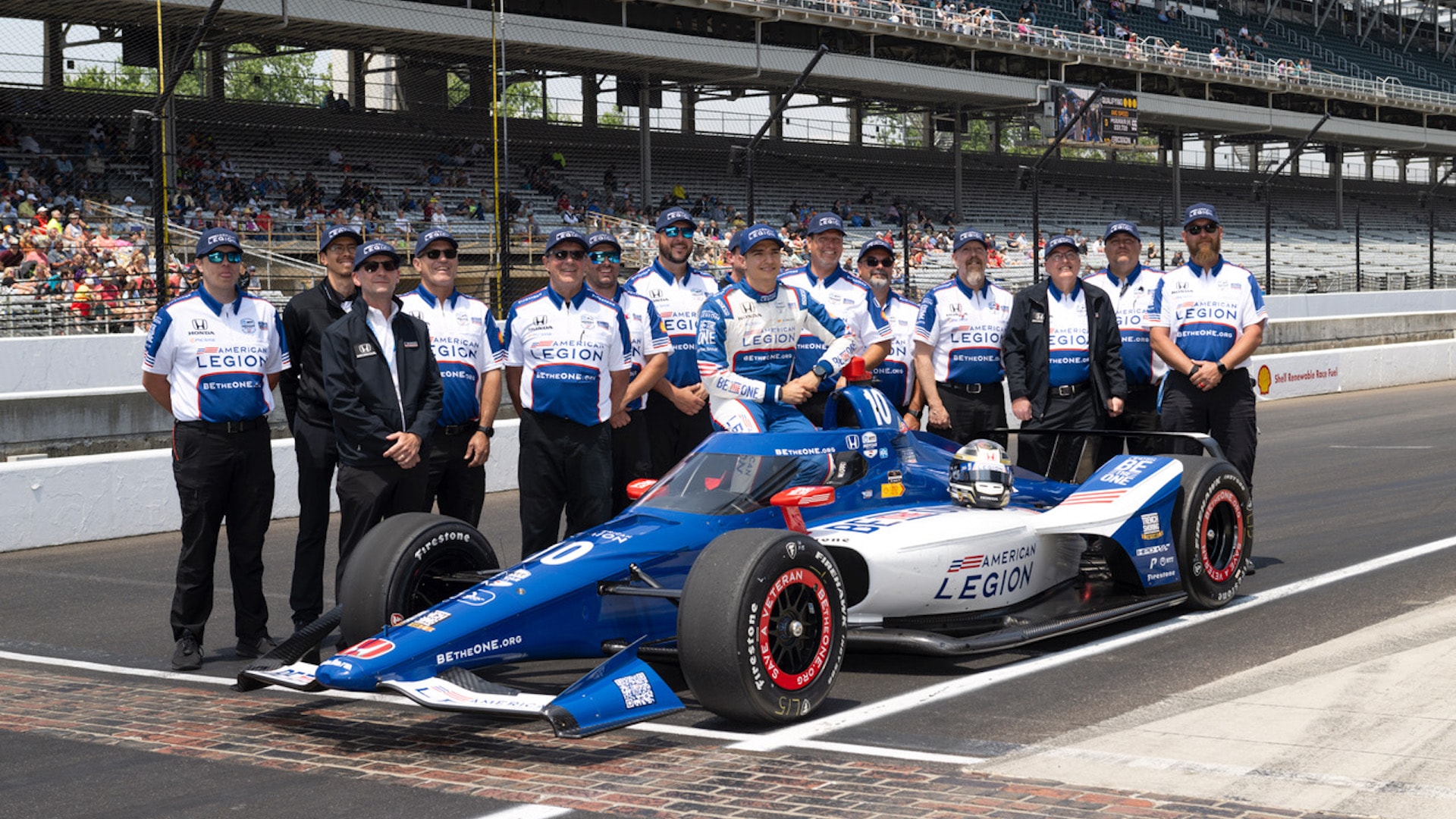
Everything is bigger at the Indy 500, including a qualifying process that takes place over two days. From the full field of 34 drivers, only 33 are able to start the race. This meant Graham Rahal was the unfortunate driver ‘bumped’ from the grid for 2023, before his unexpected return.
Drivers get four laps in each qualifying run, with an average speed then calculated. The fastest 12 drivers get to run again, fighting it out for a place in the final six, and the chance to claim pole position.
For 2023, Spain’s Alex Palou, the 2021 IndyCar champion, has emerged in pole position. This comes after he won the 2023 Indianapolis GMR Grand Prix earlier in the month.
Palou’s average qualifying speed of 234.217mph saw him claim the second-fastest Indy 500 qualifying time in history.
Which pace car is being used for the 2023 Indy 500?
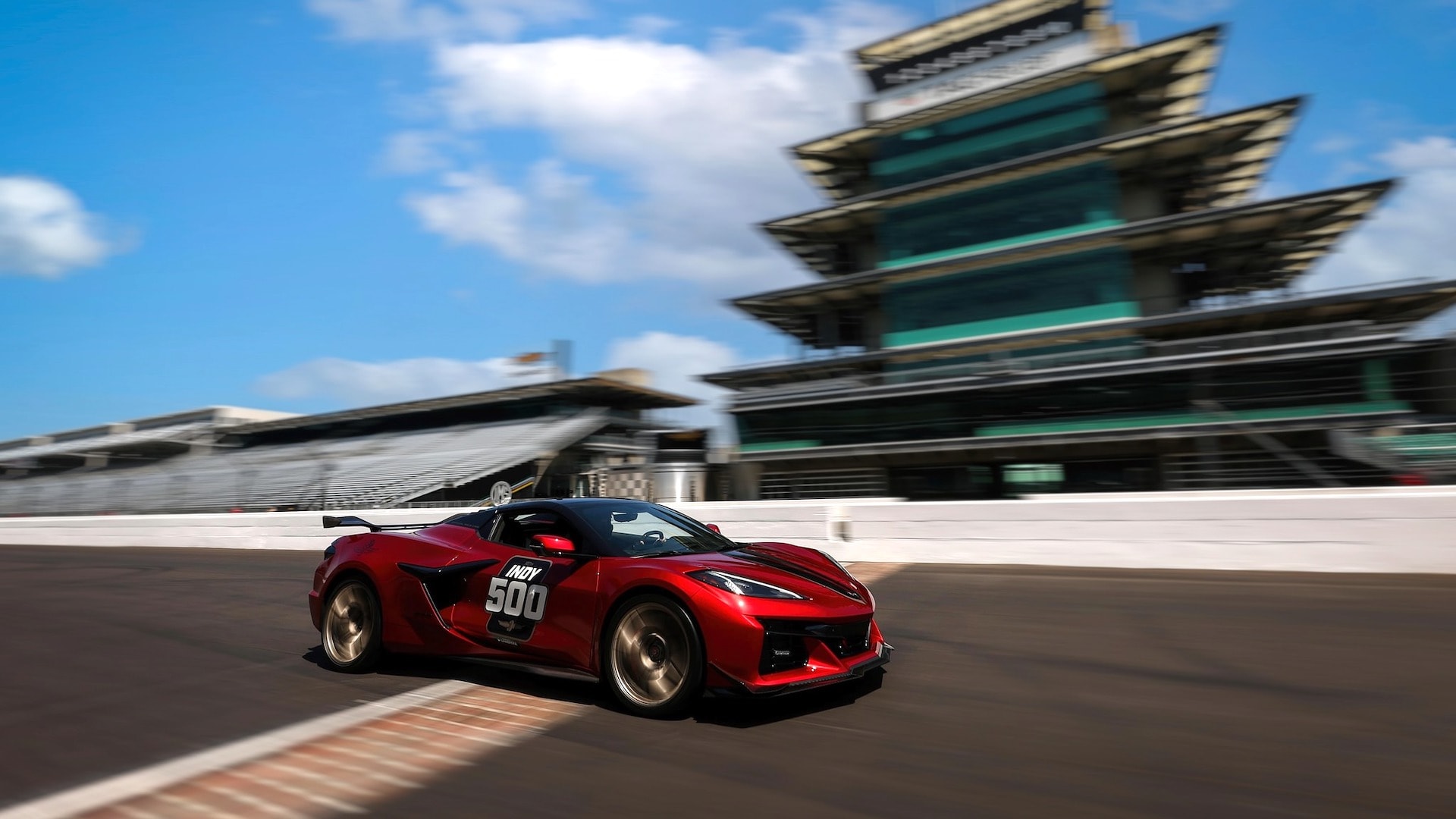
The official pace car for the 2023 Indy 500 is the mid-engined Chevrolet Corvette Z06, in hardtop convertible guise.
It marks the 20th time a Corvette has been used as a pace car for the event, and the 34th time for a Chevrolet. The Bowtie brand first led the field in 1948, and has held a monopoly on the pace car role since 2002.
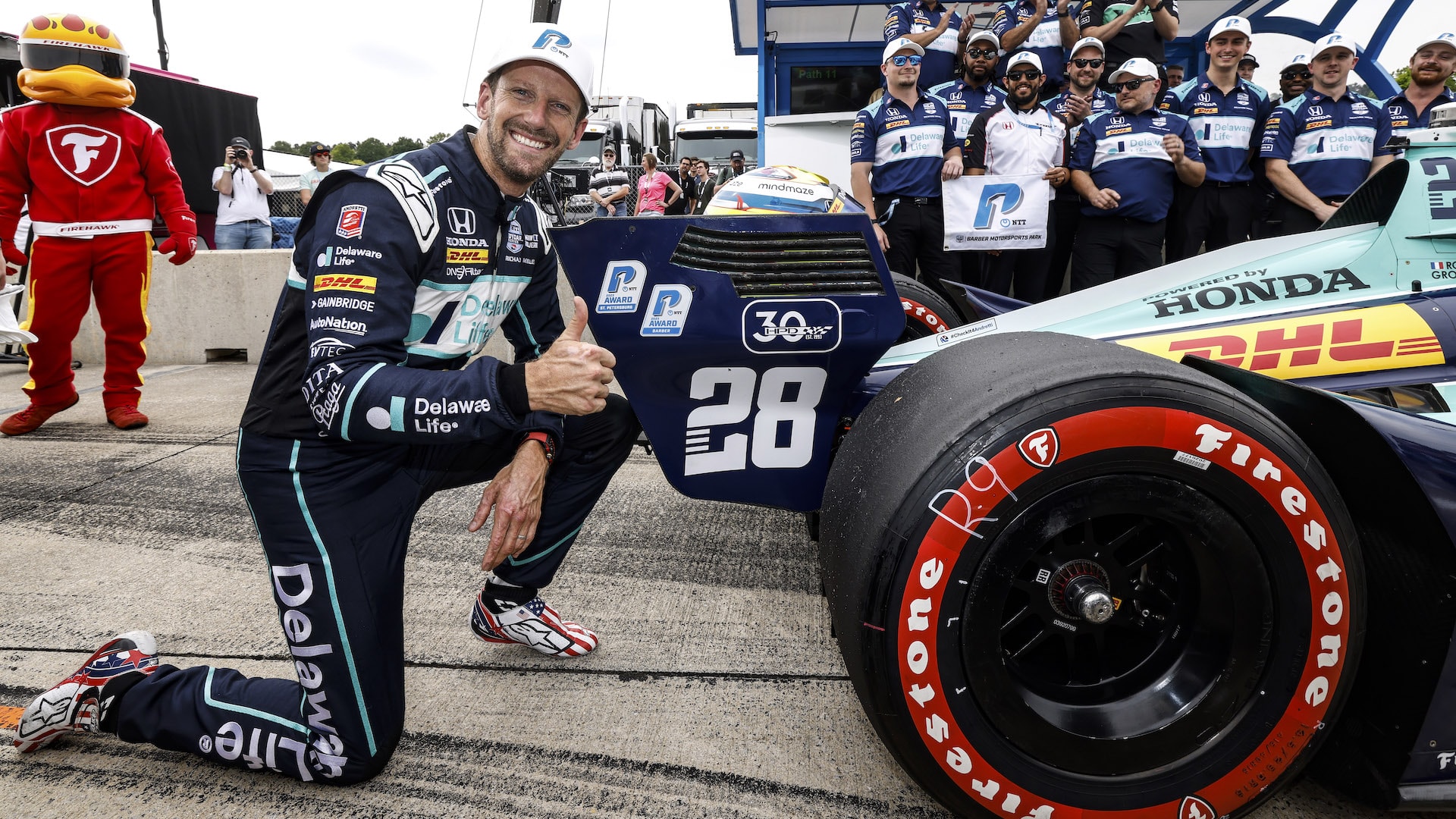
Will Romain Grosjean drive in the 2023 Indy 500?
Romain Grosjean exited Formula One in dramatic fashion at the end of the 2020 season, surviving a terrifying accident in the Bahrain Grand Prix. With no Formula One drive lined up for 2021, he made the move across the Atlantic for IndyCar.
When Grosjean initially switched to IndyCar, he was only contracted for races held on street and road courses. This was to avoid putting his family through the additional stress of him competing on high-speed circuits.
However, for 2022 and beyond, Romain has been allowed to enter all races with the Andretti Autosport team. This includes the Indy 500, where he will line-up 19th on the grid.
Are any British drivers in the 2023 Indy 500?
The 2023 Indy 500 sees three British competitors hoping to take victory in the American classic race.
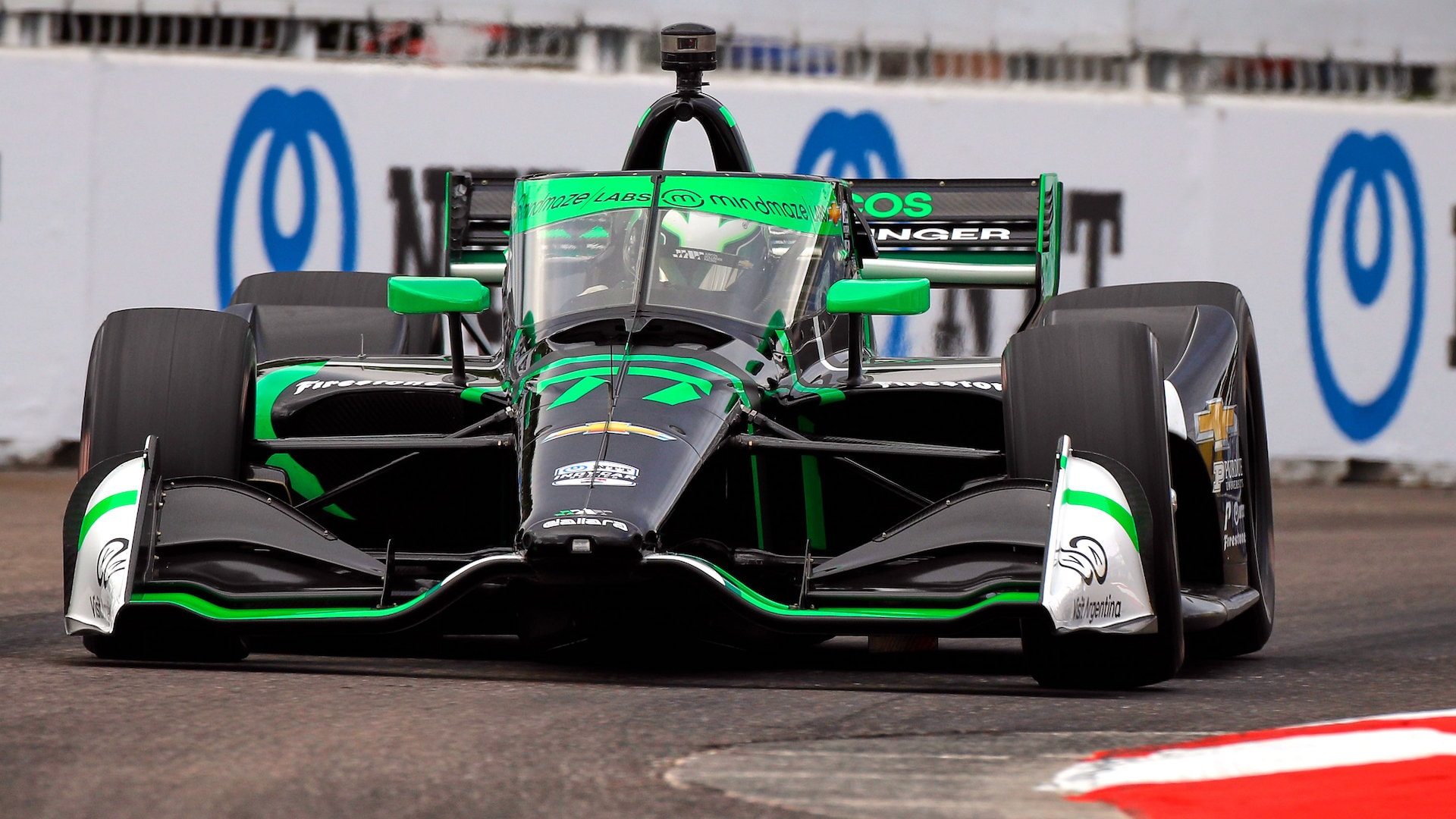
The top British driver in the 2023 Indy 500 is Cambridge’s very own Callum Ilott. Competing in the Indy 500 for the second time, Ilott managed to qualify in 28th position.
Starting 33rd, and last, on the grid is Lincoln-born Jack Harvey. The 30-year-old driver has competed in IndyCar since 2017 but, like others in the Rahal Letterman Lanigan Racing team, he struggled in qualifying. Harvey managed to secure the final place on the grid with a last-gasp run.
Katherine Legge is making her return to the Indy 500 for the first time since 2013, and is the only female driver on the grid for 2023. She emerged as the top Rahal Letterman Lanigan Racing competitor, and took 30th position on the grid.
Stefan Wilson, younger brother of the late Justin Wilson, was due to start the 2023 Indy 500 in 24th position. However, a collision with Katherine Legge in practice saw Sheffield-born Stefan sidelined, with Graham Rahal returning to take his seat instead.
What other big-name drivers are in the 2023 Indy 500?
What makes the Indy 500 special is that experienced drivers will frequently make a return to racing, just to compete in this great event. Teams will sometimes field extra cars to accommodate iconic drivers, just for the one-off race.
Brazilian driver Helio Castroneves is one of the heroes returning to the Indy 500 grid for 2023, doing so as a four-time winner of the race. Helio last won the Indy 500 in 2021, and will be looking to use his talent and experience to do so again this year. The 48-year-old is driving for the Meyer Shank Racing team, and will start from 20th place.
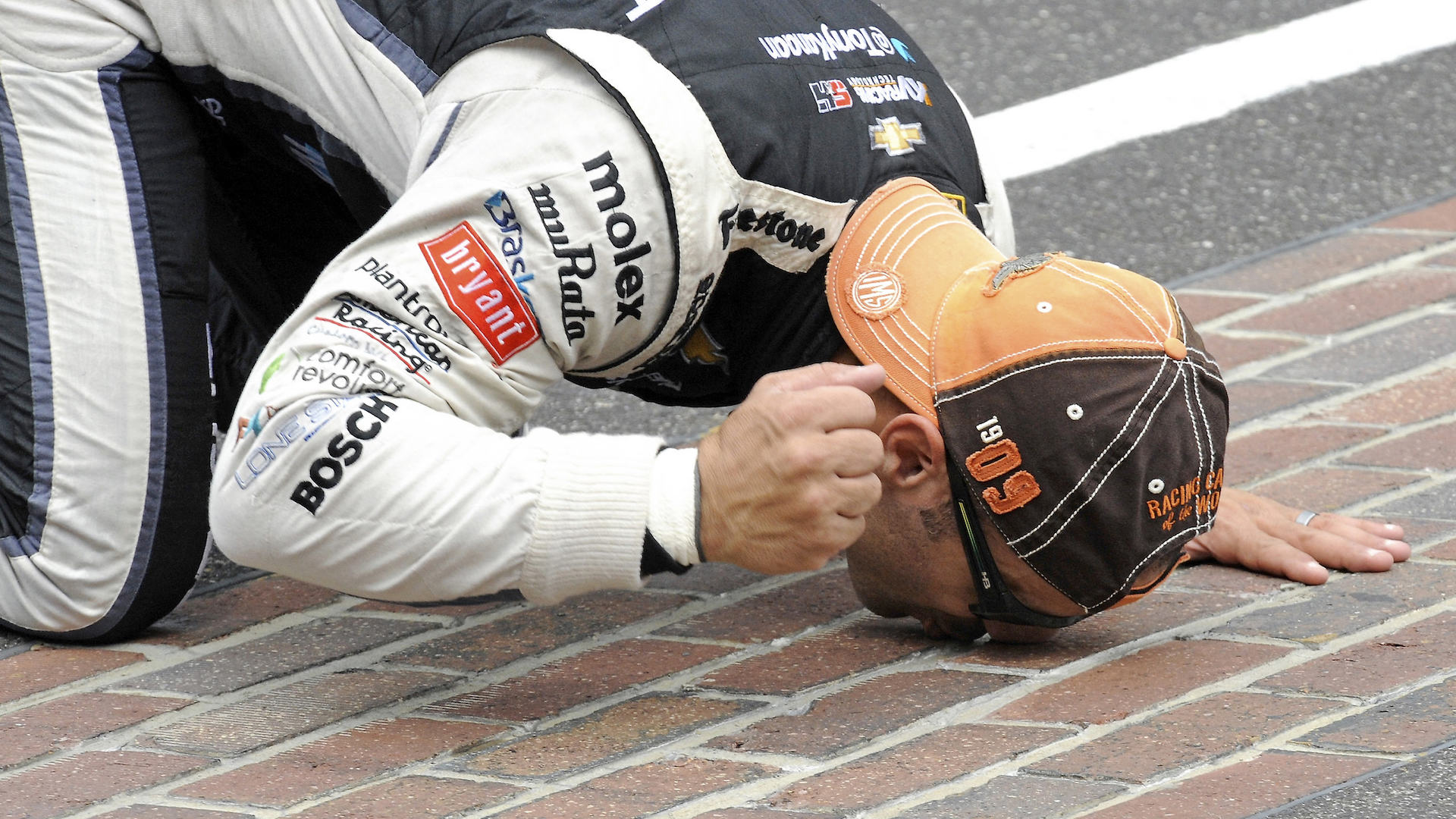
Tony Kanaan, another 48-year-old Brazilian driver, will start the 2023 Indy 500 with a great chance at claiming a second victory. Kanaan took glory back in 2013, and is pictured kissing the yard of bricks in celebration.
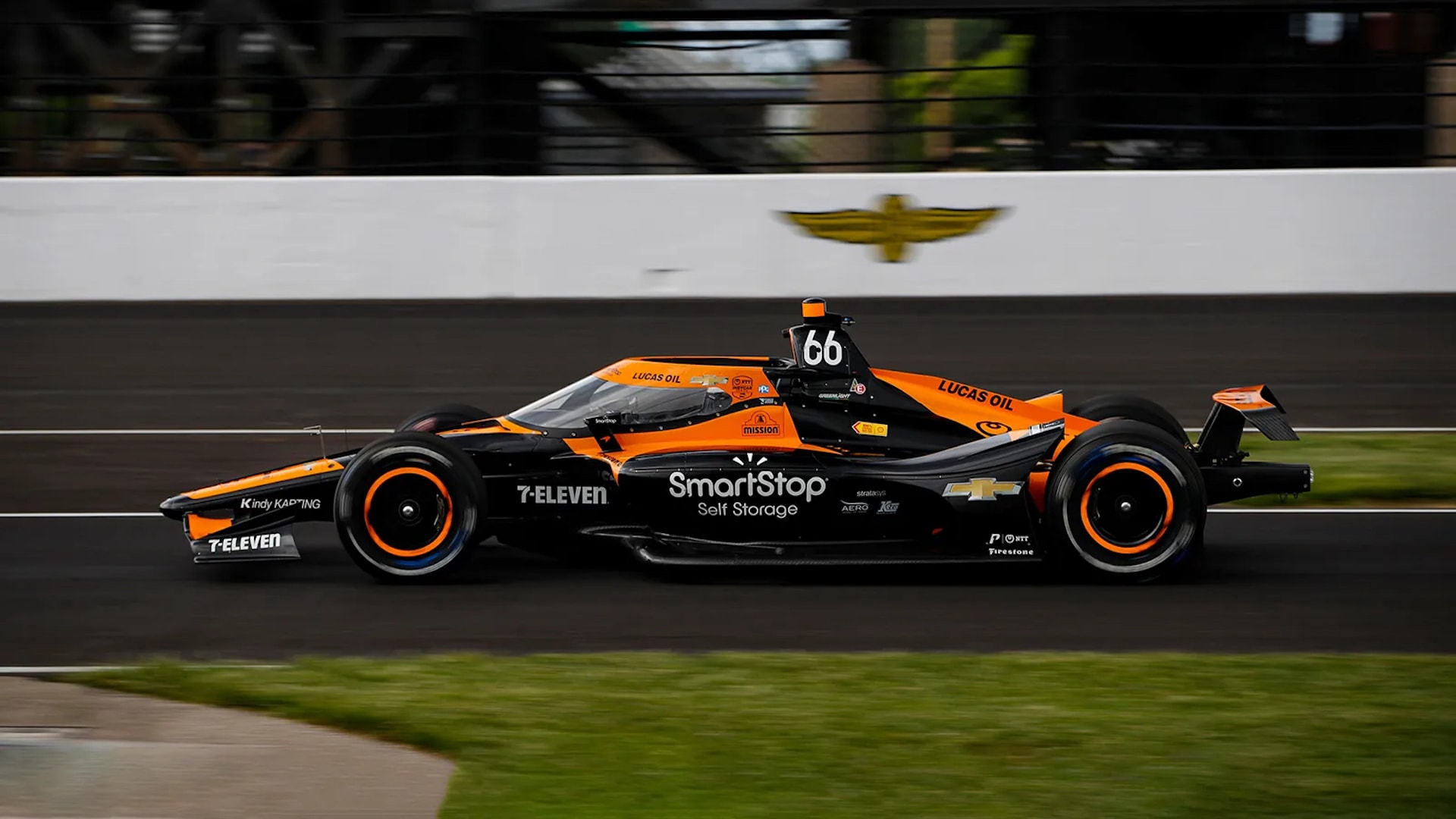
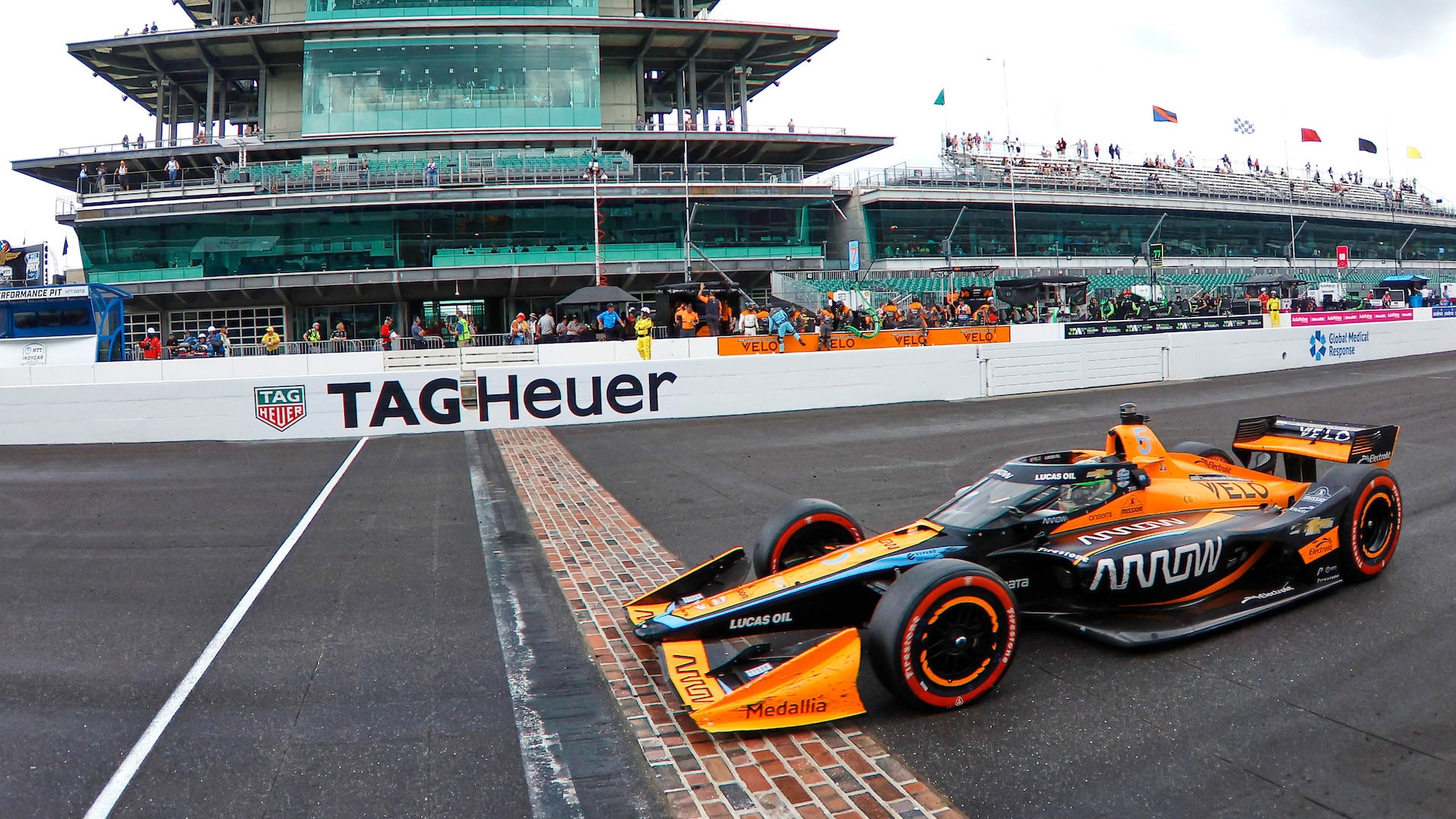
Starting from sixth on the grid, and driving for the competitive Arrow McLaren team, TK has a fantastic opportunity to take glory on Sunday.
Why does the Indy 500 circuit feature a yard of bricks?
When the Indianapolis Motor Speedway first opened in 1909, the track surface was covered in a combination of soil, gravel and limestone covered in tar. Fatal accidents after only the first three days of racing led to the need for a new track covering.
Bricks were chosen as offering the best traction, with 3.2 million bricks used to pave the 2.5-mile circuit. This resulted in the nickname of ‘The Brickyard’, with the bricks remaining until 1961.
With the track now covered with asphalt, a symbolic yard of bricks was left to mark the finish line.
Why does the Indy 500 winner drink a bottle of milk?
Arguably one of the strangest traditions in the Indianapolis 500 is the winning driver drinking a bottle of milk to celebrate.
The tradition began in 1933, after Louis Meyer took his second Indy 500 victory. Meyer chose to drink buttermilk after the race, believing it would be refreshing on a hot day. He did the same again after his third Indy win in 1936.
A dairy company executive saw a photo of Meyer drinking milk, leading to the beverage being offered to future Indy 500 winners. Today, the Indiana Dairy association gives the winning driver $10,000 for choosing to drink milk as part of their post-race celebration.
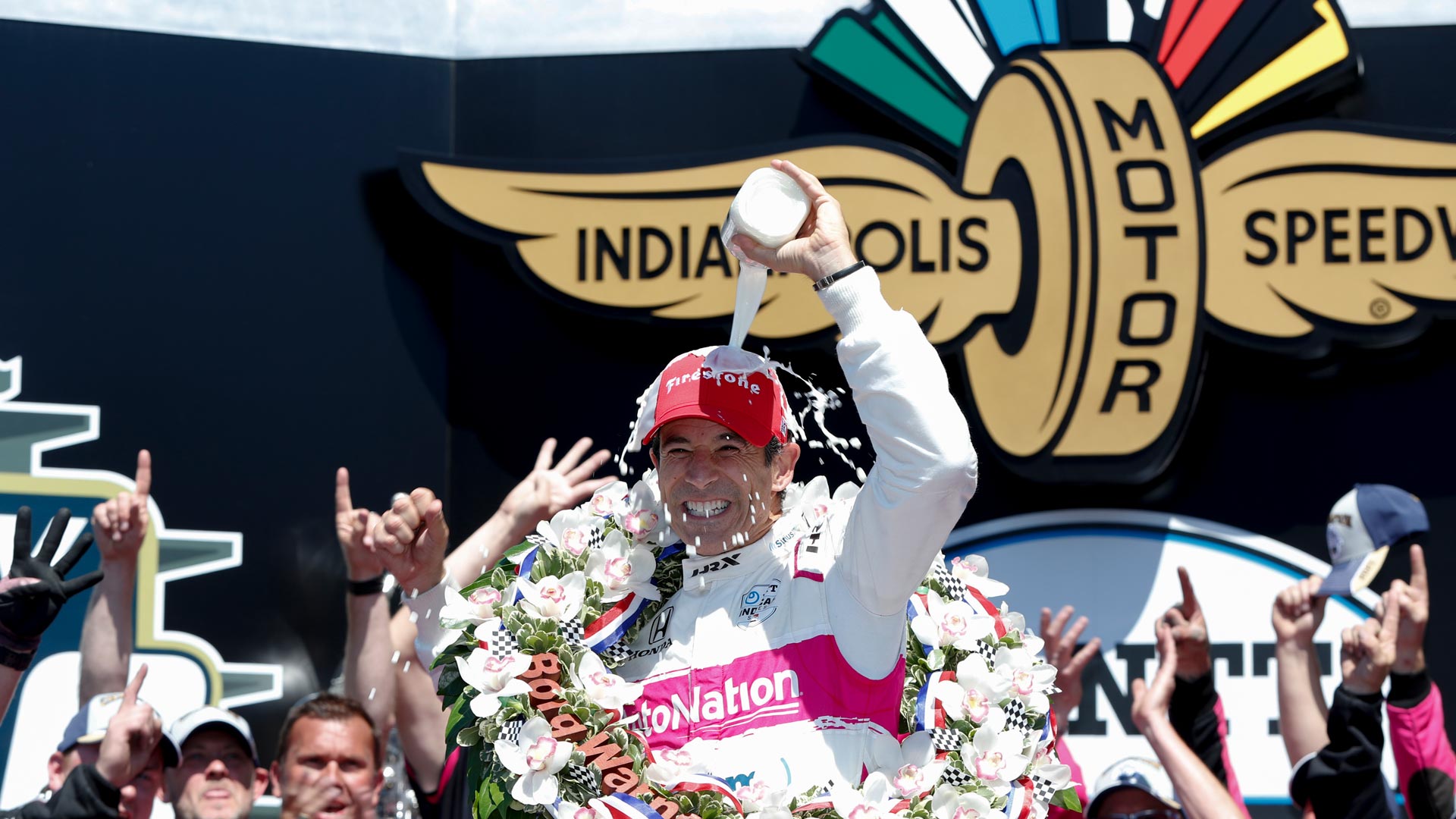
Pictured above is Hélio Castroneves, celebrating his fourth Indy 500 win in 2021.
The choice of new electric cars available to buy in the UK has quadrupled in five years, says the Society of Motor Manufacturers and Traders (SMMT).
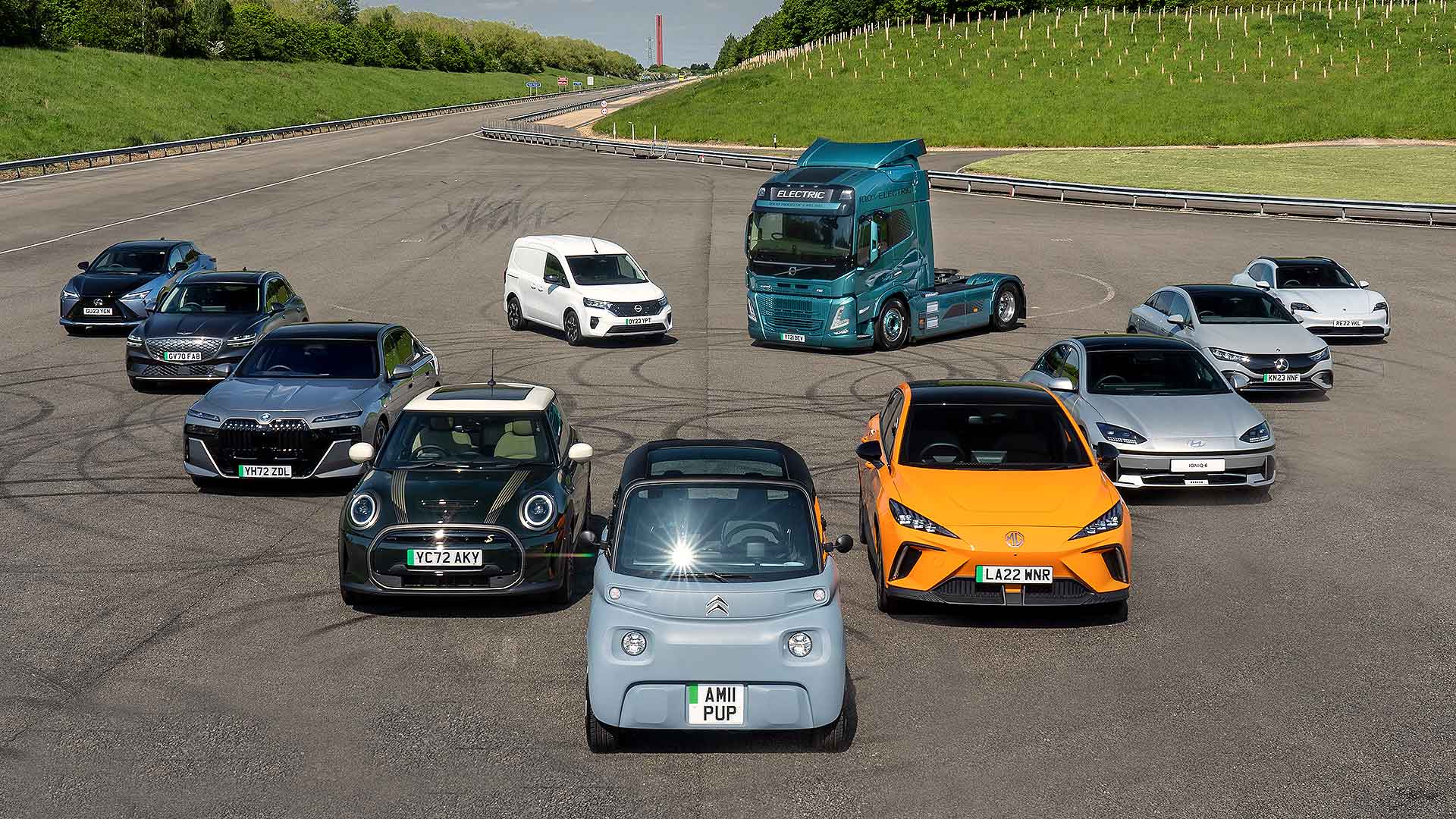
There are now around 80 electric models on sale, compared with 21 in 2018. This means that almost one in four new car models is now available with electric power.
Car buyers are increasingly responding to the change, says the automotive trade body. More than 750,000 Brits have already made the switch, and new electric car registrations have risen by more than a quarter so far in 2023.
“Britain’s drivers are benefiting from the massive investment made by manufacturers over many years to deliver an electric car choice for every need,” said Mike Hawes, SMMT chief executive.
Range anxiety should become a thing of the past as well, reckons the SMMT. Its data shows the average distance a new electric car can travel on a single charge is 236 miles – and for new cars being launched in 2023, it is almost 300 miles. This is around three times the distance an average UK driver travels in a week.
SMMT data also shows there are a further 94 plug-in hybrid (PHEV) models and 42 hybrid (HEV) models on sale. It means electrified cars make up almost two in three new cars on sale.
Support for EVs
While the automotive industry is doing its part, it is now time for the government and legislation to step up. “We now require a framework that ensures everyone can benefit from zero emission mobility,” said Mike Hawes.
The SMMT is again calling for improvements to the UK’s charging infrastructure. While more than £2 billion has been committed by the UK government to increase public chargepoint provision, binding targets on chargepoint rollout could help accelerate infrastructure growth.
Such targets would also complement targets on new EV sales due to be set by the Zero Emission Vehicle Mandate.
The SMMT is also seeking a “fair and forward-looking” VED (road tax) regime, a fiscal framework that supports company car drivers, and added incentives for private car buyers. It says reducing the VAT paid at public chargepoints to the same level as charging at home would make things fair for all, too.
“These vehicles already offer an outstanding driving experience, but motorists should have lower total running costs, no matter where they live or work, with fair taxation that inspires instead of impedes,” continued Hawes.
“With infrastructure provision accelerated ahead of need, the UK can have a healthy, vibrant market, with ever more model choice to keep the UK as a world leader in net-zero transport.”
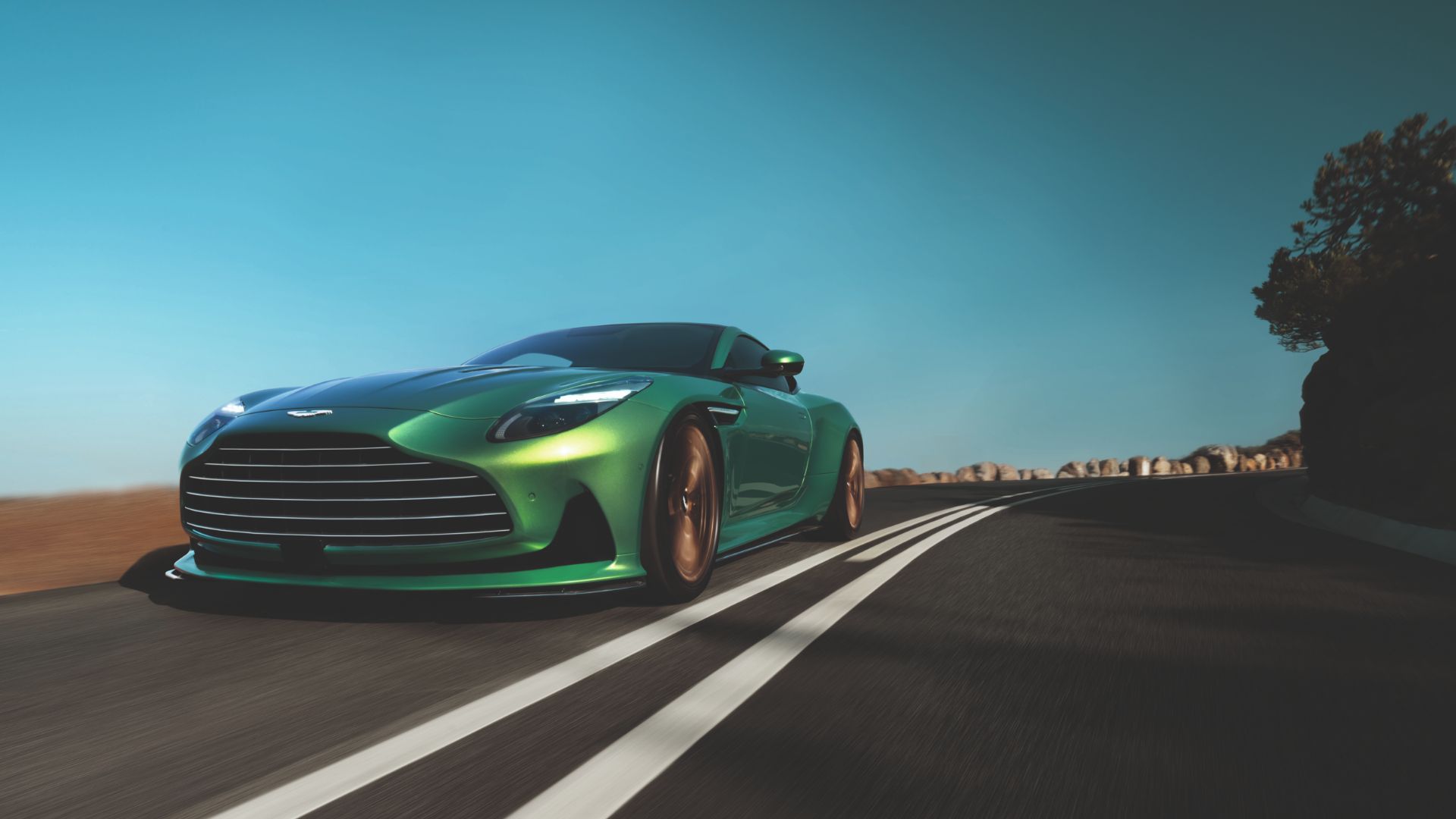
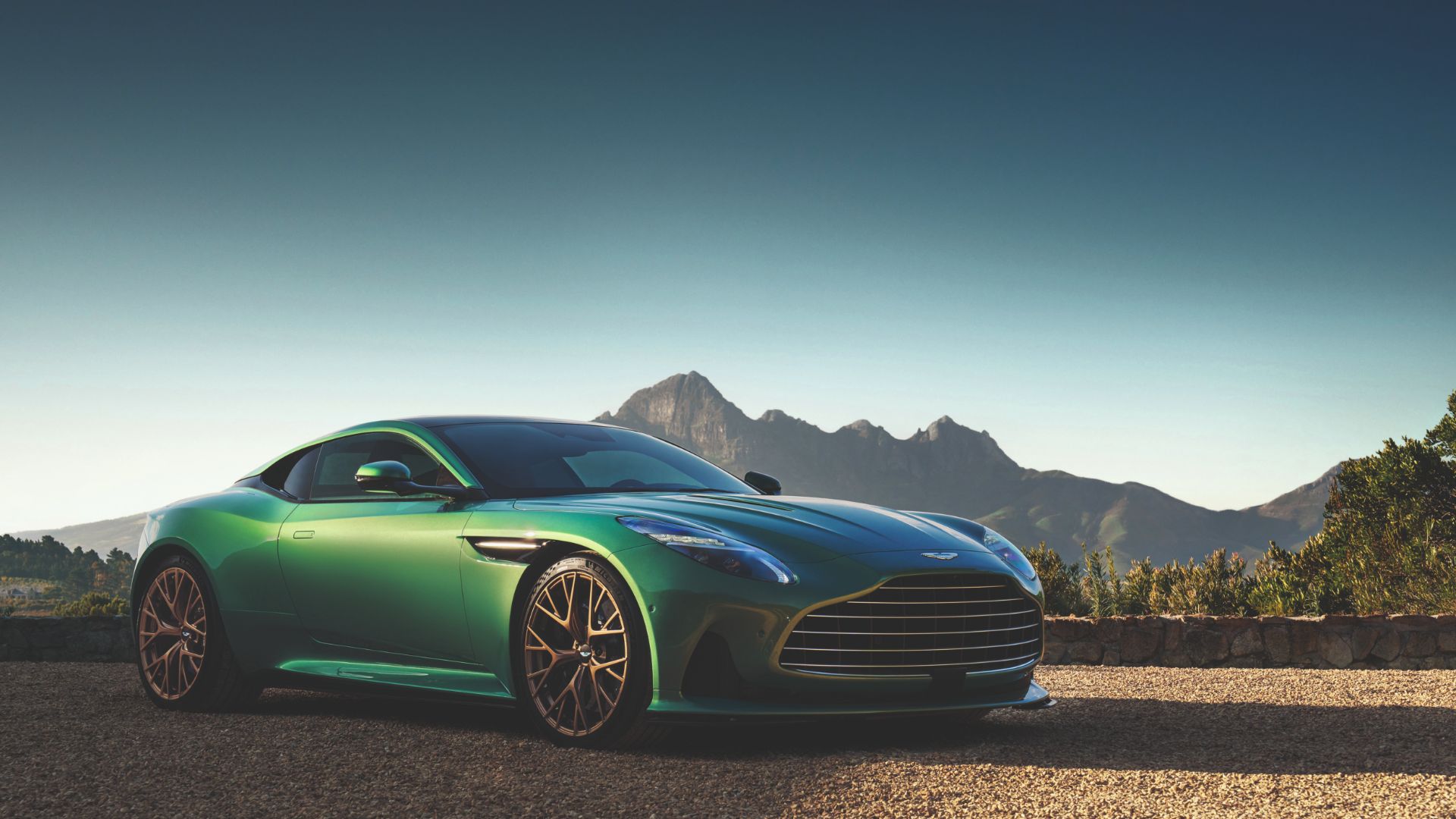
What car will 007 drive when he next screeches onto our screens? This one, probably. The 26th instalment of the James Bond franchise isn’t due until 2025, but don’t be surprised if MI6’s finest rocks up in an Aston Martin DB12.
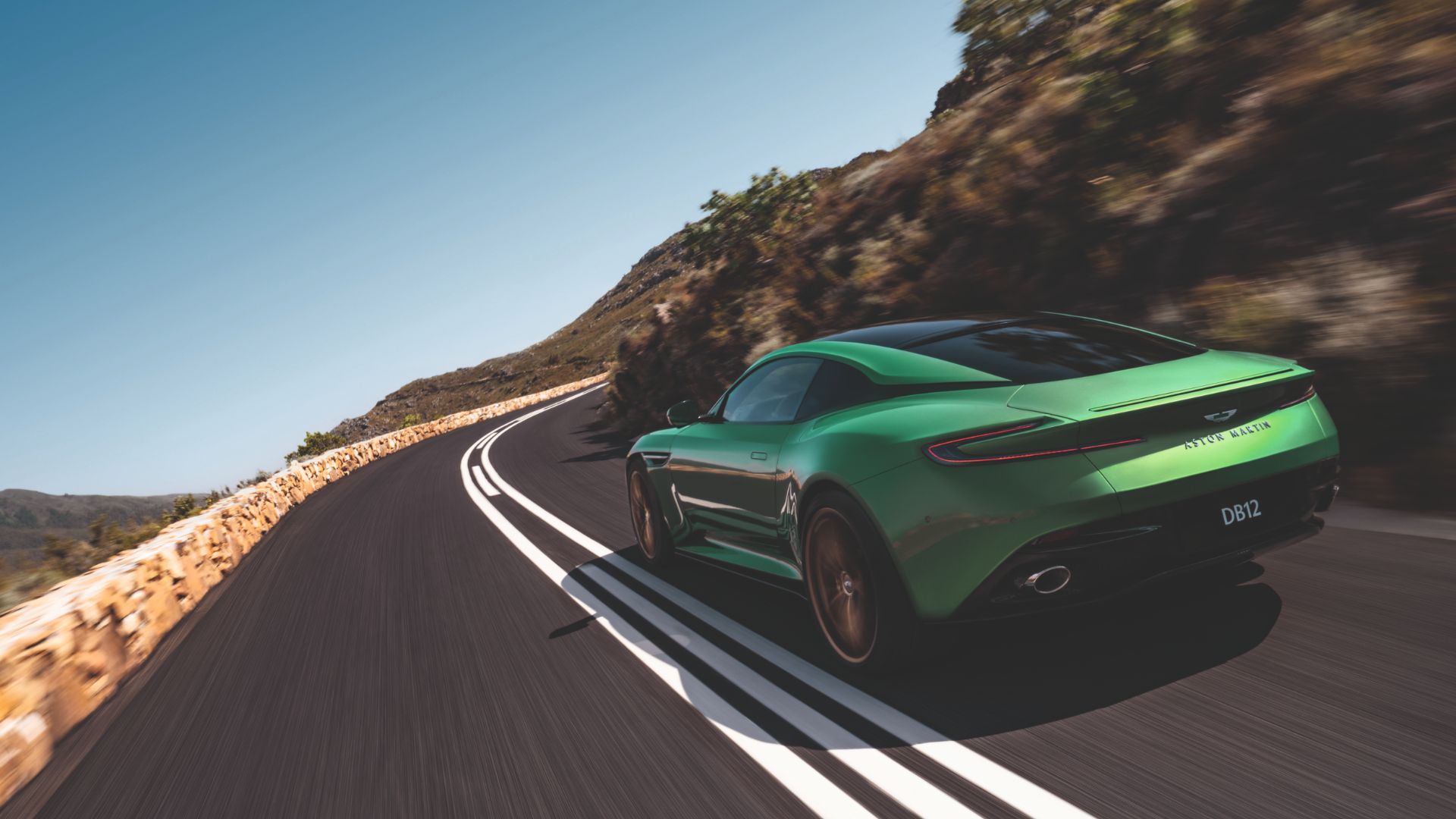
Let’s hope so, because the new DB12 certainly looks the part. With a 680hp twin-turbo V8 under its bulging bonnet, it could also lay waste to a few trigger-happy henchmen on a perilous mountain road.
Aston Martin says this is ‘the world’s first super tourer‘ and the start of a new era for the esteemed yet embattled British brand. We’ll be driving the DB12 next month – on perilous mountain roads, no less. Until then, here is everything you need to know.
Licence to thrill
The heart of the DB12 is a reworked version of Aston Martin’s proven 4.0-litre twin-turbo V8. Larger turbochargers, new cam profiles and improved cooling result in 680hp at 6,000rpm, alongside a brawny 561lb ft of torque from 2,750rpm (the outgoing DB11 V8, for comparison, mustered 535hp and 513lb ft).
With a dry weight of 1,685kg – reckon on close to 1,800kg with fluids – that’s enough to propel the DB12 to 62mph in 3.6 seconds and a top speed of 202mph. Chief engineer Roberto Fedeli promises an “exciting soundtrack” from the switchable exhaust, too.
Power reaches the rear wheels via an eight-speed automatic transmission. There’s no old-school manual alternative, but you can take control via paddles behind the steering wheel. Brakes are iron discs or optional carbon-ceramics – the latter saving 27kg in unsprung weight – while the bespoke Michelin Pilot Sport 5S tyres were developed specifically for the DB12.
What goes on tour…
Whether you call it a ‘super tourer’ or a supercar, the DB12 remains a GT in the traditional sense: a car built for long European road trips – or revisiting your childhood home in the Scottish Highlands, perhaps?
The default GT drive mode, selected via a knurled controller on the centre console, is said to offer ‘a luxurious ride quality… for sublime yet agile cruising’. Switching to Sport or Sport+ ramps up the intensity, plus there’s a new Wet mode tailor-made for British weather.
This is also the first DB model with an electronic rear differential. Unlike a mechanical diff, it can switch from open to fully locked in milliseconds, helping to enhance turn-in and improve stability at speed. Where conditions allow, it should also help the DB12 go sideways…
‘The sharpest DB ever’
That brings us to the sportier side of the DB12’s character. Aston Martin promises ‘the sharpest DB ever’ along with ‘class-leading driving dynamics’. When your rivals include the McLaren Artura and Maserati MC20, that’s a bold claim.
The car’s bonded aluminium structure is seven percent stiffer than a DB11 and its non-isolated steering column is said to offer improved feedback. We recently tried a similar setup on the run-out Aston Martin DBS 770 Ultimate and were genuinely wowed by how alert and focused it felt.
Drivers can choose from four settings for the stability control: Wet, On, Track and Off. The system relies on numerous sensors around the car, including a new six-axis inertia unit, and is calibrated to work in the background, intervening as unobtrusively as possible.
As seen on screens
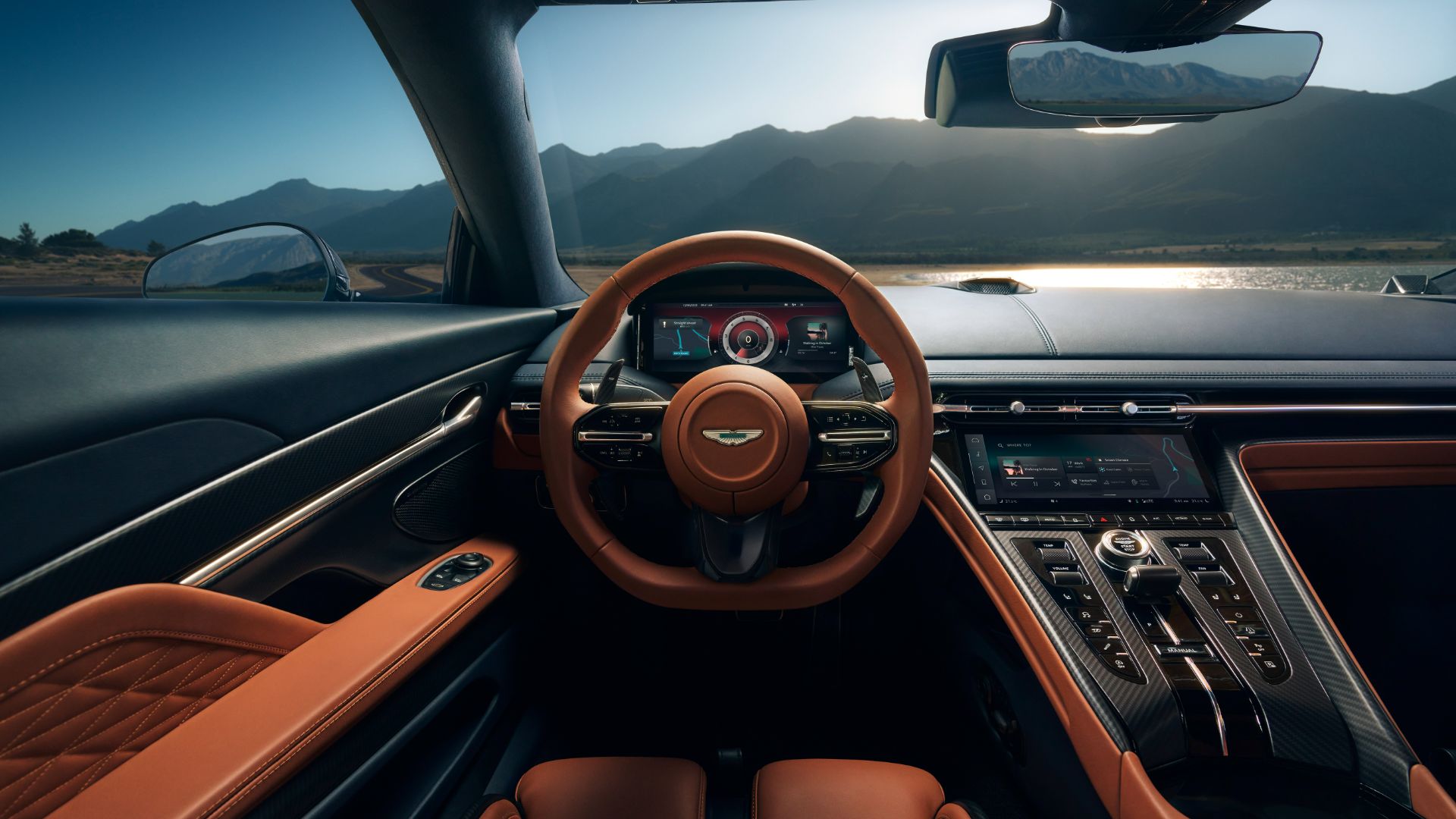
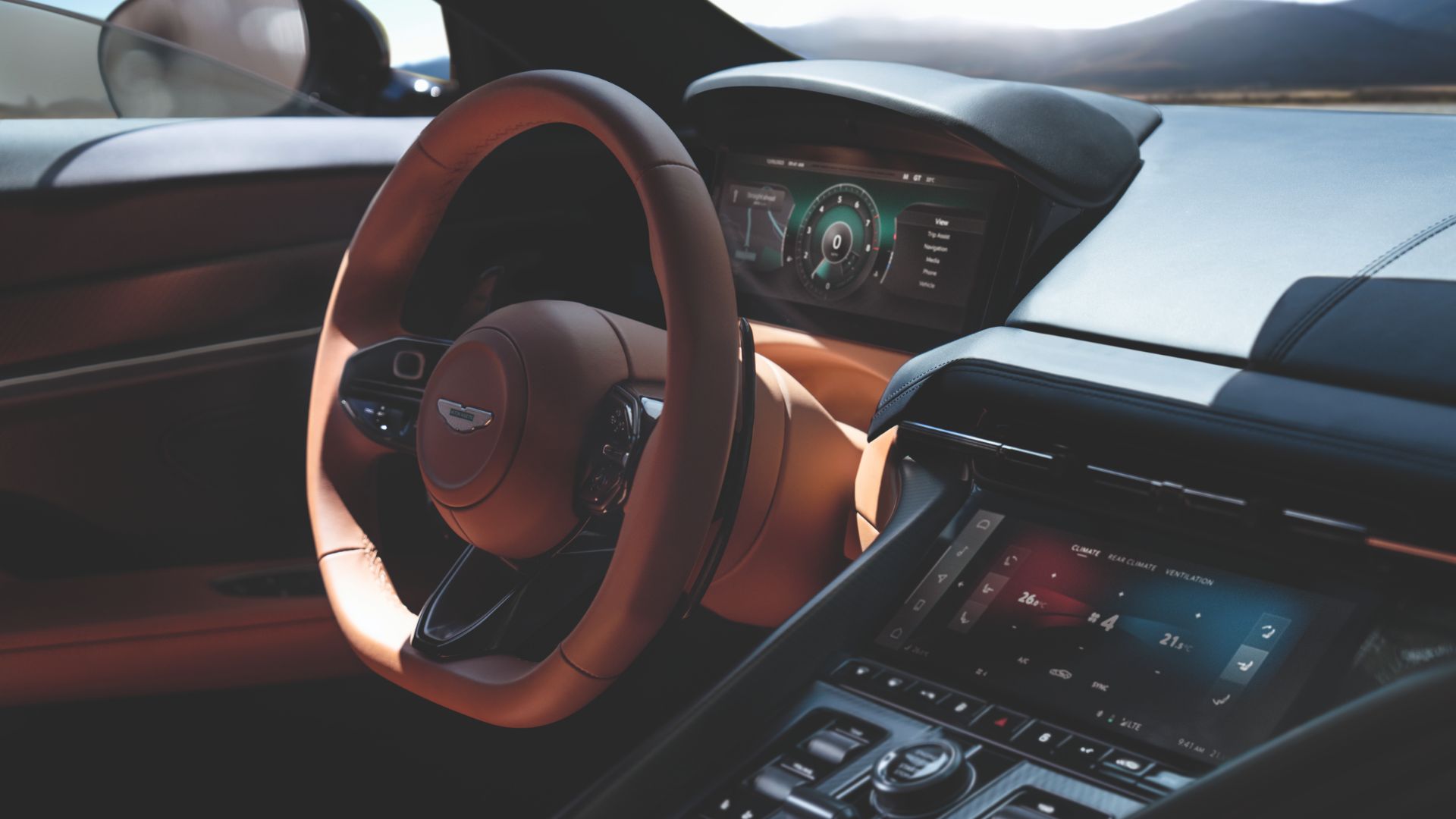
If one aspect of the DB11 cried out for an update, it was the interior. Thankfully, its successor boasts an entirely new cabin that banishes the ancient Mercedes-Benz media system for good.
This time, Aston Martin has developed its own in-house infotainment, with two 10.25-inch screens, 3D navigation, online connectivity – including over-the-air software updates – and a dedicated smartphone app. You can also link up your phone via Apple CarPlay or Android Auto.
The driver and front passenger are cocooned by a high centre console with a mixture of analogue switches and digital controls. Buyers can pick from hand-stitched leather or Alcantara upholstery, plus endless options for personalisation via Aston Martin’s ‘Q’ division. The DB12’s surround-sound audio system comes from Bowers and Wilkins, the British company that also supplies McLaren.
DB12 gives you wings
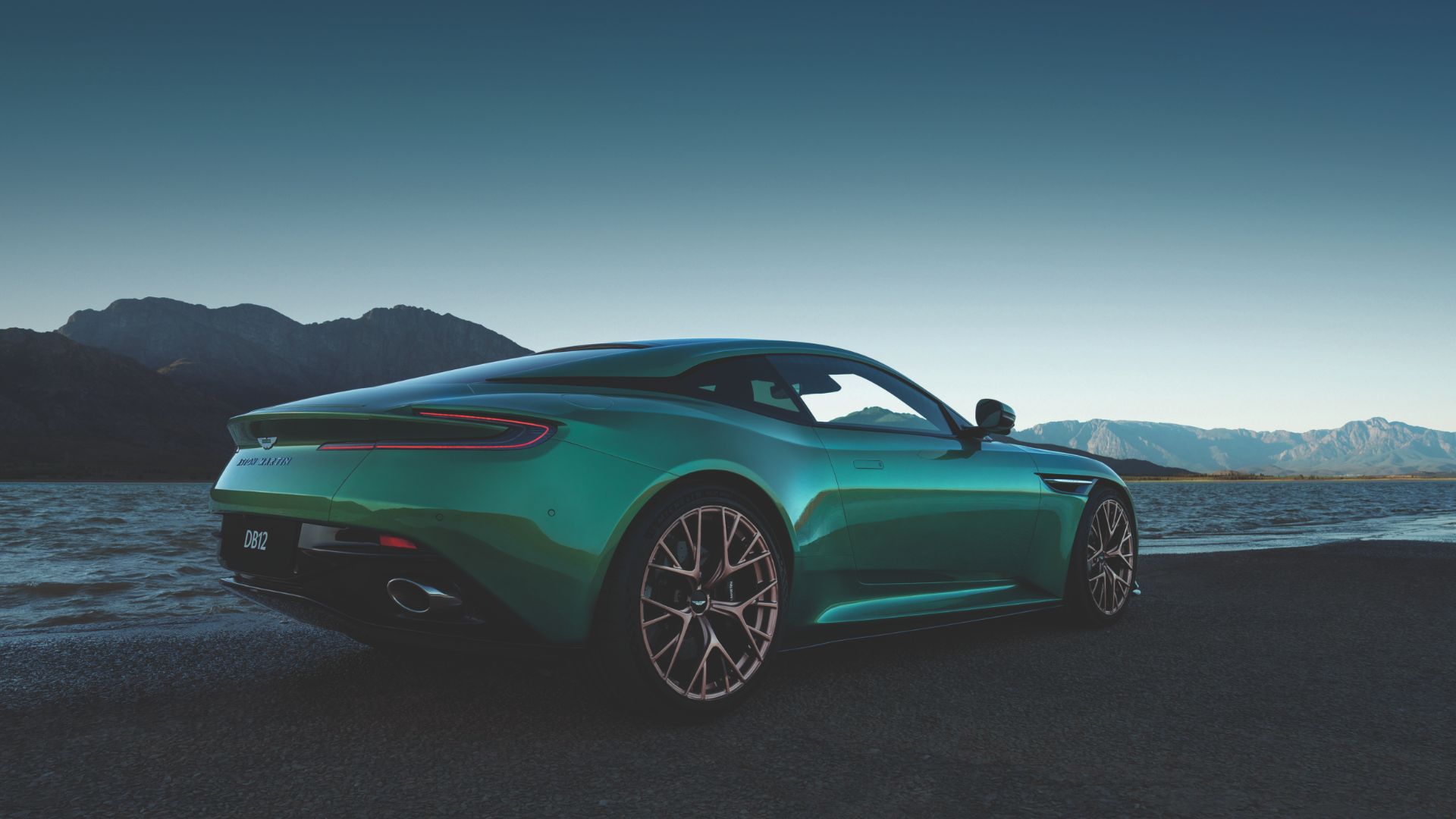
Lastly, there’s how it looks. The DB12 is clearly part of a bloodline that began with the DB7 in 1994, but its taut contours and athletic stance are definitely more Daniel Craig than Pierce Brosnan.
Riding on 21-inch forged alloy wheels, it sports frameless wing mirrors, pop-out door handles and a new version of the Aston Martin ‘wings’ badge. Design boss Merek Reichmann says: “We’ve fused everything together on the DB12 – the handling, dynamics, powertrain, sense of space, and styling – and we’ve done it to the max through technology to deliver this new category of performance-design driving experience”.
Whatever the end result – even if, God forbid, Bond went back to BMWs – the DB12 is an incredibly important car for Aston Martin. Come back to Motoring Research soon for our full first drive.
The Goodwood Festival of Speed 2023 takes place from 13-16 July in the beautiful grounds of Goodwood House, West Sussex. Our hope is for glorious sunshine – and that some contemporary F1 drivers will make an appearance before jetting off to Budapest for the Hungarian Grand Prix.
This year marks several important anniversaries, including the 30th Festival of Speed since its inception in 1993. That first event was a relatively humble affair, with only 2,000 people predicted to attend.
In fact, 25,000 joined the likes of George Harrison and Nick Mason, convincing the former Earl of March – now the Duke of Richmond – that he’d started something special.
Celebrating 75 years of Porsche
The Festival of Speed grew almost exponentially into the behemoth we know today, with classic and contemporary racing cars quickly becoming a permanent fixture.
At the turn of the century, the major car brands joined the party, along with technology partners, extreme sports stars and just about anything with wheels and an engine. Today, Goodwood hosts one of the best motoring events on the planet.
For 2023, the ‘central feature’ sculpture celebrates 75 years of Porsche, with numerous famous German road and racing cars taking to the hillclimb throughout the four-day event.
Le Mans legendsin action
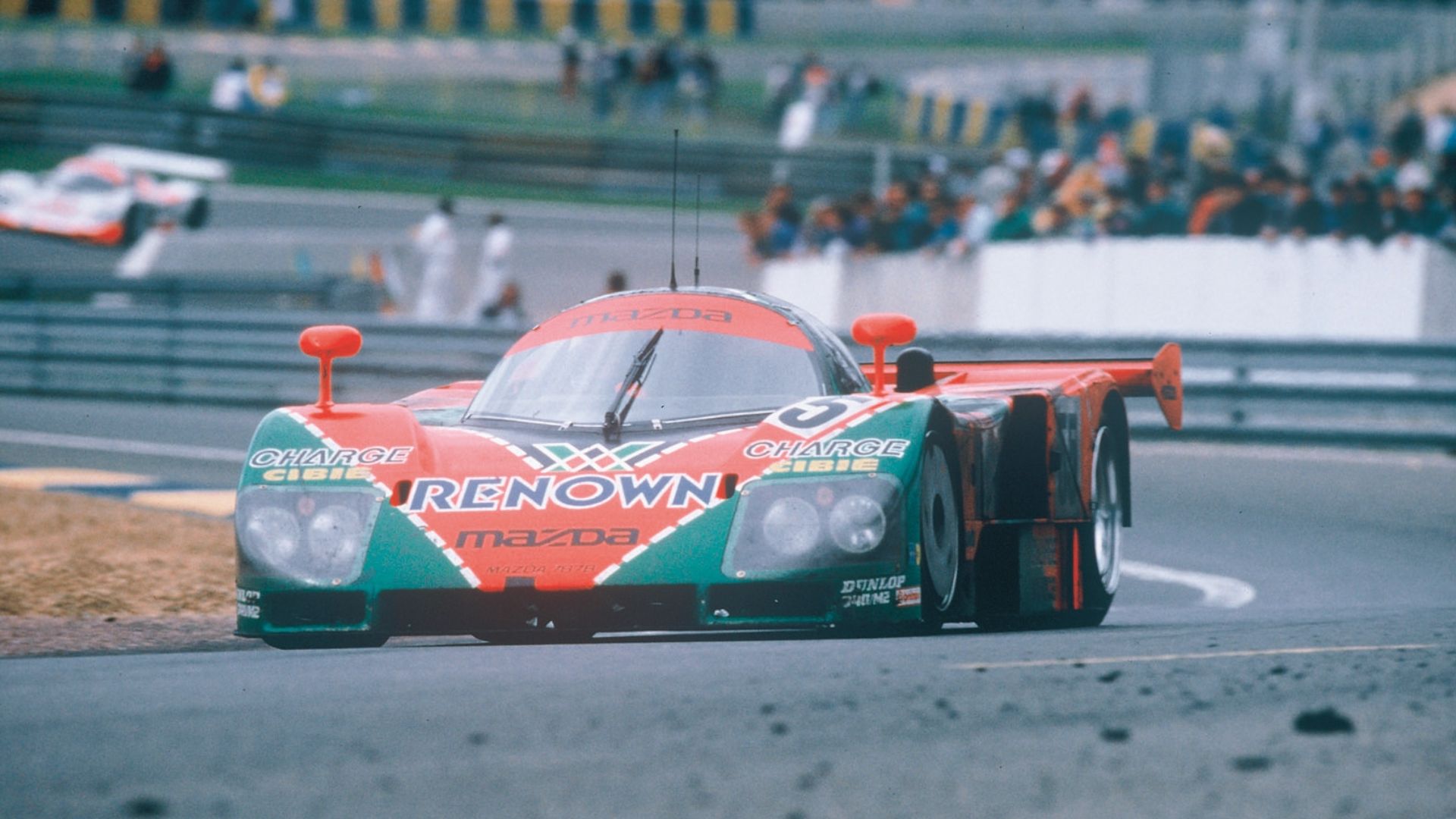
Porsches will be ever-present in celebrating the centenary of Le Mans, too – expect to see the legendary 917 in action on the hill. Another invited great from the 24-hour race is the Mazda 787B (pictured above). With its piercingly loud rotary engine, it remains the only Japanese car to win Le Mans outright.
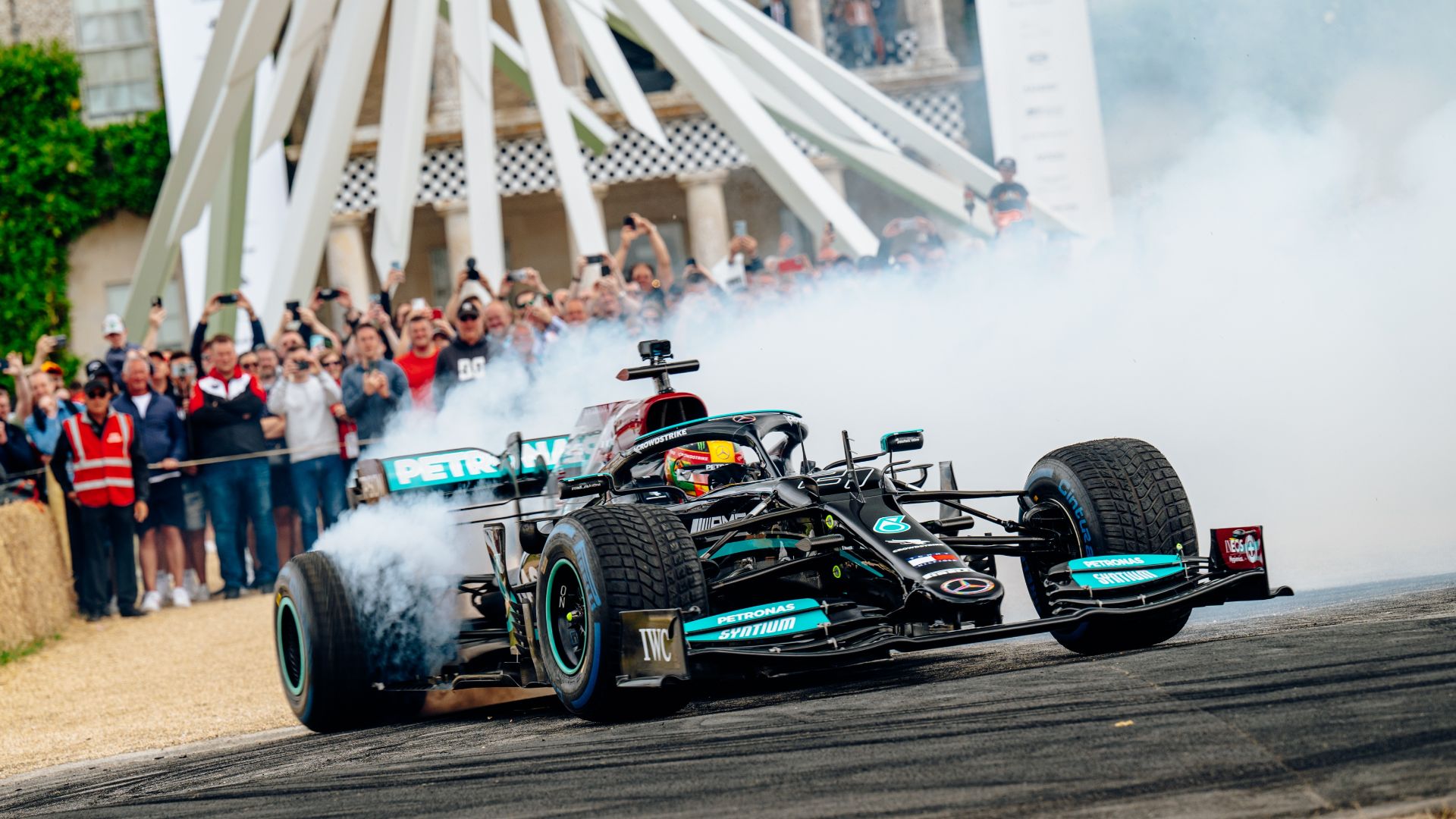
The shriek of Formula One engines will also slice through the summer air. Four-time F1 champion Sebastian Vettel will entertain the crowds in Nigel Mansell’s championship-winning Williams FW14B and Ayrton Senna’s McLaren MP4/8. Vettel’s passion for the environment means the cars will run solely on sustainable fuel.
Might we also see another hillclimb record? Nick Heidfeld’s time of 41.6 seconds, set in 1999 in the McLaren MP4/13, still stands in the non-electric category. For those lucky enough to witness Max Chilton’s record-breaking electric run of 39.08 seconds last year, set in the radical McMurtry Speirling, the same car will return to have another crack at bending space and time.
The unofficial British motor show
Beyond the track, the Festival of Speed also looks to the EV future. Electric Avenue showcases the very latest battery-electric vehicles, from urban runabouts to seven-figure hypercars, flanked by interactive activities for visitors of all ages.
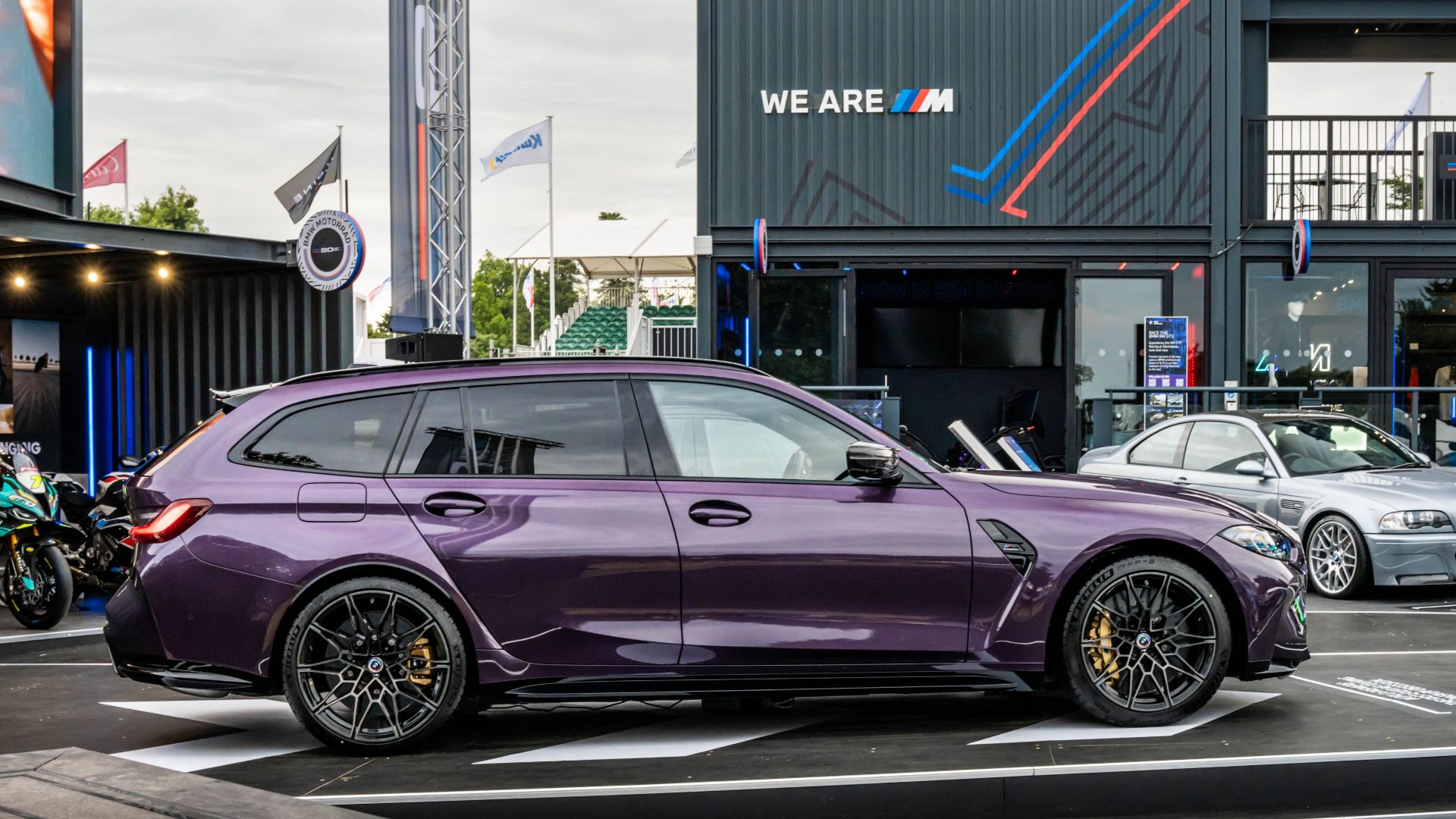
Eleswhere, the Supercar Paddock brings together many of the fastest and most exciting cars in the world. Highlights from 2022 included the Mercedes-AMG One, Ferrari SP3 Daytona and Czinger 21C. We got our first look at the BMW M3 Touring (pictured above), too.
The paddock is where the Festival of Speed shows its intimate side, as fans get up-close with famous machines. You can feel the ground shake as an F1 car fires up, or possibly indulge in a bit of celeb-spotting.
A glamorous garden party
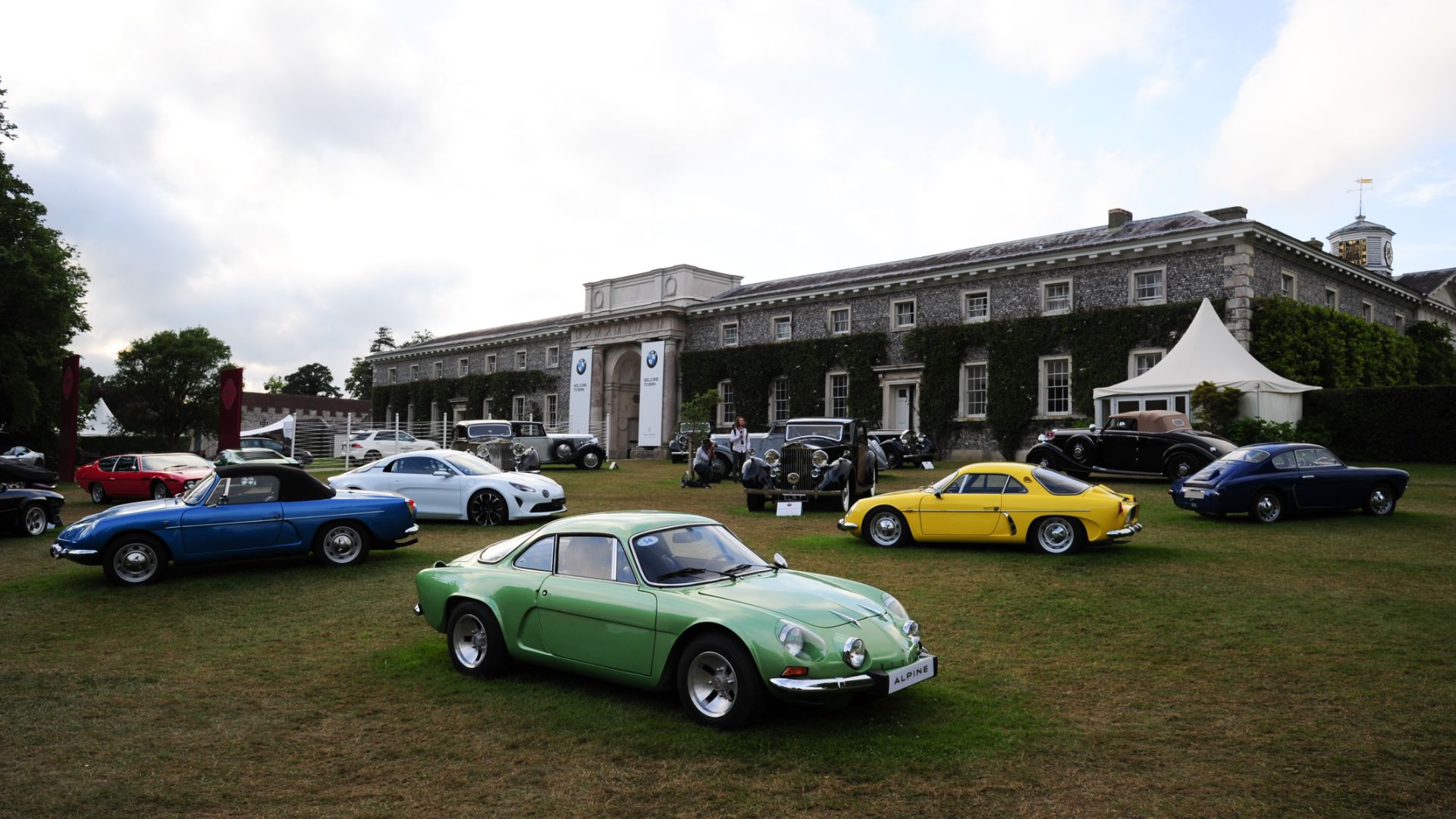
Lastly, if you want to escape the commotion, the Cartier Style & Luxe lawn features the most elegant concours cars and radical concept vehicles, all displayed for your viewing pleasure.
Tickets for the 2023 Festival of Speed cost from £60 and are available from the Goodwood website. You can spend vastly more on various hospitality packages, but honestly, we wouldn’t bother. Just take a packed lunch and enjoy the spectacle. It’s really about the cars, after all.
Vehicle thefts rose by almost a quarter last year, new figures from the Office of National Statistics (ONS) – and released to the AA – have revealed.
The total number of vehicle thefts increased from 104,435 in 2022 to 130,389 in 2023: an increase of 24.9 percent.
Thefts from vehicles also climbed by 9.9 percent, with almost 213,000 people having items stolen from their car or van.
The true figure is likely to be higher still, adds the ONS. Devon and Cornwall Police were unable to supply any statistics.
“These figures are in danger of getting out of control,” said AA Insurance Services MD, Guy Park. “This would have significant cost implications, both in terms of the impact to wider society as well as the price policy holders pay.
“We urge police chiefs and crime commissioners across the country to create an action plan to crack the issue.”
Car crime goes high-tech
The latest vehicle theft figures show how car crime has gone high-tech. Relay theft, key cloning and signal blocking continue to be the main methods of illegally obtaining vehicles.
Indeed, as carmakers improve key security and advise motorists to put keys ‘to sleep’ in order to reduce these types of offence, the AA warns that criminals have developed even more advanced practices to attack car security systems.
This is why experts are advising motorists use a physical steering wheel lock; it is a device that cannot be overcome by the technology used by gangs to steal cars.
When it comes to theft from vehicles, more ‘traditional’ techniques such as smashing windows and forcing doors are the preferred methods.
Keeping items hidden away, or not storing valuables in vehicles, may encourage the thief to move on to the next car, rather than attacking your own.
“There is no one thing that can guarantee keeping your car safe from theft, but just making it a bit harder for the thieves can make it less likely that they’ll go for your car,” adds Guy Park.
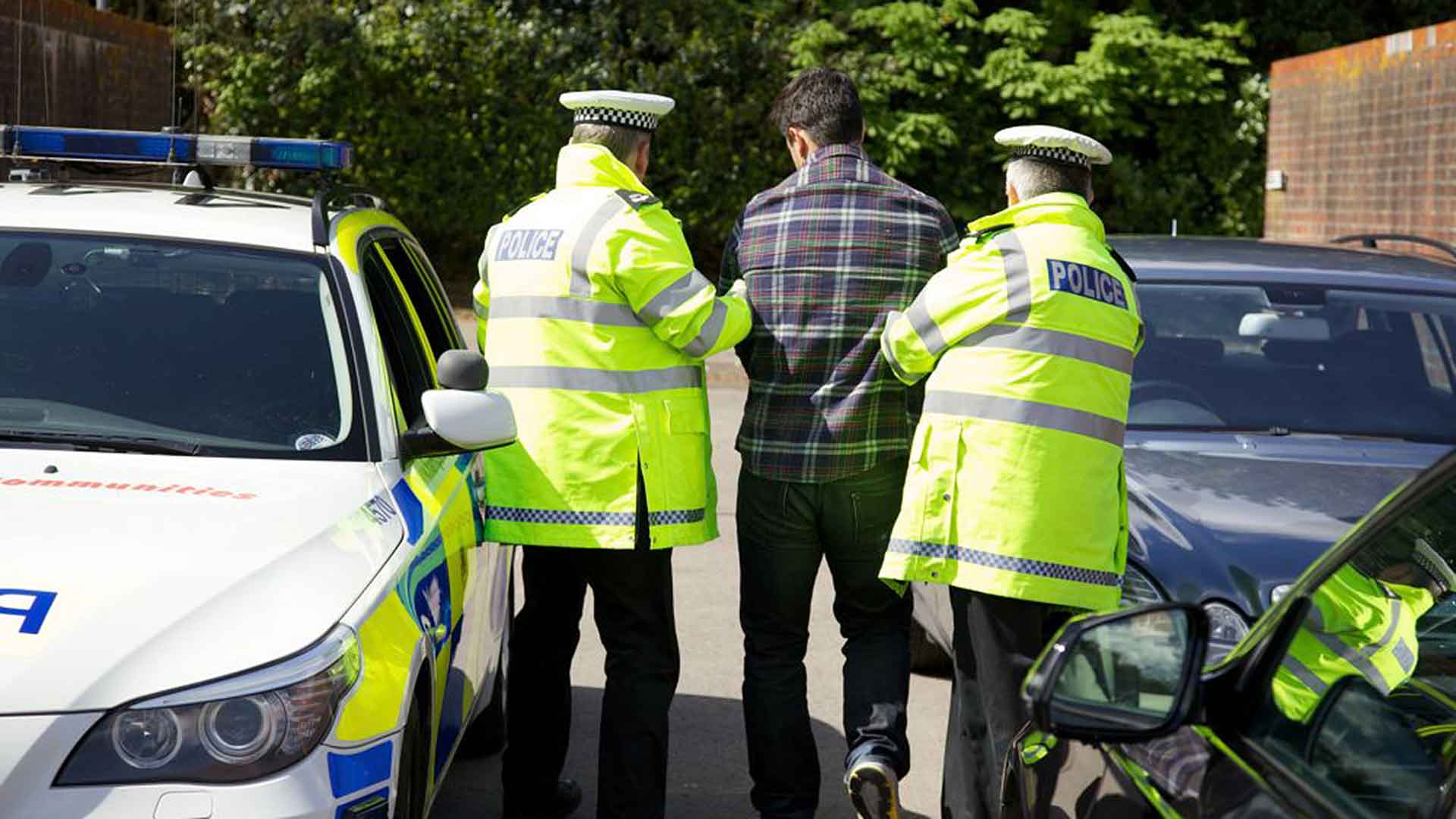
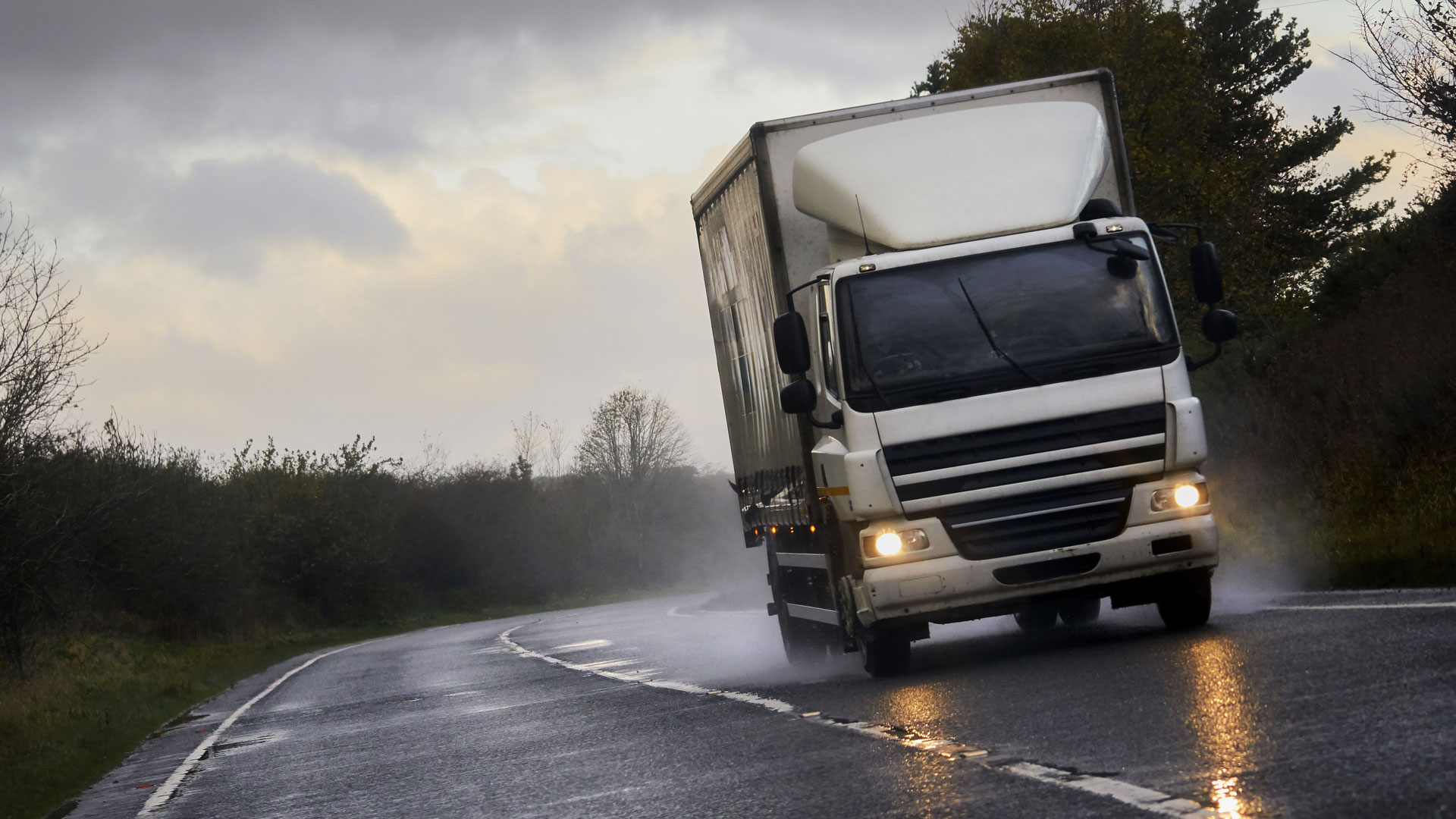
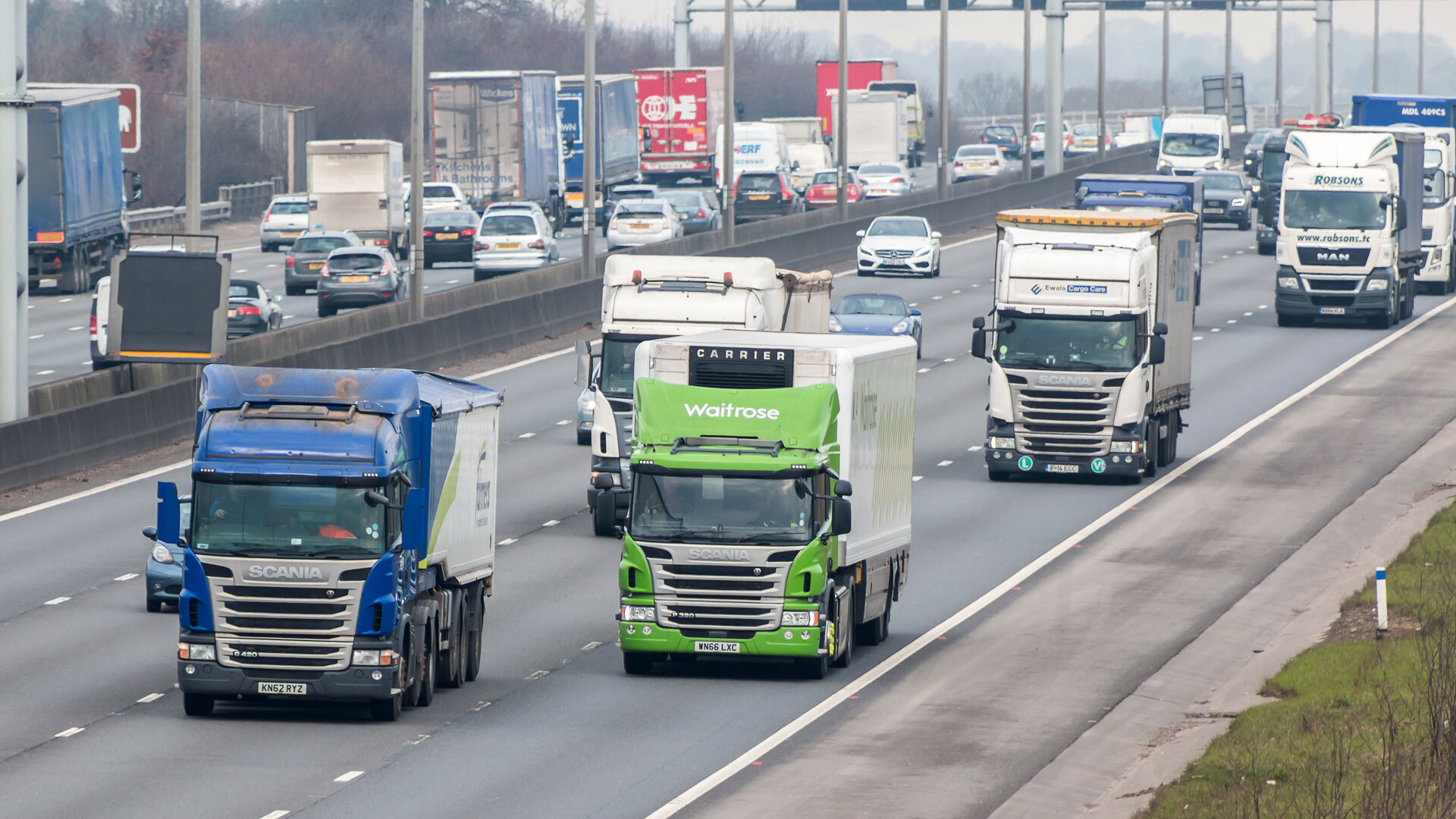
Have you witnessed an unsafe HGV, bus or coach driver? If you believe one of these vehicles has broken road safety rules, you can report the incident to the Driver and Vehicle Standards Agency (DVSA).
Legitimate reasons to contact the DVSA about a commercial vehicle or public transport driver include:
Breaking drivers’ hours rules (i.e. driving for too long between breaks)
Overloading a vehicle
Using vehicles that are unsafe or unroadworthy
Carrying dangerous or hazardous goods without permission
Driving an excessively smoky and polluting lorry, bus or coach
Telephone: 0800 030 4103 (lines are open Monday to Friday, 7.30am to 6pm)
Post: Intelligence Unit, DVSA, The Ellipse, Padley Road, Swansea, SA1 8AN
Can I report a driver anonymously?
The DVSA says it won’t ever ask for names or contact details, phone calls will not be traced and statements will not be required.
Also, if you wish to remain anonymous. you will not be called as a witness or be asked to appear in court.
However, anyone willing to supply details may be contacted for more information. And they could be asked to provide a statement or act as a witness, so think carefully before you submit the information.
What happens after a report is made?
The DVSA will review the information you provide before deciding whether or not to examine the case.
Other government agencies or the police might then get involved, depending on the severity of the incident.
You will receive feedback after the investigation, when official proceedings have ended. The DVSA cannot provide feedback on an ongoing case, however.
How to report other crimes
The process is different for other, non-vehicle-related offences, such as drink driving, speeding and driving while disqualified. In such cases, you should contact the police first.
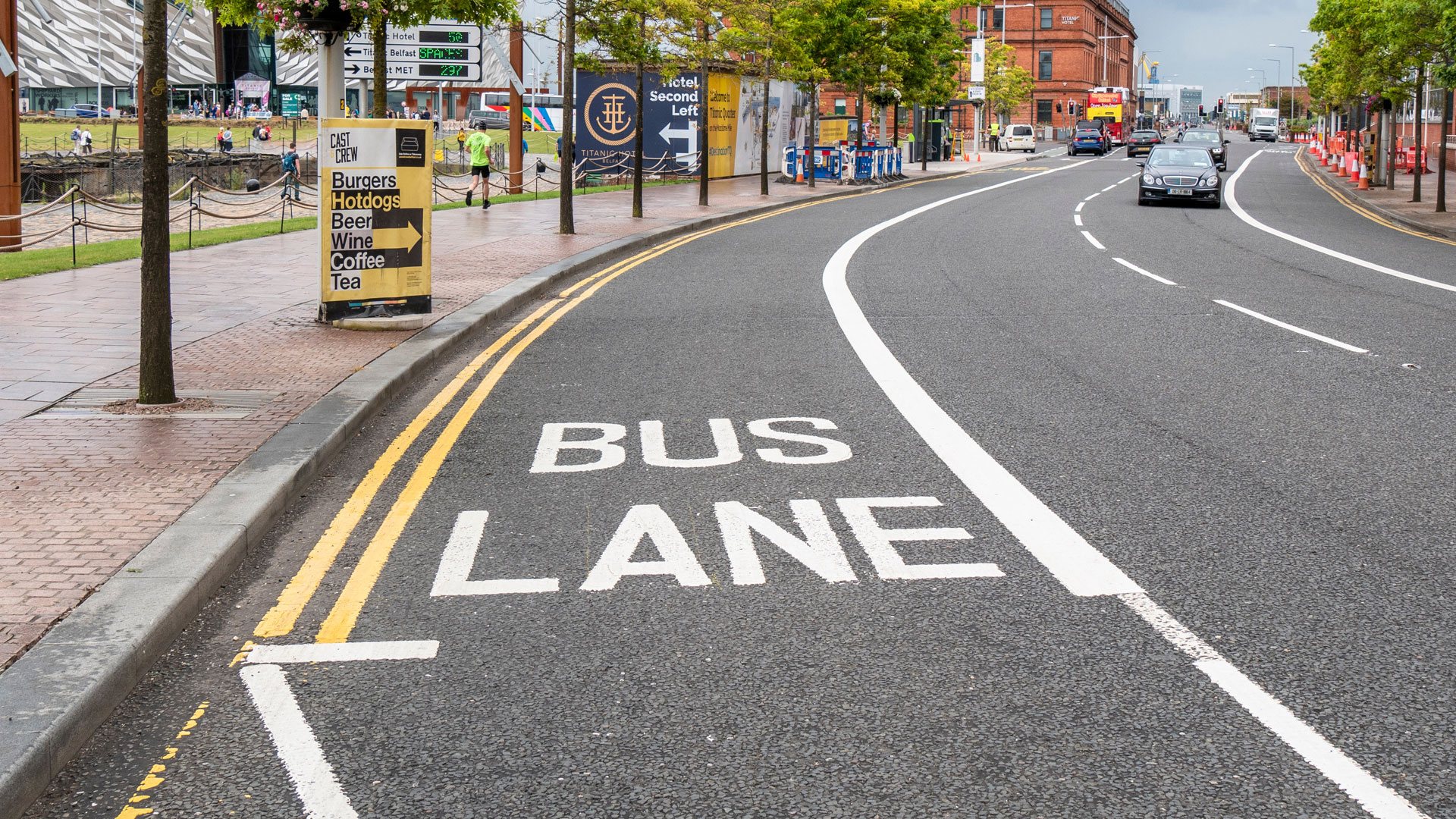
To complain about a bus driver being rude or buses not arriving as per the timetable, visit the Bus Users website.
If the bus service was in London or Northern Ireland, you should contact London TravelWatch or the Consumer Council for Northern Ireland respectively.
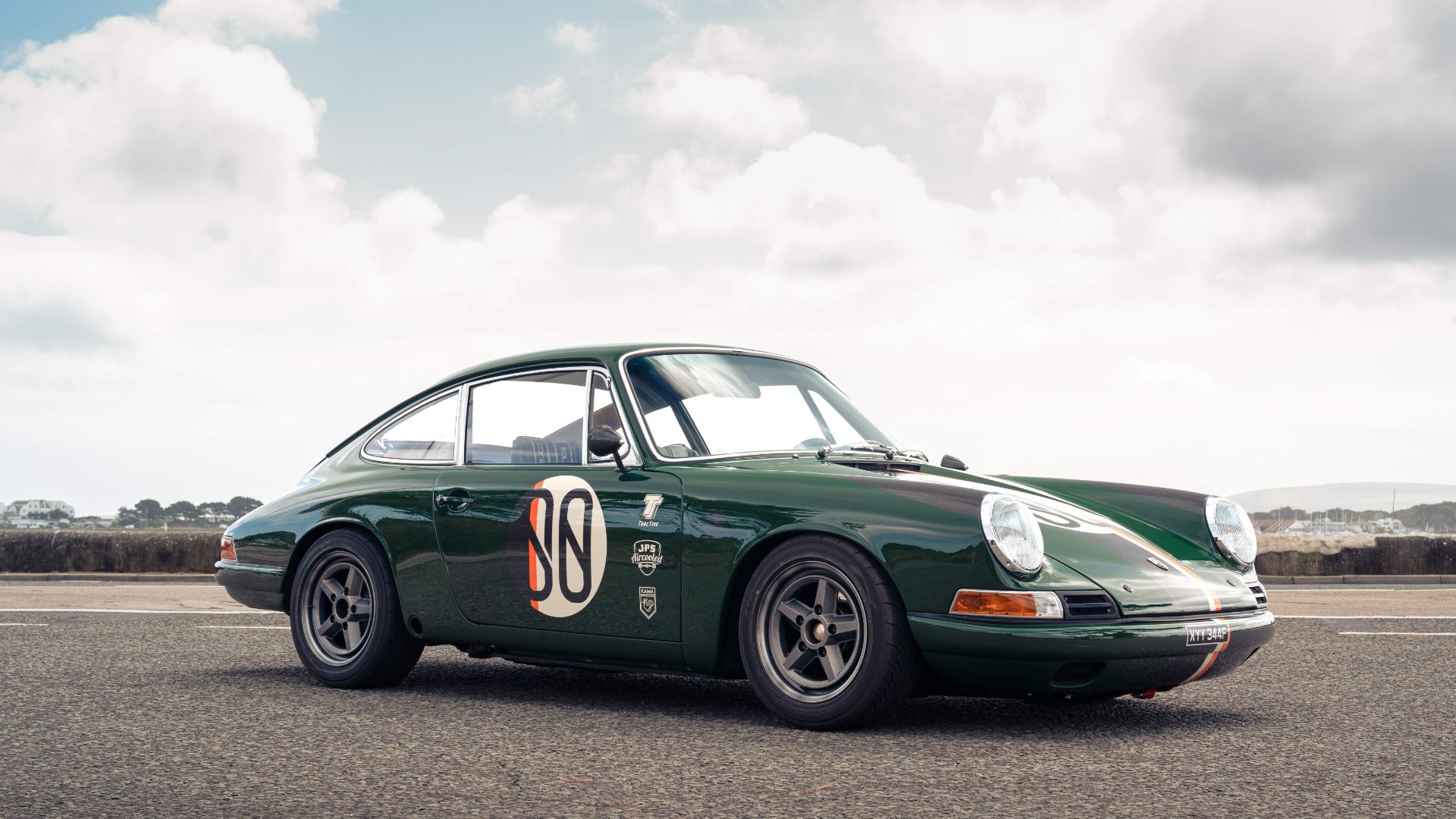
Q. When is a 911 not a 911? A. When it’s a Porsche 912. Long before the Cayman and Boxster – and before even the 924 and 914 – this was a budget version of the world’s most famous sports car. It looked like a 911, but had a four-cylinder engine in place of the usual flat-six.
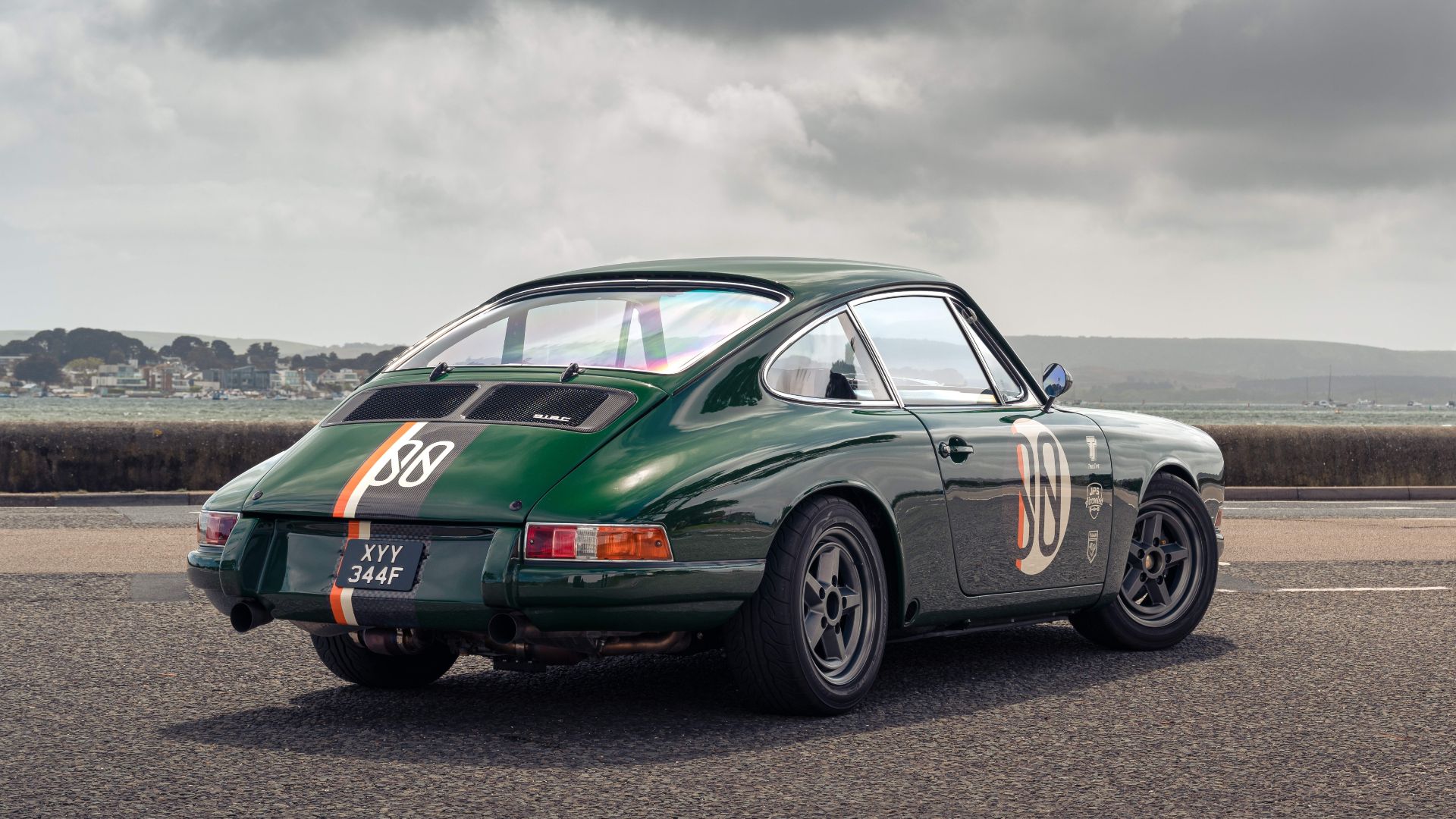
There’s nothing ‘budget’ about the Kamm 912c, a Hungarian restomod priced from £312,000 – or £278,000 if you provide your own Porsche. You may have seen the 912c prototype reviewed in the press last year, but this is our first look at the production version, complete with lots more carbon fibre and an uprated engine.
We’ve already seen countless restomod 911s from the likes of Singer, Theon Design and Paul Stephens AutoArt, but a 912 is an intriguing alternative. One of its chief advantages is light weight: Kamm quotes just 750kg with fluids. For context, that’s nearly 400kg lighter than a basic Ford Fiesta.
Punching above its weight
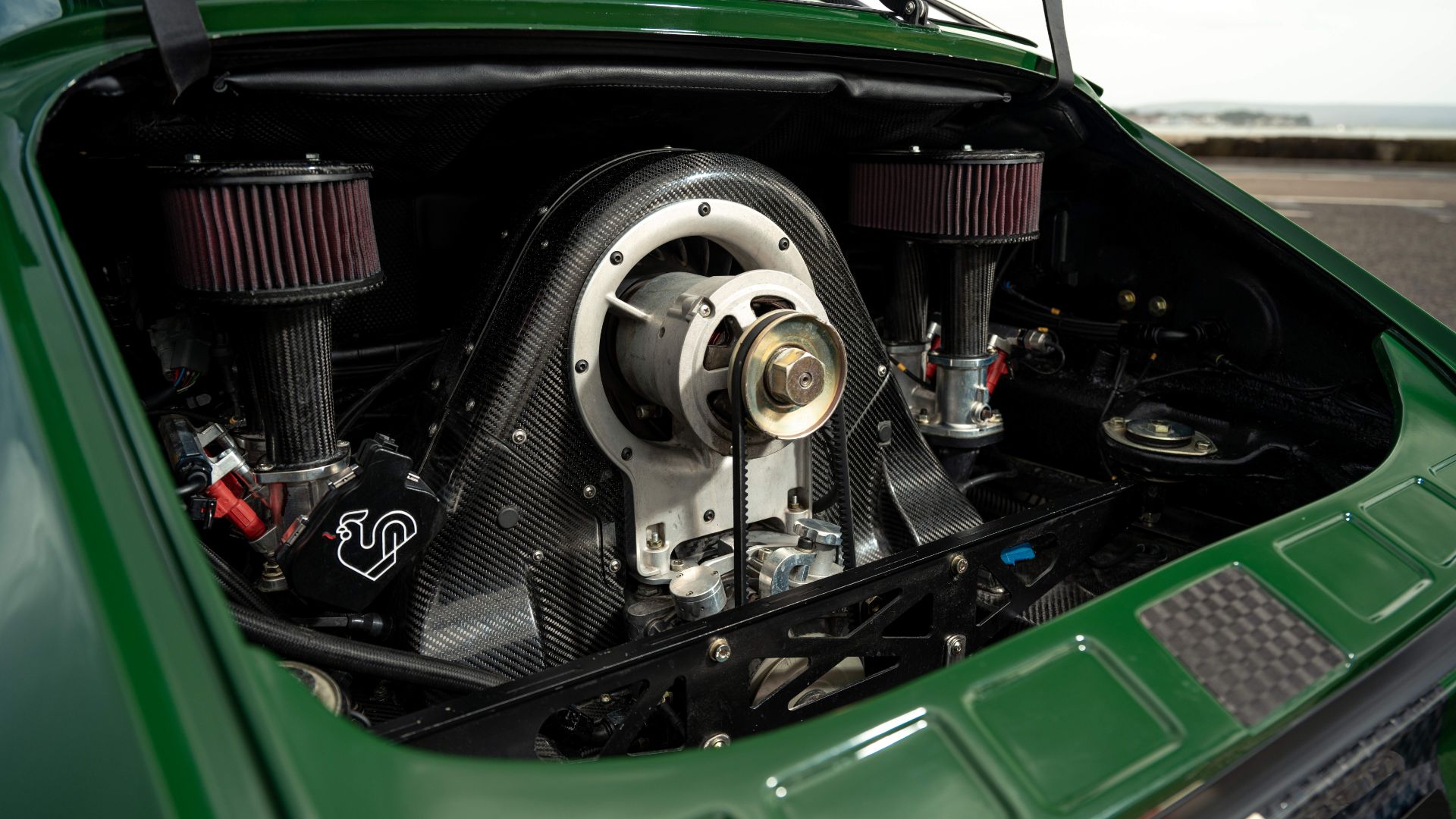
The 2.0-litre four is rebuilt by Swiss motorsport experts JPS, revs to 7,200rpm and produces 190hp. That’s a specific output of 95hp per litre, or ‘the highest horsepower per litre of any air-cooled street engine’. For comparison, the iconic 1973 Porsche 911 Carrera 2.7 RS mustered just 78hp per litre.
With electronic fuel injection, a Life Racing ECU and DBW throttle bodies, the motor is said to deliver ‘constant performance levels in all environments’. Open the rear lid and it looks mouth-watering, too, especially the unadorned carbon fan shroud.
In terms of body and chassis mods, you’ll find Lexan polycarbonate windows, TracTive semi-active coilover suspension and AP racing brakes, including a hydraulic handbrake. Steel-look alloy wheels are optional, or you can choose classic Fuchs or 917-style split-rims.
Want more carbon fibre to accentuate the 912’s small ‘c’? A fully carbon body shell is available, improving rigidity and further reducing weight.
Hungary for more
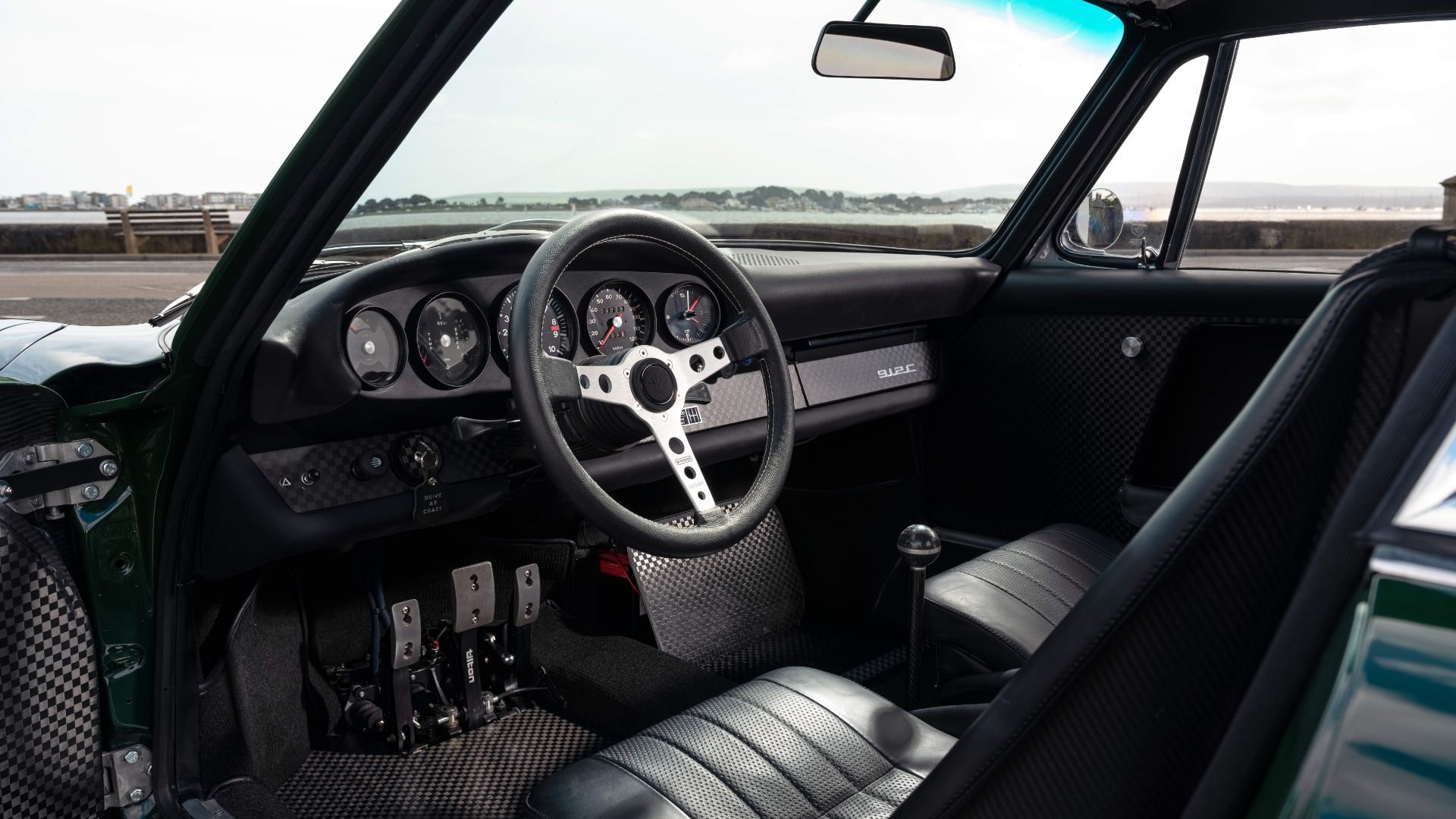
Inside, the simple cabin prioritises functionality and feedback, with classic Porsche-replica seats, lightweight carpets and electric air conditioning.
A carbon fibre gear lever stirs the five-speed ‘box, which has a racing-style dog-leg first gear. The other key touch-points are a three-spoke Momo steering wheel and AP Racing pedal box.
Each 912c is built to order in Budapest and fully bespoke. The first production car is destined for the USA, with two build slots remaining for 2023. Kamm founder Miklós Kázmér said: “The 912c is designed to be as usable as a modern car but retains the driving experience of a classic racing car. We provide reliability and performance with the analogue feel you would expect from a sports car of the sixties, and this makes it unique in the restomod sector.”
We’ll be driving this first production Kamm 912c next month, so come back to Motoring Research soon for our first drive verdict.