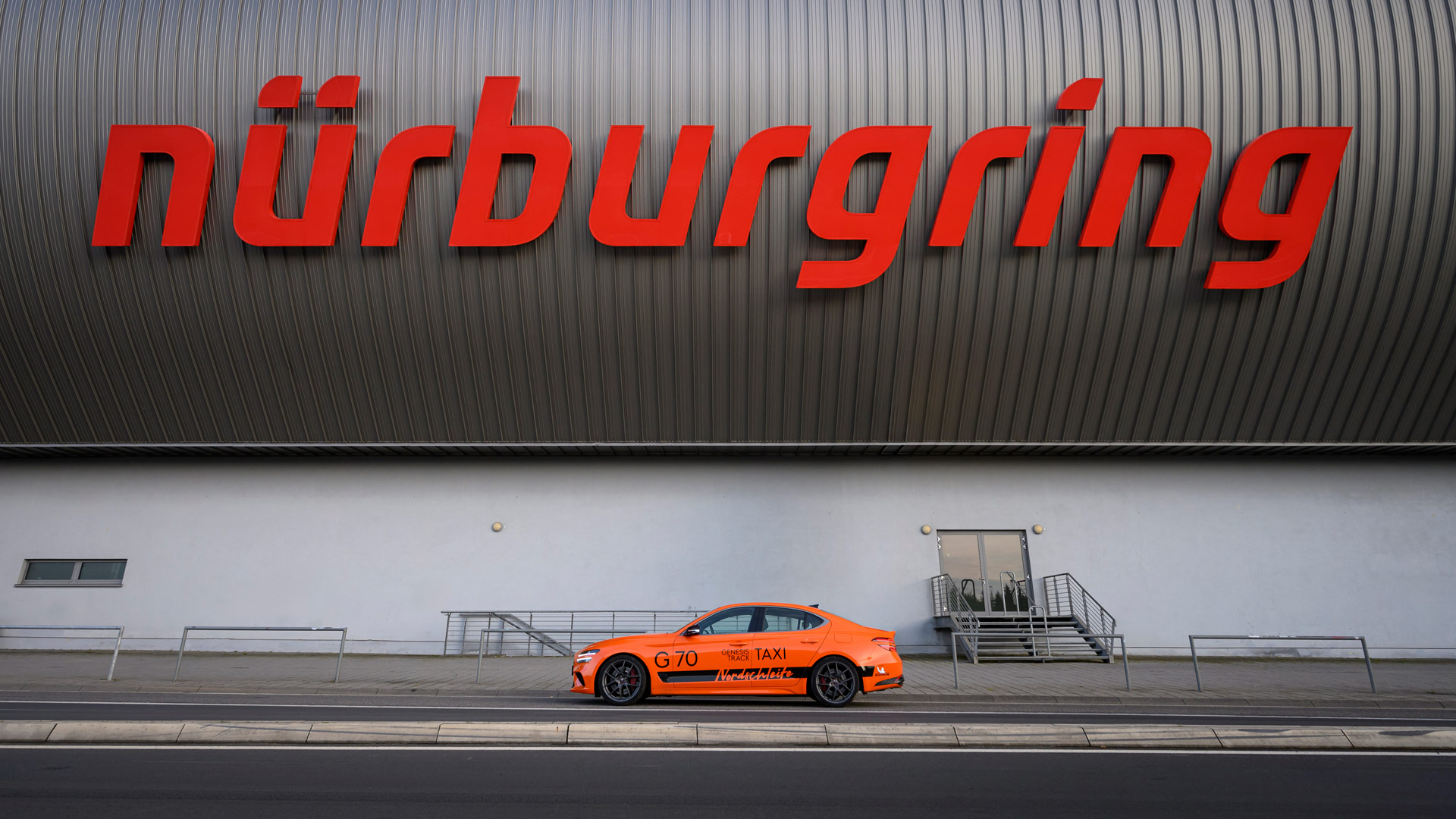
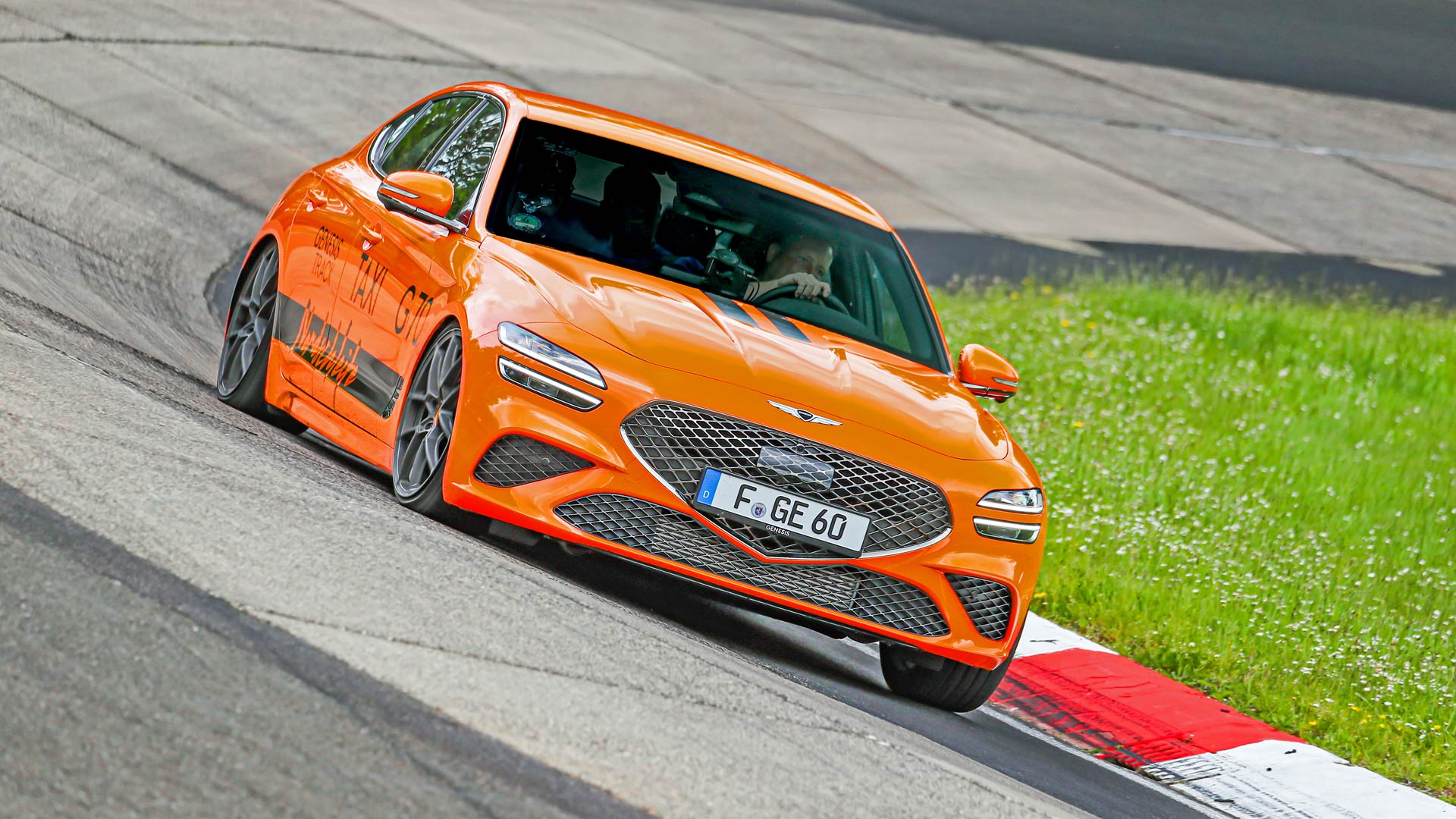
The Nürburgring Nordschleife circuit has a new track taxi service: a fleet of Genesis G70 3.3T saloons.
It marks a new initiative for the upmarket Korean brand, taking its performance model to the famous – and infamous – playground of the German car industry.
A special event at the Nürburgring marked the start of the Genesis Track Taxi programme, with motorsport legend Jacky Ickx in attendance.
Keep the meter running…
At 12.944 miles in length (20.832km), and with 73 corners, learning the racing line around the Nürburgring Nordschleife is no mean feat.
However, making use of a Ring Taxi, like the service now offered by Genesis, offers the chance to experience the ‘Green Hell’ as a passenger, with an expert driver behind the wheel.
To ensure the 373hp G70 3.3T can survive the sustained demands of the circuit, the Hyundai Motor Europe Technical Centre (HMETC) has made some minor upgrades. These include additional brake cooling ducts, plus new heat shields for the transmission oil cooling lines.
A performance showcase
Michelin will supply the Genesis Track Taxi Nordschleife with bespoke Pilot Sport 4S tyres, designed to maximise grip whatever the Nürburgring’s notoriously changeable weather conditions may be.
As a finishing touch, Genesis has given each of the G70 3.3T saloons an eye-catching orange exterior wrap, inspired by the company’s Magma high-performance division.
“The launch of the Genesis Track Taxi Nordschleife programme marks an important milestone in our journey to delivering bold high-performance cars, showcasing the power, handling and performance that the brand can offer,” said Luc Donckerwolke, chief creative officer at Genesis.
Online bookings for the Genesis Track Taxi are open now, with the first drives starting on 6 July 2024. Three passengers are allowed per ride and prices are €120 (£102) for the first person, €40 (£34) for a second person and €20 (£17) for a third person.
Bugatti has unveiled the replacement for the Chiron – and the new Tourbillon hypercar packs even more power than its predecessor.
The Tourbillon is named after a Franco-Swiss watchmaking invention, created in 1801 to improve timekeeping accuracy. It’s the first modern Bugatti not to pay tribute to one of the marque’s legendary racing drivers.
Bugatti’s reason for the change of naming strategy reflects a radical change in powertrain for the car. The incredible 8.0-litre quad-turbocharged W16 engine is no more, but its replacement is no less a feat of engineering…
‘Shaped by speed’
Frank Heyl, director of design at Bugatti, has channelled two decades of experience from the Veyron and Chiron into shaping the new Tourbillon.
Aerodynamics have led the overall design, although Bugatti trademarks such as the horseshoe-shaped front grille and two-tone colour split remain.
Thanks to a new diffuser, the rear wing no longer needs to be elevated for downforce at maximum speed. It still works as an airbrake, though, supporting the huge carbon ceramic brakes fitted all-round.
Bugatti has added upwards-opening dihedral doors to the Tourbillon, while its single windscreen wiper now parks in an upright position to aid aerodynamics. You may remember this approach was also used on Super Touring race cars in the 1990s.
True hypercar performance
The Tourbillon is powered by an all-new 8.3-litre naturally aspirated V16 engine, developed with assistance from Cosworth. Capable of revving all the way to 9,000rpm, it produces 1,000hp and 664lb ft of torque on its own.
However, Bugatti has gone further, adding two electric motors to the front axle, plus a further motor to the rear axle. The result is a combined output of 1,800hp, with a 25kWh battery allowing the hybrid Tourbillon to travel 37 miles on electricity alone.
Despite the addition of the hybrid powertrain, extensive use of carbon fibre and 3D-printed parts means the Tourbillon weighs less than a Chiron, at 1,995kg.
Outright performance is suitably ludicrous, with 0-62mph taking 2.0 seconds, 0-124mph in 5.0 seconds and 0-186mph in 10.0 seconds.
The standard top speed is 236mph, but using the special ‘Speed Key’ unlocks the ability to reach 276mph.
An impeccably timed interior
The cockpit of the Tourbillon is notable for numerous reasons, not least the obvious absence of digital touchscreens. Bugatti notes that such is the progress of infotainment tech, a new car could look dated in just 10 years.
To keep the Tourbillon looking fresh when it appears at a concours d’elegance in 100 years’ time, the only touchscreen is hidden away. It can pop up in portrait mode in two seconds to show the reversing camera, while revealing a landscape-oriented display takes five seconds. But if you can live without Apple CarPlay, it can stay out of sight.
Living up to its horology-inspired name, the Tourbillon features an exquisite instrument cluster, created with help from Swiss watchmakers. It is made of more than 600 parts, including sapphires, rubies and titanium.
The steering wheel has a fixed hub and rotates around the instrument panel, ensuring drivers have an unobstructed view of the dials. There are small paddles for the eight-speed dual-clutch transmission, too.
Buy your lottery ticket now
Bugatti is putting the Tourbillon through an extensive test programme, with prototype models already on the road.
The company plans make 250 examples, each one built by hand at the factory in Molsheim – once the final Chirons have been completed. This first deliveries should take place in 2026.
Prices for Bugatti’s latest hypercar start from €3.8million before taxes, equating to around £3.85million when VAT is included.
Maserati has announced two limited-edition versions of its MC20 supercar, influenced by a motorsport hero from 20 years ago.
The MC20 Icona and Leggenda are both inspired by the Maserati MC12, which led the Italian marque’s return to racing in 2004.
Production of the two customised ‘Fuoriserie’ MC20 models is limited to 20 cars each, in recognition of the two decades since the MC12 was launched.
A true homologation hero
The Maserati MC12 shared a platform with the Ferrari Enzo supercar. This meant a mid-mounted 6.0-litre V12 engine that was surrounded by aerodynamic bodywork made entirely from carbon fibre.
In order to homologate the MC12 for use in the FIA GT Championship, Maserati produced 50 Stradale (Street) models, along with the 12 race cars.
The MC12 proved to be hugely successful, claiming six teams’ titles, six drivers’ championships, and two manufacturers’ trophies between 2004 and 2010.
Maserati has chosen to honour the famous Vitaphone Racing MC12 GT1 with the MC20 Leggenda. The MC20 Icona, meanwhile, pays tribute to the road-going MC12 Stradale.
Extra strong mint
For the MC20 Leggenda, Maserati has used a Vitaphone-inspired colour scheme of Nero Essenza and Digital Mint Matte. Its trident-design alloy wheels are finished in black, with yellow used for the Maserati badges on the front grille and C-pillar.
On the inside, the four-way adjustable bucket seats are finished in black with silver stitching. The word ‘Leggenda’ is embroidered onto their headrests.
The MC20 Icona mimics the design of the MC12 Stradale, with a combination of Bianco Audace Matte over Blu Stradale paint.
Blue brake calipers and an Italian flag behind the front wheelarch are further highlights. The Icona’s sports seats are also upholstered in blue.
A classic comeback
Maserati has left the MC20’s 630hp 3.0-litre twin-turbocharged V6 untouched for the Icona and Leggenda editions, but it now resides beneath a carbon fibre cover.
An electronic limited-slip differential is fitted as standard on both cars, along with a front axle lift kit. A Sonus Faber audio system and carbon fibre interior trim are included for good measure.
No prices have been announced by Maserati yet, but expect the 20 examples of each special MC20 to sell out soon.
Launched in 1990, the Mercedes-Benz 190E 2.5-16 Evo II was a classic homologation special. The racing version locked horns with the E30 BMW M3 and Audi V8 in the German touring car championship (DTM), finally winning the title in 1992. And the road-going Evo II remains one of the wildest cars ever to wear the three-pointed star.
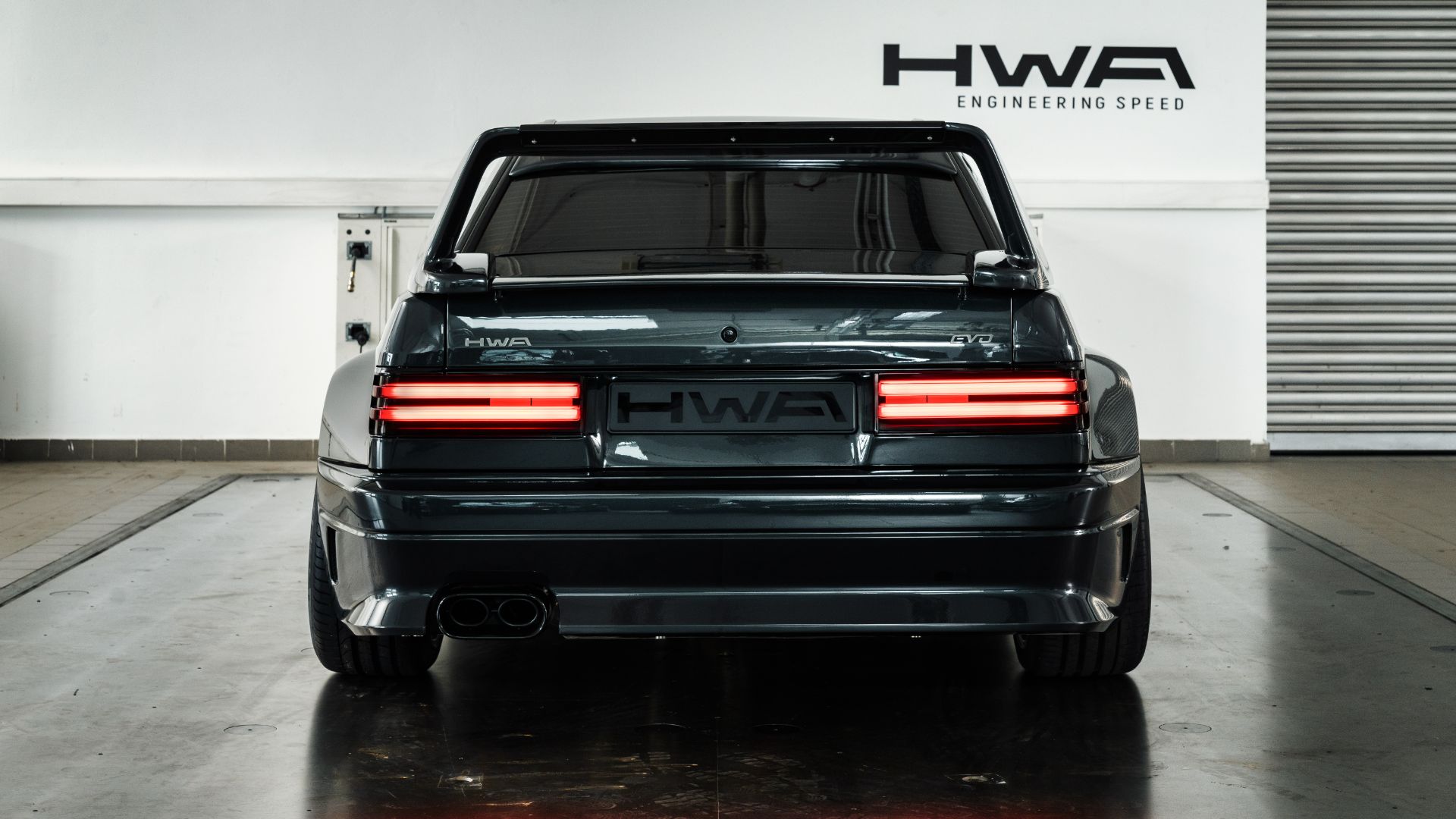
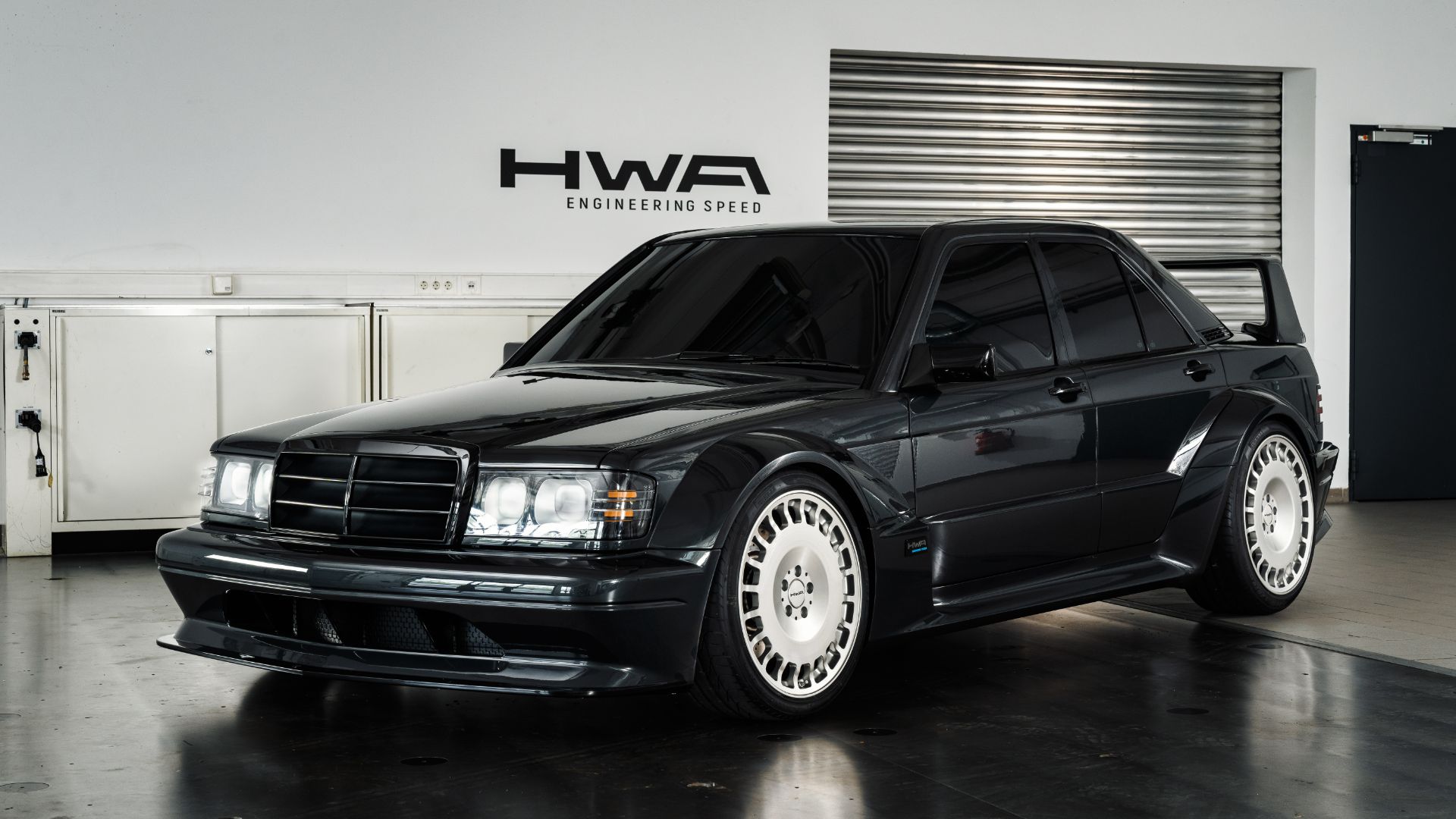
Now the Evo II is back, ‘evolved’ by HWA into a ‘road-legal, track-ready supercar‘ with carbon fibre bodywork, DTM-derived suspension and twice the power of the Stuttgart original.
Just don’t use the ‘R’ word… “This is not a restomod, it’s a completely new car,” says chief engineer Gordian von Schöning. We travelled to HWA headquarters in Affalterbach, southern Germany – also home to Mercedes-AMG – for an in-depth preview.
Born in Affalterbach
HWA’s close proximity to AMG is no coincidence. Company founder Hans Werner Aufrecht (note the initials) was also the ‘A’ in AMG, having established the now-legendary tuning firm in 1967. When DaimlerChrysler acquired AMG in 1998, Aufrecht started afresh – literally across the road on Benzstrasse – with HWA.
Now in its 26th year, HWA’s primary focus has always been motorsport. It has won 11 DTM championships with Mercedes-Benz, and supplies engines and electric powertrains for Formula 3 and Formula E. It also hand-builds around 120 AMG GT-based race cars each year, including the Track Series, GT4 and GT3.
On the road-going side, joint projects with AMG have included the extreme CLK-GTR ‘Strassenversion’, CLK DTM and SL 65 Black Series. HWA also assembled the Apollo IE hypercar and recently started building the De Tomaso P72. Yet it has never launched a car under its own banner – until now.
Making ’emotional engines’
Before we come face-to-face with the new Evo, CEO Martin Marx – who began his career as a race engineer for Bernd Schneider – takes us for a guided tour. Brightening up the reception is an HWA-built Aston Martin Vantage DTM, which competed for one season in 2019, along with an enormous trophy cabinet. It soon becomes apparent that there are motorsport trophies everywhere. They even serve as door-stops in the offices upstairs.
We start in the engine workshop, where Marx shows me the 850hp, 9,000rpm V12 that HWA developed for the Pagani Huayra R. “Horacio Pagani told us he wanted an emotional engine and we delivered,” he says with a smile.
HWA Evo’s wheelbase is stretched by 80mm, with a 300mm wider track.
Only the centre section of the donor 190E is retained, supported by new aluminium subframes and structural carbon fibre panels.
HWA chief engineer says: “This is not a restomod, it’s a completely new car”. pic.twitter.com/5hCwa9z2SL
Heading across to the design studio, we see classic Mercedes-Benz paint colours such as Silver Thistle and Sunset Orange being remixed and enhanced for the Evo. Then it’s down to the dyno rooms, where road and racing components are tested to destruction. “Our transient powertrain dyno is the only one in Germany,” Marx explains. “It can simulate hard-driven laps of any racetrack in the world: acceleration, braking and cornering forces – even bumping over the kerbs.”
Our tour concludes in the production facility, where race-ready versions of the AMG GT are built up from bare shells. The Evo will also be assembled here – at a rate of one car per week – from early 2025. Max says 71 of the 100 cars planned are already accounted for.
The evolution of Evo
With a price tag of €714,000 (approx. £730,000), that is some sales feat. However, Gordian von Schöning says the “depth of engineering is on another level to any competitor, even a certain company from California”. That’s Singer Vehicle Design, in case you failed to read between the lines…
Indeed, the steel chassis centre section is the only major part retained from the donor Mercedes-Benz 190E. After being reinforced, it is bookended by lightweight aluminium subframes, then clothed in structural carbon fibre panels. The car’s wheelbase is stretched by 80mm and track width grows by around 300mm.
The 1990 Evo II was powered by a 235hp 2.5-litre four-cylinder engine. The 2024 Evo raises the stakes somewhat, with a 450hp 3.0-litre twin-turbocharged V6 loosely related to that found in a Mercedes-AMG E 53. Opt for the Affalterbach power pack and output rises to 500hp – good for a top speed of 185mph.
Sensibly, the Evo’s brakes have been upgraded to match, with six-piston front calipers and the option of carbon-ceramic discs. Suspension is by double wishbones all-round, bolstered by KW dampers and billet-machined wheel carriers.
A homologation hero
Finally, we enter a small workshop and Marx pulls the wraps off the first Evo ‘concept demonstrator’. Parked alongside a classic 190E Evo II, the differences between the two cars are immediately apparent. In isolation, the Stuttgart original looks imposing and aggressive. In this company, it seems undernourished, perhaps even a little underwhelming.
HWA designer Edgar Chu walks us around the car, pointing out details such as the minimalist grille and one-piece LED headlight/indicator units. However, the superb stance is what hits hardest. Enlarged alloy wheels – 19 inches at the front, 20s at the rear – fill out cartoonishly swollen arches, with a hydraulic nose-lift fitted to protect that vulnerable front splitter.
Here’s the HWA Evo alongside the car that inspired it: the 1990 Mercedes-Benz 190E 2.5-16 Evo II.
The original is one of 502 built to homologate the 190E for DTM racing.
Production of the new Evo will be limited to 100 cars, with 71 already reserved. pic.twitter.com/eJ7OQpTR5e
As these photos reveal, customers can choose between ‘OEM+’ six-spoke or racing-style aero rims. We’ll go for the latter, please – preferably with a period DTM livery to match.
Later over coffee, Chu compares the Evo to one of his previous projects: the 2018 Mercedes-Benz G-Class. “When you recreate an icon such as the G-Wagen or 190E Evo II, you can’t change too much,” he explains. “It’s important to retain the essence of the original.”
What’s next for the HWA Evo?
The major part of the HWA Evo we haven’t seen yet – hidden here behind blacked-out glass – is the interior. It will only be offered in left-hand drive (although that never hindered the E30 M3) and Chu says to expect a “classic 190E dashboard with configurable digital dials”. The manual gearlever will be illuminated with each car’s individual build number, too.
A manual gearbox? Oh yes. For all its added performance and motorsport breeding, the Evo should offer a defiantly analogue experience.
We will find out how this “road-legal, track-ready supercar.” drives later this year. Perfect 50:50 weight distribution and a kerb figure of 1,360kg (almost identical to the Evo II) certainly whet our appetite, but there’s no doubt the Evo delivers on HWA’s slogan: ‘Engineering Speed’.
Click + Follow above to receive more great content written by car experts
Volkswahen has announced prices for the updated 2024 Golf GTI, ahead of order books opening this month.
Revealed earlier this year, the revised ‘Mk8.5’ version of the famous hot hatchback comes with subtle styling tweaks and a revised interior.
A 2.0-litre turbocharged four-cylinder petrol engine remains beneath the bonnet, but its 265hp output is up 20hp versus the outgoing car. Zero to 62mph takes 5.9 seconds, with a seven-speed DSG transmission fitted as standard. The Golf GTI now costs from £38,900.
A subtle facelift for 2024
In traditional Volkswagen fashion, styling changes for the latest Golf GTI are not immediately obvious.
They include new ‘IQ.Light Matrix’ LED headlights, along with an illuminated Volkswagen roundel for the front grille.
Buyers also get redesigned LED tail lights, new GTI model badges below the side mirrors and a set of 18-inch ‘Richmond’ alloy wheels. The latter look similar to the ‘Teledial’ wheels favoured by Alfa Romeo.
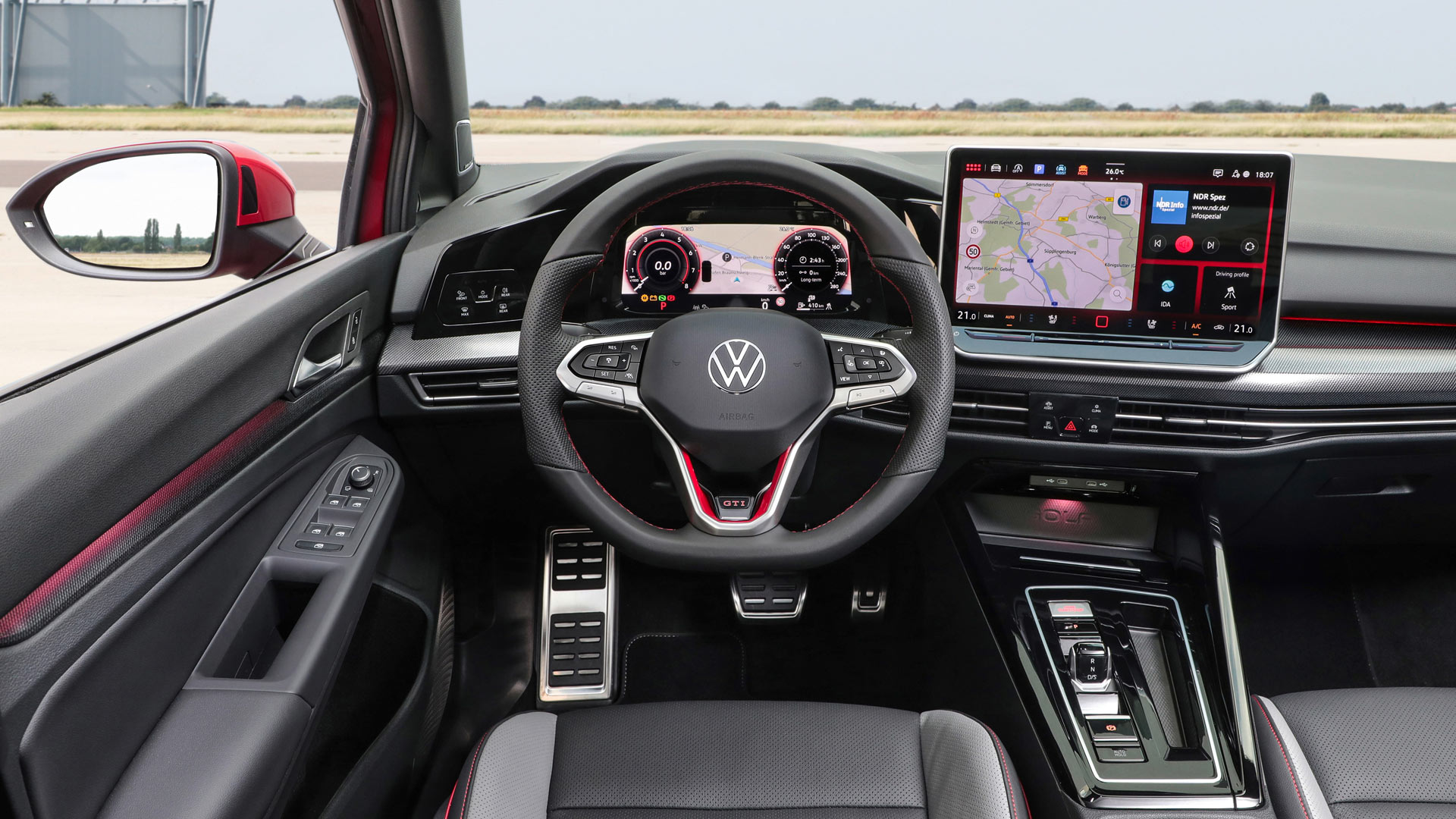
Inside, the updated Golf has a new 12.9-inch central touchscreen, which finally comes with backlit illumination for the volume control sliders.
Sadly, there are no new physical buttons for the climate control system, but ChatGPT AI is now integrated as standard.
Physical steering wheel buttons are new, however, along with heated front sports seats trimmed in classic GTI-style cloth. Keyless entry, a reversing camera and adaptive cruise control are part of the package as well.
Plug-in options on the way
Volkswagen will start accepting orders for the updated Golf GTI on 20 June 2024. It will be followed by two new plug-in hybrid Golf models, available to order from 27 June.
Priced from £36,760, the Golf Style eHybrid has a 204hp petrol-electric powertrain and is capable of covering up to 89 miles on battery power only. Three-zone climate control and a host of safety equipment are included.
The Volkswagen Golf GTE raises power output to a combined 272hp, with a potential 82 miles of EV range. Like the eHybrid, it attracts a low, five percent Benefit-in-Kind company car tax rate. Prices for the Mk8.5 Golf GTE start from £39,750.
Don’t forget to + Follow us for more stories like this written by our expert editors!
A new partnership between Vauxhall and Tesco will see new-car buyers receive 50,000 Clubcard points.
When purchasing a new car or SUV from a Vauxhall dealership, customers will be able to exchange the 50,000 Clubcard points for £500 in Clubcard vouchers to be spent in a store.
Alternatively, they can opt for having £1,000 to spend with Tesco Clubcard Reward Partners.
The offer follows an agreement reached earlier this year between Vauxhall and Tesco on electric car charging access.
Every little helps
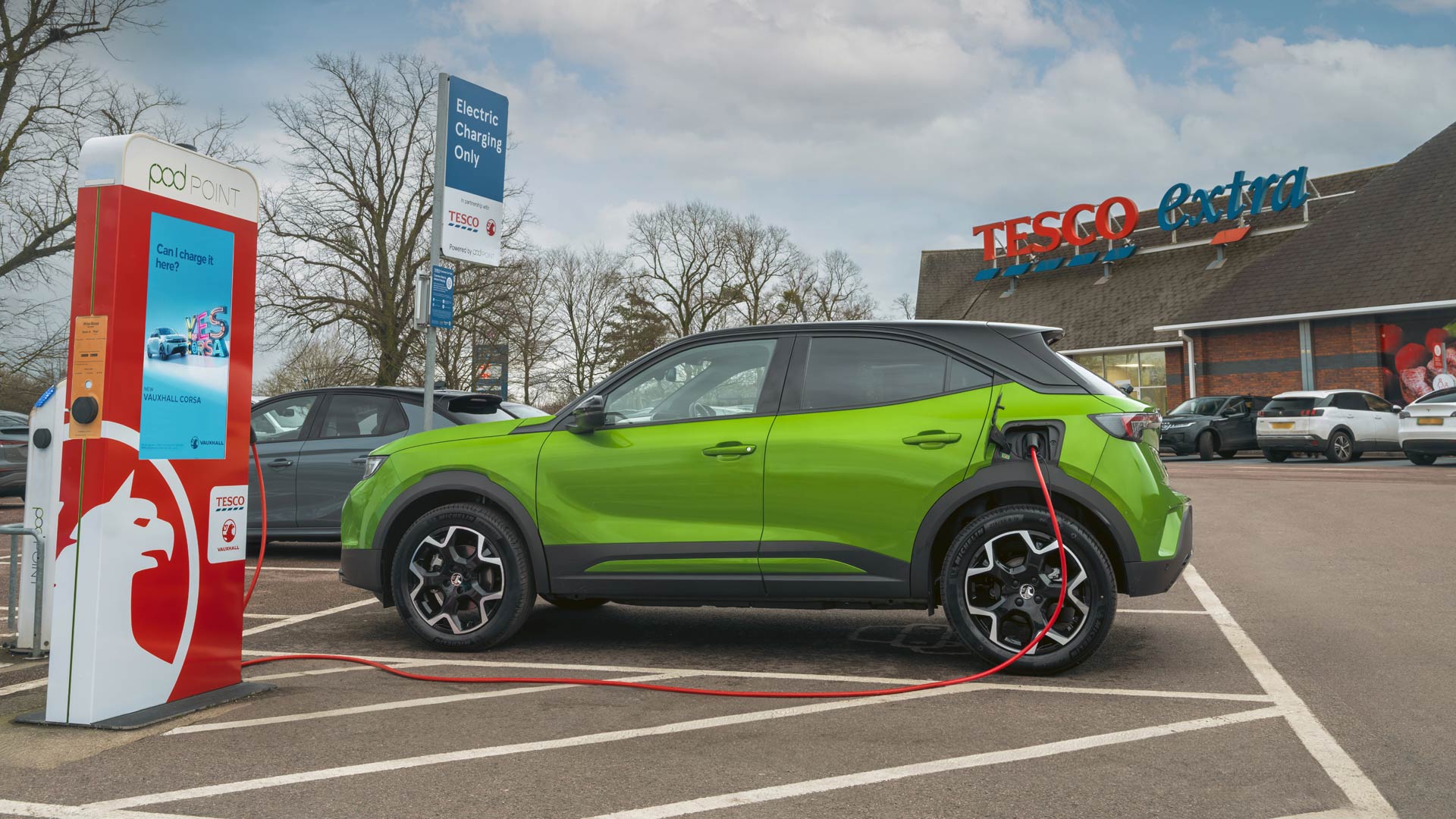
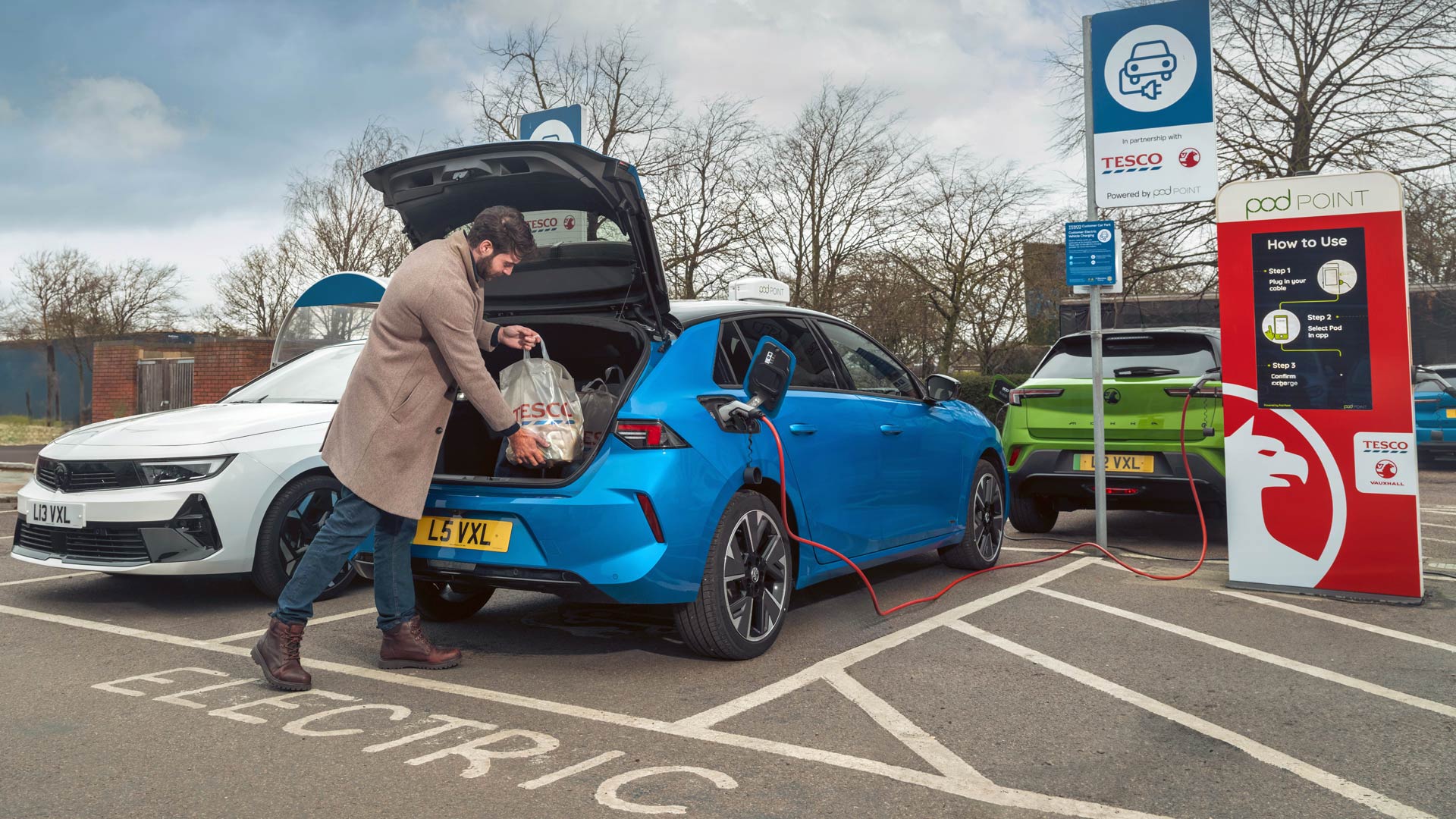
In 2018, Tesco embarked on an ambitious strategy to roll out electric vehicle charging to its supermarkets across the UK. More than 600 stores are now included, with 2,700 individual charging points available.
The Tesco charging network was originally established by Volkswagen and Pod Point. At first, it allowed EV drivers to charge for free while shopping.
However, this new offer means anyone who buys a new electric Vauxhall will receive one year’s free EV charging credit, which can be used at Tesco stores nationwide.
A supermarket sweep
Both the 50,000 Tesco Clubcard points and free EV charging offers will run concurrently, offering a double bonus for anyone purchasing a new electric Vauxhall.
James Taylor, managing director of Vauxhall, said: “Vauxhall is always looking for ways to both reward and support our customers and we are delighted to be able to bring this incredible offer to them through the Tesco Clubcard scheme.
“What is particularly exciting for us, is that for our new electric vehicle customers, we can now not only reward them for their purchase of a new EV, but also provide the incentive of one year’s free EV charging credit.”
The offer of 50,000 Clubcard points applies to new Vauxhall vehicles purchased before the end of 2024.
BMW has refreshed the M2 for 2024, with a host of detail updates for its compact, sporty coupe.
Although the M2’s styling remains virtually unaltered, there are changes to the 3.0-litre turbocharged straight-six engine beneath its bonnet.
Output now peaks at 480hp, an increase of 20hp compared to the previous version. Maximum torque also climbs to 443lb ft, moving the M2 closer to its larger BMW M4 cousin.
This reduces the car’s 0-62mph time to exactly 4.0 seconds, with a top speed limited to 155mph. However, this can be upped to 177mph with the optional M Driver’s Package.
Still sticking with it
BMW may be ditching manual transmissions from most of its models, but the M2 retains the option of clutch pedal. An eight-speed Steptronic automatic comes as standard, with the six-speed manual an extra-cost option.
Shifting gears yourself increases the 0-62mph time to 4.2 seconds, yet arguably makes the car more involving to drive.
On the inside, there is a new flat-bottomed steering wheel that features a red 12 o’clock marker. Buyers can specify a wheel trimmed in Alcantara, along with carbon fibre sports seats.
The latest version of BMW’s iDrive infotainment system is fitted to the new M2. This combines a 12.3-inch digital instrument panel with a 14.9-inch central touchscreen.
A full colour palette
As part of the 2024 update, BMW has also added an array of new paint colours for the M2. These include bold Sao Paulo Yellow, Fire Red and Portimao Blue. Curiously, BMW opted to release press photos using the understated Grigio Telesto.
After a production run lasting 11 years, Jaguar has built its final F-Type sports car – now off to become a museum piece.
The Jaguar Daimler Heritage Trust will become custodians of the last F-Type convertible, having previously taken ownership of the final coupe as well.
It means the F-Type will sit alongside icons from the history of the Jaguar brand – including the very last E-Type – as part of a carefully preserved heritage collection.
End of the line for F-Type
Rather poignantly, the F-Type will enter the Jaguar Daimler Heritage Trust exactly 50 years after the final E-Type left the factory.
The E-Type in question is a 5.3-litre V12 Series III Convertible. It represents one of the 72,528 E-Types made between 1961 and 1974, before production ended with a special run of 50 cars.
Jaguar’s inspiration for the final F-Type came from its illustrious predecessor, with Giola Green paint and a black roof chosen for the 5.0-litre V8-powered convertible. On the inside, the F-Type has a tan leather interior.
Although production of the F-Type has now ended at Jaguar’s Castle Bromwich facility, the car will remain available to buy until early 2025.
An electric future beckons
The end of the E-Type production led to the launch of the modernised XJ-S, but the F-Type’s replacement will be an even more radical transition.
Instead of the combustion-engined sports car, Jaguar will reveal an fully electric four-door GT in early 2025.
The plan is for Jaguar to become entirely electric, with the XE and XF saloons also having now reached the end of their production runs.
Rawdon Glover, managing director of Jaguar, said: “Today, as we celebrate F-Type and our 75-year history of innovative Jaguar sports cars, we are also looking forward to the beginning of a new era.
“We will reimagine and elevate the Jaguar brand that will be focused on growing client intimacy and engagement, underpinned by our purpose to inspire like no other.”
The 24 Hours of Le Mans takes place this weekend, with BMW racing in the premier Hypercar category.
It marks the first time the German company has competed in the top class at the French endurance classic since 1999.
BMW is using two of its M Hybrid V8 race cars at Le Mans, and the number 20 entry is the latest racer to get the Art Car treatment.
At the same time, BMW is paying tribute to the very first vehicle in the Art Car Collection via a special clothing collaboration with Puma.
Travelling without moving
The first BMW Art Car was created in 1975, when racing driver Hervé Poulain asked American artist Alexander Calder to paint his 3.0 CSL race car.
Chiefly known for his work as a sculptor, Calder used intense primary colours and sweeping lines on the BMW’s bodywork. The aim was to make the 480hp 3.0 CSL look like it was going flat-out, even when standing still.
Sadly, Poulain’s BMW had to retire from the Le Mans race after seven hours due to mechanical issues. Yet Calder’s design captured the imagination of the crowd – and the Art Car project was born.
BMW has since raced multiple other Art Cars at Le Mans, including those designed by Jenny Holzer, Andy Warhol and Roy Lichtenstein.
Putting a price on style
The clothing collaboration between BMW and Puma makes use of the design elements Calder included on the 1975 Art Car.
This means plenty of bold colours, contrasting lines and the number 93 – as found on the BMW 3.0 CSL racer.
Enthusiasts can pick from two t-shirts, a shirt, shorts, a five-panel baseball cap and a set of trainers, all with a similarly elaborate design.
Prices start at £46.50 for the baseball cap, rising to £102.50 for the shorts, with all items available through BMW’s online shop.
Given that Calder’s own artwork has achieved prices in excess of £20 million, these Puma accessories could be considered a bargain…
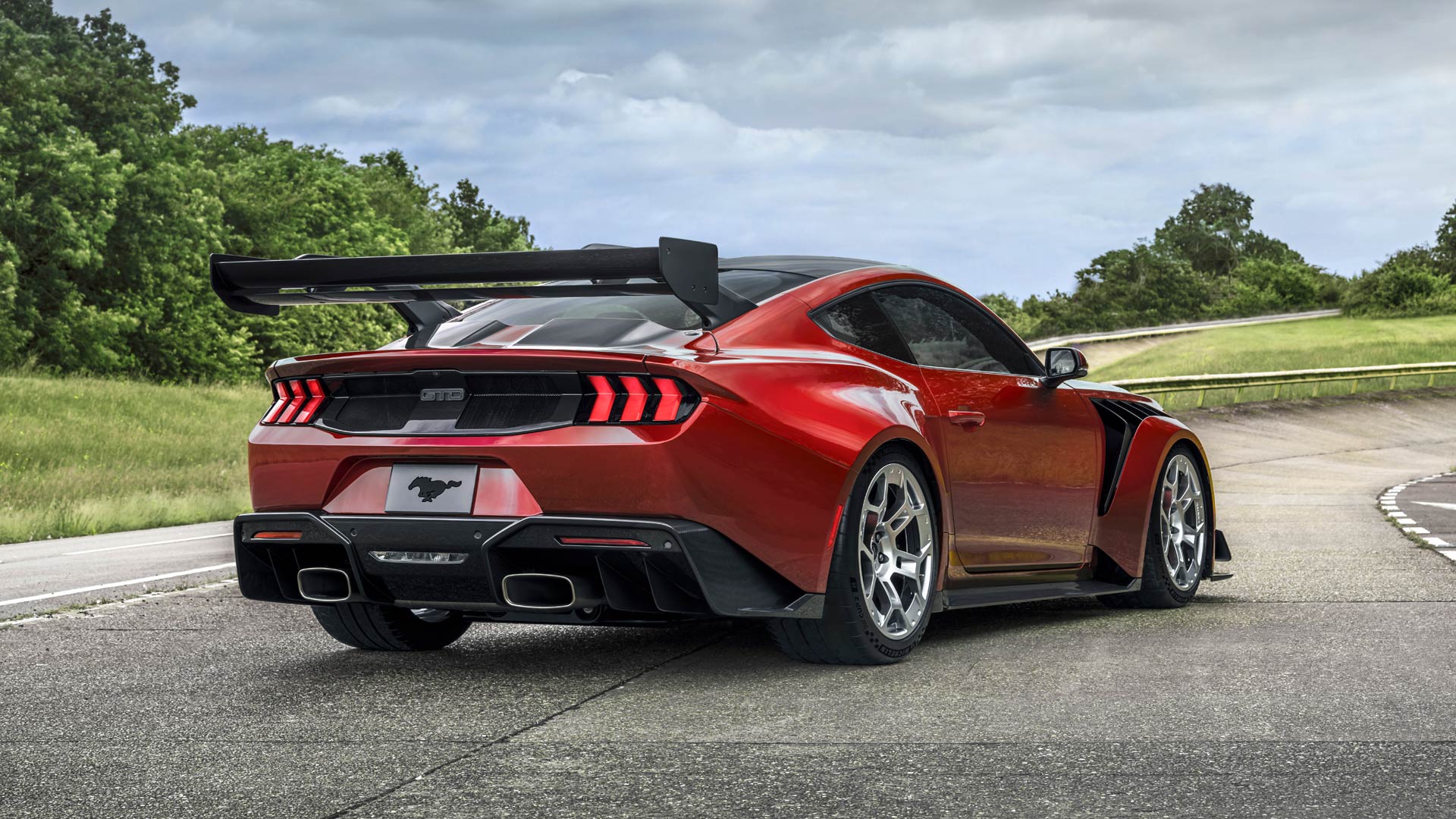
Ford has chosen this weekend’s 24 Hours of Le Mans for the European debut of the Mustang GTD – and to reveal more information about its ultimate pony car.
Conceived to allow Ford to enter the Mustang in the GT3 racing category at Le Mans, the road-going GTD promises an extreme driving experience.
Intriguingly, Ford will also start accepting expressions of interest for the 800hp Mustang from European enthusiasts.
Fastest pony in the stable
Although the GTD looks relatively similar to other models in the latest Mustang range, beneath the skin it is very different.
Not simply another modified muscle car, the Mustang GTD is closer in concept to supercars such as the Porsche 911 GT3 RS. As such, it is a true homologation special – developed with Ford’s racing partner, Multimatic.
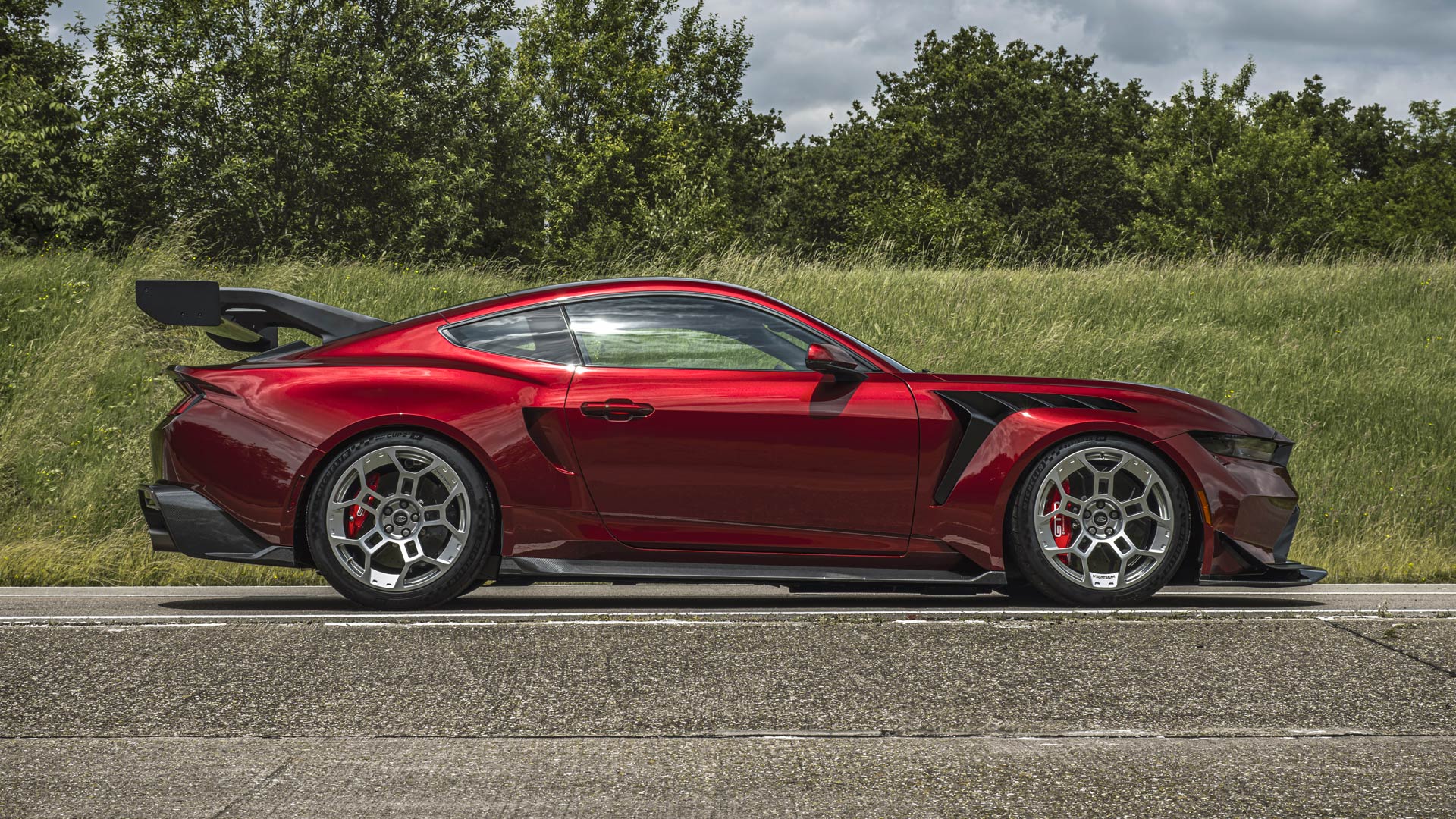
Beneath the carbon fibre bonnet is a supercharged 5.2-litre V8 that produces more than 800hp. This is connected to the rear wheels by an eight-speed dual-clutch transmission with titanium paddle shifters.
The trick suspension includes Multimatic’s DSSV spool valve dampers, with motorsport-style coilover springs occupying space in the boot. For the first time on a Mustang, there is a nose lift option to help negotiate speed humps.
Ready for the ‘Ring
Want even more? An optional new Performance Pack helps the Mustang GTD target a sub-seven-minute lap of the fearsome Nurburgring Nordschleife circuit.
It includes a deep front splitter, underbody flaps, extra dive planes and a Formula One-style Drag Reduction System (DRS) for the gigantic rear wing. Active aerodynamics are used to boost the GTD’s top speed.
The Performance Pack also includes 20-inch magnesium alloy wheels, along with the removal of sound deadening to save weight.
Greg Goodall, chief engineer for the Mustang GTD, said: “From the lightweight carbon fibre body on every GTD to the active aerodynamics of the Performance package, we’ve learned from motorsport how to make the Mustang GTD excel everywhere – all in the quest for a sub-seven-minute lap of the Nurburgring”.
Supercar power and pricing
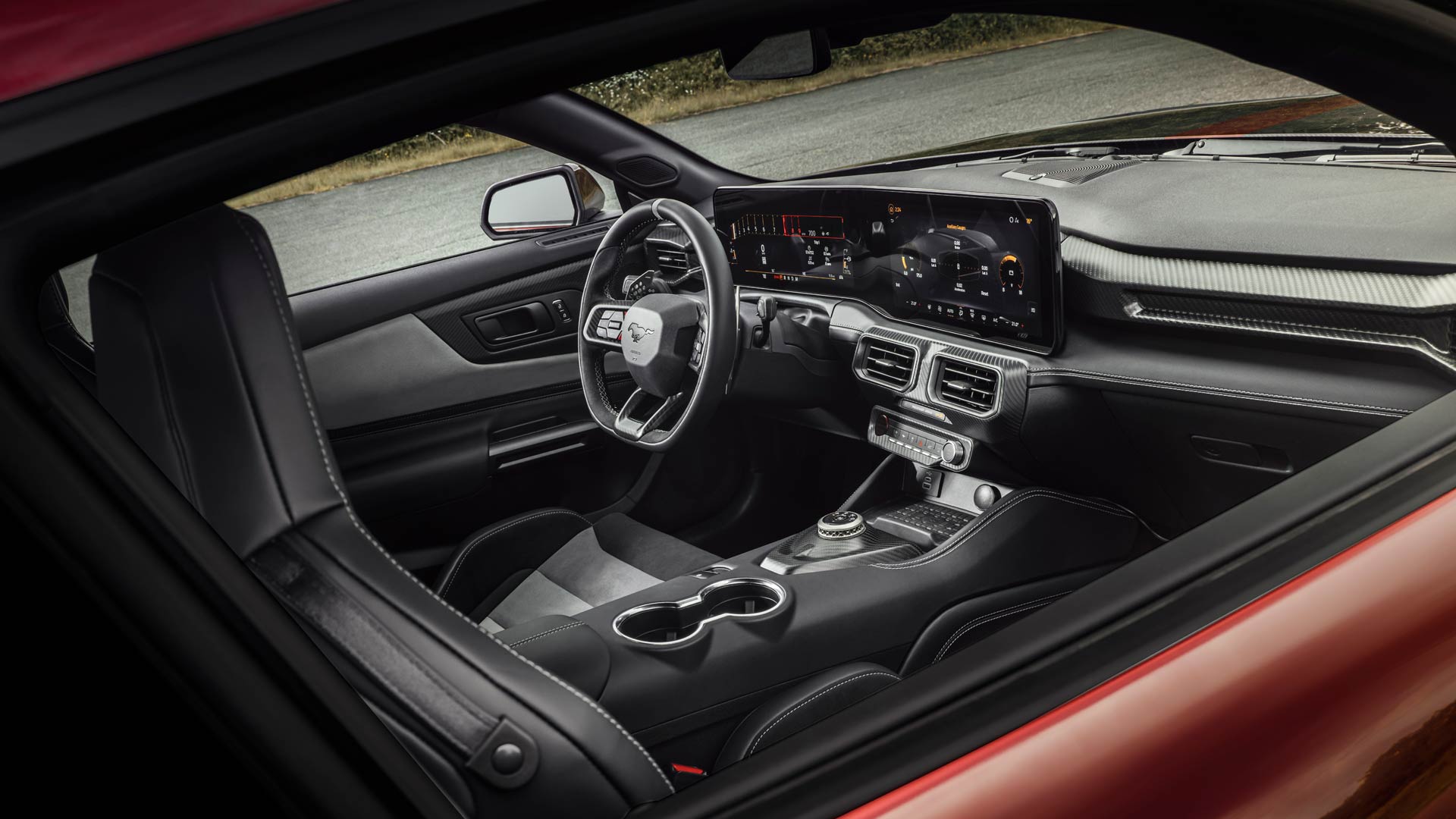
The GTD Performance Pack has a flat-bottomed steering wheel, trimmed in Dinamica, with buttons to adjust the suspension settings and alter the exhaust mode.
Buyers will have a choice of six colours, including the dramatic Chroma Flair red shown here. A Carbon Series option leaves the body panels unpainted to show-off the carbon fibre construction.
Ford has been coy about prices for the Mustang GTD, but North American buyers are expecting to pay in the region of $325,000 (£254,000). However, this did not stop more than 7,500 enthusiasts applying to own one.