Home Blog Page 476

Diesel still has a ‘valuable role’ says Chris Grayling MP

0

Chris GraylingTransport Secretary Chris Grayling MP has spoken out in favour of diesel cars as a stepping stone to future zero-emissions vehicles, during a keynote address to the UK automotive industry.

Responding to claims he advised people to ‘think twice’ before choosing a diesel car, Grayling said he was only partially quoted. It’s people in cities who should look at alternatives to diesel, such as electric cars and hybrids, he said.

“If you’re driving long distances, if you’re out and about for work, diesel is a perfectly sensible option. I think it’s a very important distinction to make.

“Diesels can still play a valuable role in reducing CO2 emissions during the transition period to that low emission future,” he said during his speech to delegates at the Society of Motor Manufacturers and Traders’ 2018 International Automotive Summit.  

“There are horses for courses in today’s technology,” he said. “I hope consumers will think about the nature of the motoring they do and buy the right vehicle and the right technology for that usage.”

This may be positive news for the fleet car industry, which makes up more than half the UK new car sector. Some businesses and fleet managers have been questioning whether they should buy diesel or switch into less economical, higher-CO2 petrol cars: Grayling’s clarity will provide much-needed guidance.

Transport needs to clean up

Grayling also spoke about the need to continue reducing emissions of the UK transport system, which currently contributes 91 percent of British greenhouse gas emissions. The government last year published its clean growth strategy and more is planned soon, said Grayling.

“This summer, we will publish our Road to Zero Strategy. We’ve worked hard to get it right.” It will contain the roadmap that will outline how every new British car and van will be “effectively zero emission by 2040”.

Expectations are that it will clear up just what the government means by electric and electrified cars, and when it expects key steps to be achieved.

But again, he said, it will not favour one technology over another. “There are no plans to bar any specific technology – our strategy remains that we should be tech neutral.”

Grayling also noted that one in eight battery electric vehicles currently sold in Europe is built in the UK. The government is thus encouraging the development of next-generation electric car batteries in the UK, with the £246 million Faraday Challenge.

The technological change that’s in store for the automotive industry “is a great opportunity for this country, for the skilled people who work in this industry. There are opportunities that are unprecedented… a revolution lies ahead.”

Advertisement

Car industry risks ‘death by a thousand cuts’ without Brexit rethink

0

Mike HawesProgress on Brexit needs to speed up in order to allay growing automotive industry concerns and address a marked slowdown in investment, the Society of Motor Manufacturers and Traders (SMMT) has warned.
The automotive industry trade body is today presenting its latest report on the health of the UK car sector, which shows that manufacturing turnover hit a record £82 billion in 2017. However, it says this success risks being reversed without the speedy conclusion of a deal that clarifies Britain’s regulatory and customs relations with the EU.

Already in 2018, inward investment in the car industry has suffered a marked slowdown. Less than £350 million has been committed to new models and factories in the UK – that’s half the amount invested in the first half of 2017. Production output has slowed and there have been job cuts.

“There is growing frustration in global boardrooms at the slow pace of negotiations,” said SMMT chief executive Mike Hawes. “The current position, with conflicting messages and red lines, goes directly against the interests of the UK automotive sector which has thrived on single market and customs union membership.

‘No Brexit dividend for cars’

Vauxhall Ellesmere Port

“There is no credible ‘plan B’ for frictionless customs arrangements, nor is it realistic to expect that new trade deals can be agreed with the rest of the world that will replicate the immense value of trade with the EU.”

Hawes’ demand was stark: “Government must rethink its position on the customs union.

“There is no Brexit dividend for our industry, particularly in what is an increasingly hostile and protectionist global trading environment. Our message to government is that until it can demonstrate exactly how a new model for customs and trade with the EU can replicate the benefits we currently enjoy, don’t change it.”

Speaking earlier to the BBC, Hawes said the risk was “death by a thousand cuts”. The slowdown in investment would lead to a weakening of the UK car industry as manufacturers invested elsewhere. 

“With decisions on new vehicle models in the UK due soon,” said the SMMT, “government must take steps to boost investor confidence and safeguard the thousands of jobs that depend on the sector.”

Advertisement

The last Dodge Viper and SRT Demon sell at auction for $1 million

0

Dodge sells final Viper and SRT Demon at auction

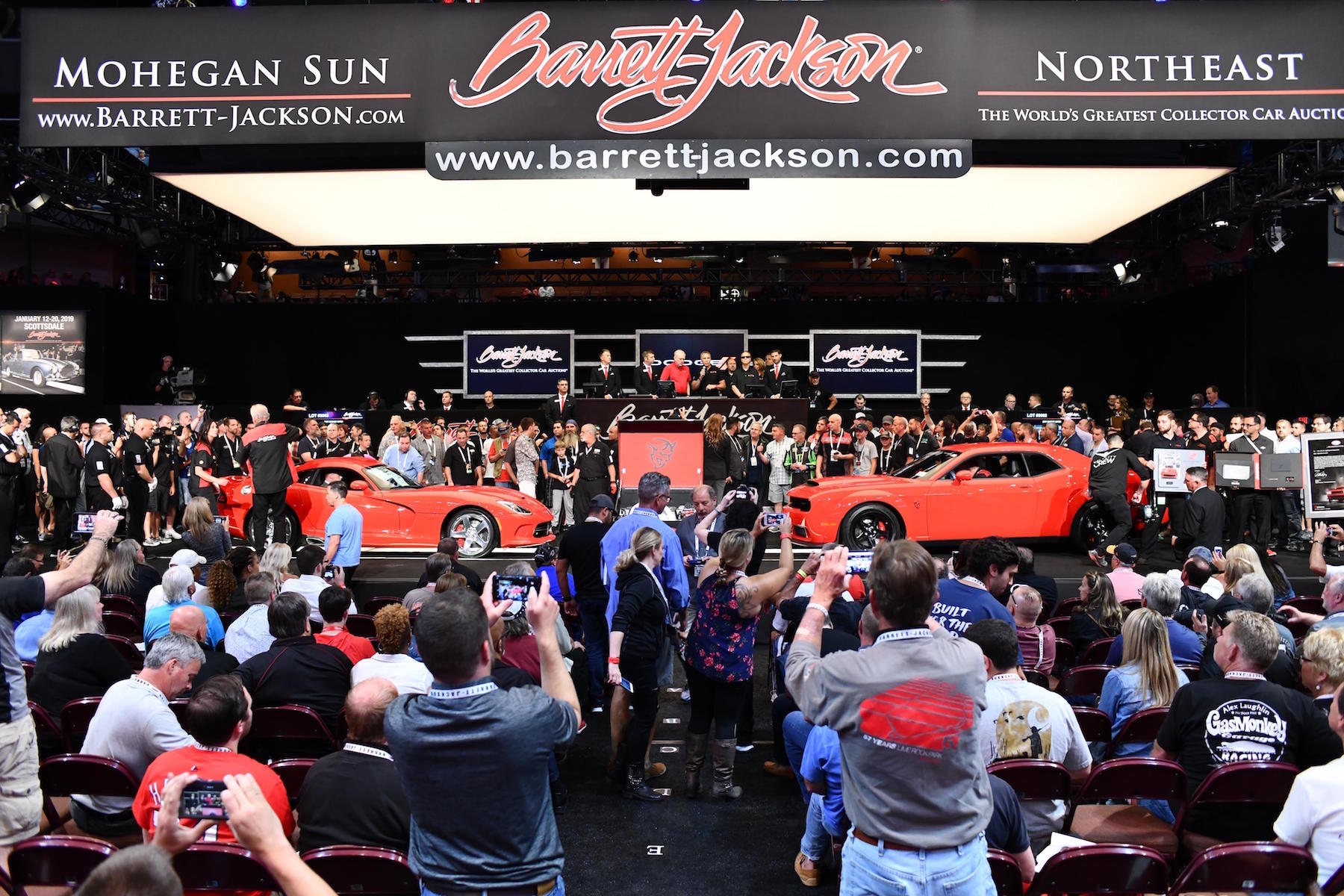
Billed as the ‘ultimate last chance auction’, two final editions of Dodge performance cars went under the hammer at the weekend.

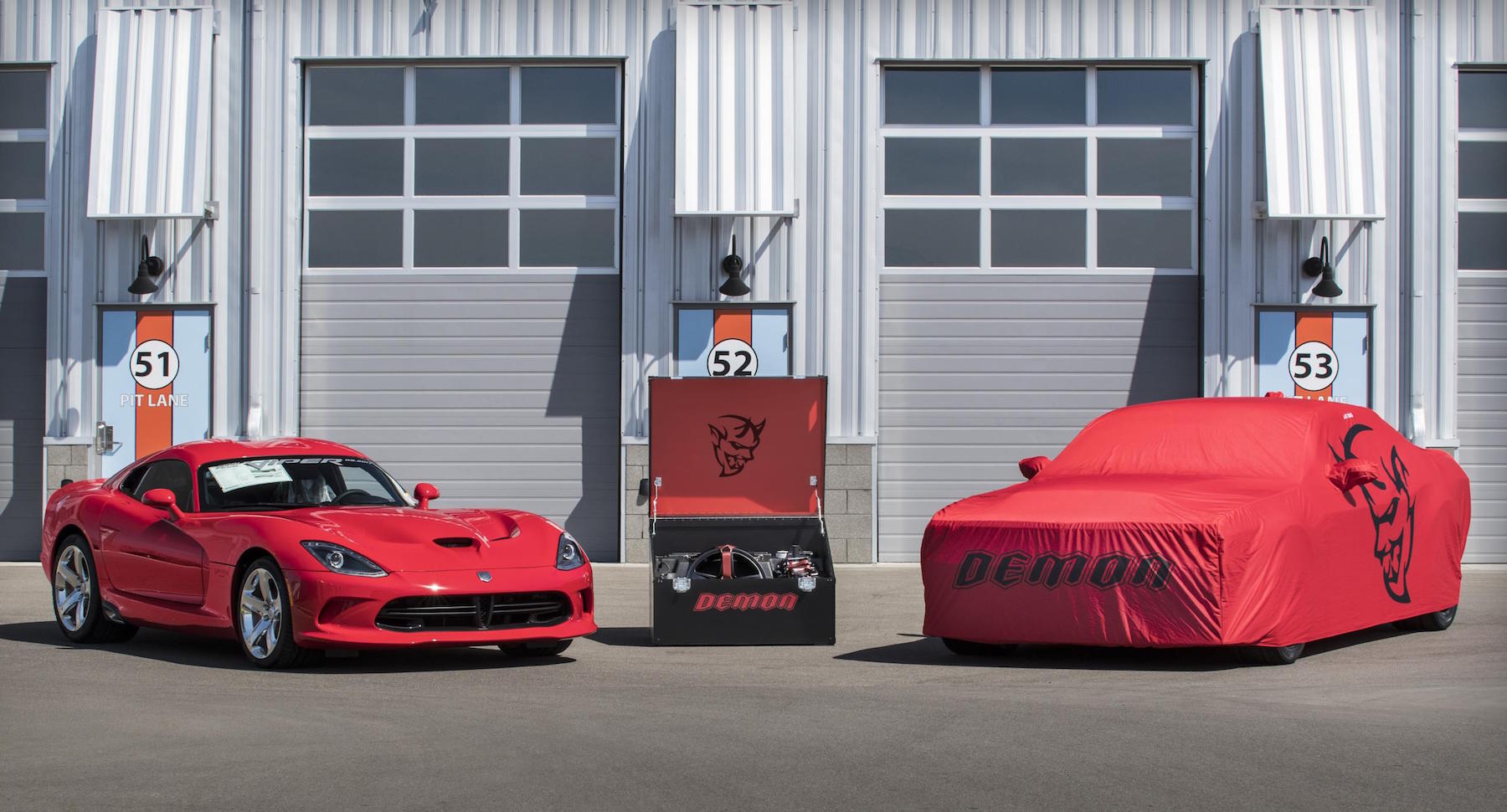
The Barrett-Jackson Northeast Auction took place in Mohegan Sun, Connecticut, and attracted huge interest in the chance to own this particular pairing. Sold together as one lot, the very last Dodge Viper was matched with the final Challenger SRT Demon muscle car.

All proceeds of the sale were destined from the outset to be given to charity, with the United Way organisation receiving the $1 million (£753,000). Given that the Viper was usually sold for $87,995, with the SRT Demon priced at $84,995, it shows just how hot the bidding war for the Dodge duo really was.

Dodge sells final Viper and SRT Demon at auction

An $827,010 (£623,000) premium may seem steep, but the desirability of the two cars for collectors is already guaranteed.

Both cars were painted in the same Viper Red colour, a classic choice inspired by the original 1992 RT/10 Viper. This required the SRT Demon to be painted by hand to match, a process which had to be done especially after the car had been built on the regular production line.

Powered by a 645hp version of the 8.4-litre V10 engine, the Viper is capable of a top speed in excess of 200mph. Some 30,000 Vipers were built between the introduction of the first-generation in 1992, through to this special car rolling off the production line in August 2017.

The SRT Demon is the ultimate version of the current Challenger muscle car, created as little more than a thinly disguised road-legal dragster. In fact, the SRT Demon is so quick on a drag strip – setting the world’s fastest production car quarter-mile time – that it was banned from competition usage in the United States.

With a list of world firsts, including the first production car to pull a wheelie on acceleration, the 6.2-litre supercharged 840hp SRT Demon has proven to be a serious collectors item already. Sales being limited to just one year will no doubt push values even higher.

Along with making a charity very happy, and taking home two serious performance cars, the lucky auction winner collected numerous other special items. Along with a number of branded items, the buyer also received certificates of authenticity, and photos detailing the build of each car.  

Advertisement

Hill climb record-breakers Bentley will now sell you a Bentayga Pikes Peak

0

Bentley Bentayga sets Pikes Peak hill climb record

It might be the most unlikely motorsport machine in the Bentley range, but the Bentayga luxury SUV has become a racing winner.

Reaching the top of the 12.42-mile long Pikes Peak International Hill Climb course took the Bentayga 10 minutes 49.9 seconds. This slashed more than two minutes from the previous SUV class record, and saw the big 4×4 average 66.5mph on the way to the top.

Experienced New Zealand driver Rhys Millen added the class win to his previous two Pikes Peak victories, in what turned out to be a successful weekend in Colorado for the Volkswagen Group. The radical all-electric Volkswagen I.D. R having set a new outright Pikes Peak record, too.

Whilst there won’t be a road-going version to celebrate Volkswagen’s achievements, Bentley fans will be able to own a tribute to the Pikes Peak Bentayga.

Powered by the same 600hp and 664lb-ft W12 engine as the car driven by Rhys Millen, the special Pikes Peak Bentayga will be limited to just ten examples.

Each will be built by Mulliner, Bentley’s coachbuilding department, and offered in a choice of two colours. Beluga Black is the subtle option, whilst those wanting the full Pikes Peak replica can can pick the eye-watering Radium green colour.

The 22-inch alloy wheels are finished in a combination of Beluga and Radium, whilst all the chrome on the Bentayga is replaced with gloss black. Carbon fibre is used for the splitter, rear spoiler, diffuser, and side skirts.

A special Pikes Peak logo adorns the wheel arches, with similar branding applied to the tread plates and dashboard facias. The seats are upholstered in a combination of black leather with Key Lime Alcantara, with the same combination found on the doors.

With the Pikes Peak record-setter based on a production model, the ten buyers will be safe in the knowledge that they will have the same technical specification as Mr Millen. That means an eight-speed automatic gearbox, adaptive air suspension, carbon ceramic brakes, and a four-wheel-drive system, of course. A sports exhaust is also standard.

Those interested in recreating the Pikes Peak record will have to wait until August, when Bentley will start accepting orders for US and European customers. Plenty of time to learn the 156 corners that make up the hill climb course.

Advertisement

Harley-Davidson is shifting production out of America to avoid EU tariffs

0

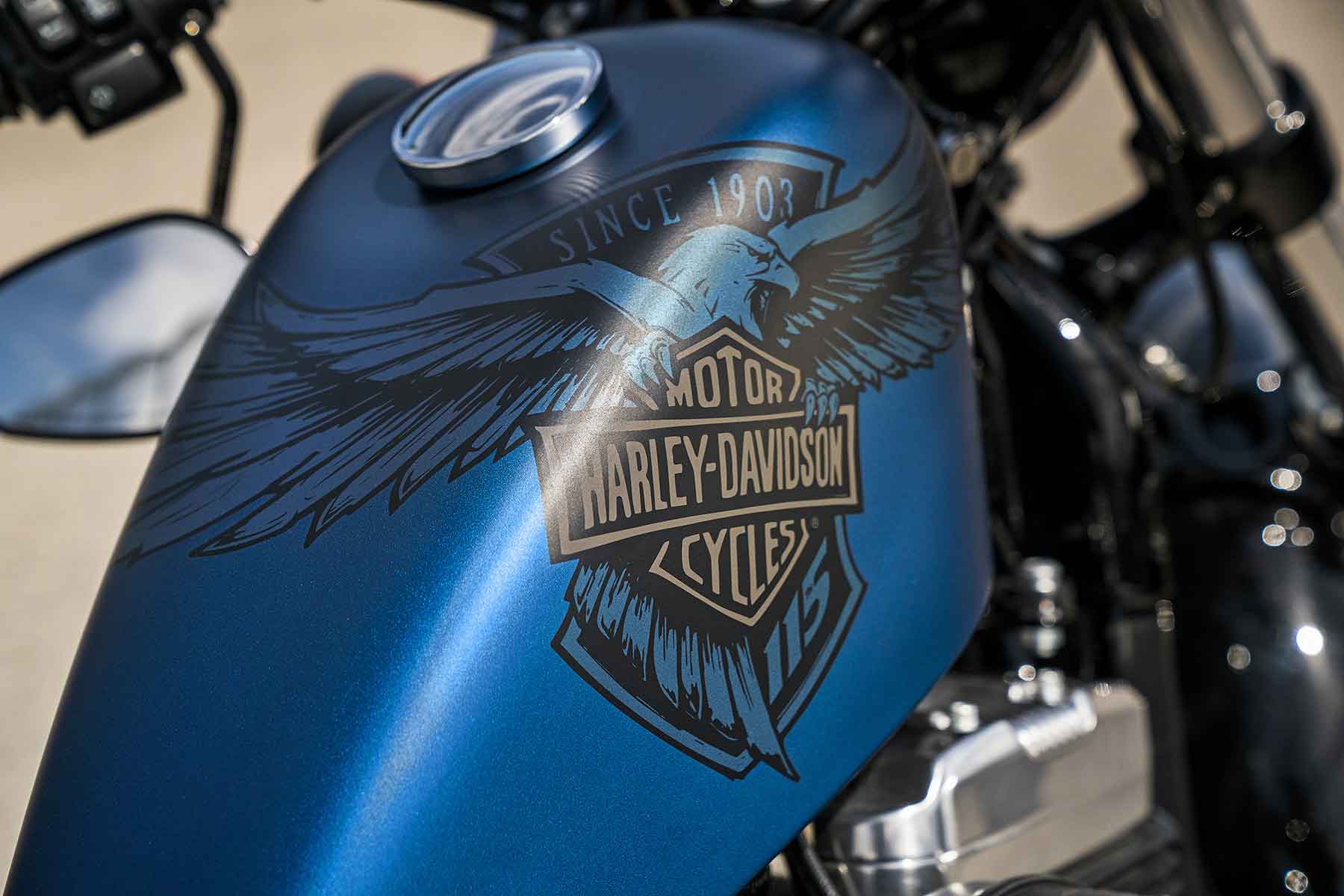
Harley-DavidsonThe trade war between the US and Europe stepped up a gear last week, with the European Union announcing a range of tariffs on products manufactured in North America, including Harley-Davidson motorcycles.
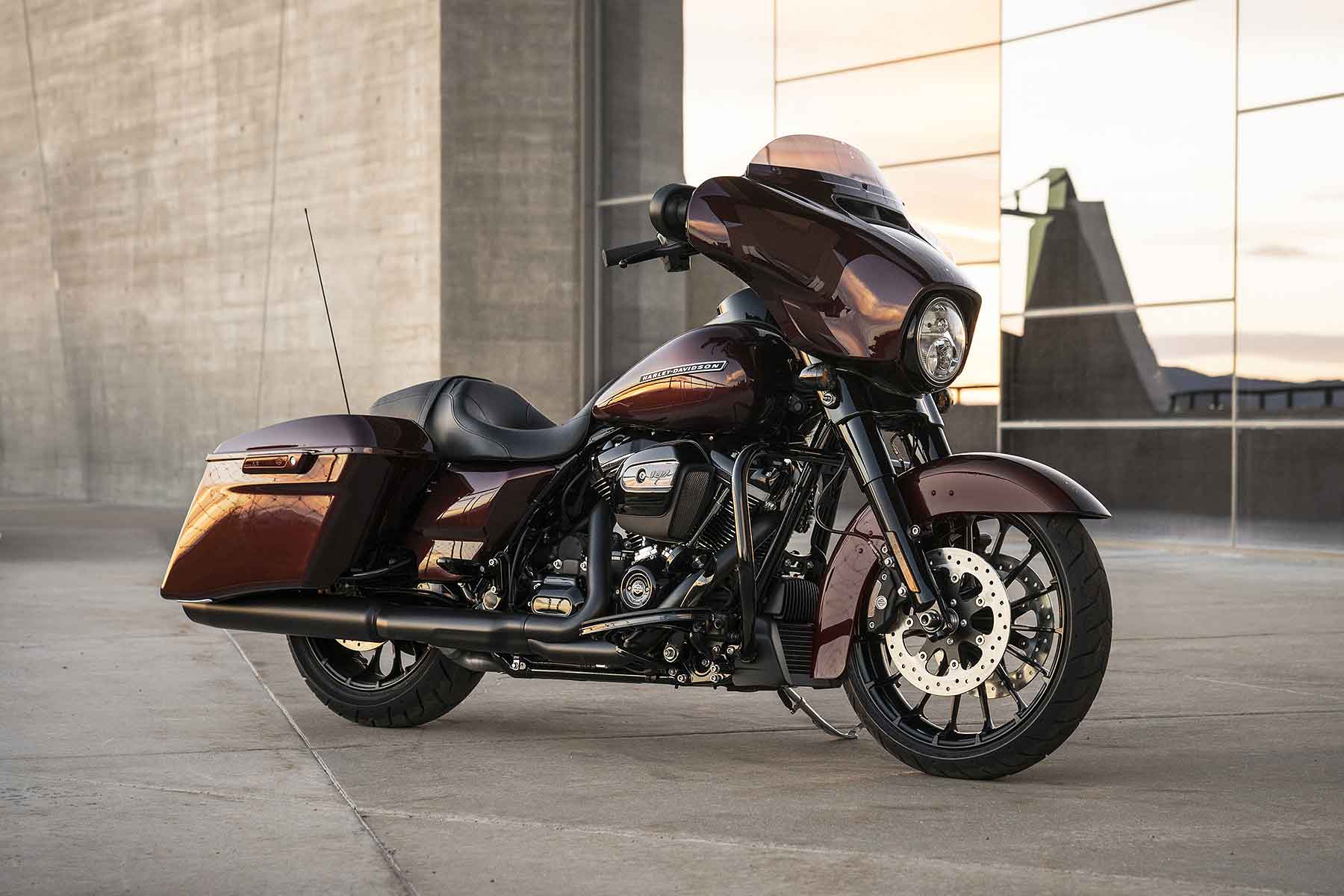
These would, says iconic American firm, result in an incremental cost of around $2,200 (£1,650) per motorcycle – so, to avoid having to put up prices and lose market competitiveness, it has announced plans to move production out of the US to other worldwide facilities.

It perhaps isn’t the result US President Donald Trump wanted, but it’s one that has been forced upon Harley-Davidson. Last year, it sold almost 40,000 motorcycles in Europe, making the region its second most profitable sales channel (behind North America).

“Increasing international production to alleviate the EU tariff burden is not the company’s preference,” it said in an 8-K filing to the United States Securities and Exchange Commission, “but represents the only sustainable option to make its motorcycles accessible to customers in the EU and maintain a viable business in Europe.”

The ramp-up of its international factories will take at least nine months, and could take up to 18 months – and the firm says the incremental cost for 2018 alone will be between $30 million to $45 million.

The full-year cost of the trade war tariffs to Harley-Davidson is estimated to be around £90 million to £100 million.

“Harley-Davidson’s purpose is to fulfil dreams of personal freedom for customers who live in the European Union and across the world,” it added. “The company remains fully engaged with government officials in both the US and the EU helping to find sustainable solutions to trade issues and rescind all tariffs that restrict free and fair trade.”

Advertisement

New Hyundai i20 has Apple CarPlay and Android Auto as standard

0

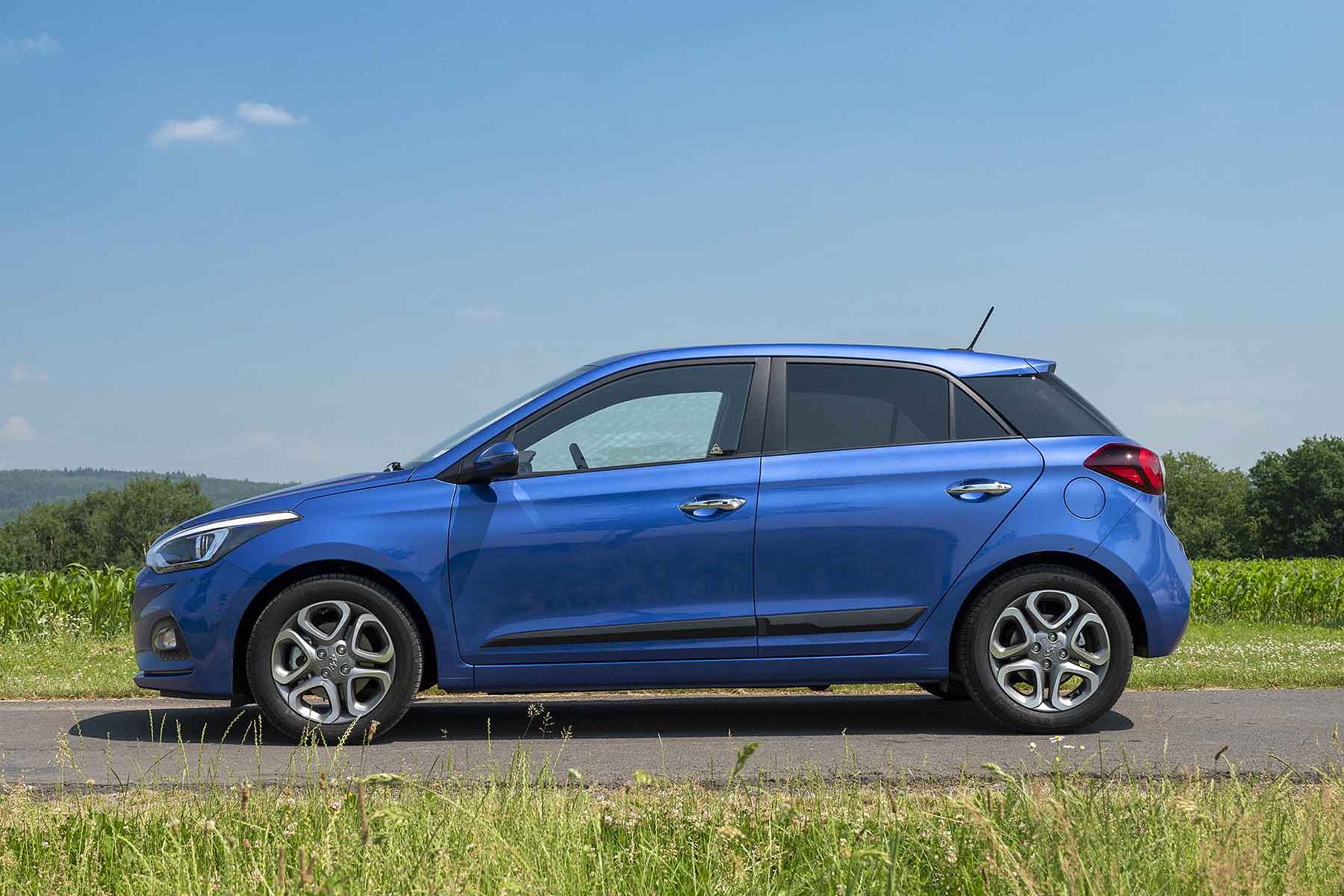
2018 Hyundai i20Hyundai has facelifted its i20 supermini for summer 2018, and has opened ordering with prices starting from £13,995.
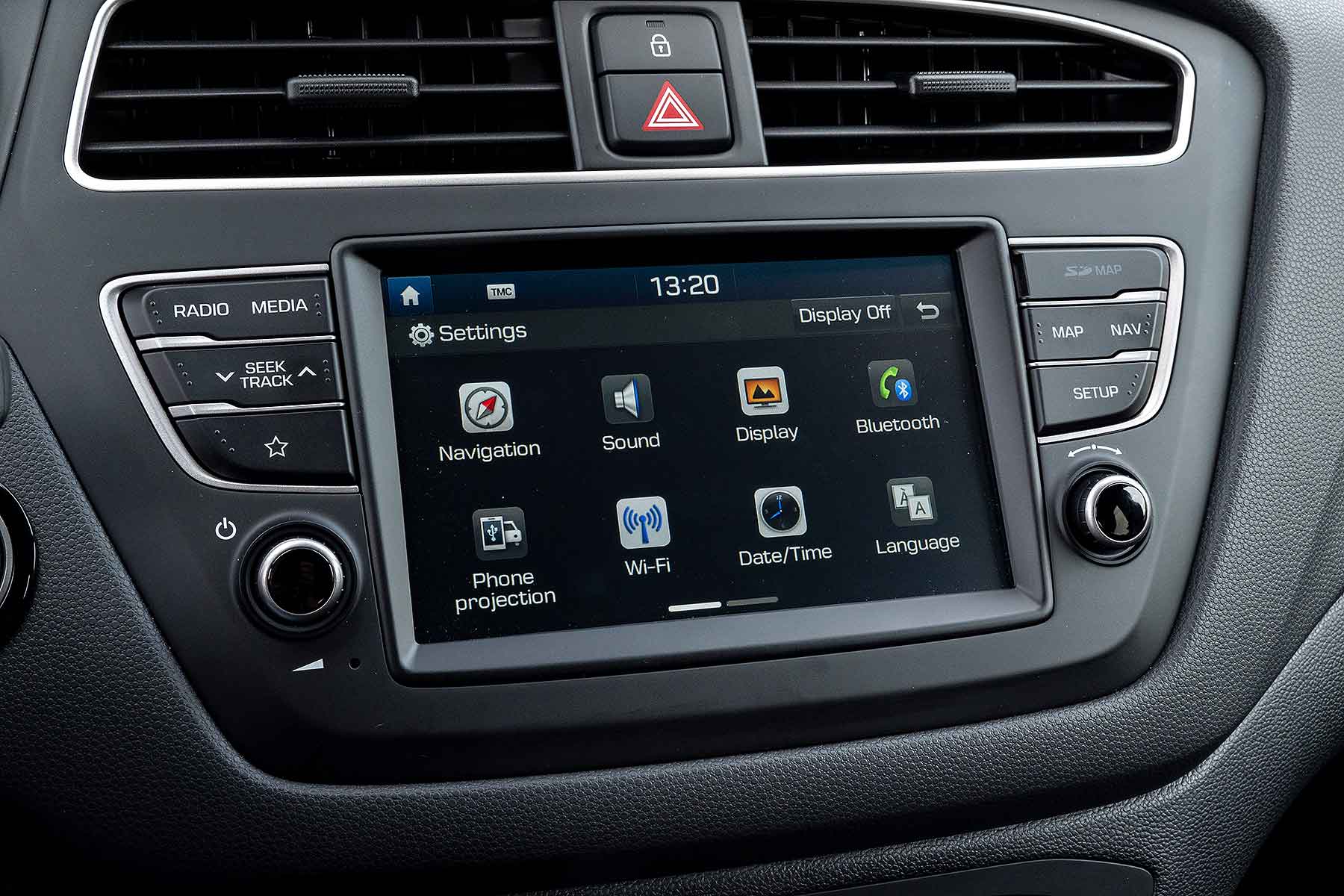
Responding to car buyers’ ever-greater desire for advanced infotainment systems, the firm has standardised Apple CarPlay and Android Auto on all models, as part of a 7.0-inch touchscreen display.

It means that all i20s effectively now come with standard sat nav, via car owners’ mobile devices, while DAB radio and Bluetooth connectivity are also included – and every i20 also comes with a reversing camera.

2018 Hyundai i20

Other standard features for 2018 cars include engine stop-start, automatic headlamps, air con and steering wheel stereo controls. Pick an SE and safety also received a boost, with standard autonomous emergency braking, lane keep assist and high beam assist.

SE models and above also feature a standard driver attention monitor.

There are three new colours as part of the eight-colour paint range: Tomato Red (which is free), Clean Slate and Champion Blue (which both cost £550).  

Hyundai’s also improved the appeal of the i20 to those who favour an automatic: a seven-speed dual clutch transmission replaces the fuel-hungry old automatic. It’s paired with the 100hp 1.0-litre T-GDI petrol engine, and now returns exactly the same 56.5mpg combined fuel economy of the regular five-speed manual.  

Tony Whitehorn, president and CEO of Hyundai Motor UK said: “Alongside the i10, the i20 played a significant part in kick starting Hyundai’s growth, with over 125,000 i20’s sold in the UK since the first generation was launched in 2009.

“Whilst the small car segment has been a challenging place for all manufacturers over the past few years, we expect the new i20 to build on its predecessor’s solid and stable sales performance by offering customers the mix of connectivity, safety and efficiency that they demand.”

2018 Hyundai i20 prices

  • 1.2 75 S: £13,995
  • 1.2 84 SE: £15,495
  • 1.2 84 Premium Nav: £16,245
  • 1.2 84 Premium Nav SE: £17,295
  • 1.0 T-GDi 100 SE: £16,395
  • 1.0 T-GDI 100 SE DCT: £17,645
  • 1.0 T-GDi 100 Premium Nav: £17,145
  • 1.0 T-GDI 100 Premium Nav DCT: £18,395
  • 1.0 T-GDI 120 Premium Nav SE: £18,695
Advertisement

England World Cup campaign has already cost Auto Trader EIGHT new cars

0

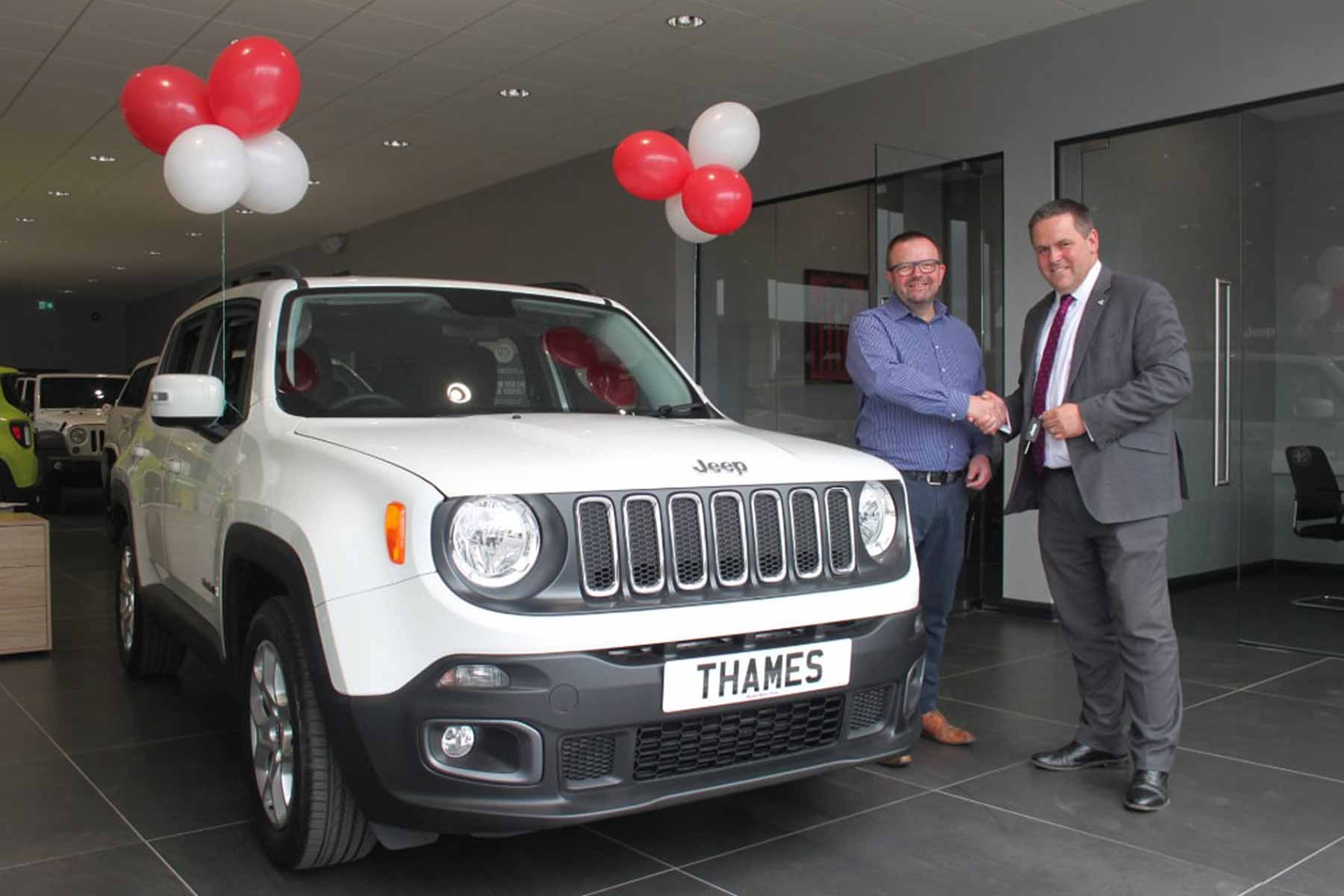
Nick Browne: AutoTraderGoals WinnerNew and used car marketplace Auto Trader has gone bold with its competition for the 2018 FIFA World Cup – by giving away a brand-new car for every single goal England scores.
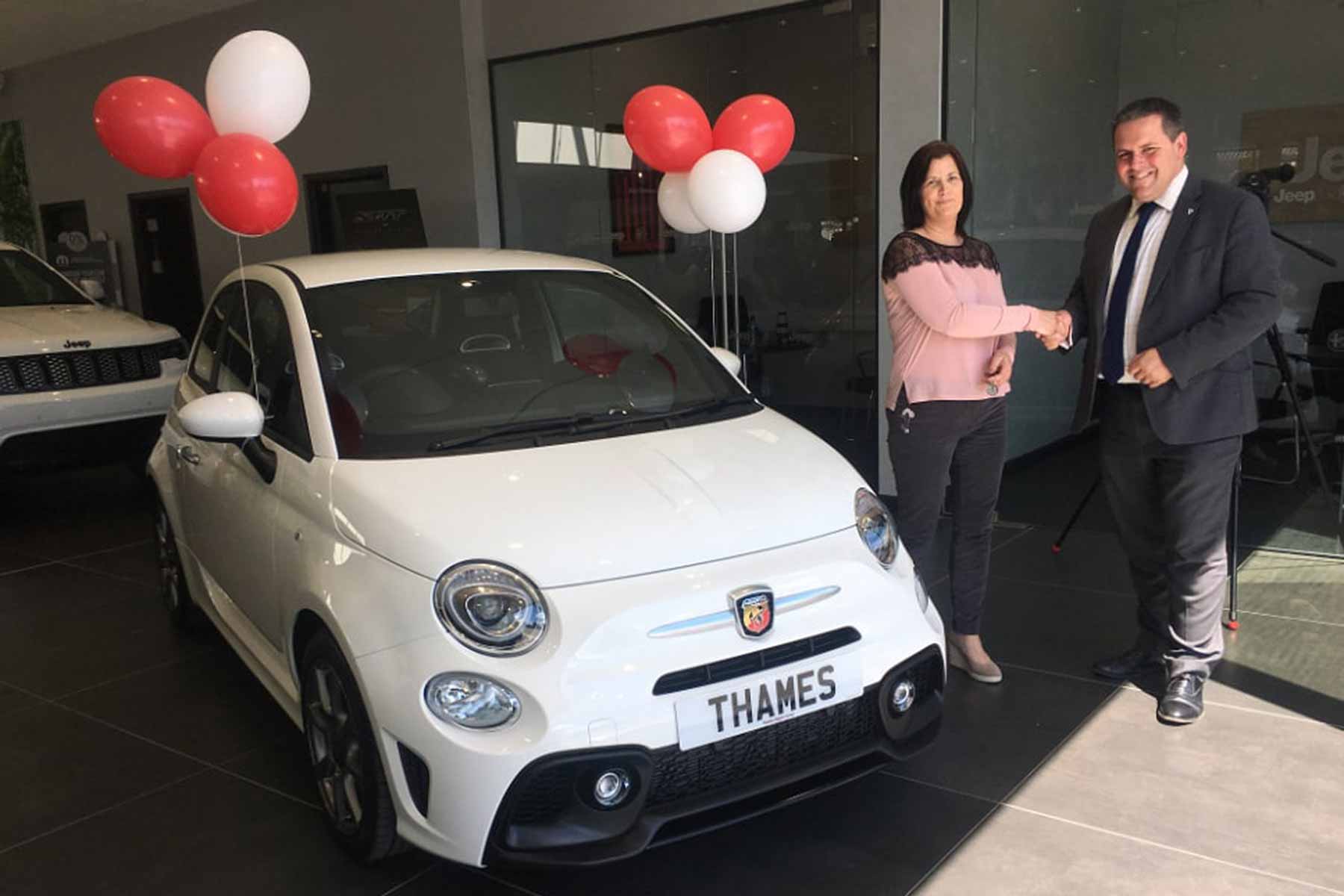
The opening match started off without too much drama, with the 2-1 scoreline costing it two vehicles – a Jeep Renegade for Nick Browne from Egham (above), and an Abarth 595 for Kendra Florence from Teesside (below).

But barely had those cars been handed over when England shocked football watchers everywhere with a record-breaking 6-1 scoreline against Panama. And as the nation celebrated, so too did another six motoring enthusiasts who found they had also scored a new car.

Kendra Florence: AutoTraderGoals Winner

The #AutoTraderGoals competition has so far seen over 34,000 entrants, reports the firm, and may well now mean bosses have to secure a fresh supply of cars ahead of England’s next match against Belgium on Thursday.

The vehicles up for grabs are an Abarth 595, Alfa Romeo Mito, Fiat 500X and a Jeep Renegade. As they all retail from around £15,000, it means the competition may have already cost Auto Trader around £120,000…

Audience and brand director Lei Sorvisto said: “Since England’s first World Cup game, #AutoTraderGoals has been posted over 98,000 times on social media, which clearly demonstrates how the campaign has engaged a huge amount of people all over the UK.

“Good luck to everyone getting involved with England’s next game against Belgium on Thursday.”

The reaction of Auto Trader’s finance department following England’s game on Sunday has not been disclosed.

Advertisement

The 2019 Mazda MX-5 is revvier and more honest

0

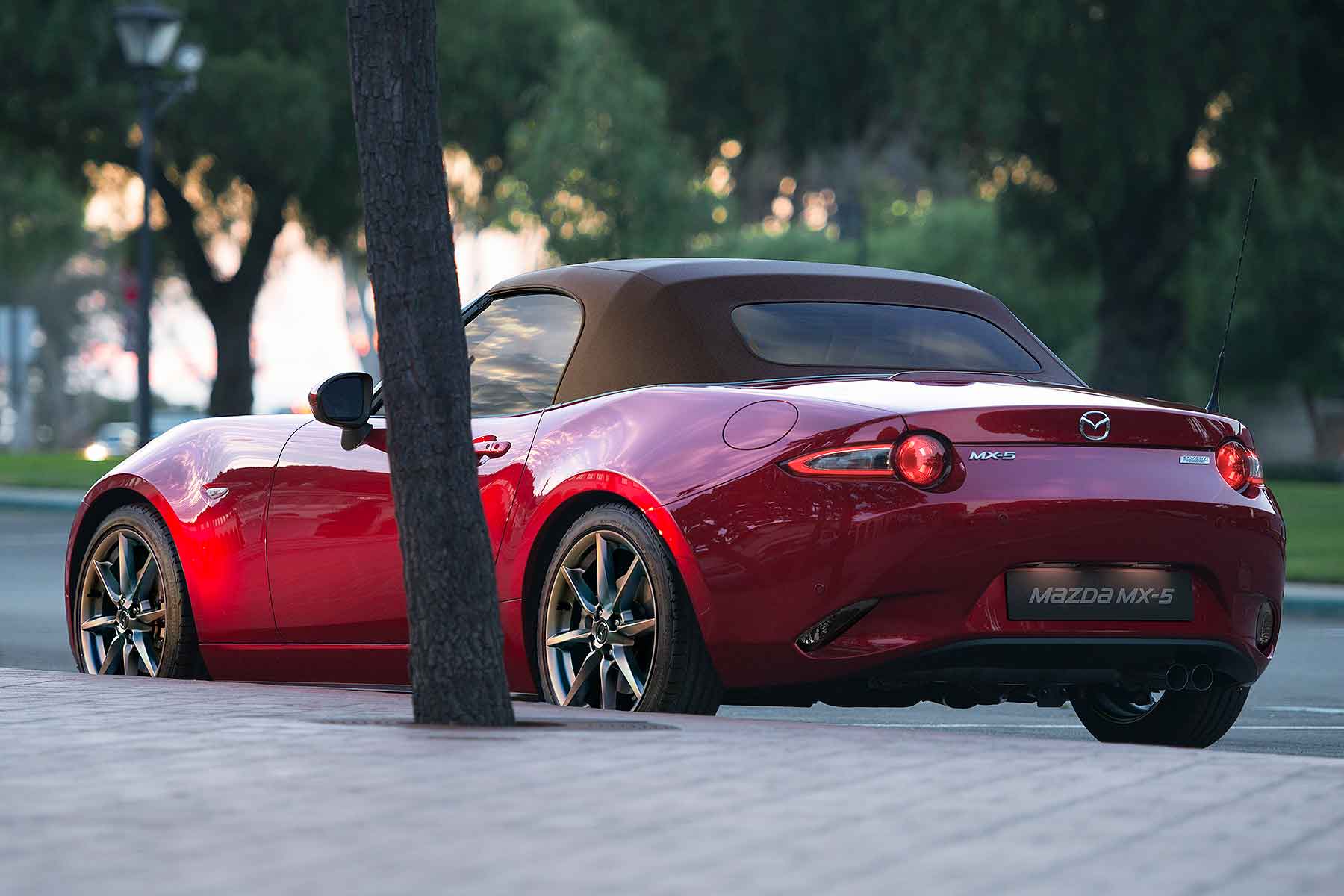
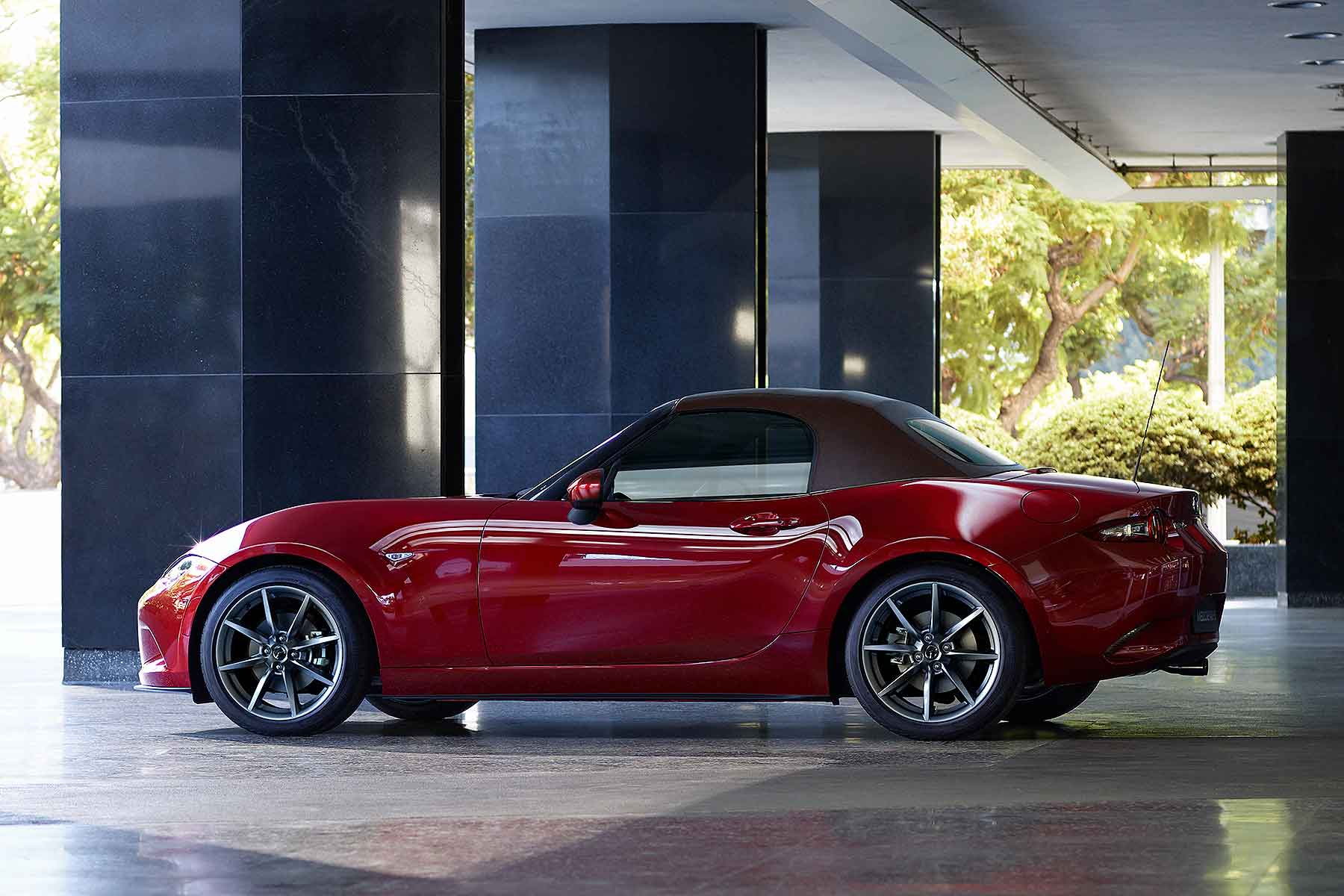
Mazda is launching a revised MX-5 next month (August 2018). While the visual changes are modestly limited to colour options for wheels and roof, enthusiasts won’t care because the world’s best-selling roadster has been improved where it matters: driver appeal.
The big news is a revised Skyactiv-G 2.0-litre engine. This enjoys a substantial power hike from 160hp to 184hp, which Mazda has achieved through the most old school of tuning tweaks: raising the rev limit.

And not by just a modest amount, either.

The 2.0-litre now revs to a dizzy 7,500rpm, which is up from the 6,800rpm of today’s car. The boosted power is actually delivered at 7,000rpm, so Mazda perhaps didn’t need to engineer an extra 500rpm of revs on top, but we’re delighted that it did (particularly as strengthening any engine to cope with sustained high revs is neither easy nor cheap).

Torque is up too, by an almost entirely irrelevant 4lb ft. The MX-5 produces a relatively weedy 151lb ft of pulling power at 4,000rpm (in contrast to its turbocharged Fiat 124 Spider cousin), but this doesn’t matter to true MX-5 drivers because they’re rarely pulling so few revs anyway.

The 2019 MX-5 isn’t just racier, though. It’s also more honest, because Mazda has homologated both 1.5-litre and 2.0-litre engines to be compliant with the new WLTP/RDE fuel economy test cycle. This is where the marginally greater torque comes in, and Mazda says the acceleration control has also been revised to ensure there’s less lag between pressing the accelerator and the engine responding.

It’s added new safety tech as well, focused on active safety. Now available are advanced smart city brake support (which works both forwards and in reverse gear), driver attention alert, traffic sign recognition and a rear-view camera (which is now mandatory on all new cars in the United States).

In 2015, the MX-5 scored four Euro NCAP stars. Since then, the safety organisation has stepped up its active safety demands: the revised car should thus at least maintain this score.

Oh, and those new wheels and hood colours? There’s a darker paint finish on 16-inch and 17-inch alloys, and a new brown roof colour for the soft-top. That’s it. But who cares, when the 2.0-litre can now rev to 7,500rpm?

Prices and performance details of the new MX-5 will be revealed closer to market launch from August. Can’t wait that long? Perhaps £1,500 towards the deposit on the current one may sway you to give up that 7,500rpm red line…

Advertisement

Radical Volkswagen EV racer wins legendary hill climb

0

Volkswagen at Pikes Peak 2018The Pikes Peak International Hill Climb is a world-famous challenge that dates back to 1916. For decades, car makers have been entering exotic one-off rally cars to set a new course record at the Colorado, North America hill climb: since 2013, the all-time record was held by nine-times World Rally Championship holder Sebastien Loeb.
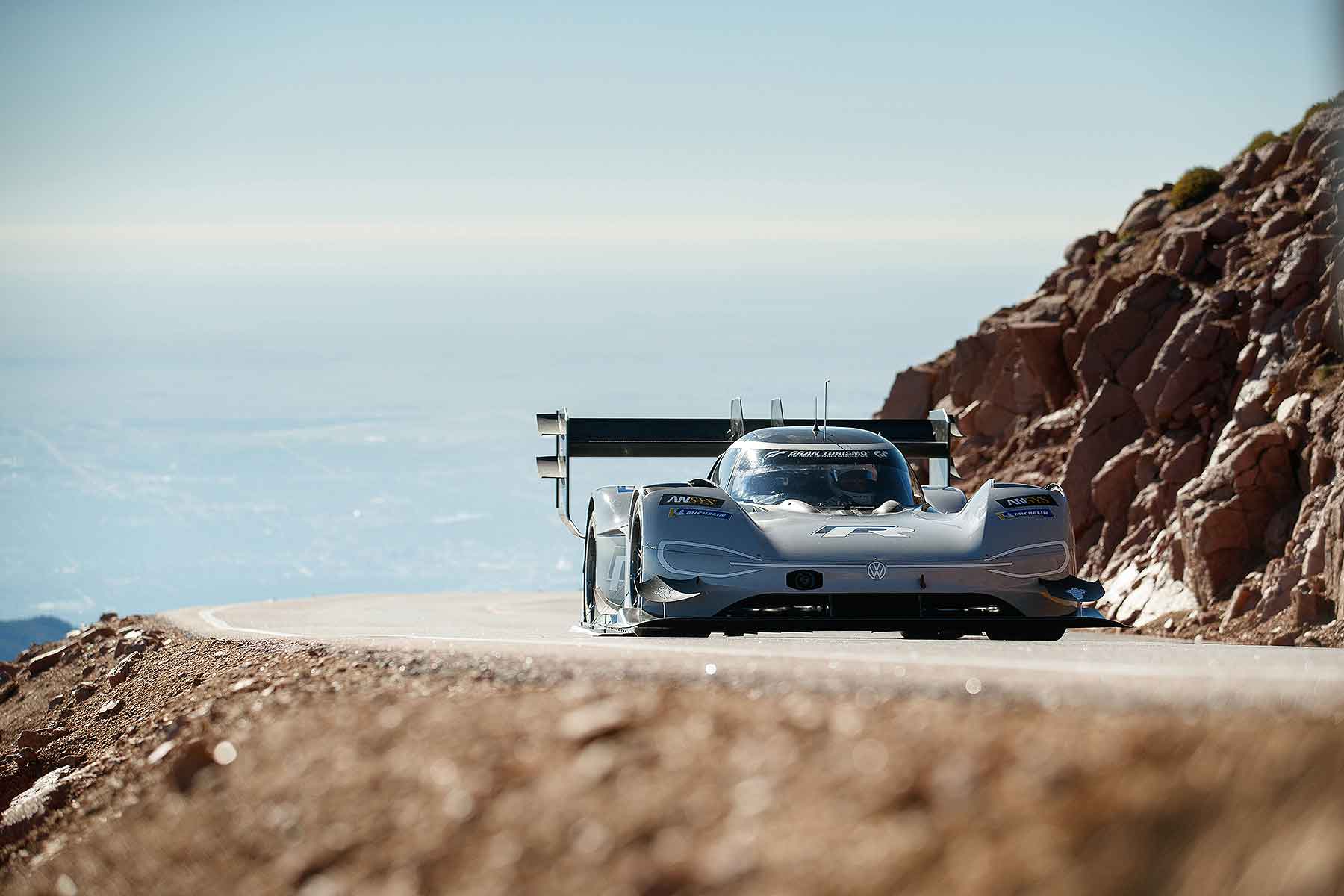
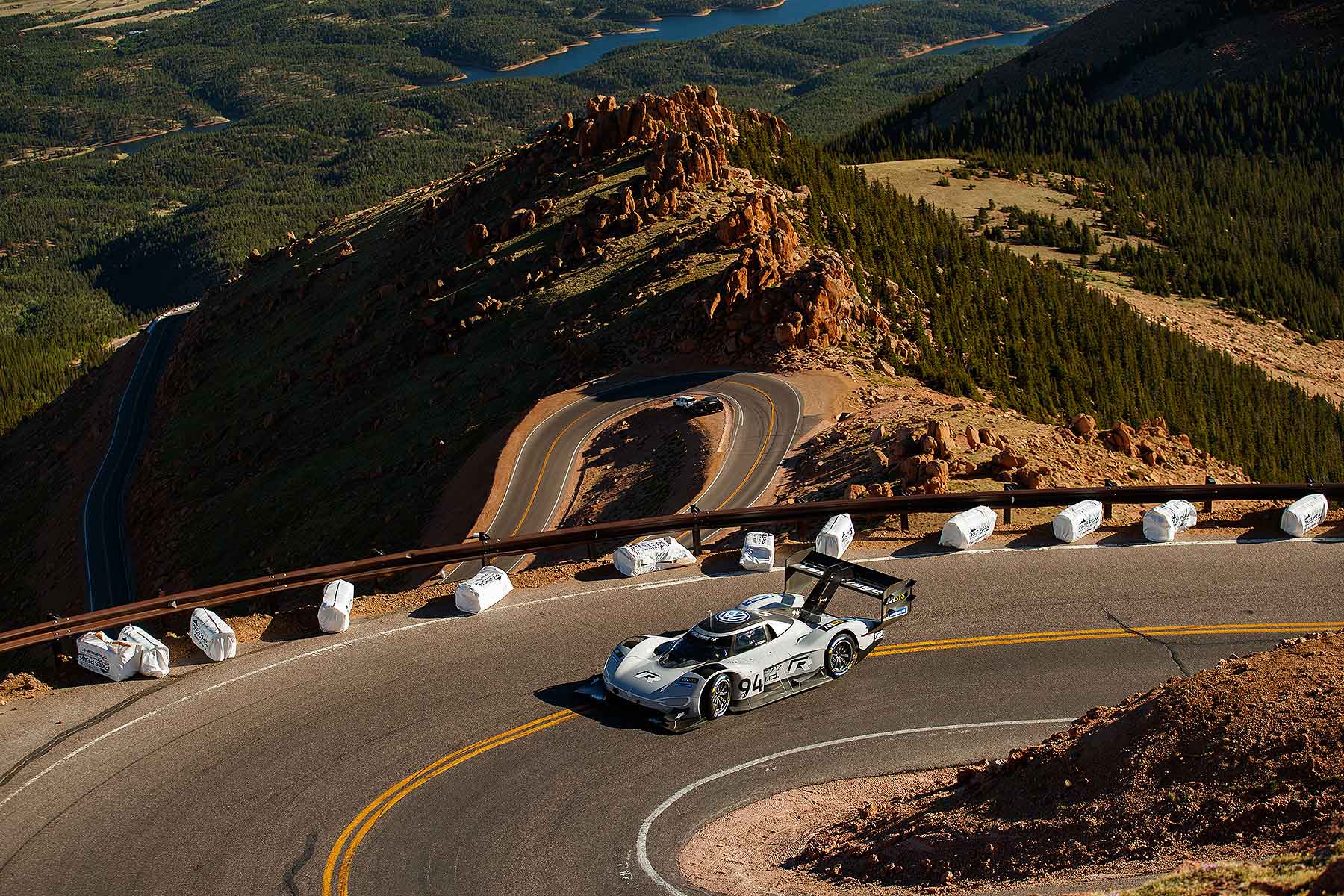
Volkswagen has now set a fresh Pikes Peak record, with a time 16 seconds faster than Loeb’s run – in an all-electric racer.

The Volkswagen I.D. R Pikes Peak is a futuristic 680hp EV that is a motorsport version of the upcoming I.D. electric road car family. It was tailored to the Pikes Peak challenge, so weighs less than 1,100kg but has a lot of downforce and a lot of quickly-deployed power: ideal for a course that has 156 corners and rises 4,720 feet (1,440 metres) to finish at a heady altitude of 14,110 feet (4,300 metres).

Volkswagen at Pikes Peak 2018

Volkswagen also designed a new fast-charge system that replenishes the batteries in less than 20 minutes; generators running on eco-conscious glycerol situated at the foot of the 12.4-mile course provide the charge.

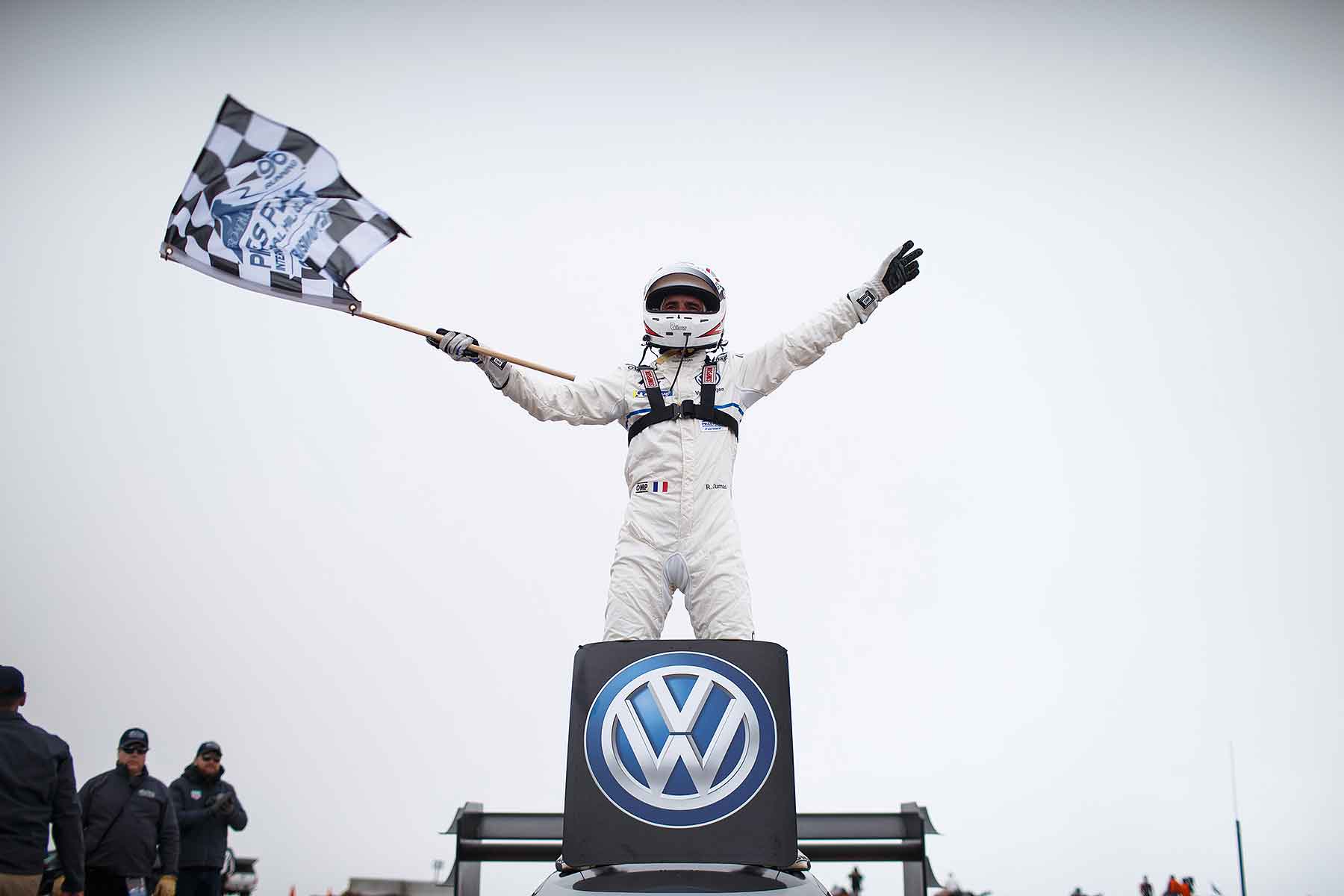
The firm’s motorsport director Sven Smeets reckons the I.D. R Pikes Peak is “the most innovative and complex car ever developed by Volkswagen Motorsport”. French racer Romain Dumas is the new record holder and reckons it is “the most impressive car I have ever driven in competition” – quite some praise from a three-times Le Mans 24 Hours winner.  

The Volkswagen bosses were duly delighted. “The I.D. R Pikes Peak is the sporty forerunner of Volkswagen’s I.D. family,” said VW board member Dr. Frank Welsh. “Today, we saw what this technology is capable of.”

Volkswagen at Pikes Peak 2018

The fact it has set a new record at a motorsport challenge that’s run for more than a century “speaks volumes for electric mobility”.

Dumas’ overall time was 7m 57.148s, and his name now joins the Pikes Peak wall of fame, alongside legends such as Loeb. Walter Rohrl, Michele Mouton and Stig Blomqvist. Not bad, added Volkswagen, for a project that only started eight months ago…

Advertisement

Lamborghini has restored the ‘astonishing’ Miura SVR

0

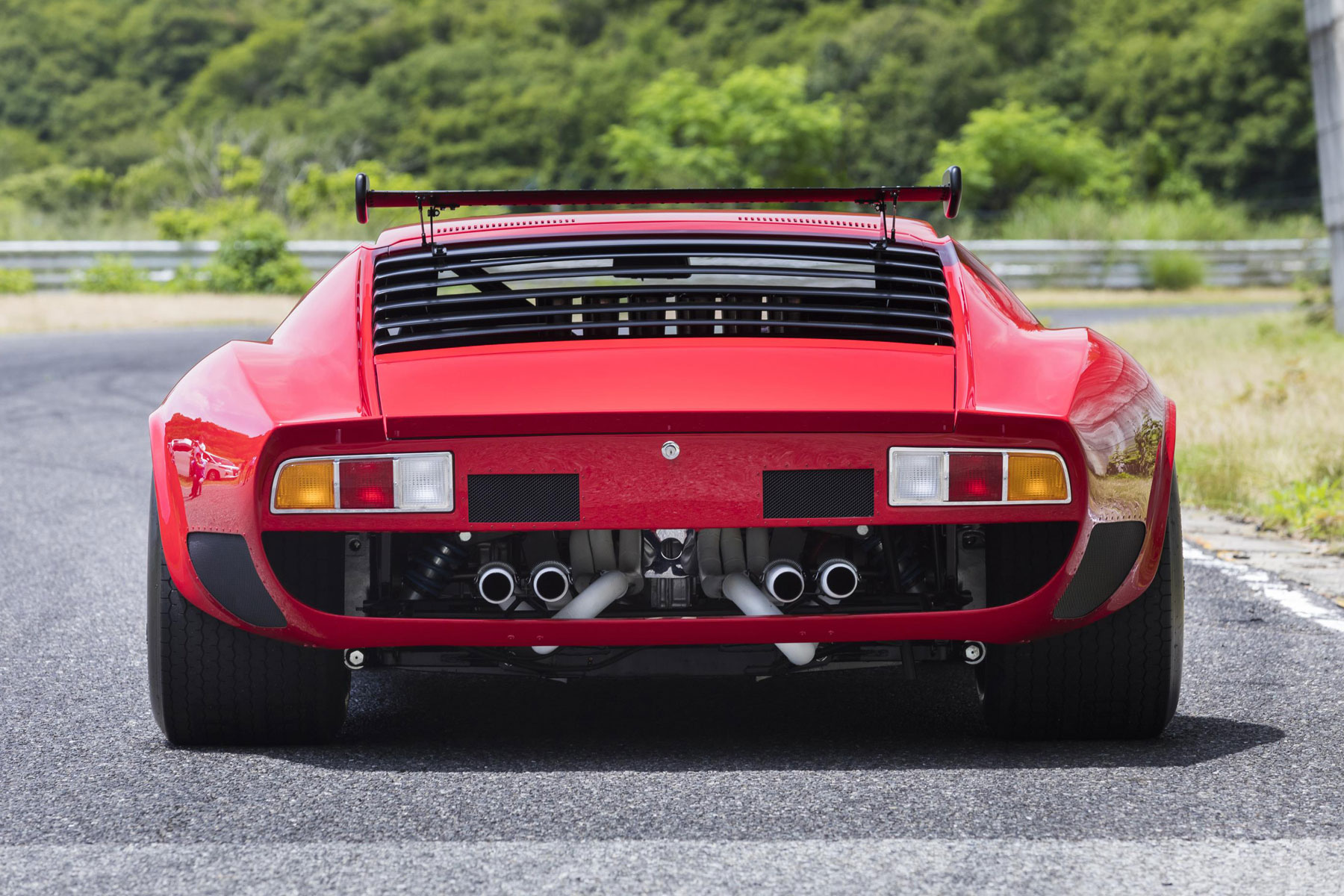
Lamborghini Miura SVR

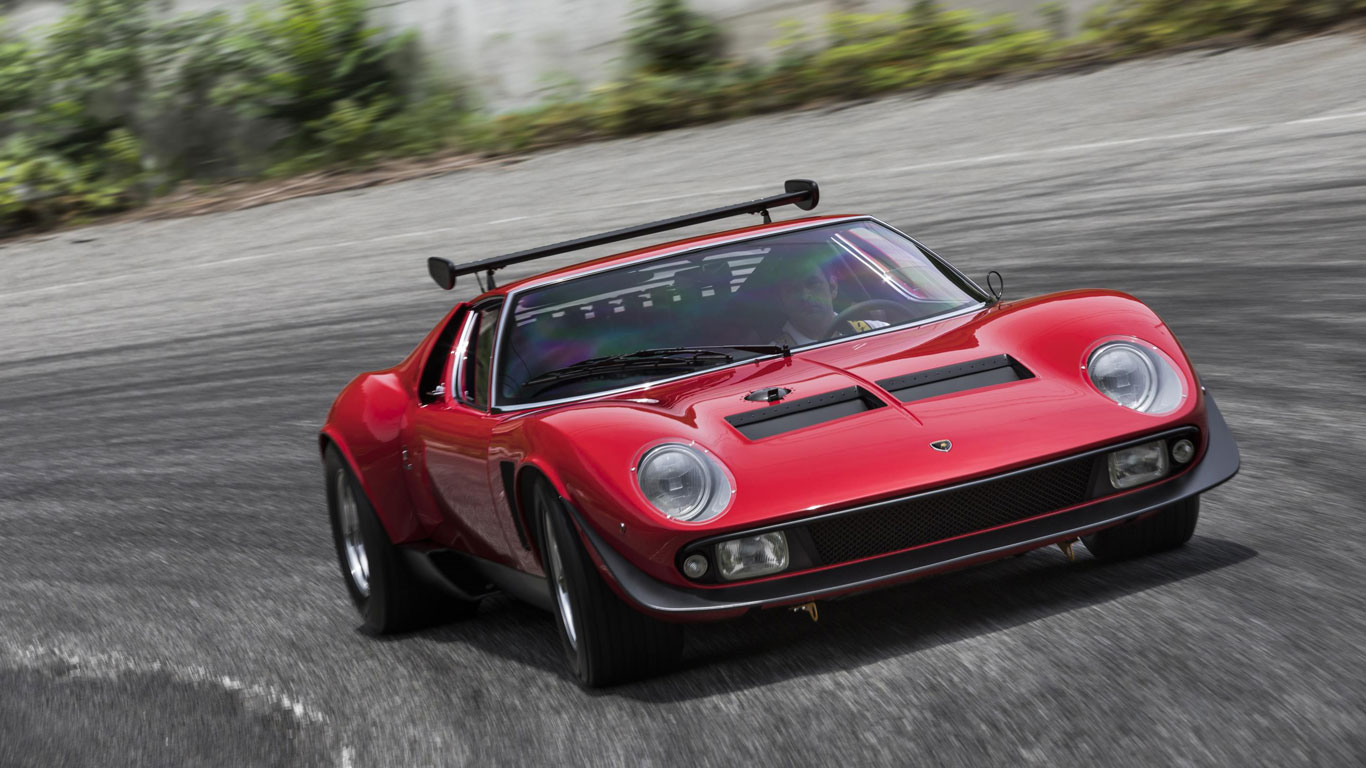
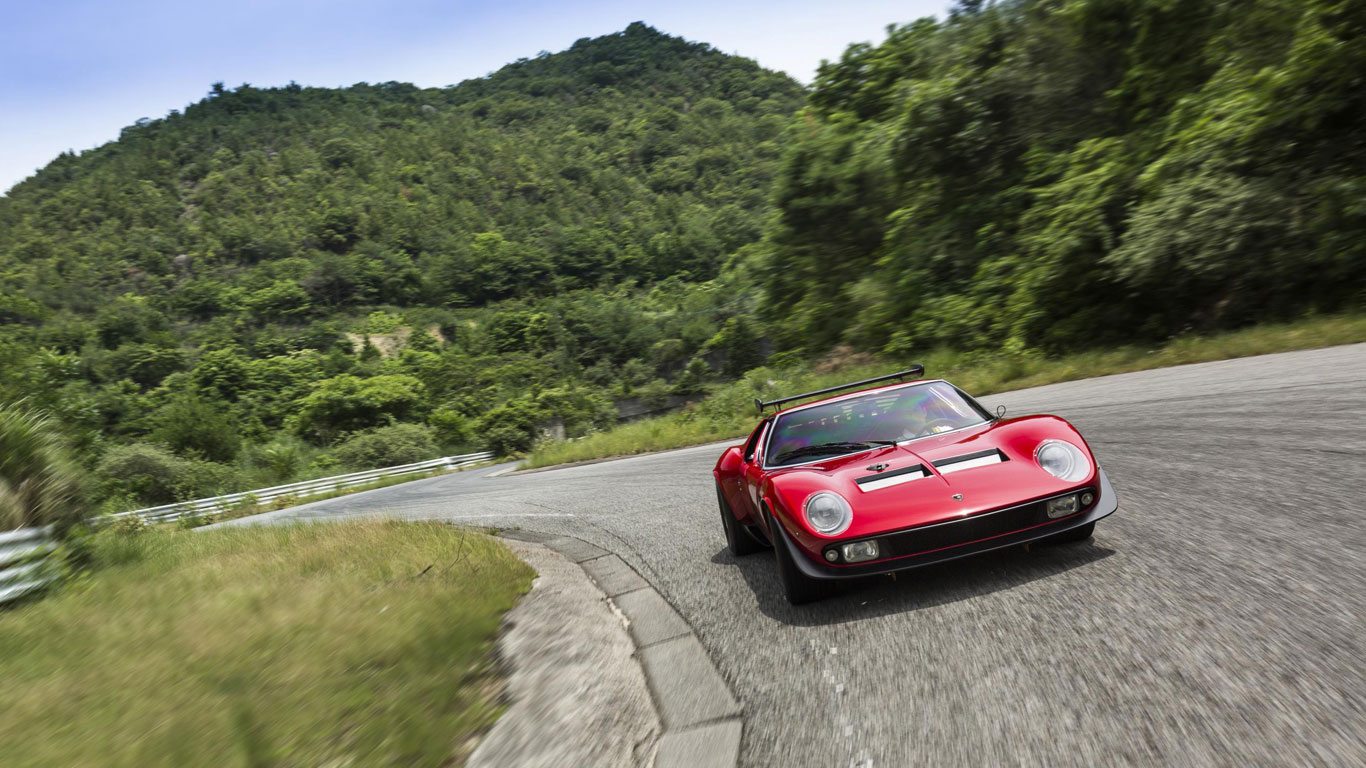
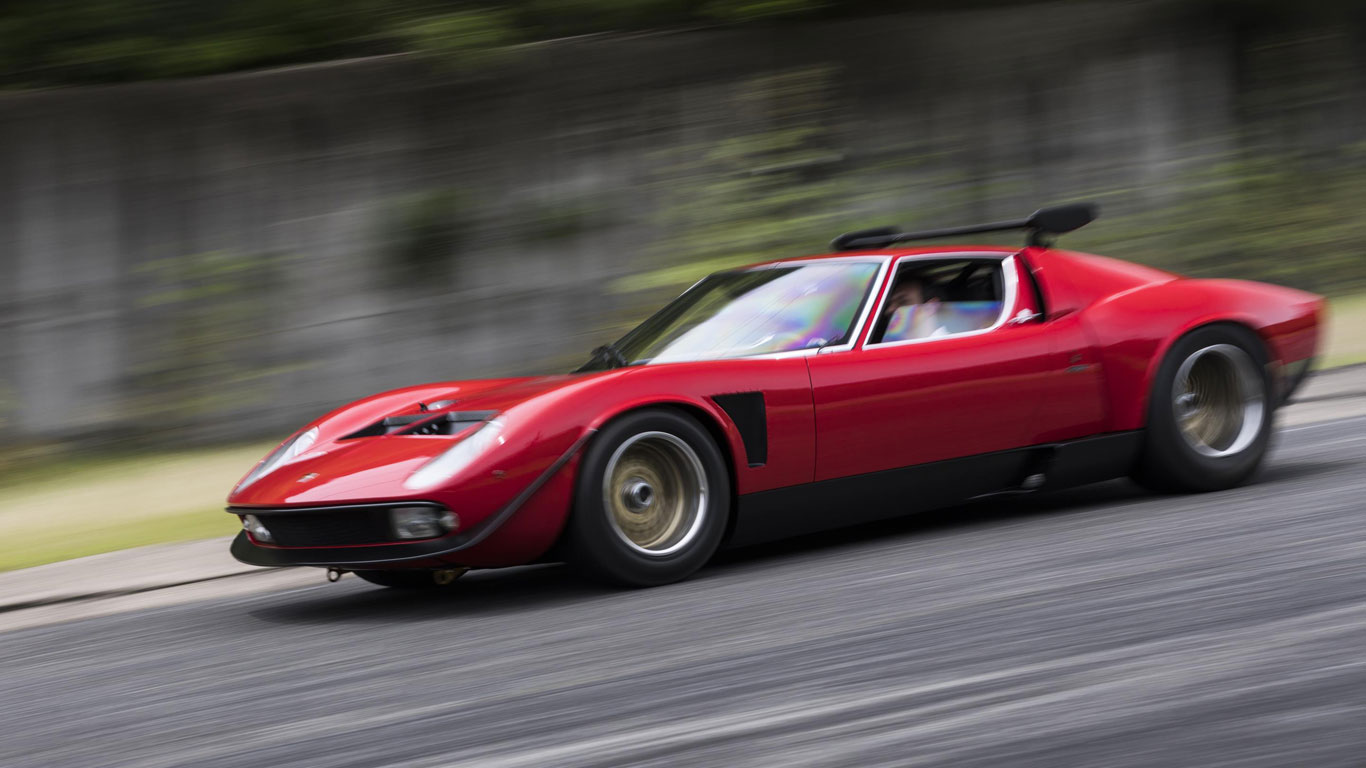
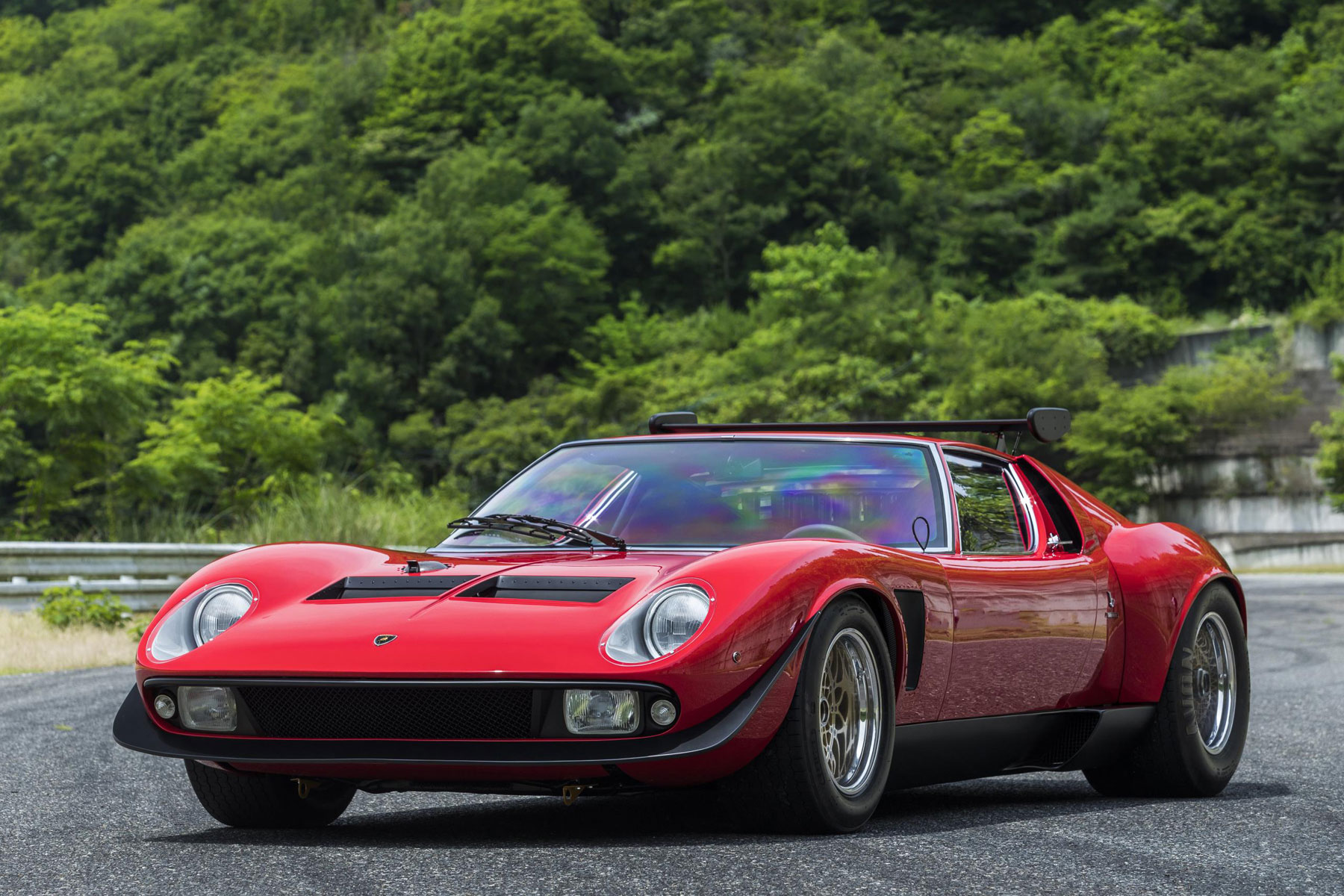
When the good people of Sant’Agata Bolognese describe a car as “one of the most astonishing Lamborghinis ever built”, you’d be forgiven for dismissing it as fluff-ridden PR speak. But in the case of the Lamborghini Miura SVR, the claim is entirely justified.

We’ll allow you a few moments to collect your jaw from the floor.

Need a couple more minutes?

Even if you think a modified version of the world’s most beautiful car™ is the automotive equivalent of repainting the Sistine Chapel with a rattle can, you can’t deny this thing has real presence. Forget Matt Monro, the Miura SVR would take a tour of the Alps to the sound of Led Zeppelin and Black Sabbath.

It’s a genuine one-off: a bespoke build inspired by the Miura Jota and created by the factory at the behest of German Lamborghini importer, Herbert Hahne. For 40 years, the SVR lived in Japan, but more on this in a moment.

Miura SVR rear

The Miura Jota

The Miura Jota (chassis no. 5084) was the work of legendary Lamborghini test driver, Bob Wallace. With Ferruccio Lamborghini having no interest in taking the Miura racing, it was left to Wallace to build the Jota during evenings and weekends, A skunkworks Miura, if you like.

Developed from the ground up, Wallace left no stone unturned in his pursuit of racing perfection. Much of the bodywork was made from super-lightweight Avional, the Miura’s iconic headlights were replaced with fixed units with plastic covers, while the body was cut and sliced to improve cooling.

The list goes on: the Jota sat on huge Campagnolo wheels, the interior was stripped out to the bare necessities, and the engine was modified to develop a roaring 440hp. This is very much a nutshell guide to the Jota, but it’s fair to say it had the potential to become one of the world’s most revered supercars.

Note the emphasis on the word ‘had’. Although Ferruccio allowed Wallace to complete over 20,000km of testing, the Jota was sold to InterAuto of Brescia where, in the hands of a mechanic on a mission to impress his girlfriend, the car was involved in a catastrophic accident. This resulted in a fire so severe, the chassis was warped beyond repair.

Although the Jota was dead, the accident led to a fair amount of press coverage, followed by requests from owners eager for Lamborghini to build a road-going version. It never came to fruition, sadly, although four or five so-called Miura SVJ models were made, while a close replica was built by UK owner Piet Pulford.

The Miura SVR

Lamborghini Miura SVR

Which brings us back to the Miura SVR. Chassis number 3781 left the factory in 1968 as a green Miura P400 S and changed hands several times in Italy before being sold to the German Heinz E. Steber. He enjoyed the car for several years before his thoughts turned to the flame-grilled Jota.

Steber approached Herbert Hahne with this phoenix-like plans for a Jota conversion, who in turn worked with the factory to create the SVR. This was in 1975, and the project was completed in April 1976.

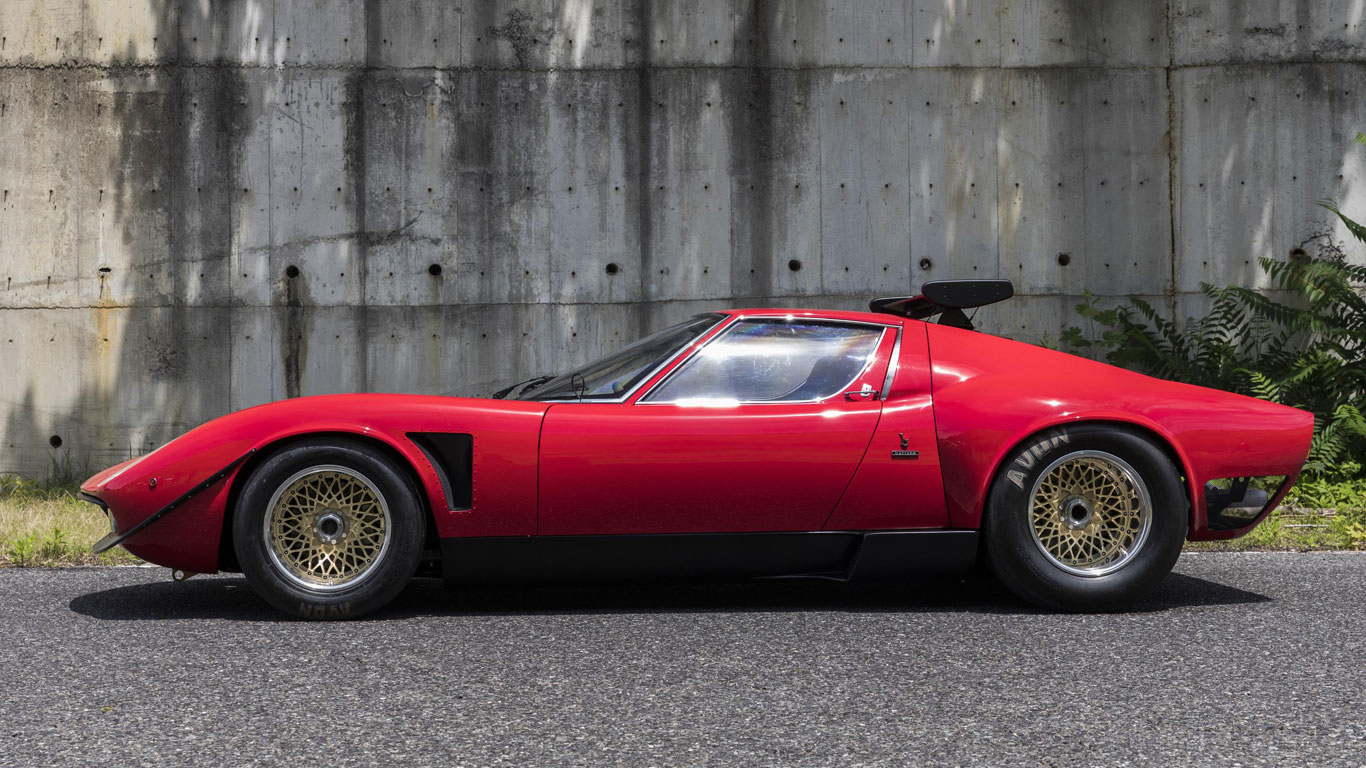
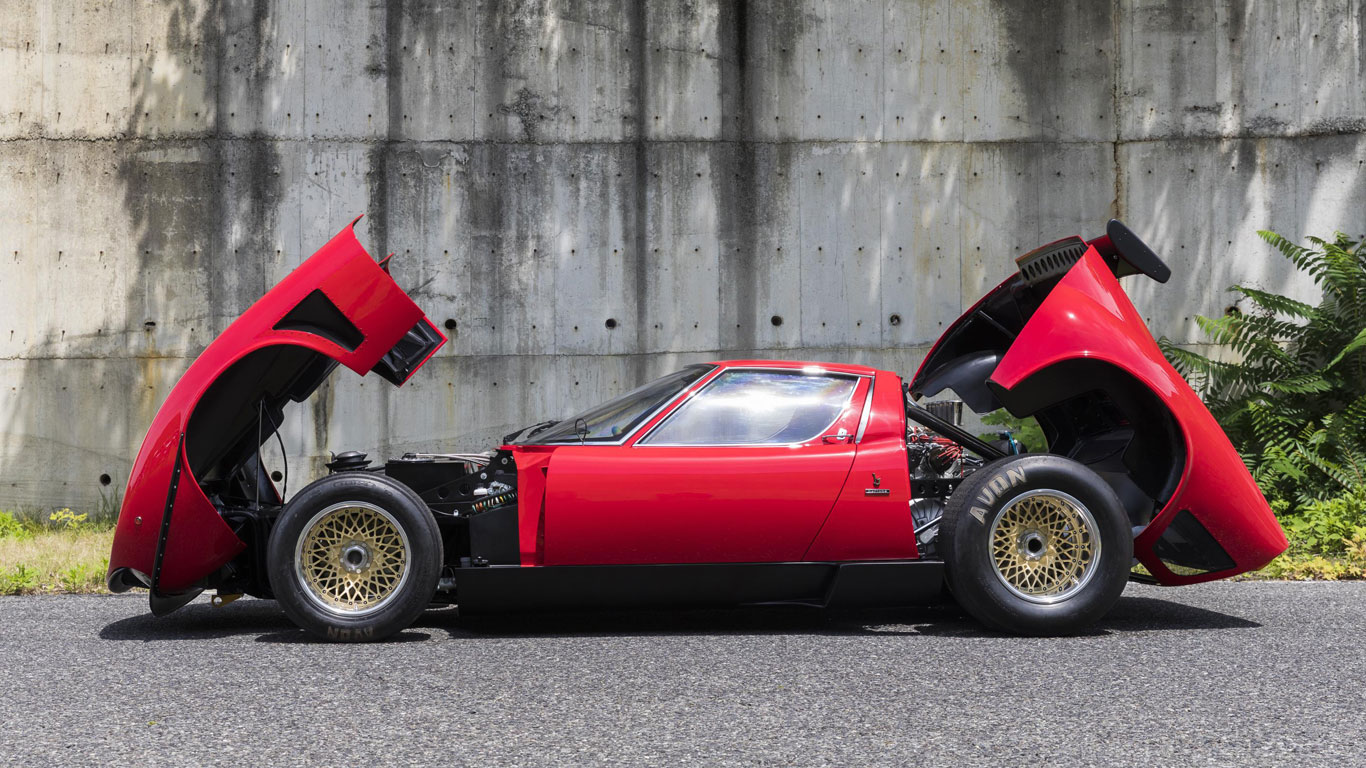
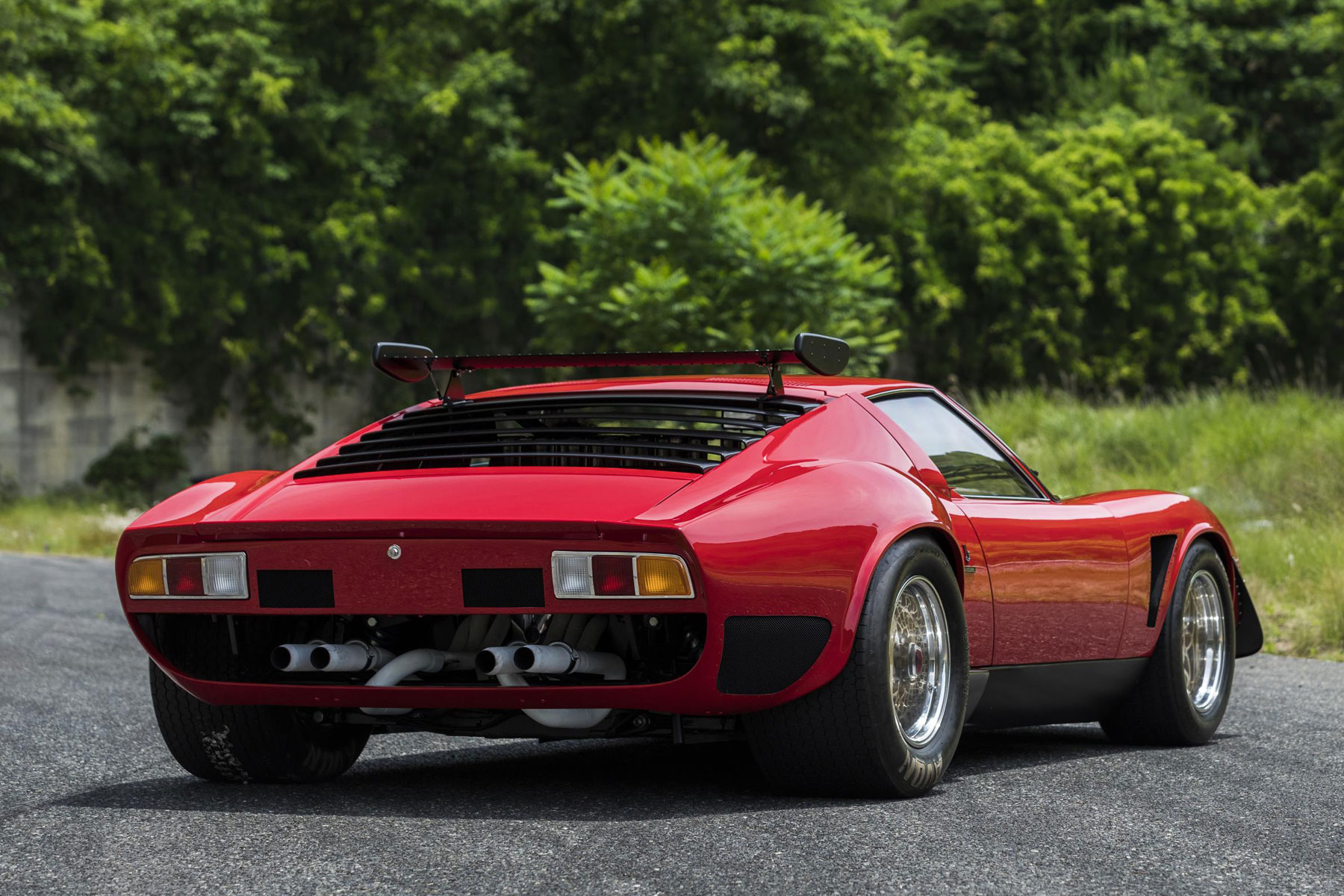
Work included a widened body, Jota-style nose, Pirelli P7R tyres, BBS alloys with knock-off centres, Koni dampers, a chin spoiler, a rear wing inspired by the Countach S and extra cooling ducts and vents. The engine output was increased to around 400hp, while mechanical changes extended to Koni dampers, Girling disc brakes from the Porsche 917, a dry sump, Weber carbs with open funnels, and a straight-through exhaust system.

On completion, it remained in Germany for less than a year before being shipped to Hiromitsu Ito in Japan for a price rumoured to be around $550,000. There it stayed for 40 years, before turning up for sale at high-end Japanese car dealer Bingo Sports.

During its time in Japan, the Miura SVR developed near-mythical status, inspiring the Circuit Wolf comic book series and a 1:18 Kyosho diecast model. Several years ago, the SVR was the subject of a restoration job, at which point the interior was swathed in gold imitation leather. There’s no accounting for taste.

Restored by Polo Storico

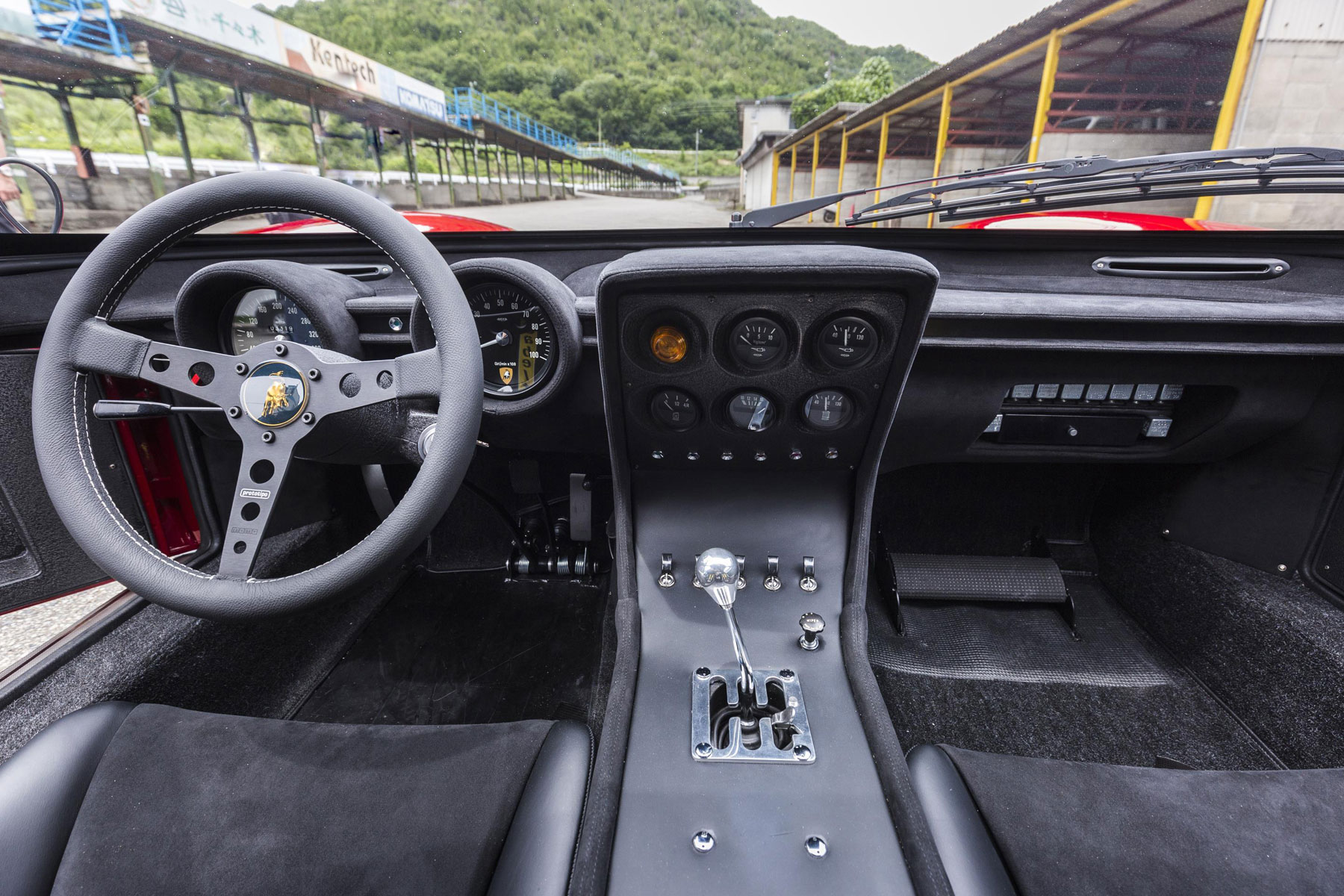
Fortunately, the talented folk at Lamborghini Polo Storico had the sense to restore the Miura SVR to its original specification, including the removal of the gold cabin, before unveiling the finished item at Japan’s Nakayama Circuit. The photos have the potential to break the internet.

Paolo Gabrielli, Lamborghini head of aftersales and director of the Polo Storico, said: “The full restoration took 19 months and required a different approach to the way we normally work. The original production sheet wasn’t of much help, as we relied mostly on the specifications from the 1974 modifications.

“The challenge for the Polo Storico team was even more daunting as the car arrived in Sant’Agata in pieces, although the parts were all there, and with considerable modifications.

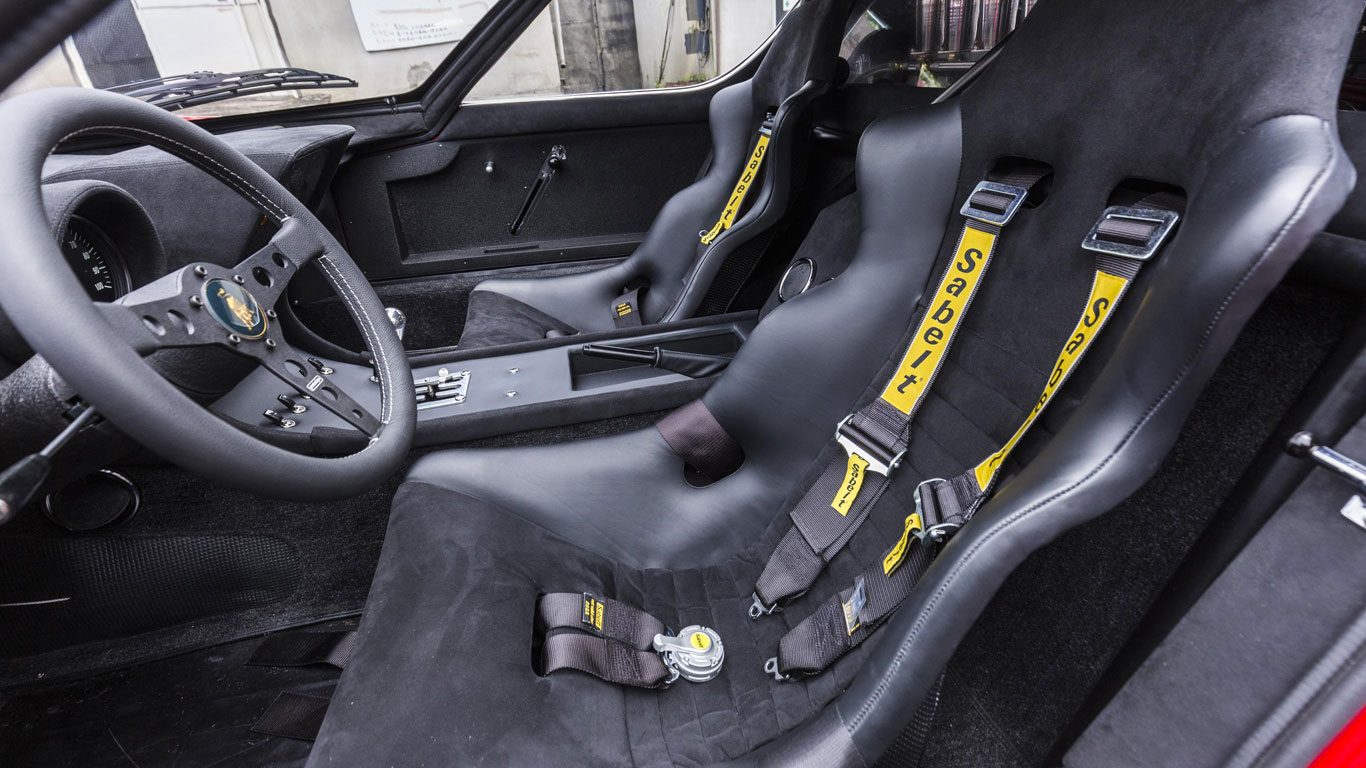
“The only variations on the original specifications were the addition of 4-point safety belts, more supportive seats and a removable roll bar. These were expressly requested by the customer and are intended to improve safety during the car’s racetrack exhibitions.”

We’ll leave you with this footage of the Miura SVR at the Fuji International Speedway, shot before its restoration. Cold flannel, anyone?

Read more:

Advertisement