It’s the latest step in a project that began three years ago, when Nico wrapped his own Mini in fairy lights and showed it off in Bracknell.
When Covid stopped many Christmas displays in 2020, Nico decided to step up his efforts – which have continued, now with the support of Mini UK, in 2021.
“I just knew last year I had an opportunity to cheer people up and also to raise funds for the MS Trust and Duchenne UK,” said Nico.
“In 2019, I was asked to take the Festive Mini to surprise an incredible young boy, Marcus Rooks, who was diagnosed with Duchenne Muscular Dystrophy.
“When I saw his face light up, I realised that I had created something truly special.”
By switching to a Mini Electric, Nico says all his trips are now environmentally friendly, and special app-controlled twinkly lights “with their amazing customisable animations really give the car a bit of extra magic”.
Mini UK director David George said the firm was “humbled to be a part of Nico’s fundraising project.
“It’s a wonderful idea that will bring people together, make them smile, and also raise funds for some amazing charities.”
A Festive Mini 2021 tour website is now live for those who want to visit one of Nico’s stops.
Remember coupe cabriolets? After decades of being little more than a footnote in the big book of automotive history, the open-or-shut car enjoyed 20 years of relative success after the start of the millennium.
Now, without so much of a farewell note left on the table in the hallway, the coupe cabriolet – or CC, if we’re being familiar – has all but disappeared, rendered obsolete by the buying public.
For the CC, this is the way the world ends, this is the way the world ends, this is the way the world ends. Not with a bang but the sound of a failed roof mechanism and the unmistakable stench of a damp footwell. When it comes to taking your top off, soft beats hard.
Despite the likes of the Mercedes-AMG SL and BMW 4 Series returning to soft-tops, the hard-top convertible isn’t entirely dead. The Mazda MX-5 RF, for example, is the closest you can get to a factory-built MX-5 coupe, while the Ferrari F8 Spider caters for those with a bigger budget.
But the boom years are most certainly over, with the pages of Auto Trader littered with examples of cars that promised endless hours of sunshine, bragging rights over your next-door neighbour and the theatre of roof origami. Like the hideous rump required to house a complicated roof, the coupe cabriolet’s glory days are behind it.
Georges Paulin: pulling teeth, raising the roof
It all started in 1934 when Parisian dentist Georges Paulin designed and patented the world’s first automatic retractable hard-top. Using Peugeot platforms, Paulin worked with coachbuilder Marcel Pourtout to create the 301, 401 and 601 Eclipse. Following initial disinterest in the technology, Peugeot used Paulin’s invention to build the 402 Eclipse.
Factors then conspired against the coupe cabriolet. The technology was too expensive, while the breakout of war meant car manufacturers were preoccupied with more important matters. Aside from the Chrysler Thunderbolt of 1941, the technology remained dormant until 1957, when Ford had another stab at popularising the concept.
Recognising that Peugeot had got there first, Ford marketed the Fairlane 500 Skyliner as the ‘world’s only hide-away hard-top’.
‘Here’s the car the motoring public has dreamed of for years… the car many automotive experts said would never be mass-produced. Now, Ford has made this “miracle” a reality. It’s another first from Ford, the company that brought you low-cost V8 power and created such automotive classics as the Thunderbird,’ proclaimed the brochure.
With just a touch of a button, the Skyliner could be transformed from a large American coupe into a sizeable American convertible, with the process taking less than a minute. If the rear deck looks enormous, that’s because it was. The Skyliner was a full three inches longer than the standard Fairlane 500, which was hardly lacking in length.
It was complicated, yes – 610 feet of wiring, three electric motors, eight circuit breakers, 10 relays and 10 limit switches – but it was also highly desirable. Ford sold around 20,000 in the first year, with production continuing until 1959.
Winter-proof in 25 seconds
Invented by the French and developed by the Americans, it was left to the Germans to take the folding hard-top to the masses. The Mercedes-Benz SLK of 1996 laid the foundations for a swathe of coupe cabriolets to hit the market in the new millennium.
Parent company Daimler’s attempts at claim a world-first were dashed, with the official line reading: ‘Mercedes-Benz was the first manufacturer to revive this type of roof, which harked back to an earlier era. When the SLK appeared as a production model in 1996 (R170), its roof was such a hit that several competitors subsequently brought out versions of their own.’
The SLK stemmed from two 1994 concepts: the SLK I and SLK II. The latter, unveiled at the Paris motor show, featured an electro-hydraulic ‘Vario roof’, transforming the oh-so-pretty SLK ‘from a convertible into a winter-proof – or vice versa – in just 25 seconds’.
By the time it was replaced by the R171 in early 2004, 308,000 had been produced, but its legacy was more far-reaching. Put simply, Mercedes-Benz, Ford and Georges Paulin have a lot to answer for.
In 2000, the SLK had one direct rival: the new Peugeot 206 CC. But while the SLK would set you back at least £28,000, the topless Pug was available for about half that price. It also looked pert and pretty, which isn’t something you can say about the majority of coupe cabriolets.
Its replacement, the 207 CC was about aesthetically pleasing as a cold sore, while the larger 308 CC is a definite ‘swipe left’ affair. For cars supposedly majoring on kerb appeal and style, the likes of the Mitsubishi Colt CZC, Nissan Micra CC and Renault Megane CC look about as glamorous as a fresher student after a ‘pound a pint’ night in Newcastle.
There are exceptions to the rule. The Volkswagen Eos, for example, looks like a bespoke build, rather than something based on an existing hatchback. Dare we suggest that it looks more desirable than the equivalent Golf, which was sold alongside the Eos for a while?
Then there’s the Pininfarina-designed and built Ford Focus CC. At the front, the Focus ST styling gives it a sense of purpose, although the rear end makes the Focus saloon look like a pin-up model. It’s that roof mechanism, you see. It needs somewhere to go.
Which brings us on to the inherent problems with the coupe cabriolet: some sacrifices are required. Taking styling out of the equation – beauty is in the eye of the beholder, after all – life with a CC often means living with cramped rear seats, a small boot, stodgy dynamics, lacklustre performance and the feeling that one day, just maybe, the roof mechanism might leave you high and dry. Or, worse still, low and wet.
Ford will point to the fact that the Focus CC offered 248 litres of space with the roof down and a massive 534 litres with the roof up, but given the fact that 50 percent of CC buyers were families, 248 litres wouldn’t the swallow the requirements for a weekend away, let alone the annual holiday.
The ultimate mating ritual?
It’s not all bad news. There’s no denying that these transformers are high on theatre. Only a peacock loitering in a National Trust car park is able to put on a display to rival a CC. Shrinking violets need not apply.
Then there’s an issue of security. It must be nice to return from a night at the opera without the prospect of a screwdriver through your soft top. And, away from bragging about meaningless 0-60mph times, how joyous to be able to compare the time it takes to raise or lower the roof.
But theatrics and security simply weren’t enough for the buying public, who were unable to look beyond the Kardashian-rivalling rears. The older they get, the less desirable they will become (much like Kim?), with buyers and dealers deterred by the complexity roof mechanisms. Did somebody mention French electrics and warranty claims?
There are also the concerns about getting wet. Consult a used car guide for a coupe cabriolet, and you’ll be greeted with more tales of unwanted leaks than an emergency plumbers hotline.
When the current obsession with SUVs and crossovers is finally consigned to the history books, maybe we’ll see the second coming of the CC. Until that day, we’ll have to watch as they spiral into banger territory, teetering on the edge of oblivion.
Georges Paulin was a very talented man but had he foreseen the horrors of the Colt CZC, the Micra CC and the back of the Focus CC, he might have stuck to pulling teeth. Pass the forceps.
The first RML Short Wheelbase retro supercar is due to hit the road next month, before full production of the British-built GT starts in spring 2022.
A total of 30 cars will be made, priced at around £1.3 million each.
This is the first own-brand car from RML Group, the engineering firm behind many of Aston Martin’s Le Mans racers, plus some very specialist road cars. Highlights from its back-catalogue include the Nissan Juke R and record-breaking NIO EP9 electric hypercar.
A ‘reimagined’ classic in the mould of a Singer 911, the Short Wheelbase is styled to resemble a 1959 Ferrari 250 GT SWB, but borrows its 5.5-litre naturally aspirated V12 from a 550 Maranello (1996-2002).
With 485 prancing horses and less than 1,600kg to shift, expect 0-62mph in 4.1 seconds and a top speed of 185mph-plus.
Each Short Wheelbase is based around the central chassis of a 550 Maranello and retains that car’s identity for registration purposes. However, many components are bespoke: designed and hand-made in Wellingborough by a 60-strong team.
Their focus has been to enhance an analogue driving experience with modern comforts. The car’s cabin, for example, combines an open-gate manual gearshift with cupholders and a pop-up touchscreen.
The carbon fibre composite body for ‘Car Zero’ is now complete and ready for paint, after which the engine, wiring, brake lines and interior trim will be added.
CFD (Computational Fluid Dynamics) has been used to fine-tune the beautiful, Ferrari-inspired shape and will soon be bolstered by real-world road testing.
Michael Mallock, chief executive of RML Group and a former British GT and GT4 driver, will be on-hand to offer feedback. He promises “an emotional experience for all the right reasons”.
Look out for a review of the RML Short Wheelbase on Motoring Research in late February.
Adding a private number plate to your car is a popular way to make it stand out from the crowd.
The DVLA’s online tool for assigning a private plate is simple and quick to use, once you understand the jargon.
Our guide explains just how easily you can add this finishing touch to your car.
Which documents do I need to assign a number plate?
Before using the DVLA online tool via the Gov.UK website, you will need the following:
A V778 Retention Document – issued if a private number plate has previously been used on another car OR
A V750 Certificate of Entitlement – issued for a brand new unused private number plate
One of these documents should be given to you when you buy a private plate, or place an existing number plate onto retention.
You will also need:
The current registration of the car you want to add the private number plate to
The 11-digit document reference number from the V5C (logbook) of the car you want to add the number plate to
The postcode of the registered keeper of the car, as shown on the V5C
This should allow you to complete all the relevant sections of the online form.
How much does it cost to assign a number plate?
Assigning a private number plate online is a free process. However, taking a private number plate off a vehicle (putting it onto retention) does incur a charge of £80.
In order to assign a private number plate to a new car, it needs to be placed on retention first. Retention rights last for up to 10 years.
How easy is it to assign a number plate online?
The process of assigning a private plate is very straightforward, providing you have the correct documents to hand. Be sure to check the eligibility requirements before starting the process.
Using the Gov.UK website, you will be prompted to enter the relevant reference numbers and details.
The online tool is only available from 7am to 7pm, plus there is also a Welsh language version.
How quick is the DVLA online form?
Unless there are any additional checks flagged up, the private number plate will be assigned to your car instantly. This will include updating relevant records for VED (road tax), too.
It means that as soon as you submit your request online, the number plate for your car will be changed.
Should you provide the DVLA with your email address, an Electronic Number Plate Authorisation Certificate (eV948 or eV948/2) will be sent to you immediately.
The registered keeper of the car will also receive a new V5C logbook, which should be delivered within a few days.
How do I get new number plates made?
Such an instant change means you need to be prepared to replace the physical number plates on your car before you drive it.
If you have had the private plate assigned to another car before, you may still have physical plates. If so, you can simply replace the old plates from your car with these.
Should you need new number plates made from scratch, you can use the eV948 or eV948/2 sent to you by email. This is typically only valid for a few days, so be ready to go and get new plates made soon.
You should use a registered number plate provider to ensure your new plates meet the correct legal standards. Registered providers will need to see proof of your identity, along with proof of your entitlement to the number plate. Check with your chosen provider which documents they accept in advance.
Can I still use paper forms to assign a number plate?
The DVLA will still accept submissions to assign a number plate by post, using the V750 or V778 form. You will also need to send the vehicle’s V5C (logbook) or green ‘new keeper’ slip with a completed V62 form.
Submitting documents by post is likely to take longer than assigning a number plate online.
Can I assign a number plate to a financed or leased car?
Finance providers for cars bought via Personal Contract Purchase (PCP) or Personal Contract Hire (PCH) may have rules around adding a private plate. However, most should allow it.
Your finance documents will specify any particular rules. You will need to contact your finance provider once a plate has been assigned.
Cars supplied on a lease deal will require permission from the lease provider before a number plate can be assigned. As the lease company is the registered keeper, you will need to liaise with them to have the plate added. Finance providers may charge an administration fee for this process.
You will need to put your private plate onto retention before your lease deal ends. This should be done around eight weeks before returning your car.
Who should I tell when I assign a number plate?
Assigning a private number plate to your car also requires you to inform others of the change.
Your car insurance provider should be the first contact you make, ensuring your policy is updated. Many insurance companies will allow you to notify them of the change online, or you may need to telephone them. Some insurance companies will charge an administration fee to cover the change.
Make sure you also update car park passes or parking season tickets with your car’s new number plate.
A unique Chevrolet Impala Wagon has been crowned the 2021 Snap-on Custom of the Year by the Goodguys Rod & Custom Association.
The two-door custom Impala was named the winner at the recent Goodguys Autumn Get-Together event, held in Pleasanton, California.
It means the special Chevy, named ‘Impressive’, will head to the Goodguys 24th Speedway Motors Southwest Nationals this weekend.
Impressive by name and nature
‘Impressive’ is the result of a nine-year build process, undertaken by the Minnesota-based Ranweiler family.
The work was all undertaken at the family’s Show Cars Automotive shop, and included converting a four-door Impala Wagon to a bespoke two-door version.
Changes include the roof being chopped, the windshield angle reclined, and the B- and C-pillars fabricated from scratch.
An entirely unique front end has been installed, with the fenders and other panels welded to the cowl for a completely seamless appearance. The grille and bumpers are also custom items.
Combining luxury and performance
Powering ‘Impressive’ is a 509-cubic inch V-8 engine, fitted with a Hillborn fuel injection system. It sends 600 horsepower to the rear wheels via a 4L60E transmission.
A modified Art Morrison chassis has been used, bringing updated suspension to the build. Custom EVOD wheels are fitted, with the rears a sizeable 20×12 inches.
Inside, there’s a 1960 Chevrolet Impala dashboard, but with Dakota Digital gauges. Custom-dyed Italian leather wraps the 1959 Cadillac Eldorado seats.
Bespoke metal trim, created by the Ranweilers, has been used throughout the cabin.
Another trophy for the cabinet
Living up to its name, ‘Impressive’ has already collected multiple awards. In 2020, it won the prestigious Ridler Award at the Detroit Autorama, and later took honors in the SEMA Show Battle of the Builders competition.
The Goodguys 24th Speedway Motors Southwest Nationals will be held in Scottsdale, Arizona. Taking place from Friday 19 November to Sunday 21 November, it marks the culmination of the Goodguys 2021 show season.
A Lamborghini Huracan has been turned into a mobile artwork by the fingertips of Paolo Troilo.
The Italian-born artist used the bodywork of the Lamborghini as a canvas for his unique ‘Minotauro’ (Minotaur) creation.
According to Troilo, the artwork represents the ‘the dynamism, power and innermost emotions’ he experienced when driving a Huracan Evo.
Narrowing space, distorting time
Speaking about his Lamborghini enlightenment, Troilo said: “Seeing the Huracan Evo and trying it out suggested to me that there are also things capable of releasing the same energy with acceleration, with speed, with momentum.
“I heard the sound of the wind picking up as the space narrowed and time distorted. I felt a flowing wind and used it to paint on the muse itself, the inspiration of these emotions: the Huracan, my Minotauro.”
Using the mythical minotaur as his muse, Troilo’s artwork features a male body and a bull – the traditional symbol of Automobili Lamborghini.
As with his previous works, the painting was done by Troilo using just his fingers, with no brushes involved.
Finger on the pulse
Spotted for creative talent as a child, Troilo worked for 15 years as an award-winning advertising executive. This included time spent with the renowned Saatchi & Saatchi organisation.
Choosing to move permanently into the art world, Paolo forgot to buy brushes to paint with. Instead, he chose to work with just his fingers, creating his own unique style.
Unveiled at La Bullona in Milan, Minotauro has been displayed as part of a curated collection of Troilo’s work.
It marks the latest in a series of Lamborghini art cars. These include a pop art-inspired design created by Skyler Grey for an Aventador S in 2019.
Porsche has pulled the wraps off a new GTS version of the pure electric Taycan at the Los Angeles Auto Show. Positioned above the Taycan 4S and below the Turbo, the company describes it as ‘a real sweet spot in the range’.
The Taycan GTS debuts a new Sport Turismo body style, too. Based on the existing Cross Turismo estate, it features lower suspension for a sportier stance.
It also ditches the SUV-style body cladding and Gravel driving mode of the more rugged Cross Turismo.
The GTS serves up 598hp (440kW) of overboost power when using launch control – enough to blast either the saloon or Sport Turismo to 62mph in 3.7 seconds, plus a (limited) top speed of 155mph. Quoted range after a full charge is 312 miles.
Porsche promises ‘further dynamic focus’ for the GTS. Adaptive PASM suspension comes as standard, with agility-enhancing rear-wheel steering an option.
A modified Electric Sport Sound system should make it sound faster, too. Let’s hope for a convincing impression of the 911 GT3’s petrol flat-six…
On the outside, black highlights on the bumpers, door mirrors and window surrounds help the GTS look the part.
Inside, you’ll discover acres of tactile Race-Tex fabric (Porsche’s answer to Alcantara) and enough space for five adults and their luggage.
One interesting option for the GTS Sport Turismo is a touch-sensitive panoramic sunroof. A liquid crystal film within the glass can change from clear to opaque at the press of a finger. Uniquely, the roof consists of nine sections, each of which can be tinted individually.
The Taycan is the final Porsche model to get the GTS treatment. First deliveries are expected in spring 2022, with prices from £104,190 – or £104,990 for the Sport Turismo. Look out for a review soon.
Famous technology journalist Rory Cellan-Jones was reunited with his missing dog, Cabbage, after a high-profile search – and fittingly, it was the latest tech from Ford that came to his rescue.
Rory’s dog was one of six in the back of a one-year-old Ford Transit Custom being used by dog minder, Brett Holte-Smith.
The dog walker, explained Rory, had left the Ford running with the keys in the ignition while he picked up another client’s pooch.
“He turned round to see it disappearing into the distance.”
Rory tweeted about the loss and, within half an hour, it had gone viral, with 10,000 retweets and 3.6 million views.
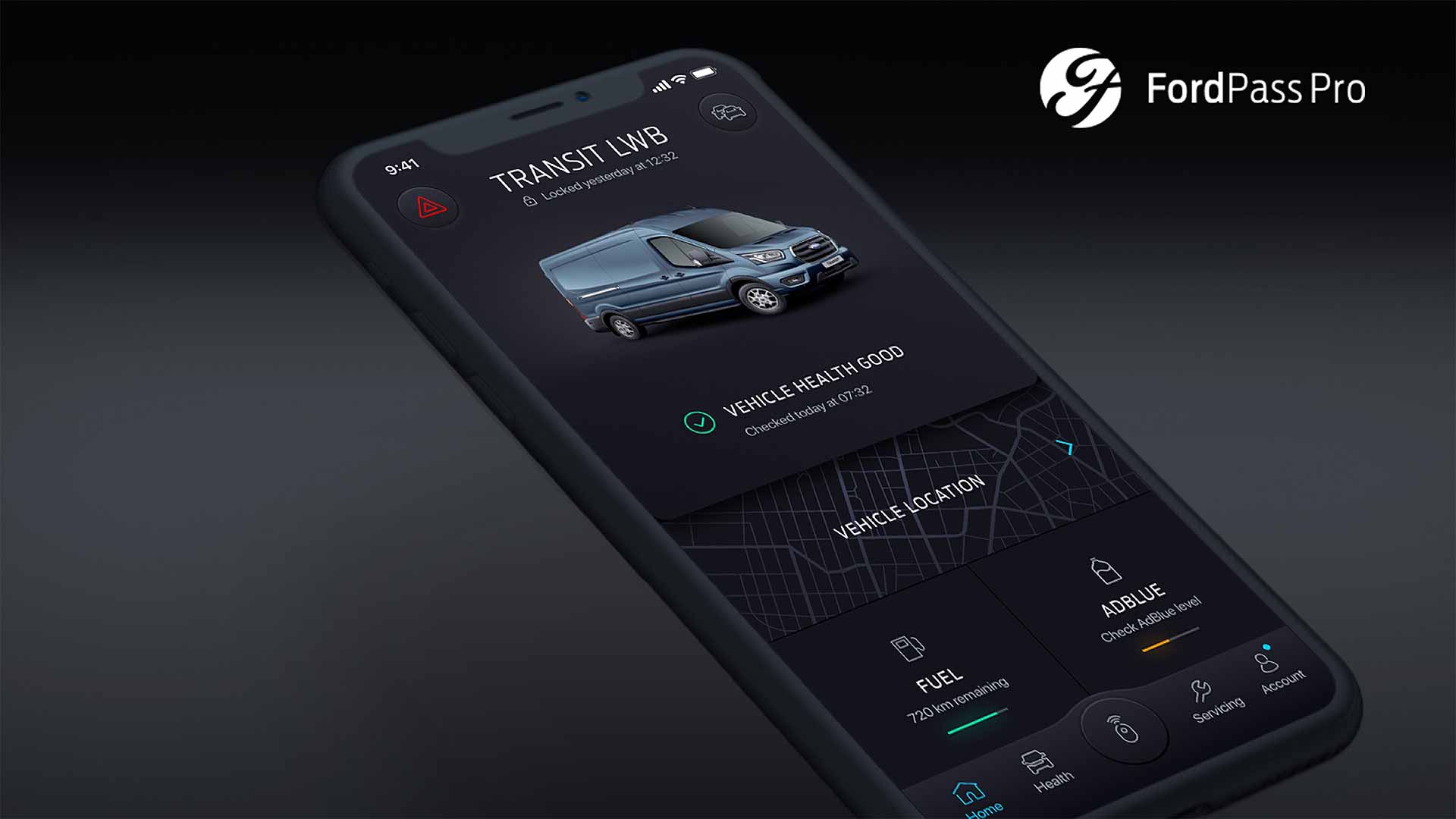
However, it was actually technology embedded in the van that helped locate the missing hounds.
This meant the location of the van could be tracked via the onboard modem and SIM card.
Once Ford Pass had been activated, the Transit’s first location following the theft showed up the following morning in Park Royal.
The search team were dispatched and, although the vehicle had gone by the time they arrived, they actually later found five of the six missing dogs roaming the area.
Later, when the thieves moved the van again, its location was traced to another area in Park Royal – and it was seized later that evening.
The sixth dog was even then found, meaning Rory was reunited with Cabbage… thanks to the combined power of social media and free Ford tech.
Mark Harvey, Ford enterprise connectivity director, said: “Connectivity is the cornerstone of our mission to deliver smart vehicles.
“What brings that plan to life, and makes it all the more rewarding, is real-life stories such as this, with Ford’s technologically advanced vehicles bringing about a better outcome for customers in need.”
Lee Johnstone’s super Swede beat competitors from around the globe to be judged the most unique and inspiring custom car. It will now be turned into a 1:64 scale die-cast model by Hot Wheels, and sold in shops.
A world-beater from Somerset
First acquired by Johnstone as a bare shell, Ain’t No Saint has been extensively modified for drag racing. It has a Chevrolet-sourced 454 cubic-inch V8 engine, which boasts a supercharger and dual four-barrel carburettors.
Helping the Volvo P1800 to victory was the family story that made this ‘Gasser’ a success on the drag strip. Lee’s project was aided by his wife, Sue, along with his three daughters: Ellie, Tori and Sarah.
Ain’t No Saint beat a host of amazing competitors. These included a 1969 Dodge Charger called Scraptona, and a Baja-spec Porsche 911.
Immortalised in miniature
Now into its fourth year, the Legends Tour spanned 11 countries, with thousands of vehicles entered.
Judging was undertaken by an array of automotive and design experts from around the world. The grand finale was hosted by Jay Leno, with his own garage used as the venue for the live-streamed event.
Like the previous winners of the Legends Tour, Ain’t No Saint will now be created as a detailed 1:64 scale die-cast toy.
It offers the chance to own the compact A-body Dodge, fitted with a legendary engine.
The listing is part of a new collaboration with the Goodguys Rod & Custom Association. This aims to highlight cars being sold by members of the nationwide enthusiast club.
“This is a tribute!”
The combination of a small body, and an engine bay big enough for V-8s, had made the Dart attractive to drag racers.
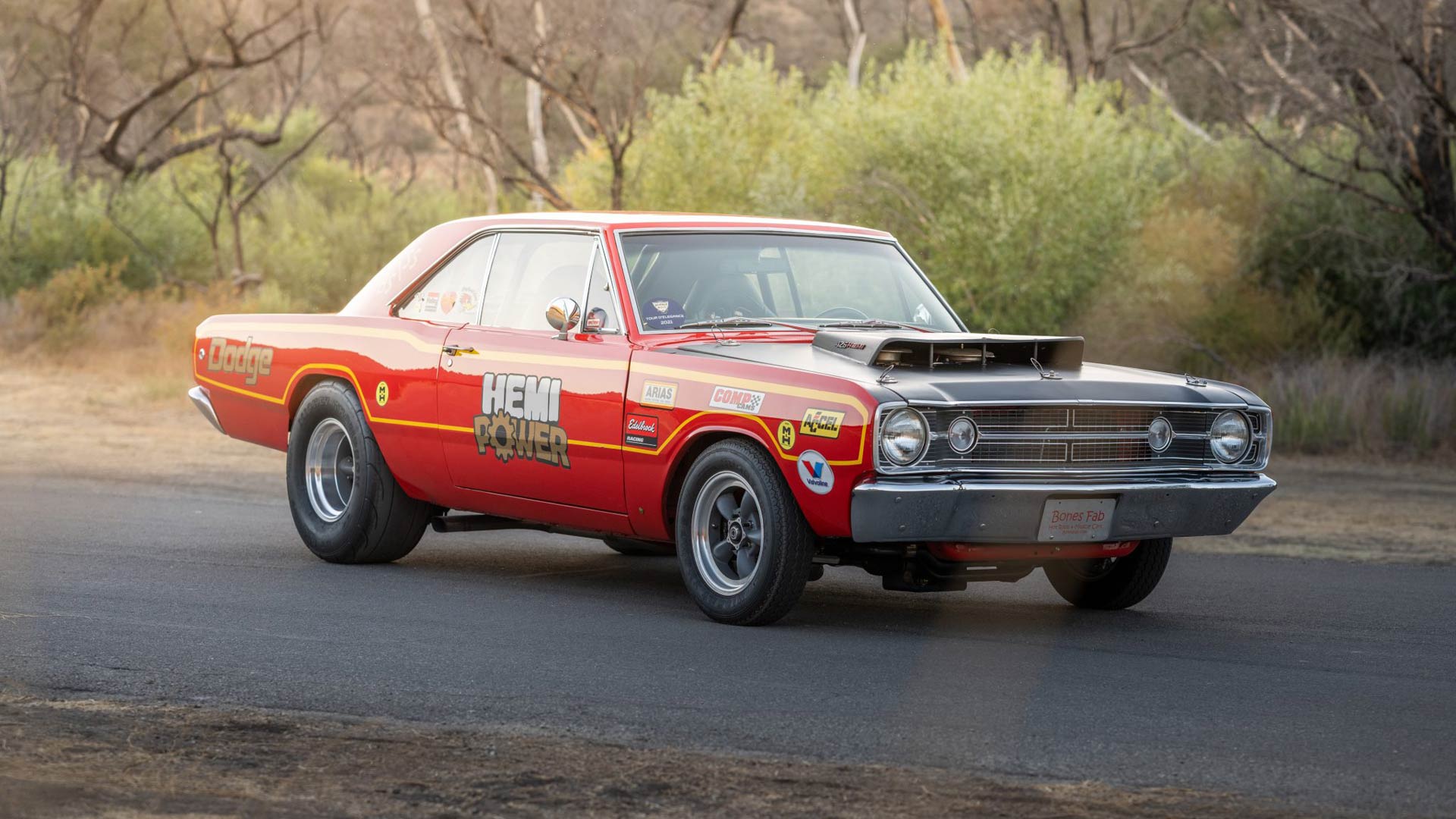
For 1968, Dodge decided to get in on the action itself. Hurst Performance was contracted to build Super Stock Darts for competition usage. Darts with both the 440-cubic inch RB V-8, and formidable 426-cubic inch Hemi V-8, would be available.
Around 80 original Dodge Hemi Dart Super Stock models are believed to have been produced. It means tracking down a factory ‘LO23’ Hemi Dart is akin to finding a needle in a haystack.
With original cars so rare, opting to build a tribute like the car up for auction is a smart move.
“Hemi-powered drones scream down the boulevard”
Subject to a five-year restoration process, the main attraction for the 1968 Dart is the 426-cubic inch Hemi beneath the fiberglass hood.
The big V-8 has been fitted with aluminum cylinder heads, Holley carburettors, MSD ignition, and Johnson Lifters hydraulic roller tappets.
Although the Dart has been photographed with velocity stacks, air cleaners are used for street driving. The Hemi V-8 is also said to be capable of running on regular pump gasoline.
A TCI 727 three-speed automatic transmission sends power to the outrageous 10-inch wide rear wheels.
Stripped back to basics
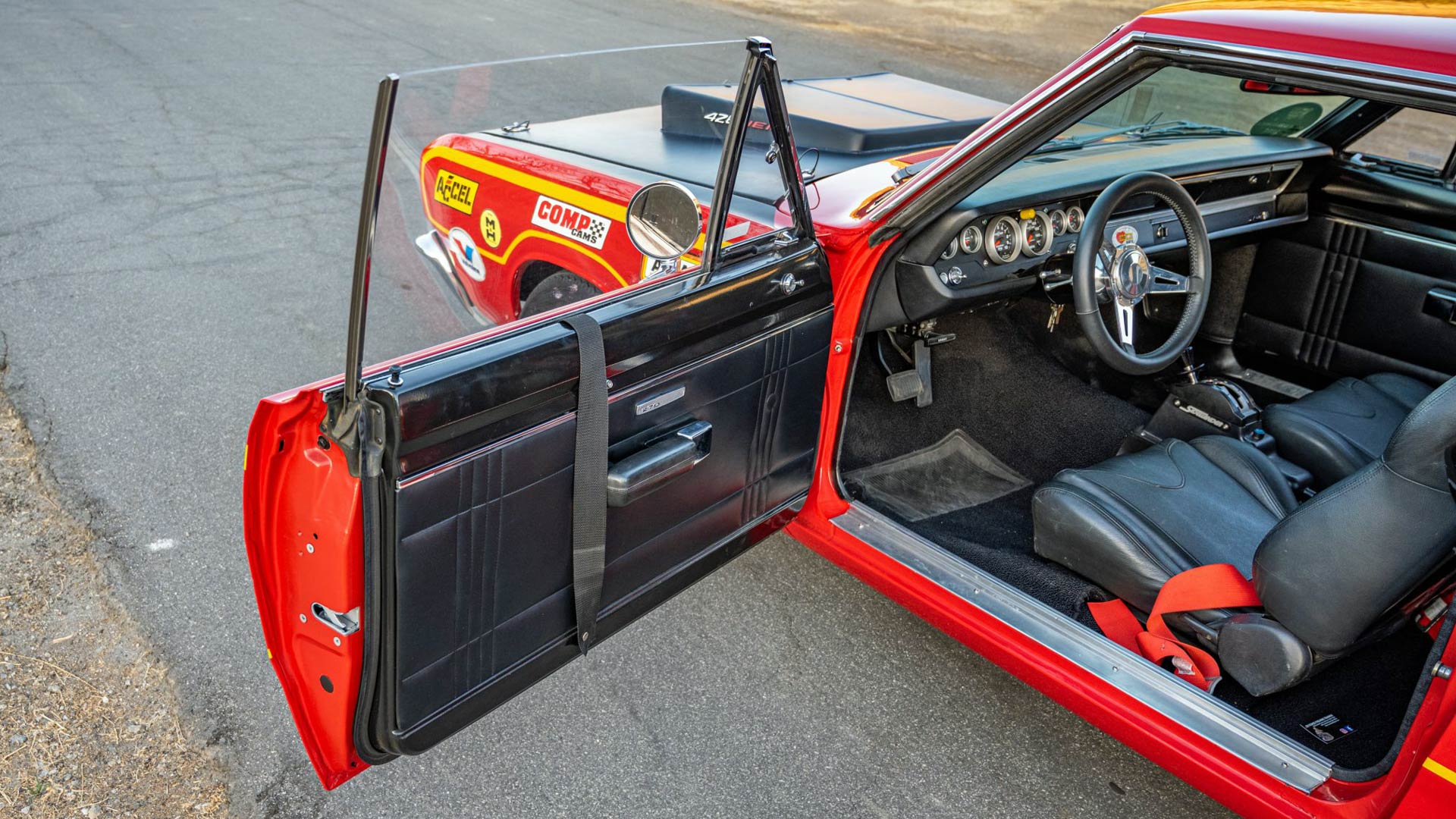
As part of the restoration work, the Hemi Dart has gained Corbeau bucket seats, finished in black leather. These are equipped with G-Force Racing Gear four-point harnesses, with a sizable roll hoop mounted behind.
The radio, heater, and rear bench seat have all been removed to save weight, while the side windows are made from polycarbonate. The window winder mechanism has also been ditched, and replaced with straps.
Extensive paperwork will be supplied with the Hemi Dart, including service records and details of the components used in the restoration.
Ready to rumble
With so few examples produced, prices for a genuine LO23 Hemi Dart typical stretch deep into six figures. Owning such a rarity is also likely to dissuade owners from hitting the drag strip in their Mopar muscle car.
Bidding on a tribute car like the Dart up for auction enables the same Hemi-powered thrills. Just without the related worry or expense.