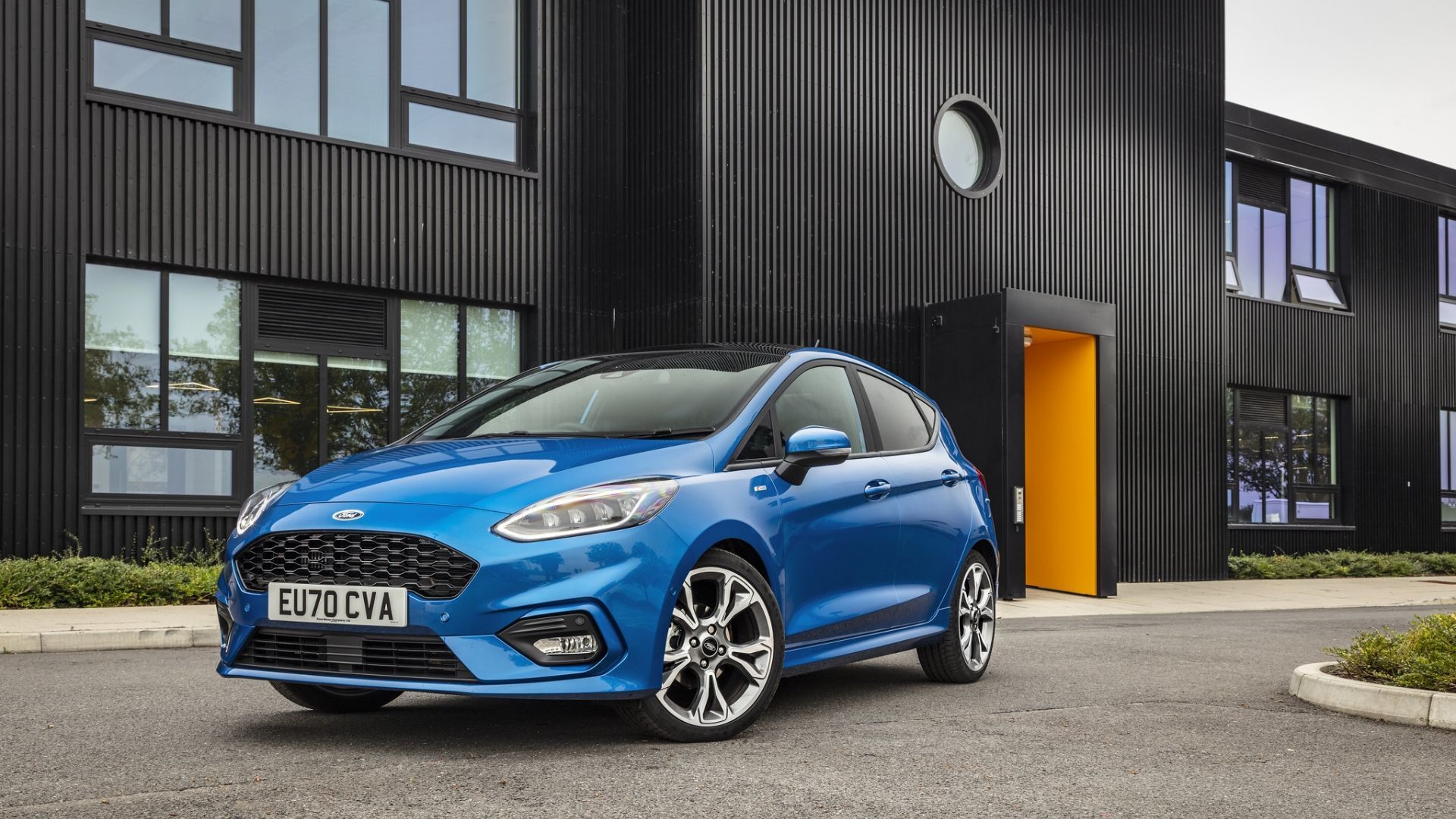
Ford has partnered with pay-per-mile insurance provider By Miles to reduce the cost of car insurance for ad-hoc car users.
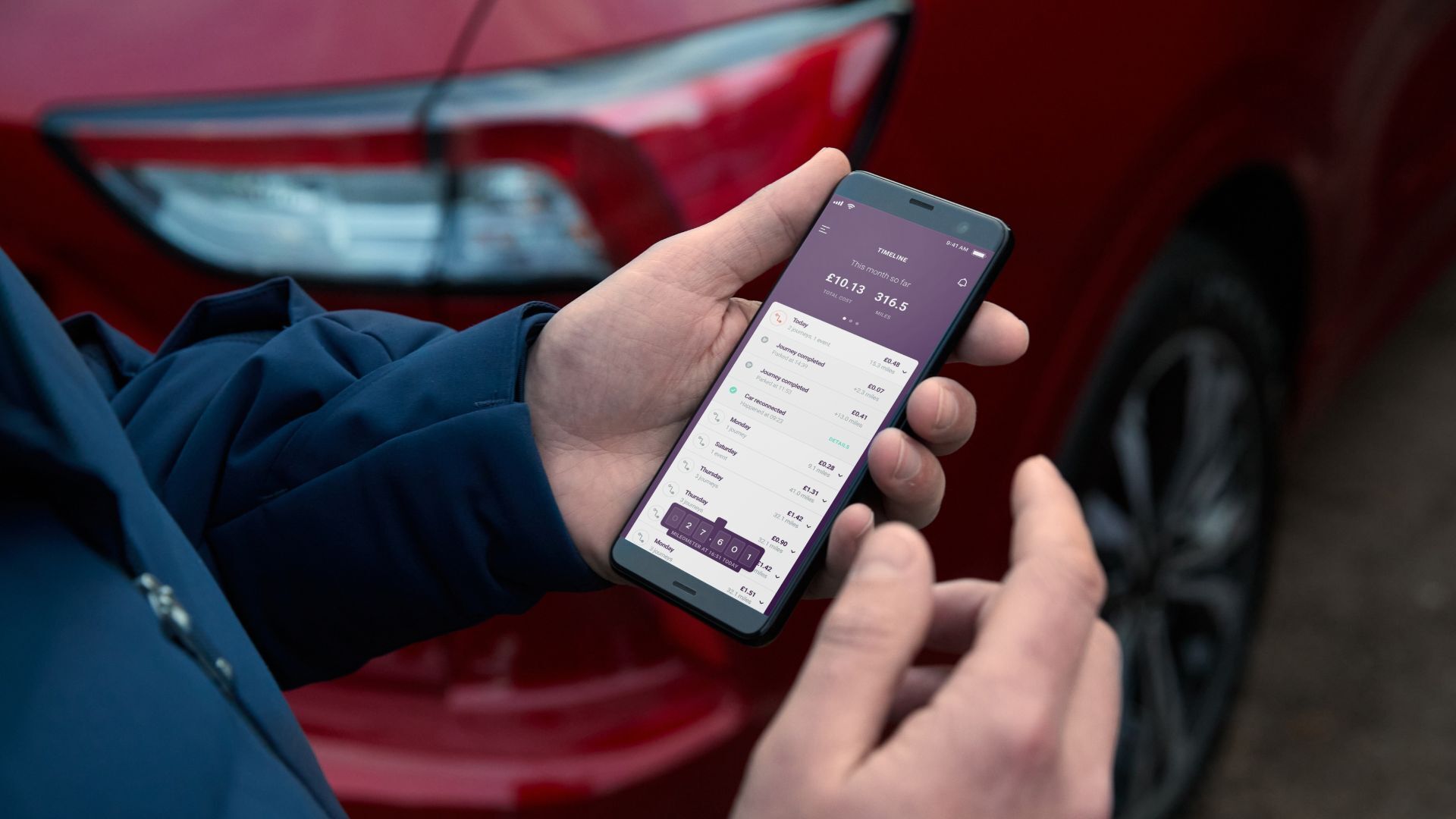
Rather than basing its premium on a projected mileage figure, By Miles charges based on the actual distance covered by a motorist, with the data coming from the car’s in-built FordPass Connect modem.
Ford cited research from financial review website Finder that said 51 percent of motorists could save £297 a year on insurance if they use By Miles. It added that a policy is activated once the driver accepts a prompt on the vehicle’s screen to share distance data after signing up online.
‘The new normal’
“The way we travel has undergone a huge shift that could well have a long-lasting impact. We want to champion the changing needs of drivers who continue to work from home,” said Mark Harvey, director of enterprise connectivity at Ford of Europe.
“Working with By Miles, we aim to use connected vehicle data to help deliver a full suite of innovative new products and services for our customers.”
James Blackham, CEO and founder of By Miles, added: “The way insurance used to work may not work for everybody. Whatever the new normal looks like, it’s clear that drivers’ needs are changing quickly – and people want fairer, more flexible cover that reflects that.
“We’re delighted that our pay-by-mile collaboration with Ford will offer drivers a seamless, connected alternative to traditional car insurance.”
Electric classic car conversion specialist Electrogenic has unveiled a battery-powered E-Type.
The Oxford-based firm is offering three zero-emission powertrain choices for Jaguar E-Type owners. Prices start from £54,000, excluding the cost of a donor car.
The entry-level ‘Tourer’ option uses the car’s original gearbox ‘in order to retain the feel of classic driving’. It has a top speed of 100mph.
The mid-tier option, called Sprint, offers an uprated electric powertrain with 347lb ft of torque going to the rear wheels. Electrogenic claims this conversion exceeds the original E-Type’s performance figures.
The top-of-the-range Grand Tourer disposes of the gearbox entirely and instead focuses on performance. The electric powertrain is said to deliver 402hp.
The Tourer and Sprint options offer an approximate electric range of 150 miles, although an optional range-extender increases that to 200 miles. The Grand Tourer has a claimed range of 250 miles between charges.
The E-Type’s interior maintains the factory dashboard, with switches and dials repurposed ‘where appropriate’. For instance, the fuel gauge displays the state of electric charge.
No modifications are required to the engine mounts or bodywork, and the company says it is possible to reverse the conversion if required.
“Electrifying an icon is always going to be a challenge, and because of that we’ve put a great deal of thought and research into the options that we will provide for customers. Each vehicle we re-create is customised, but engineering three distinct motor options gives our customers a clear starting point for the conversion,” said Steve Drummond, director and co-founder of Electrogenic.
“Each of the motor systems complements our battery and power electronics module that bolts directly to the original engine mounts, and which is designed to accommodate both left- and right-hand drive.”
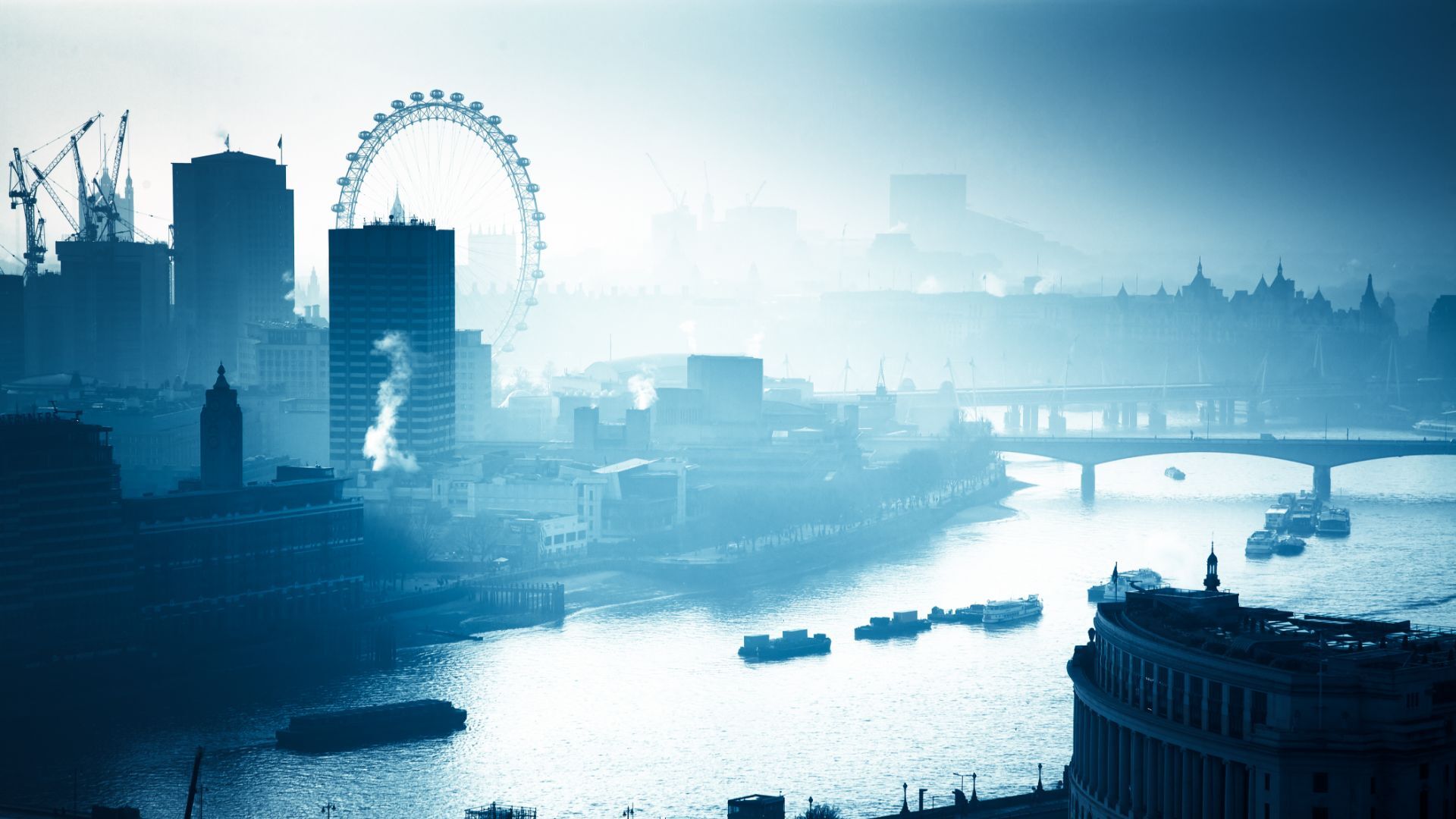
Lead from leaded petrol is still present in London’s air, despite the fuel being banned in 1999, new research has claimed.
According to a study by Imperial College London, up to 40 percent of the lead in airborne particles today is a legacy of leaded petrol. The researchers said this ‘highlights the long-term persistence of contaminants introduced by human activities in the environment’.
The Imperial College team compared the chemical and isotopic composition of particulate matter in the air with samples of road dust and urban soil. This confirmed the presence of dust contaminated from leaded petrol in London today.
As part of the study, the researchers took 18 samples of airborne particles at street level in Marylebone in the summer of 2018, plus 20 samples on a 24-metre-high rooftop at Imperial’s South Kensington campus between 2014 and 2018.
By comparing historical data of the isotopic composition of air particles in London, they discovered that lead sources have remained unchanged over the past decade.
‘Detrimental effects on health’
“Petrol-derived lead from decades ago remains an important pollutant in London. Despite the leaded petrol ban, historically combusted lead is still present in London’s air more than 20 years later,” said Eleonore Resongles, who helped conduct the work at Imperial College’s Department of Earth Science and Engineering.
“Long-term low-level exposure to lead can adversely affect health and, while we don’t yet know the health implications of our findings, they suggest that leaded petrol might still be providing low-level exposure, which can have detrimental effects on health.”
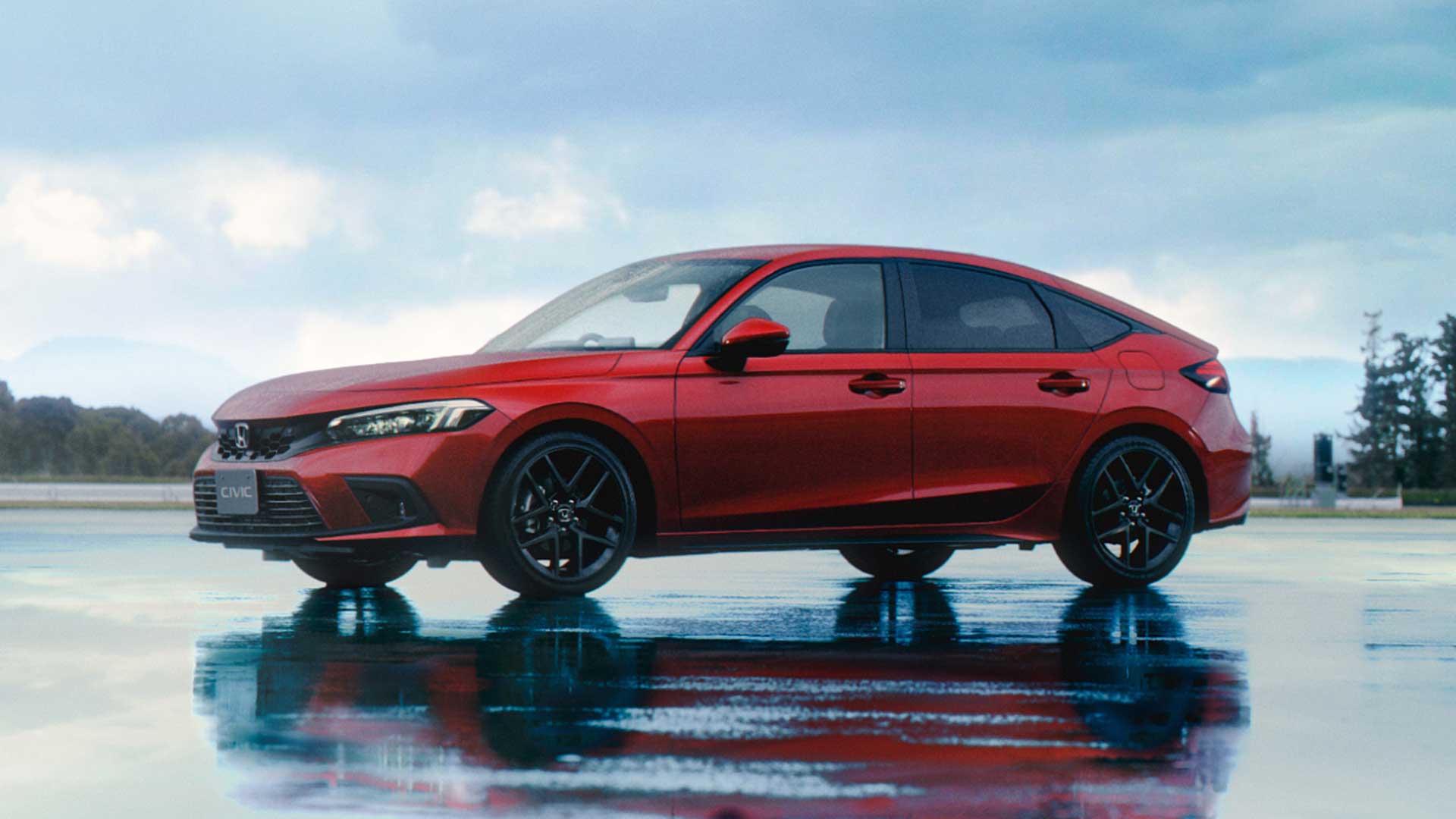
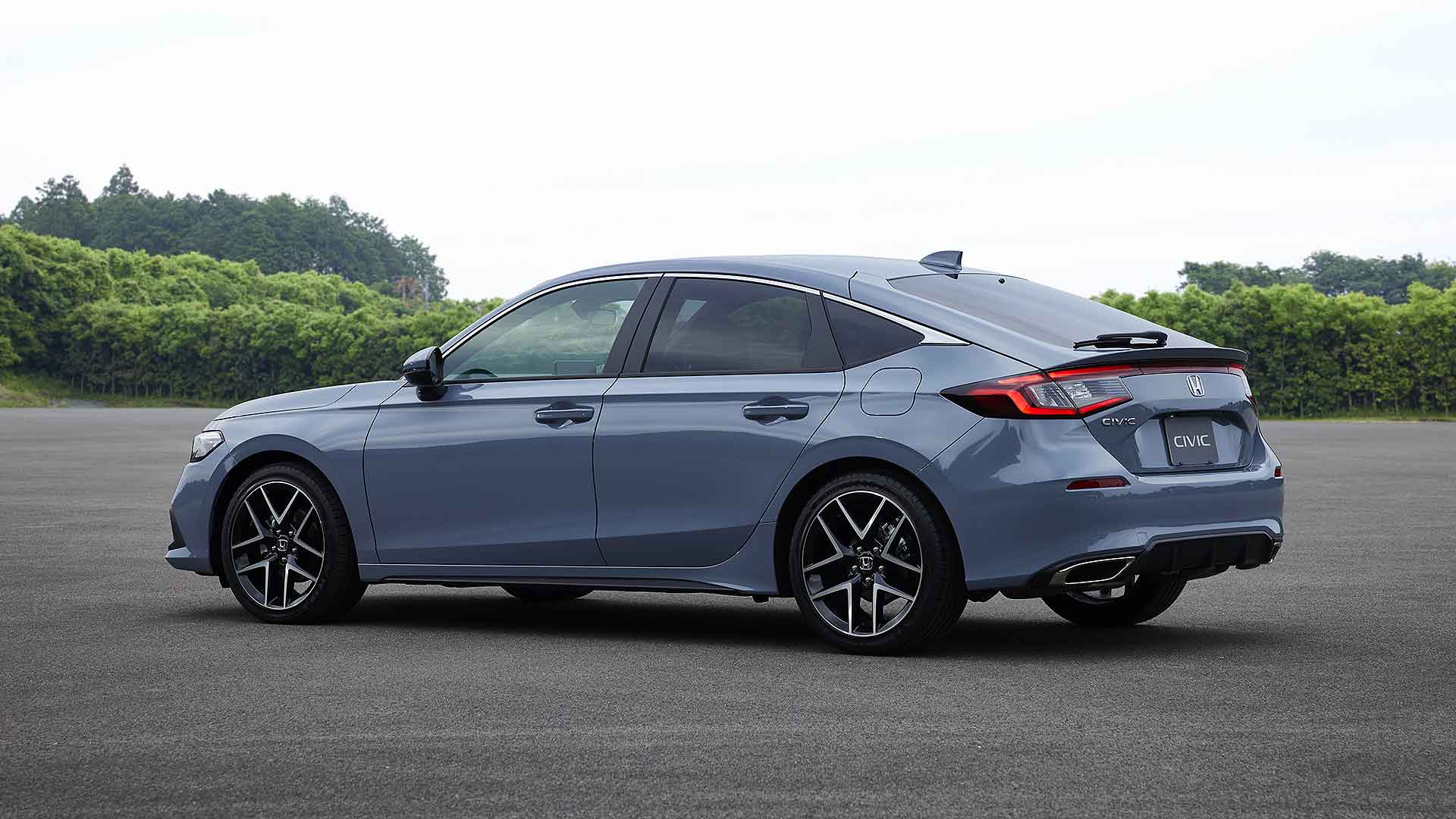
An all-new HondaCivic will arrive in 2022 boasting smooth, low-slung styling including a fastback-style rear end and a smart new interior inspired by the simplicity of the Honda e.
This will be sold alongside an upgraded version of the current 1.5-litre turbo; Honda, it seems, has no plans to fully electrify the latest Civic.
More details of the new car are still to come; Honda’s Japanese debut of the new car is to give the world its first look and introduce the “clean and simple” design philosophy.
Honda says the coupe-like profile is “inspired by European sportbacks” (and, it seems the Hyundai i30 Fastback).
The hatchback’s lines are “unique” and “give it an even sportier attitude”.
The firm continues to march ahead in terms of interior design. After the inspirational Honda e EV, and the next-generation HR-V that so impressed Motoring Research earlier this year, the new Civic looks to be another success.
Honda says it is “simple, clean and uncluttered, with exceptional visibility, intuitive ergonomics, extraordinary passenger volume and driver-focused technology”.
Initial standouts include the stylish full-width air vent panel, a well-positioned infotainment screen and, praise be, a fully-round and particularly attractive steering wheel.
As for the drive, Honda is promising an enthusiastic and “even more dynamic experience, with ride and handling fine-tuned in Europe”.
More details of the new Civic are expected later this year, with sales either beginning in the winter or early 2022, ahead of deliveries commencing next year.
Juliet Bravo was one of the first police shows I remember watching on TV, occasionally looking up from playing with my cars on the living room floor to see a Rover SD1 during the opening titles.
In reality, you were more likely to see a Mk2 Ford Escort panda car – or an Austin Mini, Metro or Maestro – as you were an SD1 during an episode, but that Rover – along with the iconic theme tune – has stuck in my mind for over 40 years.
For others, the first memory of a television police car might be the Ford Zephyrs and Zodiacs in Z Cars, which are arguably as famous as the actors who played the parts of the Newtown police officers.
And that’s the thing about TV police dramas: you might not remember the episodes or even the actors, but you’ll almost certainly recall the cars. Sorry, Elvis Costello, we weren’t watching the detectives, we were watching the motors.
Here are the coolest TV cops, according to me.
Lieutenant Columbo’s Peugeot 403
Cars driven by television detectives tend to fall into one of two categories: extremely flashy or extremely ropey. Much like his raincoat and dishevelled appearance, Lieutenant Columbo’s Peugeot 403 falls into the second group.
Peter Falk, who played the ace detective, was given the choice of the cars parked up behind Universal Studios and he selected the Peugeot 403 convertible a day before filming was due to start.
According to Peugeot, Columbo’s 403 convertible (one of a few used during filming), probably arrived in the U.S in the hands of an Air France employee who transferred to California. Around 2,000 were produced.
The Professionals’ Ford Capris
Thanks to the Zephyrs and Zodiacs used during the filming of Z Cars, Ford knew that television was a terrific marketing tool. Which is why it was all too happy to supply Capris for The Professionals.
Bodie’s Stratos Silver 3.0 S and Doyle’s Tibetan Gold 3.0 S are arguably the most famous Capris to appear in the long-running crime series. Many cardboard boxes were harmed during the filming.
Jennifer Hart’s Mercedes-Benz 450 SL
“When they met, it was moyder.” What can I tell you about Hart to Hart? Not a lot, aside from the fact that Stefanie Powers was my second crush and that her character, Jennifer Hart, drove a Mercedes-Benz 450 SL.
It meant that, before I knew any better, the R107 was the ‘Hart to Hart Mercedes’. The American show gets a 6.7 rating on IMDb, which suggests it wasn’t a televisual masterpiece, but the SL certainly ticks the ‘cool’ box.
Jim Bergerac’s Triumph Roadster
It’s just as well this isn’t the Radio Times, because my knowledge of Bergerac extends to the fact that it was set in Jersey, there was a character called ‘Hungerford’ and the lead character was played by the guy who went on to play DCI Tom Barnaby in Midsomer Murders.
DCI Barnaby drove a Ford Mondeo, Rover 75 and Jaguar X-Type, all of which are unable to compete with the elegance and class of the Triumph Roadster used in Bergerac. In 2013, the actual car sold at auction for £23,000.
Inspector Gadget’s Gadgetmobile
This is a trip down memory lane, because I’d all but forgotten about Inspector Gadget’s Gadgetmobile. Is it me or does the car resemble something that could have been penned by Giorgetto Giugiaro?
You could argue that the Gadgetmobile was a pioneering crossover because when it had finished patrolling the streets or chasing ne’er-do-wells, it could change into a van for transporting Penny and Brain. Clever.
Harriet Makepeace’s Ford Escort Cabriolet
Glynis Barber in a Mk3 Ford Escort Cabriolet. Enough said.
Inspector Morse’s Jaguar Mk2
According to John Thaw, the Jaguar Mk2 from Inspector Morse was a “beggar to drive”, but it’s arguably the most famous TV detective car of all time. Put it this way: the Mk2 is commonly referred to as the ‘Inspector Morse Jag’.
The 1960 car was bought by Carlton TV and featured in all 33 episodes of the series, complete with a non-standard black vinyl roof. In 2005, the car sold at auction for more than £100,000.
Freddie Spender’s Ford Sierra Sapphire RS Cosworth
When the most stolen car in the country arrived in “the car crime capital of Britain”, there was only going to be one outcome. The first Ford Sierra Sapphire RS Cosworth used in Spender was stolen and later found burnt out in Newcastle.
According to The Chronicle, the producers were forced into arranging a £100-a-day minder for Freddie Spender’s Cossie. Spender was a great series, and certainly better than Jimmy Nail’s singing.
Gene Hunt’s Audi Quattro
I’m not entirely sure how Gene Hunt managed to afford an Audi Quattro, but it contributed to one of the greatest televisual feasts of the past decade and gave rise to one of the most memorable phrases of popular culture.
In many ways, Gene Hunt’s previous outing in Life on Mars was superior to Ashes to Ashes, but his Mk3 Ford Cortina from the original series was outshone by the famous Tornado Red Audi.
Saga Norén’s Porsche 911
Last, but by no means least, is this the coolest TV cop car of them all? The Jäger Grün Porsche 911SC from The Bridge hit the headlines in 2018 when it sold for £141,500 at auction, with bidders keen to grab a slice of Scandi-noir history.
In episode four of series four, Saga Norén (played by Sofia Helin) revealed that she won the car in a bet with her tutor at police college. The actress wasn’t a fan of driving it, saying “it’s very hard to drive. It’s so old”.
These are my coolest cop cars, but I’m fully aware that you may have other favourites. Whether it’s a Ford Granada from The Sweeney, a Ford Anglia from Heartbeat, Luther’s Volvo or Dave Starsky’s Ford Gran Torino, please send your nominations to BBC Points of View…
The first Bentley has passed through the doors of the firm’s new Excellence Centre, opened to drive the “imperious quality” of every car the company builds.
Housed in the former Mulsanne factory, the Bentley Excellence Centre is home to a team of 50 “hand-picked craftspeople”.
They will carry out a 650-point check of all new cars, which Bentley says guarantees “perfection” before each car is signed off.
The checklist takes two hours to complete – and, each week, 20 randomly-selected cars will undergo an even more comprehensive quality audit.
The first car, a Bentayga V8, was this week driven off the new line by manufacturing board member Peter Bosch.
“Every Bentley model has always been hand-built and checked to the very highest standards,” he said. “The new Excellence Centre for Vehicle Finish takes our meticulous standards even further.
“Colleagues wear white gloves to ensure that our hand-built cars leave the facility without so much as a fingerprint on.”
These skills are augmented by artificial intelligence “to ensure our current and future cars will continue to meet our customers’ high expectations”.
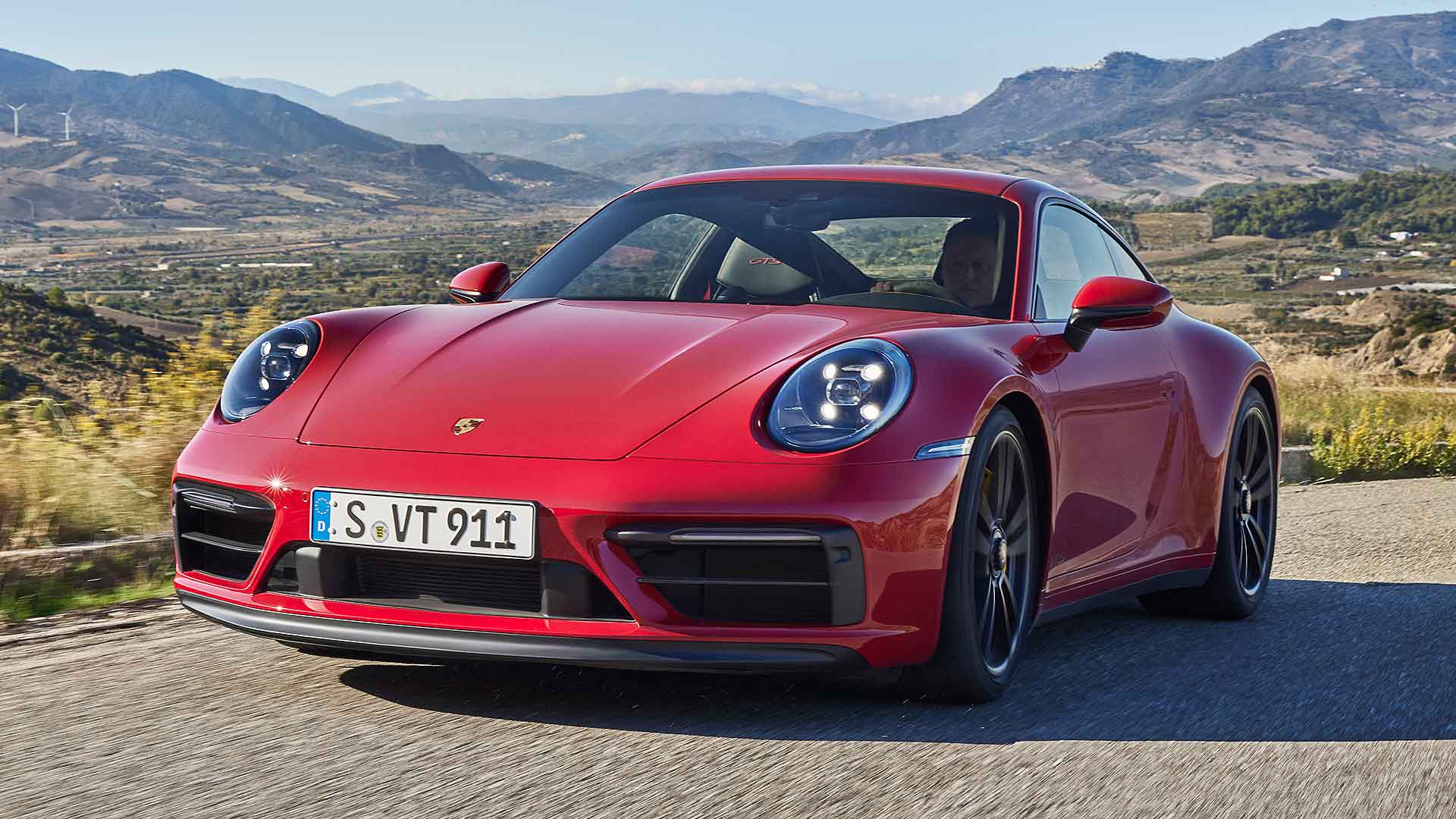
The latest Porsche 911 ‘992’ GTS range has been revealed, with prices for what many enthusiasts now consider the sweet spot of the range starting from £108,920.
Sitting between the 911 Carrera S and more extreme 911 GT3, the latest 911 GTS boasts a 30hp power boost to 480hp from its 3.0-litre flat-six turbo engine.
Available in Carrera 2 GTS and all-wheel drive Carrera 4 GTS guise, the latest 992 911 edition is also available with a seven-speed manual gearbox alongside the more commonplace eight-speed PDK automatic.
0-62mph takes as little as 3.3 seconds in the 911 Carrera 4 GTS with PDK transmission; manual versions are officially a touch slower-accelerating but, with a “particularly short lever throw”, arguably more rewarding.
GTS popularity
The GTS name was first used in the 1960s on the 904 GTS race car. Porsche revived it 12 years ago and, since then, it has become a popular edition in the contemporary line-up.
The latest cars are marked out from regular Carrera models by a SportDesign front apron and satin black spoiler lip. The headlights are tinted, and the rear lights are unique GTS lamps.
Satin black wheels are 20-inch at the front and 21-inch at the rear. They have centre-lock nuts and hide 408mm brakes taken from the Porsche 911 Turbo.
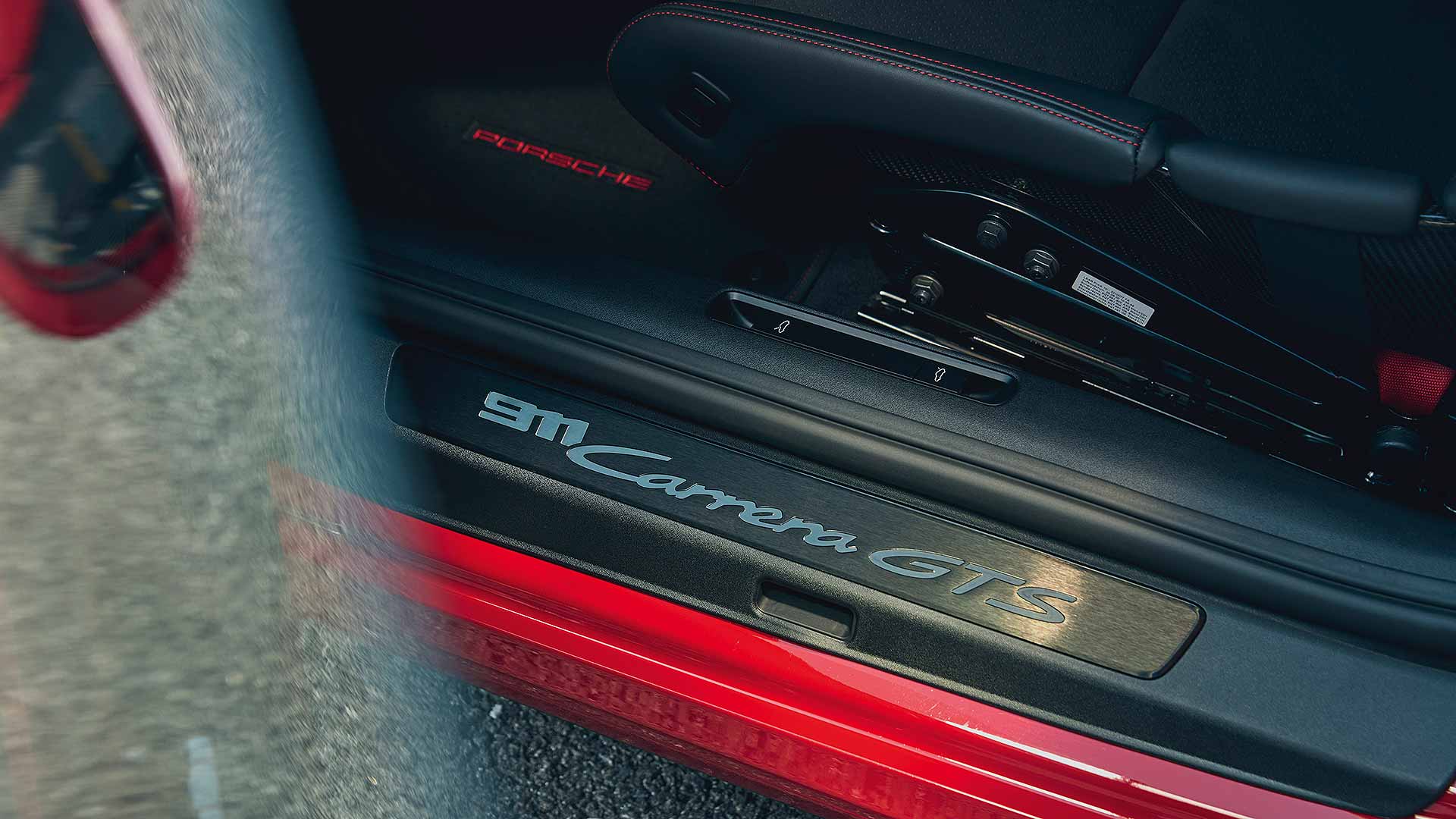
There’s also a satin black finish for the model lettering, the rear engine lid grille, GTS script on the doors and, on the Targa 4 GTS, roof bar and Targa badge.
A standard GTS-specific sports exhaust has dual tailpipes in black – and Porsche promises it sounds even better inside thanks to the removal of some interior sound insulation.
Black Race-Tex interior
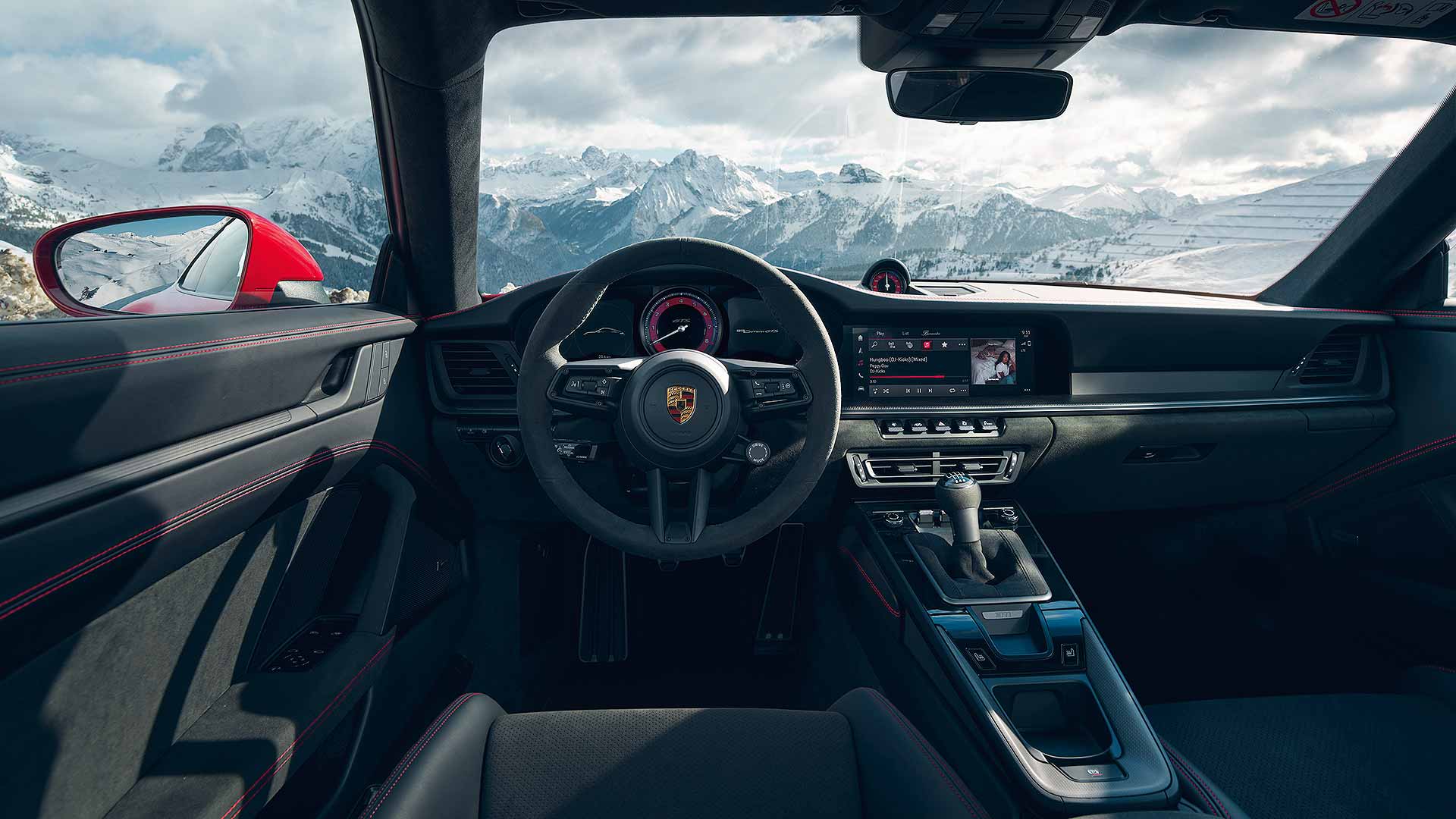
The moody, sporty theme continues inside. GTS-specific Race-Tex microfibre upholstery features on the central seat section of the standard Sports Seats Plus, steering wheel, door handles, arm rests, storage box and gearlever; Porsche says the shift throw is 10mm shorter than standard manual 911.
Also standard is a GT Sport steering wheel, Sport Chrono package, Porsche Track Precision app and, for data geeks, a tyre temperature display.
An optional GTS interior package adds either Carmine Red or Crayon contrast stitching for the seats, GTS lettering on the head rests, plus coloured seat belts, rev counter and Sport Chrono clock. Matt carbon inserts on the dashboard and door trims are also included.
Lightweight option
Later in 2021, an optional Lightweight Design Package arrives, promising to save up to 25kg.
This fits lighter carbonfibre reinforced plastic (CFRP) bucket seats, lightweight glass and a special lightweight battery.
Notably, the rear seats are removed.
Other extras featured in the Lightweight Design package include standard rear-wheel steering and “additional aerodynamic details”.
911 Turbo-derived suspension
992 911 GTS have bespoke suspension derived from the 911 Turbo. This includes standard Porsche active Suspension Management (PASM) and a 10mm lower Sport chassis.
The Sport setup has stiffer springs, revised dampers and anti-roll bar, plus a different PASM control logic and tuned Porsche Stability Management.
There are also rear-axle helper springs, shared with the 911 Turbo, which “keep the main springs under tension… with rebound remaining the same”.
We’ll find out what the dynamic benefits are with our first drive review in the coming months…
For the 18th year running, Skoda is the official car partner for the 2021 Tour de France, which begins this weekend and runs for 21 stages until 18 July.
Skoda is supplying a total of 250 vehicles in support of the Tour – including a pure electric Enyaq iV which will serve as the ‘Red Car’ command vehicle for Tour director Christian Prudhomme on the majority of stages.
Other Skodas in the fleet include the Octavia, Octavia iV and Superb iV.
Skoda is also sponsoring the Tour de France Green Jersey award for the leader in the points classification.
“Our company’s long history is inextricably linked with cycling,” said Skoda board member Martin Jahn.
“Skoda is committed to being a strong long-term partner of international elite and amateur cycling; supporting the Tour de France has been one of the cornerstones of our activities.
“I am particularly pleased that the Enyaq iV, our first all-electric SUV, will be used as the lead vehicle in the Tour de France.”
In total, the 2021 Tour de France will cover over 2,000 miles, and Skoda cars will be used by race officials as well as organisers and VIPs.
For stages where the Enyaq iV will not run as the Red Car, a Skoda Superb iV plug-in hybrid will take its place.
From either vehicle, the race director will wave the yellow flag as the start of each stage, before directing the race from the vehicle itself with a welter of onboard communication tech: hence all the aerials on each Red Car….
Skoda is also partner of the official Tour de France app, allowing cycling fans to keep up to date in real time: the free app has a live tracker, real-time GPS tracking and plenty more.
“The sharp increase in online renewals since 2016 is testament to how quick and easy this process is,” said roads minister Baroness Vere.
DVLA chief executive Julie Lennard said the online service “will always be the quickest and simplest way to renew a driving licence – whatever your age.
“With more and more licence holders aged 70 and over choosing to renew online, these figures demonstrate just how convenient our online service is.”
Figures show that, last year, almost 820,000 drivers aged 70-79 chose to renew online, as did over 10,000 drivers aged 90-99.
There were also 71 motorists aged 100-plus renewing online – up from 25 in 2016.
Used car prices are set to continue rising at an ‘unprecedented’ rate this summer, predict experts monitoring the secondhand car industry.
Prices have already been going up by almost double-digit percentages in recent months, says Philip Nothard, chair of trade body the Vehicle Remarketing Association.
Such healthy price rises are now set to continue into the summer months as experts from Auto Trader, CAP and Cazana warn they have “never seen anything like the current conditions”.
Car buyers are warned dealers are facing a “perfect storm, where stock is in very short supply, demand is high, and buyers are ready to spend freely”.
This is leading to fast-rising prices, cars flying off forecourts quickly… and improved margins for dealers, too.
“There is a general view that dealers could be even braver when it comes to higher pricing,” said Nothard.
That’s if they can get cars, he added: “Many dealers are having so much trouble getting hold of stock that they are retailing almost everything they take in part exchange.”
This means some nearly-new specialists might now happily be selling 10-year old cars.
The current situation, however, cannot continue, adds the VRA.
“At some point, we will see a levelling off of values as supply increases and demand normalises.”
This does not appear to be imminent – but when it does arrive, the industry will need to keep a close eye on any readjustments.
“The danger is that dealers could be left holding stock that is falling rapidly in value – but, so far, there is simply no sign of that occurring.”