One of the world’s largest gatherings of hot rods, custom cars, lowriders and muscle cars will take place at the Fairplex in Pomona, California.
Held from 28-30 January 2022, more than 1,000 vehicles will be on display, including two special celebratory exhibitions.
Commemorating the Deuce
The 72nd edition of the Grand National Roadster Show will celebrate the 90th anniversary of the 1932 Ford.
Presented by C.W. Moss & So-Cal Speed Shop, the ‘32 Ford display will honor an iconic car that has become a legend of hot-rodding culture.
A special external parking area will be set aside for 1932 Fords that are registered for the ‘Grand Daddy Drive-In’ event.
The 2022 show will also include ‘A Gathering of Hot VWs’, presented by Hot VWs Magazine and EMPI.
Competing for roadster glory
However, the centerpiece of the Grand National Roadster Show will be the America’s Most Beautiful Roadster (AMBR) exhibition.
A total of 12 roadsters from the country’s top builders will compete for glory, plus a check for $12,500. The winner will also have their name added to the impressive nine-foot-tall perpetual trophy – and receive a smaller personal trophy to take home.
A further 12 vehicles will be in competition for the Al Slonaker Memorial Award. This is awarded to the best car or truck not in the running for the AMBR award.
General admission tickets for the 2022 Grand National Roadster Show are on sale now, with prices starting from $25.
Peugeot has boosted the driving range of the electric e-208 through a series of tech tweaks.
The 50kWh battery is now able to power it for 225 miles between charges, up from the current car’s 217-mile range.
Peugeot has achieved this by adding an interior humidity sensor at the top of the windscreen, which allows more efficient use of the climate control system.
The efficiency of the heat pump has been improved too, so it warms and cools the interior more efficiently, particularly in winter.
A more efficient gearbox ratio for higher-speed driving also helps improve the electric range at motorway speeds, as do more efficient Class A+ tyres.
The improvements mean the Peugeot e-208 still retains a driving range advantage over its Vauxhall Corsa-e sister car, despite the British firm’s own recent tech improvements.
Both Active Premium (£28,225) and Allure Premium (£29,525) qualify for the £1,500 government Plug-in Car Grant saving.
e-208 buyers also get a six-month subscription to BP Pulse, while support for up to 100kW rapid charging means an 80 percent charge can be achieved in 30 minutes.
Regular petrol and diesel engine 208 have also been improved for 2022, with Peugeot simplifying the range by removing the unpopular Allure variants.
Customers can now pick from a four-strong line-up of Active Premium, Allure Premium, GT and GT Premium.
Top-spec GT Premium models are now only offered with a 1.2-litre Puretech petrol engine option; it produces 100hp with a six-speed manual, or 130hp with an eight-speed auto gearbox.
Active Premium and Allure Premium buyers also get diamond black door mirror covers as standard.
Peugeot adds that every 208 feature a touchscreen with Android Auto and Apple CarPlay, while alloy wheels, rear parking sensors and automatic headlights are also standard.
A full £3,000 reduction has been applied across all Vauxhall Corsa-e and Mokka-e – which, in the case of the Corsa-e, takes prices down to less than £26k.
The entry-level Vauxhall Corsa-e SE now costs £25,805, once the Plug-in Car Grant is applied.
Previously, it cost £27,305.
Vauxhall Mokka-e prices also now start from less than £30k, with the entry-level SE priced from £29,365 – down from almost £31k before.
“Vauxhall wants to move the UK to electric motoring as quickly as possible,” said MD Paul Willcox.
“In light of a further evolution to the government Plug-in Car Grant, we have taken the decision to change our pricing policy on our all-electric Corsa-e and Mokka-e models.
“With more attainable pricing from significant reductions on both models, as well as the grant, we hope to put zero-emissions-in-use motoring within the reach of even more British motorists.”
Vauxhall adds that the new pricing is in lieu of all previous customer offers.
Last week, the government caused controversy with a surprise cut to the Plug-in Car Grant – the second in 2021.
The £2,500 discount was reduced to £1,500, while the qualifying price cap was reduced from under £35k down to under £32k.
Still searching for the ultimate Christmas gift? Instead of buying your kids 2021’s must-have piece of plastic – a remote control BatBot, my 10-year-old tells me – how about a three-quarter-scale electric Ferrari Testa Rossa?
Just imagine the fun you (sorry, they) could have on Christmas morning. Batteries are included, as you’d hope for £95,000.
Granted, the Testa Rossa J (for ‘Junior’) isn’t cheap, but one of the 34 full-size original cars, built between 1957 and 1961, could set you back £30 million. And this is a genuine Ferrari, officially endorsed by Maranello.
Little wonders
“Ferrari was on board with the idea straight away,” explains Ben Hedley, founder of The Little Car Company. “We also proposed making a 250 SWB California Spyder or P4, but the Testa Rossa was a clear favourite. They allowed us to scan the technical drawings, so the chassis is identical.”
Based at Bicester Heritage, a former RAF base near Oxford, The Little Car Company makes ‘little’ versions of motoring icons. Projects so far include the Bugatti Baby II (based on the 1924 Type 35) and Aston Martin DB5 Junior – newly available in No Time To Die spec, with rotating mini-guns, digital number plates and a push-button smokescreen.
A road-legal replica of the Tamiya Wild One RC buggy is in development, too.
Racing Red
Despite their playful side, Hedley insists these aren’t toys: “We take classic cars that are now too valuable to drive, then shrink them down 25 percent”.
For the Testa Rossa J, that also means batteries and a 12kW electric motor: good for a 50mph top speed and fully-charged range of 56 miles. “Raffaele di Simone [Ferrari’s official test-driver] took the car out and came back smiling,” he says, as I clamber awkwardly aboard.
Here’s the production Testa Rossa J from the Little Car Company.
Nine official Ferrari liveries are available – this one replicates car no. 0724.
The hand-beaten aluminium body of my Testa Rossa is finished in authentic Ferrari Rosso Corsa. The chassis plate and prancing horse badges are also pukka Ferrari parts, while the drilled pedals come from a 488 Pista.
Other spec highlights include a Nardi steering wheel, Bilstein coilover suspension, Brembo brakes (sourced from a Ducati Diavel motorbike), and Borrani wire wheels with Pirelli tyres.
Take to the track
A modern Ferrari-style manettino on the dashboard offers four drive modes. Novice is for smaller children and permits just 1kW of power, with a key fob kill-switch for parents. Mind the Christmas tree! Comfort allows speeds up to 25mph (into the garden with you), while Sport serves up the full 12kW (save it for the country estate).
There’s also a Race mode, which offers balance of performance settings for miniature motorsport. The Little Car Company hopes to organise Testa Rossa J races alongside Ferrari’s FXX track days.
My drive takes place on the Bicester Airfield circuit and, after a few exploratory laps, I’m straight into Sport mode. With just 250kg to shift and the instant torque of an electric motor, the Ferrari catapults out of corners, easily reaching its maximum speed on the main straight.
There are no gears to shift, so you can left-foot brake and concentrate on clipping each apex. All that’s missing is the visceral roar of a Colombo V12.
Don’t wrap it…
Hedley says the weight distribution of the Testa Rossa J is similar to the real thing – and while I don’t have a near-priceless classic car for comparison, it does feel supple and neatly balanced.
Indeed, on a slightly damp track, the car is easily provoked into four-wheel drifts, my hands juggling the wood-rimmed wheel as I daydream about Mike Hawthorn on the 1958 Targa Florio.
The Testa Rossa J is brilliant fun and a perfect gift for the petrolhead who has everything. That said, come Christmas morning, Thomas is far more likely to unwrap a BatBot than a Ferrari. Sorry son, maybe next year.
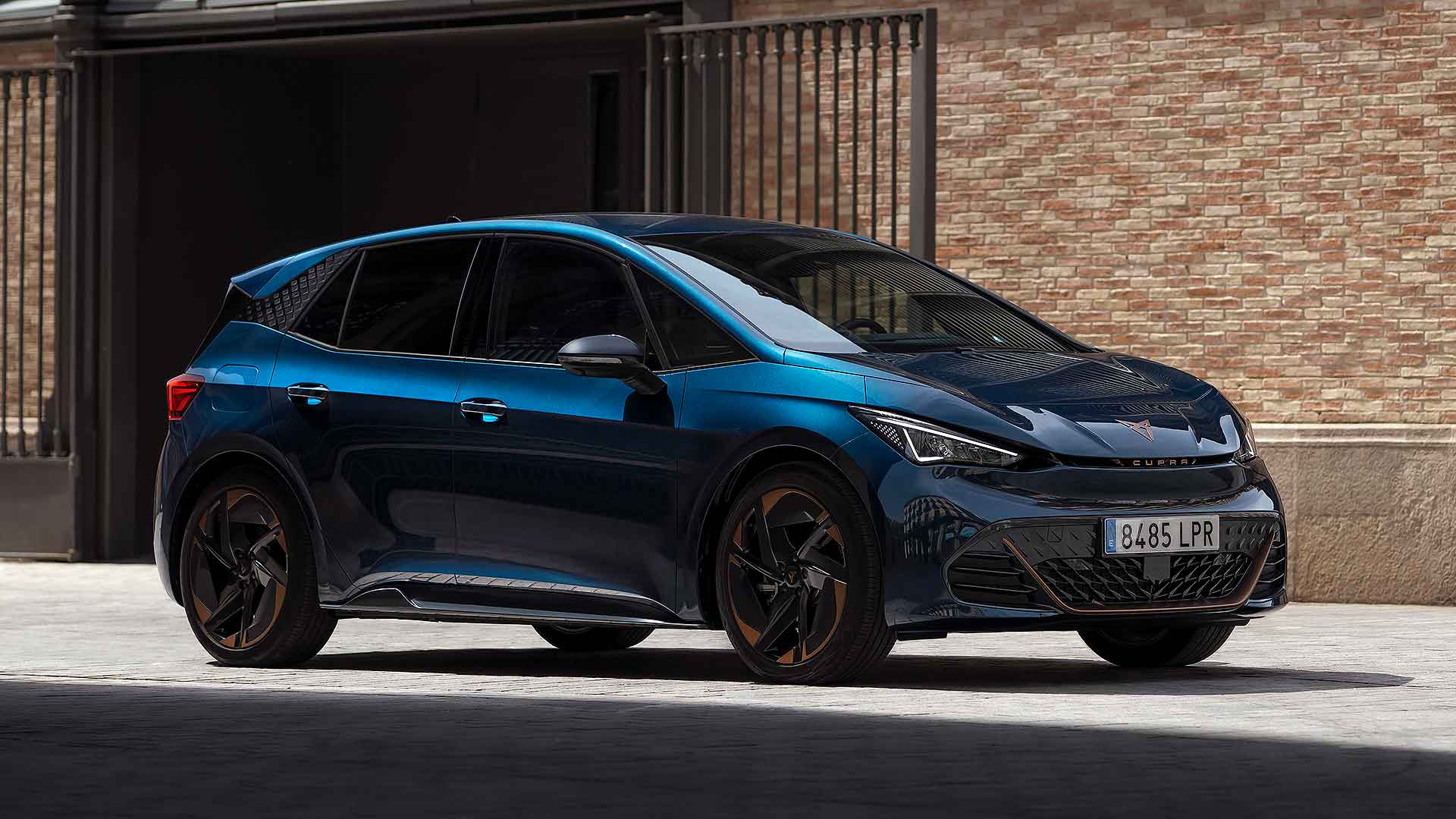
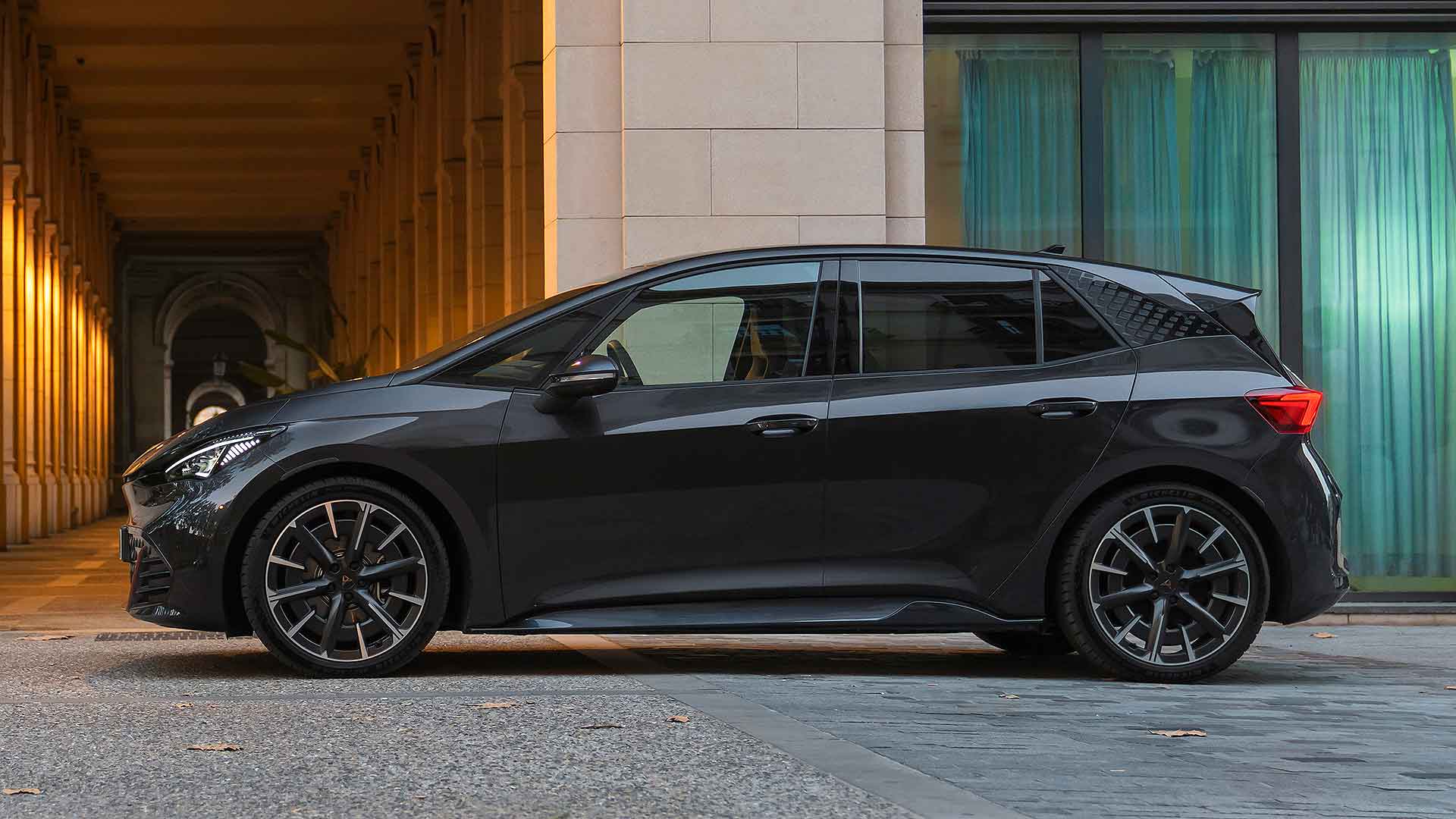
The first all-electric Cupra, the Born, is now available to order, with prices starting from £33,735.
First deliveries of the sporty five-door electric hatchback are expected in spring 2022.
A more focused sister car to the Volkswagen ID.3, the Cupra Born will initially be offered in 204hp guise, with a 58kWh battery.
This will quickly be followed by a more affordable 150hp version with a 45kWh battery – a car that’s likely to qualify for the newly-reducedPlug-in Car Grant.
Cupra says a more powerful 231hp version, with either 58kWh or 77kWh batteries, will arrive later in 2022.
Rapid-charge ready
The launch Born’s 58kWh battery gives a driving range of 263 miles, plus a 0-62mph time of 7.3 seconds.
It’s ready to use DC rapid chargers up to 120kW, which will top the battery up from five percent to 80 percent in 35 minutes.
Keeping it simple
The firm’s simple model-grade structure continues with the Born: choose it in V1, V2 or V3 guises.
Even the smallest alloy wheel size is 18 inches, and all models get full LED headlights, a 12-inch touchscreen, front bucket seats in sustainable Seaqual yarn, plus 11kW AC capability for speedier home charging via a wallbox.
V2, which costs £34,190, adds 19-inch alloys, dark-tinted rear windows, heated front seats and an augmented reality head-up display – a first for Cupra.
V3 stretches the wheels further, to 20-inches, and switches the seats to heated, massaging, electrically-operated granite grey Dinamica buckets. It costs £37,375.
As a global shortage of semiconductor chips continues to stifle the new car market, the used car sector has witnessed rocketing prices and sales growth.
According to the Society of Motor Manufacturers and Traders (SMMT), second-hand sales are up 16.4 percent year-to-date versus 2020.
DVLA and Department for Transport figures also show drivers are keeping their cars for longer. In 2019, there were 6.1 million cars over 13 years old taxed – around 20 percent of the UK total. In 1994, by contrast, there were only 1.3 million in the same age group.
Used cars in demand
Data from aftermarket warranty provider Warrantywise shows a larger number of motorists are extending their leasing deals due to lack of new vehicle availability –with some waiting up to 12 months for a replacement car.
Uncertainty about the impending 2030 ban on petrol and diesel cars may have exacerbated the situation, with many drivers undecided about switching to an EV.
The result, reported in October, was a £3,000 increase in the average used car price over five months, when Auto Trader also said nearly one in four nearly-new cars were more expensive than their new equivalents.
Average warranty is five years
The ageing car population means many cars are well beyond their manufacturer warranty, too. Traditionally, most brands offered three years and 60,000 miles, but Warrantywise says the average length of cover is now five years.
Kia has famously offered a seven-year warranty since 2006, but even the 10-year warranty recently announced by Toyota and Lexus (dependent an annual servicing at a franchised dealer) wouldn’t cover many of Britain’s ageing cars.
Indeed, Warrantywise reports that only 15 percent of drivers opt for an extended warranty once their manufacturer-supplied cover has run out.
“Our research shows the average new car warranty lasts for just five years, meaning that there is a significant percentage of the UK population driving used cars that are not protected by warranty cover and therefore presenting a significant financial liability to their owners,” said Lawrence Whittaker, CEO at Warrantywise.
Even the Dacia Sandero, Britain’s cheapest car, now costs more than £10,000, while the entry-level Ford Fiesta has edged closer to £17,000.
New cars are getting more expensive – but Kia aims to offer an exception to the rule with a well-equipped special version of its Picanto city car.
Priced from £13,845, the new Picanto Shadow includes premium features such as rear privacy glass, LED front and rear lights, and standard metallic paint.
It also has an 8.0-inch touchscreen with Apple CarPlay and Android Auto connectivity, a reversing camera and ‘faux leather’ upholstery that some upmarket brands would be tempted to call ‘vegan leather’.
Casting a Shadow
Other standard features include air conditioning, electric and heated door mirrors, and automatic emergency braking.
Kia insists the Picanto Shadow ‘eclipses its rivals’, with the extra features adding just £845 to the price of the Picanto 2 it’s based upon – a car that was facelifted earlier in 2021.
Power comes from a 66hp 1.0-litre petrol engine, which is mated to a five-speed manual gearbox.
Kia has sold more than 11,000 Picantos in the UK so far in 2021, making it the second best-selling city car behind the Fiat 500.
Ordering is open now and deliveries of the Picanto Shadow begin in early 2022.
The Plug-in Car Grant to help make electric cars more affordable has been cut by further £1,000 in a surprise announcement that will infuriate electric car buyers and manufacturers alike.
Previously £2,500, the Plug-in Car Grant is now just £1,500 as of 7am today (15 December 2021).
What’s more, the qualifying maximum price of an electric car has been reduced, from under £35,000 down to less than £32,000.
Both cuts are effective immediately.
The government argues that its approach to Plug-in Car Grant cuts “is clearly working – whilst the grant has slowly reduced over time, the sales of electric vehicles has soared”.
Transport minister Trudy Harrison said the government is “refocusing our vehicle grants on the most affordable vehicles and reducing grant rates to allow more people to benefit, and enable taxpayers’ money to go further”.
Any motorists who placed orders between 8 December and 14 December will still qualify for the old £2,500 grant, on cars costing up to £35,000.
The Plug-in Van Grant has also dropped, to £2,500 for vans under 2.5 tonnes and £5,000 for vans between 2.5 tonnes and 5.0 tonnes.
A larger reduction in the maximum qualifying price of vehicles, from £50,000 to £35,000 was also announced – and immediately criticised by car manufacturers.
At the time, the government argued the changes were made to ensure the funding lasts longer.
With the recent acceleration in electric car sales – last month, they comprised almost 1 in 5 new car sales – it is likely to make the same arguments again.
‘Counterintuitive’ and ‘disappointing’
RAC head of roads policy Nicholas Lyes said “this disappointing cut means that only around 20 EV models are now eligible for the grant, which doesn’t leave a great deal of choice for consumers.
He pointed to research that showed motorists already feel that new electric cars are too expensive. “This has to be seen as a step in the wrong direction.
“We’re concerned the government has taken this step too soon.”
AA president Edmund King said that reducing the Plug-in Car Grant incentive is “counterintuitive”.
Many motorists are not in a position to consider electric cars “so reducing the grant and the number of vehicles will be a disappointment for many.”
He added the AA still believes the most effective method of encouraging mass EV adoption is to scrap the VAT – “a policy we have called for since 2020”.
Auto industry trade body the SMMT called the move “a blow to customers” and said it “couldn’t come at a worse, time, with inflation at a ten-year high and pandemic-related economic uncertainty looming large”.
Rather than cutting grants, the UK should be doubling down on them, just as other markets across Europe are doing so.
“UK drivers risk being left behind on the transition to zero-emission motoring.”
Leading online marketplace Auto Trader said it too was disappointed. “The incentives available to British motorists are already miles behind our European counterparts – where adoption levels are far higher,” said commercial director Ian Plummer.
“In order for the government to hit its ambitious 2030 target, they need to support he mass adoption of EVS… which will only happen with the right monetary incentives in place.”
The Vauxhall Corsa-e and Mokka-eelectric cars have both received a boost to their driving range, thanks to a number of tweaks to tech and tyres.
The Corsa-e supermini’s electric range has improved from 209 miles to 222 miles, according to the official WLTP test cycle: an improvement of six percent.
The Mokka-e crossover’s range has been upped from 201 miles to 209 miles, a four percent increase.
One further tech upgrade may help the cars’ real-world driving range – particularly in winter weather. Vauxhall says it has improved the efficiency of the heat pump, which both warms and cools the cars’ interiors.
Already more efficient than traditional petrol and diesel car heaters, the latest heat pumps require even less energy from the battery – something that will be especially noticeable in cold weather, when demand on the heat pump is at its highest.
Vauxhall has also fitted ‘A+’ low rolling resistance tyres, in both 16-inch size for the Corsa-e and 17-inch for the Mokka-e.
A new design of transmission reducer, which converts the rotation of the motor into drive for the wheels, helps further boost the range.
Vauxhall is still offering its comprehensive ‘Plug & Go’ EV package for new car buyers. This includes a free home charging unit, eight years’ roadside assistance and battery warranty, three years’ servicing and a six-month subscription to BP Pulse.
The firm adds it will offer an electrified version of every car it sells, and its range will be fully electric by 2028 – “years ahead of the UK government deadline”.
The latest Chevrolet Corvette has scooped a major prize in the prestigious Japan Car of the Year (JCOTY) Awards.
As part of the 42nd annual awards ceremony, the eighth-generation Corvette was named Japan’s Performance Car of the Year.
The win saw the mid-engined Chevrolet beat homegrown competition, including the new Toyota GR86 and platform-sharing Subaru BRZ.
On the right side of success
The C8 Chevrolet Corvette is the first version to be produced in right-hand drive. This has allowed it to be marketed across the globe, with Japan one of the key targets for sales.
Chevrolet’s move has seemingly been successful, with the JCOTY panel acknowledging the benefits of right-hand drive. The judges said it had improved the experience of using the Corvette on the road, making it easier for everyday driving.
However, the main star for the JCOTY judges was the Corvette’s 495hp 6.2-litre V8 engine. Being able to accelerate from 0-60mph in less than three seconds, aided by an eight-speed dual-clutch gearbox, all bolstered the Corvette’s case.
Taking overall top honours as Japan’s Car of the Year was the new Nissan Note. Aimed squarely at the Japanese market, the Note is offered in four distinct versions.
The regular Note is available with Nissan’s electrified e-Power drivetrain, as is the Note Autech Crossover. Alongside them is the luxurious Note Aura, plus a Nismo Note Aura featuring a dramatic GT-R-inspired bodykit.
Voting saw the Nissan Note receive 355 points overall, with the Toyota GR86 and Subaru BRZ in second place.
The JCOTY judges also chose to give the new BMW 4 Series a design award, singling out its bold front grille.