The Mazda MX-5 may be the world’s best-selling sports car, but the Porsche 911 is the most iconic. And today, after 54 years in production, the company built its one-millionth 911.
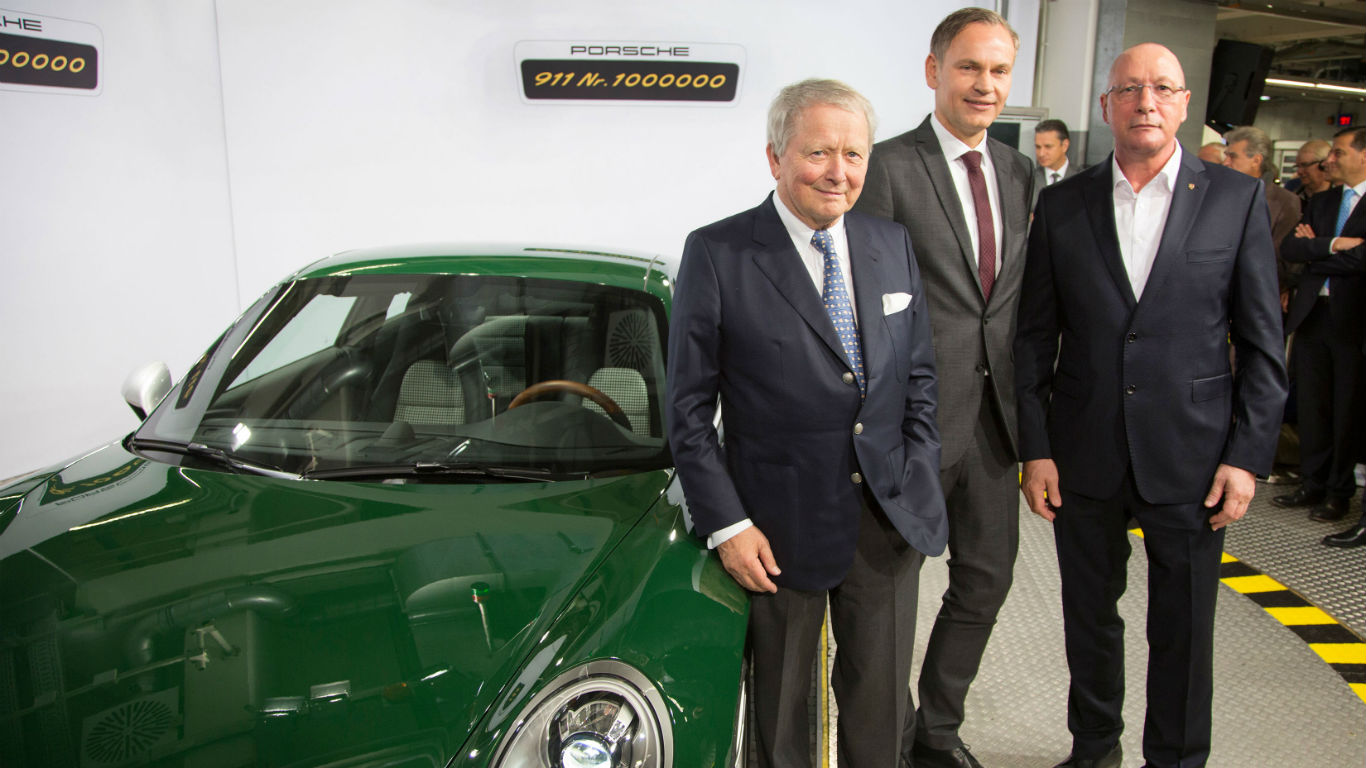
Dr Wolfgang Porsche unveiled the milestone car in Zuffenhausen, where it begins a promotional world tour that includes the Scottish Highlands, Nurburgring, USA and China – ending up as part of the collection at the Porsche Museum.
Classic Porsches on show at Autofarm for MR Retro Live
Porsche sat nav now standard in UK on all new models
Porsche tops list of Europe’s most popular classics
The 991 Carrera S has a distinctly retro theme, with many details that evoke the 1963 original. Spot the Irish Green paint (a special order colour since 1965) chrome window-surrounds, old-style Porsche bonnet crest and – oh yes – gold badges.
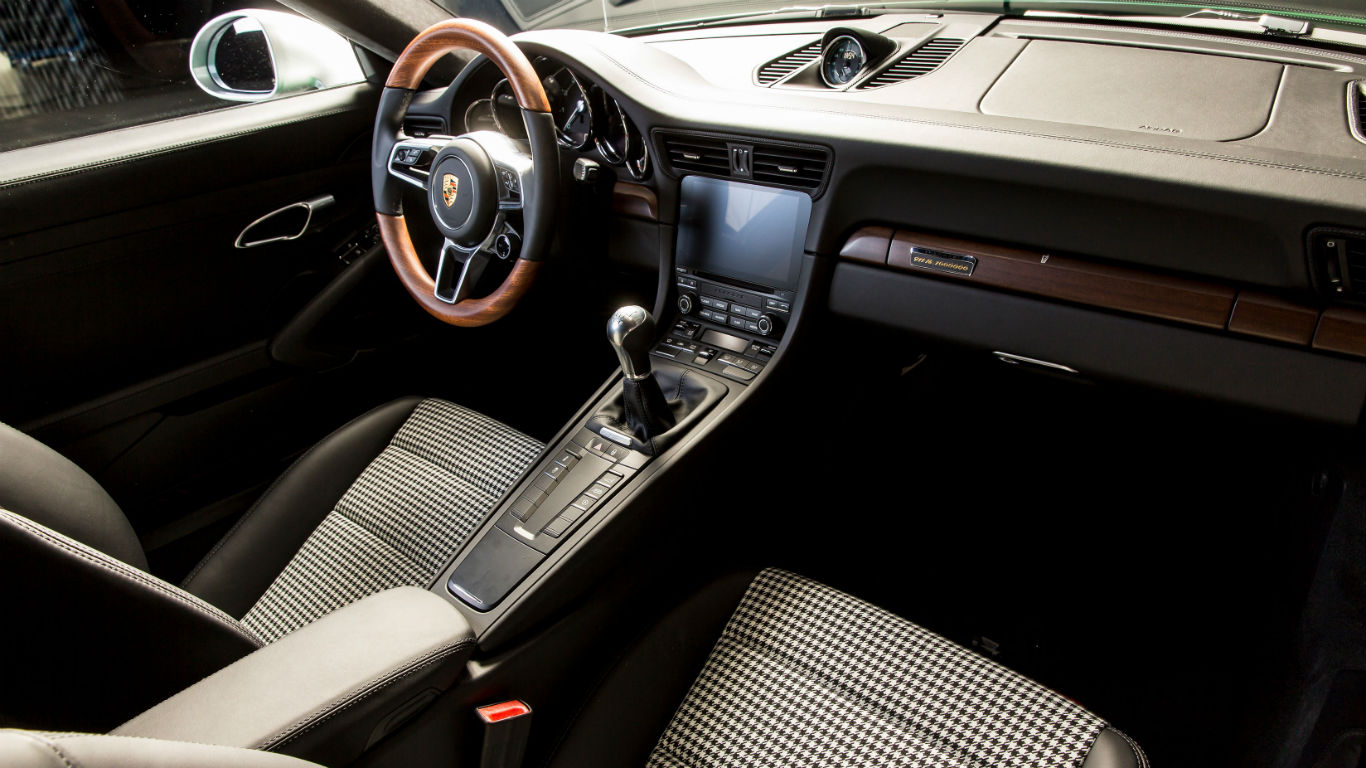
Inside, there’s liberal use of mahogany on the steering wheel and dashboard (no, us neither), plus ‘Pepita’ houndstooth trim on the trad-911 ‘tombstone’ seats. A plaque marks this car out as number 1,000,000 off the production line.A visibly proud Dr Porsche said: “Fifty-four years ago, I was able to take my first trips over the Grossglockner High Alpine Road with my father. The feeling of being in a 911 is just as enjoyable now as it was then. That’s because the 911 has ensured that the core values of our brand are as visionary today as they were in the first Porsche 356/1 from 1948”.
Although the 911 is easily outsold by Porsche’s Macan and Cayenne SUVs today, it remains core to the German brand: a halo car that shines brighter than perhaps any other.
Amazingly, more than 70 per cent of all 911s ever built are still on the road, and over half of Porsche’s 30,000 race wins can be credited to the car, too.
We don’t expect this very special 911 will be racking up the miles – it’s already too valuable for that – but devotees can buy an Irish Green Porsche Design watch, with a strap using the same leather as the 911’s interior.
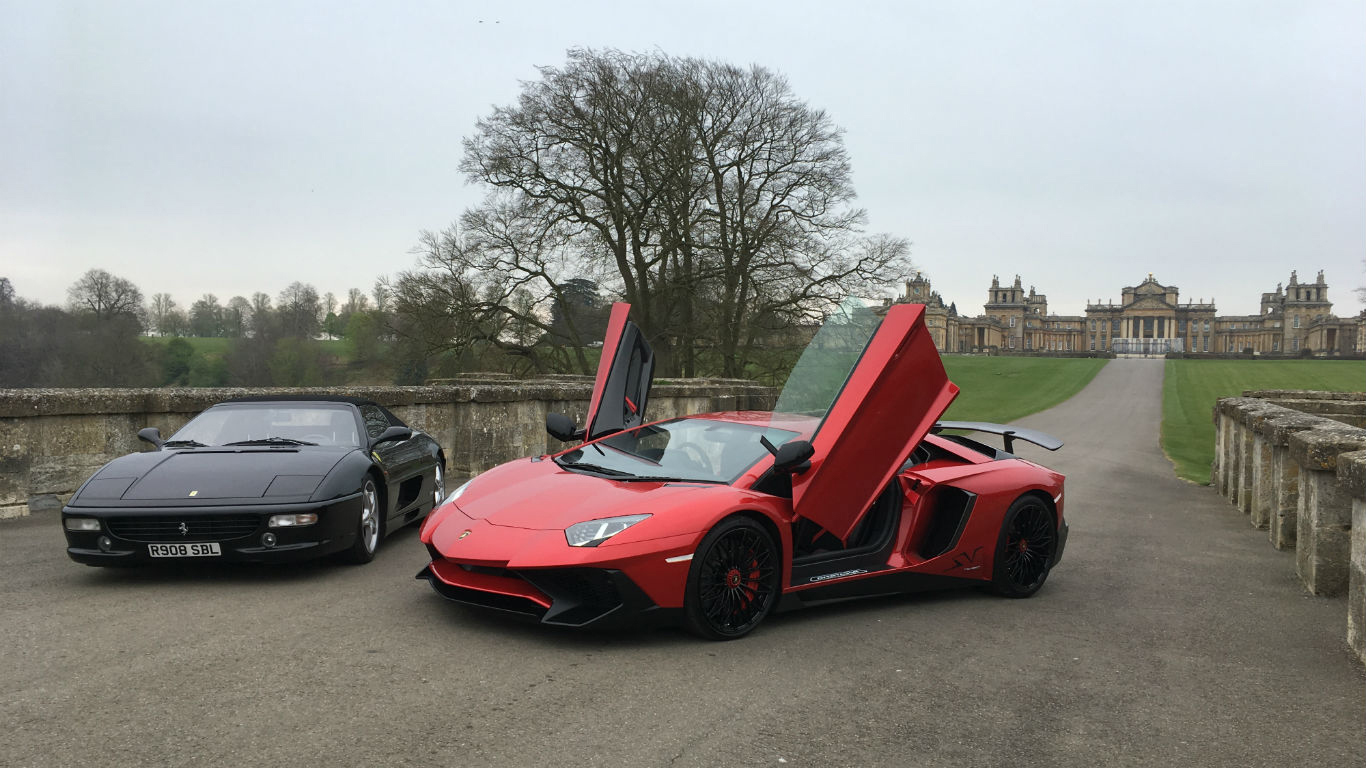
In the red corner: the Lamborghini Aventador SV. In the black corner: the Ferrari 355 GTS F1. Two prize fighters separated by 20 years and a not-insignificant 370hp. Yet these supercars have more in common than you might expect.
Both are Italian, for starters. And both use high-revving, naturally-aspirated engines with semi-automatic gearboxes. Also – less obviously – both are the property of two brothers: Andrew and David Bagley.
The Bagleys are the brains behind Salon Privé, an exclusive classic and supercar show hosted each summer at Blenheim Palace. Today, Blenheim serves as the suitably dramatic back-drop for our supercar showdown. Can classic hero defeat modern master?
“I fell in love with the Aventador after seeing one at Salon Privé,” Andrew explains. “It looked like a fighter jet, all crazy angles.” A few years later, he realised that dream, visiting Lamborghini HQ in Sant’Agata to specify his own Aventador SV.
The SV, or Superveloce, badge was first used on the Miura SV of 1971. It denotes something special: a lighter, faster Lamborghini, built in limited numbers. “Going for a special edition such as this – one of 600 SV coupes made – does mean the car should hold its value longer-term,” says Andrew. “Just look at the prices of RS Porsches. That said, I buy cars to drive and enjoy, not as investments.” And who wouldn’t enjoy a Lamborghini?
Drawing a crowd
I start by taking a few moments simply to stand and stare. I’m not alone: a crowd of Blenheim day-trippers gathers, asking questions and taking supercar selfies. I walk around and drink in the details: the shark-like snout, gaping air intakes framed in naked carbon, louvred rear window (a Lamborghini trademark) and, of course, that towering rear wing.
Pardon the cliché, but the SV looks like it’s doing 200mph standing still. And people can’t get enough of it. The Ferrari parked alongside looks remarkably understated: a Learjet versus a stealth bomber.
Waking up the neighbours
If half the visitors at Blenheim have already clocked the Lamborghini, the other 50% snap to attention when I flip the red ‘bomb switch’ cover and stab the starter button. With a theatrical blip of the throttle, the 750hp V12 barks into life, settling to a menacing idle that echoes across immaculate Capability Brown gardens.
I pull down the dihedral door via a small leather strap (this is a lightweight special, remember?) and adjust the mirrors. Mental note: the Aventador is A LOT wider at the back than the front. The pedals are skewed towards the centre, but the ‘long arms, short legs’ driving position of Italian supercars past is thankfully absent. Even the seats are comfortable – Andrew decided against the hard-shell buckets standard on the SV.
Unleash the beast
The exit road is peppered with speed humps, so I push the ‘suspension lift’ button and we crawl cautiously along. The mid-mounted V12 gargles and growls like a caged lion pawing at my shoulder blades. The ride feels racecar-firm, with very little travel from the in-board suspension, yet all the major controls, from the steering to the clutch pedal, move with weighty precision. It’s not difficult to go slowly, but neither would your grandmother feel comfortable driving it.
We turn onto a stretch of dual-carriageway and it’s time to let the Lambo off the leash. I shift to second, hit the loud pedal and – bam! – we lunge forwards like Bolt from the blocks. With four-wheel-drive traction, there’s no wheelspin: just grip and relentless G-force. I snatch third just before the 8,500rpm rev limit and by now we’re piling on serious speed – polite conversation suspended as cabin reverberates with Italian V12 thunder.
Lord of the ’Ring
I steal a glance at Andrew: he’s grinning broadly. “Like riding a bull, isn’t it?”, he laughs. “You grab it by the horns and hang on.” It’s a good analogy – the Aventador feels totally unhinged, like being strapped to a heat-seeking missile. You’ll be lucky to use even a fraction of its performance on the road. On a race track, it would be an absolute weapon.
Want proof? A driver with vastly more talent than me lapped the Nürburgring Nordschleife in six minutes 59 seconds – just two seconds shy of Porsche’s 918 Spyder hypercar. Which proves the SV isn’t merely about straight-line speed. Along with the new (and Nürburgring record-breaking) Huracan Performante, it also shows Lamborghini is finally on par with Porsche and Ferrari for ultimate driving performance.
Wide and wild
On rutted and occasionally narrow Cotswold lanes, however, the Aventador feels mildly out of its comfort zone. It’s savagely fast and utterly planted – you’d need to be a complete hooligan to unstick the rear end – but it’s also a big car. I involuntarily hold my breath every time a Range Rover or Transit van squeezes past.
The gearbox is the only other minus point. The seven-speed automated manual is whipcrack-fast when you’re pressing on, but feels a little clunky at low speeds. The latest dual-clutch ’boxes are smoother and just as quick.
Lights, camera, action
Heading back to base, we again reach a long stretch of straight dual-carriageway. I pull across into the outside lane and bury my right size-eight. Seven hundred and fifty Italian horses awaken and the scenery blurs into fast-forward. Imagine jumping out of a plane, but with carbon-ceramic brakes instead of a parachute.
Suddenly, blue lights appear. Andrew and I glance at each other in nervous silence. I slow to a steady 50mph and a Vauxhall Astra looms large in my mirrors, sirens wailing. Relief: it’s an ambulance car with no interest in this now-dawdling Lamborghini. But the experience serves as a stark reminder of the restraint needed to drive a 217mph supercar on the road.
Betting on black
The Aventador leaves me wired and wanting more. Can David’s Ferrari possibly measure up? We grab a quick coffee first. “The F355 was on my bedroom wall as a kid – I’ve always wanted one,” he explains. “And it took me a long time to afford one, so this car’s a keeper. I don’t plan to sell it.”
In defiance of Ferrari purists, David shunned the iconic open-gate manual and sought out a F355 with the semi-automatic gearbox (badged ‘355 F1’). “I like paddle-shifters,” he explains. “That said, I don’t leave it in auto – I always use the paddles to change gear.”
Ageing gracefully
Me? I had a red Testarossa on my wall, but as a child of the 1980s, I automatically consider any car with pop-up headlights to be cool. It seems ironic that Ferrari designed the 355 with an F1-style flat undertray, then undid those aerodynamic gains with upright lights.
But no matter: this 20-year-old is ageing gracefully. It may even be the last genuinely beautiful Ferrari. While later models look increasingly aggressive, the 355 has the classic, almost dainty elegance of a 308 GTB or Berlinetta Boxer. It’s stylish, but not shouty.
Scintillating soundtrack
At least, not until I fire up the 3.5-litre V8. David’s car has an aftermarket Capristo exhaust and is even louder than the Aventador at idle. It hums with the undisguised potency of a naturally-aspirated engine that produces nearly 109hp per litre (380hp total): the highest specific output of any car at the time. With only a fabric roof between me and those four tailpipes, the cacophony fills the cabin and reverberates through my skull.
There’s a whole other dimension to the Ferrari’s soundtrack beyond 5,000rpm, though. At lower revs, the flat-plane-crank V8 is boisterous, but not especially tuneful. Only when you close in on the 8,500rpm redline (the same, incidentally, as the Lambo) does it shift up an octave, morphing into a high-pitched howl that has every hair on your body standing to attention.
Into the red
You need to work this engine hard to get the best from it, too. With a paltry 268lb ft of torque at 6,000rpm, the Ferrari is no quicker than many modern hot hatchbacks in everyday traffic. But then a gap opens, you drop a cog and it feels like a bona fide supercar again.
Cards on the table: I’d have my 355 with a manual gearbox – and no doubt pay a premium for doing so. But the F1 transmission, with its comically small lever on the centre console, is better than I’d been led to expect. The paddles move with mechanical precision, and the ability to upshift at full throttle keeps the engine spinning furiously. It’s rather more recalcitrant around town, but that’s also true of a manual Ferrari ’box. Ultimately, the faster you go, the better it gets.
The light fantastic
And believe me, it gets very good indeed. The 355’s steering is sublime – a reminder of how feelsome a hydraulic system can be in this era of anaesthetised electric helms. It’s slower and weightier than present-day Ferraris, yet still fabulously communicative.
On damp roads, I’m acutely conscious that, unlike every new car on sale, the 355 has no stability control. There’s no electronic safety net. Clearly, its limits are much lower than the ’Ring-slaying Aventador, but it doesn’t intimidate. Its suspension is supple and the whole car feels light on its feet. You couldn’t say that about a Testarossa.
Analogue to digital
With its compact dimensions and unfiltered driving feel, the 355 reminds me of two other cars of this era. One is the original Honda NSX – the brilliantly usable Japanese supercar that showed up Ferrari’s below-par 348 and, ironically, forced the Italians to up their game with the 355. The other is the Porsche 964 Carrera RS, a raw road-racer with an equally charismatic engine and superb chassis.
There’s perhaps an argument that these were the last of the truly analogue sports cars. Electronics would soon infiltrate every area of car construction, to the benefit of reliability and safety, but often to the detriment of good old-fashioned fun. No wonder the prices of all three cars are heading skywards.
Picking a winner
This isn’t a comparison test. Nobody is likely to whittle their shortlist down to an Aventador SV (from £280,000) or F355 (from £45,000). However, it shows how far high-performance cars have come in 20 years. These two share some similarities, but they could hardly feel more different.
The Lamborghini is awe-inspiring and magnificent; it’s the supercar turned up to 11 – a double Sambuca washed down with a Red Bull. I loved driving it, but can’t escape the feeling I’d lose my licence if I owned one. The 355 is more of a robust Italian red: equally intoxicating, but fun at saner speeds and a better fit for UK roads. It’s a tough call, but I’d take the Ferrari.
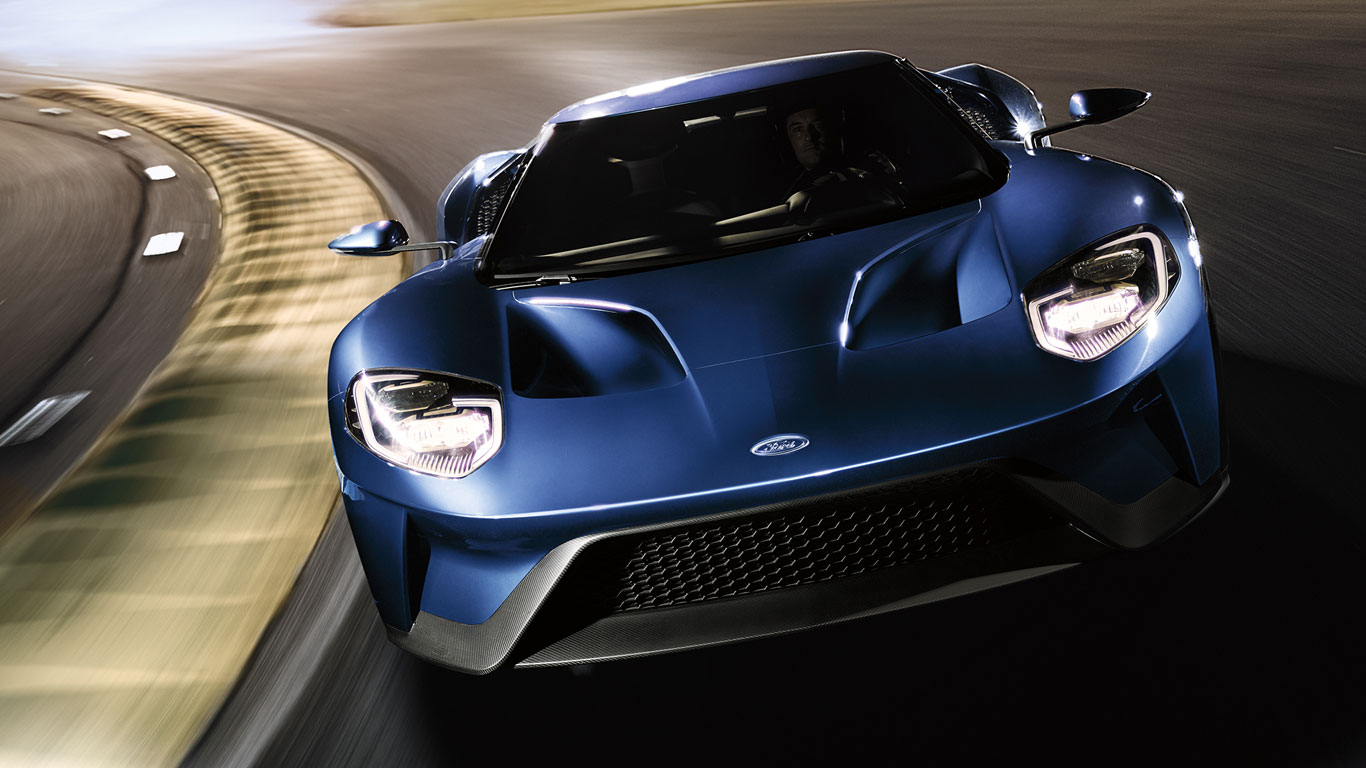
GT: two letters that mean so much in the car industry. The badge is primarily used to designate a grand tourer, but has been put to good use on mildly warm hatches or for when a GTi badge would promise something a car might not be able to deliver.
So, with the new Ford GT hitting the headlines, we trawled the archives in search of other famous GT cars. Note, this is a not an exhaustive list and we’ve steered clear of badge extensions, meaning you won’t find a GT-R, GTi, GTS or GTE here.
When production of the Carrera GT ceased in 2006, Porsche concluded – with a certain degree of bravado – that it was “ the most successful supercar in history”. Its point was that, at 1,270 units, more Carrera GTs rolled out of the Leipzig production facility than the McLaren F1, Ferrari Enzo and Pagani Zonda combined.
OK, so 605hp and a 0-62mph time of 3.9 seconds might not seem like a big deal in an age of the Dodge Demon, but it was the way in which the Carrera GT went about its business that made the difference. The race-honed V10 engine makes a noise rivalled only by Thor gargling on a single malt Scotch.
Citroen AX GT
The Citroen AX GT is unlikely to win a game of Top Trumps, unless the chosen category is ‘lightness’ or ‘risk of death in the event of an accident’. But that doesn’t mean it’s not fit to wear the GT badge, because the featherlight Citroen was one of the most exciting cars of the late 80s and early 90s.
Power was sourced from a 1.4-litre engine developing just 86hp, but it was mated to a body that tipped the scales at a mere 722kg. It meant that the AX GT could punch well beyond its weight, especially on a twisty B-road, where it could hold its own against more illustrious competition.
Ferrari 456 GT
The GT badge is part of the furniture at Maranello, albeit more commonly with the addition of an extra letter. The 250 GTO, F355 GTS and 348 GTB are just three examples.
The 456 GT saw Ferrari return to the front-engine layout for the first time since the 365 GTB4 of 1968 and was, perhaps, one of the greatest grand tourers of the 1990s. A 2+2 coupe with the beating heart of a 5.4-litre 12-cylinder engine isn’t a bad form of transport for crossing a continent or two.
Opel GT
“Only flying is better,” proclaimed Opel when it launched the achingly beautiful GT. That it looked like a European Corvette was no accident, because the styling of contemporary Opel cars was heavily influenced by its American owners.
Underneath the GT you’d find the floorpan of a humble Kadett, while the fastback coupe body was built in France. The rotating headlights are superb, but although more than 100,000 GTs were built, none were right-hand drive. Shame.
Lamborghini 350 GT
For Lamborghini, this was where it all began. The 350 GT was an evolution of the earlier 350 GTV and was the first Lamborghini to be mass-produced. If Ferruccio Lamborghini’s sole aim was to stick a metaphorical two fingers up at Ferrari, he well and truly succeeded.
Carrozzeria Touring built 120 units, the majority of which were powered by a 3.5-litre 12-cylinder engine. Two Spyder versions were also built by the famous Italian coachbuilder. A 400 GT followed in 1966 and was the first proper 2+2 four-seat Lamborghini.
Toyota 2000GT
Is this the most beautiful car to emerge from Japan? You’d struggle to find anything better than the Toyota 2000GT, which was completed in prototype form by Yamaha in 1965. With Japan’s wealthy elite quick to open their wallets – shouting the equivalent of “take my money” – Toyota got involved with the next stage of development.
Yamaha was entrusted to tackle the production, with the first of these hand-built supercars arriving in 1967. Two open-top versions were created for use in the Bond movie, You Only Live Twice.
MGB GT
The MGB was launched in 1962, but the Pininfarina-penned GT fastback wouldn’t arrive in 1965. It retained all of the handling characteristics of the roadster, with a raised windscreen height ensuring there was ample room in the cabin, at least in the front.
The MGB GT V8 arrived in 1973, right in the midst of the energy crisis. Timing is everything.
Audi Coupe GT
The common or garden Audi Coupe arrived six months after the launch of the iconic Quattro and offered some of the styling for much less cash. OK, so the wide arches and ‘bahnstorming’ performance were absent, but the Coupe managed to cut a mean figure on the Audi forecourts of the land.
Select a Coupe GT with a five-cylinder engine and you could at least pretend to be Hannu Mikkola or Michele Mouton as you made your way home from the office.
Alfa Romeo GT
It’s a modern Alfa Romeo, so you know you’ll have to make one or two sacrifices in order to live with the GT, but it’d be worth it just to stare at it on your driveway.
When powered by the 3.2-litre V6 engine, the Alfa GT is more than capable of living up to the promise of both badges. A proper Alfa and a proper GT.
Renault 5 GT Turbo
The Renault 5 GT Turbo was a true hot hatch hero of the 1980s, able to hold its own against the might of the 205 GTi and Golf GTi. Key to its brilliance – aside from the turbocharged engine – was its lightness, with the GT Turbo tipping the scales at just 850kg.
Today, Renault uses the GT badge to denote its flagship models, as demonstrated by the Megane and Twingo. In truth, they can’t hold a candle to the French GTs of yesteryear.
Car manufacturers know that safety sells, which is why they embrace the high-profile, ultra-tough Euro NCAP crash test safety standard. Not achieving a five-star safety rating in the family segment could mean the difference between success and failure.
Read on to discover which new family cars have achieved the maximum five-star rating in 2016 and 2017.
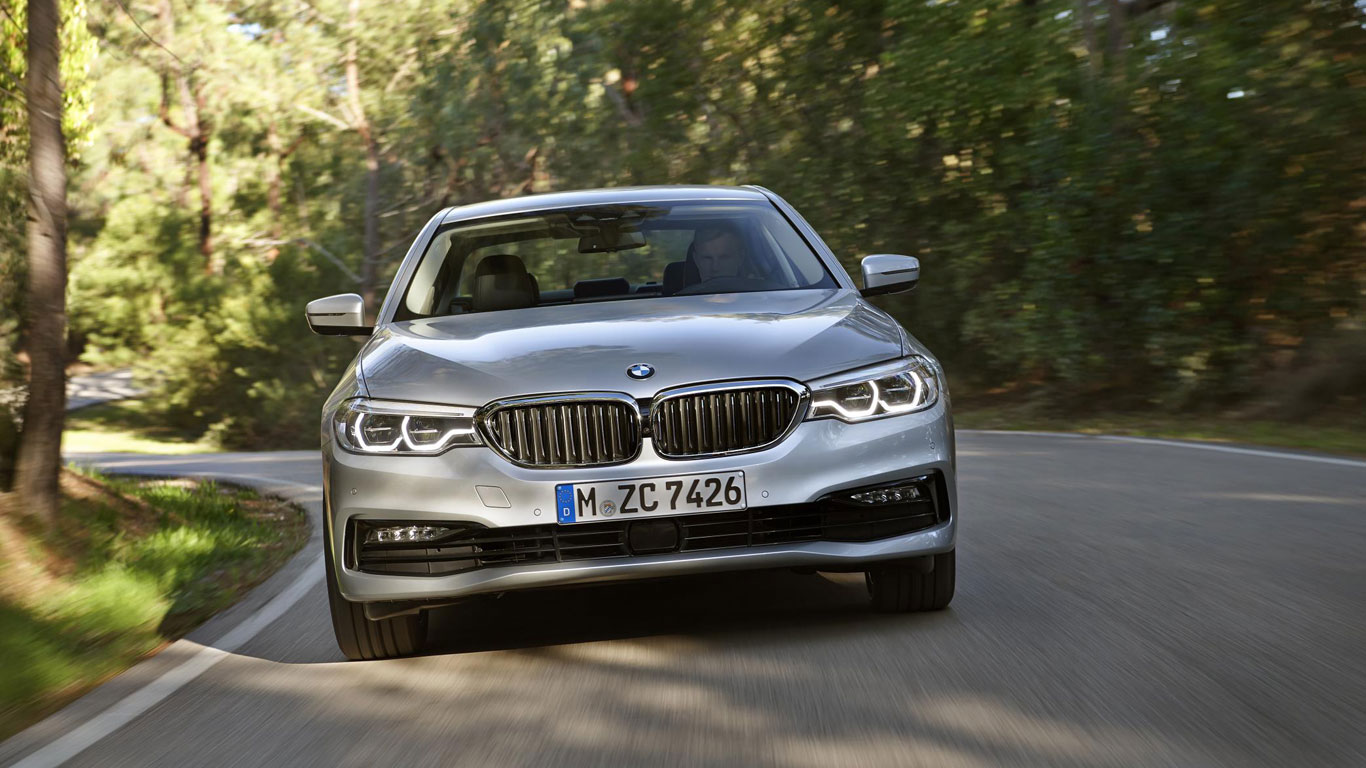
The new BMW 5 Series is the latest car to be awarded a five-star safety rating, including an impressive 81% for pedestrian safety. According to Euro NCAP, “the car showed good all-round performance in crash protection and avoidance tests thanks to its new platform, body and safety features”.
Euro NCAP’s secretary general, Michiel van Ratingen, said: “BMW has led the way with a new 5-Series that features lots of driver assistance systems which Euro NCAP believes will transform safety in the years to come”.
Audi Q5
To achieve a five-star safety rating, a car must perform well in four key areas, namely: adult occupant protection, child occupant protection, pedestrian protection and safety assist.
The Audi Q5 performed well in the safety test, with a 93% rating for adult occupant protection being the standout performance. The adult occupant score is determined from frontal impact, side impact and whiplash tests.
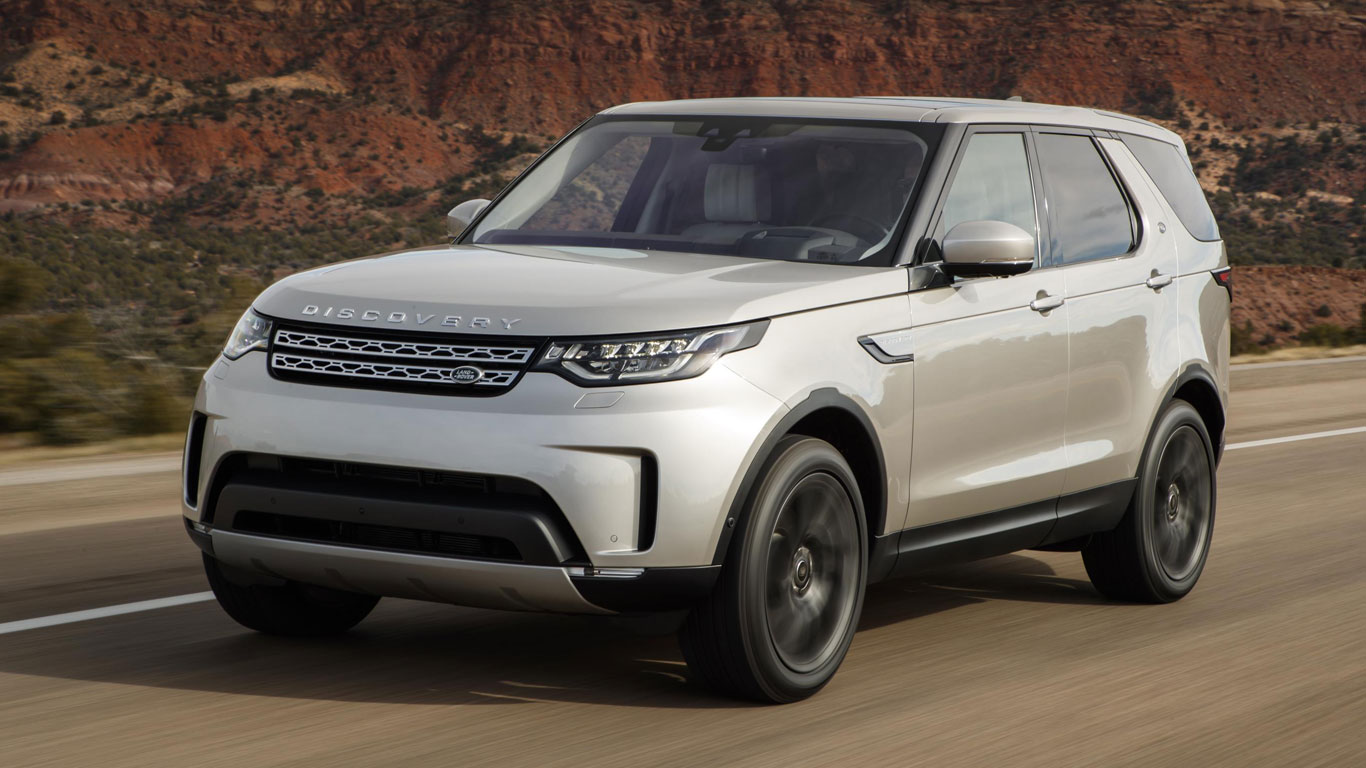
Land Rover Discovery
Meanwhile, the child occupant protection covers three aspects: the protection offered by the child restraint systems in the frontal and side impact tests; the vehicle’s ability to accommodate child restraints of various sizes and designs; and the availability of provisions for safe transport of children in the car
The new Land Rover Discovery – which offers an optional seven-seat layout – scored an impressive 80% in this area.
Toyota C-HR
The third part of the Euro NCAP safety rating concerns pedestrian protection, which is determined from the most important vehicle front-end structures, such as the bonnet and windscreen, the bonnet leading edge and the bumper.
The bold looking Toyota C-HR scored 76% in this area and a highly impressive 95% for adult occupant protection.
Volvo S90/V90
Perhaps unsurprisingly, the Volvo S90 and V90 have achieved the most impressive figures across the board. A 95% for adult occupant protection and 93% for safety assist puts the big Swede at the top of the class, while 80% and 76% for child protection and pedestrian protection respectively are close to the benchmarks.
Safety assist focuses on driver-assist technologies, such as electronic stability control, seatbelt reminders, speed assistance, automatic braking and lane support systems. The Volvo is the final car on our list to have been awarded a five-star rating in 2017. All of the remaining cars were tested in 2016.
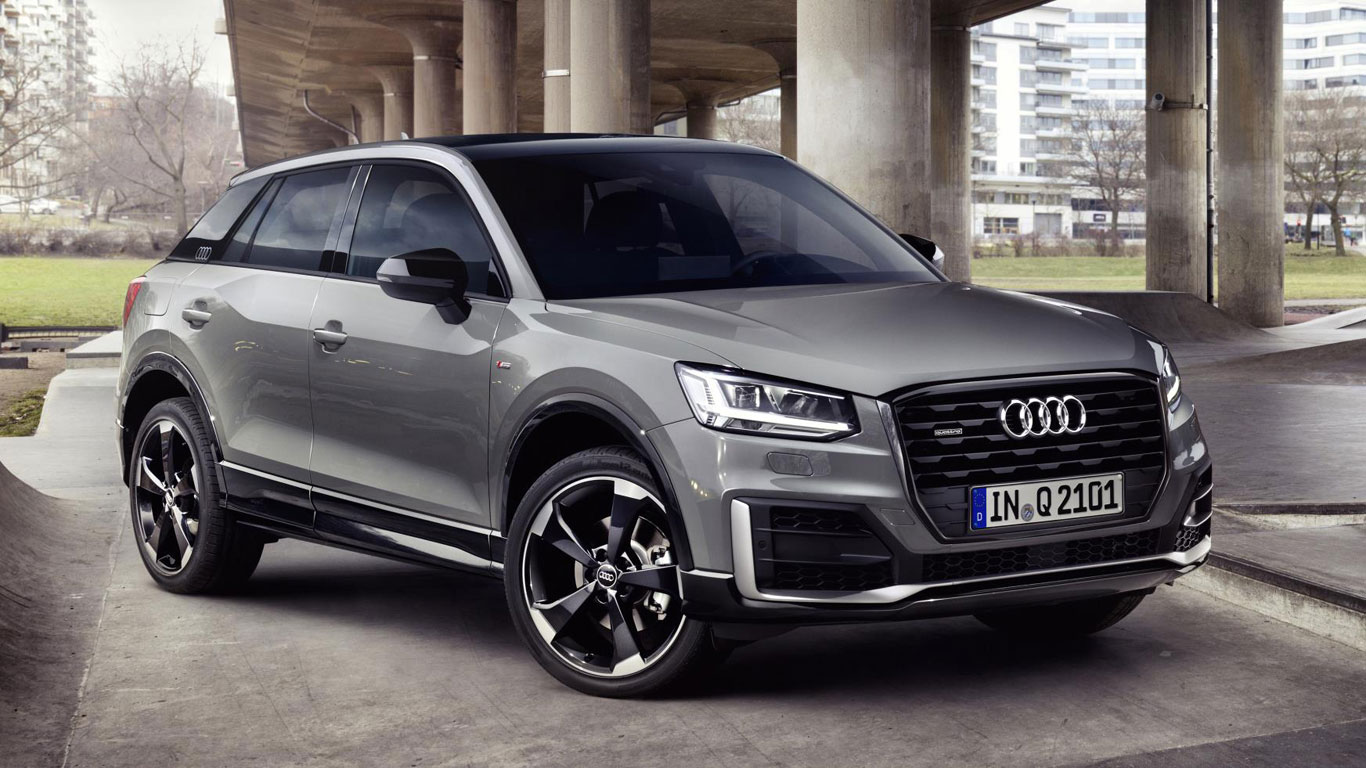
Audi Q2
A compact crossover with an Audi badge is always going to be popular, even with prices starting from £21,360. Audi is launching the Q2 with the help of a so-called ‘Edition #1’, which commands a price tag of £31,170.
The Q2 scored well across the aboard, including 93% for adult occupant protection and 86% for child occupant protection.
Ford Edge
The Ford Edge’s 89% rating for safety assist technology was the highest of 2016 and is beaten only by the 93% scored by the Volvo S90/V90 in 2017.
The Edge is Ford’s flagship SUV and prices range from £32,295 for the Zetec to £39,545 for the super-posh Vignale.
Hyundai Ioniq
The five-star Euro NCAP rating covers all versions of the Hyundai Ioniq, including electric and PHEV.
The Ioniq is available with a host of safety systems, including lane departure warning system, blind spot detection, automatic brakes and adaptive cruise control.
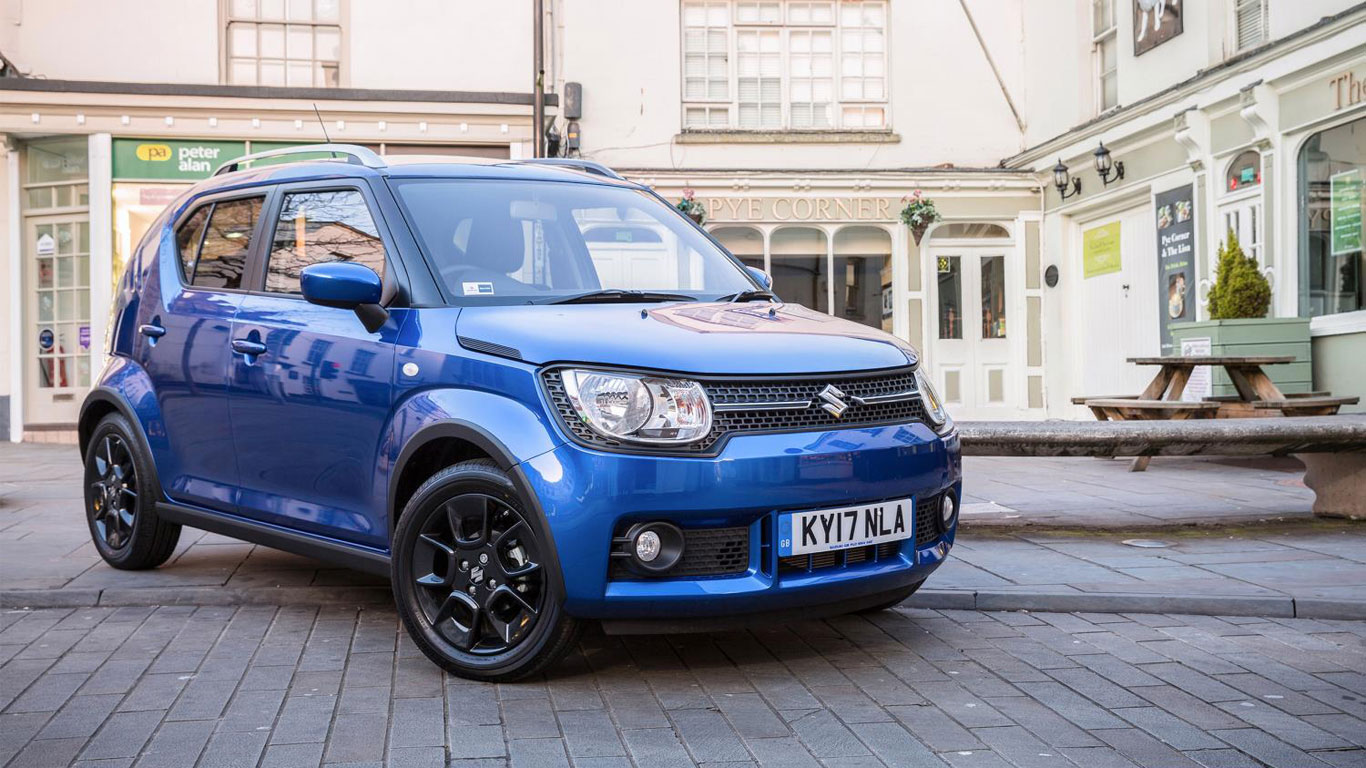
Suzuki Ignis (safety pack)
In 2016, Euro NCAP introduced a new ‘Dual Rating’ system, which means that the default rating is based on standard safety equipment available throughout the range. Additional tests are done to determine what the result would be with an optional safety pack.
Without the safety pack, the Suzuki Ignis was awarded a middling three-star rating. However, the top-spec SZ5 model with dual camera brake support was awarded a five-star rating.
Mercedes-Benz E-Class
You’d be surprised if a car such as the Mercedes-Benz E-Class wasn’t awarded a maximum five-star rating. It is, of course, simpler and more cost-effective to optimise the safety of a larger, more expensive car.
The E-Class scored an impressive 95% for adult occupant protection.
Peugeot 3008/5008
The Peugeot 3008 and 5008 are structurally identical, except for extra length in the rear and a third row of seats. With this in mind, Euro NCAP was happy to award a five-star rating to the 5008 based on the 3008 as tested.
In March 2017, the Peugeot 3008 was named the European Car of the Year at the Geneva Motor Show.
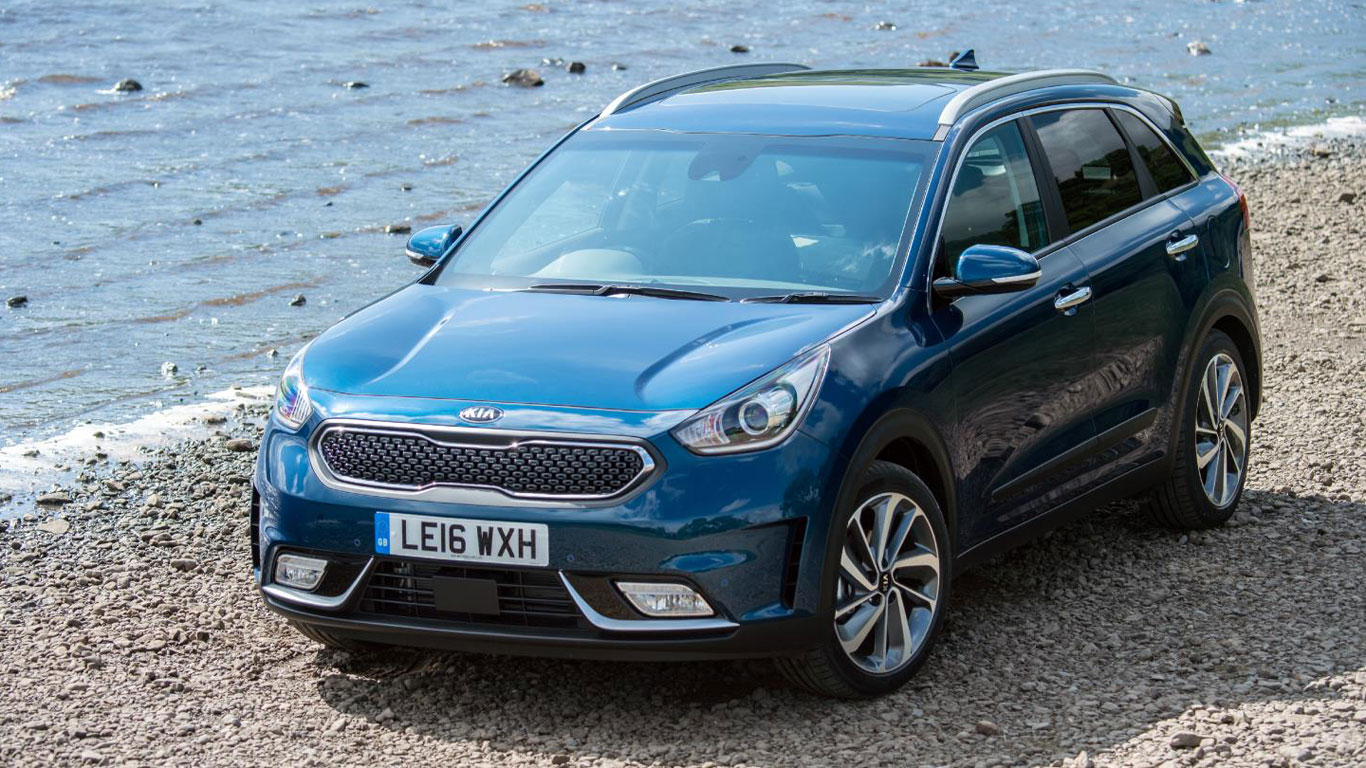
Kia Niro (safety pack)
The Kia Niro is another car to benefit from the new ‘Dual Rating’ system. With the optional safety pack, the hybrid achieved a four-star rating. With it, the Niro achieved full marks.
Pedestrian safety jumped from 57% to 70%, while safety assist rocketed from 59% to 81%. And, of course, you also get Kia’s seven-year warranty.
Renault Scenic
Motorists are falling out of love with MPVs, which is why the Renault Scenic looks more like an SUV. Renault was the first company to achieve a five-star rating, when the Laguna (remember that?) was given full marks in 2001.
The Euro NCAP crash test has come a long way since. Back then, the safety rating was based solely on occupant protection. The child protection rating wasn’t introduced until November 2003.
Subaru Levorg
Euro NCAP celebrated its 20th anniversary in February 2017, at which point it claimed that 78,000 lives have been saved as a result of the tough crash safety tests.
As many as nine out of 10 new cars sold in Europe hold a Euro NCAP rating. One of these is the Subaru Levorg, which scored 92% for adult occupant protection.
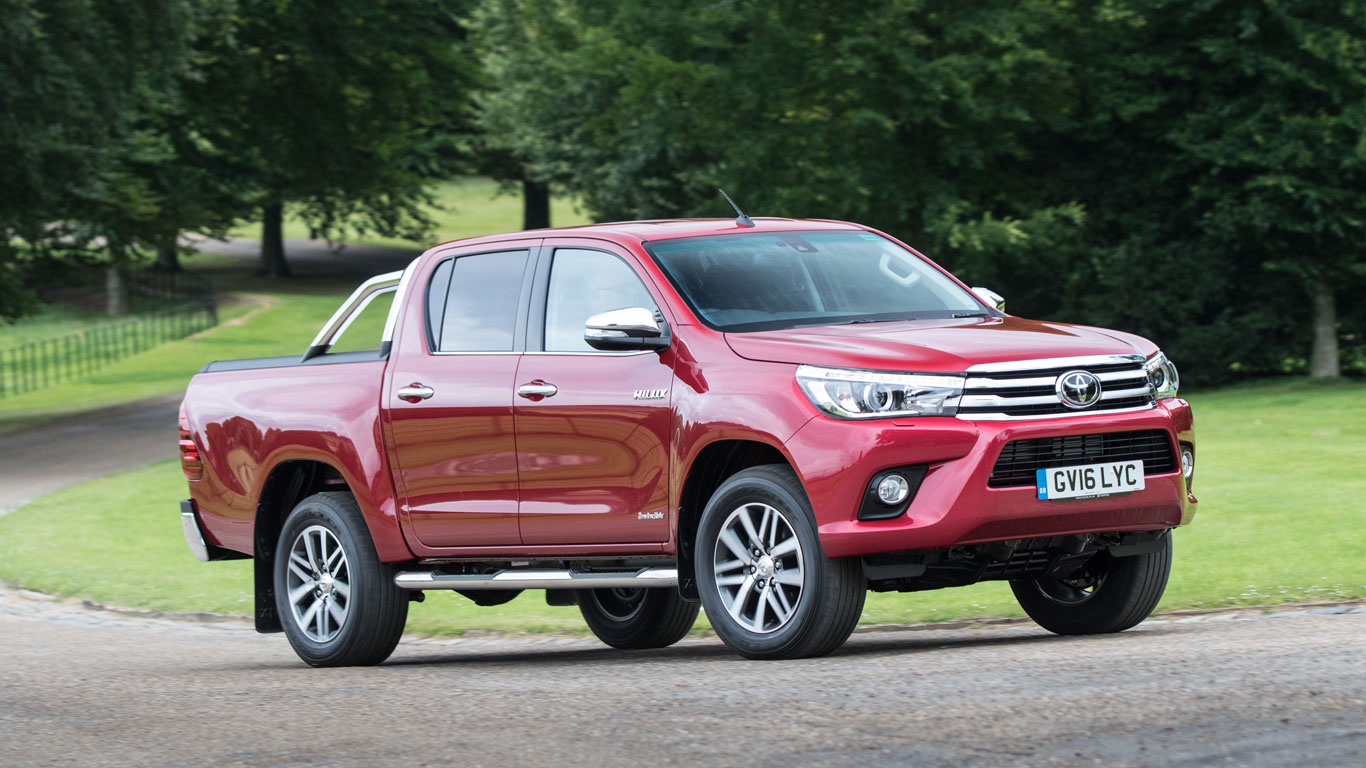
Toyota Hilux (safety pack)
In February 2008, Euro NCAP began testing pick-ups as more of these vehicles were being used for lifestyle and family use. The Toyota Hilux was awarded a three-star rating in 2016, including a lowly 25% for safety assist.
However, equip Toyota’s excellent Safety Sense package – which includes pedestrian detection, road sign assist and lane departure alert – and the Hilux achieves a maximum five-star rating.
Alfa Romeo Giulia
This is impressive. The Alfa Romeo Giulia received a score of 98% for adult occupant protection: the highest score ever achieved by any car, even with the introduction of a more stringent rating system in 2015.
Standard equipment across the Giulia range includes lane departure warning and blind spot monitoring, with rear cross path detection available as an option.
SEAT Ateca
The SEAT Ateca is one of the latest breed of compact SUVs battling for position in a fiercely competitive sector.
A five-star safety rating – which includes a 93% rating for adult occupant protection – will help its cause. Prices start from £18,150.
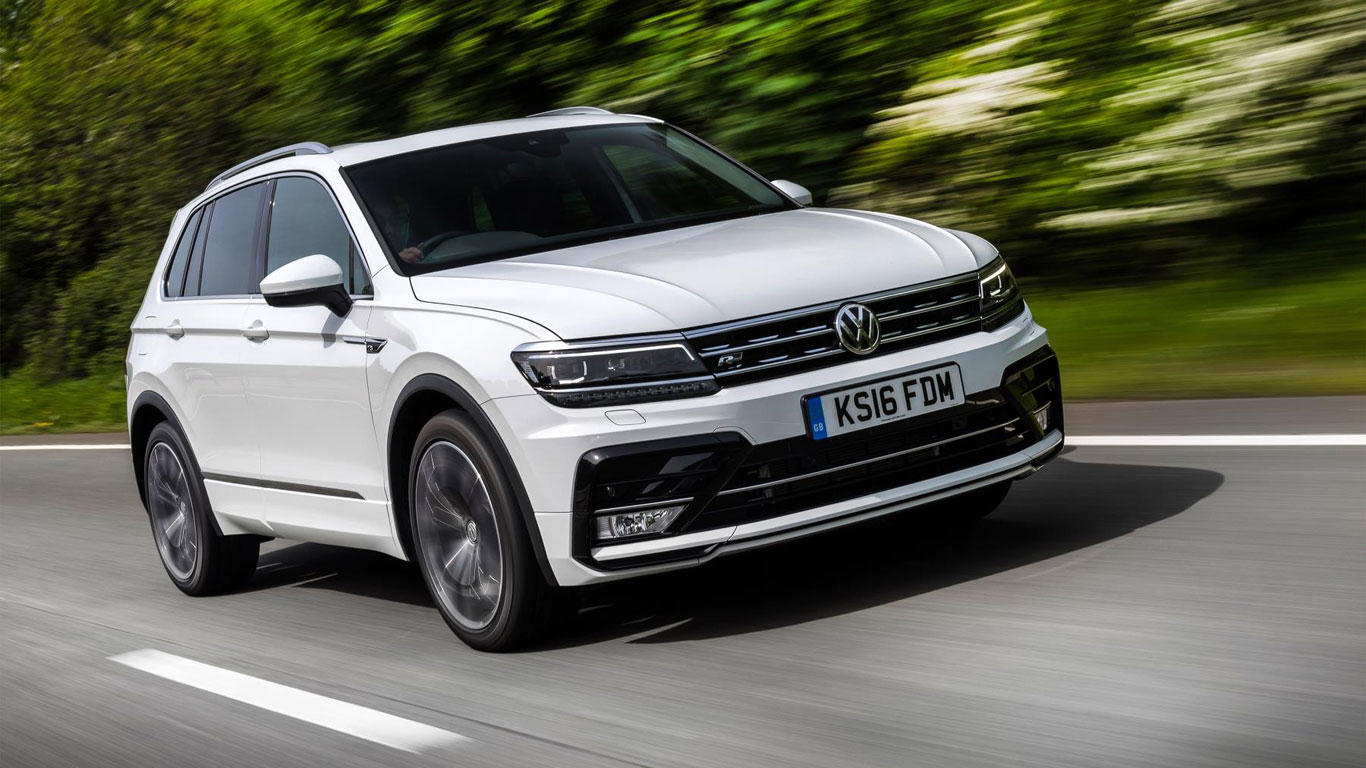
Volkswagen Tiguan
The Volkswagen Tiguan is built on the same MQB platform as the Ateca, which also provides the platform for the Skoda Kodiaq and the forthcoming replacement for the Yeti.
In 2016, the Tiguan scored 96% for adult occupant protection and 84% for child occupant protection. Prices start from £23,250.
Toyota Prius
And finally, the Toyota Prius, which delivered an impressive set of results in 2016. The 85% for safety assist was the second highest score of 2016, while 92% for adult occupant protection was equally as impressive.
For more information on the safety ratings, visit euroncap.com.
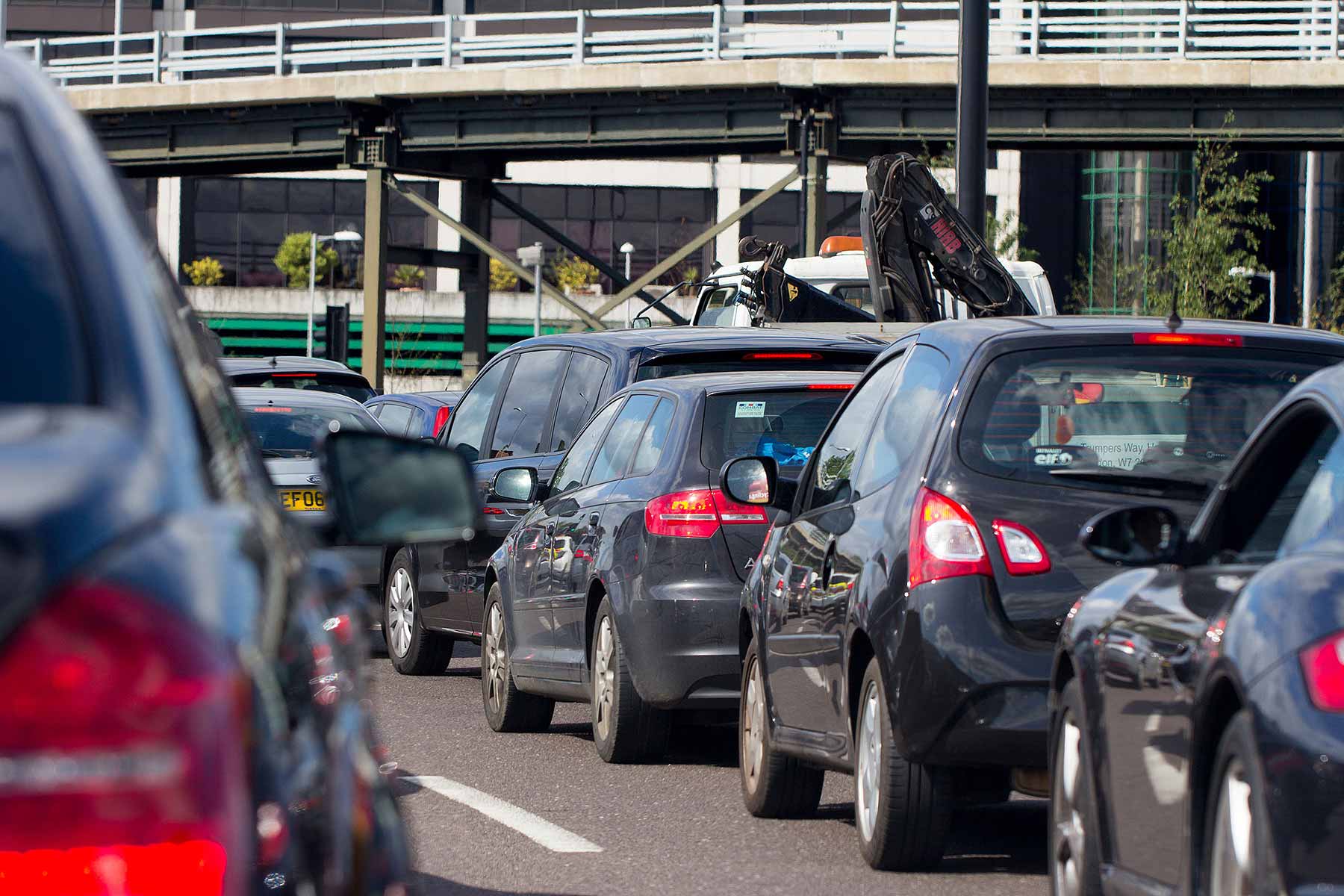
The Society of Motor Manufacturers and Traders (SMMT) has welcomed new government proposals for a UK Air Quality Plan, particularly the recognition that “new Euro 6 diesels which have been on sale for the past two years will not face any penalty charges anywhere in the UK”.
Greenpeace has, however, called the plan a “hodge-podge of vague proposals [that] offers little help and no justice to drivers duped by car companies and people breathing toxic air pollution.
“The only real winners here are the car makers who, despite misleading customers about their cars’ real emissions and causing this mess in the first place, are getting off scot-free.”
National road safety charity Brake has gone further, accusing ministers of an “abdication of responsibility”. Its campaigns director Gary Rae said the organisation “will study the details in the plan, but the headlines give us cause for concern. It appears the government has abdicated responsibility for reducing air pollution to local authorities. If any issue needs tackling on a national – and international – level, it’s this one. We have a national health emergency, and the government is kicking the issue into the long grass.”
Greenpeace says the government “accepts that diesel is at the root of the problem, and that phasing it out is the most effective solution”. The SMMT disagrees, by stressing the fact Euro 6 diesels face no threat of charges as part of the plan. Greenpeace says “a plan to help drivers swap polluting diesel for electric cars would be a good idea,” but the SMMT believes it is more important to accelerate rollout of the car industry’s multi-billion pound investment in existing low emissions vehicles.
The SMMT adds that any proposed diesel car scrappage scheme should deliver clear environmental benefits. It is also “encouraged that plans to improve traffic flow and congestion, as well as increased uptake of electric hybrid vehicles, will be prioritised in towns and cities.”
Consultation is now underway on the government’s draft UK Air Quality Plan. The final report will be published by 31 July; consultation closes on 15 June.
The Royal College of Physicians estimates UK air pollution is linked to around 40,000 premature deaths a year.
New car registrations plummeted by 19.8% in April as new car tax rates were introduced.
That’s according to data released this morning by the Society of Motor Manufacturers and Traders (SMMT) which shows 152,076 new cars were registered last month – making it the worst April since 2012.
The new VED rates, which were brought into force on on 1 April 2017, introduced a flat-rate of £140 for all petrol and diesel vehicles after the first year, compared to the CO2-based system used previously.
While electric cars continue to be tax-free, alternative-fuel vehicles including hybrid and plug-in hybrid models face a £130 yearly fee. This has resulted in the first downturn in alternatively-fuelled car registrations in nearly four years, as registrations dropped by 1.3% compared to April 2016.
“With the rush to register new cars and avoid VED tax rises before the end of March, as well as fewer selling days due to the later Easter, April was always going to be much slower,” said SMMT chief executive, Mike Hawes. “It’s important to note that the market remains at record levels as customers still see many benefits in purchasing a new car. We therefore expect demand to stabilise over the year as the turbulence created by these tax changes decreases.”
Registrations by private buyers were down by 28.4%, while businesses and large fleets also registered fewer cars (-21.0% and -12.3% respectively).
Despite the substantial hit in April, the SMMT says the overall new car market remains ‘strong’, with registrations over the first four months of 2017 up 1.1% compared to 2016.
Every year, the Federation of Historic British Vehicle Clubs holds Drive It Day, to raise awareness of everything that’s wonderful about old British cars and the clubs that support them. This year, we took part in a special run from Towcester Racecourse to Bicester Heritage, to join in the increasingly popular Sunday Scramble. Here’s how we got on.
Isofix points are built into a car’s structure to provide the safest means of mounting a child car seat. They’ve been mandatory on all new cars sold in Europe since 2014, but you’ll find them on models dating back to 2006. Cars with two Isofix points are common, but what if you require three or more? We’ve put together a list of cars with at least three Isofix child seat points, either as standard or as an optional extra. It’s by no means an exhaustive list, but it should provide a good overview of your options.
Audi Q2
The Q2 is a compact SUV with an Audi badge, which makes it one of the most desirable cars you can buy. There are two Isofix points on the outer rear seats and one for the front passenger seat, with airbag deactivation. This means you can fit three child seats in the Q2, which makes it ideal for the school run. Prices start from £24,000, so it’s not the cheapest small SUV you can buy, but you get plenty of equipment as standard.
Audi Q7
The Q2’s big brother is larger in many ways, including the number of Isofix points. The Audi Q7 has six – yes, six – Isofix points, one for each passenger seat. Prices start from around £57,500, or a little over £9,500 per Isofix point. The entry-level Q7 Sport features Matrix LED headlights, 19-inch alloys, air suspension, two touchscreens, a digital instrument panel, climate control and leather seats.
BMW 2 Series Active Tourer / Gran Tourer
The idea of a front-wheel-drive MPV with a BMW badge might upset the purists, but the fact remains: these are two of the classiest options in their respective sectors. Both the 2 Series Active Tourer and the seven-seat Gran Tourer offer Isofix points on the two outer second row seats and one at the front. The middle rear seat might be a little cramped with two child seats either side, so the Gran Tourer could actually be the best option if you intend to carry five people.
Citroen Berlingo
The Citroen Berlingo offers the kind of practicality an SUV can only dream of. There are two versions: the five-seat M and the seven-seat XL, both of which offer Isofix points on each of the three rear seats. There’s enough room for child seats to be mounted three abreast. Both versions are extremely spacious, but the Berlingo XL gives you the choice of an extra two seats or boot space to rival an estate car.
Citroen Grand C4 SpaceTourer
Fitting child seats three abreast in a single row is the holy grail for some parents, which is why the Citroen Grand C4 SpaceTourer is so popular with families. All three seats in the middle row have Isofix points, plus you get the bonus of two Isofix points in the third row. Because all five seats can be moved independently, it means that you can carry five child seats in the back, making this a brilliant family car. Prices start from around £26,000.
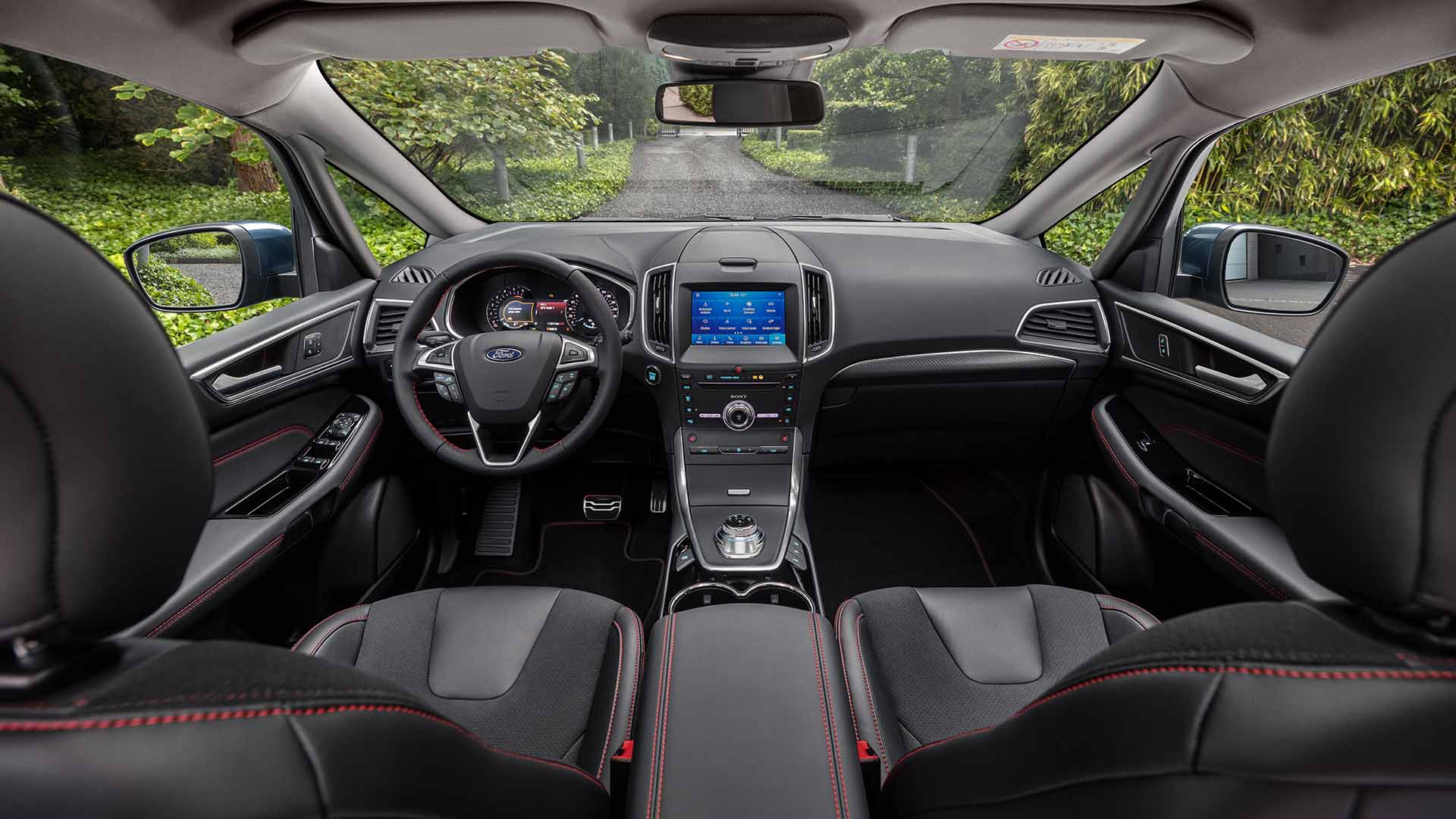
Ford Galaxy
The Galaxy might feel like an ageing product in a market obsessed with crossovers and SUVs, but Ford’s practical seven-seater proves that there’s life in the MPV yet. There are three Isofix points on the middle row of seats, with enough space in the cabin for seven adults. It’s also nicer to drive than many SUVs, although your children won’t thank you for testing this theory on the school run. Prices start from £33,000.
Ford S-Max
The Ford S-Max is the Galaxy’s sportier cousin. This has always been the people carrier for parents who demand a decent driving experience to go with the practicality. The three Isofix points in the middle row will ensure your little ones stay locked tight if you’re a little too eager through the bends. Prices start from around £30,000, although you’ll pay closer to £40,000 for the plush Vignale model.
Land Rover Discovery
The Land Rover Discovery features seven adult-sized seats, including up to five Isofix points. These can be found on the front passenger seat, outer second row seats and both third row seats. This is one of the most versatile and spacious SUVs you can buy, with the added reassurance of a five-star Euro NCAP safety rating. Few cars are as accomplished as the Discovery, especially if you intend to venture off-road or tow anything heavy.
Mercedes-Benz GLB
The Mercedes-Benz GLB is a more family-friendly alternative to the larger and more expensive GLC. There are four Isofix points – two in the middle row and an extra pair in the third row. Although it’s slightly shorter and narrower than the GLC, the loftier stance creates an interior that’s spacious enough for five adults. Prices start from £37,000.
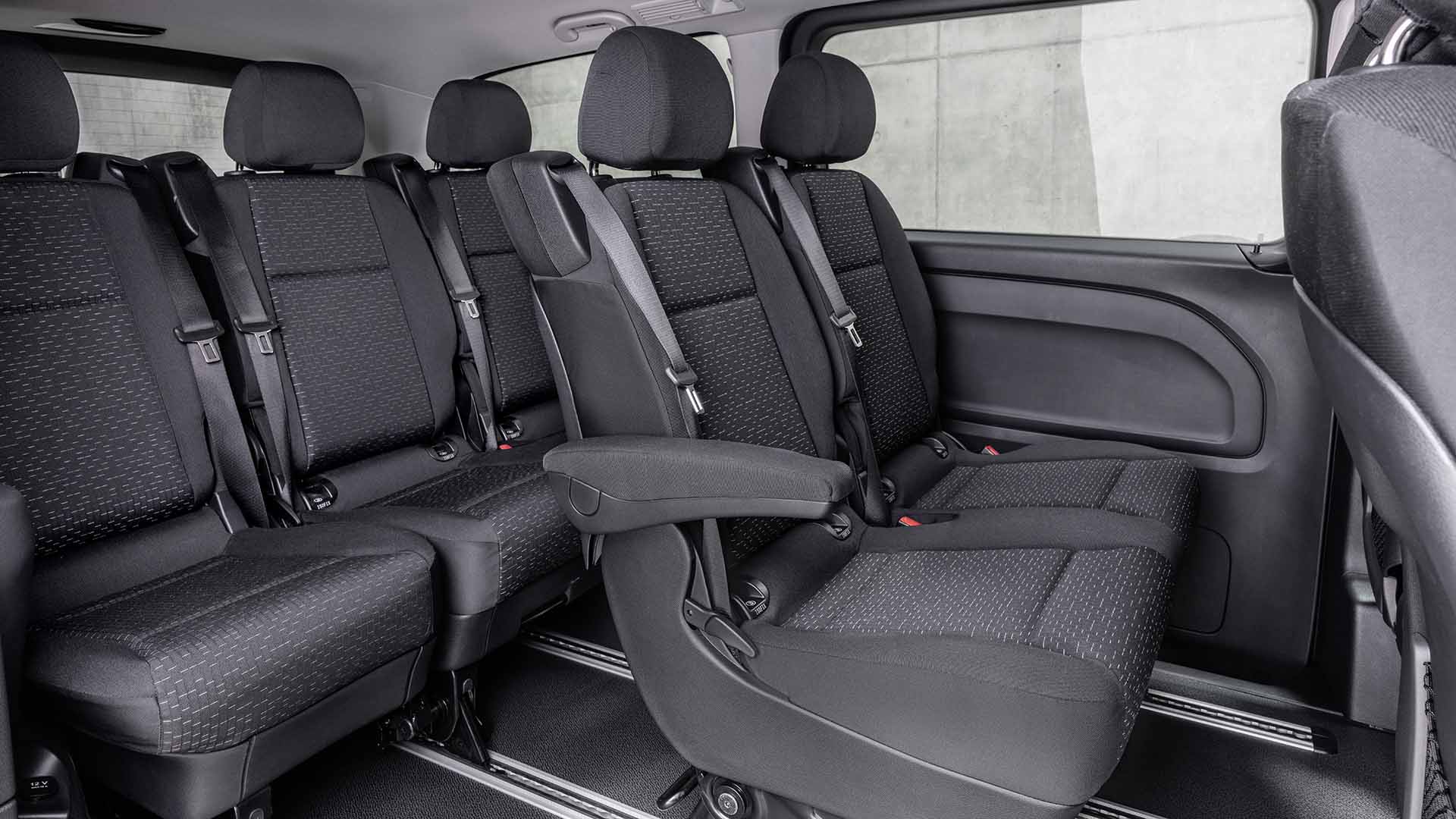
Mercedes-Benz Vito Tourer
The passenger compartment of the Mercedes-Benz Vito Tourer can be configured according to requirements: for example with a two-seat bench in the first row and a three-seat bench in the second. In this guise, child seats with Isofix attachment points can be fitted to up to four seats. Upgrade to the Vito Tourer Pro and Isofix points are available on all seven seats.
Mini Countryman
The Mini Countryman is bigger and more expensive than before, and is sure to divide opinion just like the original. In many ways, the latest model is far more convincing than the old one, and you’ll find two Isofix points in the back and an optional third Isofix point in the front. This costs £100 and comes with passenger airbag deactivation.
Nissan Micra
If you’ve got three children but you don’t want a large car, the Nissan Micra is an excellent choice. There are two Isofix points in the back, a third Isofix point in the front, plus a comprehensive suite of safety systems. The list includes emergency braking with pedestrian recognition, high beam assist, lane departure warning and intelligent lane intervention. All of this comes as standard, even on the £14,500 entry-level Micra.
Peugeot 3008
Nothing encapsulates the crossover boom quite like the Peugeot 3008, which has ditched the dowdy MPV styling of the old model, replacing it with something more akin to an SUV. A particular highlight is the well-made and clever interior, which just happens to include three Isofix points, one in the front and two in the back. A recent update makes it better than ever, with prices starting from £27,000.
Peugeot 5008
The 3008 is upstaged by its big brother, the Peugeot 5008, which manages to squeeze three Isofix points along the middle row of seats. You get an excellent level of standard equipment, including 17-inch alloy wheels, dual-zone climate control, LED headlights, LED rear lights, eight-inch touchscreen infotainment system, 12.3-inch digital instrument panel and seven seats.
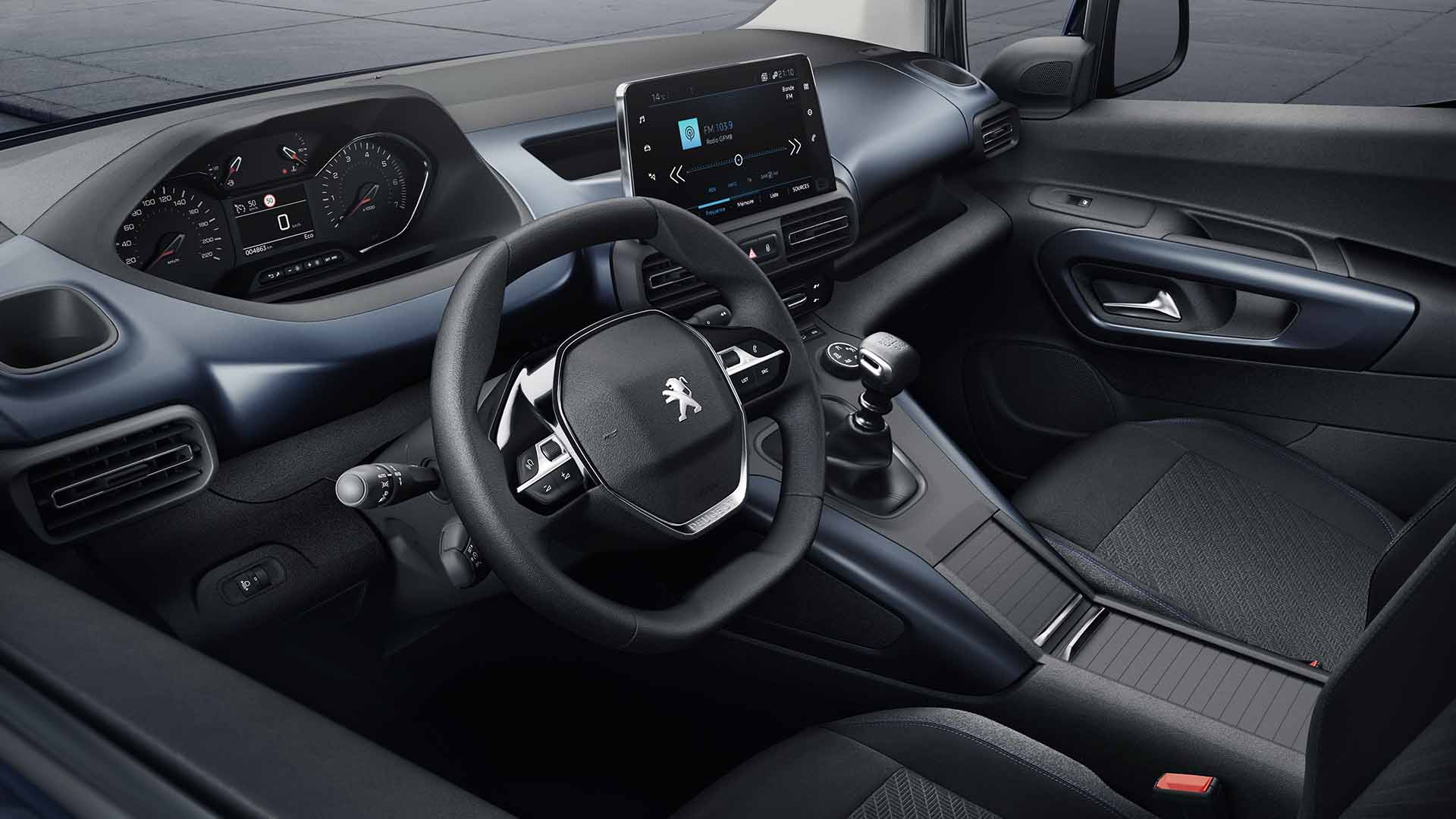
Peugeot Rifter
The Peugeot Rifter shares a platform and engines with the Citroen Berlingo, so you get the same level of versatility. It’s available as a five- or seven-seater, and in two lengths (standard and long). If anything, the Rifter feels a little more upmarket than the Berlingo, thanks to its SUV-like styling and classy interior.
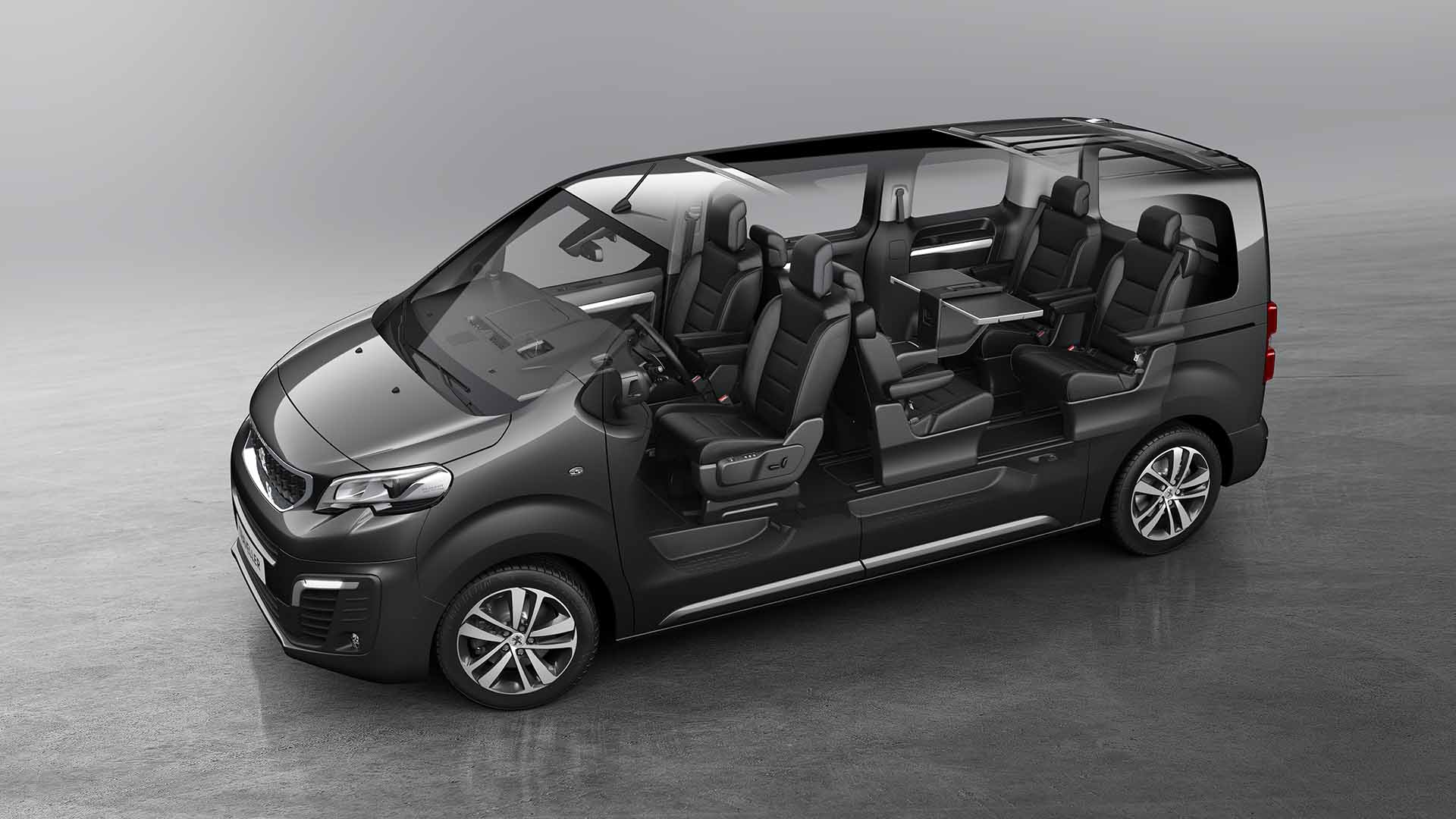
Peugeot Traveller
We didn’t include the Citroen SpaceTourer, but the specs are broadly similar to the Peugeot Traveller. Three Isofix points are fitted across the second row, but up to six Isofix points can be specified for larger families. The Traveller is available in standard or long length, with prices starting from £37,000. All-electric versions offer a range of 148 miles.
Renault Zoe
All versions of the Renault Zoe electric car come with three Isofix points: two in the back and one in the front. Standard features include LED headlights, air-conditioning, keyless start, cruise control, seven-inch touchscreen infotainment, Apple CarPlay, Android Auto and a free wallbox home charger.
Skoda Kodiaq
The Skoda Kodiaq is available as a five- or seven-seater and comes fitted with two Isofix points as standard. For a modest £45, you can equip the front passenger seat with an extra mounting point. The Kodiaq range starts from £26,500, with the cheapest seven-seater available for just under £28,000.
Tesla Model X
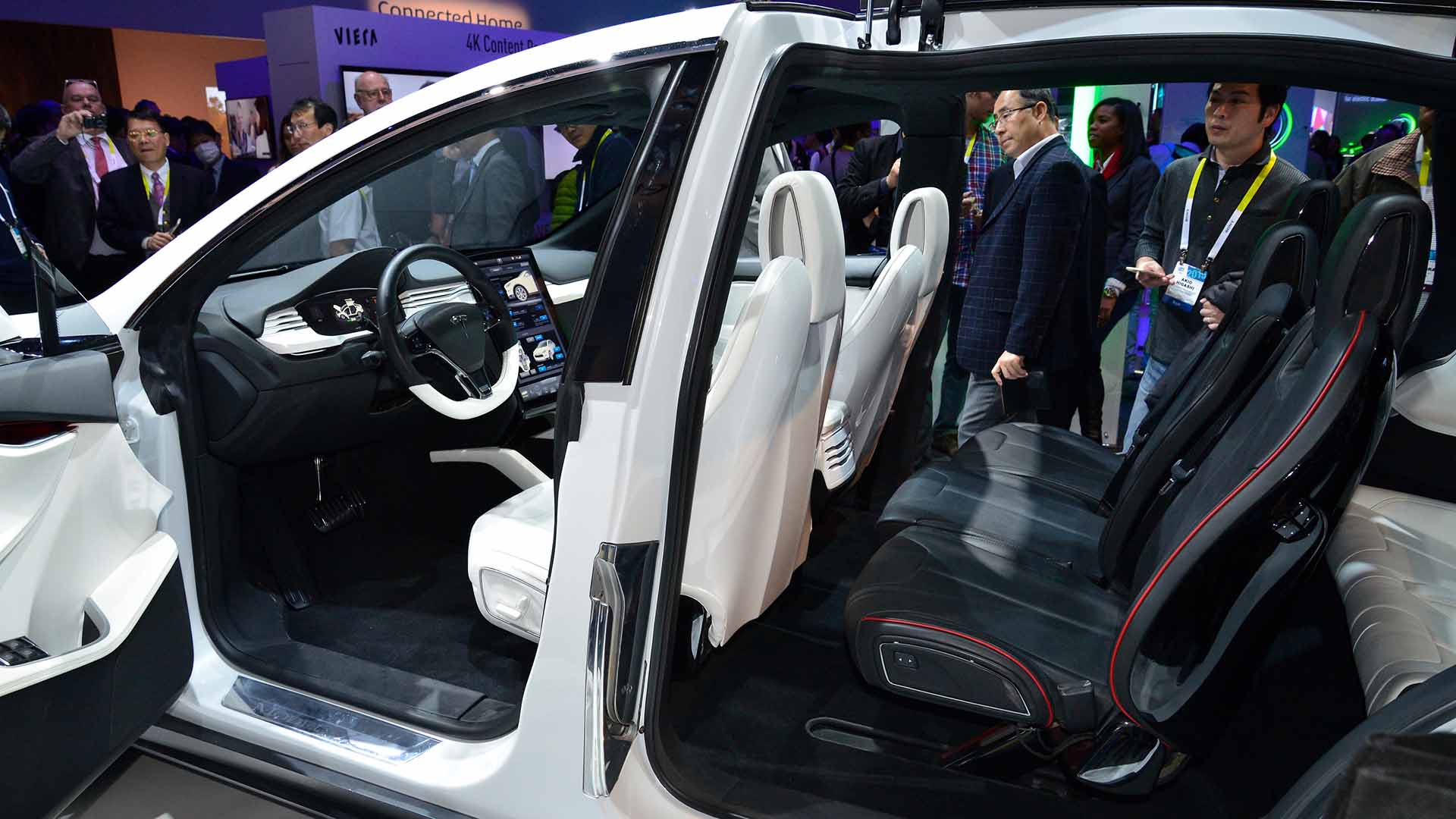
Tesla claims that the Model X is the safest SUV ever built, with a huge array of active and passive protection features. There are up to seven seats on board, four of which include Isofix mounting points. The middle seats are mounted on a single post and recline independently.
Toyota Proace Verso
The Toyota Proace Verso shares much in common with the Peugeot Traveller and Citroen SpaceTourer, but you get the added benefit of Toyota’s five-year warranty. You can select from three grades: seven-seat VIP, eight-seat Family or nine-seat Shuttle. The VIP model comes with a rail-mounted rear passenger lounge table, so your children can host their own meeting on the move.
Vauxhall Combo Life
The Vauxhall Combo Life is the less fancy alternative to the Peugeot Rifter and Citroen Berlingo. Edition and SE models come with a 60/40 split-folding rear seat in the middle row, but a three-person 33/33/33 layout is standard on the Elite and optional on the others. Even the seven-seat Combo Life Elite costs less than £29,000, which makes it a bit of a bargain.
Vauxhall Grandland X
The Vauxhall Grandland X is based on the Peugeot 3008, so it’s no surprise to discover that it offers the same number of Isofix points: two in the back and one in the front. The Peugeot in a Vauxhall frock is available from a little under £25,000. The Elite Nav Premium costs £30,000 and offers the kind of equipment you’d associate with a premium car.
Volkswagen Sharan
Although it’s no longer possible to buy a new Seat Alhambra, its platform-sharing Sharan sibling remains on sale. There are three Isofix points along the middle row, plus the benefit of two additional seats in the third row. The Sharan is showing its age, but few cars offer the same blend of quality and seven-seat space. Prices start from £33,500.
Volkswagen Touran
The Touran might be smaller and less practical than the Sharan, but it has one or two aces up its sleeve. Crucially, it offers five Isofix points, with anchor points on all second and third row seats. For many families, this will make it one of the best MPVs you can buy.
Being practical doesn’t necessarily mean having to give up your street cred. When the time comes to transport a growing family, there are ways and means to resist the slide into blandness. These 20 cars prove that you can achieve domestic bliss, yet still gain envious glances in the supermarket car park.
Porsche tops list of Europe’s most popular classics
No replacement for displacement: the 25 cars with the biggest engines
Classic Mini makes a £50,000 comeback
1982 Peugeot 505 Familiale
Notable for being Peugeot’s last rear-wheel-drive production car, the 505 was produced in various forms between 1978 and 1999. With more than 1.3 million sold, it must have done something right, but the version we’re interested in is the ‘Familiale’. Introduced at the 1982 Geneva Motor Show, this estate offered seating for up to eight thanks to a folding third-row bench. Oh, and the styling was a collaboration with Pininfarina, which clearly ratchets up the cool points.
1984 Renault Espace
Often cited as being the first real MPV, the original Espace landed in 1984 after a lengthy and tumultuous gestation period. Designed by Chrysler UK to replace the uncool Talbot Rancho, it then ended up in the hands of PSA Peugeot Citroen. Finally, via Matra, the Espace went on sale badged as a Renault. Its fibreglass body was novel, but customers took time to warm to the radical styling. Today, if you can find one, it would make a suitably leftfield family transporter.
1986 Mercedes-Benz W124 E-Class Estate
Get ready to tick off the typical Mercedes-Benz list of clichés with the W124 E-Class. Yes, this estate is from the time when Mercedes models were associated with ‘vault-like’ build quality and ‘bulletproof’ reliability. Most significant was the option of seven seats, courtesy of a rear-facing third row that folded flat into the boot floor. This combination of space, plus the ability to rack up galactic mileage, means the W124 wagon still commands strong prices.
1957 Chevrolet Nomad
Proving that family transportation was cool more than six decades ago, the Nomad was related to the iconic Chevy Bel Air. Featuring a two-door shooting brake design with a split two-piece tailgate, the Nomad offered practicality and good looks. For 1957, it gained the option of the wondrously named ‘Super Turbo Fire V8’ with 283hp from this cutting-edge fuel-injected engine. Only sold for three years, you’ll need at least $45,000 (£35,000) to rock this retro-cool look.
1959 Ford Country Squire
Proving that car manufacturers were doing ‘lifestyle’ photoshoots long before the Lycra-clad 1990s, it’s the 1959 Ford Country Squire. This particular car featured push-button lifestyle accessories, with a roof-mounted boat that flipped over to reveal a tent beneath. There was even an electric fridge in the boot. The Country Squire soldiered on as part of the Ford range until 1990 when America fell out of love with the station wagon. In case you’re wondering, the woodgrain trim was fake – and had been since 1953.
1991 Jeep Grand Wagoneer
Another car guilty of the fake veneer treatment was one that can legitimately claim to be the first premium SUV. Introduced in 1963 by the Kaiser Jeep Corporation, the Wagoneer had an upmarket interior that set it apart from other 4×4 models at the time. By 1991, and under the control of Chrysler, the last few Grand Wagoneers were even more luxurious and better equipped. Accordingly, they attract premium prices from collectors.
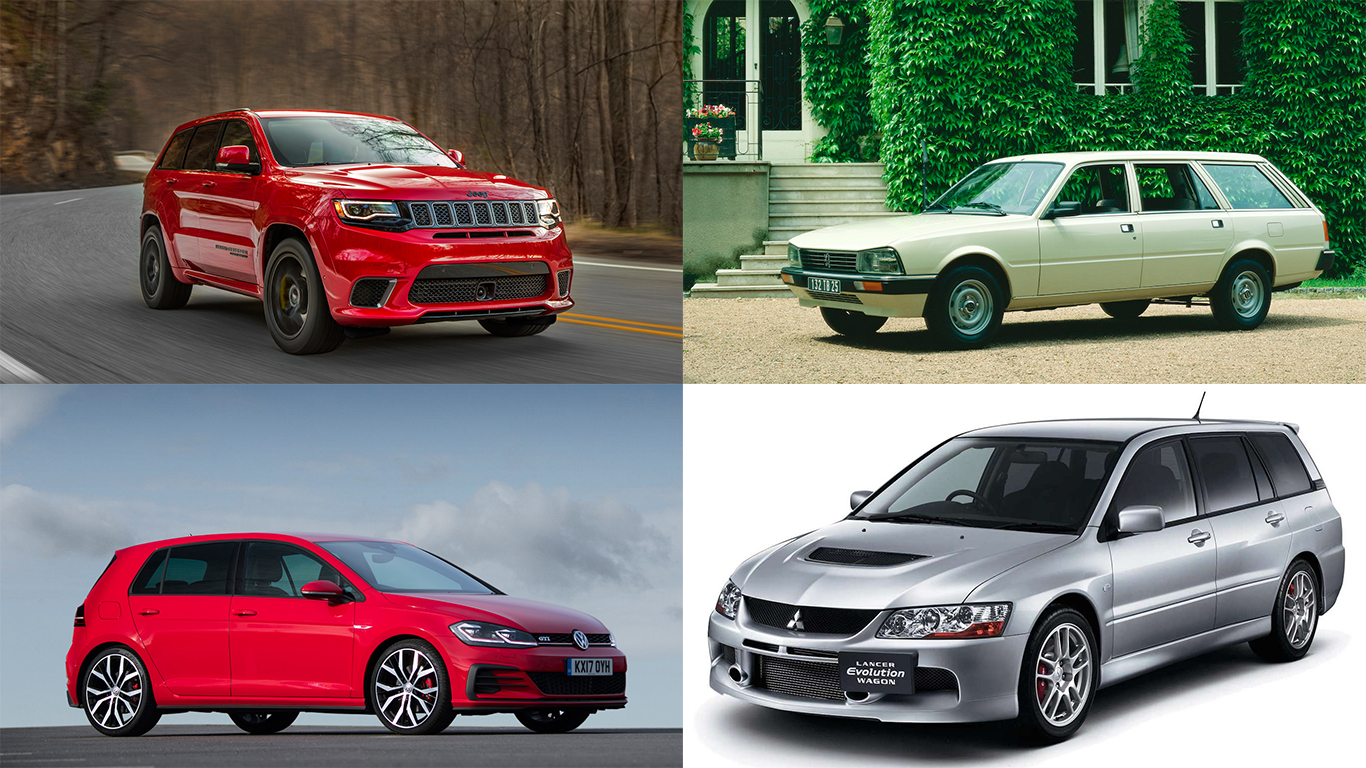
2018 Jeep Grand Cherokee Trackhawk
Jeep hasn’t forgotten how to produce cool family machines since the Wagoneer, although the brand-new Trackhawk is desirable for slightly different reasons. Taking the 707hp 6.2-litre supercharged V8 engine from the Dodge Challenger Hellcat and mating it to a 4WD system means 0-60mph in 3.5 seconds. Top speed is an equally ridiculous 180mph.Plus, you can set the suspension and gearbox to ‘Track mode’ should you want to get impress at the race circuit. Sick bags don’t appear on the options list, but at least the leather upholstery will be wipe-clean.
1998 Toyota Land Cruiser Amazon
Cool doesn’t necessarily mean fast or stylish. In fact, for family transport, automotive chic can be as simple as dependability in the most extreme situations. With a lineage that stretches back to 1951, the Land Cruiser has built a reputation for reliability and trustworthiness. Just ask Land Rover what it did for their export sales in places like Australia. The J100 Amazon, introduced in 1998, could be had with a 4.7-litre V8 engine, and offers a sense of quiet confidence when tackling the school run.
2000 Volkswagen Sharan 2.8 VR6
Much like this decade has been defined by the SUV, the 1990s were the era of the MPV. Offerings like the Sharan – and its Ford Galaxy/SEAT Alhambra sisters – were the answer to almost every family problem. Even the need to drive a seven-seater MPV, with a 2.8-litre 201hp narrow-angle V6 engine, was covered. Picking the VR6 still only meant 0-60mph in 10.6 seconds, but fuel economy dropped to a faintly ridiculous 22mpg. A small price to pay for transporting your kids with a six-cylinder soundtrack?
2001 Vauxhall Zafira GSi
The first-generation Zafira suffers from something of an image problem, perhaps not helped by Vauxhall’s TV adverts with Griff Rhys Jones. But in 2001, Vauxhall launched the sporty GSi version, with a 189hp turbocharged 2.0-litre engine from the Astra. A 0-60mph sprint of 7.5 seconds, combined with relatively subtle styling, make this something of a Q-car. If you can cope with the badge snobbery…
2006 SEAT Altea FR TFSI
Rarer and even more random than the Zafira, the Altea FR TFSI offers a fleeting chance that buying a compact MPV doesn’t mean giving up completely. Not only does it feature styling by Walter de Silva – he of Alfa Romeo 156 fame – but the FR had the option of a 197hp 2.0-litre TFSI engine. That’s the very same engine that powered the Mk5 Golf GTI, to much acclaim from journalists and enthusiasts alike. FR spec also means sports suspension, meaning this Altea handles better than you might imagine.
2006 Ford S-Max 2.5 Titanium
However, the title of ultimate performance MPV must go to the original Ford S-Max. Using the 2.5-litre five-cylinder engine from the Focus ST, its 216hp output means 0-60mph in 7.4 seconds and top speed of 143mph. Add a five-cylinder warble, seven seats and impressive handling, and the S-Max becomes quite a desirable package. It also proved popular with numerous police forces, adding an extra layer of coolness.
1995 Volvo 850 T-5R
Also beloved of the constabulary, the 850 T-5R was a worrying presence in the rear-view mirror of many motorway drivers. Created as Volvo went through a period of reinvention, the T-5R was a limited edition that used a 245hp 2.3-litre turbocharged engine. Although offered in estate and saloon body styles, the wagon was infinitely cooler – not least because of the 850 estate campaigned in the British Touring Car Championship.
2005 Mitsubishi Lancer Evolution IX Wagon
Not officially sold outside of Japan, and created in limited numbers, the Evo IX Wagon is an opportunity to transport your family in a unique machine. Only 2,500 were built, melding the Evo IX saloon chassis to bodywork from the regular Lancer estate, with extensive additional welding and strengthening. Power was unchanged at 276hp, as was the full-time 4WD system with active centre differential. Tracking down an import might not be easy, but will be worth it.
2006 Audi B7 RS4 Avant
Flared wheelarches, Audi build quality and a 4.2-litre V8 engine that also saw service in the original R8 supercar. Not a bad place to start for a five-door estate, and such qualities made the RS4 a genuine challenger to the BMW M3. A rear-biased Quattro drivetrain offered slip and security in equal measure, while 0-62mph in 4.9 seconds is more than fast enough for a family wagon.
2007 BMW E60 M5 Touring
In the early 2000s, BMW established a reputation for building the most powerful V10 engines in Formula 1. Although they never took a World Championship against a dominant Ferrari team, BMW still won plaudits for its 10-cylinder powerplant. Seeking to capitalise on this, it equipped the E60 M5 with a 5.0-litre V10 producing 500hp. A semi-automatic gearbox allowed drivers to live out their inner Juan Pablo Montoya fantasies, with launch control offering lightning-fast getaways from a standing start. Today it looks almost subtle but, to those in the know, this is an achingly cool machine.
2017 SEAT Leon ST Cupra 300
Despite the love for crossovers and SUVs, compact estate cars have seen a renaissance in recent years. The SEAT Leon ST has proven to be very popular, not least because of striking good looks, strong equipment levels and decent value. Top of the tree is the Cupra 300, which makes, as the name suggests, 300hp from its 2.0-litre turbo engine. Consider the Cupra 300 a cut-price version of the Golf R Estate and it makes a surprising amount of sense, with even the option of 4WD on the cards.
2004 Subaru Forester STi
If 4WD really is a necessity for your family needs, how about another import-only Japanese creation? With the 2.5-litre flat-four boxer engine from the Impreza WRX STi, this second-generation Forester made 265hp. That’s good enough for 0-62mph in around 5.0 seconds, with Brembo brakes and tuned suspension to keep everything in check. Fuel economy might not be family-friendly, at 25mpg or less, but just remind yourself that you’re buying a practical estate with rally pedigree.
2016 Audi RS Q3 Performance
Should you want retro-rally ancestry in your family car, the RS Q3 could be the choice for you. The five-cylinder turbocharged engine sounds like those used in the wild Group B Quattro rally cars of the 1980s, even if the RS Q3 has to make to do with only 362hp. Performance specification brings cool-looking titanium alloy wheels and blue Alcantara seats. But ultimately you’re buying it for the noise made by the giant oval tailpipe.
2017 Volkswagen Golf GTI five-door
If a hot hatch is meant to be all things to all people, the Golf GTI is surely the ultimate expression of that. It’s classless yet classy, desirable but affordable, and as practical as a regular Golf hatchback. Does family motoring get cooler than this? The latest GTI is an absolute corker, with 230hp on tap from its 2.0-litre turbo motor. Make sure you keep it five-door and you’ll have a car that’s as usable as any normal family hatchback, but with a badge that truly means something.
Unless you’ve been living under a rock for the past decade, you’ll know that SUVs are hotter than hot cakes right now. New car buyers simply cannot get enough of the high-ridin’ heroes of the high street.
The 2017 New York Auto Show offers everything from a supercar-taming Jeep to a crazy concept from Toyota. We check out 10 of the best SUVs on display.
Auction specialist names top 6 best-investment cars
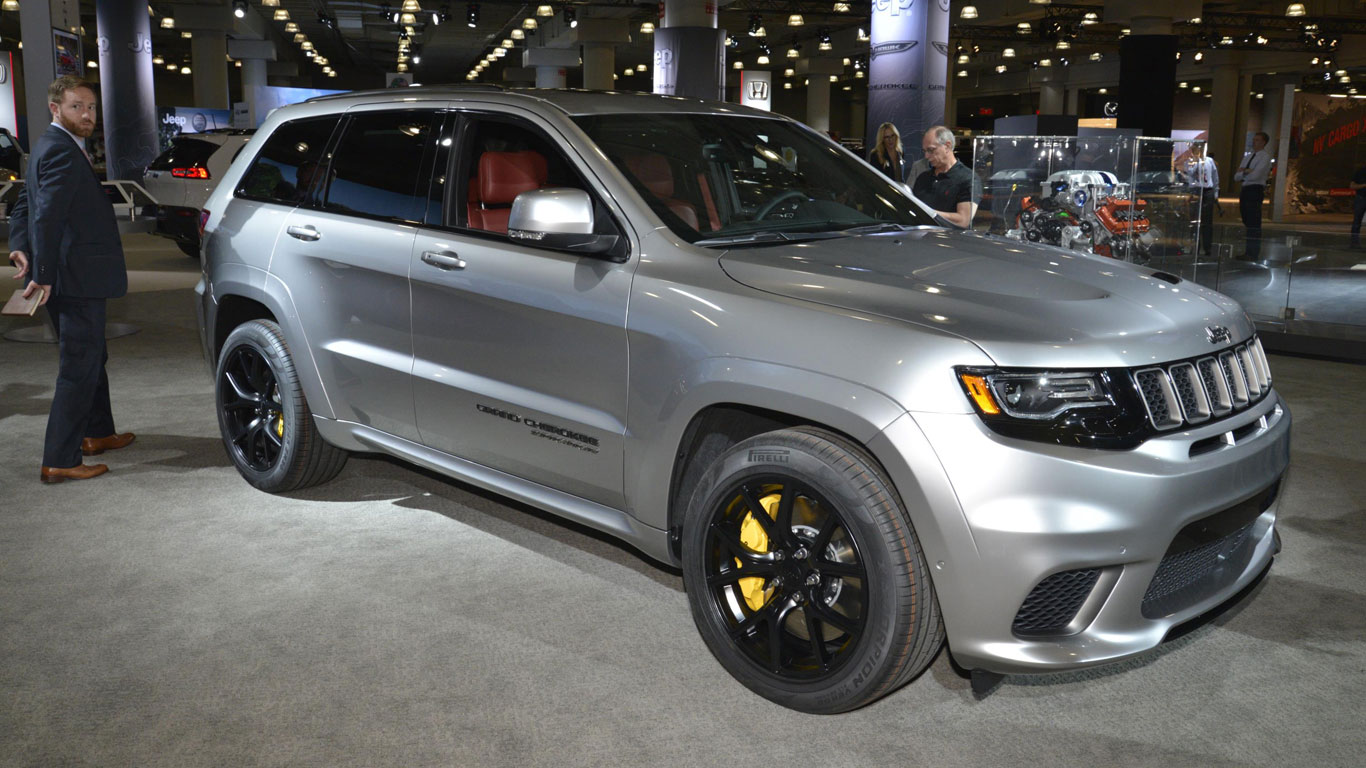
Jeep’s claim that the Grand Cherokee Trackhawk is the “quickest SUV ever” might ruffle a few feathers at Tesla, but there’s no doubting its performance credentials. The supercharged 6.2-litre V8 engine delivers 707hp and 645lb ft, enough to keep that new Dodge Demon thingy on its toes.
The top speed is 180mph, while the 0-60mph time is polished off in 3.5 seconds. For reference, the Tesla Model X will sprint to 60mph in a claimed 2.9 seconds. But if the Tesla represents the future of the SUV, the Trackhawk is thoroughly old-school. A jackhammer to Tesla’s silent assassin.
Mercedes-AMG GLC63 S Coupe
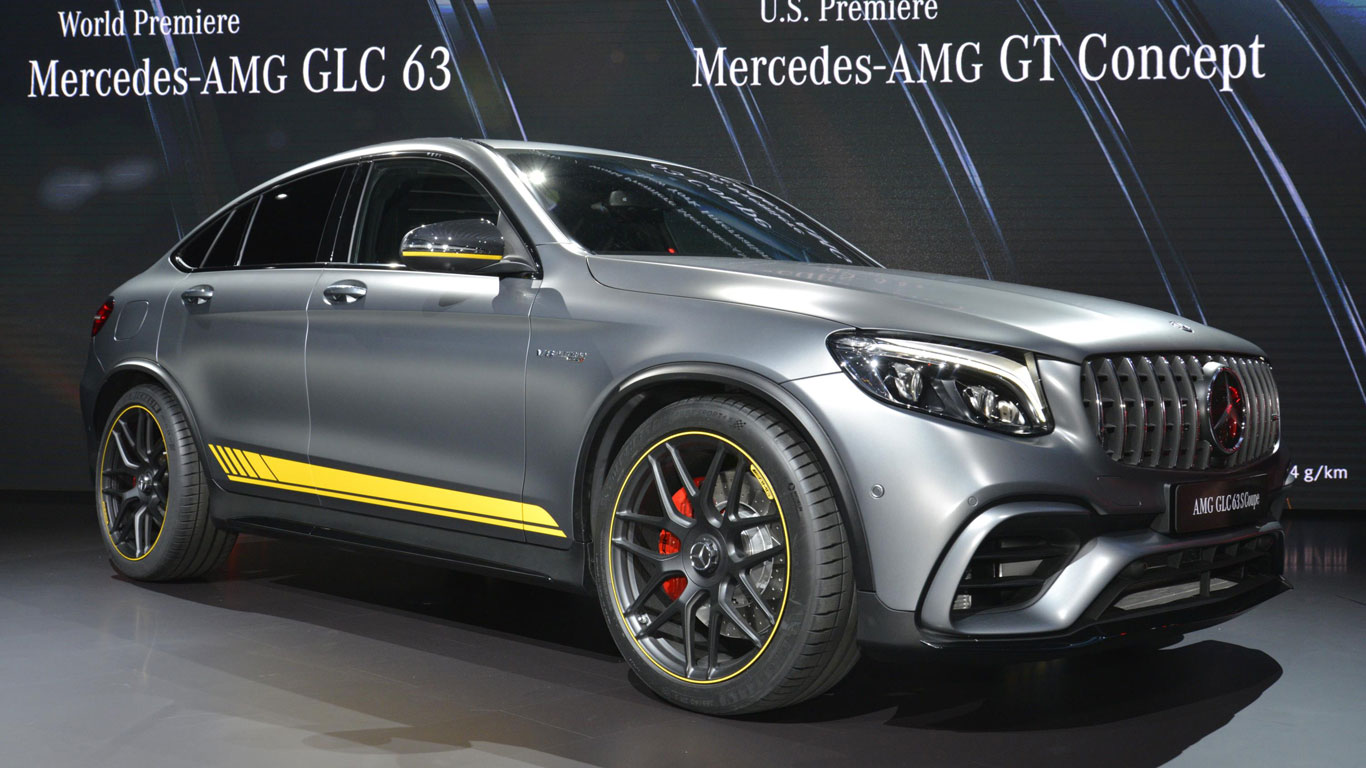
Nearly 50 years of AMG history has led us here: to the Mercedes-AMG GLC63 S Coupe. The 4.0-litre V8 biturbo produces 503hp and 516lb ft of torque, helping to propel the aesthetically-challenged SUV to 60mph in 3.7 seconds.
The Coupe shares many of its styling cues with the standard and more practical GL63 SUV, which means a bold AMG Panamericana grille at the front and an aggressive rear bumper featuring an integrated diffuser. The key difference is the sloping roofline, which gives it the look of a classic coupe. That’s if you squint. Like, really hard. No, harder than that.
Chevrolet Tahoe RST
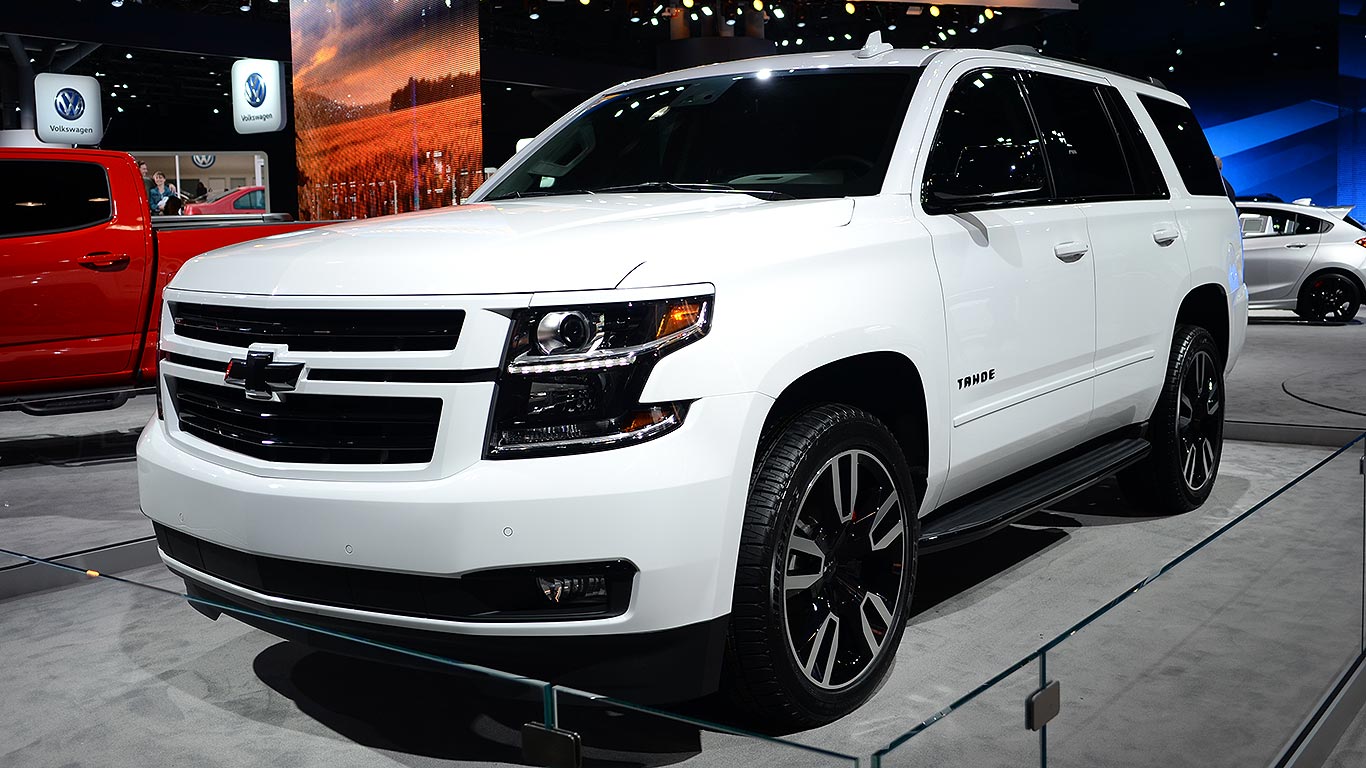
Keen not be left chasing shadows – or rather the Grand Cherokee Trackhawk – Chevrolet has released a Rally Sport Truck (RST) package for the Suburban and Tahoe. The RST delivers the obligatory styling upgrades and larger wheels, but it’s the Tahoe that has piqued our interest.
Tick the box marked ‘Performance’ and the Tahoe RST is treated to the 6.2-litre V8 engine lifted straight out of the Silverado. While 420hp and 460lb ft of torque might not seem like a big deal in a world where the Grand Cherokee Trackhawk exists, it certainly makes for an interesting SUV. The 0-60mph time of 5.7 seconds is more hot hatch than supercar, mind.
Lincoln Navigator
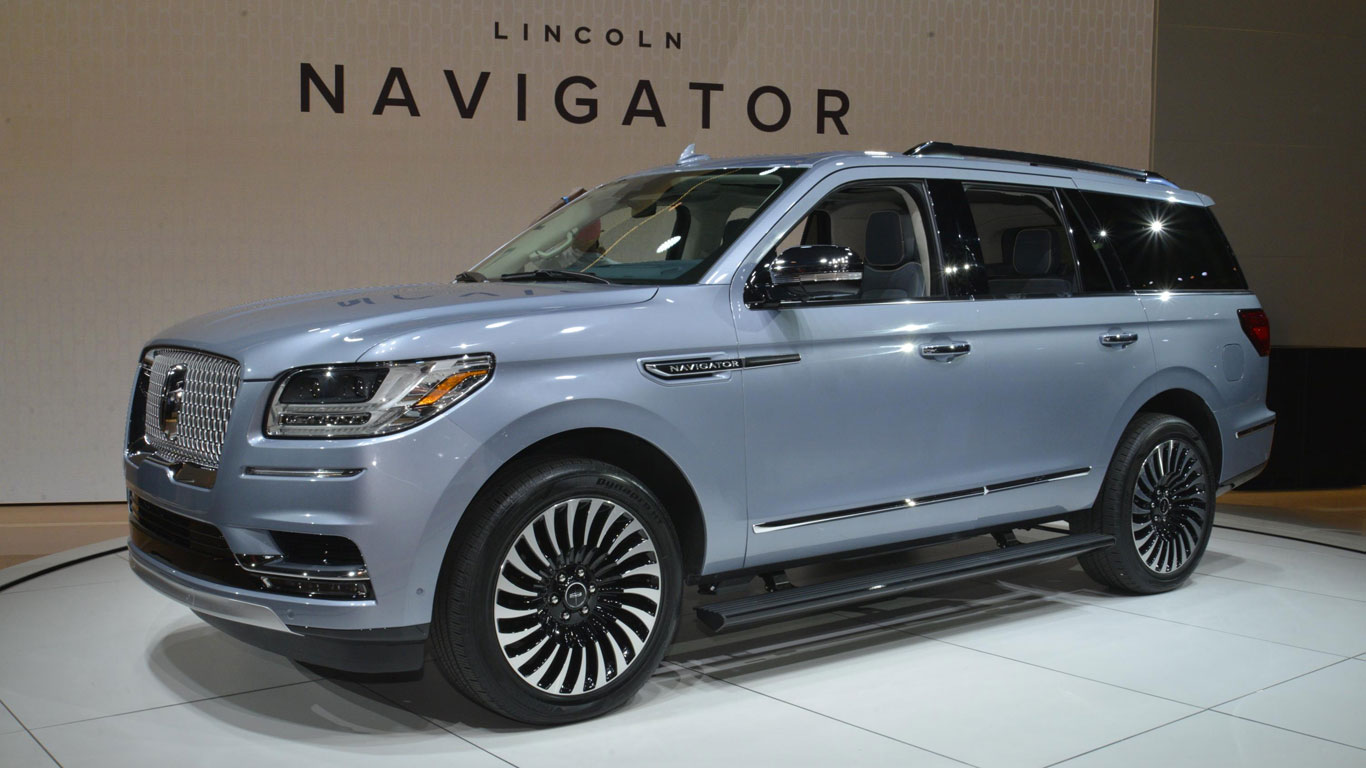
Nobody does supersize SUVs quite like the Americans, and the new Lincoln Navigator has the potential to be the best of the breed. Lincoln claims that it will elevate “family travel to first class” and it’s certainly large enough to rival an airliner, with enough comfort and convenience features to challenge a first class departure lounge.
It’s lighter, too, with a new aluminium-alloy helping the new Navigator to tip the scales some 200 pounds lighter than before. That said, it’ll still weigh the equivalent of an out-of-town supermarket. Power is sourced from a twin-turbocharged V6 engine producing 450hp.
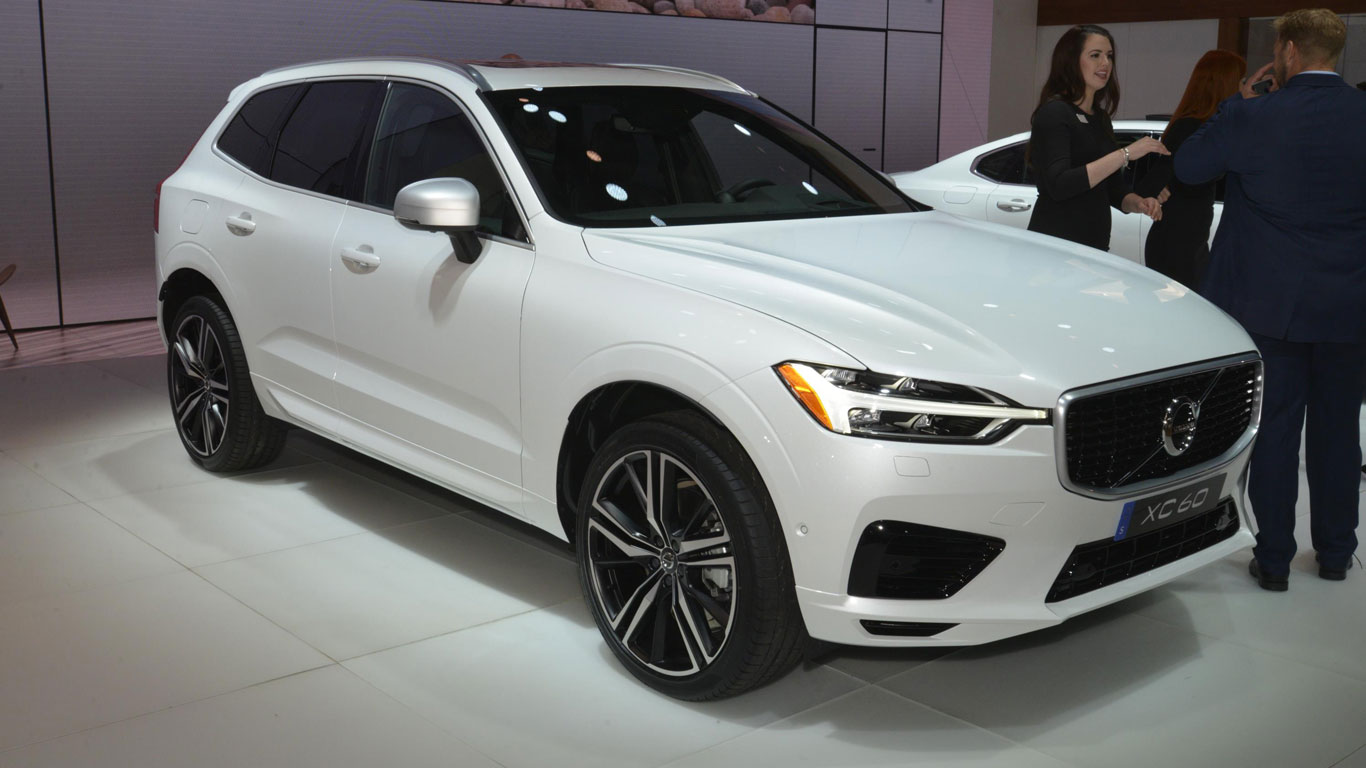
Volvo XC60
If the Lincoln Navigator and Cadillac Escalade are prime examples of all-American SUVs, the Volvo XC60 offers a more European flavour. Introduced at the 2007 North American International Auto Show, the XC60 muscled in on the US market, quickly establishing itself as Volvo’s best-selling vehicle.
More than a million XC60s have been sold, which represents 30% of Volvo’s global sales, so there’s a lot of pressure resting on the shoulders of this good looking SUV. If it’s as good as the XC90 – which we suspect it will be – it stands every chance of picking up where the old model left off.
Buick Enclave
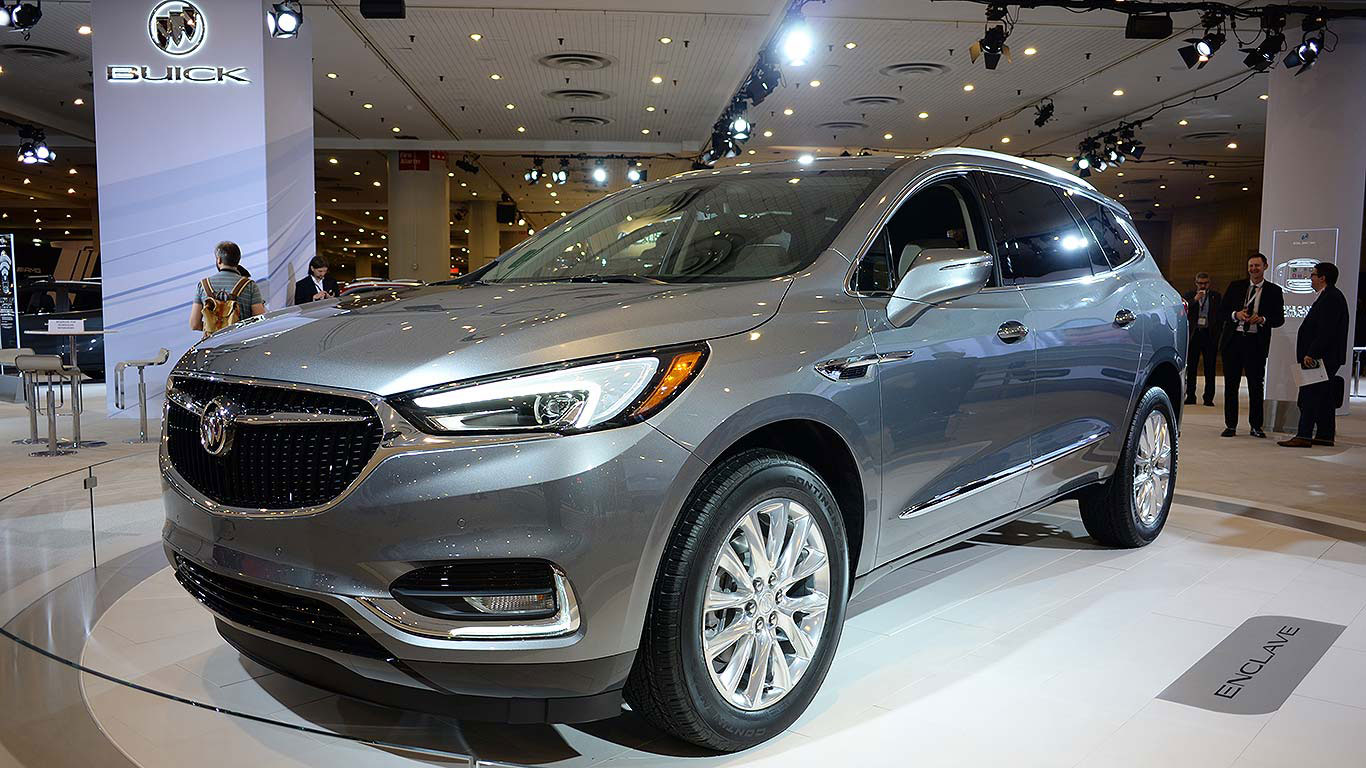
The Enclave is as important to Buick as the XC60 is to Volvo. Duncan Aldred, vice president of Global Buick and GMC, called the original model a “game-changer”: a reference to the fact that it arrived at a time when GM was in need of a hero. The outgoing model has been on sale for close to a decade: a testament to its success and popularity.
The new Enclave is bigger than before, but remains powered by a 3.6-litre V6 engine, with power increased to 302hp. Buick has used the new Enclave to launch the new Avenir sub-brand. Think along the lines of Ford’s Vignale, with plusher materials, improved tech and a higher price.
Subaru Ascent
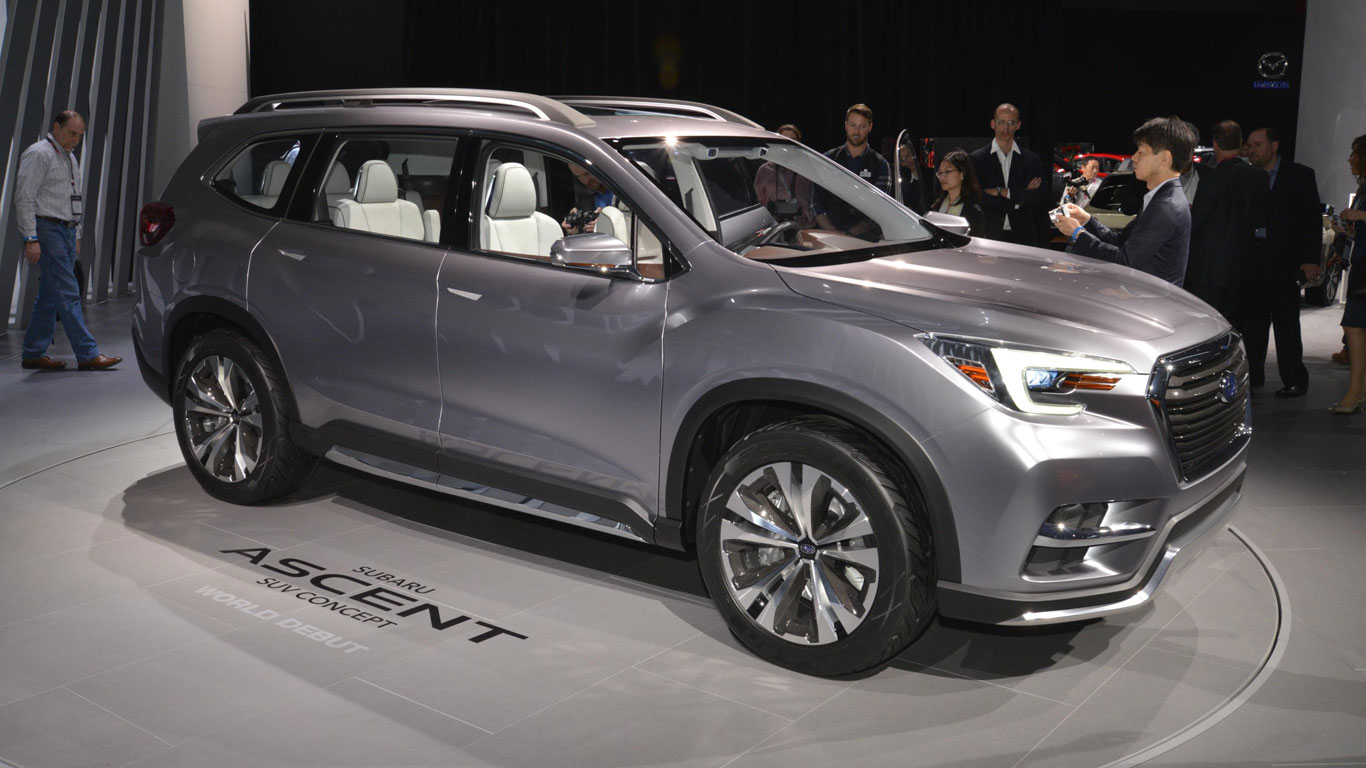
If Subaru wants to mix it with the big boys, it needs an authentic SUV. Something larger than the Outback, tougher than the XV and less niche than the Forester. The Ascent concept previews a future three-row SUV that will be called the, er, Subaru Ascent.
The good news is that the interior looks superb, complete with middle-row captain’s chairs and three seats in the third row. You also know that it will be formidable off-road. The bad news is that the Ascent will be sold exclusively in North America.
Infiniti QX80 Monograph
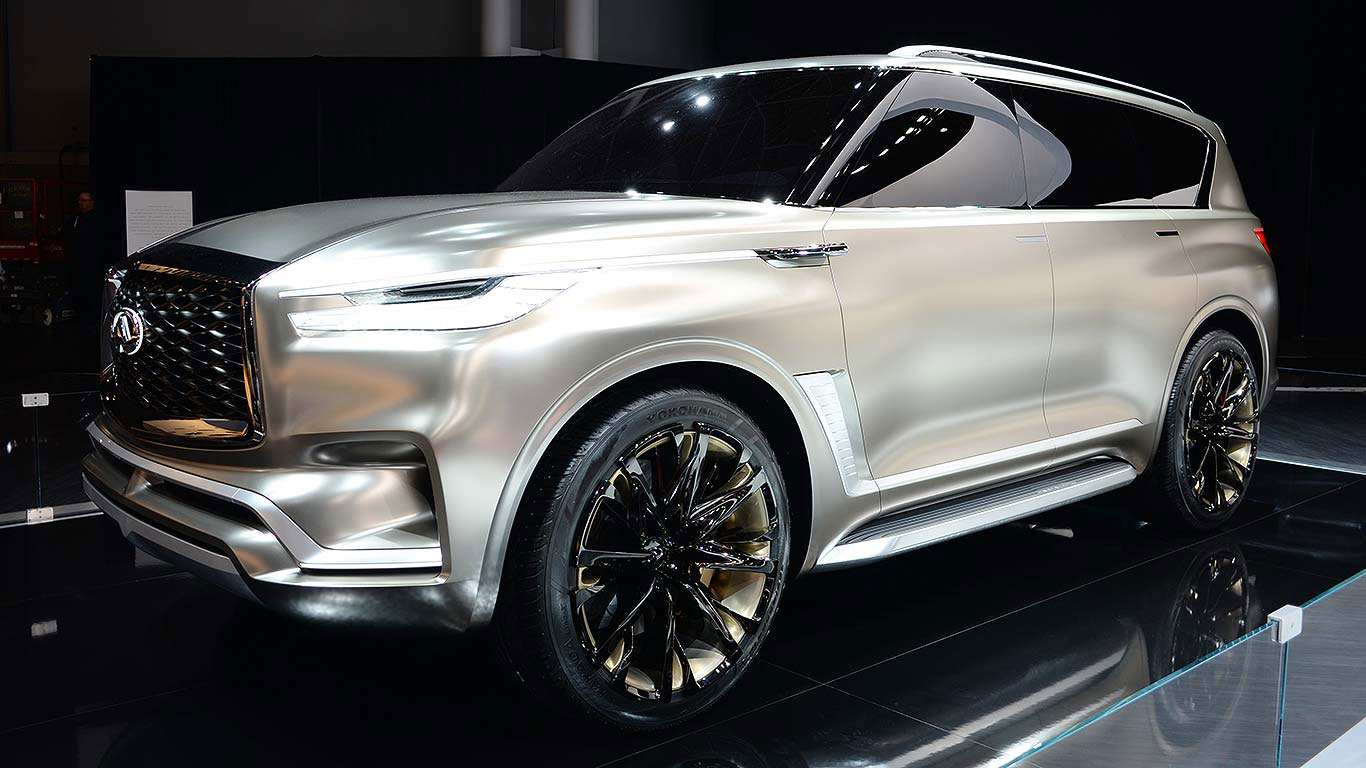
To say that the Infiniti QX80 Monograph is slightly less ugly than the current QX80 would be like saying Freddy Krueger is slightly less scary than Michael Myers. While it might be true, it’s still going to give you nightmares. But don’t worry, it’s just a design study, so there’s still time for Infiniti to have a rethink.
Infiniti has issued many words to promote the Monobrow – 1,224, to be precise – but doesn’t give too much away. The alloy wheels, in case you’re wondering, are 24-inch in diameter and overlap the tyres to present the appearance of 26-inch rims. An SUV for the Middle East, perhaps, but not one for Middle England.
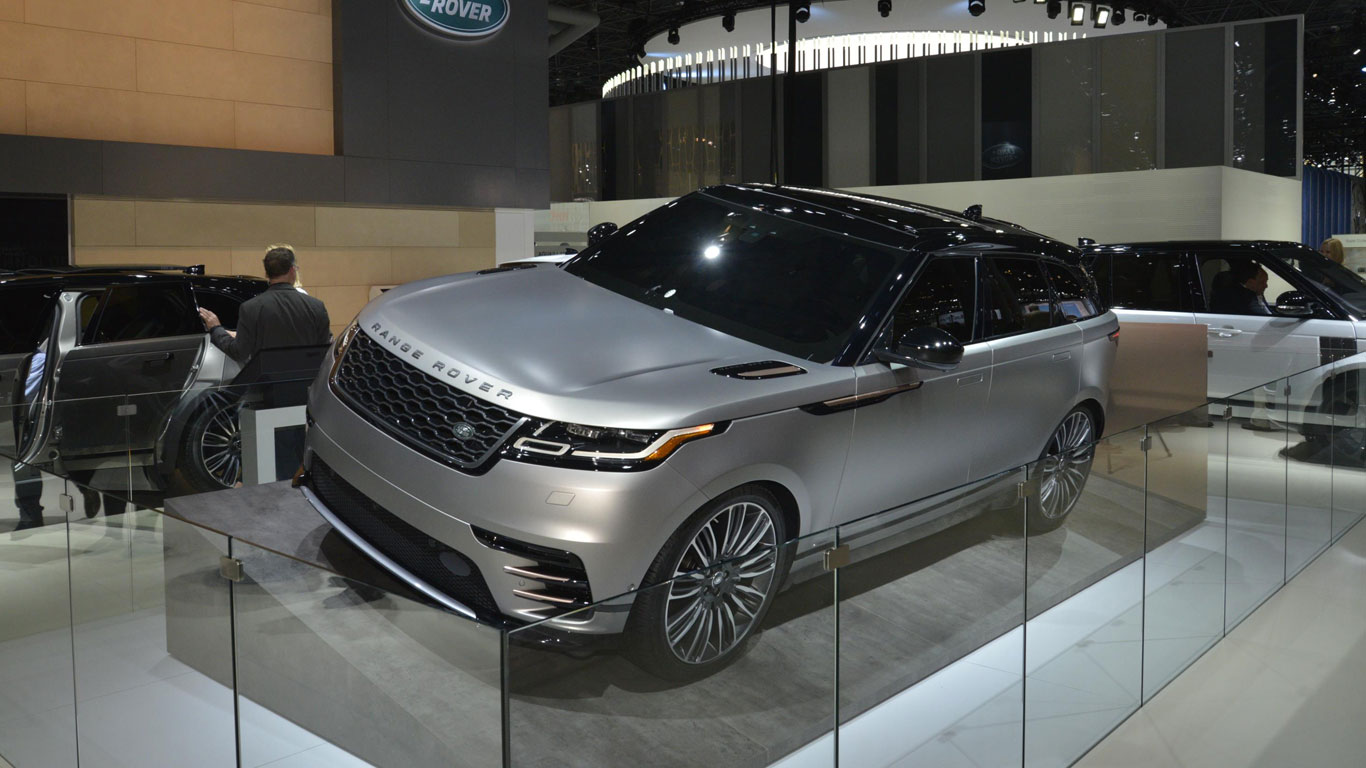
Range Rover Velar
The Range Rover Velar is old news. Fresh from its debut at the Geneva Motor Show, Ellie Goulding was invited to take a tour of New York in the SUV that will sit between the Evoque and Sport in the Range Rover range.
Three engine options will be offered in the US, including a 247hp 2.0-litre petrol, 180hp 2.0-litre diesel and 380hp supercharged V6 petrol. “I have always been a big Range Rover fan”, said a starry-eyed Ellie Goulding.
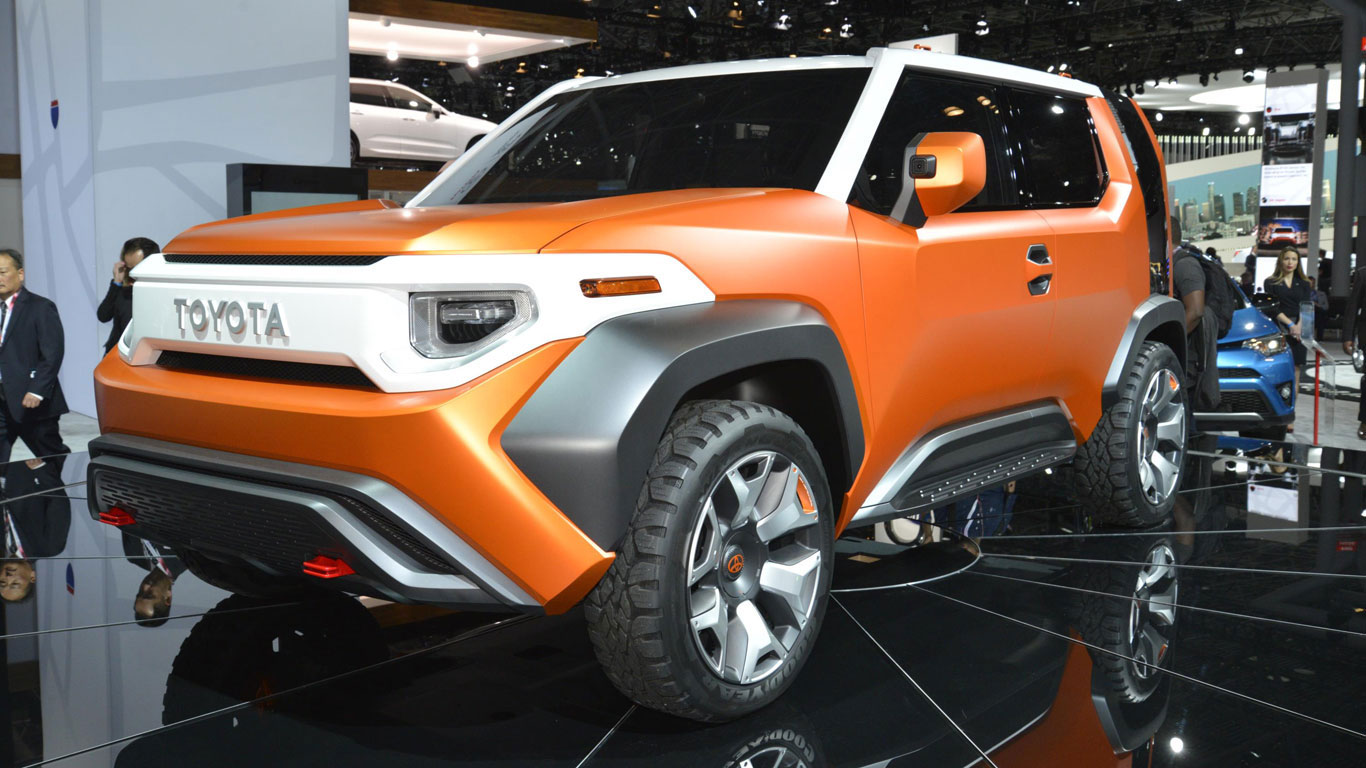
Toyota FT-4X
Half-Blade Runner escapee, half-lifestyle accessory, the Toyota FT-4X concept is based on the same platform as the new CH-R. That makes it a potential rival for the Jeep Renegade – if Toyota builds it.
Inside, there’s an instrument cluster that looks like a smartphone, a removable radio and door handles that double as water bottles. There’s also a GoPro camera mounted in the door mirror. Young, outdoorsy types will love it. If only they could afford to buy new cars…
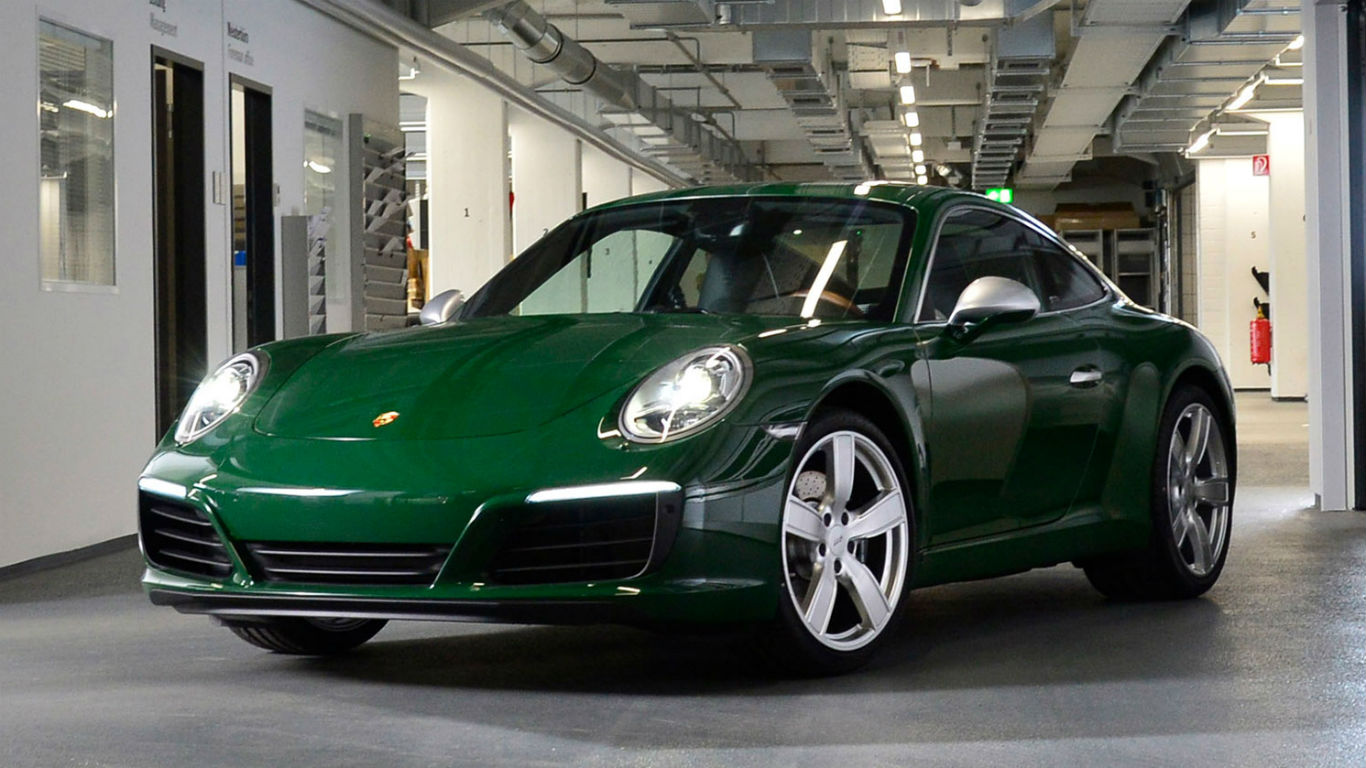 The Mazda MX-5 may be the world’s best-selling sports car, but the Porsche 911 is the most iconic. And today, after 54 years in production, the company built its one-millionth 911.
 The 991 Carrera S has a distinctly retro theme, with many details that evoke the 1963 original. Spot the Irish Green paint (a special order colour since 1965) chrome window-surrounds, old-style Porsche bonnet crest and – oh yes – gold badges.
 A visibly proud Dr Porsche said: “Fifty-four years ago, I was able to take my first trips over the Grossglockner High Alpine Road with my father. The feeling of being in a 911 is just as enjoyable now as it was then. That’s because the 911 has ensured that the core values of our brand are as visionary today as they were in the first Porsche 356/1 from 1948”.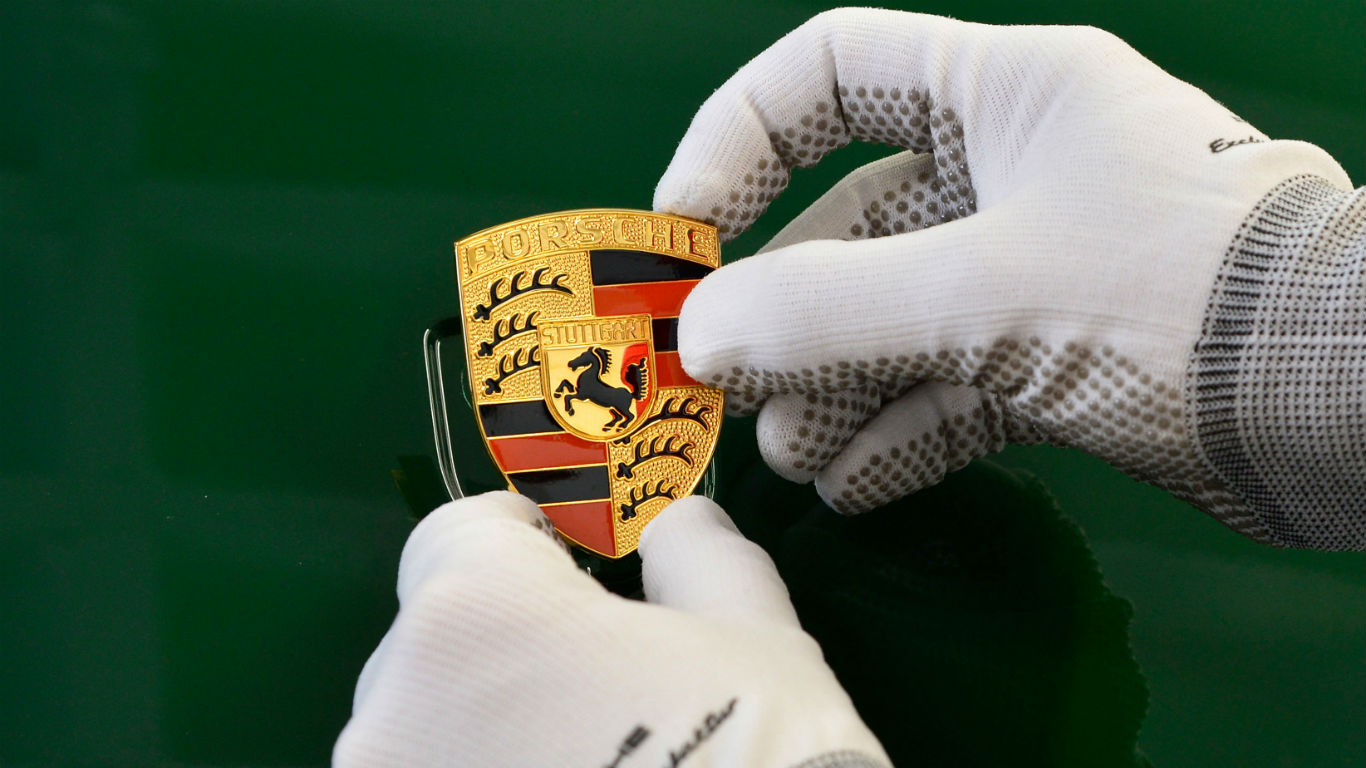
 In the red corner: the Lamborghini Aventador SV. In the black corner: the Ferrari 355 GTS F1. Two prize fighters separated by 20 years and a not-insignificant 370hp. Yet these supercars have more in common than you might expect.


 GT: two letters that mean so much in the car industry. The badge is primarily used to designate a grand tourer, but has been put to good use on mildly warm hatches or for when a GTi badge would promise something a car might not be able to deliver.


 The Society of Motor Manufacturers and Traders (SMMT) has welcomed new government proposals for a UK Air Quality Plan, particularly the recognition that “new Euro 6 diesels which have been on sale for the past two years will not face any penalty charges anywhere in the UK”.









 Being practical doesn’t necessarily mean having to give up your street cred. When the time comes to transport a growing family, there are ways and means to resist the slide into blandness. These 20 cars prove that you can achieve domestic bliss, yet still gain envious glances in the supermarket car park.


 Unless you’ve been living under a rock for the past decade, you’ll know that SUVs are hotter than hot cakes right now. New car buyers simply cannot get enough of the high-ridin’ heroes of the high street.