
So, my time is almost up with the Renault 5. I had quietly hoped that Renault’s press office would forget to ask for it back, but no such luck. After four months as our do-it-all family car, we’re obliged to say au revoir.
Production of the reborn R5 started in October 2024 and, two years later, there’s still a buzz around this French supermini. Even friends and relatives with zero interest in cars seem intrigued by it. Several of them made comments along the lines of “I don’t like electric cars, but I’d happily have one of these”.
Spoiler alert: were I shopping around for a small-ish EV, I’d have one of these too. Objectively, you get more for your money with a Chinese competitor – the BYD Dolphin Surf or Aion UT, for example – but the Renault feels like more than just basic transport. It looks chic, handles well and has that certain je ne sais quoi that car enthusiasts like to call ‘character’.
What I liked about the Renault 5

For this final long-term test report, I’ve decided to list my likes and dislikes about the Renault 5, based on using HT26 LZF – a 52kWh model in Iconic Five+ spec – as my daily driver since June. Let’s start with the good stuff…
How it looks
To my eyes, the 5 E-Tech’s design owes more to Marcello Gandini’s second-generation Supercinq, launched in 1984, than the Michel Boué original of 1972. Either way, it’s instantly recognisable as a Renault 5, yet somehow avoids looking overtly retro. You’d never mistake it for anything other than a modern car.
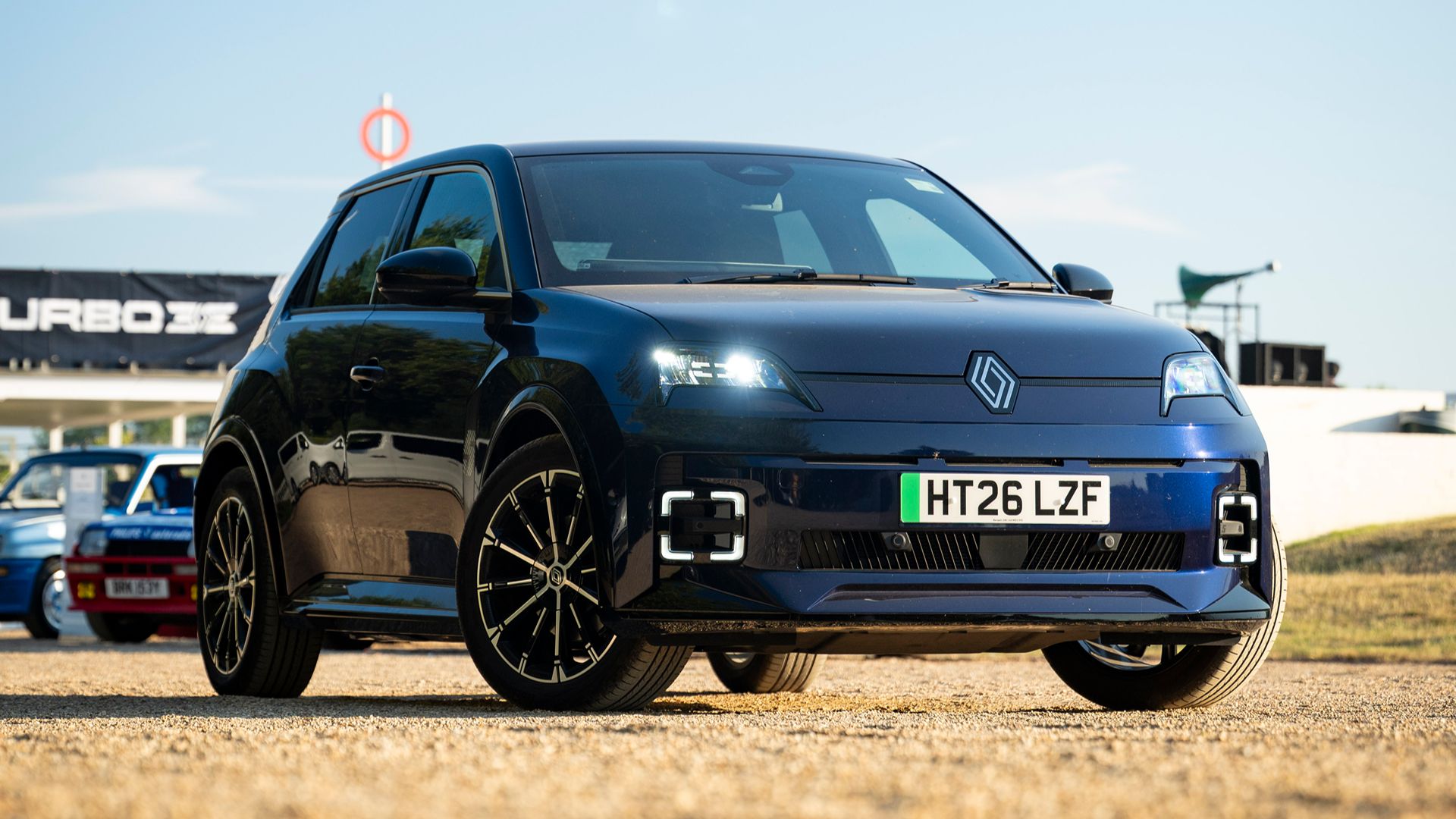
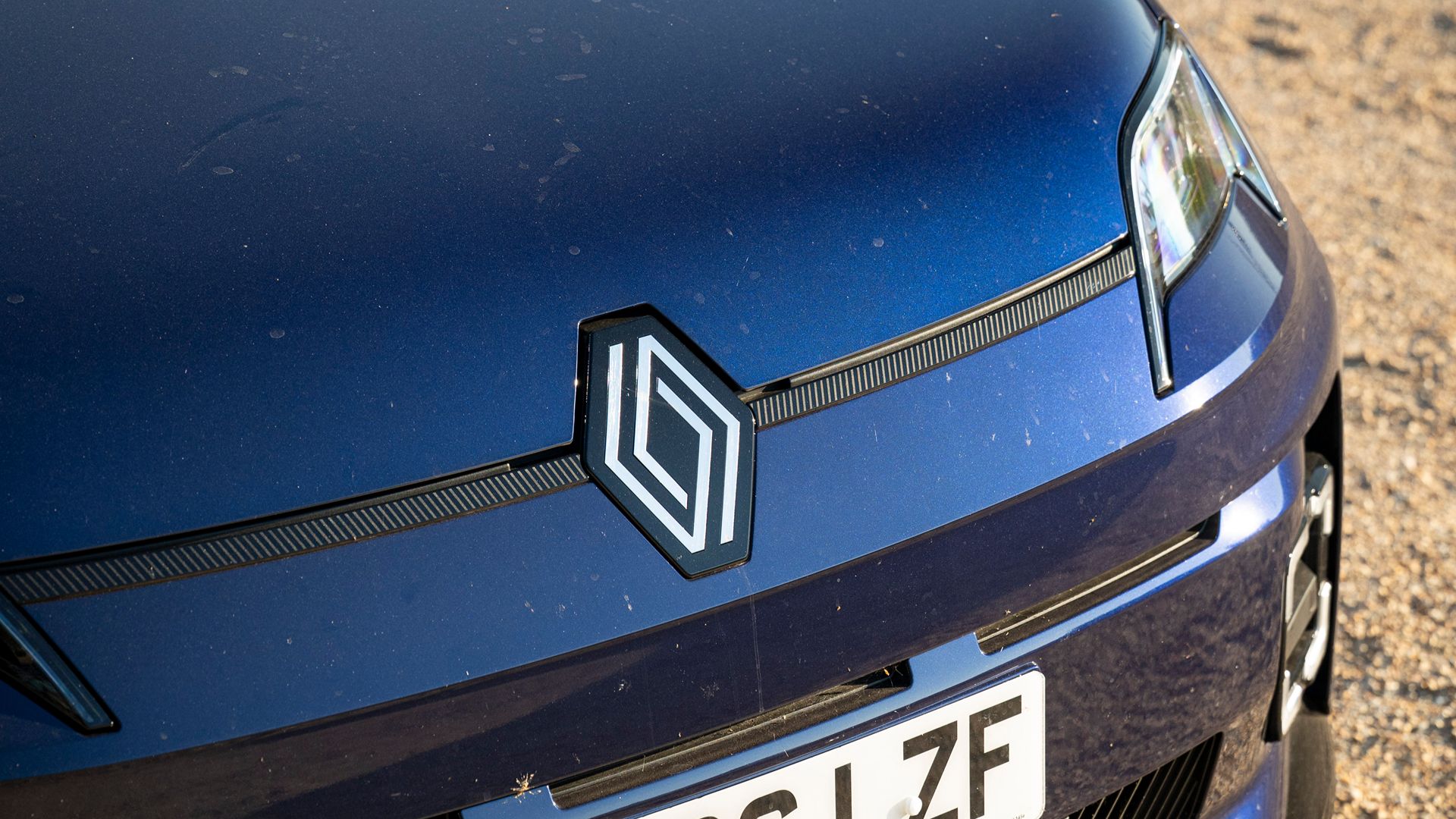
There are also lots of neat details when you look closer, such as the French Tricolore flags within the headlights and 5-shaped charge indicator on the bonnet. And you can also order in the R5 in ‘proper’ paint colours, such as dazzling Pop Yellow and Pop Green, rather than just varying shades of grey. My car is a more subtle Midnight Blue, although I’ve convinced myself it resembles the Renault 5 GT Turbo Raider – an object of my affections in the 1990s.

The 5 is equally stylish inside, where its dark exterior contrasts with yellow recycled denim upholstery and drive mode-dependent ambient lighting. There are further nods to the past in the R5 Turbo-style seats, ribbed dashboard trim and textured rooflining. While many new-car cabins contain little more than an oversized iPad, the Renault does things differently.
How it drives
It has taken a while, but we’re reaching a point where affordable EVs are genuinely fun to drive. The R5’s closely related cousin, the Alpine A290 hot hatch, was a trailblazer here. And the recently launched Peugeot E-208 GTI is even better.
The standard 5 isn’t a car you’d set your alarm for on a Sunday morning, but its well-weighted steering, eager turn-in and punchy 150hp e-motor can still raise a smile. Just as importantly, it rides well, smothering speed humps and potholes like a larger, more luxurious car. There isn’t the delicacy of a classic R5, but this remake is in a different league when it comes to build quality – and at least half-a-tonne heavier, too.

I find the car flows better in default Comfort mode than in over-caffeinated Sport. However, the energy-saving Eco mode, which softens throttle response, limits top speed to 70mph and dials down the heating or air-con, is genuinely useful when you want to eke out extra miles without the need for a charging stop.
A further plus point is the nicely calibrated One Pedal mode, activated by pulling the right paddle behind the steering wheel. This ramps up regenerative braking, helping to recharge the battery and lengthen the car’s range. It also means you can drive around town using – you guessed it – one pedal, which is an engaging, EV-specific skill in itself.
Charging and efficiency
That segues us neatly into talking about batteries, charging, range and other topics that will have petrolheads shrugging their shoulders or rolling their eyes. Bear with me.
Theoretically, this bigger battery 52kWh version of the R5 can deliver 252 miles on a full charge, although recent aerodynamic and battery management upgrades have boosted this to 267 miles. In reality, my car never displayed a range of more than 224 miles with a 100 percent charge, which has decreased to around 200 miles in recent colder weather.

That doesn’t sound like a lot, but a) the figure is a realistic one, and b) the 5’s small battery can be charged at up to 100kW, so refills en route don’t take long. But the time you’ve been to the bathroom, bought a coffee and caught up with the latest drama on the parents’ WhatsApp group (OK, just me then), it should have added enough juice to get you home.
Throughout my time with the R5, its average efficiency has wavered between 4.3 and 4.4 miles per kWh. That’s not bad, even for a small EV, particularly given that many of those miles were on motorways.
In truth, I still wouldn’t want to run an electric car without access to a home charger, but the public network is improving all the time. I never had any problems with connecting the Renault to charging points, either – an issue that has cropped up with other EVs. As in all other areas, the 5 has been completely reliable.
What I didn’t like about the Renault 5
This is a shorter section, because I liked the R5 a lot. Given how many awards it has won – European Car of the Year 2025 and UK Car of the Year 2026 among them – that may not come as a surprise. However, testing a car for a few hours, often on great roads, isn’t the same as daily-driving it for months. And to its credit, the Renault’s initial sparkle didn’t fade.
It’s a tight squeeze in the back
In the 1970s, erudite motoring journalist LJK Setright described the back seat of a Peugeot 104 as ‘no more than a padded parcel shelf’. The Renault’s rear bench isn’t quite so cramped, but legroom is tight for anyone other than small children. My two lanky teenagers complained about it with tedious regularity.
The Renault’s 326-litre boot is also on the small side, partly because of the batteries beneath its floor. There’s no ‘frunk’ under the bonnet to store a charging cable, either. Perhaps trying to use the R5 as an all-round family car was a little unfair; Renault would say the bigger and boxier R4 is more suited to that role. Nonetheless, this car’s limited practicality would be my only real barrier towards buying one.

‘Reno’ will get on your nerves
Those convinced that artificial intelligence is poised to take over the world should spend time with Reno, the 5’s built-in AI assistant, who is powered by ChatGPT. In theory, the diamond-shaped character – a close cousin of ‘Clippy’, the paperclip mascot for Microsoft Office – should pop up when you say “Hey Reno” (pronounced ‘Ree-no’). However, Monsieur Reno has other ideas.
Summon him and he’ll often stay quiet, then butt into conversations at random intervals with a chirpy “Here’s what I found” (a list of local Indian restaurants, perhaps, when you were talking about the weather). It’s quite funny at first, but soon gets rather tiresome. Thankfully, you can switch him off.
And that’s it: my final missive on the Renault 5. It’s been fun, and certainly made me more amenable to EVs. I’m hoping to spend some time with the faster and feistier Alpine A290 early next year, so watch this space.
Keep reading for my third report on running a Renault 5 E-Tech.
________________________________________________________________________
Renault 5 E-Tech 2026 long-term review – third report

It happened again yesterday. Twice now, while navigating the Surrey suburbs, I’ve had a cheery wave from a fellow Renault 5 driver heading in the opposite direction. This kind of car-based camaraderie was the norm when I drove an original Mini, and I know folk with classic Land Rovers do the same. I’ve never experienced it in an EV before, though.
On the one hand, it’s nice to feel part of the unofficial Renault 5 owners’ club. On the other, with Renault’s UK sales up by 19 percent last month and the R5 amidst the top 10 best-selling EVs, all this smiling and waving could soon become exhausting.
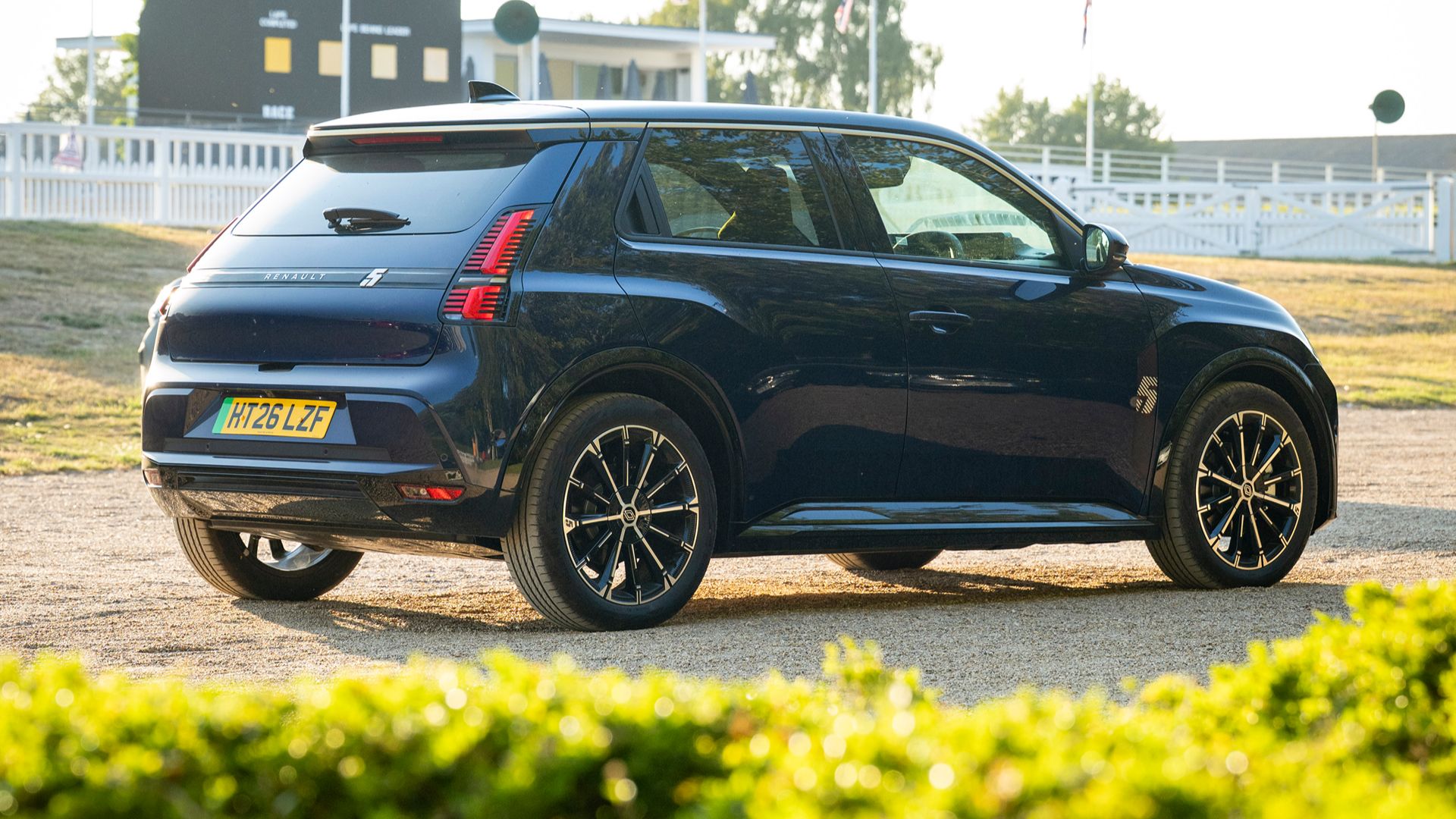
While it hasn’t become ubiquitous quite yet, the Renault is an easy car to spot – chiefly because many are painted near-fluorescent Pop Green or the equally dazzling Pop Yellow. Mine is a more subtle Midnight Blue, which is deep and lustrous when washed, but also serves as the perfect canvas to display dust. During the recent heatwave, it was impossible to keep the car looking clean.
Tribute to the Clio Williams
Speaking of style, Renault has just introduced gold wheels as an option for higher-spec Techno+ and Iconic+ 5 models. When combined with Midnight Blue paint (as pictured above) the result clearly evokes the 1990s Clio Williams, making these 18-inch rims instantly desirable to anyone who remembers the cars of that era.
(As an aside, I was lucky enough to drive Clio Williams number 0001 – originally owned by Frank Williams himself – for our Retro Road Test some years ago. A forerunner to the many brilliant Renault Sport Clios, from 172 to 200 Cup, it remains one of my all-time favourite hot hatchbacks.)
Besides gold rims, the other new cosmetic options for the R5 are a star-patterned roof, grey roofline stripes and Flame Red paint. The latter (pictured below) is similar to the Rebel Red hue on the closely related Nissan Micra, which is built in the same factory in France. Again, I think it suits the Renault really well.
New battery for entry-level R5

Onto more technical matters, the mid-life update extracts a little more range from the larger 52kWh battery fitted to Techno+ and Iconic+ cars – up from 252 miles to 267 miles.
Notably, Renault is also replacing the 40kWh battery found in the entry-level 5 Evolution with a 36.5kWh lithium-iron-phosphate battery from the new Twingo. It has a slightly shorter range (190 miles) and charges more slowly (80kW), but could cost less to buy when it arrives in the UK. The current starting price for an R5 is £21,495.
Inside, the yellow seats in Iconic+ cars like mine, which I rather like, will henceforth be blue and grey instead. There’s also a more powerful wireless phone charger and the Multi-Sense button on the steering wheel has disappeared. Instead, the car will switch between Comfort, Eco, Sport and Individual modes automatically, depending on your driving style. You can still change drive mode manually using the touchscreen, however.
Renault 5 running costs

Back to my long-termer, its combination of zippy performance and deft dynamics mean that, three months in, I am still enjoying every journey. Renault opted to fit the 5 with a multi-link ear axle, which costs a few hundred euros more per vehicle than a simple torsion beam, but the results are worth it. Turn-in feels eager and there’s plenty of feedback through the squared-off steering wheel, while damping is taut but calmly controlled.
I’ve never witnessed the official range figure of 252 miles, even after charging the Renault to 100 percent in temperate weather, but a full fillup provides a displayed (and pretty realistic) 215-220 miles, with average consumption of 4.4 miles per kWh so far.
Using Eon Next’s cheaper overnight electricity at home, priced at 6.9p per kWh, that equates to just 1.5p per mile – something no petrol or diesel car can compete with. What a shame that public EV chargers are typically at least 10 times more expensive.
Space: the R5’s final frontier

Aside from the R5’s occasional reluctance to connect my phone using Apple CarPlay, I’ve experienced no niggles so far. Nothing has fallen off, nor have any damning flaws come to light.
It isn’t perfect, of course. The voice-activated ‘Hey Reno’ AI assistant, powered by ChatGPT, is often eager to involve himself in conversations, regardless of whether you have actually summoned him or not. And some of the cheaper, harder plastics on the centre console have already begun to look scuffed.
My only real gripe with the Renault 5, though, given it serves as our all-purpose family car, is the lack of space inside. Lanky teenagers have grumbled about the limited rear legroom, while the boot holds a modest 326 litres.
Still, if you need more carrying capacity, be it for passengers or luggage, that is where the SUV-shaped Renault 4 comes in. I must try to drive one soon.
Keep reading for my second report on running a Renault 5 E-Tech.
________________________________________________________________________
Renault 5 E-Tech 2026 long-term review – second report
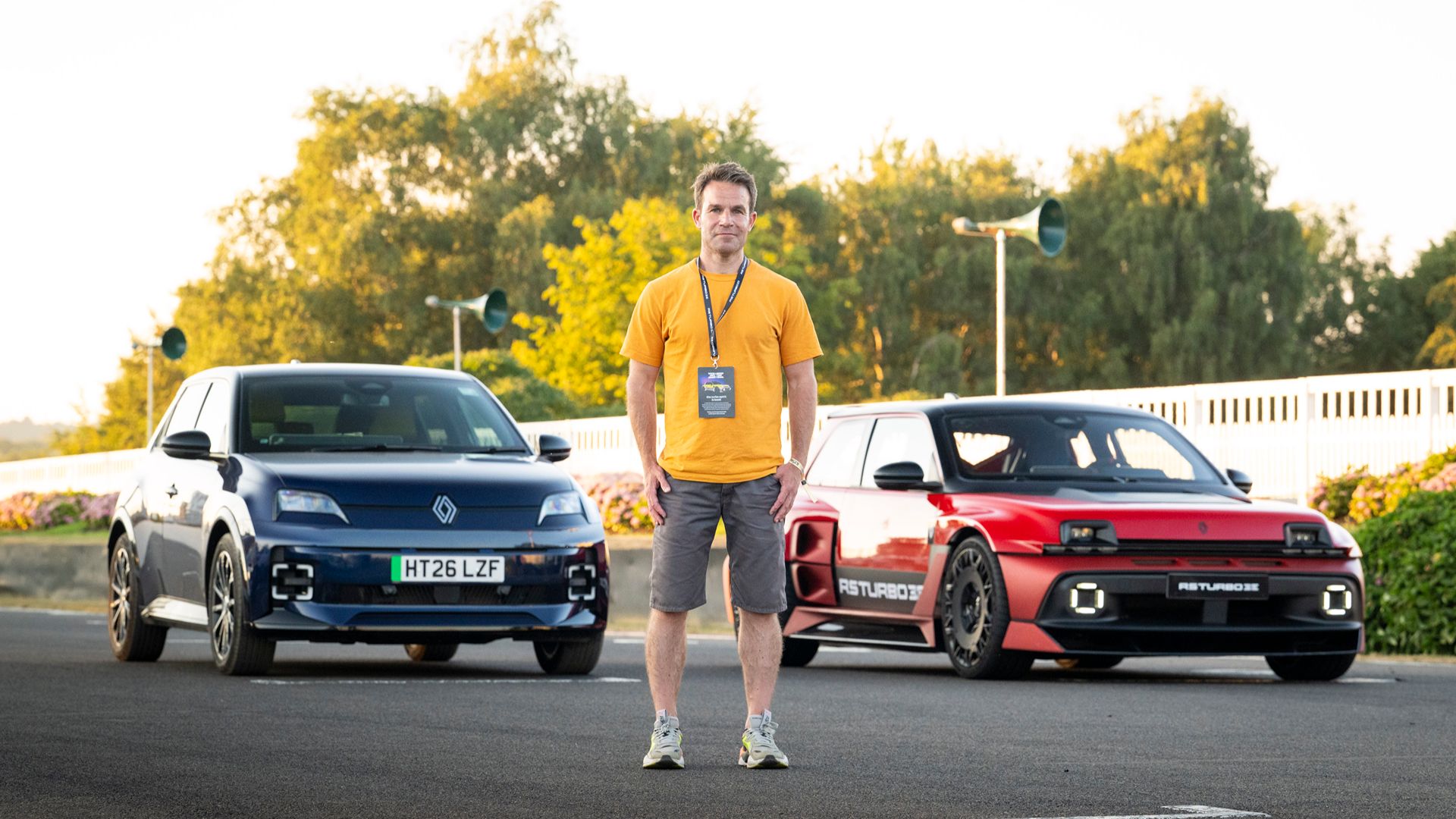
Lined up on the starting grid at Goodwood, the two cars resemble the ‘before and after’ photos from a bodybuilding magazine. Each one is ostensibly a Renault 5, but the similarities almost end there.
On the left is my long-term test Renault 5 E-Tech. Compact and straight-sided, its classic hatchback proportions draw directly from the first two generations of R5. In normal circumstances, it looks understated and effortlessly cool: the fashionable EV du jour. Here, it seems decidedly out of its comfort zone.
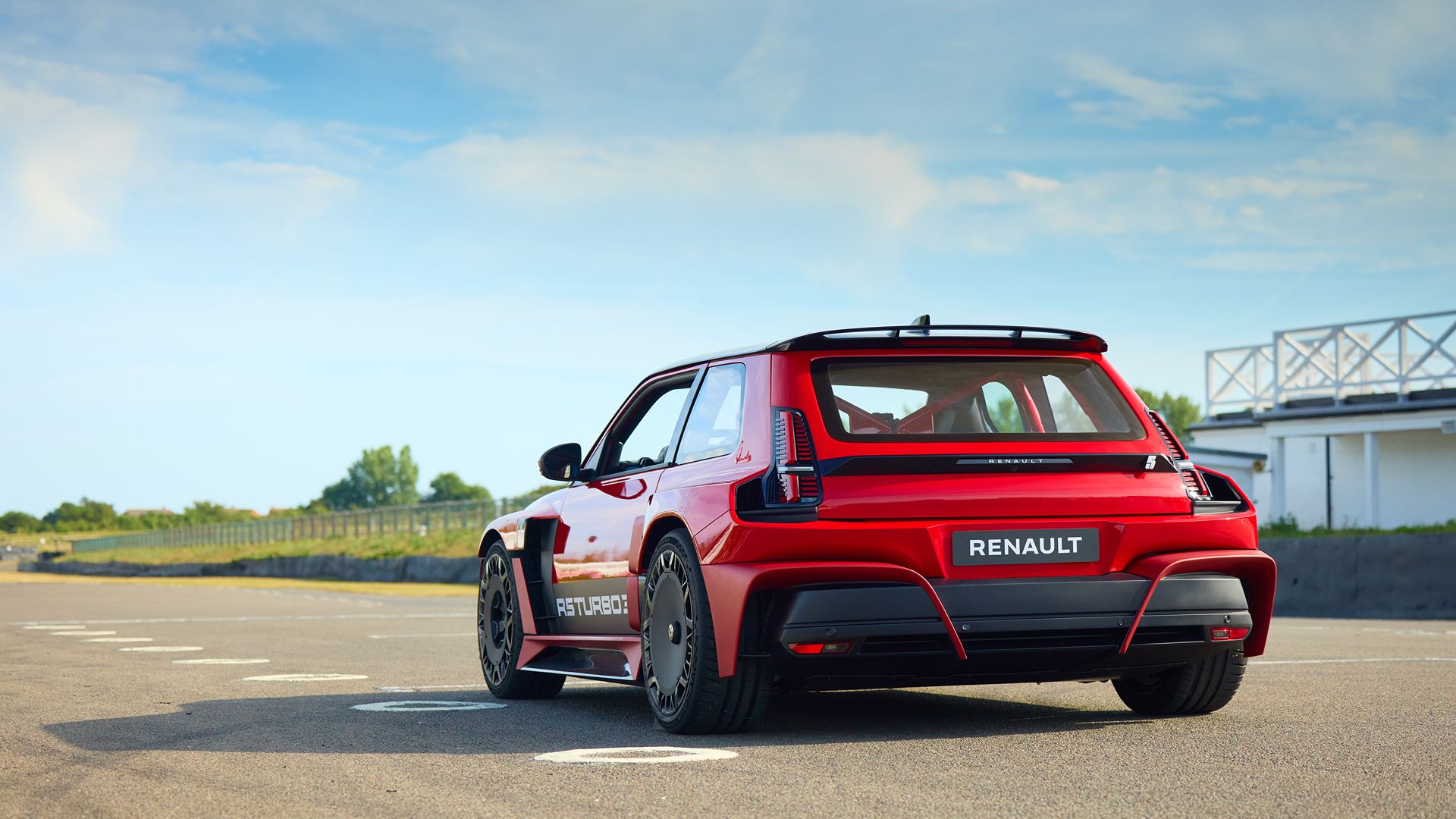
On the right is the new 5 Turbo 3E, an electric hot hatch inspired by the original 5 Turbo. Squat and square-jawed, with comically swollen wheelarches to stretch over its wider track, this is the 5 after six months of pull-ups, squat thrusts, raw eggs and protein shakes. It’s also the fastest and most expensive car Renault has ever made.
First drives of the 5 Turbo 3E won’t take place until later this year, or perhaps early 2027, so when Renault invited me for a flat-out passenger ride around Goodwood Motor Circuit, chauffeured by one of its tame racing drivers, I jumped at the chance. EVs this exciting don’t come along very often.
How my long-term 5 E-Tech felt about this one-sided, David-and-Goliath encounter with its ‘mini-supercar’ sibling was less clear. But if a car was capable of arching an eyebrow, then giving a nonplussed Gallic shrug, I suspect it would have done so.
Classic 5 Turbos on show
The journey down through West Sussex on a balmy July evening was glorious. Unlike the related Alpine A290, the Renault isn’t a hot hatchback, but its well-judged damping and calmly calibrated controls make it a pleasure to drive.
This 150hp version offers zesty performance (entry-level cars have 120hp), even if you rarely feel inclined to squeeze every joule of energy from the 52kWh battery. I’m not convinced by Sport mode, either, which makes the car feel nervier and less fluid without improving performance. Loose-limbed Comfort mode works best, even on flowing country roads.
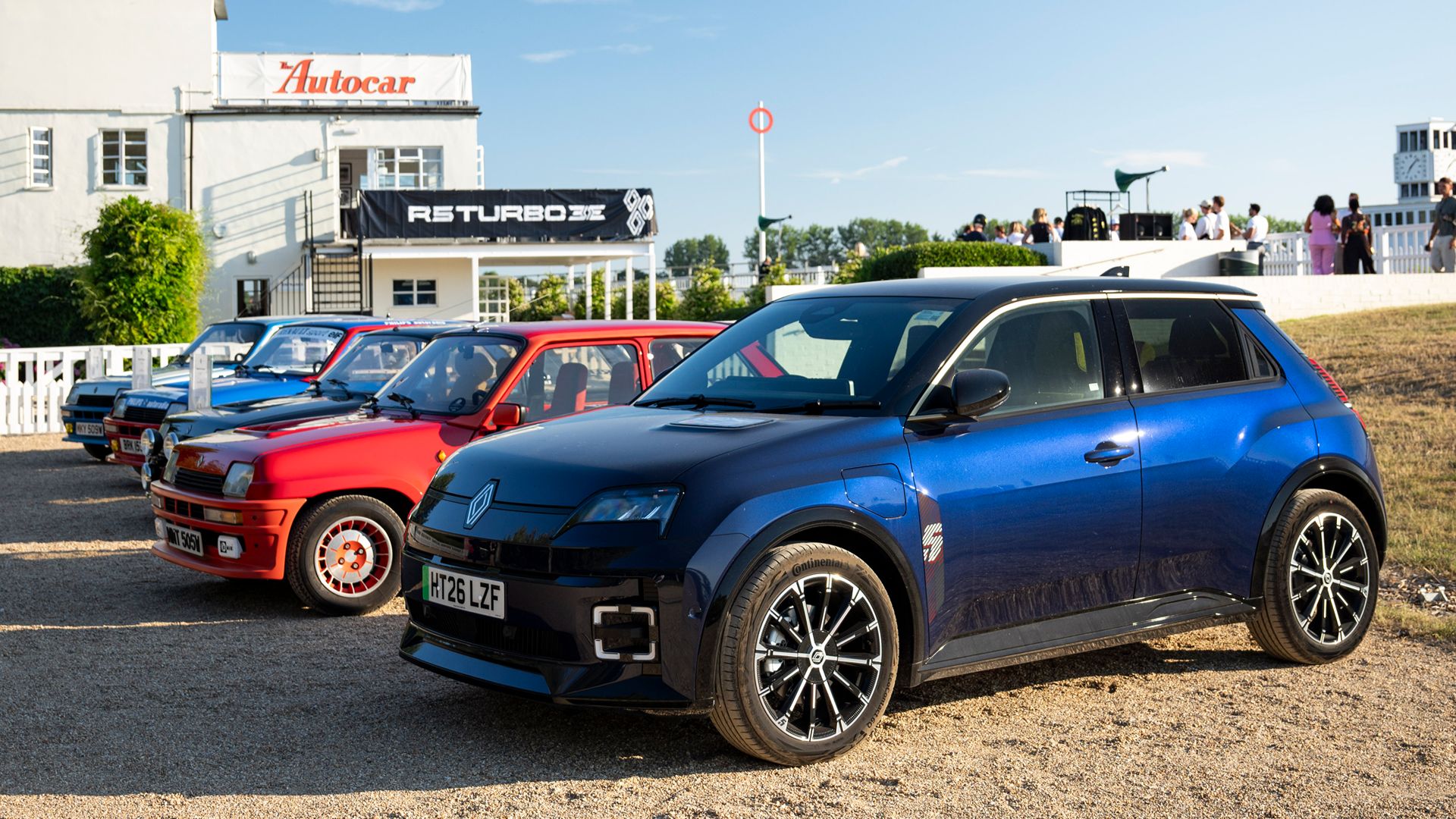
Arriving at Goodwood, I park alongside Renault royalty: a lineup of classic 5 Turbos brought along by their enthusiastic owners. Sold between 1980 and 1984, these mid-engined mutants were designed to meet rallying homologation rules, with enormous hips punctured by air intakes and cooling vents, plus one of the wackiest interiors ever seen in a production car (scarlet and bright blue in the red, W-reg Turbo pictured above, with an asymmetrical steering wheel).
By all accounts, the old-school Turbo is scarily snappy at the limit, while a total of 160hp from its fuel-injected, Garrett-boosted 1.4-litre engine barely outguns my new EV. Yet this middle-aged hatchback still looks like nothing else. Well, until the new Turbo 3E hums ominously into view.
Every detail is different
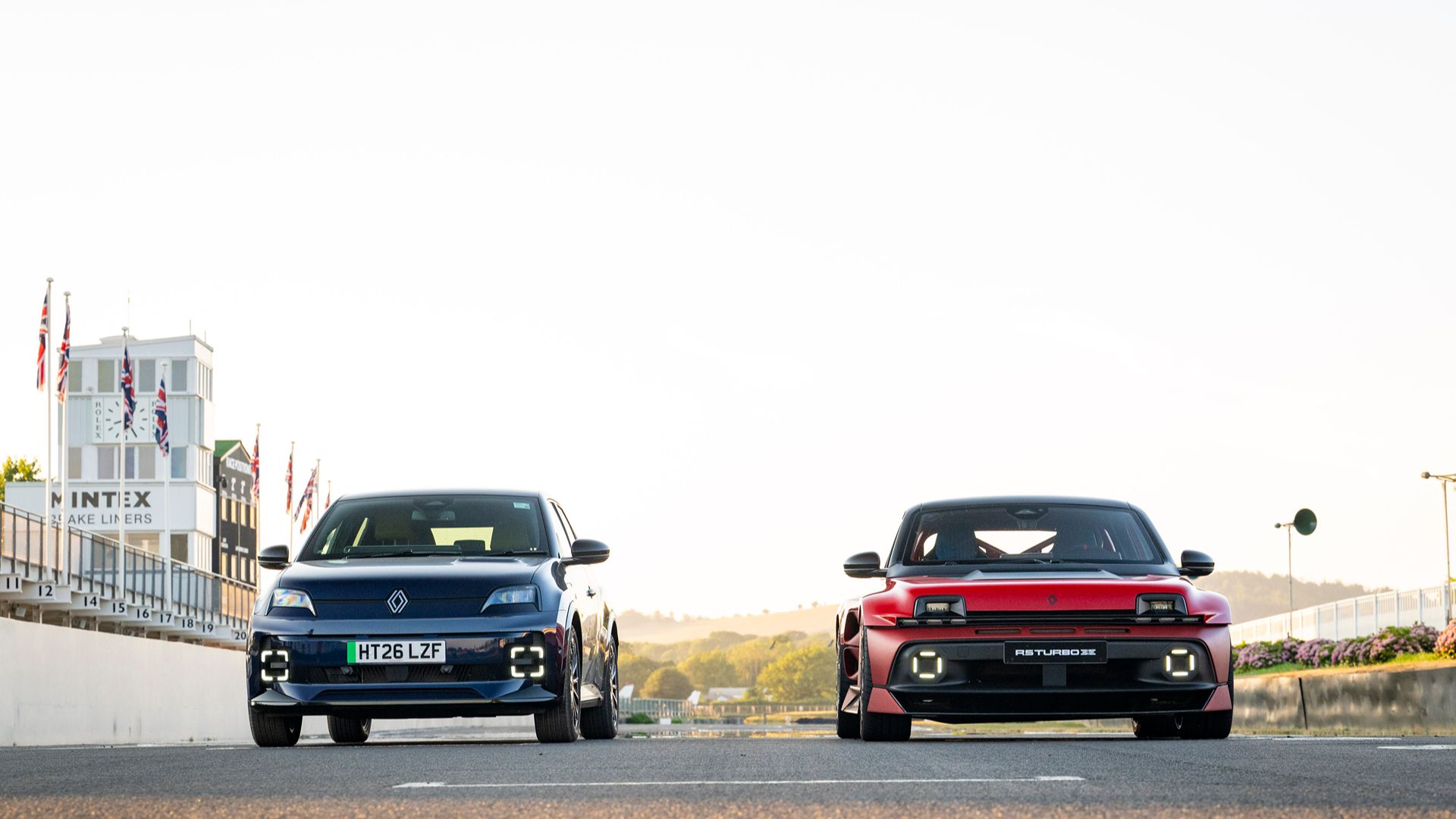
The Turbo 3E pictured here is a prototype and not registered for road use – hence being confined to Goodwood. A total of 1,980 cars (a nod to the Turbo’s birth year) are planned when production gets underway next year, priced at £135,000 apiece. Renault says the majority have already been sold.
With a 70kWh battery and two in-wheel motors delivering 540hp across its rear axle, the feistiest 5 can rocket to 62mph in 3.5 seconds and reach a maximum of 165mph. More prosaically, it also charges at up to 350kW and can eke out 250 miles of range – albeit not when performing hot laps at one of Britain’s fastest circuits.
Although the 3E is still recognisably a Renault 5, virtually every detail is different. In fact, the only external parts shared with my long-termer are the tail lights, wing mirrors and door handles. This particular car has a red and black colour scheme, but there are numerous liveries and other ways for buyers customise their Turbo 3E. Dive head-first into the options list and you could splash £200,000.
Inside the Renault 5 Turbo 3E
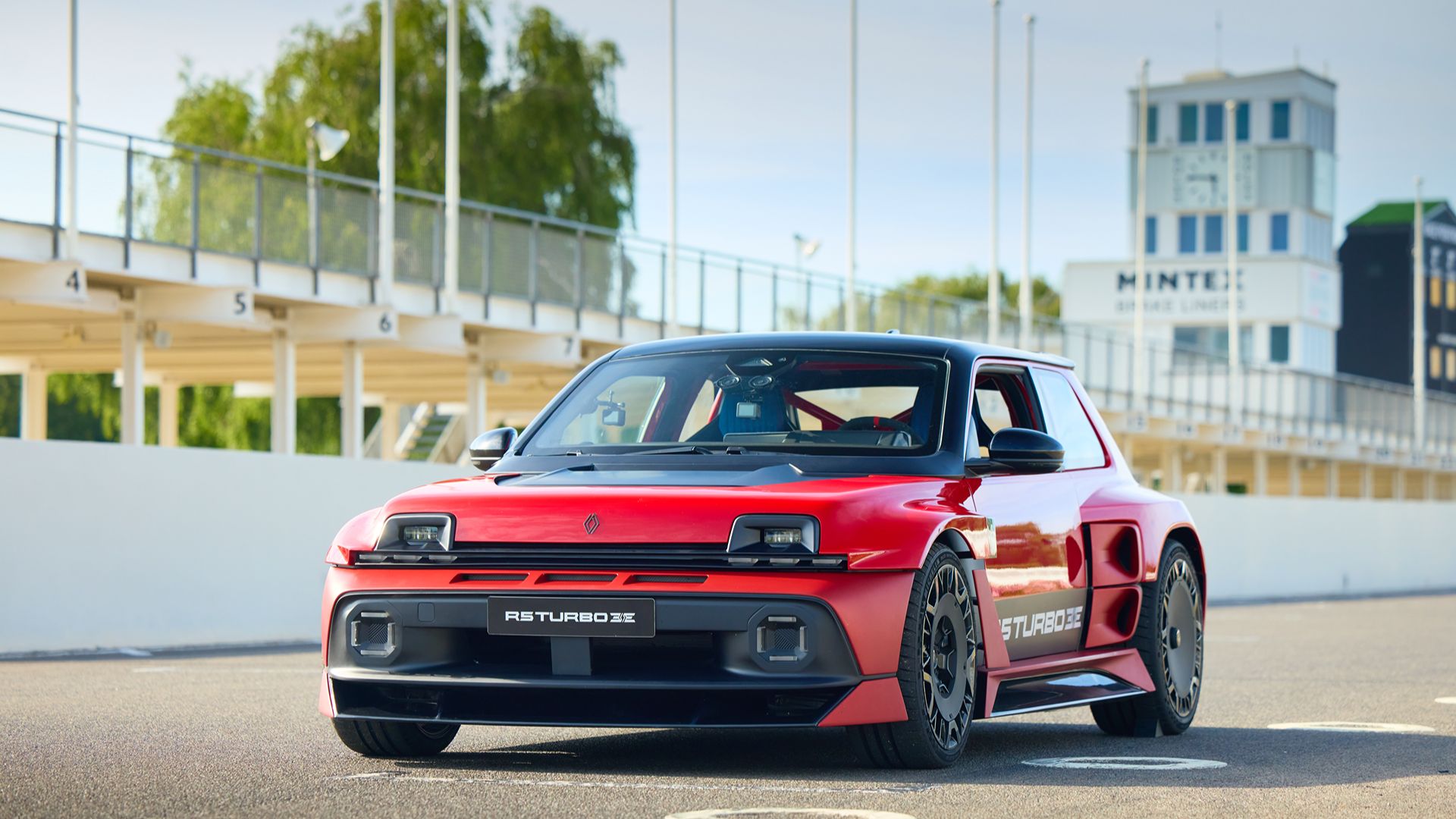
Inside, the 5 Turbo 3E clearly means business, with chunky sills, Perspex side windows, a substantial roll cage and carbon fibre bucket seats fitted with five-point Sabelt harnesses. It has the raw, no-nonsense ambiance of a racing car.
That didn’t stop Renault from having some fun, though. The digital graphics on the dashboard are inspired by retro video games, including a virtual teddy bear named ‘Drifty’. Yes, really. There’s also a prominent boost button on the steering wheel and an upright, rallying-style hydraulic handbrake. This car’s seats are trimmed in the same garish red and blue as the classic R5 Turbo in the car park, too.
There’s no eruption of noise when Renault’s driver presses the start button (marked ‘Free Play’ – another reference to gaming), but the Turbo 3E is primed and ready. “You OK?” he asks, selecting Drive while holding the car firmly on the brake. “Oh, definitely OK,” I respond a bit too quickly. “Then let’s go…”
Slide away, give it all you’ve got
With up to 3,540 lb ft of torque from its in-wheel motors, all channeled through 275-section Michelin Pilot Sport Cup 2 rear tyres, the car is traction-limited off the line. No doubt, it feels supercar-quick, but it isn’t brutally accelerative like, for example, a new Porsche Cayenne Turbo Electric.
Hurtling into the first corner at Madgewick, there’s more dive under braking and body-roll than I’d expected, but I remind myself that this is a road car – not simply a track toy. Unlike some EV manufacturers, Renault hasn’t layered on an artificial soundtrack, so most of the noise comes from those wide tyres, particularly as our speed increases and the car starts to move around.
Indeed, it seems ‘Drifty’ has whispered in my driver’s ear, because all of a sudden we’re going very sideways indeed. With so much power, a short wheelbase and a wheel-at-each-corner stance, the Renault flicks back and forth with gleeful abandon, taking the long right-hander at Lavant like it’s auditioning for the next Gymkhana video. It feels playful and exuberant, a car that doesn’t take itself too seriously.
Racing drivers always make their jobs look easy, and I’m sure there is considerable skill involved in hustling this hyper-hatch around Goodwood. Nonetheless, the way the Turbo 3E will settle into a slide, transition back to the direction of travel, then slingshot away feels balanced and not too intimidating. At least from the passenger seat.
Back in the real world
After a couple of intense laps in the Turbo 3E, I clamber out with brain buzzing and nerves tingling. Then I peel off my race suit, swig some cold water and climb back into my Renault 5 ordinaire for the journey home.
There will be no going sideways this time, but driving back as the curtain of dusk falls slowly across a perfect summer evening is its own reward. I even take the long route, avoiding the M23 and M25 to meander through pretty villages and along hedge-lined lanes.
For my next long-term report, it’ll be back to reality with a bump, as I discuss what the R5 is like to live with, including questions of interior space, battery range and charging costs. Ah well, it was fun while it lasted.
Keep reading for my first report on running a Renault 5 E-Tech.
________________________________________________________________________
Renault 5 E-Tech 2026 long-term review – first report
My first rendez-vous with the Renault 5 was at a rain-lashed EV charging hub, just off the A1(M) in Stevenage. Not the most auspicious start, you might think, but somehow this little car seemed to prise the sunshine out from between leaden clouds. I was smitten.
The occasion was a driving day for UK Car of the Year. Some of Britain’s top motoring journalists (and, ahem, yours truly) had gathered to test all the contenders for the 2026 title. There were eight vehicles in total, each already a winner in its class, from the Citroen C3 Aircross (small crossover) to the Audi A6 Avant (estate car).
Interestingly, the Renault 5’s sportier sibling, the Alpine A290 hot hatchback, was also among the finalists; it represented the performance car category.
I voted for the Renault that day, charmed by its chic styling, lively performance, nimble handling, good build quality and compelling value for money. And evidently I wasn’t the only one. A few weeks later, the 5 was announced as the overall UKCOTY 2026 winner.
Still, a whirlwind first date is one thing. A long-term relationship is quite another. Would those initial rays of sunshine fizzle out like a holiday romance? That’s what I aim to find out.
Living with a Renault 5
The plan is to spend three months with a Renault 5, then a further three with an Alpine A290. The cars will be driven daily, used for everything from school runs to weekends away. I’ll share my honest, unvarnished thoughts on how they drive and what they’re like to live with – plus keep a close eye on energy consumption, running costs and how battery range stacks up in different conditions.
As it turned out, the arrival of the 5 was remarkably well-timed. Firstly, the Pitts have moved to a new home with a) a driveway, and b) a wallbox charger installed. We previously had a terraced house with on-street parking only, which meant relying on the public charger network whenever I tested an electric car. The result was some very elongated and stressful journeys, along with charging costs similar to refuelling a petrol car. It’s been said before, but unless you can charge at home, buying an EV really doesn’t make sense. At least, not yet.
Secondly, our (t)rusty family car, a Mk5 Volkswagen Golf GTI, was recently side-swiped by a truck, forcing it off the road to await repairs. So the Renault really is our only transport for the time being. Will it truly be practical enough for a family of four?
Electric Car Grant saving
Putting aside the Roland-Garros – a special edition with clay-coloured details and gear lever inspired by a tennis racket handle – there are three tiers to the new Renault 5 range.
Base spec is called Evolution, costs from £21,495 (or typically £229 per month) and uses a 40kWh battery for 120hp, 0-62mph in 9.0 seconds and 192 miles of range. It comes with 18-inch alloy wheels, a 10.1-inch touchscreen, Apple CarPlay and Android Auto phone connectivity, cruise control, rear parking sensors and a heat pump.
Stepping up to Techno+ costs £23,495 (or £249 per month) and gets you a larger 52kWh battery: good for 150hp, 0-62mph in 7.9 seconds and 252 miles between fill-ups. Extra equipment includes an LED ‘5’ charge indicator on the bonnet, a reversing camera, a wireless charging pad, Google Maps navigation and ambient interior lighting.
My car is fully loaded Iconic Five+ spec: yours for £25,945 or £269 a month. With the 52kWh battery and 150hp, performance figures are identical to the Techno+, but this range-topper gains diamond-cut alloy wheels, heated seats, a heated steering wheel, blind-spot monitoring and hands-free automatic parking.
Interestingly, when it comes to the UK Government’s official Electric Car Grant, the 40kWh Evolution model only qualifies for a £1,500 incentive, whereas Techno+ and Iconic Five+ versions with the 52kWh battery – which is locally sourced from Renault’s factory in Douai, France – are eligible for the full £3,750 discount. In other words, the more powerful, longer-range R5 is actually better value. Très bon.
Inside the Renault 5 E-Tech
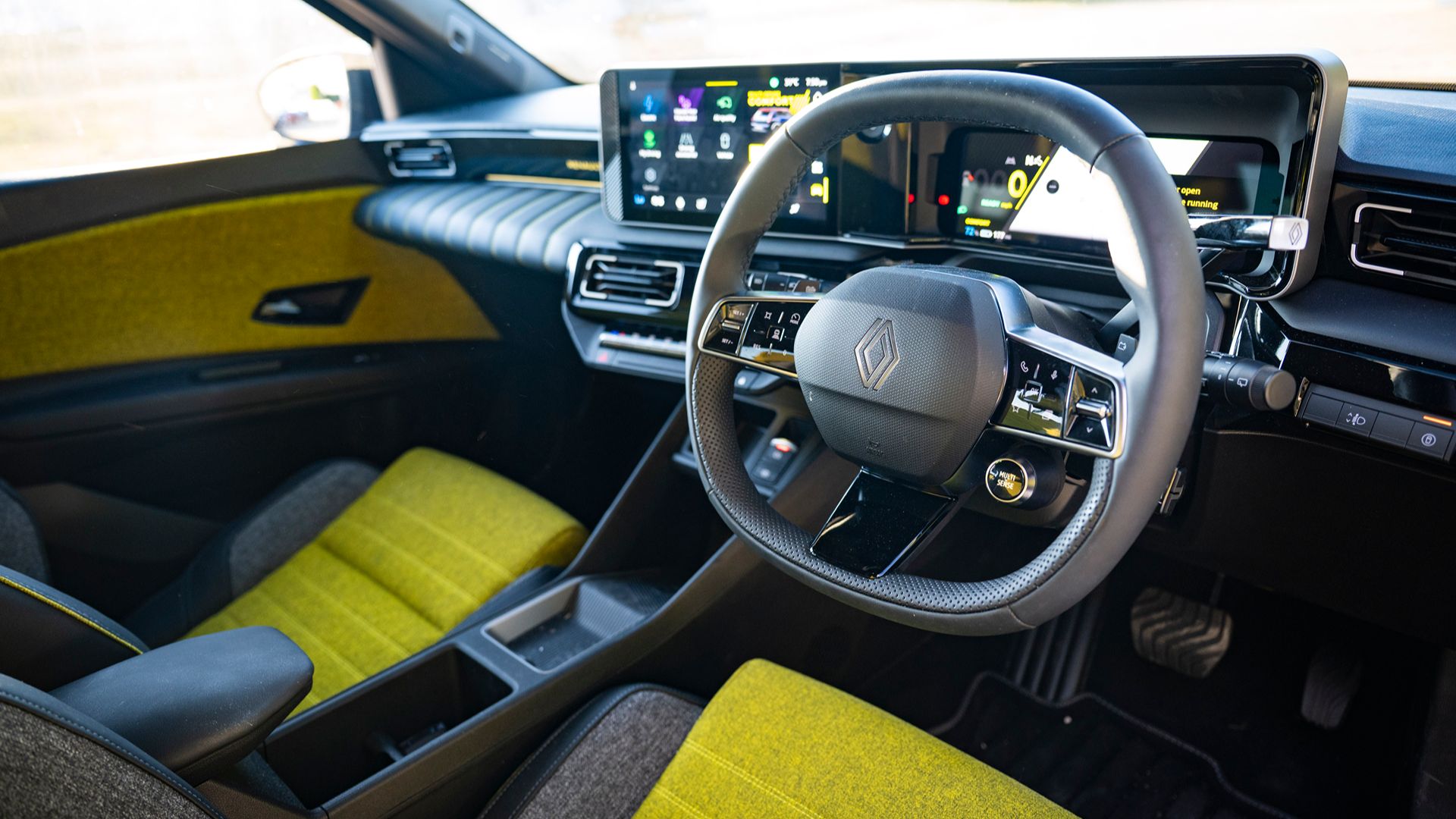
Pop Green! (exclamation mark very much included) is the only ‘free’ paint colour on the Renault 5. Otherwise, the disappointingly limited range of hues comprises Diamond Black (£650), Midnight Blue (£750), Arctic White (£750) and Pop Yellow! (£900).
My test car is Midnight Blue, with a Diamond Black roof framed by Warm Titanium pinstripes. It’s a relatively subtle spec… until you open the door and see inside. The vibrant yellow upholstery is made from 100 percent recycled textiles, with a matching colour for the stitching, light-up ‘Renault 5’ script and retro graphics on the driver’s digital display.
Again, there are knowing nods to the classic 5 in the shape of the big-bolstered seats and sculpted dashboard, even if few of today’s buyers will spot them.
Unlike the Renault 5 GT Turbo I lusted after in the 1980s, though, the plastics no longer seem to be off-cuts from a yoghurt pot factory. Only the column stalk drive selector – used to switch between neutral, drive and reverse – feels a bit flimsy.
Easter eggs all year round
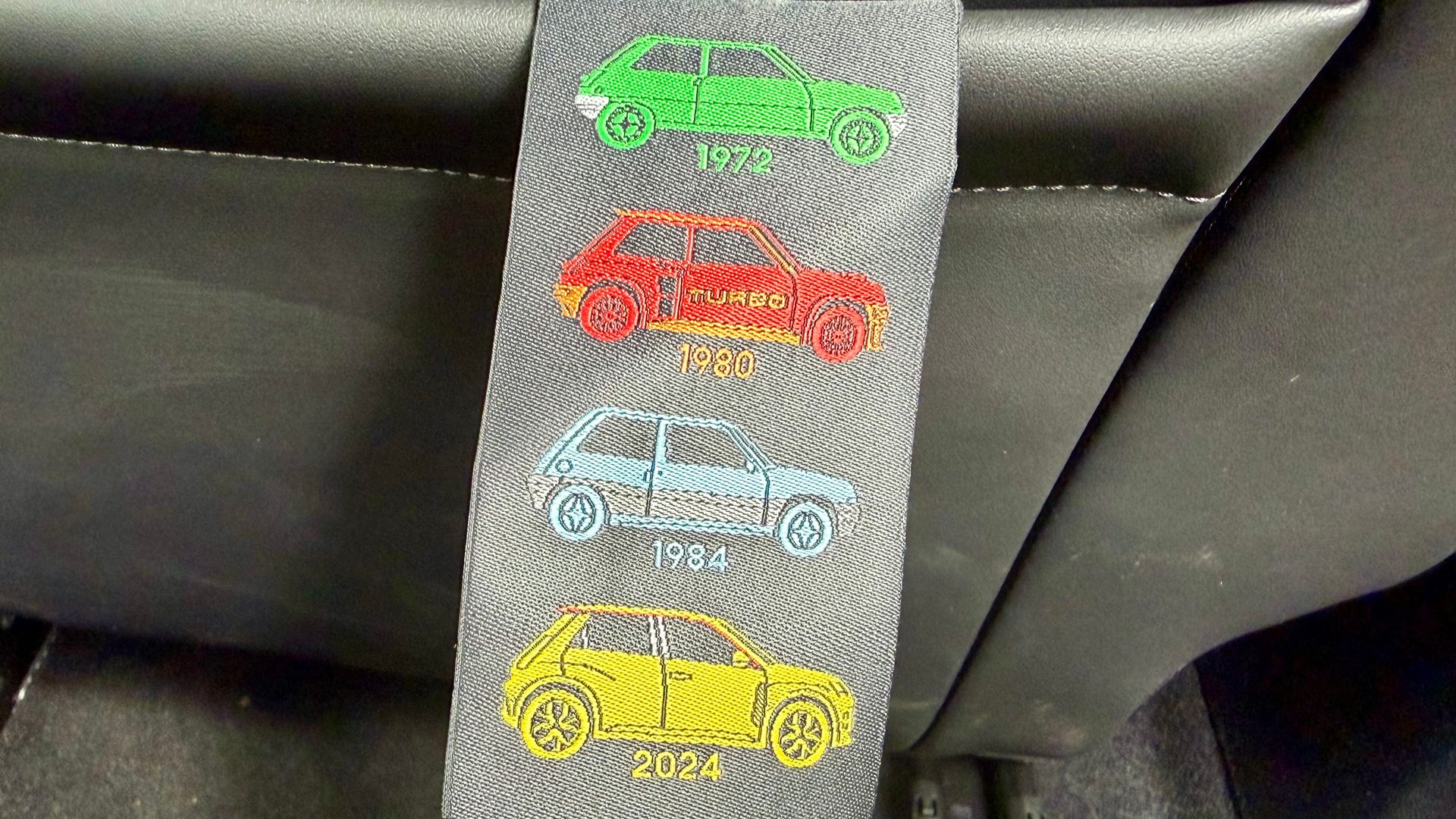
So far, I’ve enjoyed discovering the 5’s surprise-and-delight details: the Tricolore flags in the headlights, for instance, or the French cockerels tucked in the corner of the windscreen and inside the boot closure. It feels like more than simply a car built down to a cost.
My favourite detail so far, however, is the fabric tag hidden inside the driver’s seat-back pocket, which depicts four generations of R5: the 1972 original, 1980 mid-engined Turbo, 1984 ‘Supercinq’ and current E-Tech. I only discovered it when clearing out my son’s packed lunch leftovers, which had been considerately stuffed into the seat in front. Still, every cloud…
These are early days with the R5 and I’ll report back in more detail soon. Yet it’s fair to say that, after that promising start at UKCOTY, the honeymoon period isn’t over yet.
ALSO READ:
Renault Scenic E-Tech 2026 review
