Jaguar Land Rover will this year begin public road trials of ‘driverless’ autonomous vehicles as part of a four-year real-world test.
The news means JLR will beat premium rival Volvo in commencing a public-road UK driverless car trial – the Swedish brand confirmed earlier this year it’s beginning an autonomous car test in London from 2017.
> More car news on Motoring Research
The first JLR research cars will drive on a 41-mile autonomous car test route around Coventry and Solihull, with a fleet of more than 100 research vehicles eventually taking to public roads.
The test route will include both motorways and urban roads, initially involving trials of vehicle-to-vehicle and vehicle-to-infrastructure communications tech that’s going to help make autonomous cars viable.
Future test vehicles will become progressively more autonomous, even allowing driverless operation through challenging sequences such as roadworks.
JLR will also develop more comprehensive connected car tech that it says will allow streams of traffic to talk with one another, improving traffic flow and safety.
But the firm famous for its engaging-to-drive cars isn’t planning to let the machines take over entirely, stresses head of research Tony Harper. Drivers are “able to choose how much support and assistance they need”.
They may, he says, pick full autonomy in boring motorway runs or stressful traffic, but still take over to enjoy twisty backroads – even though “the new technology we are creating will still be working in the background to help keep them safe”.
JLR autonomous innovations
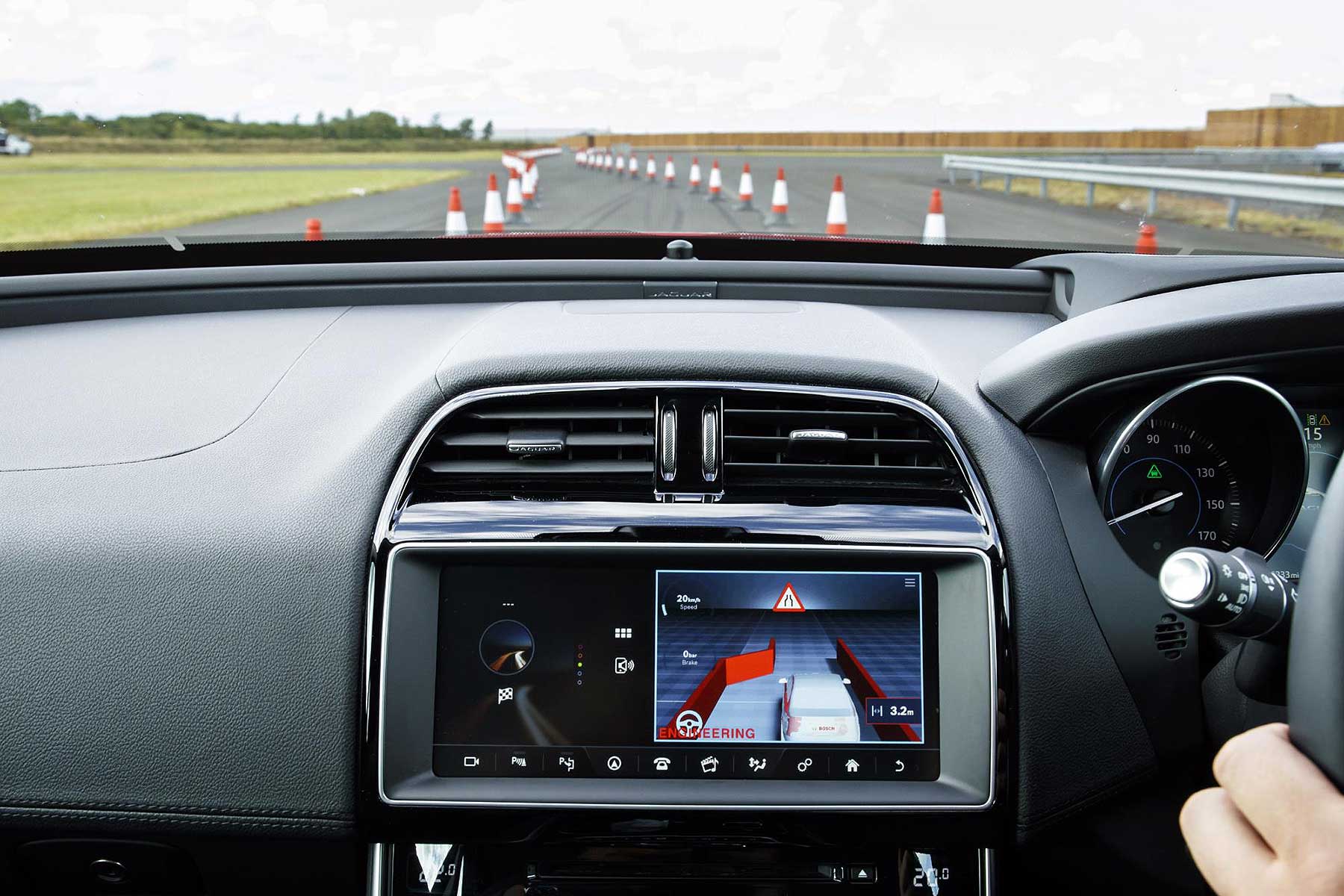
Jaguar Land Rover engineers have today revealed some key technology innovations they’re working on, that they say will not only help make autonomous cars safer, they’ll also be safer and more reassuring to live with.
- Roadwork Assist: a 3D camera uses image processing software to decipher the road ahead. It can plot a route through fiddly sequences of cones, helping centralise the vehicle safely through narrow sections
- Safe Pullaway: if the driver goes to accelerate but the car ahead hasn’t moved, brakes are auto-applied. Good for roundabouts where the car behind goes for a gap the one in front does not…
- Over the Horizon Warning: uses radio communications to alert drivers about incidents over the brow of a hill; a stopped car beams a ‘Hazard Ahead’ warning to nearby vehicles
- Emergency Vehicle Warning: reduces the stress of hearing sirens but not seeing the emergency vehicle by telling drivers which direction the vehicle is coming from and how far away it is
“Our connected car and automated technology could help improve traffic flow, cut congestion and reduce the potential for accidents,” said Harper.
“Proving the right information at the right time will enable better and safer decision-making, whether the car is driven by a human or is autonomous.”
ALSO READ
Opinion: we need more motorway cameras
Porsche’s turbocharged street car saga
Should drivers be given bigger car insurance discounts for using dashcams?