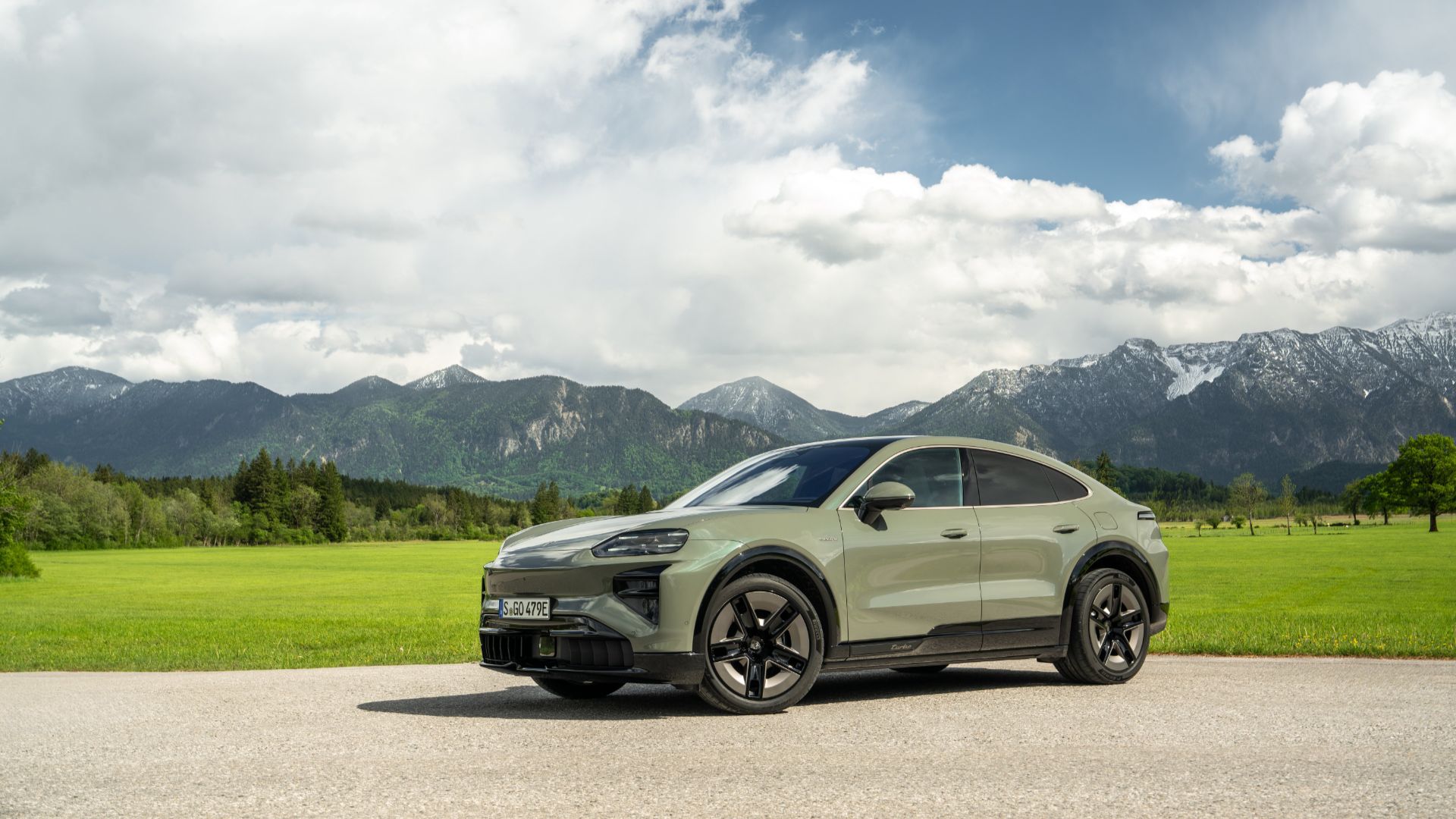
The SUV coupe is a curious species. Less roomy and practical than a traditional, upright SUV, yet less dynamic and stylish than a coupe, it seems to be the worst of all worlds.
Still, nobody buys a Porsche for entirely rational reasons – especially not one that produces 1,156 horsepower. No, that isn’t a typo. The new (deep breath) Porsche Cayenne Turbo Coupe Electric isn’t just a bit of a mouthful, it’s also the most powerful production Porsche ever made.
To put that hypercar-baiting output into context, the new hybrid Porsche 911 Turbo S – a car not noted for its lack of get-up-and-go – musters a comparatively meagre 711hp. And the most powerful sports car racer of all time, the Can-Am Porsche 917/30, developed anything up to 1,100hp.
Alternatively, if we look at ball-park SUV competitors, there are the Audi RS Q8 Performance (640hp), BMW X6 M Competition (625hp) and Mercedes-AMG GLE 63 S (612hp). Ratchet up your budget and the Aston Martin DBX S (727hp) and Lamborghini Urus SE (800hp) also blast into view. Yet none of them can outgun the craziest Cayenne.
Is that important? Can you actually use 1,156hp on the road? And does this steroidal SUV coupe make any sort of sense? These questions and more will be answered below.
Hurry up and weight
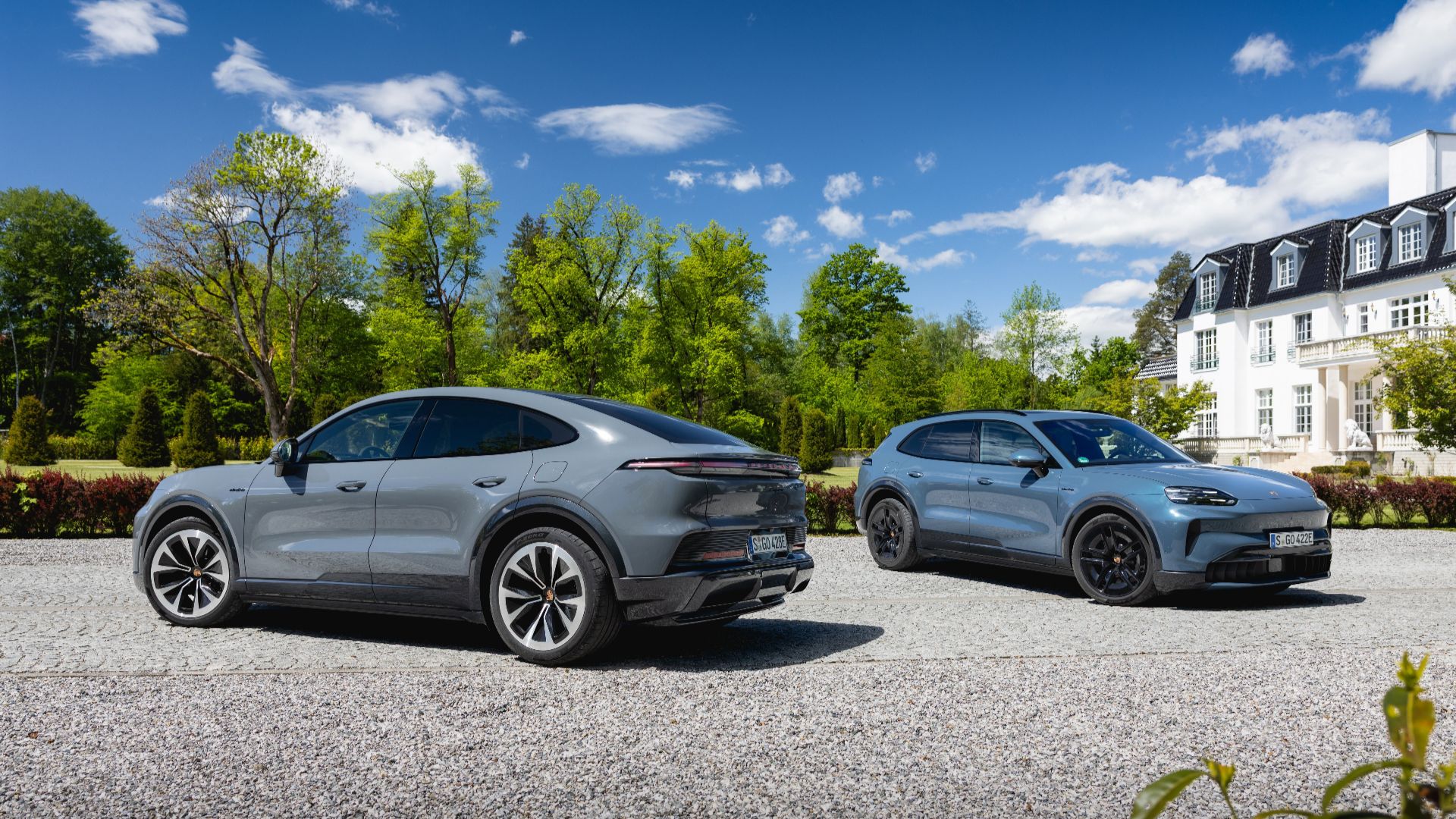
We’ve already driven the regular Cayenne Electric SUV, which uses the same drivetrain in the flagship Turbo derivative. So yes, technically the Coupe is the joint most powerful production Porsche ever made.
Also, while we’re adding asterisks, it’s worth noting that the Cayenne Turbo’s full 1,156 horses are only available when you activate launch control. In normal driving, it makes do with a mere 857hp. Spoiler alert: that is still sufficient.
Being electric, of course, this (big-T) Cayenne Turbo doesn’t actually have a (small-t) turbo. Instead, it combines a liquid-cooled 113kWh battery with two electric motors, a single-speed transmission and four-wheel drive. Despite a hefty kerb weight of 2,650kg, that means 0-62mph in just 2.5 seconds – level-pegging with the 911 Turbo S – and a top speed of 162mph.
Avoid the temptation to drag-race any hypercars and you could achieve 390 miles on a full battery, while a maximum charging speed of 390kW potentially means a 10-80 percent fill-up in 16 minutes – if you can find a powerful enough public charger. The Cayenne Electric is also the first car compatible with wireless home charging. More on that shortly.
Shaped like a Porsche 911
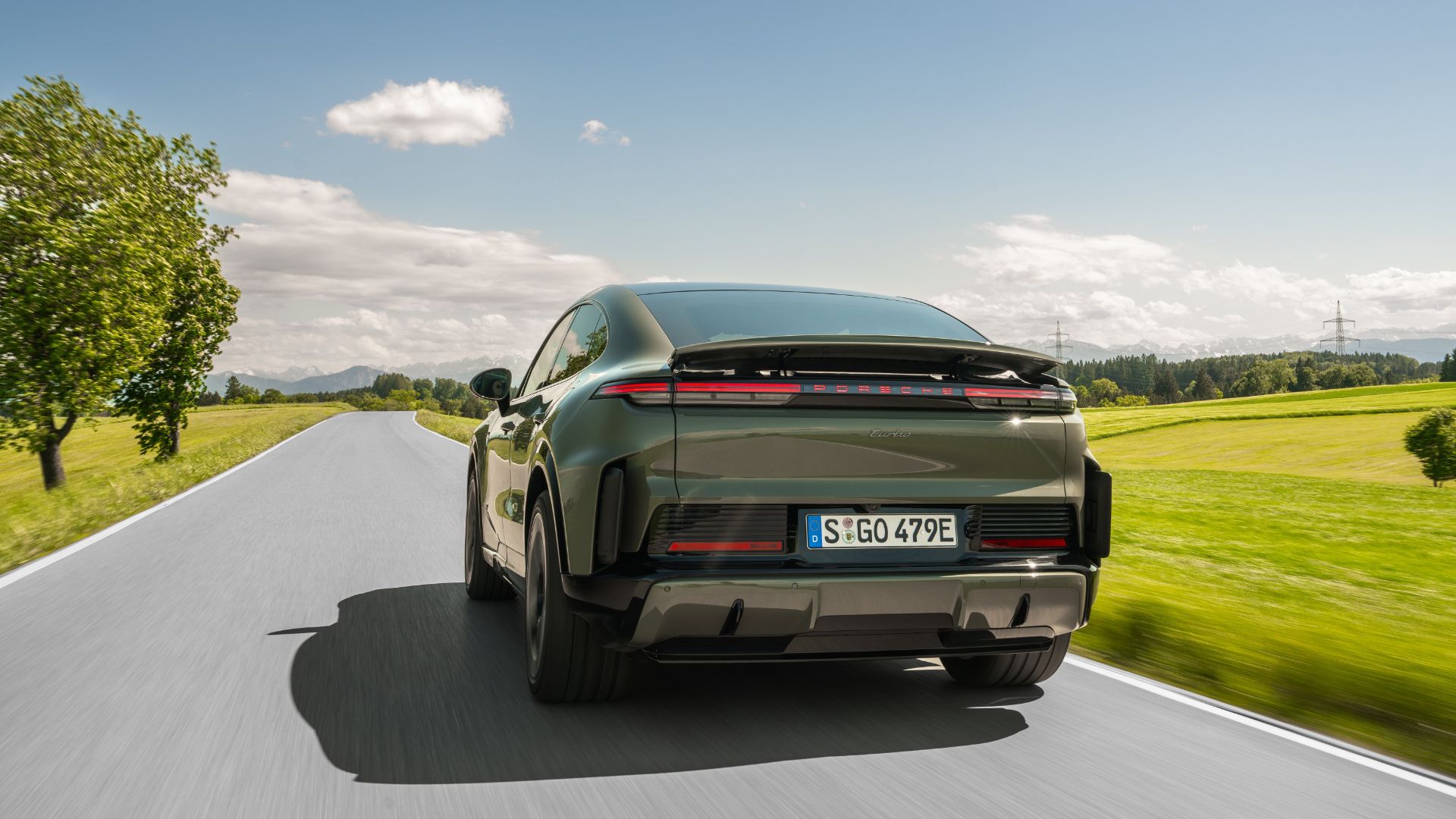
The obvious difference here versus the blocky, flat-backed Cayenne SUV is the Coupe’s much sleeker profile. Porsche calls this swooping roof the ‘flyline’ and it’s directly inspired by the iconic silhouette of the 911.
In fact, from the A-pillar backwards, every panel differs to the SUV – including the windscreen itself. The lower roof (by 24mm) and more svelte shape reduce the Coupe’s coefficient of drag to 0.23, which boosts battery range by up to 11 miles.
Unique to Cayenne Turbo models, ‘Active Aeroblades’ also extend from the rear wings at speed, smoothing airflow along the sides of the car. Look closely and they’re inscribed with the coordinates of the wind tunnel at Weissach, Porsche’s famous proving ground near Stuttgart.
With its bluff front end and heavy haunches, nobody will mistake this portly Porsche for a 911. Nonetheless, to my eyes at least, it’s one of the best looking SUV coupes on sale. And if that sounds like a back-handed compliment, so be it.
Porsche Cayenne Coupe model lineup
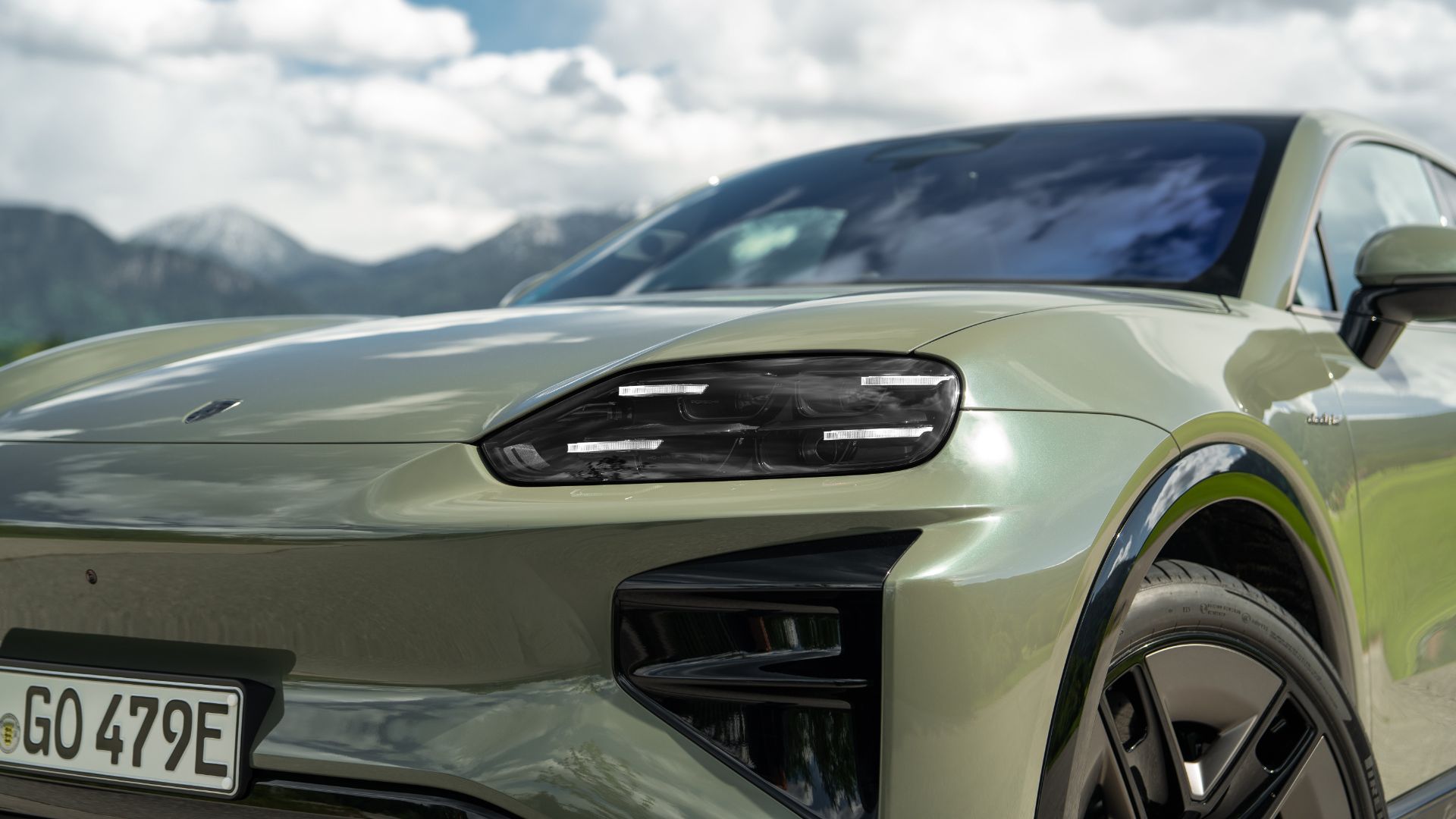
There are three tiers to the Cayenne Coupe Electric range. The base model – simply badged ‘Cayenne’ – develops 408hp (442hp on overboost), sprints to 62mph in 4.8 seconds and can manage 409 miles on a full battery. It will cost you £86,200.
Step up to the mid-range Cayenne Coupe S and power climbs to 544hp (666hp on overboost), which is good for 0-62mph in 3.8 seconds. The official, WLTP-tested range is 414 miles and your wallet will be £103,100 lighter.
The Turbo Coupe Electric tested here is the top dog, with a bite much mightier than its (near-silent) bark. We have already talked vital statistics, but the price of entry is £130,300. Expensive for a Cayenne or good value for the sheer performance on offer? Arguably, it’s both.
Across the board, prices are around £3,000 more than the equivalent Cayenne Electric SUV. However, the Coupe does come with extra equipment, such as a panoramic glass sunroof and the Sport Chrono package. The latter adds a dashboard stopwatch, Sport Plus driving mode and a Sport Response ‘push to pass’ button.
Optional Lightweight Sport package
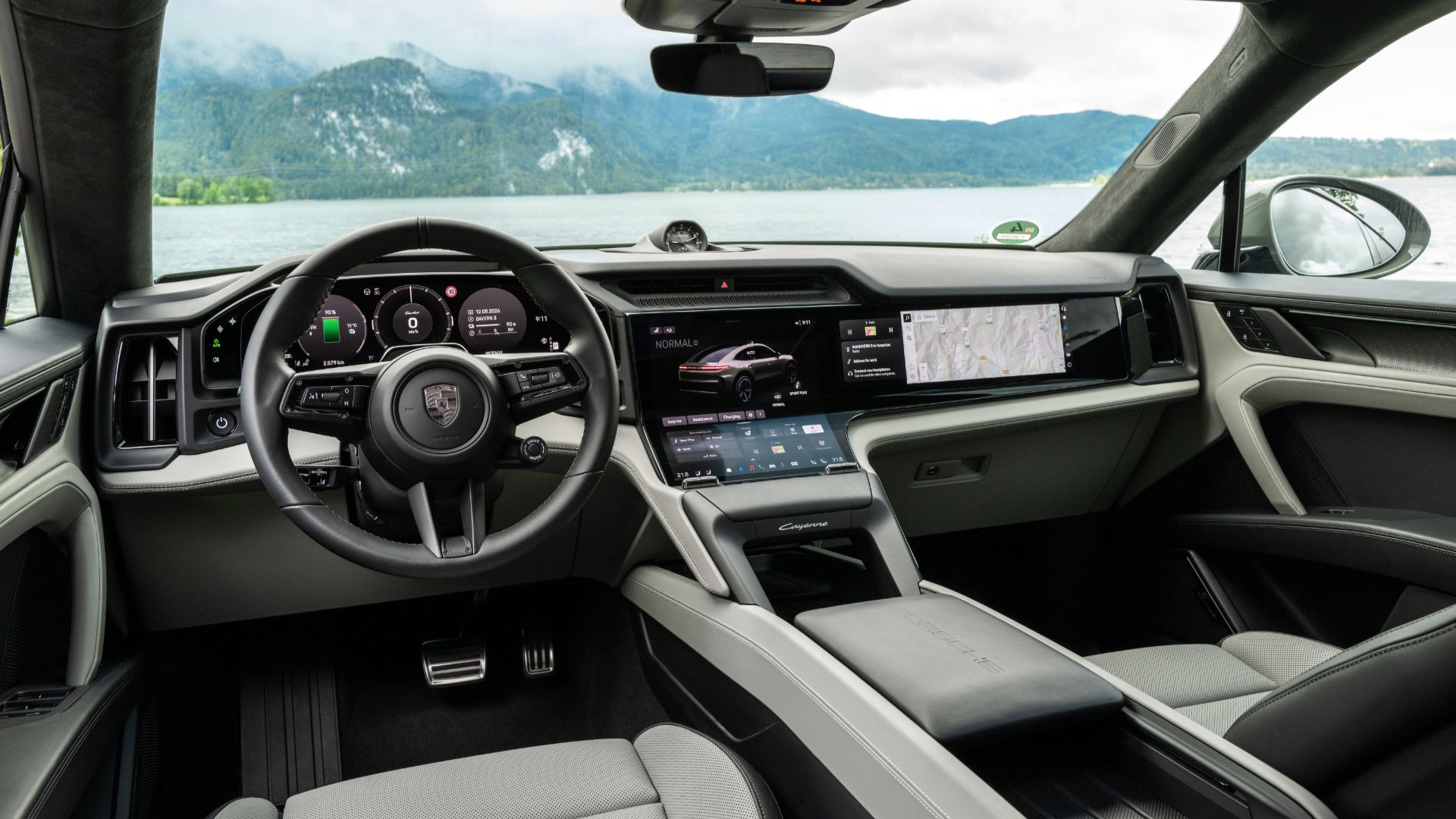
Standard kit on all Cayenne Coupes includes air suspension, adaptive LED headlights, an active rear spoiler, eight-way electric sports seats, a curved ‘Flow Display’ central touchscreen and ‘Mood Modes’ ambient interior lighting.
As you’d expect from Porsche, there is also a lengthy list of options, from the rugged Off-Road Package – with underbody protection and maximum towing capacity boosted by 500kg to 3,500kg – right up to bespoke, one-off vehicles via the Sonderwunsch (‘special wishes’) programme.
One option unique to the Cayenne Coupe Electric is the Lightweight Sport package, which comprises a SportDesign bodykit, larger 22-inch alloy wheels, carbon fibre interior trim and retro ‘Pepita’ seat upholstery, with grippy Race-Tex (Porsche’s version of Alcantara) for the steering wheel and headlining. It saves a total of 17.6kg, less than one percent of the car’s kerb weight, but it does add some aesthetic attitude.
Combining space and pace
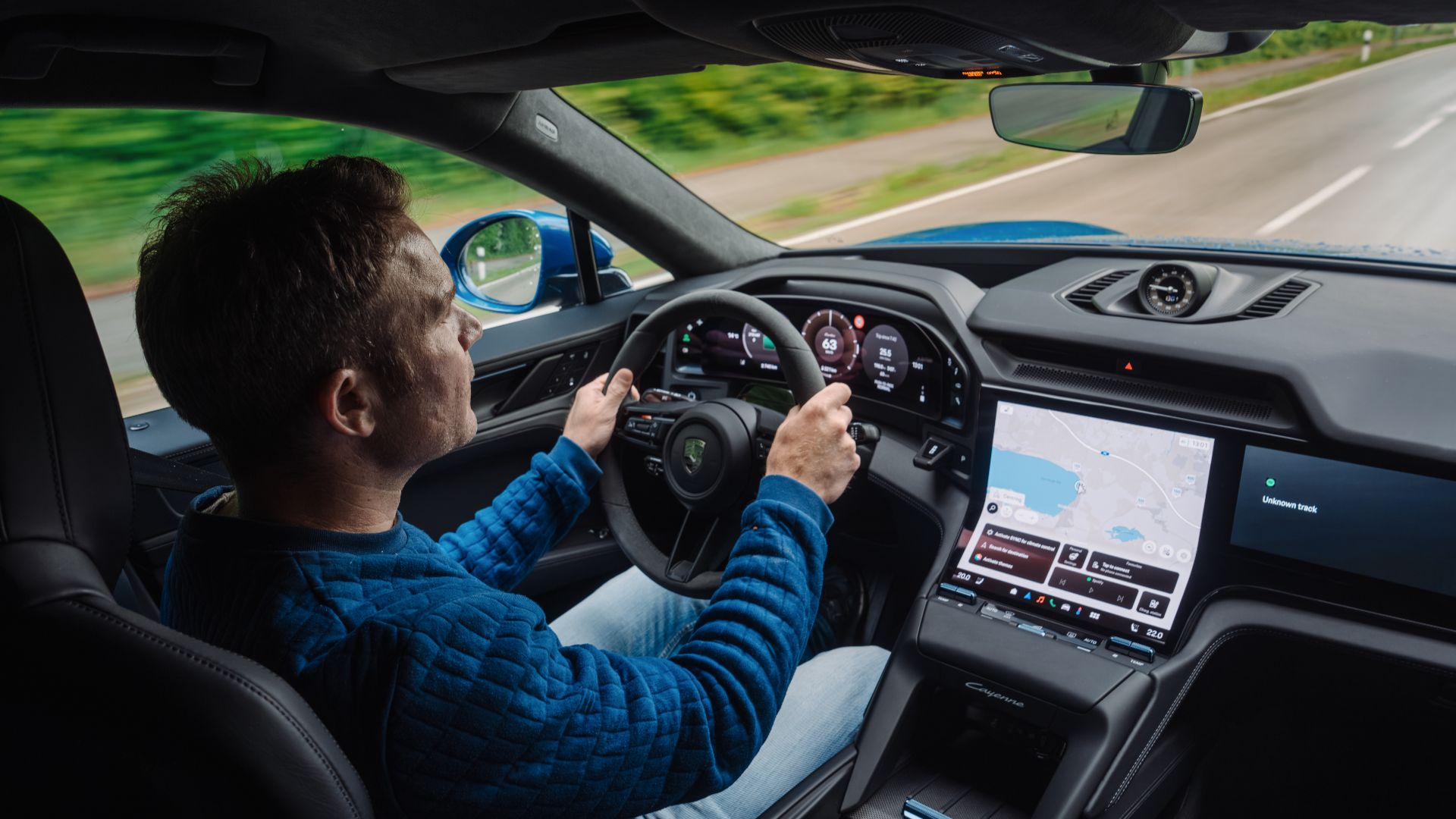
Press launches often take place in glamorous locations, driving on the kind of sun-dappled mountain roads that you thought only existed in car ads. This time, however, we collect the keys from outside Munich airport and it’s raining: a steady drizzle that our jovial German host describes as “typical UK weather”. Consider this a real-world test, then.
The Coupe’s 534-litre boot can’t compete with the enormous 781 litres offered by regular Cayenne, but it’s still larger than many ‘upright’ SUVs. Headroom in the back is plentiful, too – our six-foot photographer had no complaints – despite the descending ‘flyline’ roof. You can opt for two individual rear seats or a ‘2+1’ bench with a narrower central perch.
Up front, the dashboard is dominated by screens (including an optional passenger display fitted to our car), although Porsche has wisely retained physical controls for functions such as audio volume and climate control settings. The curved touchscreen looks futuristic and is intuitive to operate, with plenty of connected apps that allow you to pre-heat/cool the cabin, watch films on Disney+, play in-car video games and more. Who said sitting around at EV charging stations was dull?
The Porsche’s interior has a pleasingly Germanic solidity, even if some of the plastics are a bit, well, plasticky. What seems fine on an entry-level Cayenne feels less so on a Turbo costing nearly £50,000 more.
Bahn-storming performance
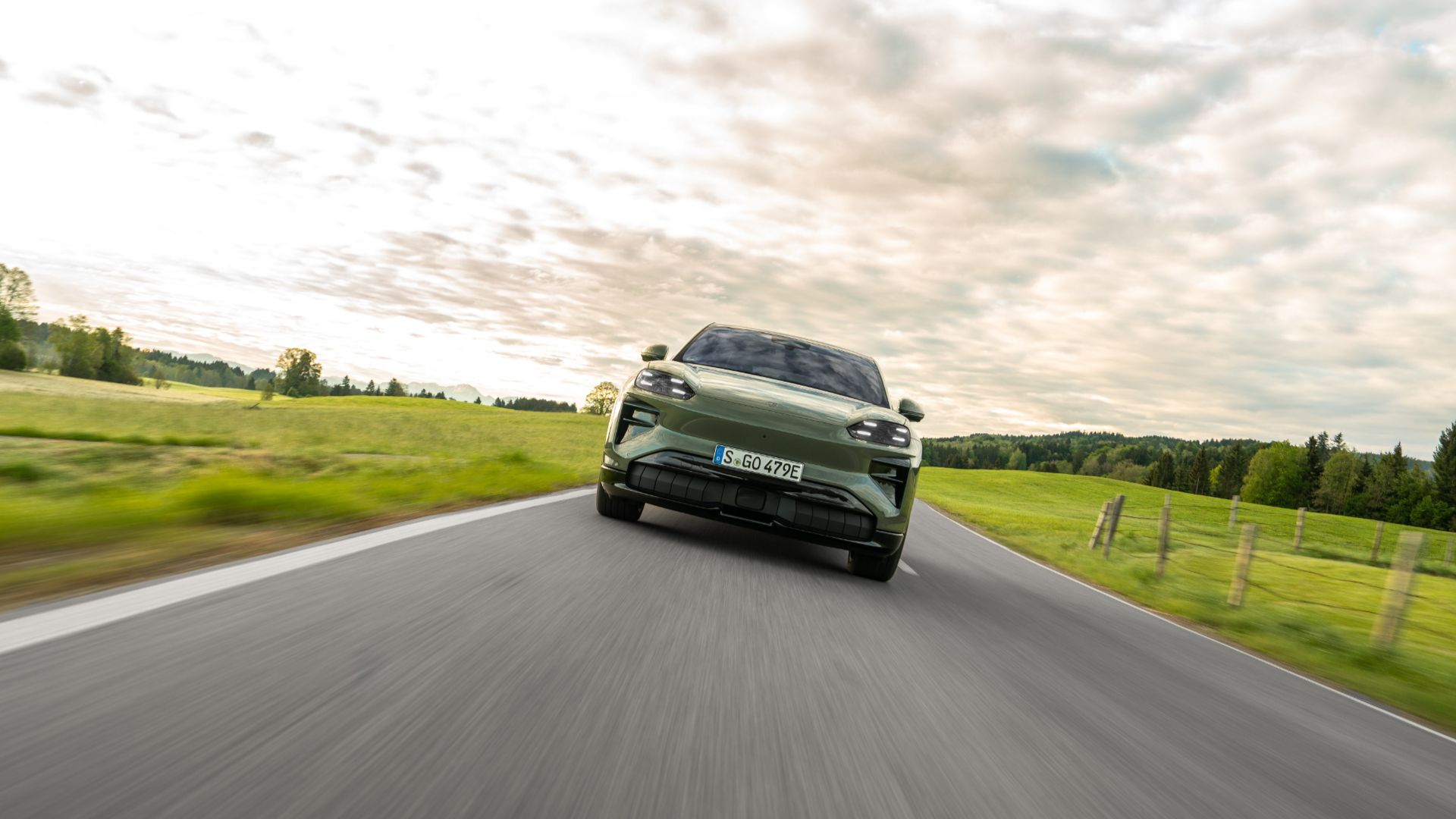
After escaping from Munich, the first part of our route is on the autobahn. The combination of traffic and inclement weather means there isn’t an opportunity to test the Porsche’s 162mph maximum, so we settle at a steady 170kph (106mph) cruise, eating up miles towards the beautiful Lake Starnberg, located south of the city.
At three-figure speeds, the Turbo feels imperious. It’s remarkably refined – the wind bluster and tyre roar that afflict many EVs are absent here – and its huge 10-piston front brakes with carbon-ceramic discs feel reassuringly capable when a stray Dacia ambles into the outside lane. Porsche’s optional Active Ride suspension, which Cayenne product director Dirk Britzen says “almost completely compensates for body movements”, also keeps the car rock-solid during sudden lane-changes.
That said, I find the steering a little twitchy in anything beyond Normal mode, particularly on the autobahn. My tip is to customise your settings via the Individual menu, combining slower ‘Normal’ steering with stiffer ‘Sport’ suspension for the best balance of stability and schnell.
World-first wireless charging tech
We exit onto meandering country roads and the Cayenne’s size becomes more apparent. This is a wide car and its low-profile tyres mean kerbs are often a worry. On the flip side, it sails over speed humps that might reduce a conventional (non-SUV) coupe to a cautious crawl.
After following a tractor for several miles, I attempt a push-to-pass overtake and feel the back end of the car squirm sideways. It’s quickly caught by the ESC system, but serves as a timely reminder that 857hp and damp roads are a potentially perilous combination. Suitably chastened, I proceed more steadily to the lunch stop.
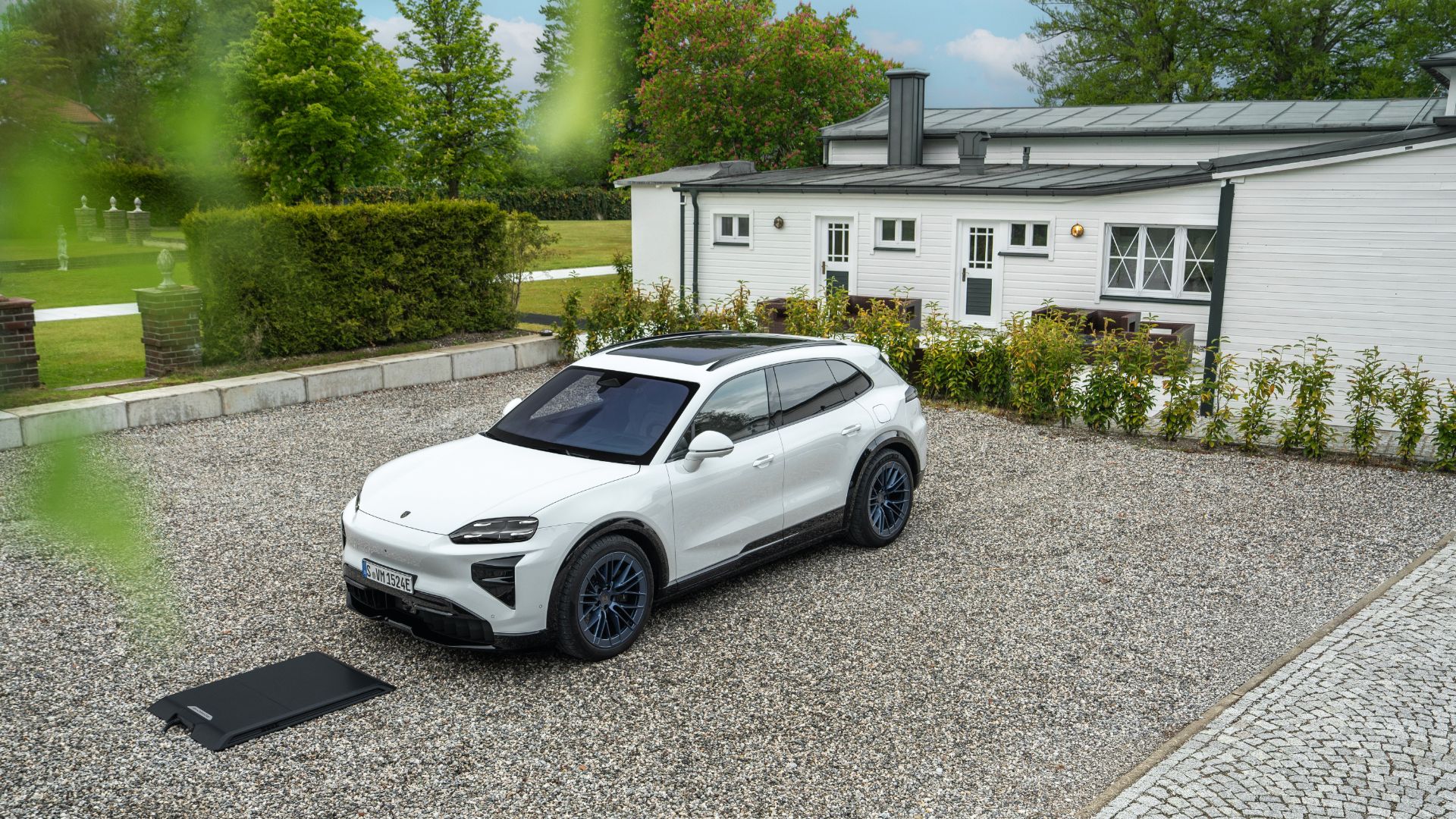
Over a cappuccino and a cake, Simon Klein, Porsche development engineer for charging equipment, demonstrates the world-first wireless inductive charger. Essentially, this uses a waterproof electromagnetic charging plate that fits between the front wheels, connecting to a receiver unit behind the front axle. To ensure correct alignment, you simply line up a green dot on the central display (the car) inside a circle (the centre of the plate).
It can charge at up to 11kW, although output will usually be restricted to 7.6kW in the UK – the same as most home wallbox devices. Klein also points out that inbuilt motion detectors ensure there is “no danger of frying your cat”. Overall, the process is impressively quick and straightforward, with no need to handle mucky charging cables. The only downside is the price: upwards of £5,000 including installation.
Don’t try this after lunch
By the time we head back towards Munich, the lead-coloured clouds have been chased away by blue skies and blazing sunshine. Now, on newly dried roads, the Turbo is able to unleash its full performance, even if you rarely have enough space or the right conditions (an empty autobahn, preferably) to fully flatten your right foot
A full-bore launch control start is something you will probably only attempt once – the effect on your internal organs is akin to riding a vertical-drop rollercoaster – and isn’t something I’d recommend shortly after eating lunch. I genuinely felt quite sick.
For all its bombastic speed, though, the way the Cayenne takes apart a twisty road is what impresses most. Porsche’s ability to make a tall and heavy SUV handle like a sports car has set the Cayenne apart for 24 years and four generations now. And while there is clearly a lot of clever hardware and software at work, including rear-axle steering and Active Ride on our Turbo test car, it doesn’t detach you from the experience. The Coupe Electric feels as sure-footed and captivating to drive as any Cayenne ever has. It sounds silly, and nobody in their right mind ever will, but you can even imagine enjoying it on a track day.
I didn’t get the opportunity to sample a car without Active Ride, but my colleague Richard thought it was transformative for the Cayenne SUV – and certainly worth the £6,799 outlay. The option is also available on the middling Cayenne S, although not on the base car. Interestingly, the Cayenne with Active Ride doesn’t raise its suspension to aid access like a Porsche Taycan with the same system – presumably because the seat is already at a more comfortable height.
Verdict: Porsche Cayenne Coupe Turbo Electric
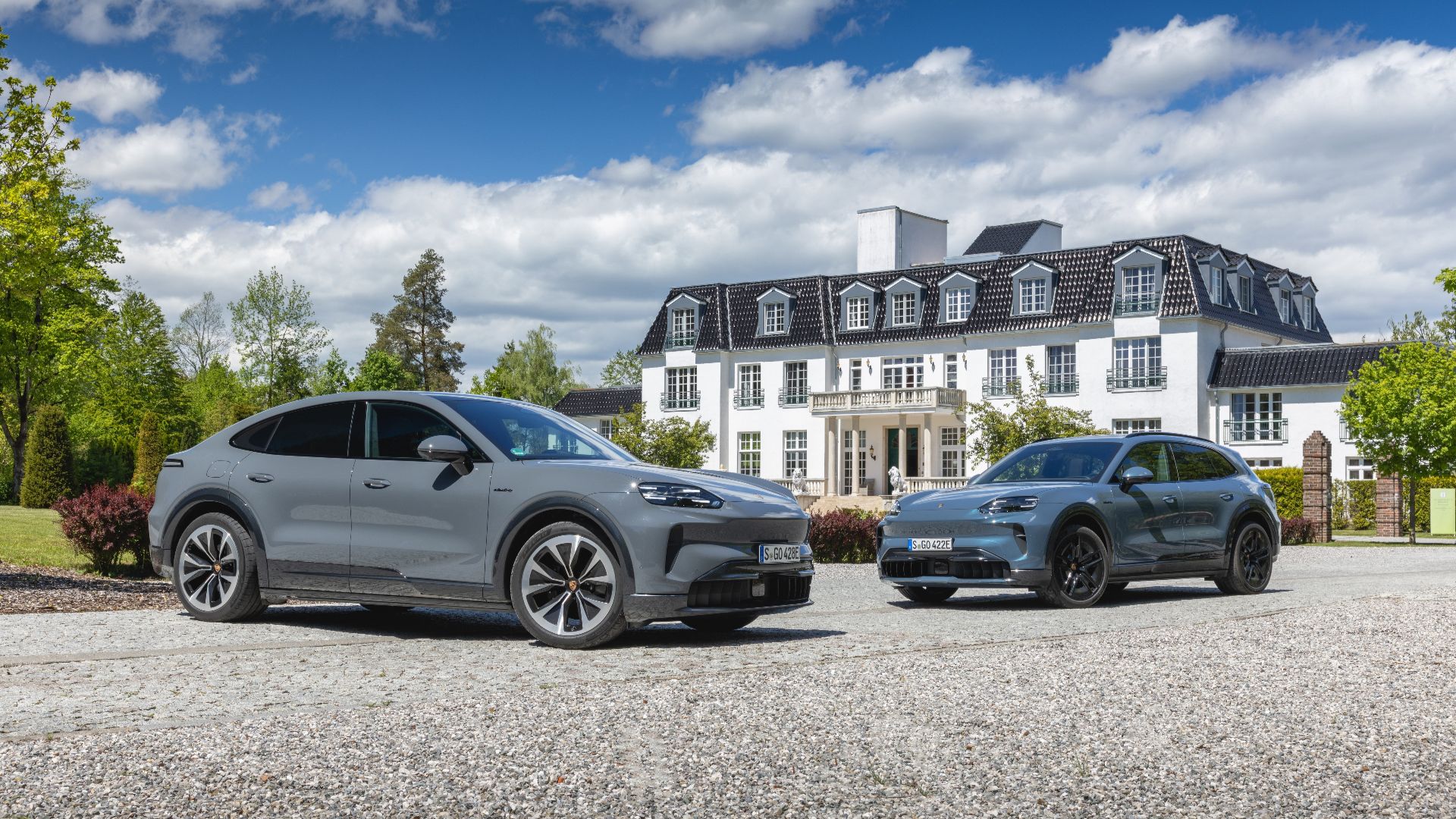
Look at the raw numbers and you might assume the Cayenne Turbo Electric was some kind of barely tamed muscle car: a sledgehammer SUV not unlike the Mercedes-AMG G63, but with batteries and electric motors instead of an old-school V8.
In reality, the Porsche is a far more rounded proposition. Yes, it’s blisteringly fast and feels athletic on the right road, yet it’s also comfortable, quiet, very practical and loaded with tech. If an EV works for you – i.e. you have a home charger and don’t need to drive hundreds of miles on a regular basis – few cars do so many things so well.
To answer my initial questions, 1,156hp is indeed more than you can realistically use on the road, and no, despite its abilities, I’m not sure this car makes a lot of sense. Certainly, there’s an argument for saying the Turbo is overkill and another that says you’re better off with the cheaper, more versatile Cayenne Electric SUV. But nobody buys a Porsche for entirely rational reasons, right?
ALSO READ:
Porsche Cayenne Electric 2026 review
