
If you had contemplated buying a Mazda CX-60 SUV, but wanted to carry seven people, the new CX-80 could be the answer. With an upmarket image, it’s a more affordable challenger to vehicles such as the Land Rover Discovery and Audi Q7.
Despite its considerable size, the CX-80 is not the largest SUV made by Mazda. The Australian and North American markets receive the enormous CX-90, but sensibly it was deemed too big for European sensibilities.
Mazda has a reputation for doing things its own way, often choosing to buck mainstream trends and follow its own unique path. The company eschewed turbocharged petrol power in favour of its efficient Skyactiv naturally aspirated engines. And it has so far been reluctant to fully embrace electric vehicles.
However, the Japanese marque is gradually dipping its toe further into electrification, such as the plug-in hybrid powertrain in our test CX-80. By contrast, the model range also includes a traditional diesel option.
So, has Mazda nailed the combination of seven seats and electrified efficiency with the CX-80 PHEV?
The unconventional approach
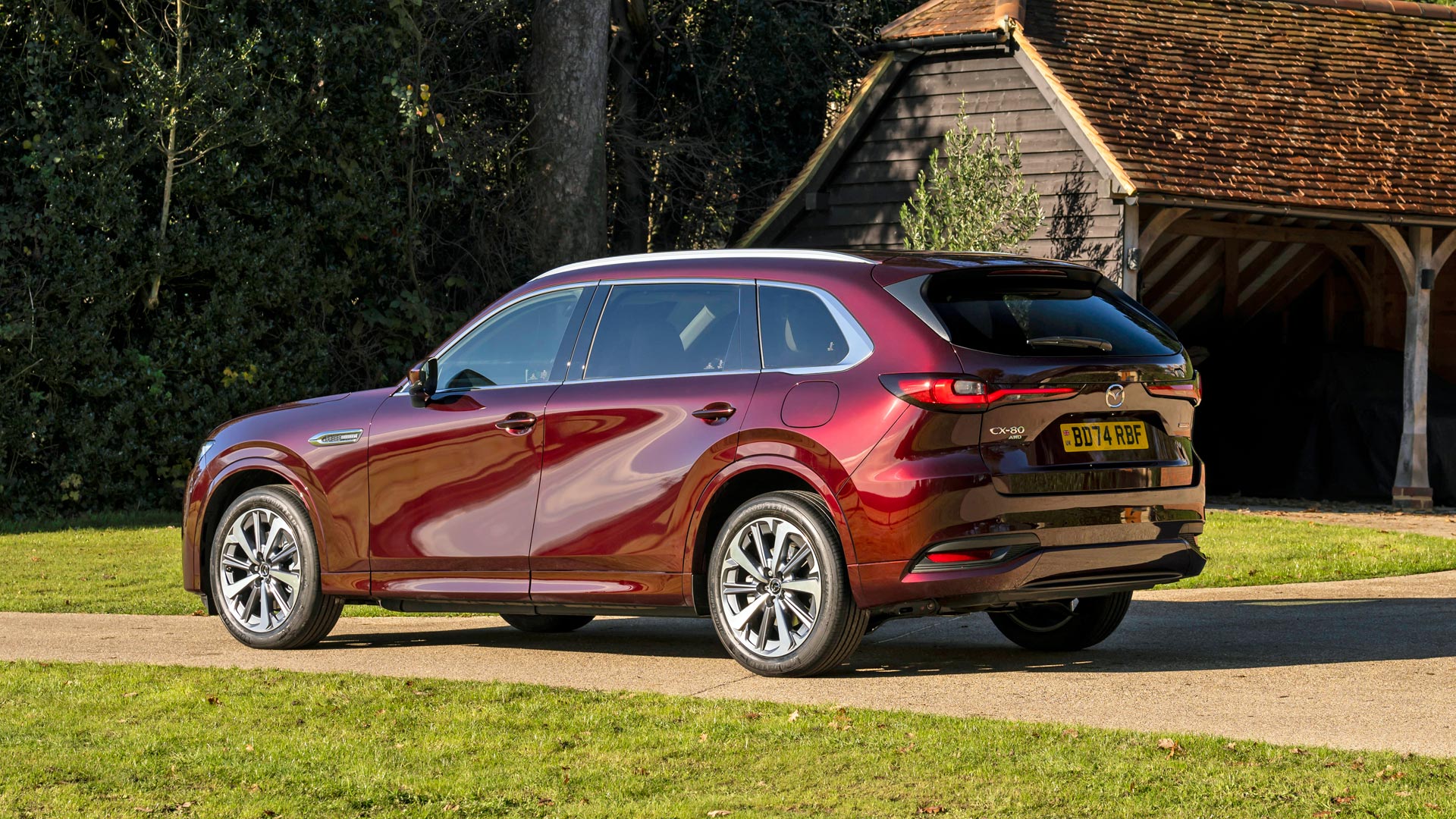
Mazda stretched the wheelbase of the CX-60 by a substantial 250mm to create the CX-80, and it’s clear where that additional length went. Look at the rear doors of this seven-seat flagship and they appear positively vast, giving the CX-80 limousine-like proportions inside.
This doesn’t detract from the CX-80 being very handsome for a large SUV, with neat exterior details that give it real kerb appeal. It manages to look upmarket without being pretentious or chintzy, not unlike the premium German marques from 25 years ago.
Powering the CX-80 PHEV is a combination of a 2.5-litre four-cylinder petrol engine with an electric motor. All-wheel drive is standard on the CX-80, along with Mazda’s unique take on an eight-speed automatic gearbox.
Working together, the PHEV setup produces 327hp and 369lb ft of torque. However, it does have to contend with the CX-80’s substantial kerb weight of 2,165kg.
No need to shout about it
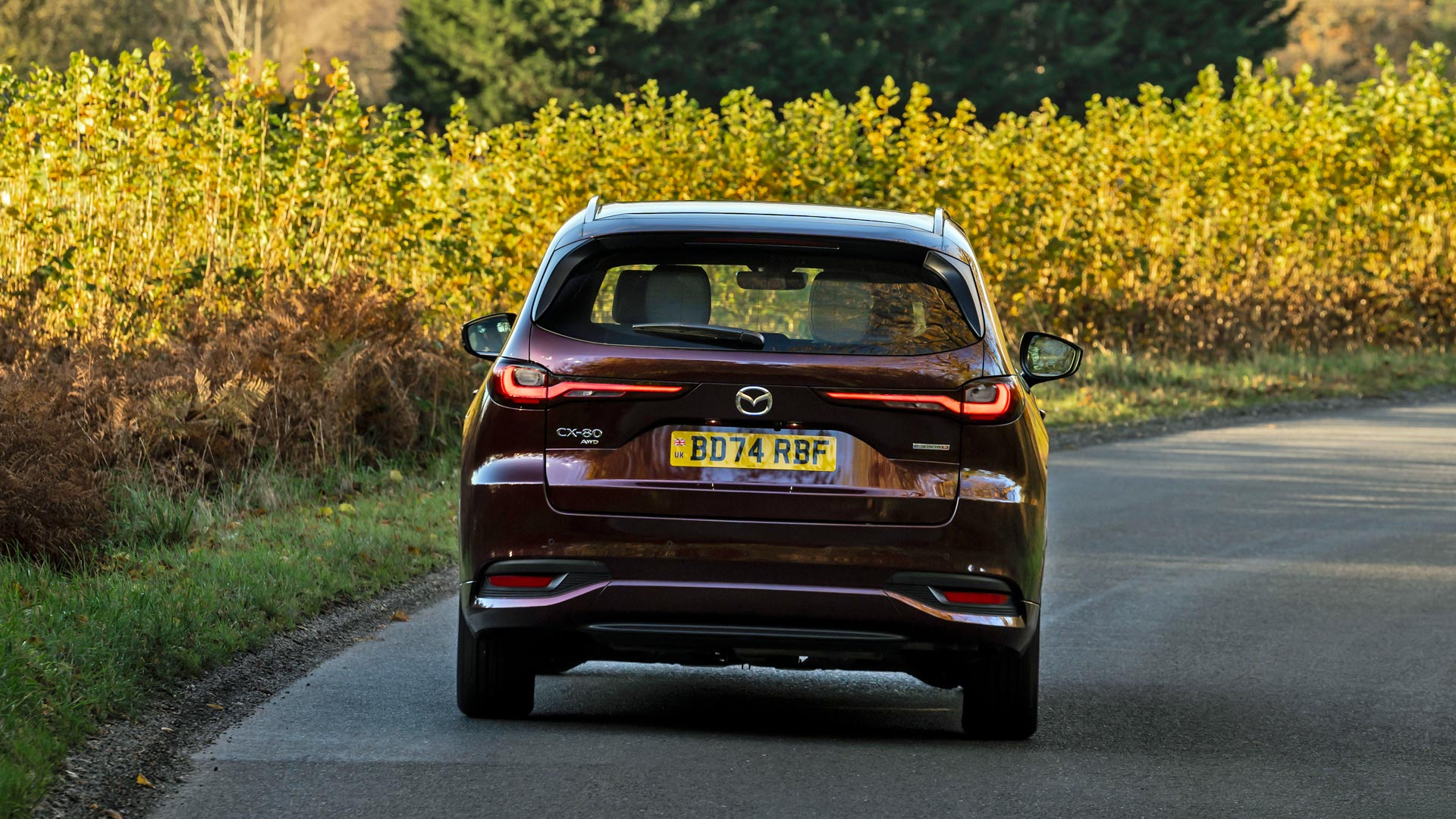
The CX-80 PHEV can accelerate from 0-62mph in a brisk 6.8 seconds. But the reality is a lot of strained noise from the petrol engine, combined with the automatic gearbox sometimes feeling caught out by the transition between petrol and battery power.
The Mazda’s boisterous engine is a genuine disappointment, and something of a surprise. Mazda has long been adept at creating internal combustion engines that sound incredibly sweet – even when powering something as workmanlike as a Mazda 6 Tourer, for instance.
It creates a strange scenario where the diesel-engined CX-80 is the more refined option. Indeed, the 254hp 3.3-litre turbocharged straight-six diesel feels smooth and powerful, even if it accelerates slower than the PHEV. Recommending a diesel does feel unusual in 2025, though.
Mazda has done a great job of keeping the CX-80’s weight in check. There’s only minimal body-roll when cornering, even if the steering feedback is muted. Be aware that the 20-inch wheels of higher-grade models make the ride feel firm, too.
Premium, but without pretension
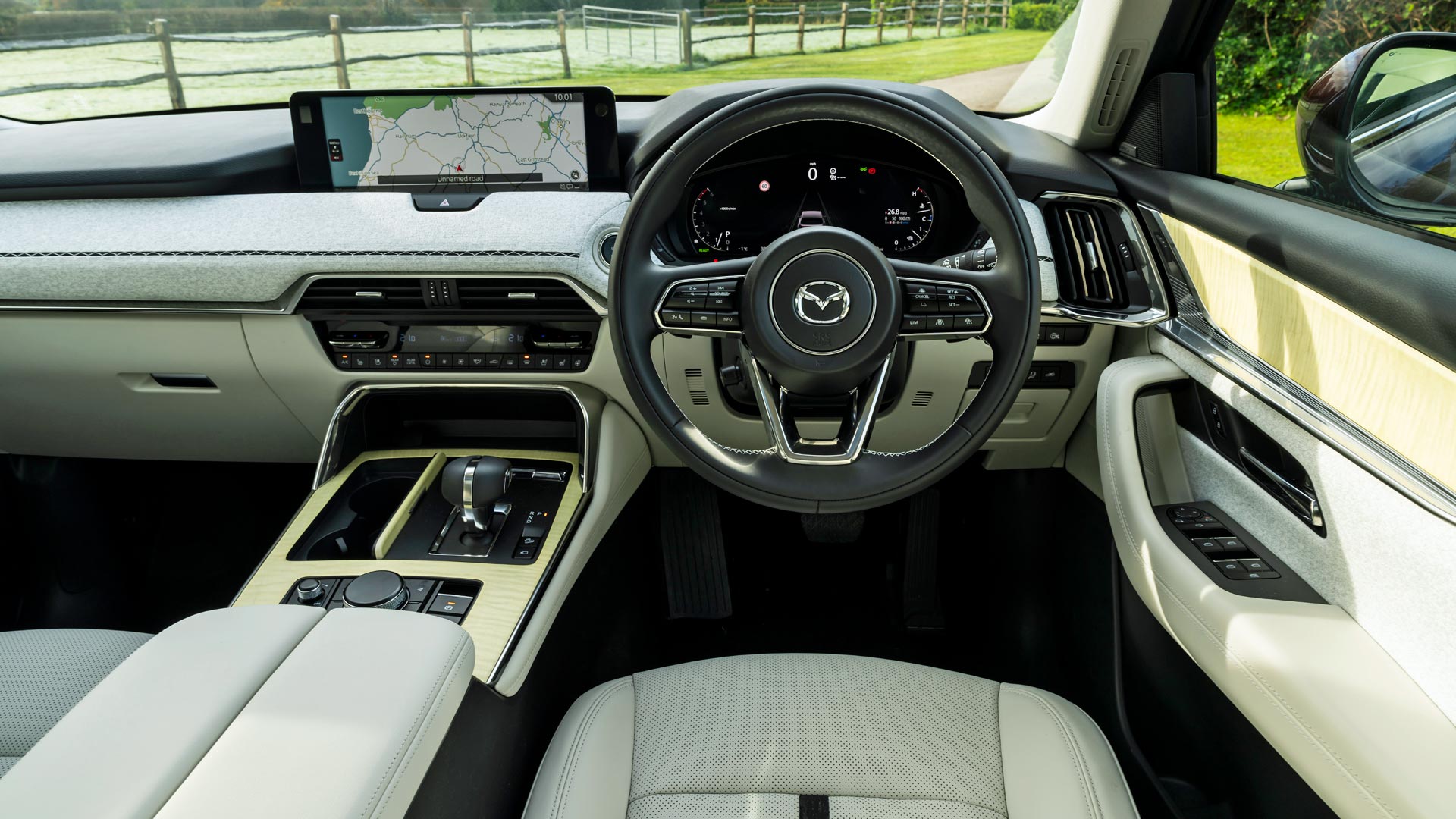
Where the CX-80 really demonstrates Mazda’s leftfield thinking is on the inside; the dashboard and centre console are a lesson in usable design. Unlike car manufacturers who force drivers to use a central touchscreen for almost everything, Mazda has retained a pleasing array of traditional buttons.
So you can forget fiddling with a display to adjust the climate control, and instead rejoice at quickly flicking a switch to change the temperature. Mazda’s rotary controller effortlessly operates the 12.3-inch display when the CX-80 is moving.
Top-spec Takumi models come with an attractive combination of white Nappa leather and real maple wood trim. Whether white seats are a good choice for an SUV likely to be ferrying children around is another matter, however.
There’s an upmarket ambience inside the CX-80 that, when combined with the rotary controller, feels reminiscent of BMW interiors before the Bavarians decided to ditch the buttons.
Leading the space race
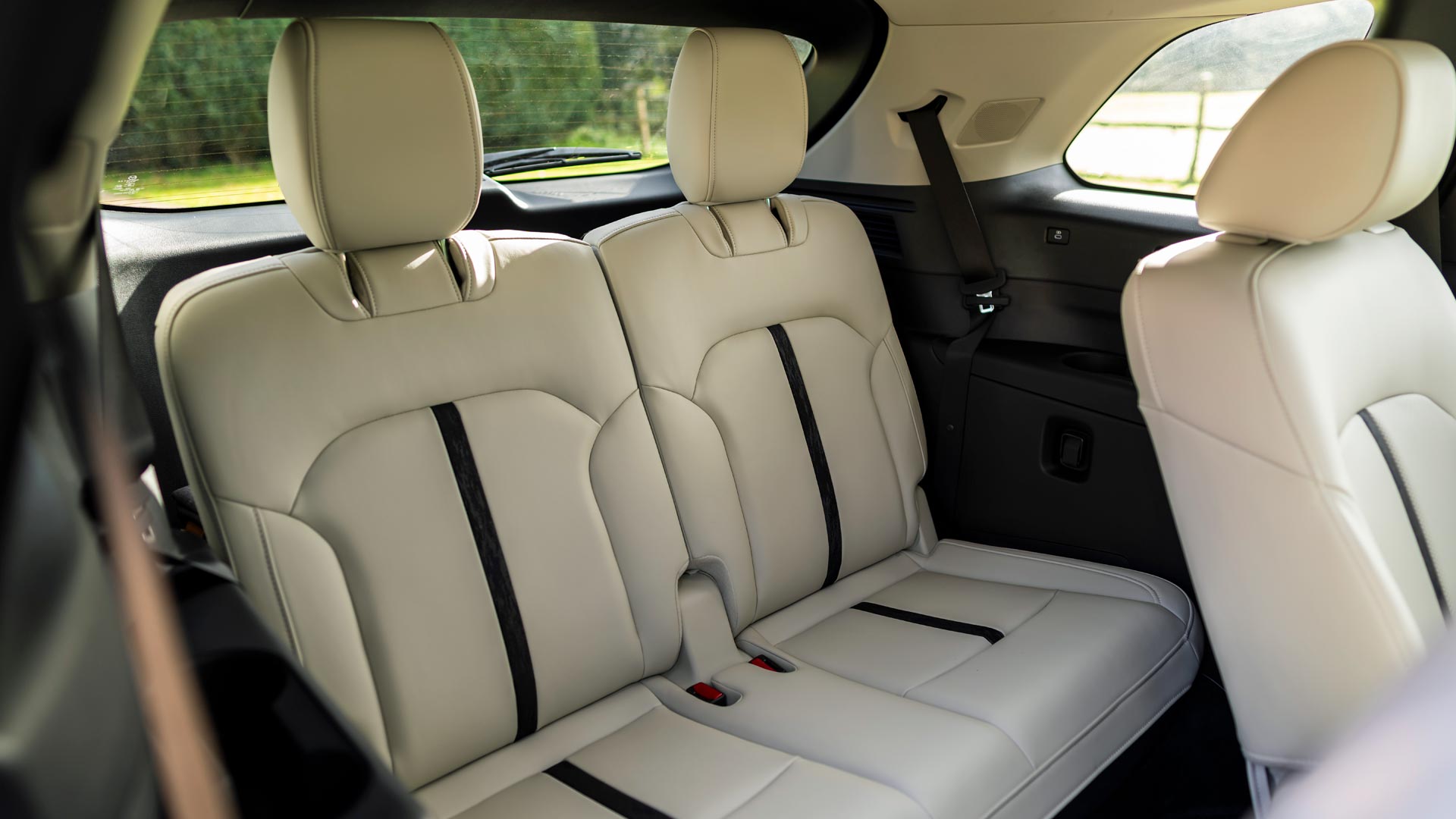
Practicality is likely to be a major reason for anyone choosing a Mazda CX-80, given that the smaller CX-60 does the same job but only seats five.
CX-80 buyers can choose a three-seat middle bench for the full seven-person capacity, or have a pair of heated ‘captain’s chairs’ for a six-seat setup.
The second row of seats can slide backwards and forwards by 120mm, creating the potential for an impressive amount of legroom. Combined with the wide-opening rear doors, it makes getting children into and out of car seats in the second row supremely easy.
Mazda reckons the third row can comfortably carry passengers up to 1.7m tall, and it is more than sufficient for kids or occasional adult use. The third row even has its own USB-C charging ports, along with air conditioning vents.
Inevitably, using the rearmost seats does impact luggage space. With the back row in place, the CX-80 can accomodate just 258 litres of cargo – comparable to a typical supermini. Fold the third row flat and this swells to a much healthier 687 litres. Or there is a van-like 1,971 litres with all the rear seats dropped.
Big on room, small on running costs

Even if the Mazda CX80’s plug-in hybrid powertrain lacks refinement, it certainly delivers when it comes to economy. Officially, with the PHEV’s battery fully charged, the big SUV can return up to 176mpg, with CO2 emissions of just 36g/km.
For company car drivers, this would mean Benefit-in-Kind tax rates of 13 percent for the 2025/26 tax year, compared to a 35 percent rate for the CX80 diesel.
With the CX-80 PHEV’s battery topped up, it can travel up to 38 miles on electricity alone. If you can charge at home, and have a short commute, it could mean rarely needing to engage the petrol engine.
Verdict: Mazda CX-80 PHEV

Prices for the CX-80 PHEV start at £49,780 for the entry-level Exclusive-line model, which comes with black leather upholstery and 18-inch alloy wheels. Further standard kit includes climate control air-con, satellite navigation, a head-up display and a host of safety equipment.
Fancier grades, such as the Takumi with its white Nappa leather, start at £53,800: a major saving compared with premium-badged rivals from Volvo or Audi.
With a spacious interior, intuitive dashboard layout and handsome styling, there is plenty to like about the Mazda CX-80. Only the unrefined petrol engine in the PHEV counts against it, making the diesel a more attractive option for private buyers.
Ultimately, the CX-80 is a typically leftfield Mazda take on the three-row SUV, with just enough character to stand out from alternatives such as the Hyundai Santa Fe or Skoda Kodiaq.
ALSO READ:
Mazda Iconic SP concept points to rotary-engined hybrid MX-5
