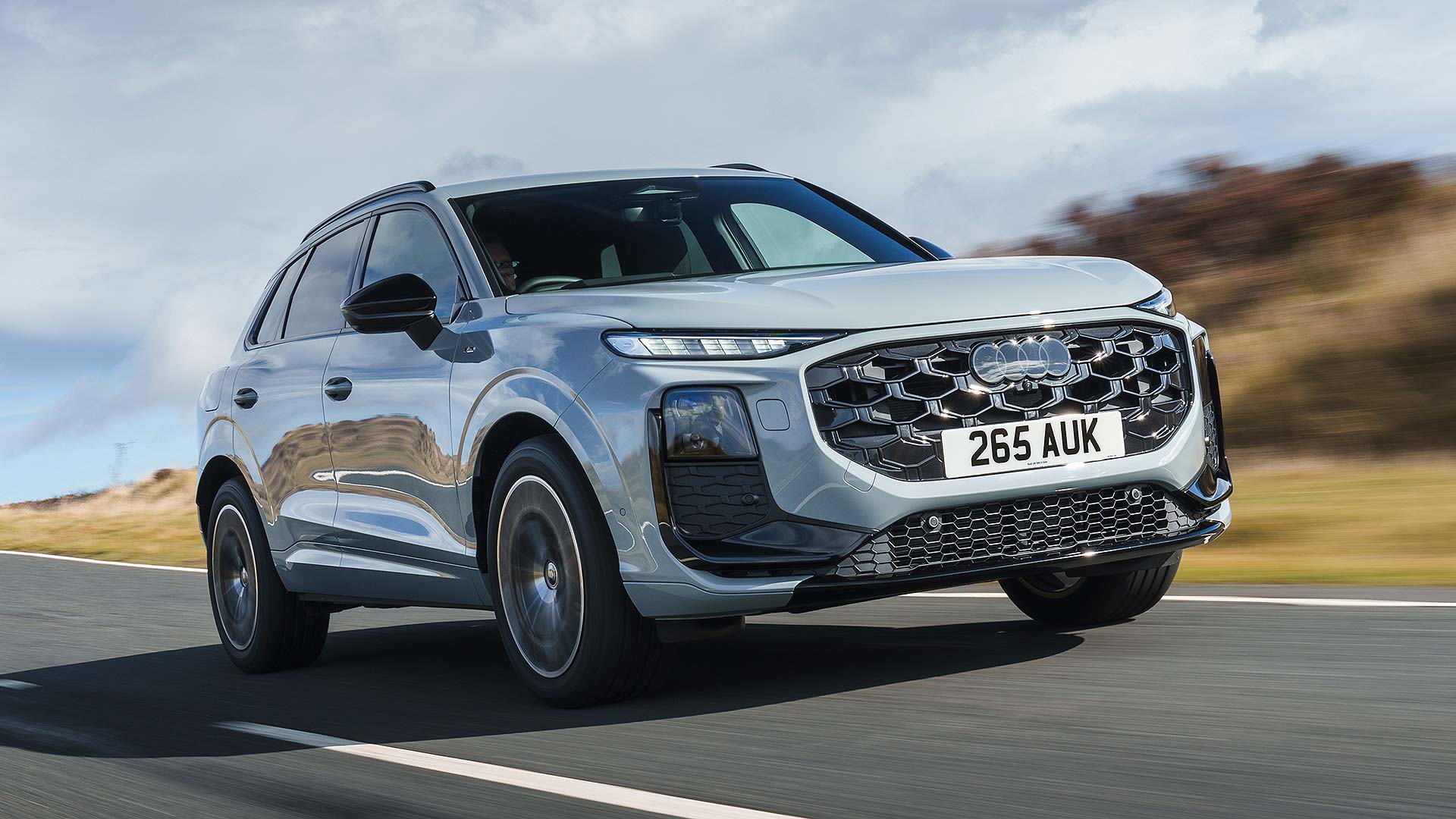
The Audi Q3 is a well-established mid-size SUV. It’s a premium alternative to the Volkswagen Tiguan, and a direct rival to the BMW X1 and evergreen Volvo XC40. However, this is a packed sector, and the second-generation Q3, launched back in 2018, was getting a bit long in the tooth. Cue an all-new one then, sporting Audi’s hardly-subtle new design cues and a fully overhauled interior.
Somewhat against current trends, there isn’t a fully electric new Audi Q3. Instead, buyers can choose from mild hybrid, plug-in hybrid or – shock – plain old petrol or diesel. Then pick from Sport, S line or Edition 1 trims. Only one version, the entry-level mild hybrid petrol, costs less than £40,000 (the 1.5 TFSI 150 Sport is £38,300). So the new Audi Q3 isn’t a cheap car, but is it any good?
Say goodbye to stalks

The new Audi Q3 is, visually, a clearly smaller sibling to the Audi Q5 and Q6 e-tron. Its design is both cleaner and, from both the front and rear, also busier. It’s around 40mm longer, most of which has gone into the bonnet, giving a sleeker and less blocky profile in spite of a wider, more upright grille. This isn’t a naturally elegant or discreet shape like Audis of yore, but there’s no missing its newness.
The interior has the open-plan look favoured by modern Audis, with the centrepiece being a single-piece curved panoramic display of extremely high resolution. It looks high-tech, bringing an upmarket Audi feature into a more affordable sector, and the engineers have worked to make the icons more readable. The Android-based system is slick to use and, thanks to over-the-air updates, will keep on improving further.

There is the usual modern Audi mix of decent quality materials in the upper part of the cabin, then hard plastics lower down. This may surprise customers of the old Q3. The centre console has plenty of fingerprint-prone gloss black plastic, but I quite like the curved trim panel on the dashboard itself. The semi-floating door pulls are novel, too.

Audi has also decided to reinvent the indicator stalk. Instead of boring old levers, indicators and wipers are mounted on a rectangular panel that sits behind the steering wheel. It looks quirky at first, but is actually quite intuitive. The fiddliest bit is the small rotary dial for the wipers, but you’ll probably just leave them on auto. There is a wash-wipe button on the end of the panel (the main beam flash is a toggle on the back).
Less easy-to-use are the naff touch-sensitive buttons on the steering wheel, hidden behind yet more gloss black plastic. The steering wheel is an odd four-spoke design, but that’s nothing new in modern cars.
The doors open nice and wide, it feels spacious and airy inside, and the Q3 actually seems like quite a large car on the road. It measures almost 1.9 metres wide and is over 4.5 metres long, so it’s not just your imagination. I thought it felt like a notable step up in status.
Fully loaded launch cars

The first Q3 I drove is expected to be the best-seller: the TFSI 150 petrol. Like all new Q3s, it has an S tronic automatic gearbox with a selector behind the steering wheel. That 150hp output serves up 0-62mph in 9.1 seconds and average fuel economy of 46.3mpg.
It’s a little on the rorty side when pressing on, but the mild hybrid system does serve up a decent sense of EV rolling when in town. The ‘coasting’ function is smart, too: lift off at speed and the engine can shut down, imperceptibly so. More perceptible are the downchanges necessary to release its power when you need a bit of oomph, not helped by the S tronic’s tendency to change up early.
Generally though, it’s a fine all-rounder, with enough hybrid EV sophistication to not leave you feeling short-changed.
Elsewhere, road noise quickly became apparent during my test drive. I noticed it even at speeds below 30mph as I left the launch destination. Of course, the test cars all had 20-inch alloys, which didn’t help (18-inch wheels are standard on Sport), but it was still a surprise in a brand new car.

The launch vehicles also had Audi’s fancy new twin-chamber adaptive damping system. This is an expensive option, so most people probably won’t choose it, but those who do can rest assured they’re getting an effective system.
The twin chambers are designed to optimise both up and down suspension movement independently – with each corner of the car operating independently, too. It means Audi is able to deliver superb body control, with the Q3 remaining flat and stable on the most challenging of roads, no matter how ‘dynamically’ you are driving. I thought it was superb, providing a real feeling of sophistication. The ride was decent too, in that slightly stern Audi way.
Our test cars were also fitted with progressive steering. Part of the driver assist pack, this is designed to be stable in the centre and quicker as you wind on lock. With the control of the adaptive suspension, it may not have much feel, but it makes the Q3 surprisingly chuckable and responsive. You can, should you wish, belt through roundabouts at a considerable lick without things feeling remotely dramatic.
Driving the Q3 e-Hybrid

I later drove the Audi Q3 e-Hybrid. A plug-in hybrid, this has a battery with 19.7kWh of usable capacity, giving a generous 73 miles of pure EV range before the petrol engine kicks in. There’s a potent electric motor to make use of this, and the two combine to produce a strong 272hp – good for 0-62mph in 6.8 seconds.
Right away, the e-Hybrid offers strong EV vibes. It always defaults to electric mode and, even when the battery is exhausted, carries enough in reserve to run as an EV at lower speeds. Reliance on the electric motor means acceleration is linear, and it generally feels a commendably smooth and refined system.
When you want maximum power, the engine will kick in, but it does so unobtrusively – and, once up to speed, the background noise (including the tyre roar) means you may not notice the engine dipping in and out during everyday driving. The ability to use DC rapid chargers means you can infuriate EV owners and top it back up to 80 percent charge in less than 30 minutes.
That said, you’d perhaps expect the Q3 e-Hybrid to be good, given how it costs £7,500 more than the basic TFSI 150…
Seeing the lights

In other areas, the Audi Q3 does exactly what it needs to. It’s roomy in the rear, with spacious footwells and plenty of headroom. (There’s a Q3 Sportback alternative, with a more rakish rear roofline that eats into headroom for adults.) You’ll notice its size again from the sizable step down when you get out.
The rear seat slides, so you can vary boot space from 488 litres to 575 litres, or fold it flat for 1,386 litres. The boot is wide, maybe a little high off the ground, and there’s lots of space under the floor. It’s a well-shaped luggage area, like in most new Audis.
The final fancy feature of the launch cars was digital matrix LED headlights, standard on Edition 1 spec. These can flash up warning logos onto the road and, when you indicate, light up the lane you’re set to move into. We only had a short evening drive so we’ll reserve judgement on them. But the digital OLED rear lights they are combined with, complete with an illuminated Audi logo, are cool.
Verdict: Audi Q3

The new Audi Q3 is as you’d expect: a nicely refined version of a car that had become rather long in the tooth, with enough tech to make it once again feel thoroughly contemporary. The entry-level petrol engine is fine, while the e-Hybrid is advanced enough to almost justify its £7,500 premium.
Judgement has to be somewhat reserved until we try the standard suspension most customer cars will come with – and see if the smaller wheels serve up less tyre roar – but first impressions are positive. The Q3’s distinctively Audi feel should be just the job to take on that ever-growing throng of rivals.
ALSO READ:
