On September 30 1955, an open-top sports car nicknamed ‘Little Bastard’ was speeding towards the intersection of routes 466 and 41 in California. At the same moment, a 23-year-old student called Donald Turnipseed turned left across the carriageway in his Ford Tudor. With little time to react, the approaching car struck the heavy Ford almost head-on, then cartwheeled several times before coming to rest in a roadside ditch.
The other driver that day was James Dean, a revered and impossibly handsome Hollywood actor best known for his role in Rebel Without A Cause. He was heading to Salinas to compete in a road race when the crash – at what is known today as James Dean Memorial Junction – claimed his young life. Dean had already been stopped for speeding by police earlier that day, and was estimated to be travelling at 55mph when he collided with Turnipseed, who survived the impact.
As for ‘Little Bastard’, it was a Porsche 550 Spyder: a thinly disguised racing car with an aluminium body and mid-mounted flat-four engine. An evolution of the original, Beetle-based Porsche 356, the lightweight roadster quickly proved itself in motorsport, winning its class at the Carrera Panamericana, then delivering Porsche its first major sports car victory at the Targa Florio in 1956. Only 129 examples were made.
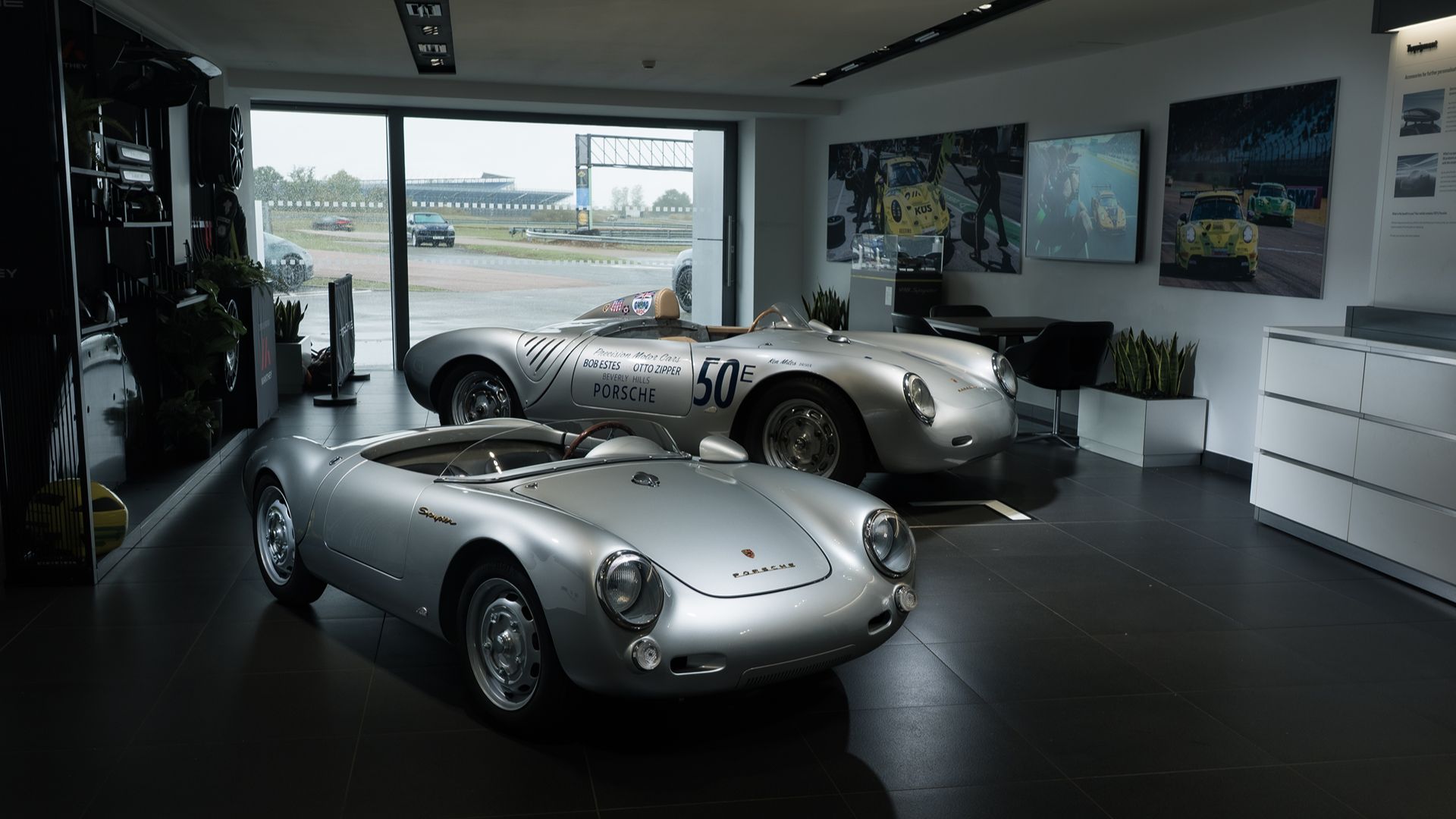
Fast-forward 71 years and a gorgeous, ex-Ken Miles 550 Spyder borrowed from the Porsche Museum is on display at Silverstone. However, the car I’m here to see is somewhat smaller: 80 percent scale, to be exact. Designed and built in Britain by Hedley Studios, the new 550 J (for ‘Junior’) comes with the official approval of Porsche AG. And while it isn’t cheap, at £83,400, that’s considerably less than the £4 million required for the real thing.
A history of Hedley Studios
Previously known as The Little Car Company, Hedley Studios is based at Bicester Motion, a former RAF base in Oxfordshire. It specialises in downsized, battery-powered replicas of iconic vehicles, which are typically bought by car collectors (“They are definitely not toys,” says CEO Ben Hedley). The company’s first project was the Bugatti Baby II, a factory-sanctioned tribute to the classic Bugatti Type 35, with a 2.8kWh battery and a top speed of 40mph. This was followed by the Ferrari Testa Rossa J and Aston Martin DB5 J – the latter available with ‘Bond gadgets’ such as revolving number plates, a smoke screen and imitation machine guns.
Hedley Studios has also created some not-so-little cars, including the road-legal, 85 percent scale Bentley Blower Junior and the forthcoming Tamiya Wild One Max: a full-sized version of a radio controlled beach buggy. “We don’t have to be slaves to absolute accuracy,” explains Hedley. “We can reinterpret cars and have a bit of fun with them.”
The 550 J has been seven years in the making and involved laser-scanning a real 550 Spyder and combing through documents in Porsche’s corporate archive: home to 2.2 miles of printed records, five million photographs, 5,000 books and 2,100 hours of film material. “We thought about making a 356 or 911, or even a version of the 918 Spyder hypercar, but the 550 Spyder just felt like the right choice,” Hedley adds. “It was Porsche’s first purpose-built racer and a car that could compete with the world’s best – and win.”
Clothed in carbon fibre
Technically speaking, the ‘J’ is based on the later 550 A Spyder, which switched from a ladder frame chassis to a stronger tubular spaceframe. While Porsche used aluminium panels, however, Hedley Studios has clothed its chassis in carbon fibre. The result is a kerb weight of 330kg – 220kg less than the old-timer and exceptionally light for an EV.
Hedley Studios also replicated the Porsche’s suspension, with twin trailing arms at the front and a swing axle at the rear, supported by modern Eibach springs and Bilstein dampers. The 1950s drum brakes have been upgraded to discs, gripped by Brembo calipers from a Ducati Diavel motorcycle. And the bespoke 13-inch alloy wheels, which resemble the steel rims of the original, are wrapped in Continental tyres also fitted to the Renault Twizy.
The Porsche lettering and period-correct Stuttgart crest on the bonnet are genuine parts, while other design elements have been cunningly repurposed; the chromed fuel filler cap now conceals a charging socket, for instance. Options include a curved front aero screen, wing mirrors, a tonneau cover for the passenger seat and Speedster-style humps atop the rear deck.
Upgrading to the RS Pack
Like its full-size sibling, the 550 J is effectively mid-engined, with its two 1.8kWh lithium-ion batteries mounted centrally, just behind the cockpit. Peak power of 11hp is sufficient for a top speed of 40mph, plus up to 30 miles of range – provided you don’t drive like James Dean.
Want more? For £11,400, you can have the RS Pack, which adds a further two batteries and almost doubles output to 21hp. It boosts maximum speed to 50mph and driving range to 50 miles, with drilled brake discs and adjustable coilover dampers to help manage the extra oomph.
If this all sounds a bit serious, a metal toggle switch modelled on the drive selector in the Porsche Taycan (“We’ve steampunked it,” says Hedley) can flick between the drive settings, including a lockable mode limited to 10mph for junior drivers. So you needn’t worry quite so much when letting the grandchildren loose in your brand new Porsche.
Inside the Porsche 550 J
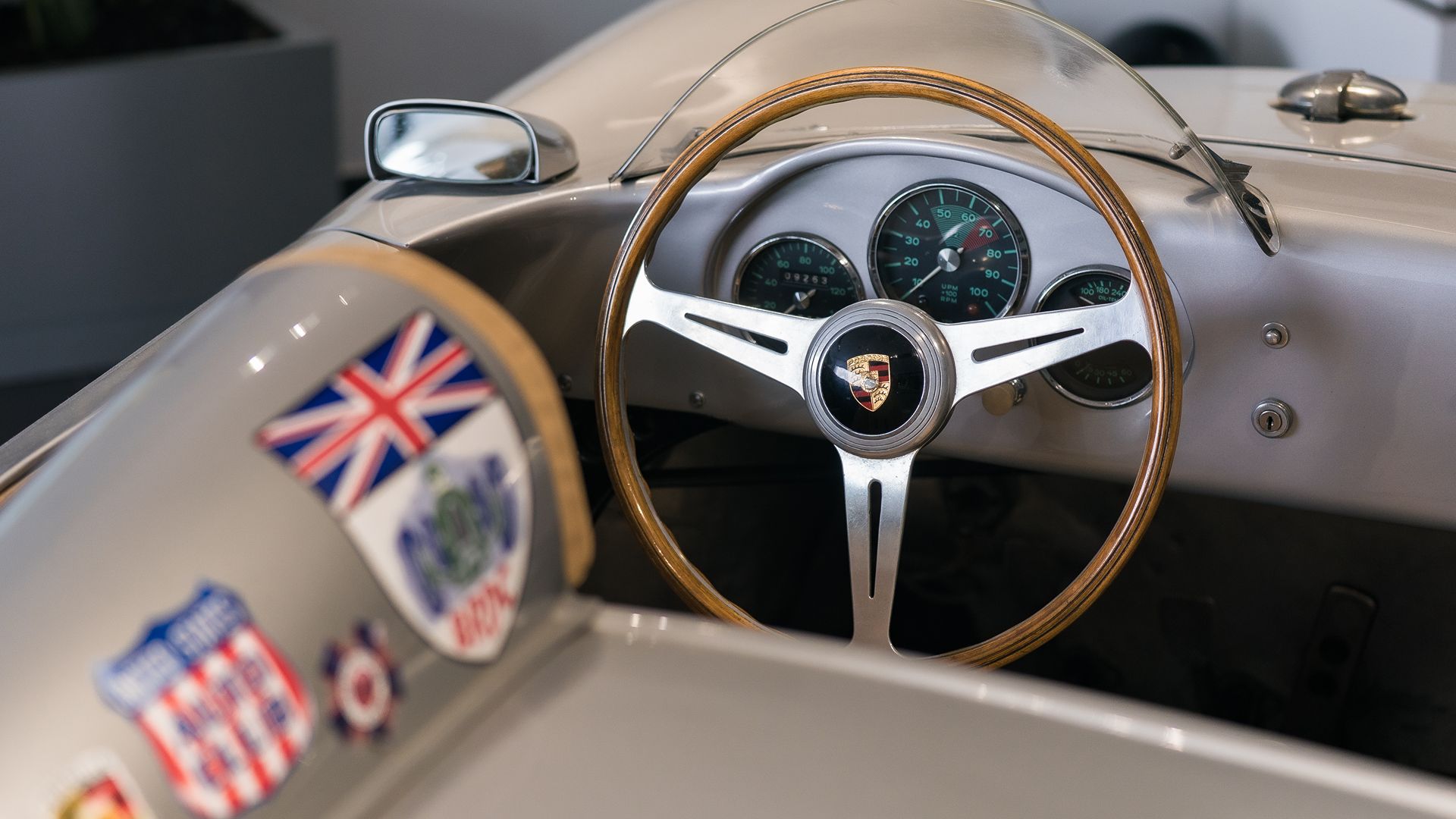
The 550 Spyder wasn’t a large vehicle to start with, so you’d expect this four-fifths version, measuring approximately 2.9 metres in length and 1.2 metres wide, to feel a tad cramped inside. Once you’ve clambered aboard, though – the doors don’t open – it actually seems more spacious than the original, with low-slung leather seats and a plain, flat-panel dashboard.
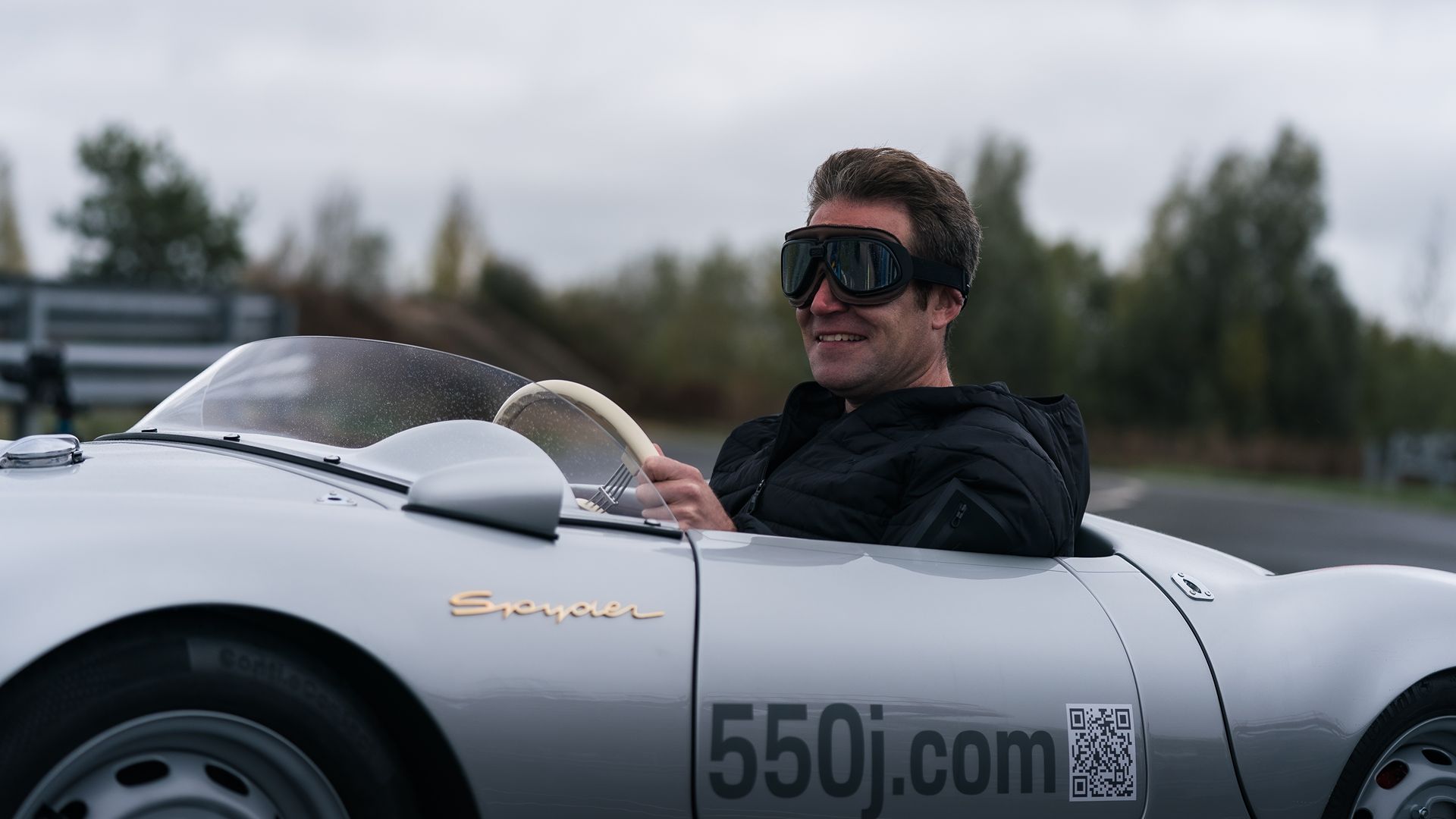
Hedley Studios fits a wood-rimmed Nardi steering wheel as standard, although you can upgrade to a slim-spoked 356 ‘banjo’ item at extra cost. The analogue dials are green-on-black, just like Porsches of the era, and the former fuel gauge shows how much battery charge is left.
If you don’t want leather, Alcantara (man-made suede) upholstery is available instead, or you can opt for houndstooth checked cloth inspired by Porsche’s retro ‘Pepita’ trim. Like any new Porsche, the potential for personalisation is almost endless.
On-track at Silverstone
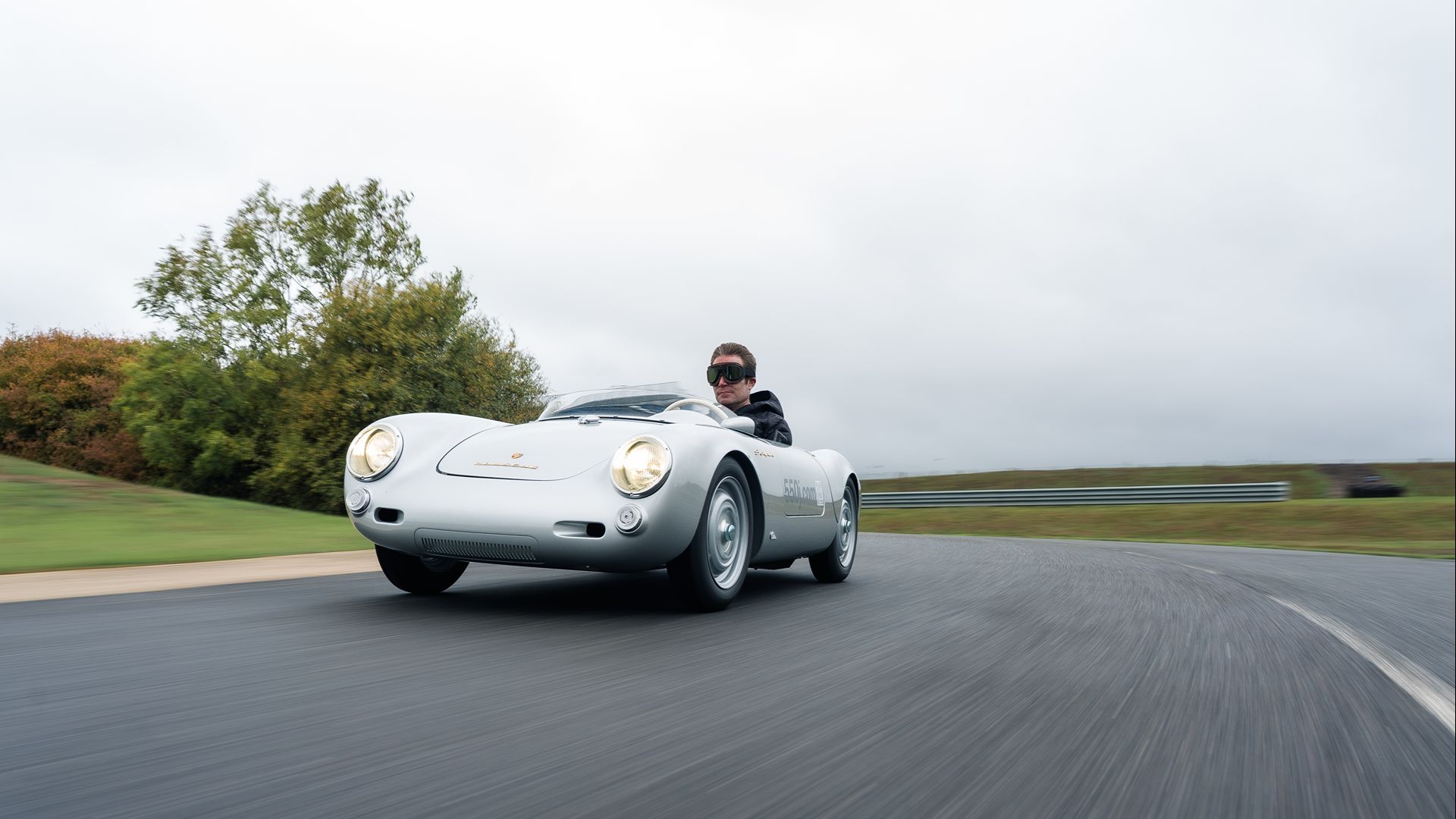
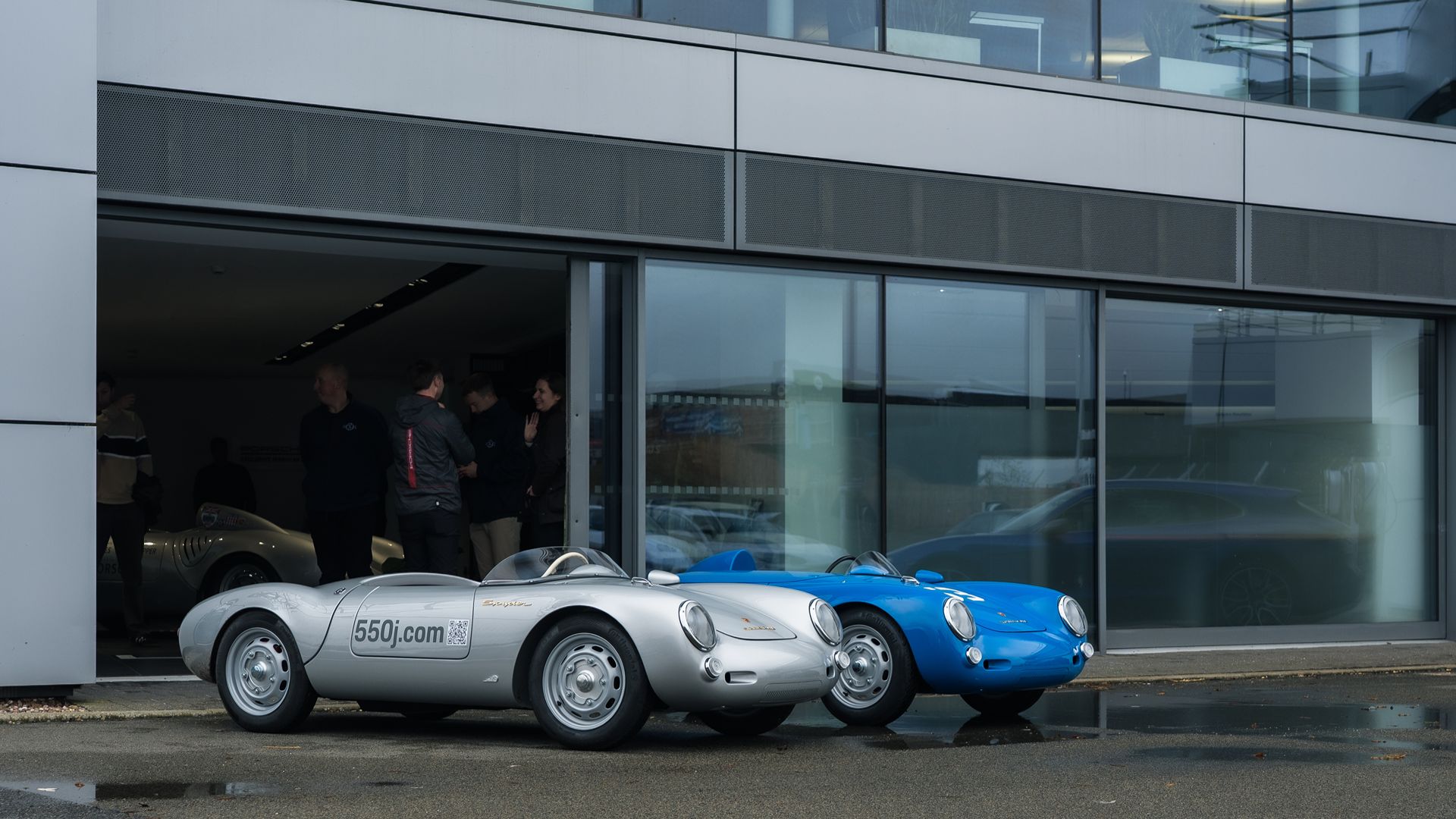
The same goes for the outside, which can be painted in classic Porsche hues such as Traffic Yellow and Capri Blue, or modern shades such as GT Silver and Oak Green Metallic Neo. Buyers can also select any paint-to-sample (PTS) option from the current Porsche 911 palette.
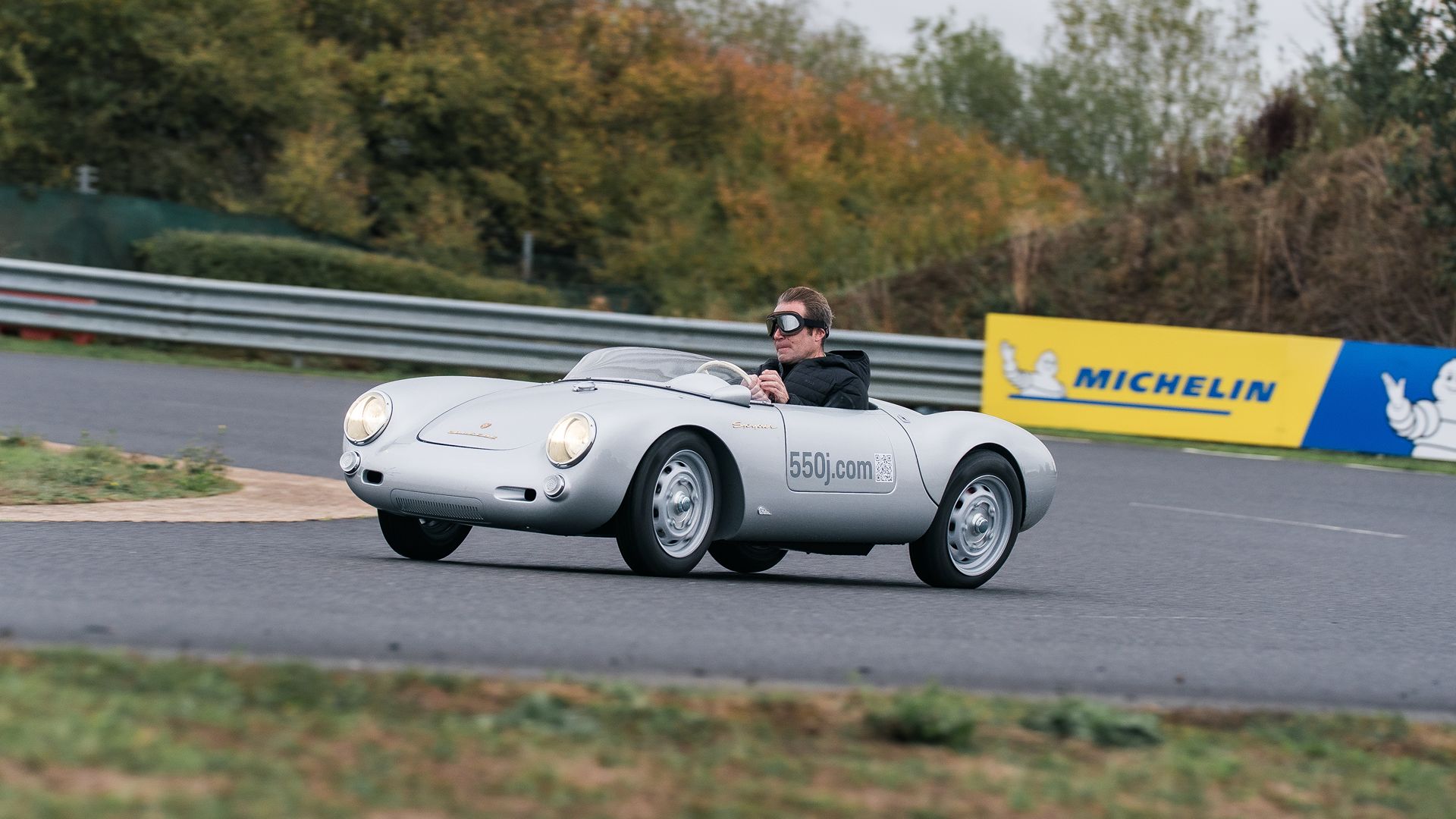
Whichever colour you choose, the 550 J looks achingly pretty: its simple curves as evocative now as they must have been in the mid-1950s. I decide to start in the blue car pictured here, then switch to the silver RS version. It’s been raining and the undulating, tightly coiled track at Porsche’s Silverstone Experience Centre is cold and damp. Never has the prospect of 11hp made me feel so trepidatious.
Strapping on a pair of goggles, I follow a Taycan Sport Turismo pace car – which looks enormous – out onto the circuit. There’s instant torque from the electric motor and very little sense of inertia, while the skinny steering wheel feeds back every detail of the road surface. Pretty soon my speed and confidence are building… right up until the moment when I take a downhill left-hander too fast and pirouette gracefully onto the grass.
Big fun in a small package
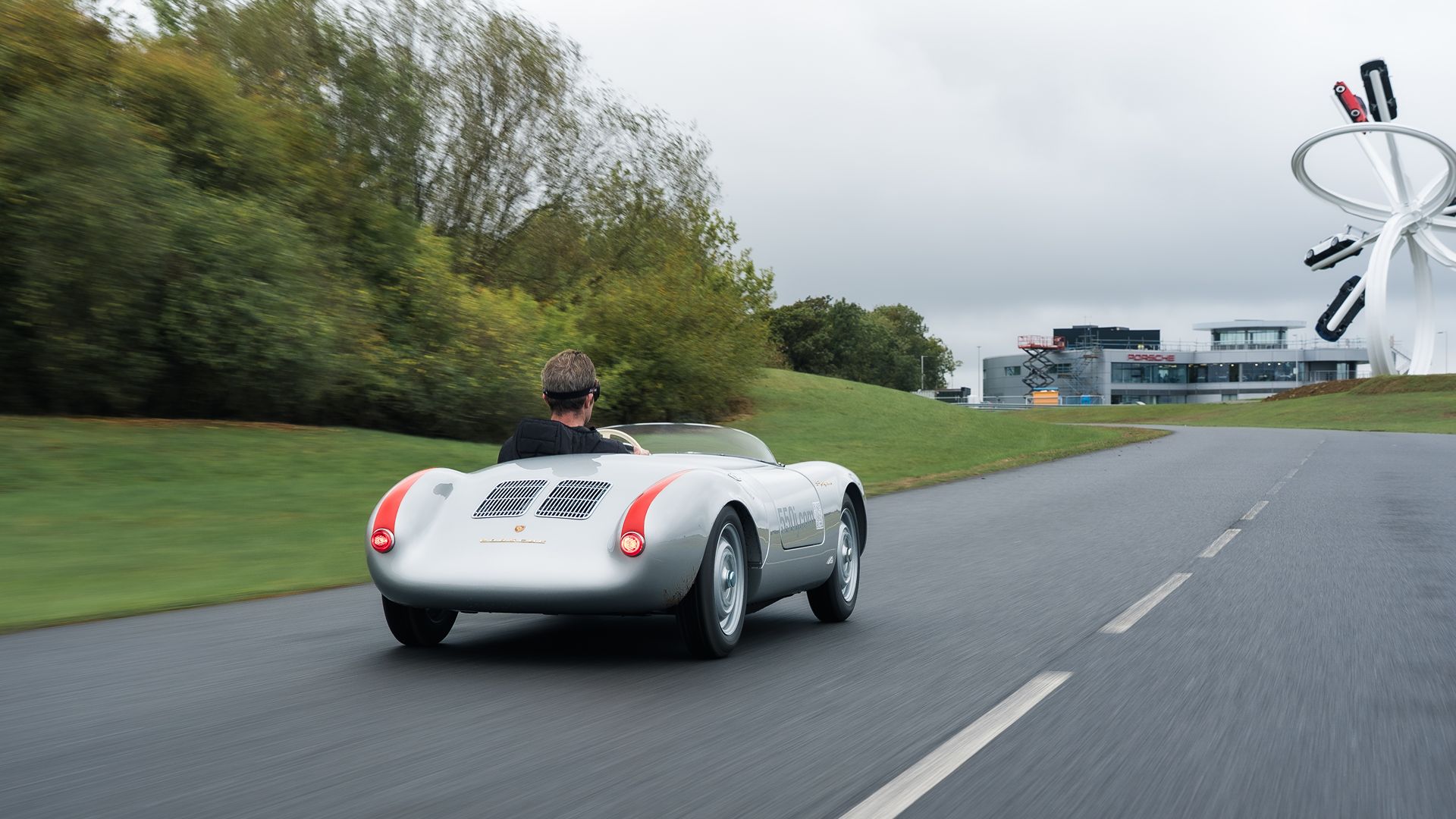
Clearly those Twizy ‘eco’ tyres have their limits, but there’s no time to ponder my mistake as I jump into the silver, RS Pack-equipped car. Instead of merely being brisk, acceleration now feels positively Porsche-like: a linear shove that threatens to overwhelm the rear wheels. Chasing the Taycan on the back straight, I hit the indicated maximum of 50mph, which feels very swift indeed when your buttocks are inches from the asphalt.
The extra power of the RS also makes it more playful in the corners. You can coax a slide with a jab at the throttle, then deploy all 21 horses as you straighten the wheel. There are no gears, and no angry snarl of a ‘Fuhrmann’ boxer engine, but the lithe and lively 550 J is still, in the best sense, a handful to drive. As the leading Taycan got quicker, hugging the racing line between apexes, I was totally immersed in the experience.
Sadly, Ben Hedley says many of his customers don’t use their cars, but store them as part of a collection. And yes, some owners of real 550 Spyders have already ordered a 550 J. Still, such folk are missing out, because like any Porsche, these half-pint heroes deserve to be driven. With a little encouragement, Hedley Studios may even be able to convert your 550J for road use, as one owner has with his Bugatti Baby II. Just imagine the stares when you rock up to a Cars & Coffee meet on a Sunday morning.
Verdict: Porsche 550 J
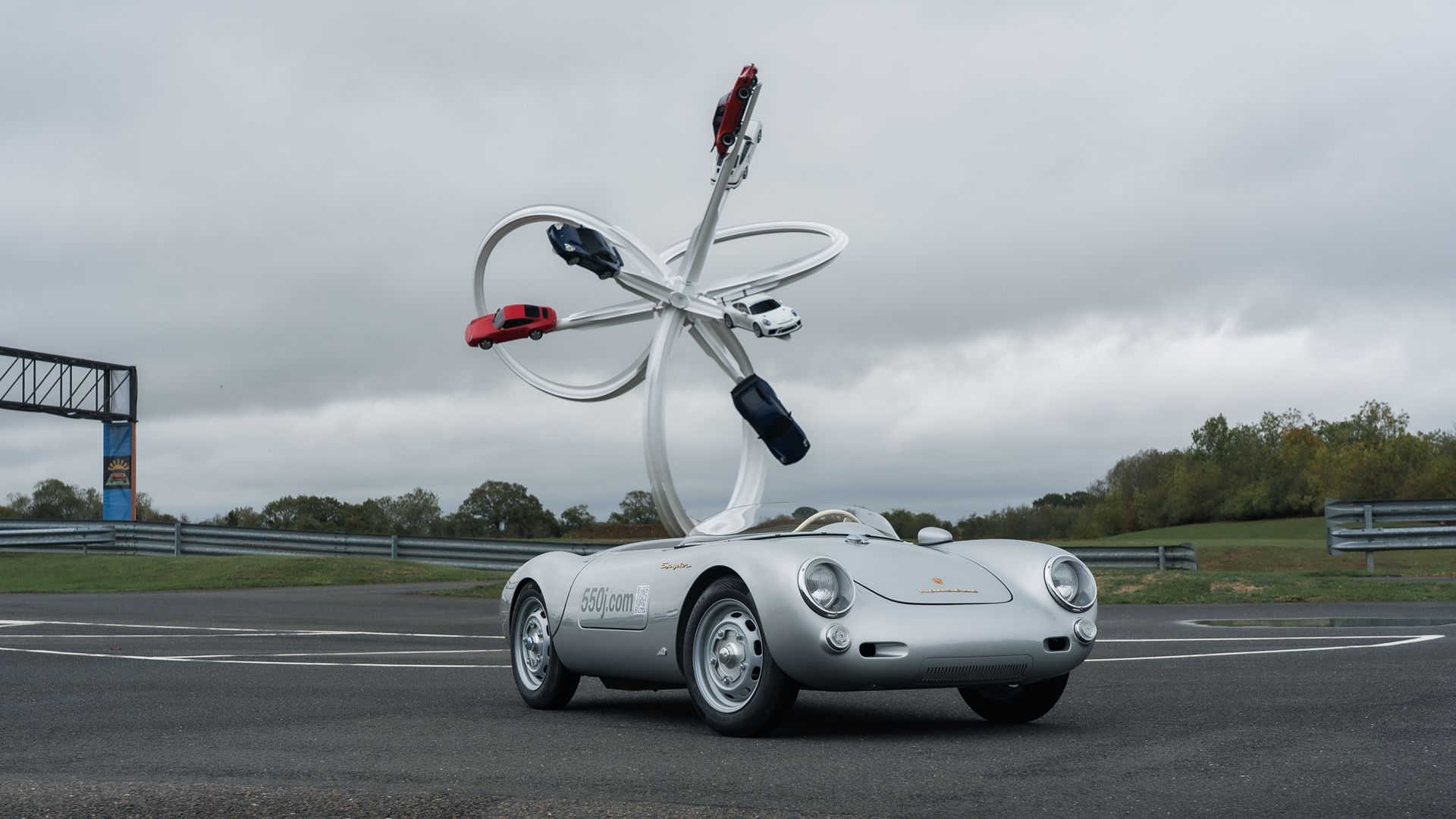
As the owner of a classic ‘964’ 911 himself, Ben Hedley has a passion for Porsche that shines through in the 550J. Only 250 examples will be built, which makes it rarer than any modern RS model – albeit not than the original 550 Spyder itself. A future classic, then? A collectible, certainly.
There’s no question that spending the thick end of £100,000 on a 550 J is pure indulgence, particularly when you could have an air-cooled 911, Cayman GT4 or any number of used Porsche sports cars for similar money. Such comparisons miss the point, though; for Hedley’s customers, this isn’t an either/or decision. They will buy a 550 J because they want one – and frankly, who wouldn’t?
ALSO READ:
